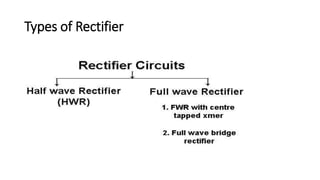
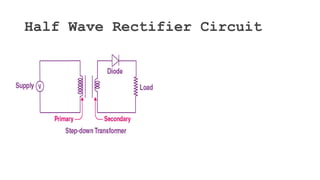
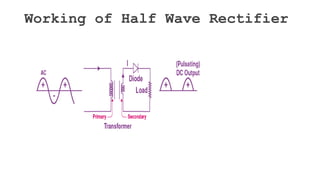
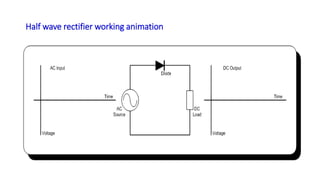
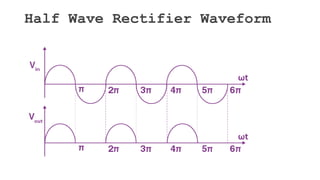
The document discusses different types of rectifiers. It describes half-wave rectifiers, full-wave center-tapped rectifiers, and full-wave bridge rectifiers. For each type, it provides the circuit diagram, explains how it works during each half-cycle of the AC input, and lists the advantages and disadvantages as well as common applications.

Rectifier
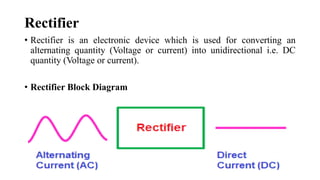
• Rectifier isan electronic device which is used for converting an
alternating quantity (Voltage or current) into unidirectional i.e. DC
quantity (Voltage or current).
• Rectifier Block Diagram
3.
Rectification
• Rectification isa process of converting the alternating quantity
(voltage or current) into a corresponding direct quantity(voltage or
current).
• The input to a rectifier is AC whereas its output is unidirectional or
DC.
Half Wave RectifierCircuit
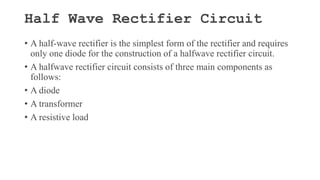
• A half-wave rectifier is the simplest form of the rectifier and requires
only one diode for the construction of a halfwave rectifier circuit.
• A halfwave rectifier circuit consists of three main components as
follows:
• A diode
• A transformer
• A resistive load
Advantages of HalfWave Rectifier
• Simple circuit with less number of components
• Economical at initial state. Although there is a higher cost over time
due to more power losses
11.
Disadvantages of HalfWave
Rectifier
• Power loss
• Low output voltage
• The output contains a lot of ripples
12.
Applications of HalfWave
Rectifier
• In day-to-day life, the half-wave rectifier is mostly used in low power
applications
13.
Full Wave Rectifier
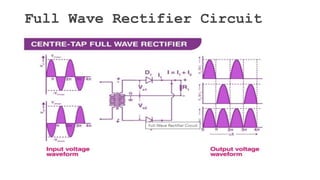
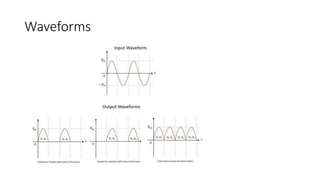
•A full wave rectifier is defined as a rectifier that converts the complete
cycle of alternating current into pulsating DC.
Working of Centretapped Full
Wave Rectifier
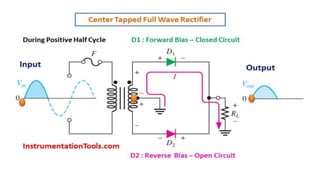
• During the positive half cycle, diode D1 is forward biased as it is
connected to the top of the secondary winding while diode D2 is
reverse biased as it is connected to the bottom of the secondary
winding. Due to this, diode D1 will conduct acting as a short circuit
and D2 will not conduct acting as an open circuit
18.
Working of Centretapped Full
Wave Rectifier
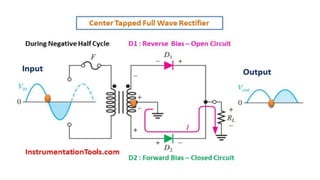
• During the negative half cycle, the diode D1 is reverse biased and the
diode D2 is forward biased because the top half of the secondary
circuit becomes negative and the bottom half of the circuit becomes
positive.
• Thus in a full wave rectifiers, DC voltage is obtained for both positive
and negative half cycle.
19.
Advantages of centretappedFull
Wave Rectifier
• The rectification efficiency of full wave rectifiers is double that of half
wave rectifiers. The efficiency of half wave rectifiers is 40.6% while
the rectification efficiency of full wave rectifiers is 81.2%.
• The ripple factor in full wave rectifiers is low hence a simple filter is
required. The value of ripple factor in full wave rectifier is 0.482 while
in half wave rectifier it is about 1.21.
• The output voltage and the output power obtained in full wave
rectifiers are higher than that obtained using half wave rectifiers.
20.
Disadvantages of centretapped
Full Wave Rectifier
• They need more circuit elements than the half wave rectifier which
makes, making it costlier.
21.
Applications
• The applicationsof center-tapped FWR include the following.
• This rectifier is used to convert high input AC voltage to low DC
voltage.
• These types of rectifiers are used as basic components within the
power supply units due to their high efficiency.
• These are used to provide power to motors, LEDs, etc.
22.
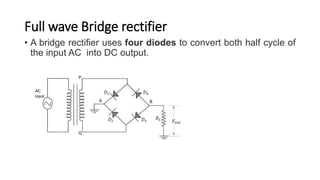
Full wave Bridgerectifier
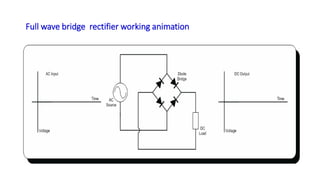
• A bridge rectifier uses four diodes to convert both half cycle of
the input AC into DC output.
23.
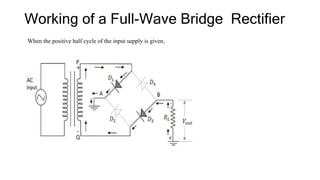
Working of aFull-Wave Bridge Rectifier
When the positive half cycle of the input supply is given,
24.
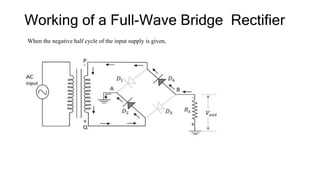
Working of aFull-Wave Bridge Rectifier
When the negative half cycle of the input supply is given,
Advantages of aBridge Rectifier:
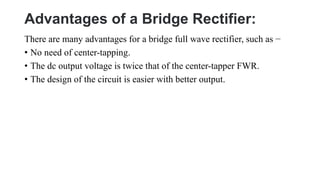
There are many advantages for a bridge full wave rectifier, such as −
• No need of center-tapping.
• The dc output voltage is twice that of the center-tapper FWR.
• The design of the circuit is easier with better output.
28.
Disadvantages of BridgeRectifier:
1.Bridge rectifier is more complex than a half-wave rectifier
2.More power loss compared to centre tapped full wave rectifier.
29.
Applications
• The importantuses of the full-wave bridge rectifier are
given below.
• Mobile phones, laptops, charger circuits.
• Uninterruptible Power Supply (UPS) circuits to convert AC to
DC.
• LED Driver Circuits.