CHAPTER 4
FREQUENCY-DOMAIN ANALYSIS
04/02/25
Content in Chapter 5
5-1 Frequency Response (or Frequency
Characteristics)
5-2 Nyquist plot and Nyquist stability
criterion
5-3 Bode plot and Bode stability criterion
04/02/25
5-1 Frequency Response
04/02/25
A Perspective on the Frequency-Response
Design Method
The design of feedback control systems in industry is
probably accomplished using frequency-response methods
more than any other.
Advantages of frequency-response design:
-It provides good designs in the face of uncertainty in the
plant model
-Experimental information can be used for design
purposes.
Raw measurements of the output amplitude and phase of a plant
undergoing a sinusoidal input excitation are sufficient to design a
suitable feedback control.
-No intermediate processing of the data (such as finding
poles and zeros) is required to arrive at the system model.
04/02/25
Frequency response
04/02/25
The frequency response of a system is defined
as the steady-state response of the system to a
sinusoidal input signal.
0
( ) sin
r t R t

 0
( ) sin( )
y t t
Y  
 
For a LTI system, when the input to it is a sinusoid signal,
the resulting output , as well as signals throughout the
system, is sinusoidal in the steady-state;
G(s)
H(s)

The output differs from the input waveform only in
amplitude and phase.
The closed-loop transfer function of the LTI
system:
( ) ( )
( )
( ) 1 ( ) ( )
Y s G s
M s
R s G s H s
 

For frequency-domain analysis, we replace s by
jω: ( ) ( )
( )
( ) 1 ( ) ( )
Y j G j
M j
R j G j H j
 

  
 

04/02/25
The frequency-domain transfer function M(jω)
may be expressed in terms of its magnitude and
phase:
( ) ( ) ( )
M j M j M j
  
 
magnitude phase
The magnitude of M(jω) is
( )
( )
1 ( ) ( )
( )
1 ( ) ( )
G j
M j
G j H j
G j
G j H j


 

 




The phase of M(jω) is
 
( ) ( )
( ) 1 ( ) ( )
M
M j j
G j G j H j
  
  
 
   
( )
M j
A
0 
c


0
( )
M j
 
Gain-phase characteristics
of an ideal low-pass filter
( )
0
c
c
A
M j
 

 





Gain characteristic
Phase characteristic
04/02/25
Example. Frequency response of a Capacitor
Consider the capacitor described by the equation
dv
i C
dt

where v is the input and i is the output. Determine the
sinusoidal steady-state response of the capacitor.
Solution. The transfer function of the capacitor is
( )
( )
( )
I s
M s Cs
V s
 
So ( )
M j Cj
 

Computing the magnitude and phase, we find that
( )
M j Cj C
  
 
( ) 90
M
M j 
   
04/02/25
( )
M j Cj C
  
 
( ) 90
M
M j 
   
( ) ( ) ( )
I j M j V j
  

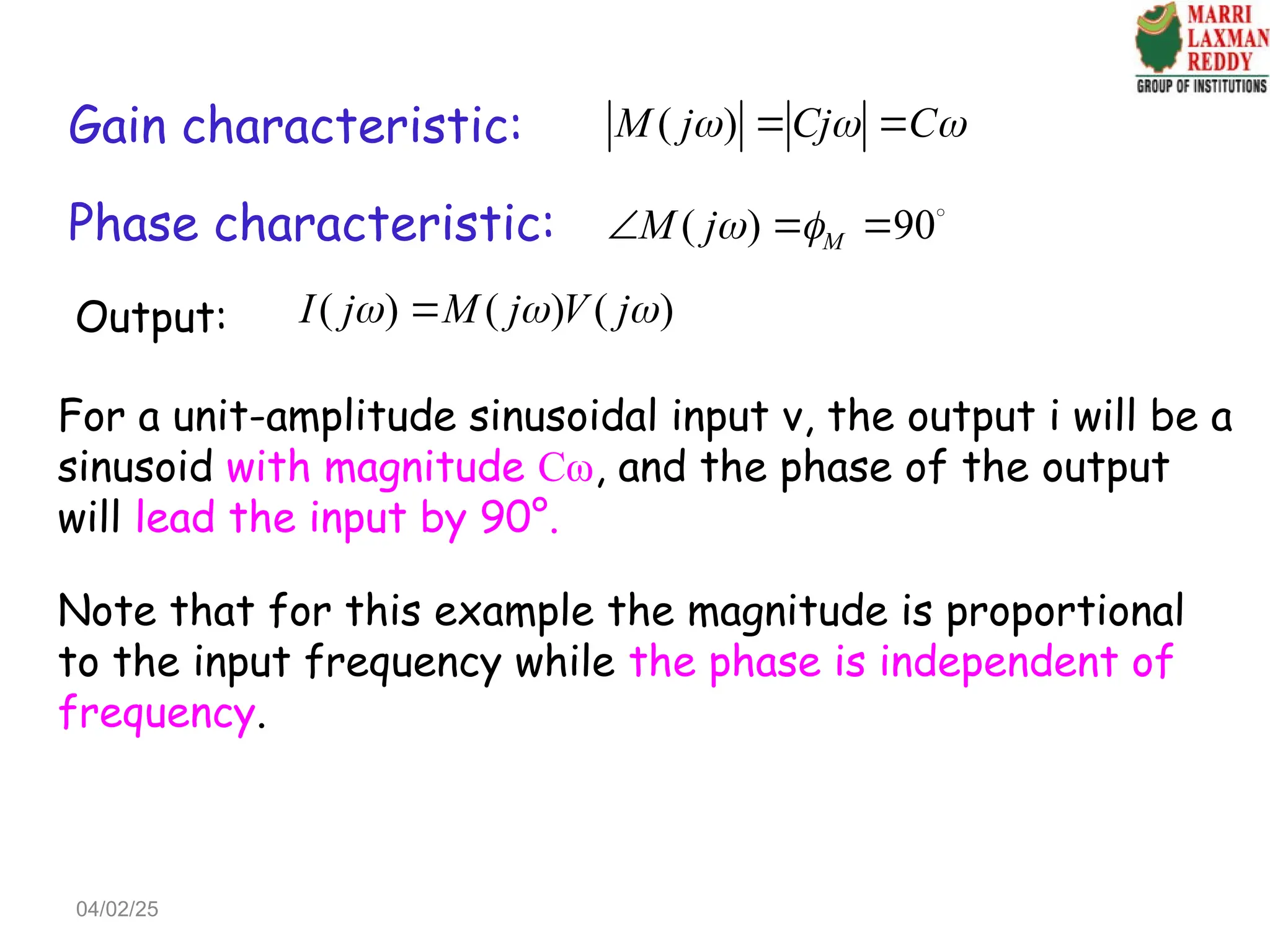
Gain characteristic:
Phase characteristic:
For a unit-amplitude sinusoidal input v, the output i will be a
sinusoid with magnitude Cω, and the phase of the output
will lead the input by 90°.
Note that for this example the magnitude is proportional
to the input frequency while the phase is independent of
frequency.
Output:
04/02/25
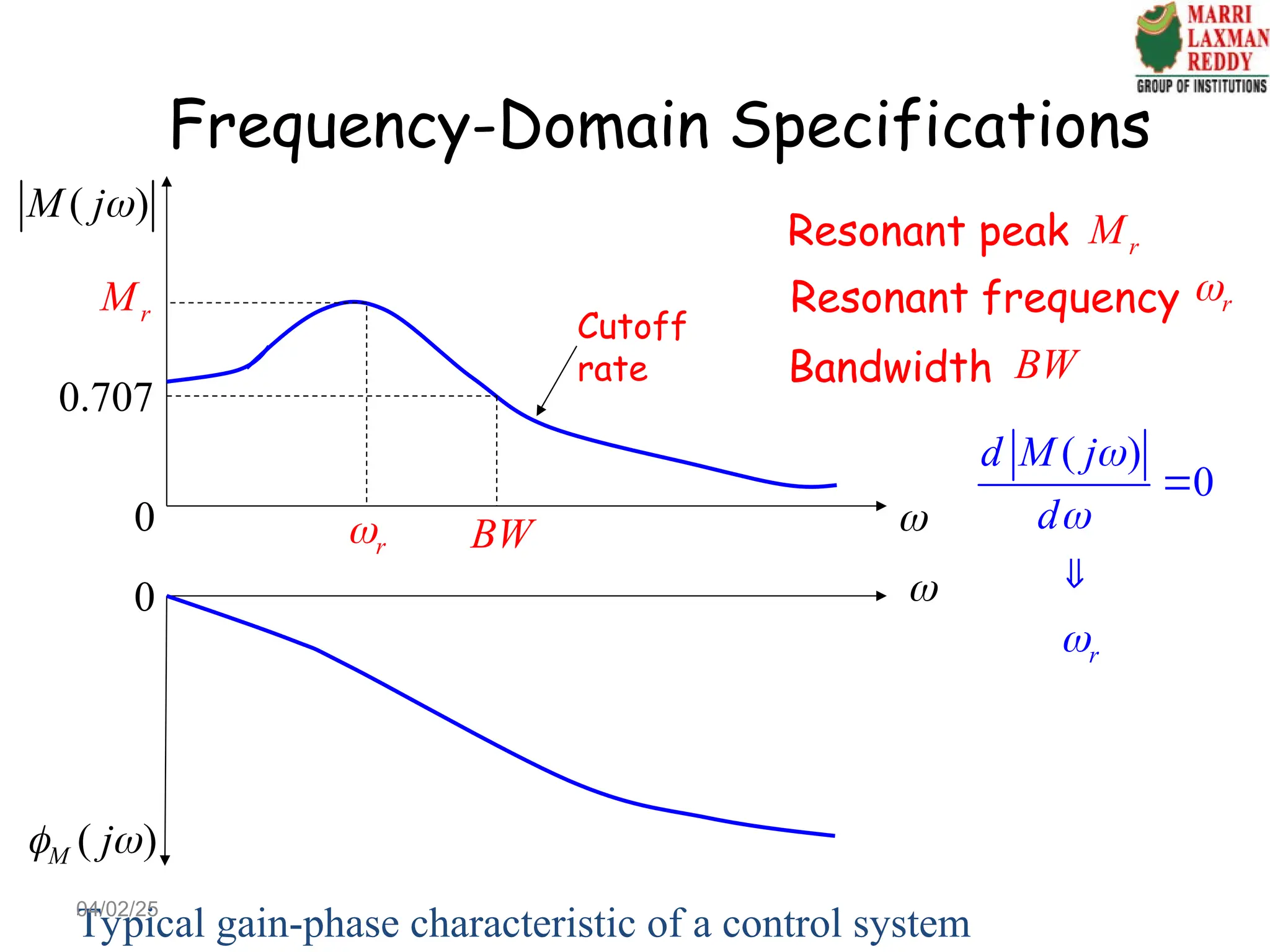
Resonant peak r
M
Resonant frequency r

Bandwidth BW
0
( )
M j

BW
r

0.707
r
M
( )
M j
 

0
Cutoff
rate
Typical gain-phase characteristic of a control system
Frequency-Domain Specifications
( )
0
r
d M j
d





04/02/25
Frequency response of a prototype
second-order system
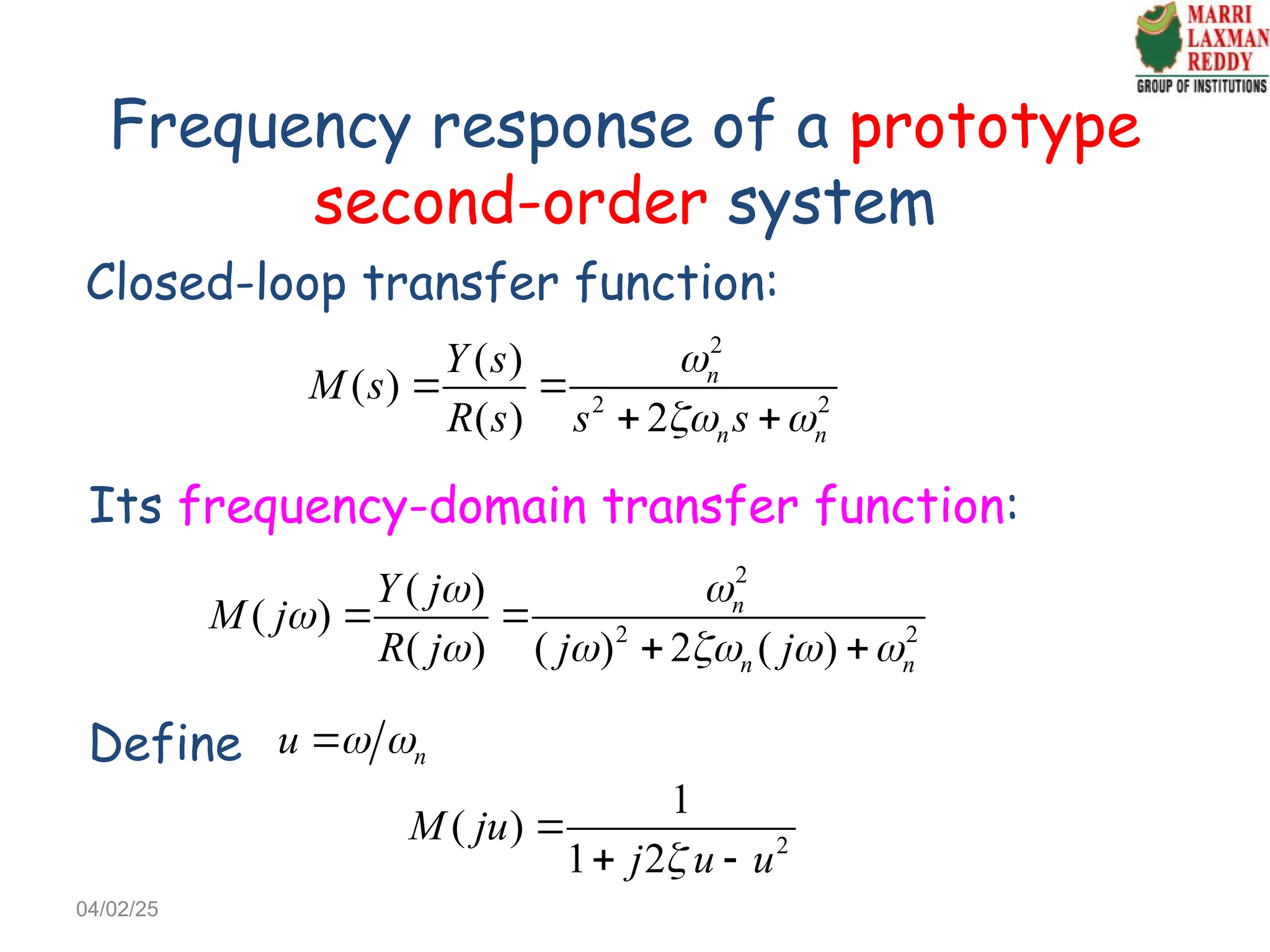
Closed-loop transfer function:
2
2 2
( )
( )
( ) 2
n
n n
Y s
M s
R s s s

 
 
 
Its frequency-domain transfer function:
2
2 2
( )
( )
( ) ( ) 2 ( )
n
n n
Y j
M j
R j j j



    
 
 
Define n
u  

2
1
( )
1 2
M ju
j u u


 
04/02/25
The magnitude of M(ju) is
2 2 2 1/2
1
( )
[(1 ) (2 ) ]
M ju
u u


 
The phase of M(ju) is
1
2
2
( ) ( ) tan
1
M
u
M j j
u

   
  

The resonant frequency of M(ju) is
( )
0
d M ju
du
 2
1 2
r
u 
 
With , we have
r r n
u  
 2
1 2
r n
  
 
Since frequency is a real quantity, it requires 2
1 2 0

 
So 0.707
 
2
1
2 1
r
M
 


Resonant peak
04/02/25
According to the definition of Bandwidth
2 2 2 1/2
1 1
( ) 0.707
[(1 ) (2 ) ] 2
M ju
u u

  
 
2 2 4 2
(1 2 ) 4 4 2
u   
    
With , we have
n
u  

2 4 2 1/2
[(1 2 ) 4 4 2]
n
BW    
    
04/02/25
Resonant peak
2
1
2 1
r
M
 


Resonant frequency
2
1 2
r n
  
 
For a prototype second-order system ( )
0.707
 
Bandwidth
2 4 2 1/2
[(1 2 ) 4 4 2]
n
BW    
    
depends on only.
For 0, the system is unstable;
For 0< 0.707, ;
For 0.707, 1
r
r
r
M
M
M


 


  
 
depends on both and .
For 0< 0.707, fixed, ;
For 0.707, 0.
r n
n r
r
  
   
 
  
 
is directly proportional to ,
For 0 0.707, fixed, ;
n n
n
n
BW BW
BW
BW
 
 
  
 
 
   
04/02/25
Correlation between pole locations, unit-step response and
the magnitude of the frequency response
2
2 2
2
n
n n
s s

 
 
( )
r t ( )
y t
0 1

 
j

0
n


1
cos
 


0
( )
M j
0dB
0.3dB
BW 
2 4 2 1/2
[(1 2 ) 4 4 2]
n
BW    
    
2
1 0.4167 2.917
r
n
t
 

 

0
( )
y t
1.0
0.9
0.1 t
2
/ 1
max overshoot e  
 

04/02/25
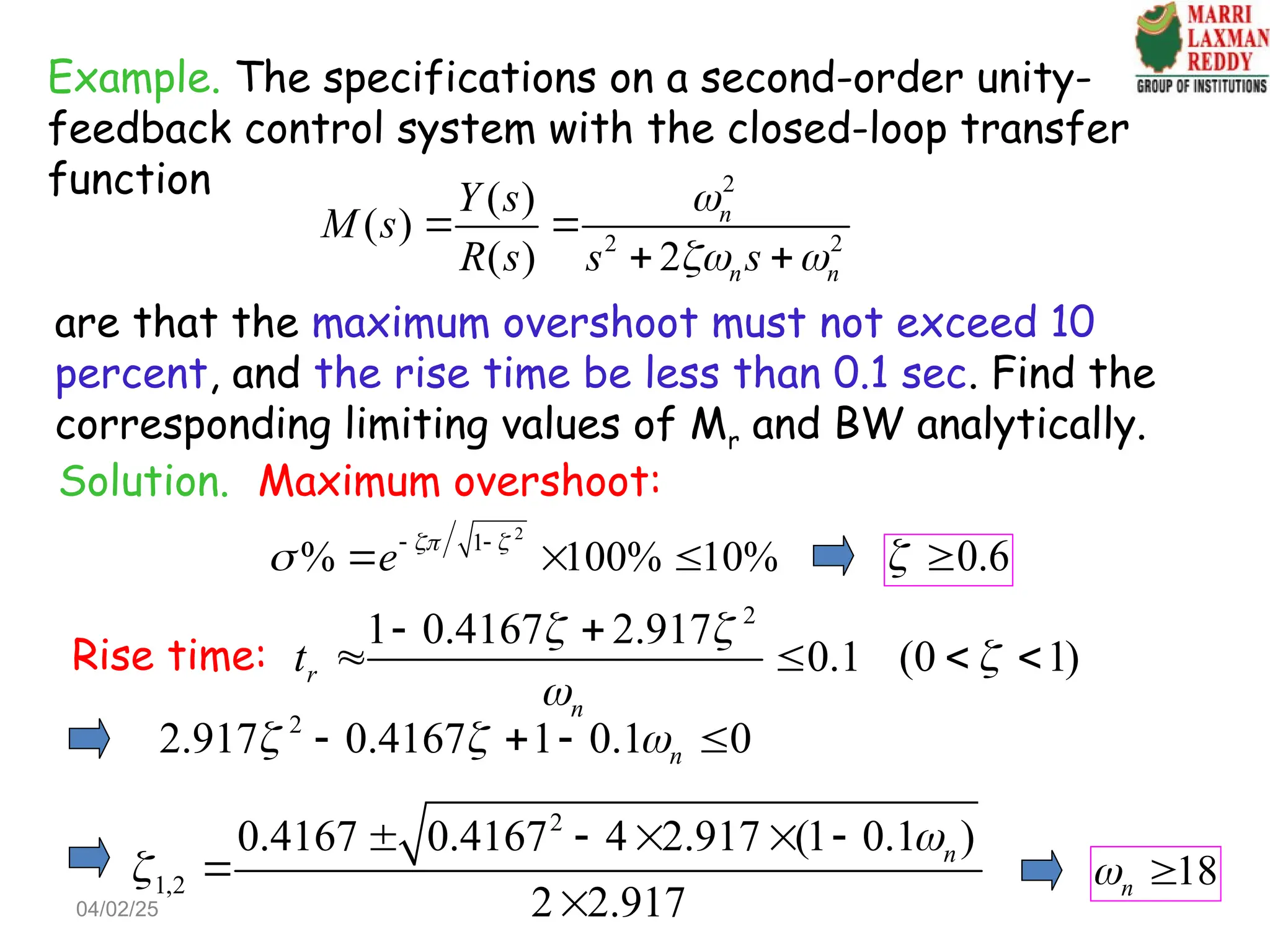
Example. The specifications on a second-order unity-
feedback control system with the closed-loop transfer
function 2
2 2
( )
( )
( ) 2
n
n n
Y s
M s
R s s s

 
 
 
are that the maximum overshoot must not exceed 10
percent, and the rise time be less than 0.1 sec. Find the
corresponding limiting values of Mr and BW analytically.
Solution. Maximum overshoot:
2
1
% 100% 10%
e  
  
  
Rise time:
2
1 0.4167 2.917
0.1 (0 1)
r
n
t
 


 
   
0.6
 
2
2.917 0.4167 1 0.1 0
n
  
   
2
1,2
0.4167 0.4167 4 2.917 (1 0.1 )
2 2.917
n


    


18
n
 
04/02/25
Resonant peak
2
(
1
2 1
0.707)
r
M






0.6
  18
n
 
For 0< 0.707, ;
For 0.707, 1
r
r
M
M
 

  
 
1 1.04
r
M
 
0.6
 
Bandwidth
2 4 2 1/2
[(1 2 ) 4 4 2]
n
BW    
    
is directly proportional to ,
For 0 0.707, fixed, ;
n n
n
n
BW BW
BW
BW
 
 
  
 
 
   
0.6 0.707

  1 1.15
n
BW 
 
1.15
n n
BW
 
 
18
n
 
18
BW 
Based on time-domain analysis, we obtain and
Frequency-domain specifications:
04/02/25
( )
R s ( )
Y s
2
( 2 )
n
n
s s



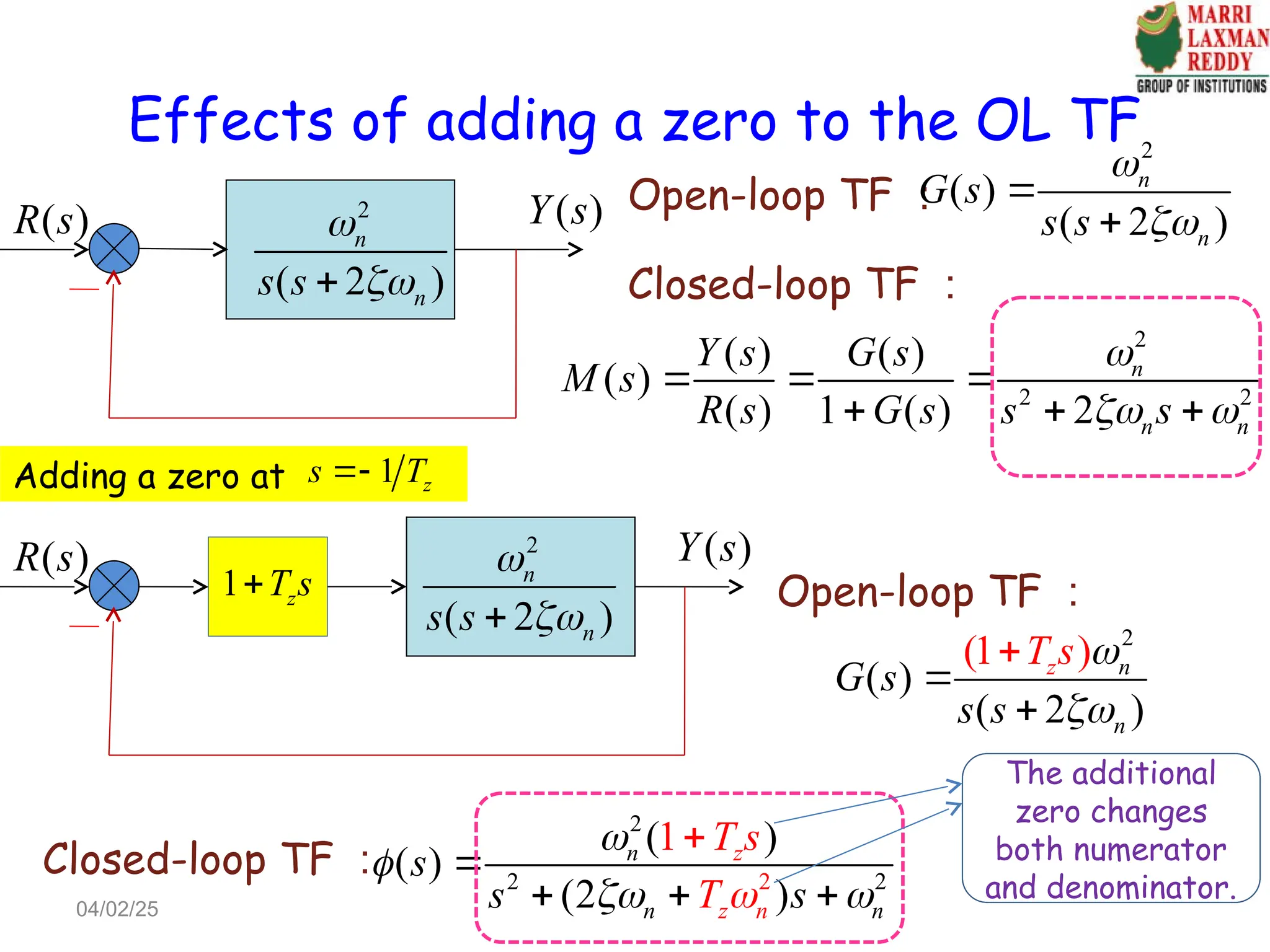
1 z
T s

( )
R s ( )
Y s
2
( 2 )
n
n
s s


 Closed-loop TF :
Open-loop TF :
2
2 2
( ) ( )
( )
( ) 1 ( ) 2
n
n n
Y s G s
M s
R s G s s s

 
  
  
Adding a zero at 1 z
s T

2
( )
( 2 )
(1 )
z n
n
T s
G s
s s





Open-loop TF :
Closed-loop TF :
2
( )
( 2 )
n
n
G s
s s




2
2
2 2
1
( )
( )
(2 )
z
z n
n
n n
s
s
T s
T s



 

  

The additional
zero changes
both numerator
and denominator.
Effects of adding a zero to the OL TF
04/02/25
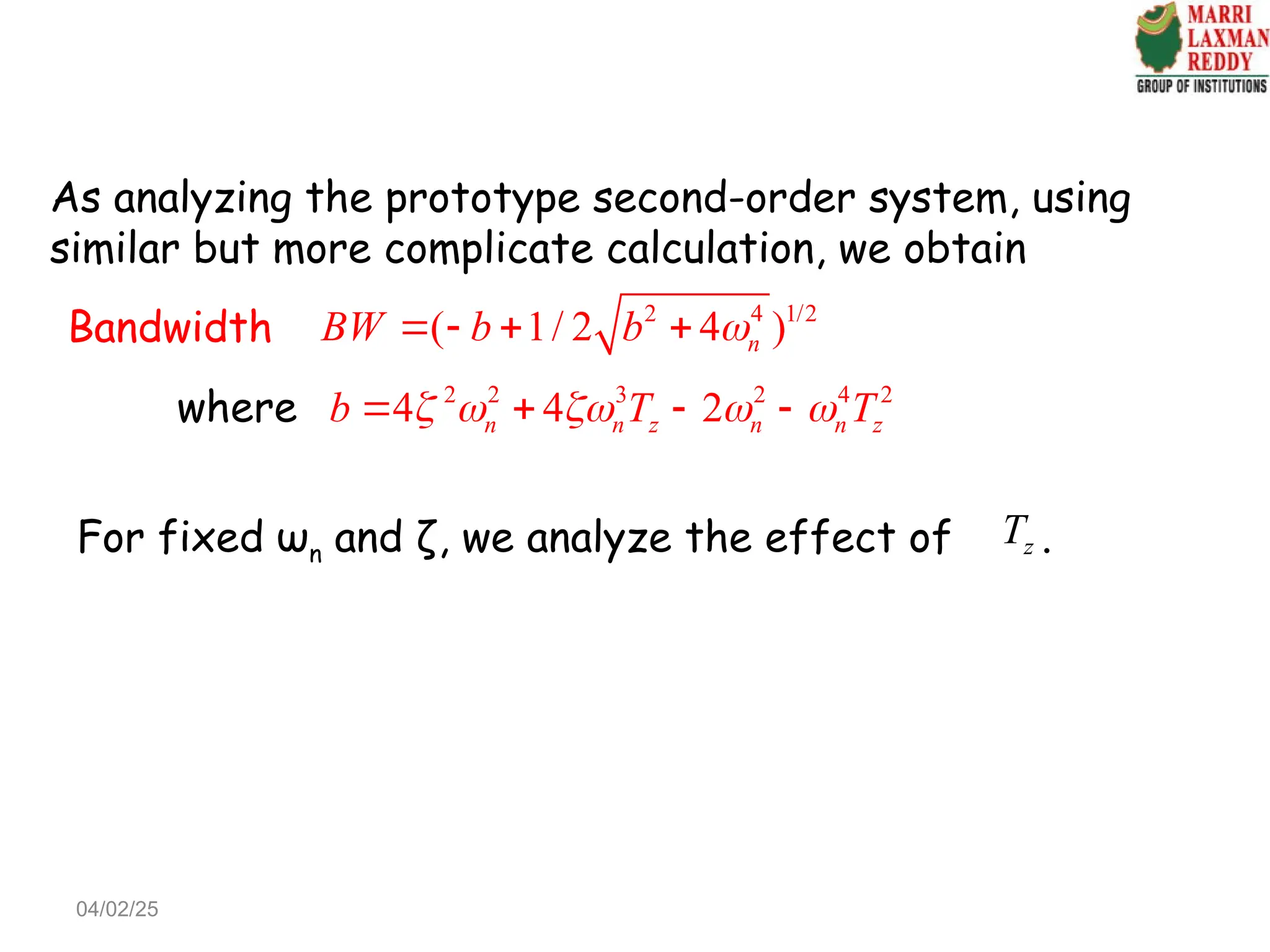
As analyzing the prototype second-order system, using
similar but more complicate calculation, we obtain
Bandwidth 2 4 1/2
( 1/ 2 4 )
n
BW b b 
   
where 2 2 3 2 4 2
4 4 2
n n z n n z
b T T
    
   
For fixed ωn and ζ, we analyze the effect of .
z
T
04/02/25
-80
-60
-40
-20
0
20
Magnitude
(dB)
10
-1
10
0
10
1
10
2
-180
-135
-90
-45
0
Phase
(deg)
Bode Diagram
Frequency (rad/sec)
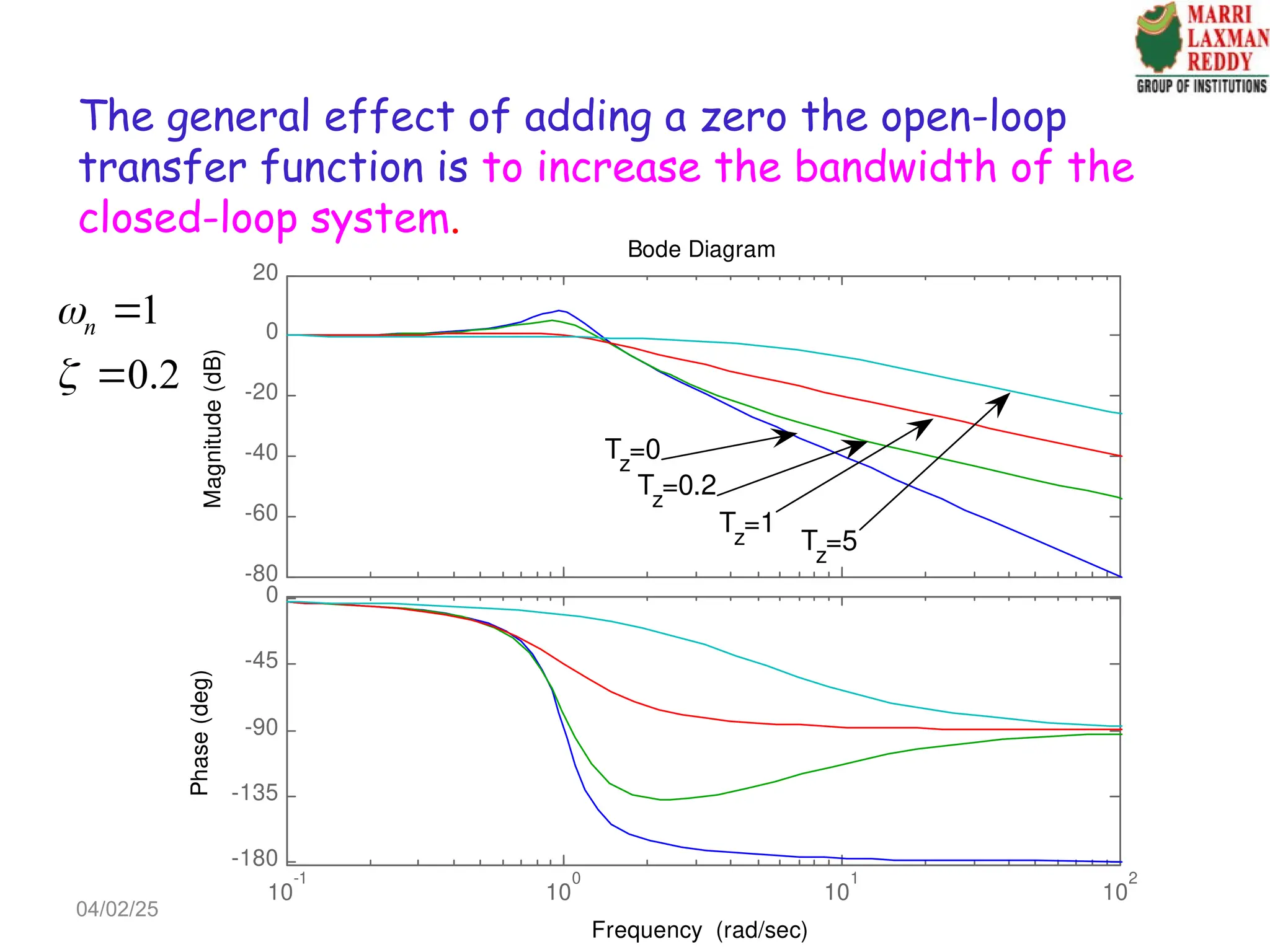
Tz
=0
Tz
=0.2
Tz
=1
Tz
=5
The general effect of adding a zero the open-loop
transfer function is to increase the bandwidth of the
closed-loop system.
1
0.2
n




04/02/25
( )
R s ( )
Y s
2
( 2 )
n
n
s s



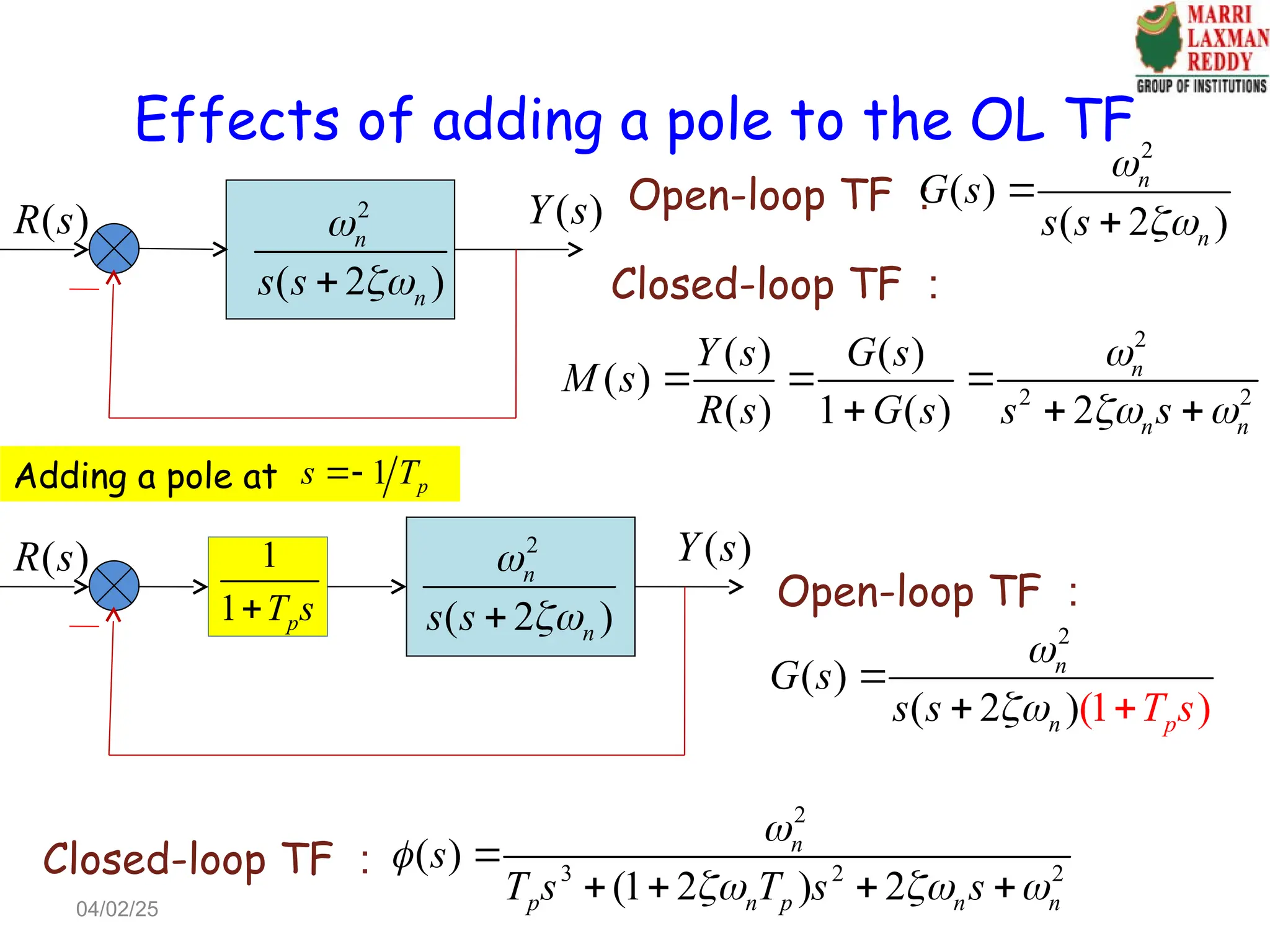
1
1 p
T s

( )
R s ( )
Y s
2
( 2 )
n
n
s s


 Closed-loop TF :
2
2 2
( ) ( )
( )
( ) 1 ( ) 2
n
n n
Y s G s
M s
R s G s s s

 
  
  
2
( )
( 2 (1 )
)
n
n p
G s
s T s
s

 


Open-loop TF :
Open-loop TF :
2
( )
( 2 )
n
n
G s
s s




Closed-loop TF :
2
3 2 2
( )
(1 2 ) 2
n
p n p n n
s
T s T s s


  

   
Effects of adding a pole to the OL TF
Adding a pole at 1 p
s T

04/02/25
-150
-100
-50
0
50
Magnitude
(dB)
10
-2
10
-1
10
0
10
1
10
2
-270
-225
-180
-135
-90
-45
0
Phase
(deg)
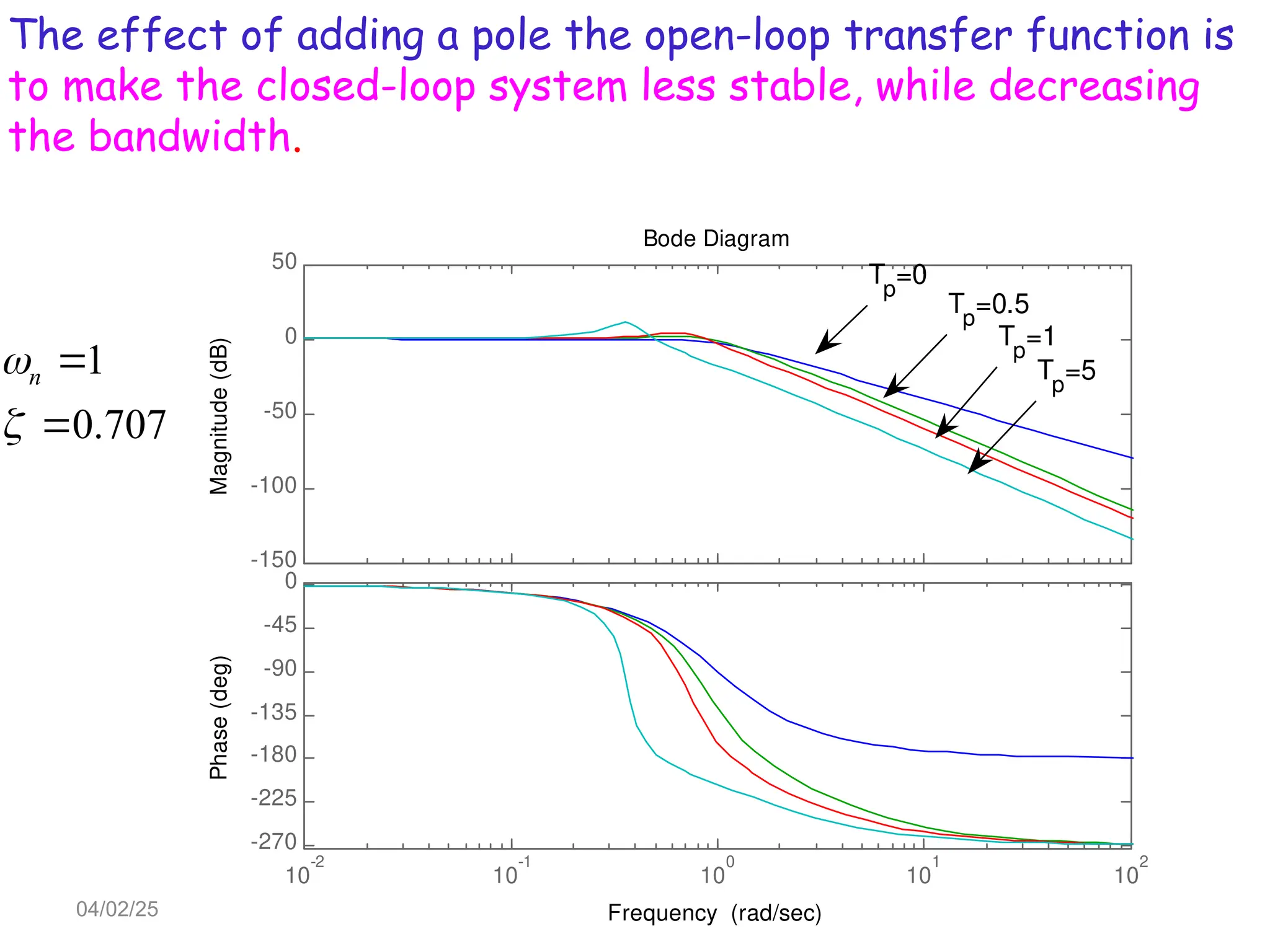
Bode Diagram
Frequency (rad/sec)
Tp
=0
Tp
=0.5
Tp
=1
Tp
=5
The effect of adding a pole the open-loop transfer function is
to make the closed-loop system less stable, while decreasing
the bandwidth.
1
0.707
n




04/02/25
5-2 Nyquist Plot and Nyquist Criterion
04/02/25
Nyquist Criterion
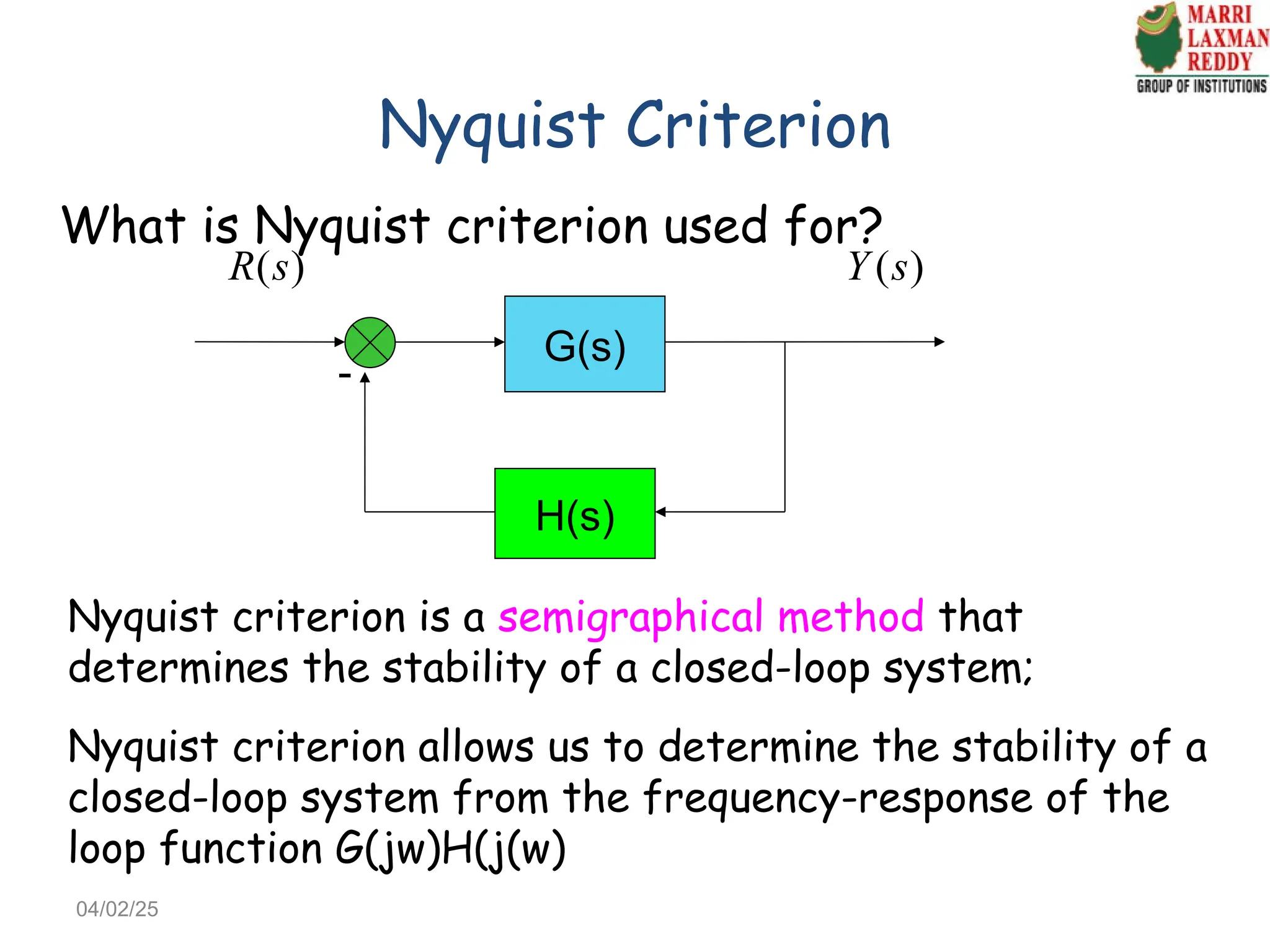
What is Nyquist criterion used for?
G(s)
H(s)

( )
R s ( )
Y s
Nyquist criterion is a semigraphical method that
determines the stability of a closed-loop system;
Nyquist criterion allows us to determine the stability of a
closed-loop system from the frequency-response of the
loop function G(jw)H(j(w)
04/02/25
Review about stability
Closed-loop TF:
( )
( )
1 ( ) ( )
G s
M s
G s H s


Characteristic equation (CE):
( ) 1 ( ) ( ) 0
s G s H s
   
Stability conditions:
Open-loop stability: poles of the loop TF G(s)H(s) are all in
the left-half s-plane.
Closed-loop stability: poles of the closed-loop TF or roots
of the CE are all in the left-half s-plane.
04/02/25
Definition of Encircled and Enclosed
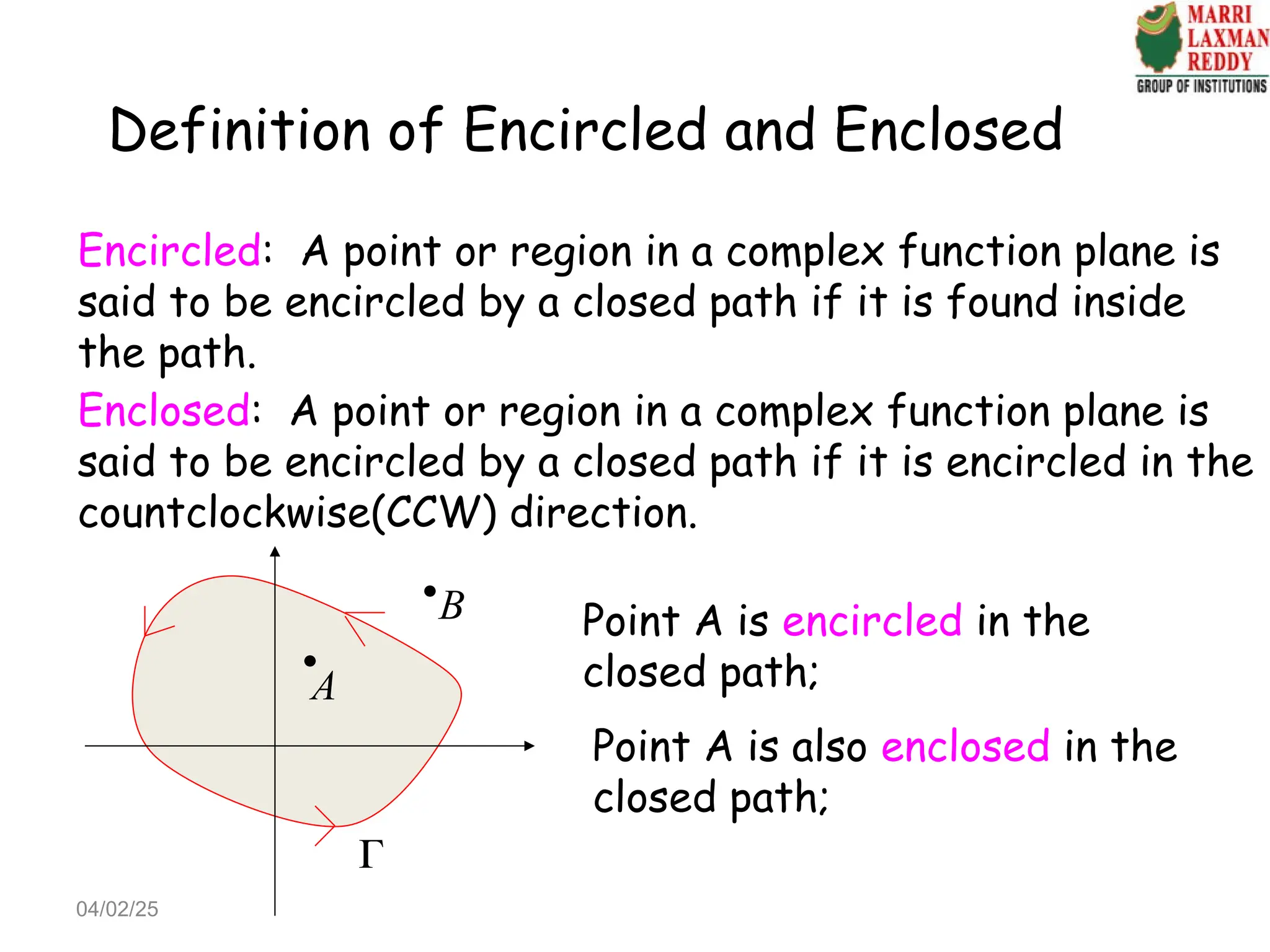
Encircled: A point or region in a complex function plane is
said to be encircled by a closed path if it is found inside
the path.
Enclosed: A point or region in a complex function plane is
said to be encircled by a closed path if it is encircled in the
countclockwise(CCW) direction.
A
B

Point A is encircled in the
closed path;
Point A is also enclosed in the
closed path;
04/02/25
Number of Encirclements and Enclosures
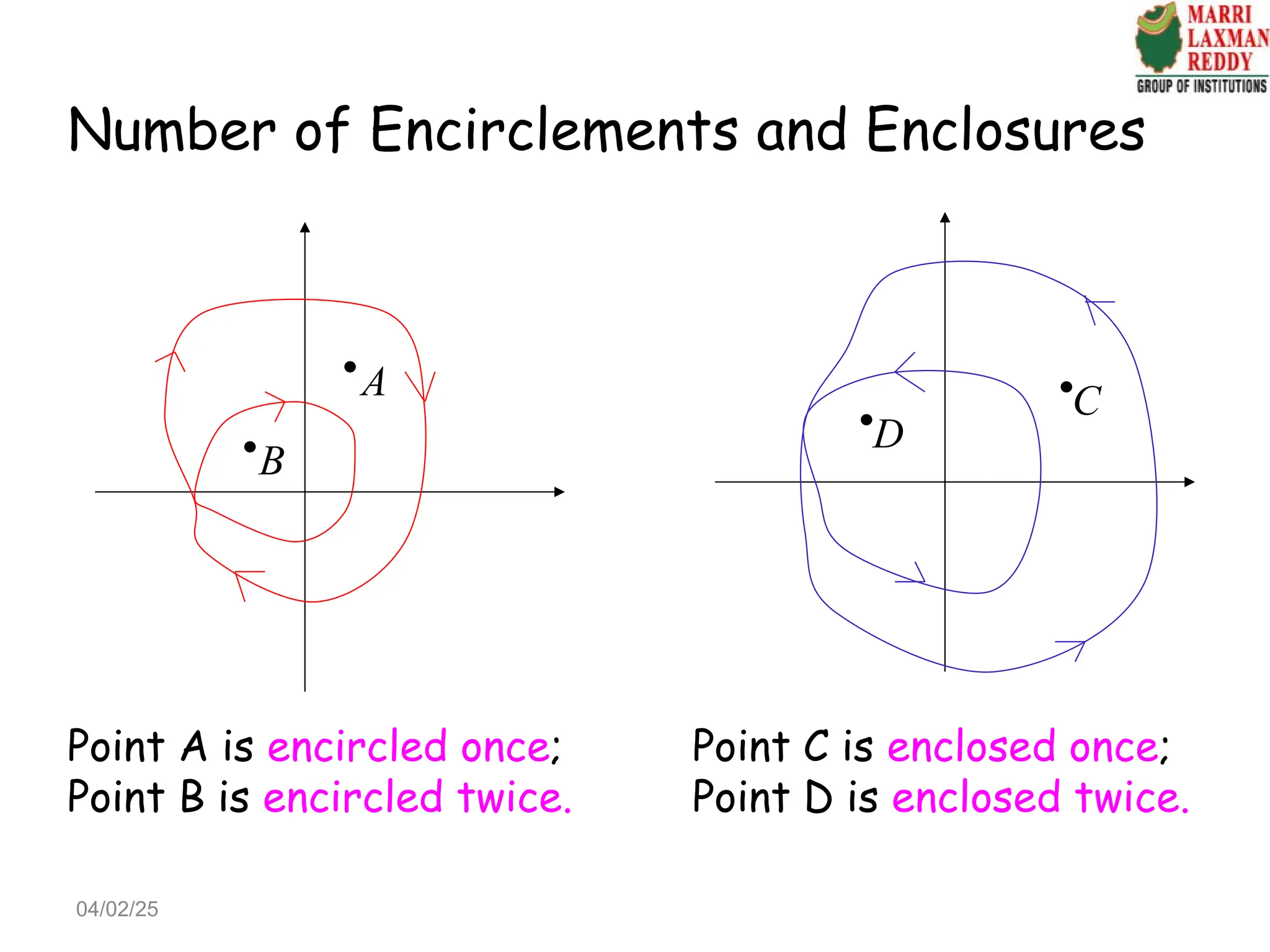
B
A
D
C
Point A is encircled once;
Point B is encircled twice.
Point C is enclosed once;
Point D is enclosed twice.
04/02/25
Mapping from the complex s-plane to the
Δ(s) -plane
Exercise 1: Consider a function Δ(s) =s-1, please map a
circle with a radius 1 centered at 1 from s-plane to the
Δ(s)-plane .
1 2
3 4
2; 1
0; 1
s s j
s s j
  
  
1 2
3 4
( ) 1; ( )
( ) 1; ( )
s s j
s s j
   
   
Δ( s)-plane
Im
j
Re[ ( )]
s

1
( )
s

2
( )
s

3
( )
s

4
( )
s

0
1
s-plane
j

1
s
2
s
3
s
4
s
2
1
1

0
Mapping
04/02/25
Principle the Argument
Let be a single-valued function that has a finite
number of poles in the s-plane.
Suppose that an arbitrary closed path is chosen in the s-
plane so that the path does not go through any one of the
poles or zeros of ;
The corresponding locus mapped in the -plane will
encircle the origin as many times as the difference
between the number of zeros and poles (P) of that are
encircled by the s-plane locus .
N Z P
 
In equation form:
( )
s

s

( )
s


 ( )
s

s

( )
s

N - number of encirclements of the origin by the -plane locus
( )
s

Z - number of zeros of encircled by the s-plane locus
( )
s

P - number of poles of encircled by the s-plane locus
( )
s

04/02/25
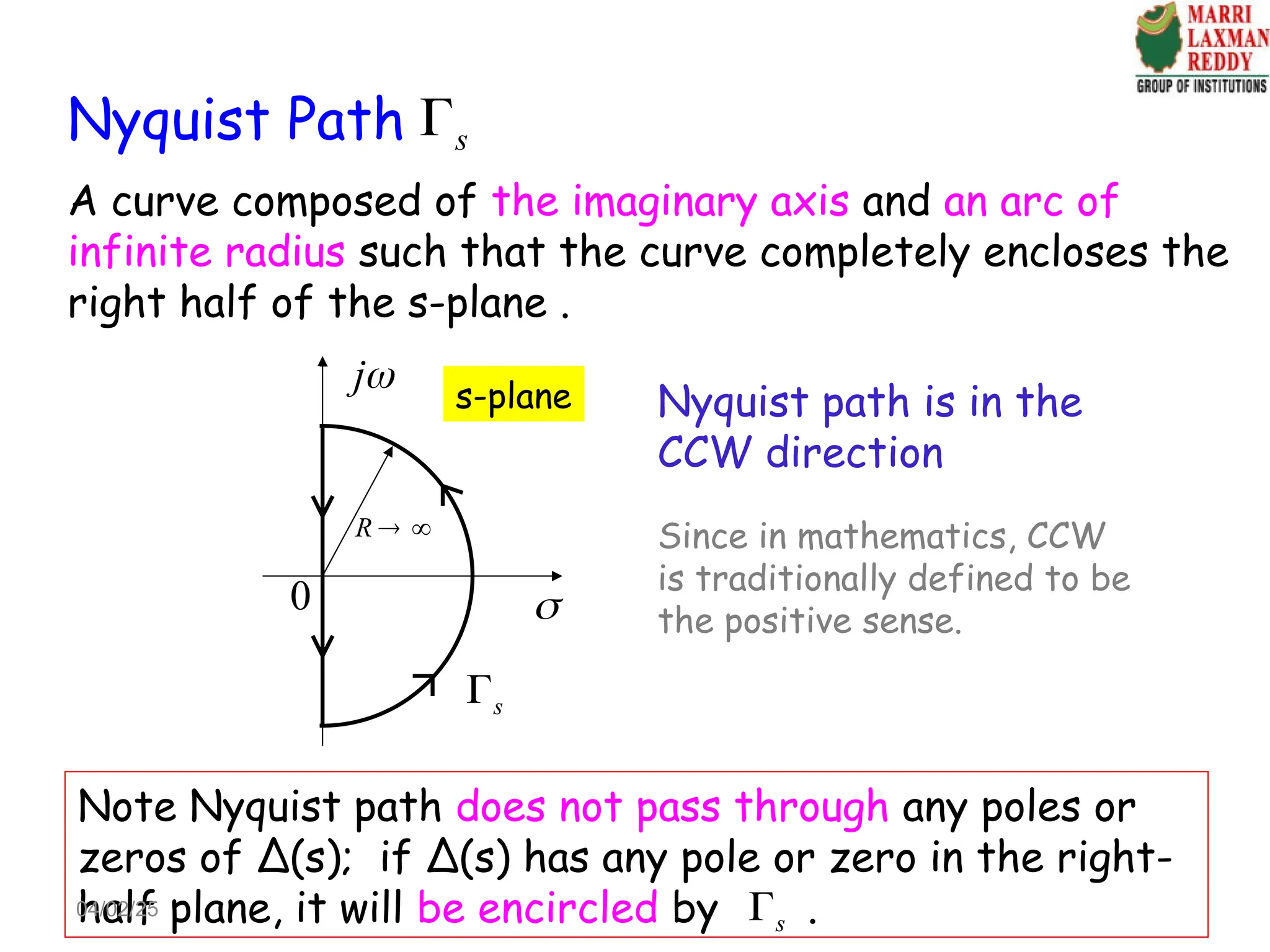
Nyquist Path
A curve composed of the imaginary axis and an arc of
infinite radius such that the curve completely encloses the
right half of the s-plane .
Nyquist path is in the
CCW direction
s

j

s-plane
0
R  
s

Note Nyquist path does not pass through any poles or
zeros of Δ(s); if Δ(s) has any pole or zero in the right-
half plane, it will be encircled by .
s

Since in mathematics, CCW
is traditionally defined to be
the positive sense.
04/02/25
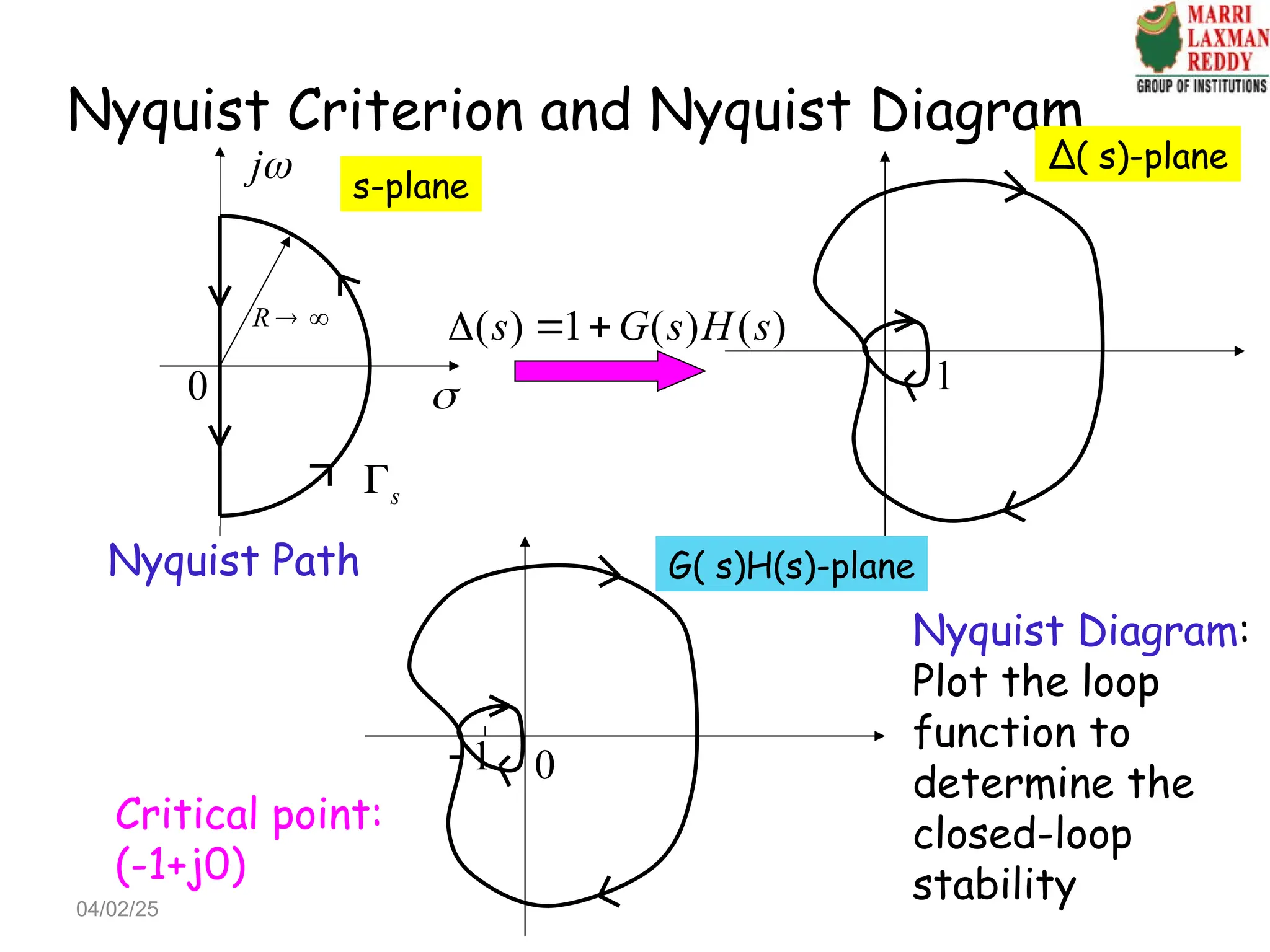
Nyquist Criterion and Nyquist Diagram
j

s-plane
0
R  
s

( ) 1 ( ) ( )
s G s H s
  
Δ( s)-plane
1
Nyquist Path
Nyquist Diagram:
Plot the loop
function to
determine the
closed-loop
stability
G( s)H(s)-plane
0
1

Critical point:
(-1+j0)
04/02/25
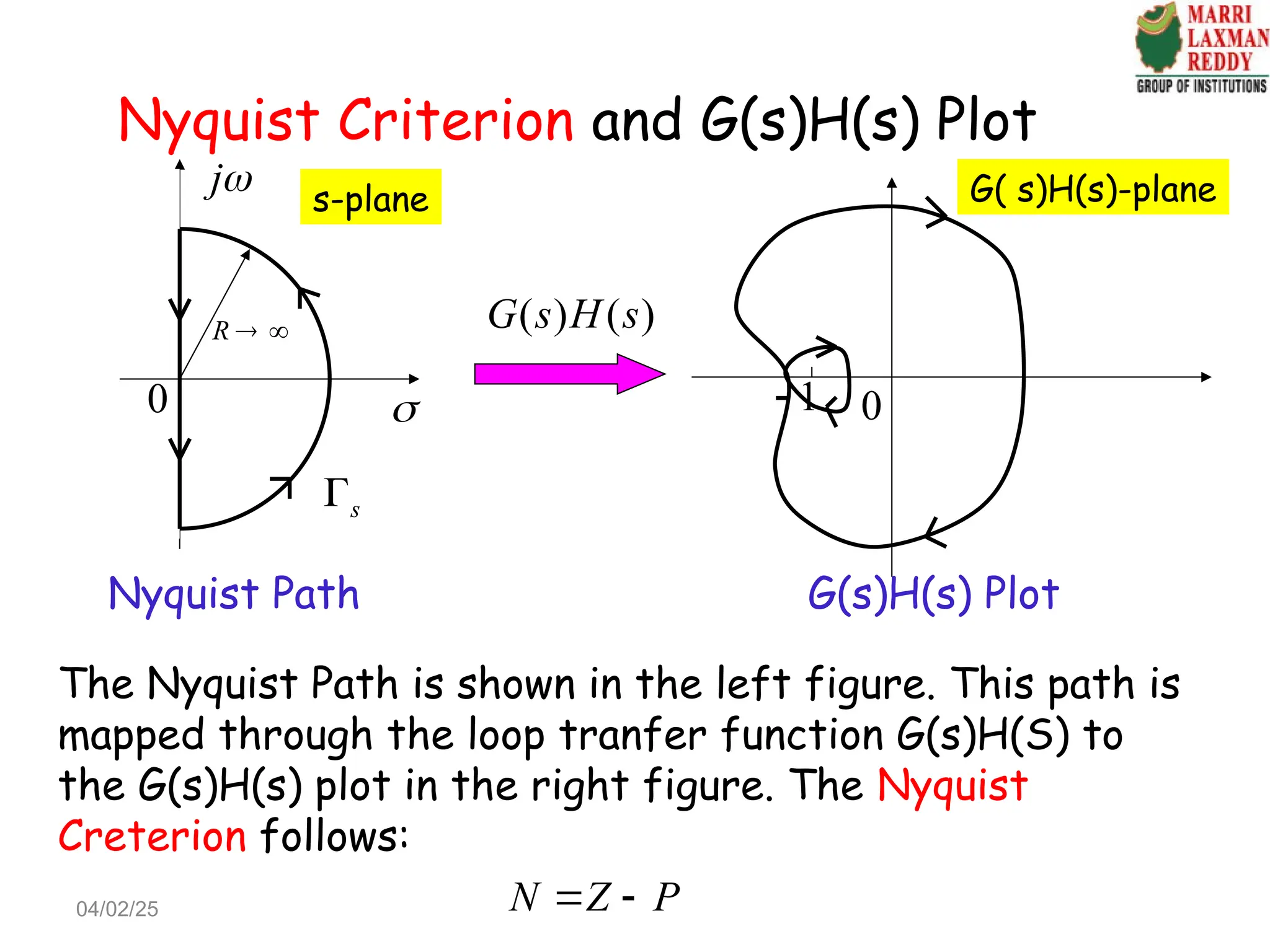
Nyquist Criterion and G(s)H(s) Plot
j

s-plane
0
R  
s

( ) ( )
G s H s
G( s)H(s)-plane
0
1

Nyquist Path G(s)H(s) Plot
The Nyquist Path is shown in the left figure. This path is
mapped through the loop tranfer function G(s)H(S) to
the G(s)H(s) plot in the right figure. The Nyquist
Creterion follows:
N Z P
 
04/02/25
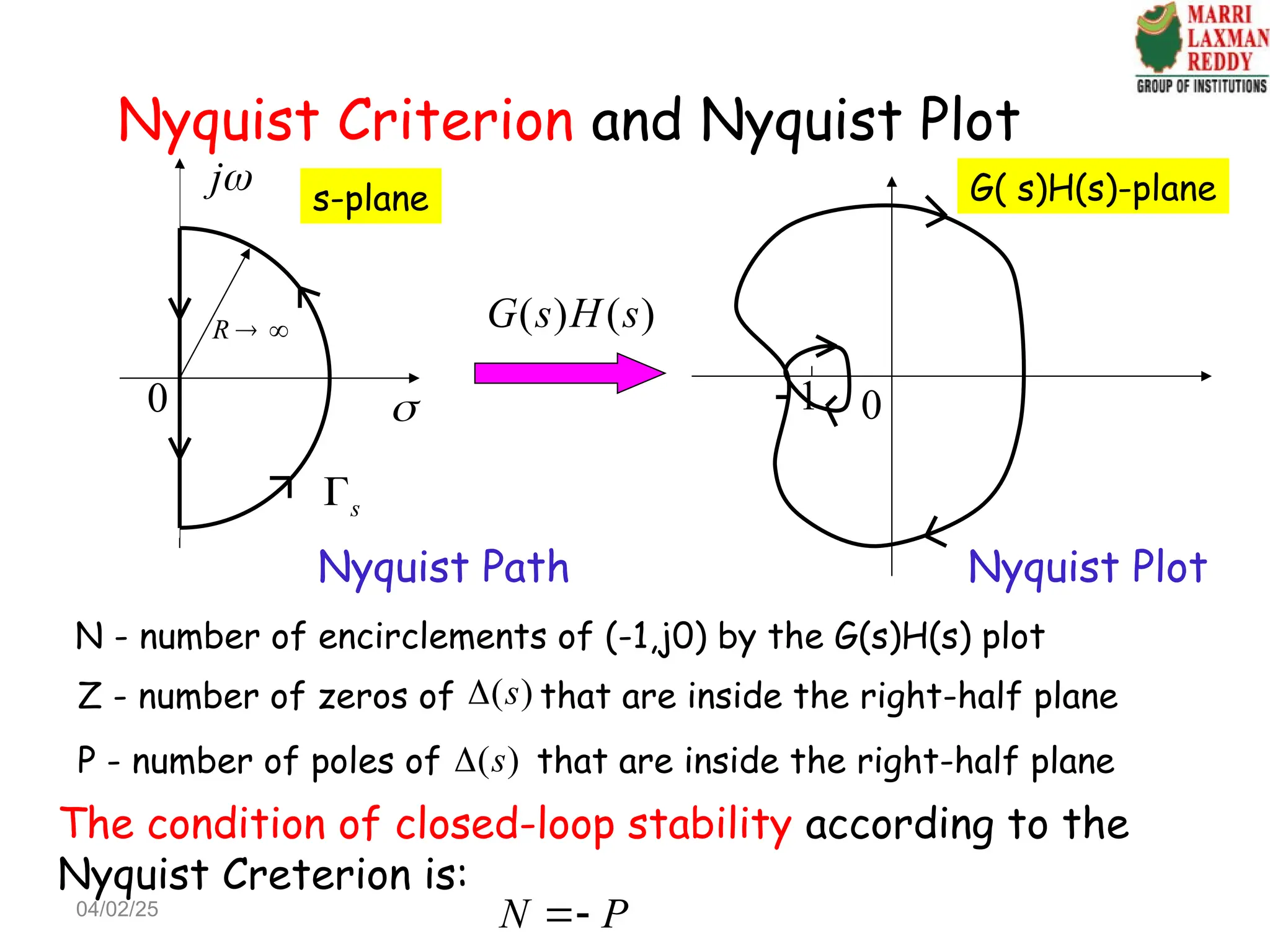
Nyquist Criterion and Nyquist Plot
j

s-plane
0
R  
s

( ) ( )
G s H s
G( s)H(s)-plane
0
1

Nyquist Path Nyquist Plot
The condition of closed-loop stability according to the
Nyquist Creterion is:
N P

N - number of encirclements of (-1,j0) by the G(s)H(s) plot
Z - number of zeros of that are inside the right-half plane
( )
s

P - number of poles of that are inside the right-half plane
( )
s

04/02/25
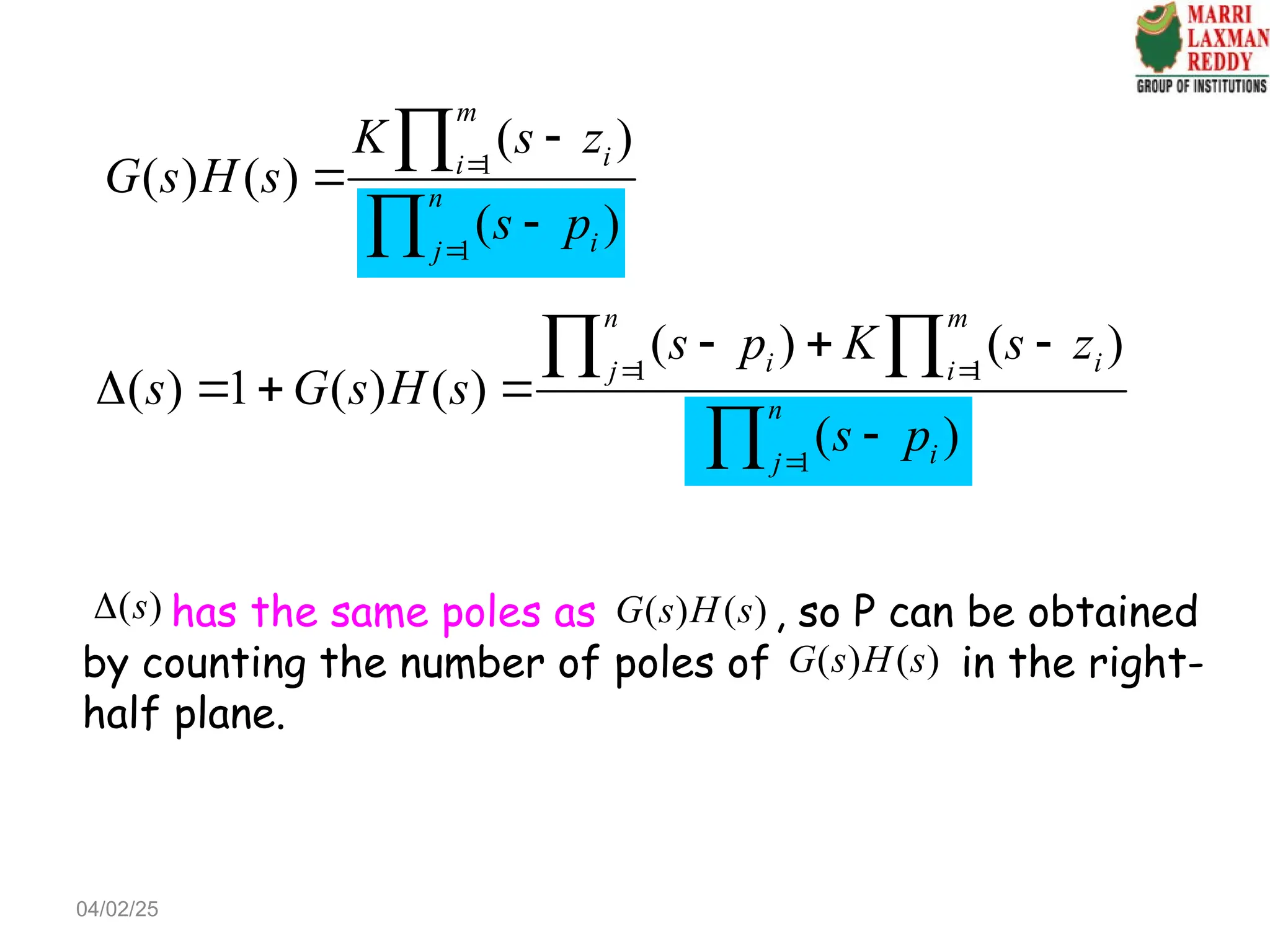
1 1
1
( ) ( )
( ) 1 ( ) ( )
( )
n m
i i
j i
n
i
j
s p K s z
s G s H s
s p
 

  
   

 

1
1
( )
( ) ( )
( )
m
i
i
n
i
j
K s z
G s H s
s p







has the same poles as , so P can be obtained
by counting the number of poles of in the right-
half plane.
( )
s
 ( ) ( )
G s H s
( ) ( )
G s H s
04/02/25
-2 -1 0 1 2 3 4 5
-4
-3
-2
-1
0
1
2
3
4
Nyquist Diagram
Real Axis
Imaginary
Axis
An example
Consider the system with
the loop function
3
5
( ) ( )
( 1)
G s H s
s


Matlab program for
Nyquist plot
(G(s)H(s) plot)
>>num=5;
>>den=[1 3 3 1];
>>nyquist(num,den);
Question 1: is the
closed-loop system
stable?
Question 2: what if
3
5
( ) ( ) ?
( 1)
K
G s H s
s


N=0, P=0,
N=-P, stable
04/02/25
Root Locus
Real Axis
Imaginary
Axis
-4 -3 -2 -1 0 1 2
-3
-2
-1
0
1
2
3
*
3 3
5 1
( ) ( )
( 1) ( 1)
K
G s H s K
s s
 
 
1. With root locus technique:
For K* varies from 0
to ∞, we draw the RL
>>num=1;
>>den=[1 3 3 1];
>>rlocus(num,den);
When K*=8
(K=1.6), the RL
cross the jw-axis,
the closed-loop
system is
marginally stable.
For K*>8 (K>1.6), the closed-loop system has two roots in
the RHP and is unstable.
*
K  
*
K  
*
K
 
*
0
K 
*
8
K 
04/02/25
2. With Nyquist plot and
Nyquist criterion:
-2 -1 0 1 2 3 4 5
-4
-3
-2
-1
0
1
2
3
4
Nyquist Diagram
Real Axis
Imaginary
Axis
>>K=1;
>>num=5*K;
>>den=[1 3 3 1];
>>nyquist(num,den);
Nyquist plot
does not
encircle (-1,j0),
so N=0
K=1
3
5
( ) ( )
( 1)
K
G s H s
s


No pole of
G(s)H(s) in
RHP, so P=0;
Thus N=-P
The closed-loop system is stable
04/02/25
-2 -1 0 1 2 3 4 5 6 7 8
-6
-4
-2
0
2
4
6
Nyquist Diagram
Real Axis
Imaginary
Axis
2. With Nyquist plot and
Nyquist criterion:
>>K=1.6;
>>num=5*K;
>>den=[1 3 3 1];
>>nyquist(num,den);
The Nyquist plot
just go through
(-1,j0)
K=1.6
3
5
( ) ( )
( 1)
K
G s H s
s


No pole of
G(s)H(s) in RHP,
so P=0;
The closed-loop system is marginally stable
04/02/25
-5 0 5 10 15 20
-15
-10
-5
0
5
10
15
Nyquist Diagram
Real Axis
Imaginary
Axis
2. With Nyquist plot and
Nyquist criterion:
>>K=4;
>>num=5*K;
>>den=[1 3 3 1];
>>nyquist(num,den);
Nyquist plot
encircles (-1,j0)
twice, so N=2
K=4
3
5
( ) ( )
( 1)
K
G s H s
s


No pole of
G(s)H(s) in RHP,
so P=0;
Thus Z=N+P=2
The closed-loop system has two poles in RHP and is unstable
04/02/25
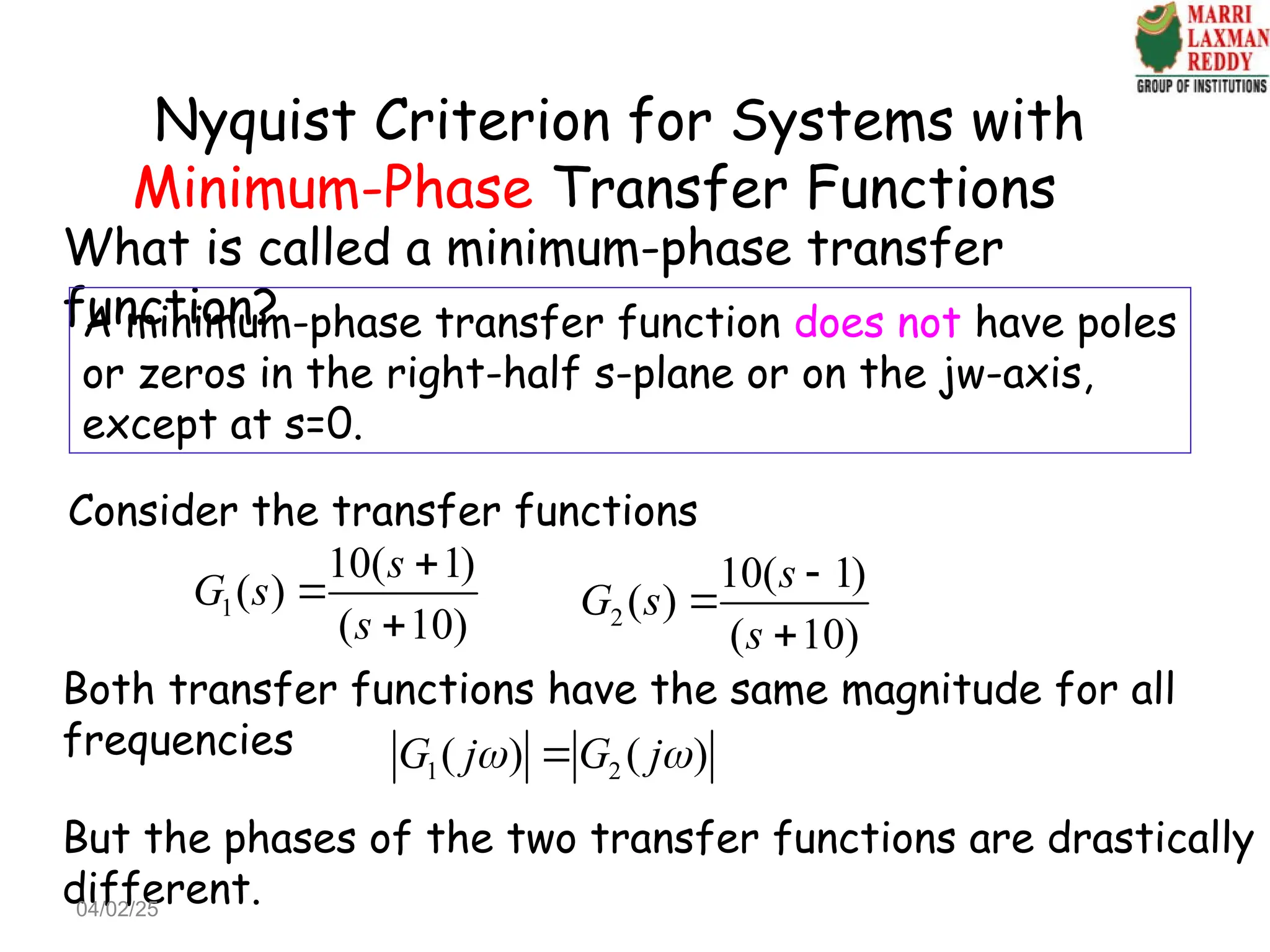
Nyquist Criterion for Systems with
Minimum-Phase Transfer Functions
What is called a minimum-phase transfer
function?
A minimum-phase transfer function does not have poles
or zeros in the right-half s-plane or on the jw-axis,
except at s=0.
1
10( 1)
( )
( 10)
s
G s
s


 2
10( 1)
( )
( 10)
s
G s
s



Consider the transfer functions
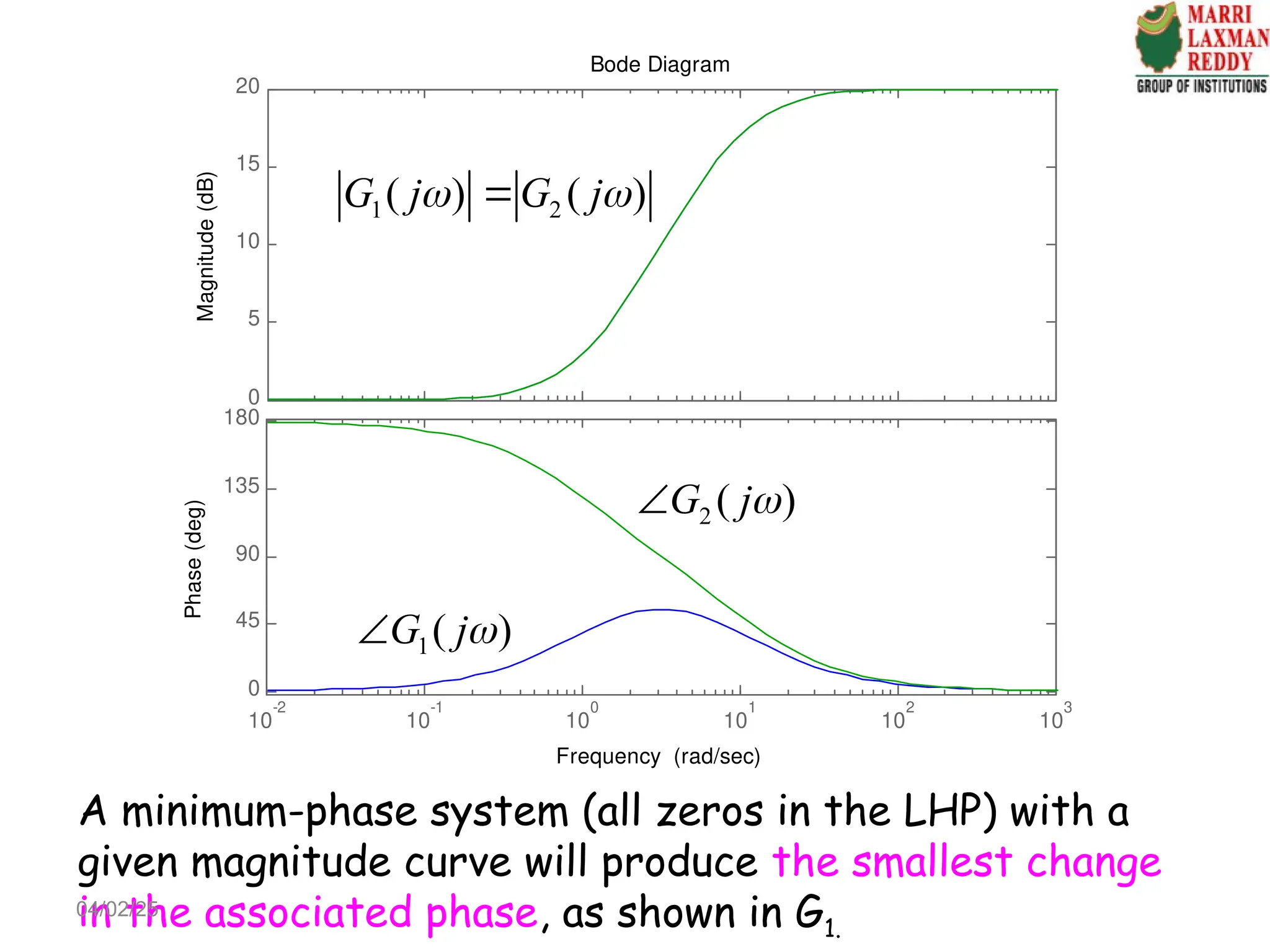
Both transfer functions have the same magnitude for all
frequencies
1 2
( ) ( )
G j G j
 

But the phases of the two transfer functions are drastically
different.
04/02/25
0
5
10
15
20
Magnitude
(dB)
10
-2
10
-1
10
0
10
1
10
2
10
3
0
45
90
135
180
Phase
(deg)
Bode Diagram
Frequency (rad/sec)
1 2
( ) ( )
G j G j
 

1( )
G j

2 ( )
G j

A minimum-phase system (all zeros in the LHP) with a
given magnitude curve will produce the smallest change
in the associated phase, as shown in G1.
04/02/25
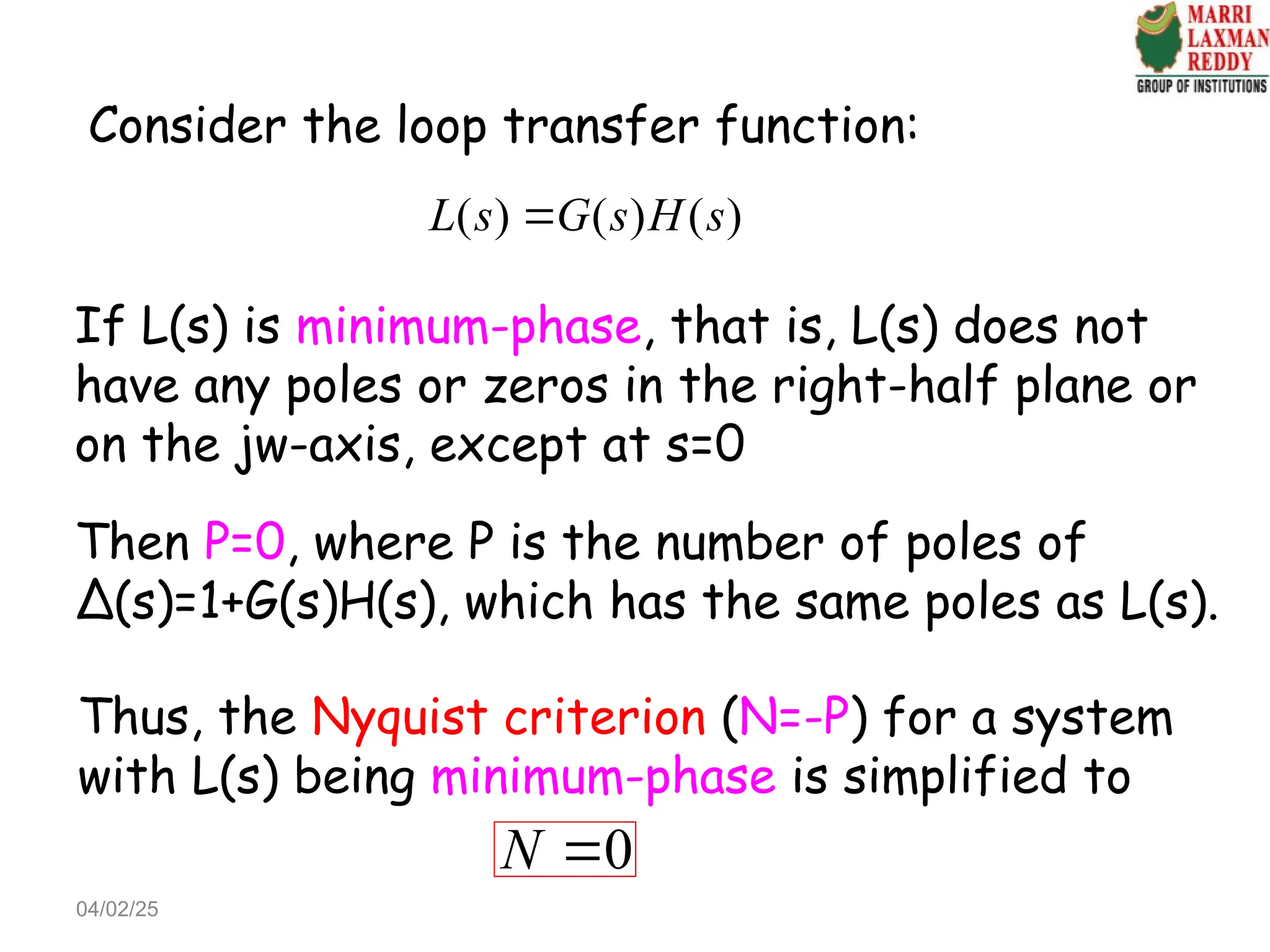
Consider the loop transfer function:
( ) ( ) ( )
L s G s H s

If L(s) is minimum-phase, that is, L(s) does not
have any poles or zeros in the right-half plane or
on the jw-axis, except at s=0
Then P=0, where P is the number of poles of
Δ(s)=1+G(s)H(s), which has the same poles as L(s).
Thus, the Nyquist criterion (N=-P) for a system
with L(s) being minimum-phase is simplified to
0
N 
04/02/25
For a closed-loop system with loop transfer function
L(s) that is of minimum-phase type, the system is
closed-loop stable , if the Nyquist plot (L(s) plot) that
corresponds to the Nyquist path does not enclose (-
1,j0) point. If the (-1,j0) is enclosed by the Nyquist
plot, the system is unstable.
The Nyquist stability can be checked by plotting the
segment of L(jw) from w= ∞ to 0.
0
N 
Nyquist criterion for systems with minimum-phase loop
transfer function
04/02/25
Example Consider a single-loop feedback system with the
loop transfer function
( ) ( ) ( )
( 2)( 10)
K
L s G s H s
s s s
 
 
Analyze the stability of the closed-loop system.
Solution.
Since L(s) is minimum-phase, we can analyze the closed-loop
stability by investigating whether the Nyquist plot enclose
the critical point (-1,j0) for L(jw)/K first.
( ) 1
( 2)( 10)
L j
K j j j

  

 
w=∞:
( )
0 270
L j
K

   
w=0+
:
( 0)
90
L j
K
  
0
 
Im
j
Real
0
 
Im[ ( ) ] 0
L j K
 
04/02/25
1
Im[ ( ) ] Im[ ] 0
( 2)( 10)
L j K
j j j

  
 
 
20 /
rad s
 
The frequency is positive, so 20 /
rad s
 
1
( 20) 0.004167
20( 20 2)( 20 10)
L j K
j j j
 
 
1. 240 ( 20) 1
K L j
   
the Nyquist plot does not enclose (-1,jw);
2. 240 ( 20) 1
K L j
  
the Nyquist plot goes through (-1,jw);
3. 240 ( 20) 1
K L j
   
the Nyquist plot encloses (-1,jw).
stable
marginally stable
unstable
04/02/25
-30 -25 -20 -15 -10 -5 0 5 10
-20
-15
-10
-5
0
5
10
15
20
Root Locus
Real Axis
Imaginary
Axis
1
( ) ( ) ( )
( 2)( 10)
L s G s H s K
s s s
 
 
>>z=[]
>>p=[0, -2, -10];
>>k=1
>>sys=zpk(z,p,k);
>>rlocus(sys);
240
K 
By root locus technique
04/02/25
Relative Stability
Gain Margin and Phase Margin
0
 
Im
j
Real
0
 
1

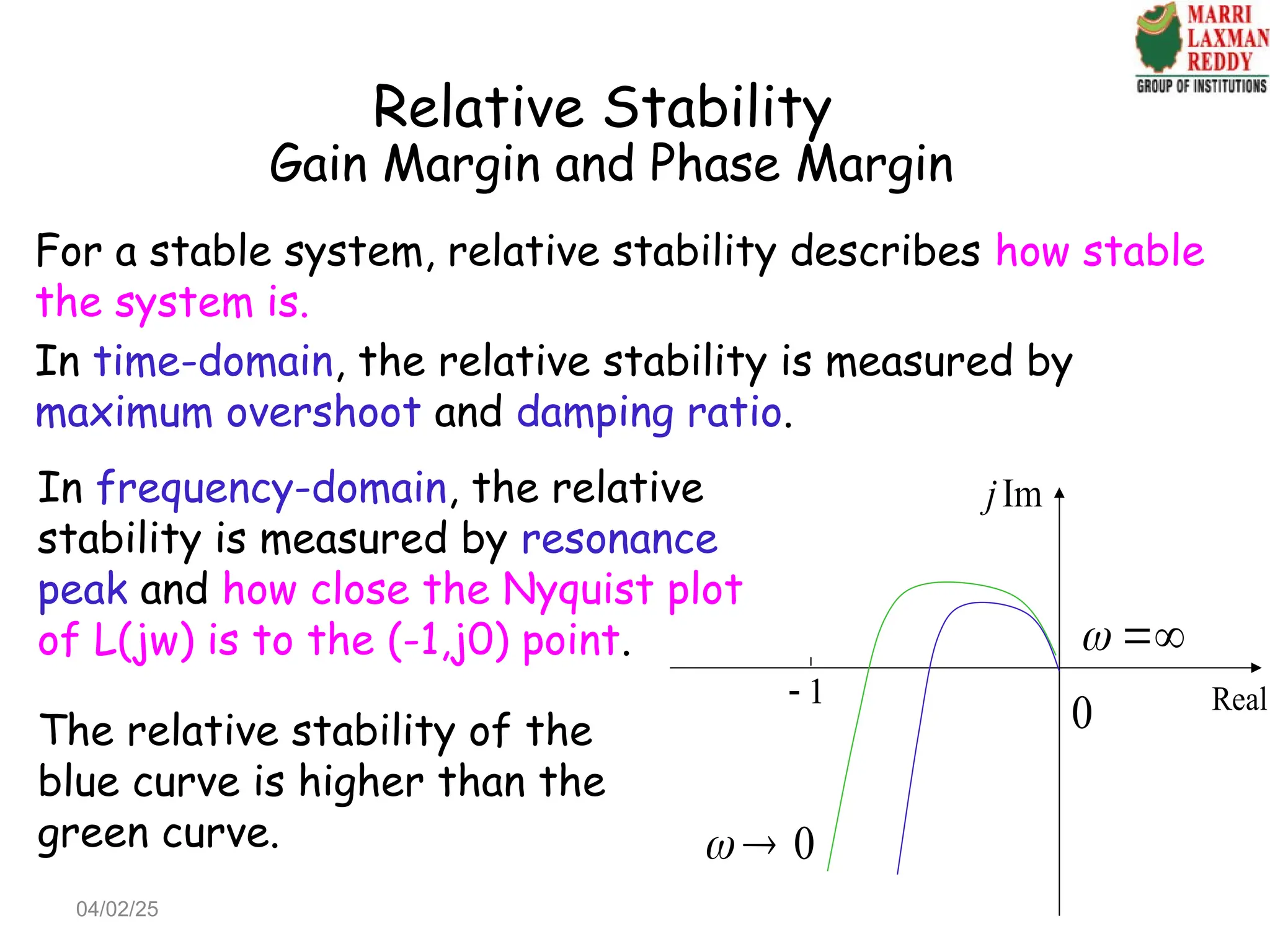
For a stable system, relative stability describes how stable
the system is.
In time-domain, the relative stability is measured by
maximum overshoot and damping ratio.
In frequency-domain, the relative
stability is measured by resonance
peak and how close the Nyquist plot
of L(jw) is to the (-1,j0) point.
The relative stability of the
blue curve is higher than the
green curve.
04/02/25
Gain Margin (GM)
(for minimum-phase loop transfer functions)
0
 
Im
j
Real
0
 
p

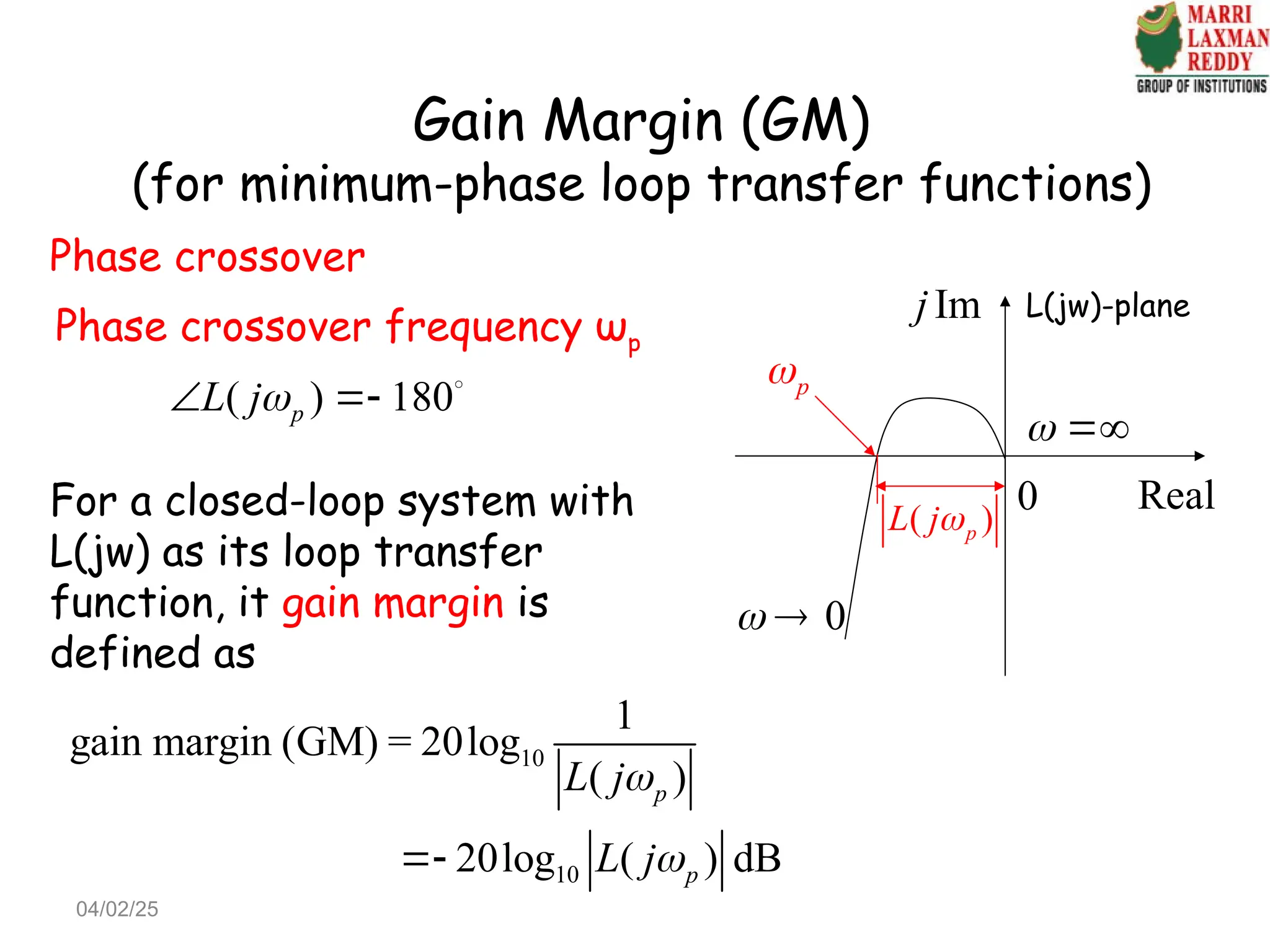
Phase crossover
Phase crossover frequency ωp
( ) 180
p
L j
  
For a closed-loop system with
L(jw) as its loop transfer
function, it gain margin is
defined as
10
10
1
gain margin (GM) = 20log
( )
20log ( ) dB
p
p
L j
L j



( )
p
L j
L(jw)-plane
04/02/25
10
(stable
When ( ) 1 , log (
) GM 0
) 0
L j L j
    

(closer to the or
( ) GM
igin) (more stable)
L j   
(closer to -1) (les
( s stab e
) G l )
M
L j   
10
(unstabl
When ( ) 1 , lo
e) GM<
) 0 0
g (
L j L j
 
  
10
(marginally s
When ( ) 1 , log
table) GM
) 0 0
( =
L j L j
 
  
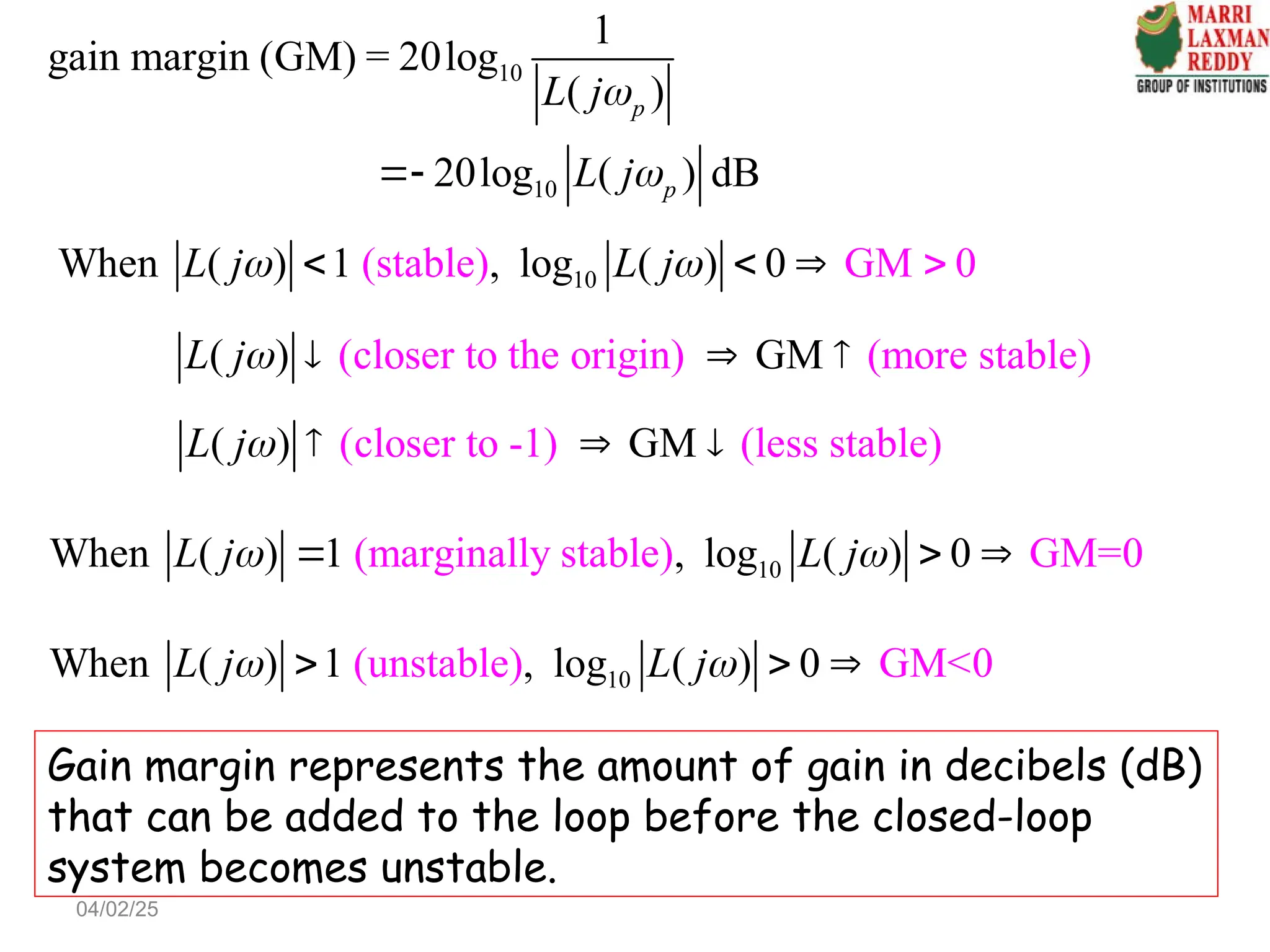
Gain margin represents the amount of gain in decibels (dB)
that can be added to the loop before the closed-loop
system becomes unstable.
10
10
1
gain margin (GM) = 20log
( )
20log ( ) dB
p
p
L j
L j



04/02/25
Phase Margin (PM)
(for minimum-phase loop transfer functions)
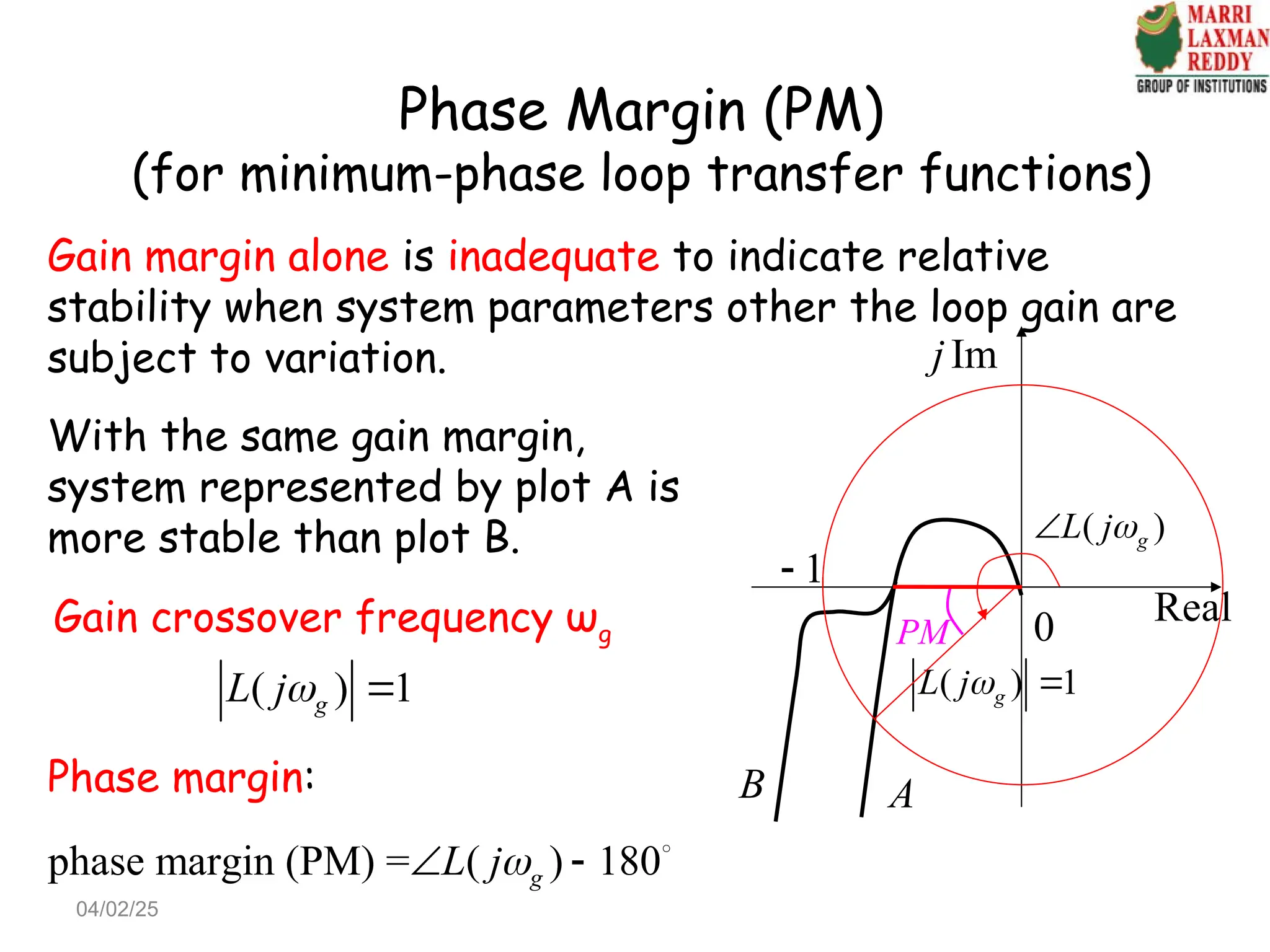
Gain margin alone is inadequate to indicate relative
stability when system parameters other the loop gain are
subject to variation.
( ) 1
g
L j 
0
Im
j
Real
A
B
1

With the same gain margin,
system represented by plot A is
more stable than plot B.
Gain crossover frequency ωg
( ) 1
g
L j 
Phase margin:
phase margin (PM) = ( ) 180
g
L j
  
( )
g
L j

PM
04/02/25
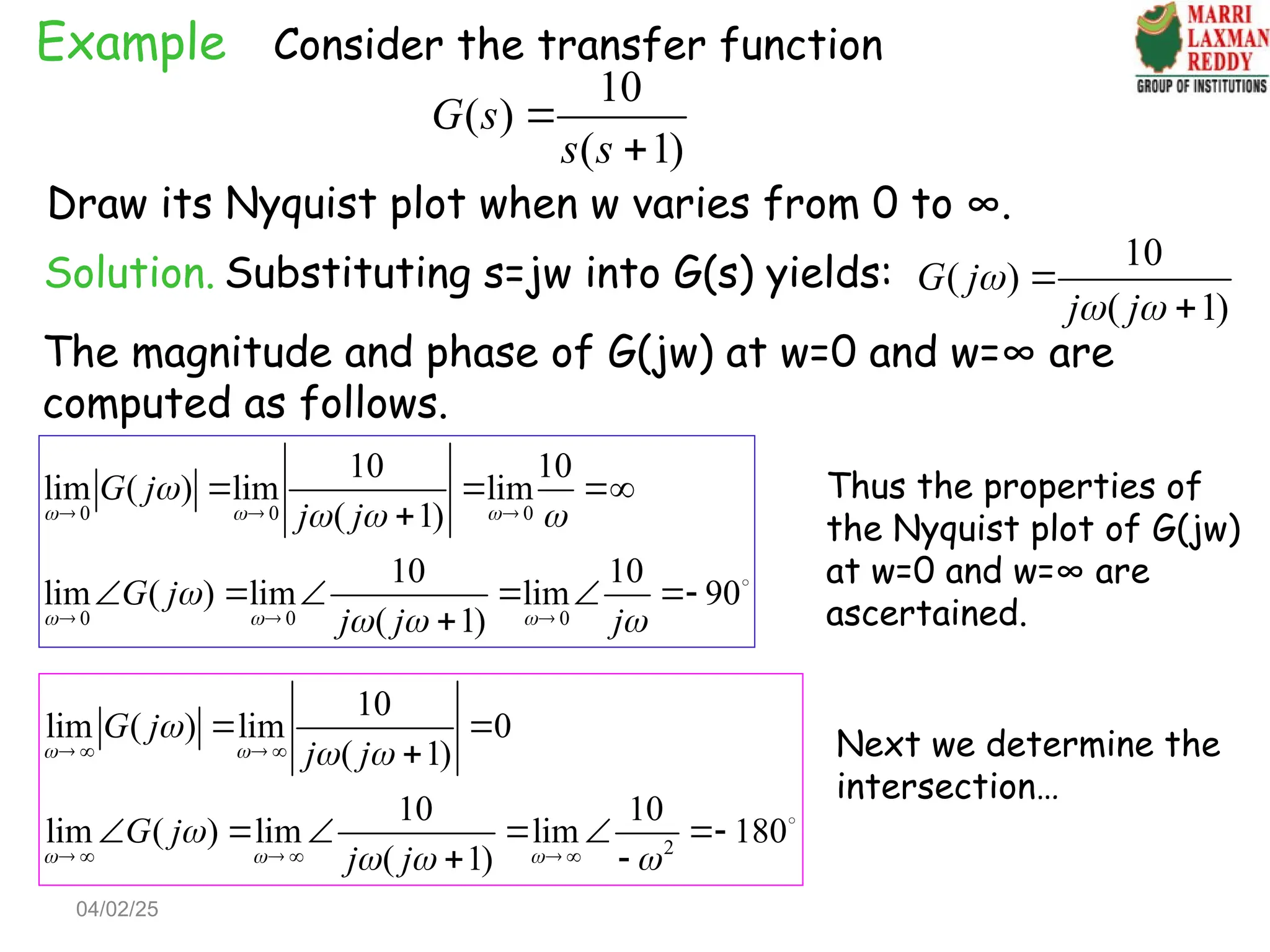
Example Consider the transfer function
10
( )
( 1)
G s
s s


Draw its Nyquist plot when w varies from 0 to ∞.
Solution. Substituting s=jw into G(s) yields:
10
( )
( 1)
G j
j j

 


The magnitude and phase of G(jw) at w=0 and w=∞ are
computed as follows.
0 0 0
0 0 0
10 10
lim ( ) lim lim
( 1)
10 10
lim ( ) lim lim 90
( 1)
G j
j j
G j
j j j
  
  

  

  
  
  
  

     


2
10
lim ( ) lim 0
( 1)
10 10
lim ( ) lim lim 180
( 1)
G j
j j
G j
j j
 
  

 

  
   
     
 

     
 

Thus the properties of
the Nyquist plot of G(jw)
at w=0 and w=∞ are
ascertained.
Next we determine the
intersection…
04/02/25
If the Nyquist plot of G(jw) intersects with the real axis, we have
Im[ ( )] 0
G j 
2
4 2 4 2
10 10 10
( )
( 1)
G j j
j j
 

     

  
  
4 2
10
0

 


 
This means that the G(jw) plot intersects only with the real axis of the
G(jw)-plane at the origin.
Similarly, intersection of G(jw) with the imaginary axis:
 
which corresponds to the origin of the G(jw)-plane.
The conclusion is that the Nyquist
plot of G(jw) does not intersect any
one of the axes at any finite
nonzero frequency.
Re[ ( )] 0
G j 
At w=0, Re[ ( )] 10
G j 
At w=∞, Re[ ( )] 0
G j 
04/02/25
Example Consider a system with a loop transfer function as
2500
( )
( 5)( 50)
L s
s s s

 
Determine its gain margin and phase margin.
Solution. Phase crossover frequency ωp:
Im[ ( )] 0 15.88 rad/sec
p
L j 
  
10
GM = 20log ( ) 14.80 dB
p
L j
 
Gain margin:
Gain crossover frequency ωg:
( ) 1 6.22 rad/sec
g g
L j 
  
Phase margin:
PM = ( ) 180 31.72
g
L j
  
 
0
 
Im
j
0
 
1

( ) 0.182
p
L j  15.88
p
 
6.22
g
 
31.72
0.182

04/02/25
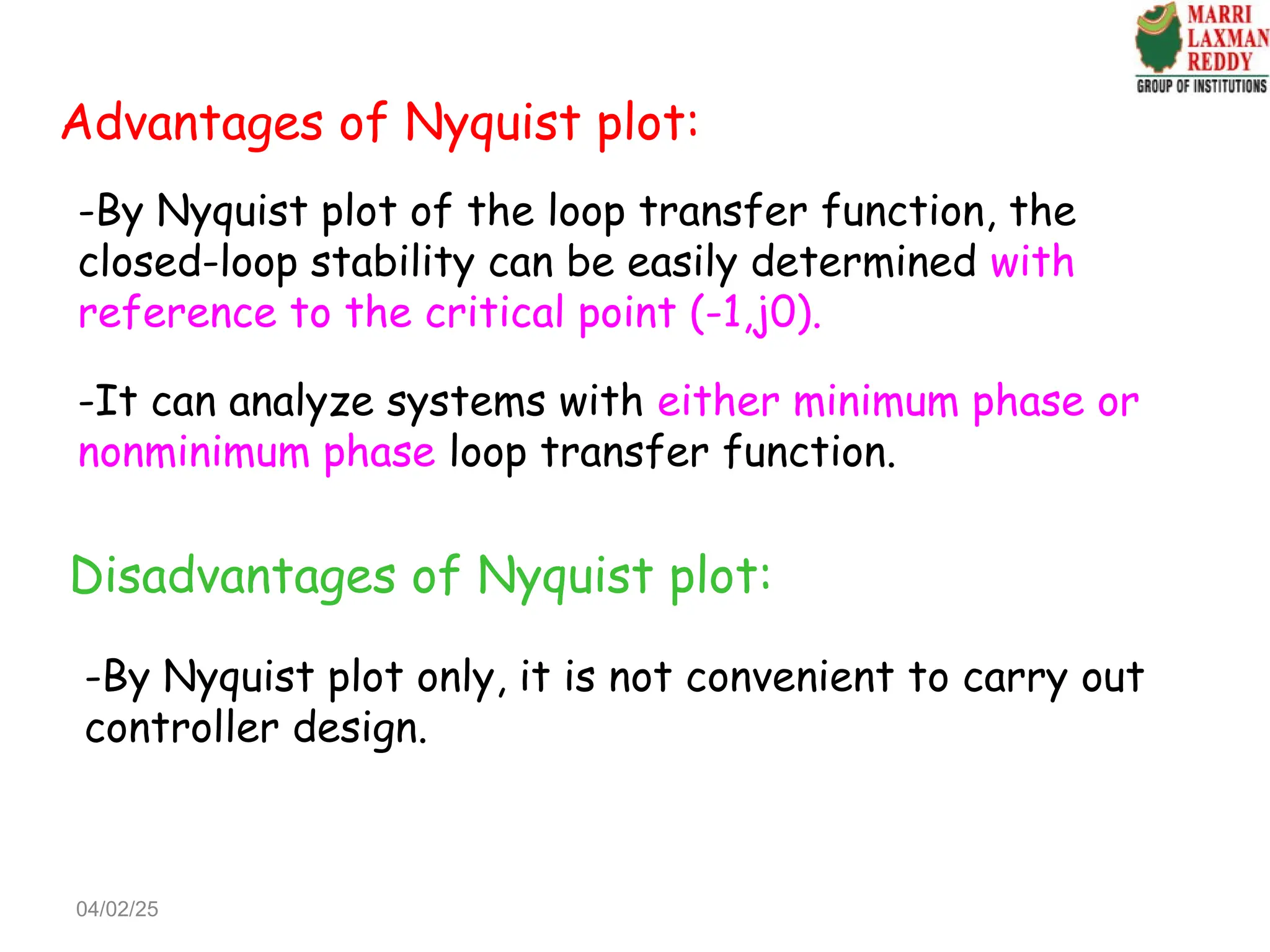
Advantages of Nyquist plot:
-By Nyquist plot of the loop transfer function, the
closed-loop stability can be easily determined with
reference to the critical point (-1,j0).
-It can analyze systems with either minimum phase or
nonminimum phase loop transfer function.
Disadvantages of Nyquist plot:
-By Nyquist plot only, it is not convenient to carry out
controller design.
04/02/25
5-3 Bode Plot
04/02/25
Bode Plot
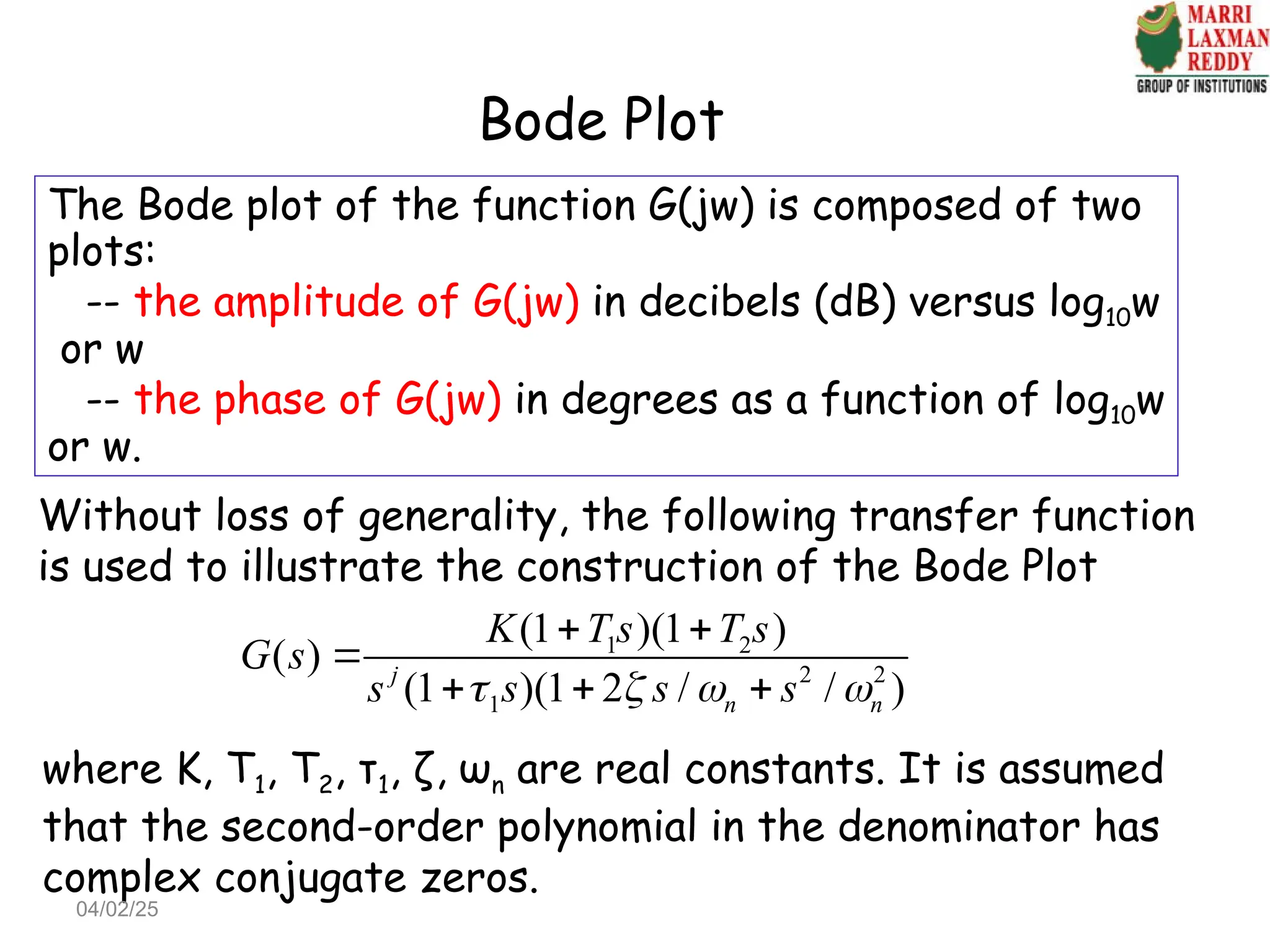
The Bode plot of the function G(jw) is composed of two
plots:
-- the amplitude of G(jw) in decibels (dB) versus log10w
or w
-- the phase of G(jw) in degrees as a function of log10w
or w.
Without loss of generality, the following transfer function
is used to illustrate the construction of the Bode Plot
1 2
2 2
1
(1 )(1 )
( )
(1 )(1 2 / / )
j
n n
K T s T s
G s
s s s s
   
 

  
where K, T1, T2, τ1, ζ, ωn are real constants. It is assumed
that the second-order polynomial in the denominator has
complex conjugate zeros.
04/02/25
The magnitude of G(jw) in dB is obtained by multiplying the
logarithm (base 10) of |G(jw)| by 20; we have
1 2
2 2
1
(1 )(1 )
( )
( )(1 )(1 2 / / )
n n
K jT jT
G j
j j j
 

      
 

  
Substituting s=jw into G(s) yields
10
10 10 1 10 2
2 2
10 10 1 10
( ) 20log ( )
20log 20log 1 20log 1
20log 20log 1 20log 1 2 / /
dB
n n
G j G j
K jT jT
j j j
 
 
      

    
     
The phase of G(jw) is
1 2
2 2
1
( ) (1 ) (1 )
(1 ) (1 2 / / )
n n
G j K jT jT j
j j
   
     
       
      
04/02/25
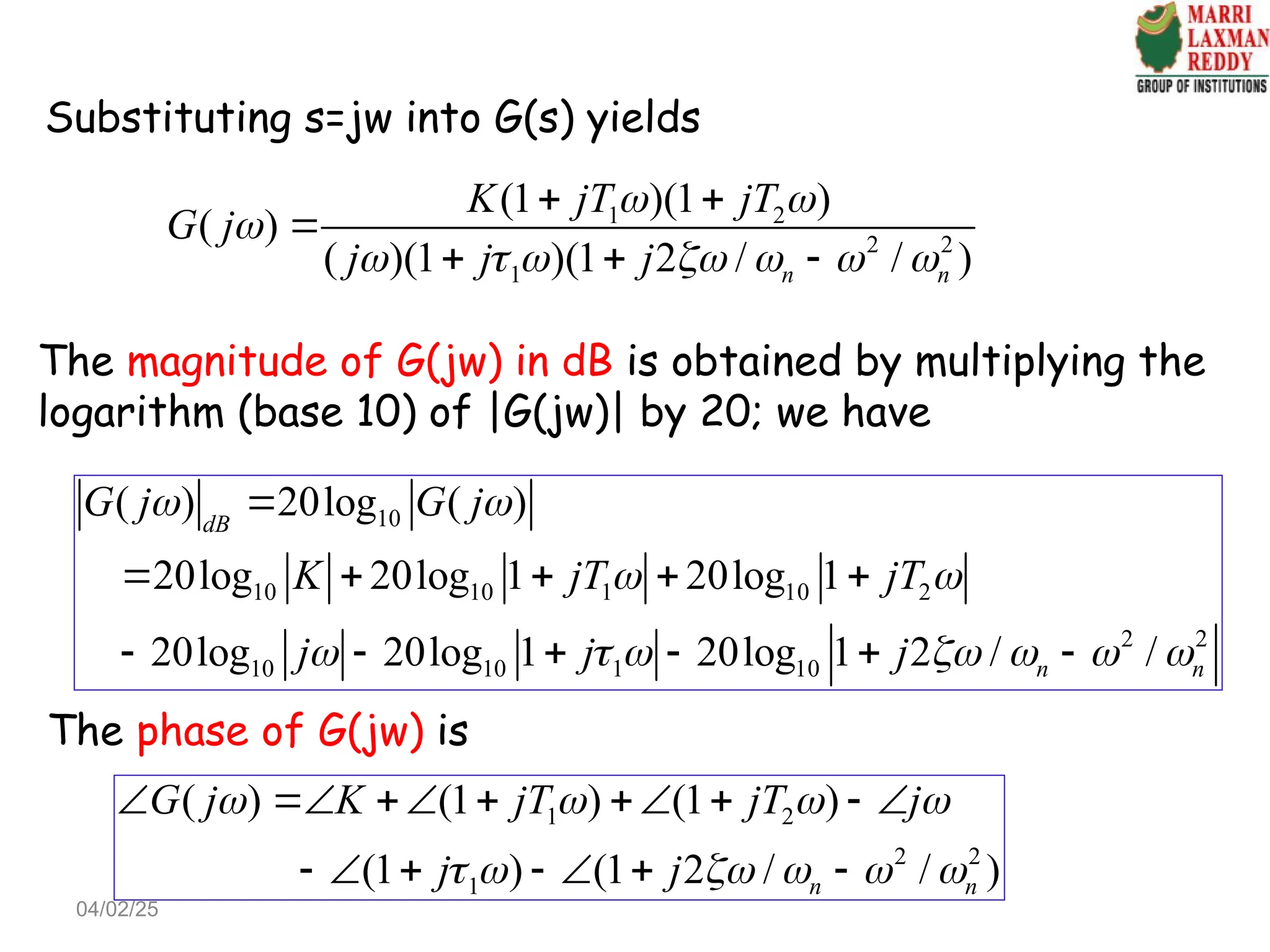
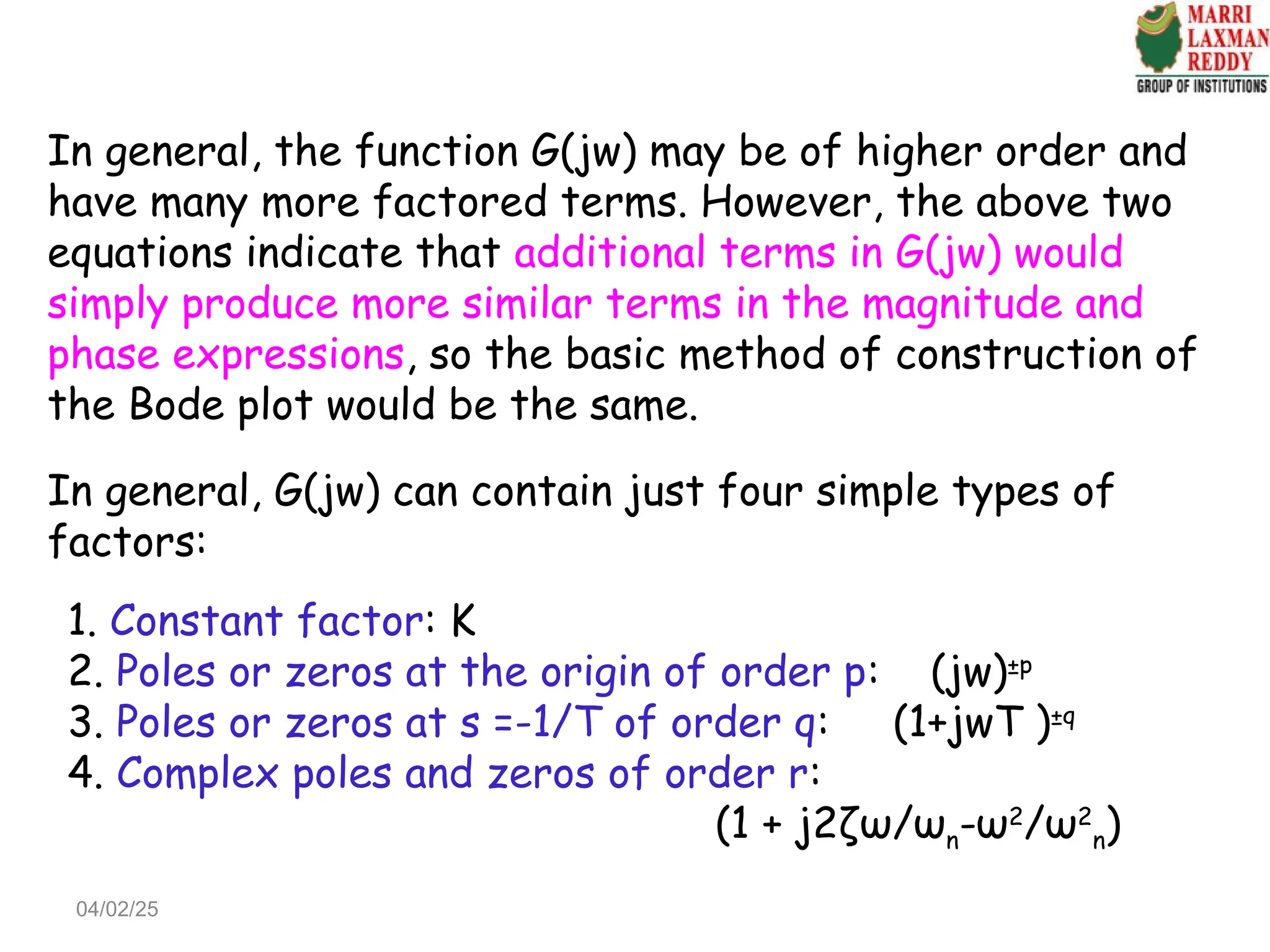
In general, the function G(jw) may be of higher order and
have many more factored terms. However, the above two
equations indicate that additional terms in G(jw) would
simply produce more similar terms in the magnitude and
phase expressions, so the basic method of construction of
the Bode plot would be the same.
In general, G(jw) can contain just four simple types of
factors:
1. Constant factor: K
2. Poles or zeros at the origin of order p: (jw)±p
3. Poles or zeros at s =-1/T of order q: (1+jwT )±q
4. Complex poles and zeros of order r:
(1 + j2ζω/ωn-ω2
/ω2
n)
04/02/25
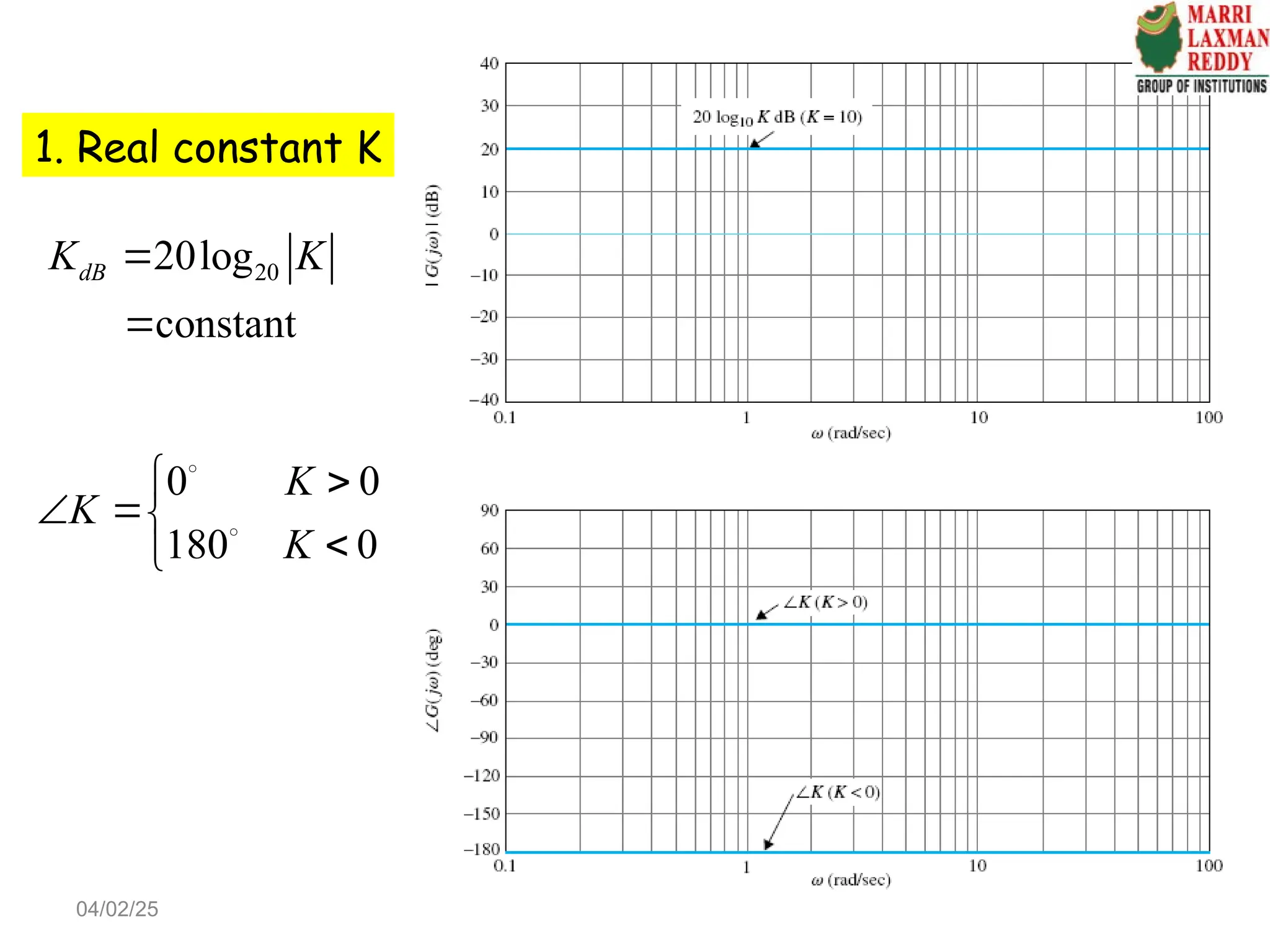
1. Real constant K
20
20log
constant
dB
K K


0 0
180 0
K
K
K
 
 




04/02/25
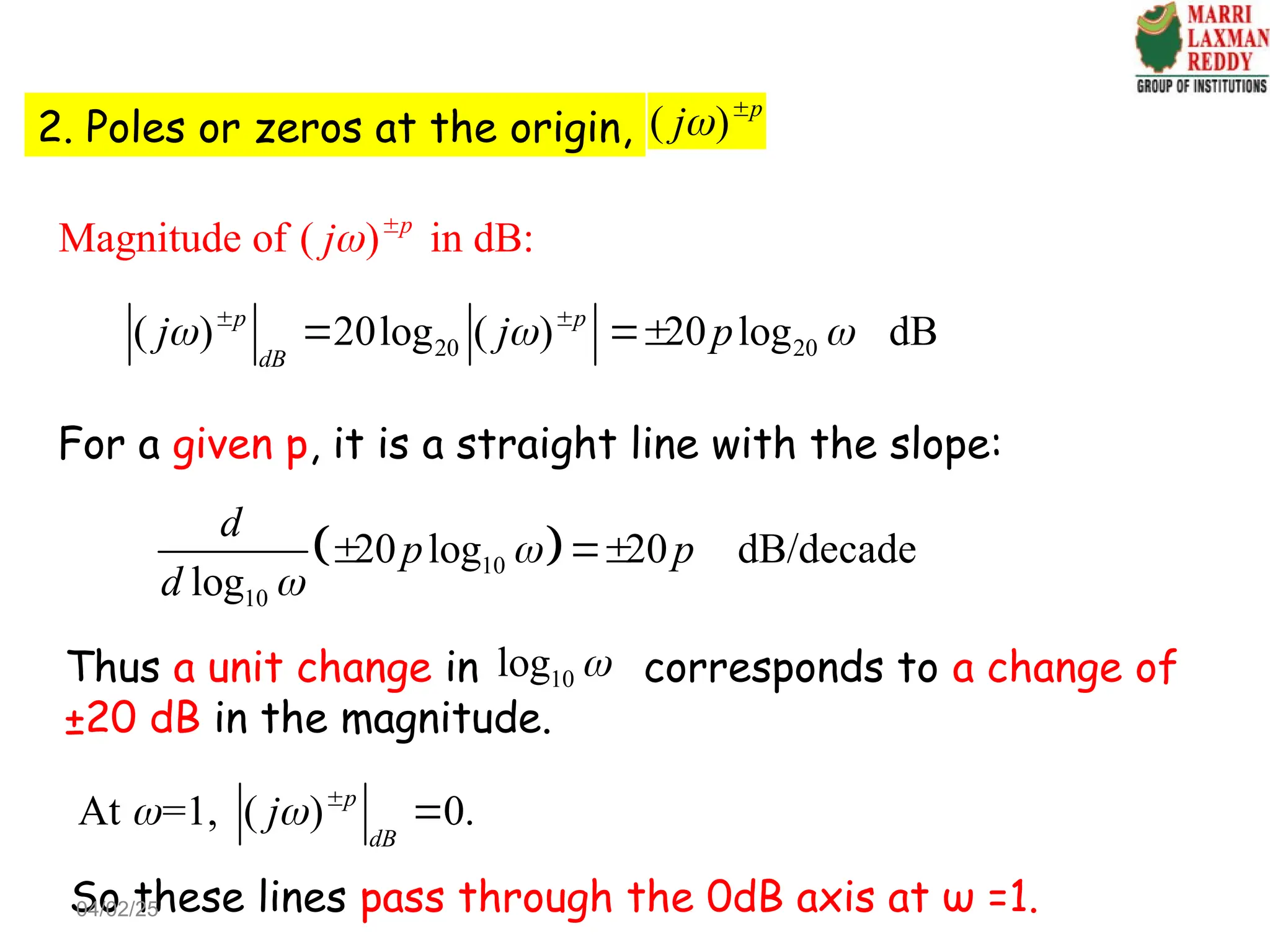
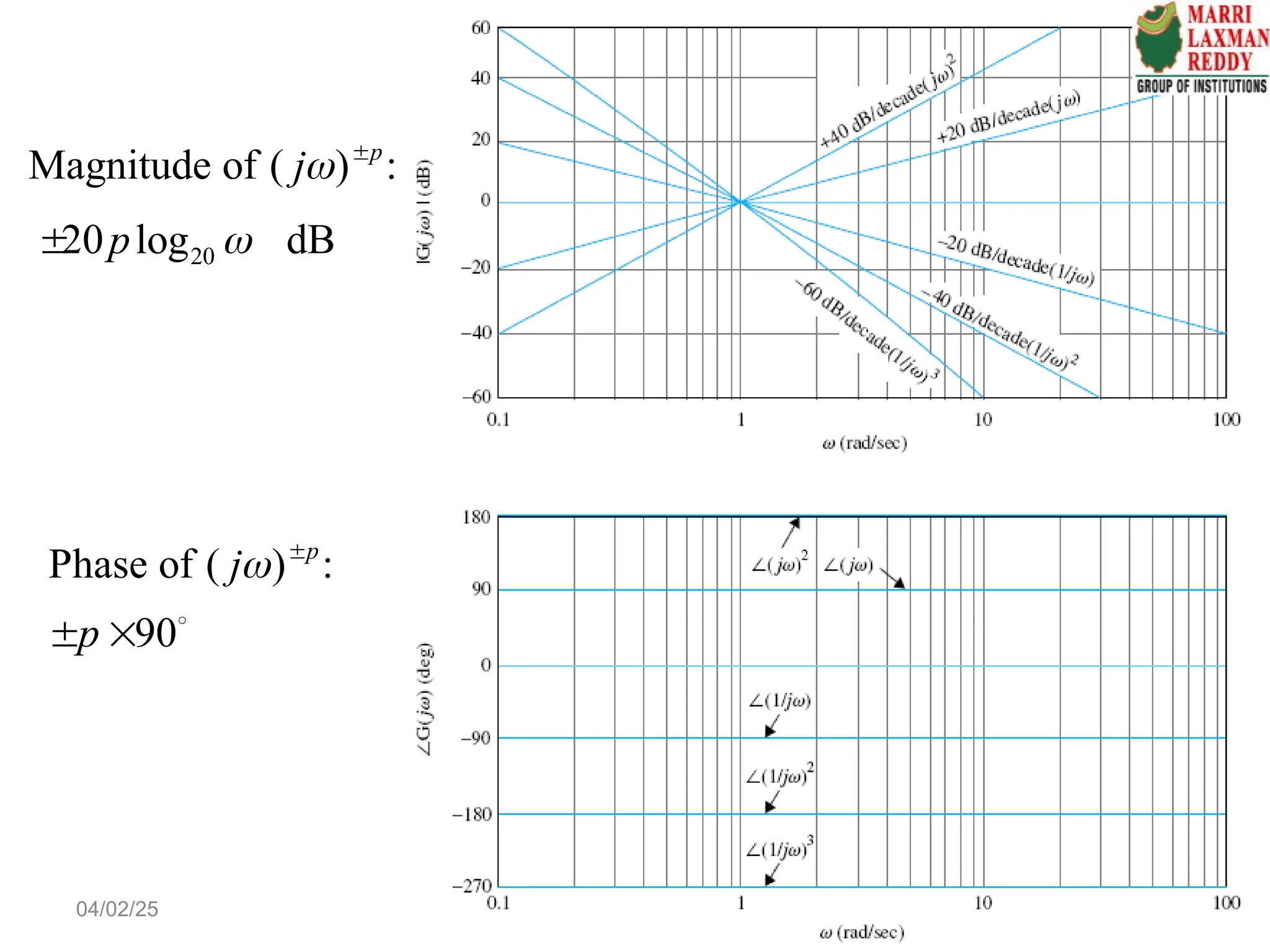
2. Poles or zeros at the origin, ( ) p
j 
Magnitude of ( ) in dB:
p
j 
20 20
( ) 20log ( ) 20 log dB
p p
dB
j j p
  
 
 
For a given p, it is a straight line with the slope:
 
10
10
20 log 20 dB/decade
log
d
p p
d


 
At =1, ( ) 0.
p
dB
j
  

Thus a unit change in corresponds to a change of
±20 dB in the magnitude.
10
log 
So these lines pass through the 0dB axis at ω =1.
04/02/25
Phase of ( ) :
90
p
j
p
 
  
Magnitude of ( ) :
p
j 
20
20 log dB
p 

04/02/25
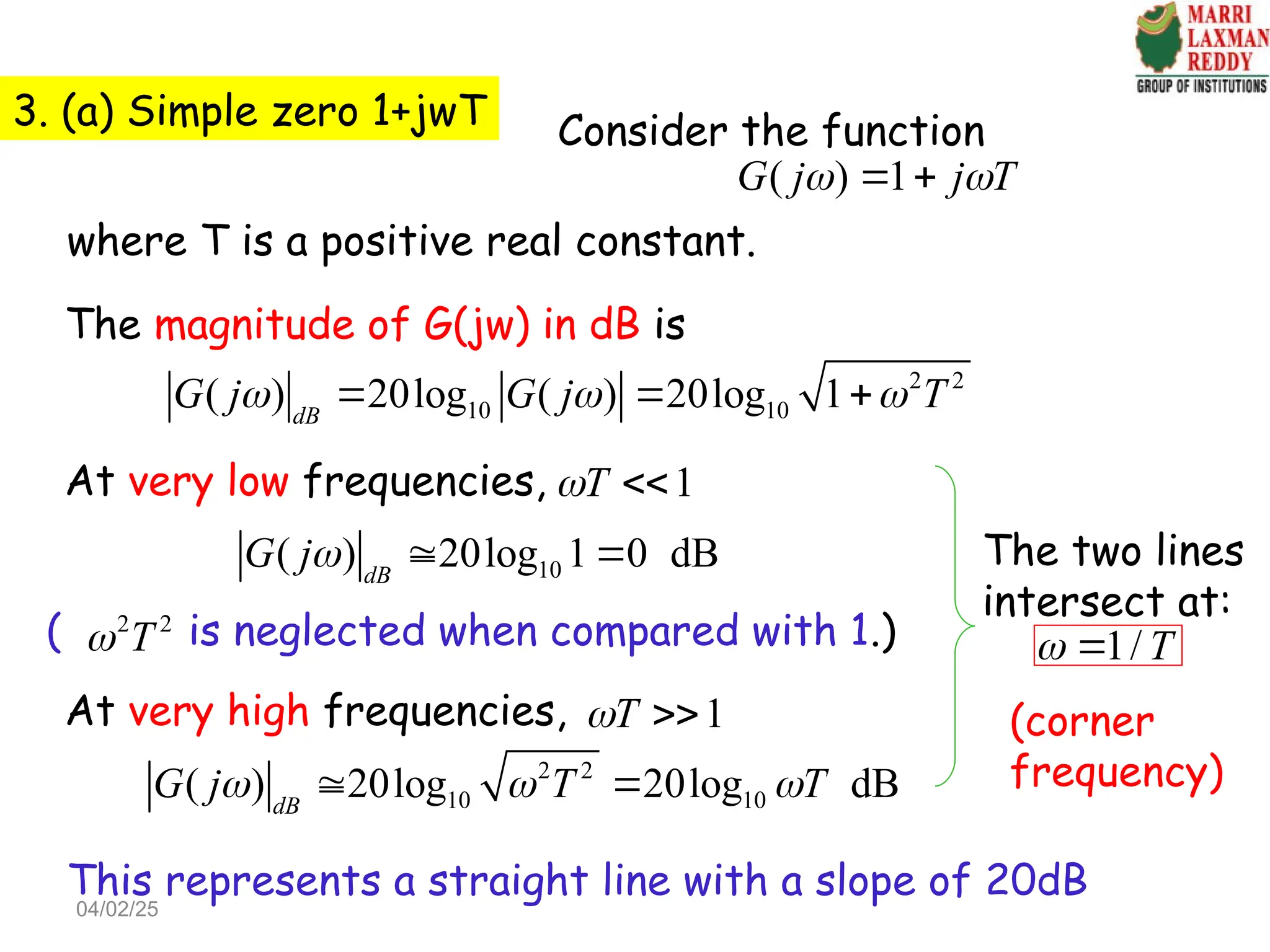
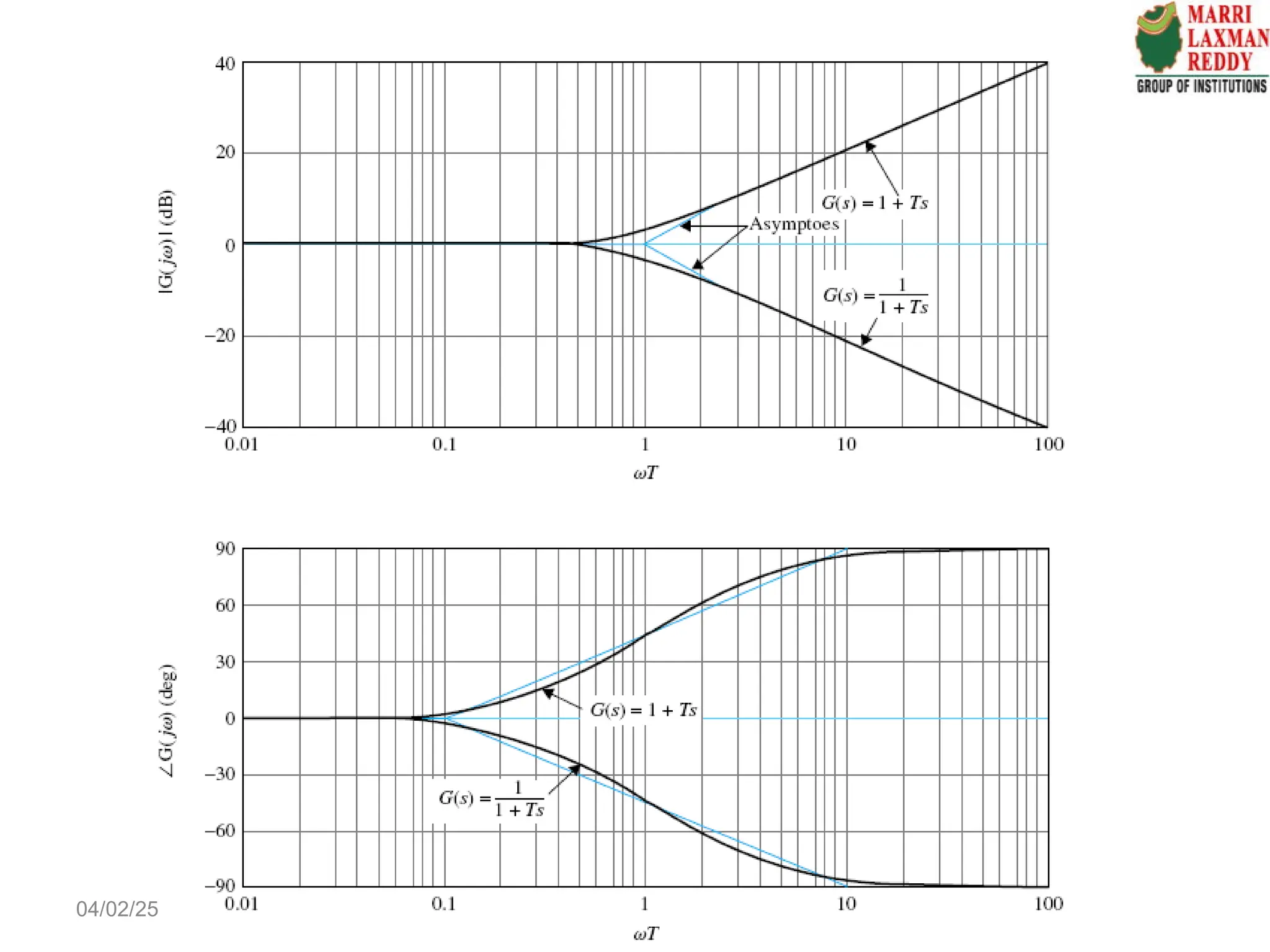
3. (a) Simple zero 1+jwT Consider the function
( ) 1
G j j T
 
 
where T is a positive real constant.
The magnitude of G(jw) in dB is
2 2
10 10
( ) 20log ( ) 20log 1
dB
G j G j T
  
  
At very low frequencies, 1
T
 
10
( ) 20log 1 0 dB
dB
G j  
( is neglected when compared with 1.)
2 2
T

At very high frequencies, 1
T
 
2 2
10 10
( ) 20log 20log dB
dB
G j T T
  
 
This represents a straight line with a slope of 20dB
The two lines
intersect at:
1/ T
 
(corner
frequency)
04/02/25
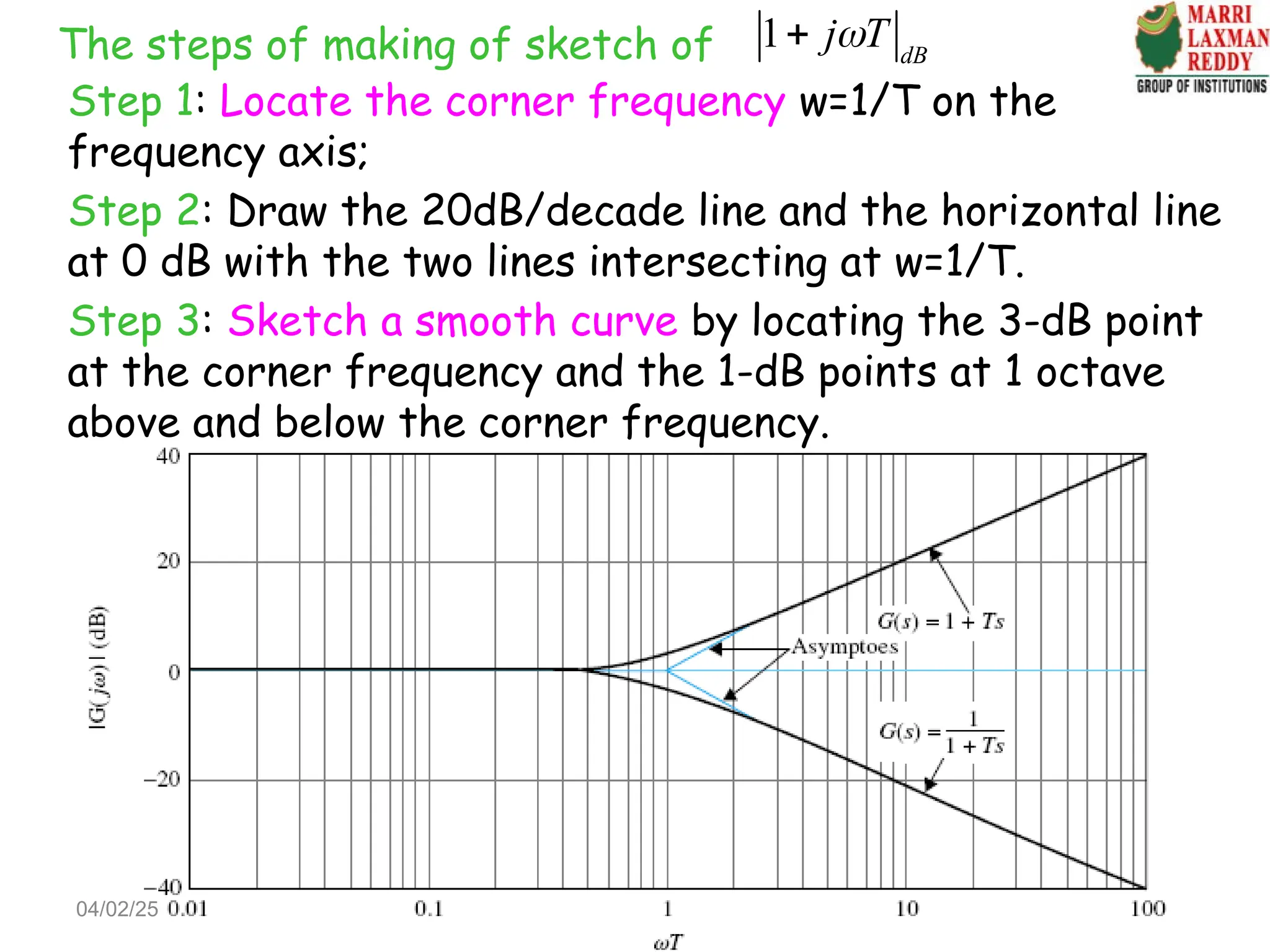
The steps of making of sketch of 1 dB
j T


Step 1: Locate the corner frequency w=1/T on the
frequency axis;
Step 2: Draw the 20dB/decade line and the horizontal line
at 0 dB with the two lines intersecting at w=1/T.
Step 3: Sketch a smooth curve by locating the 3-dB point
at the corner frequency and the 1-dB points at 1 octave
above and below the corner frequency.
04/02/25
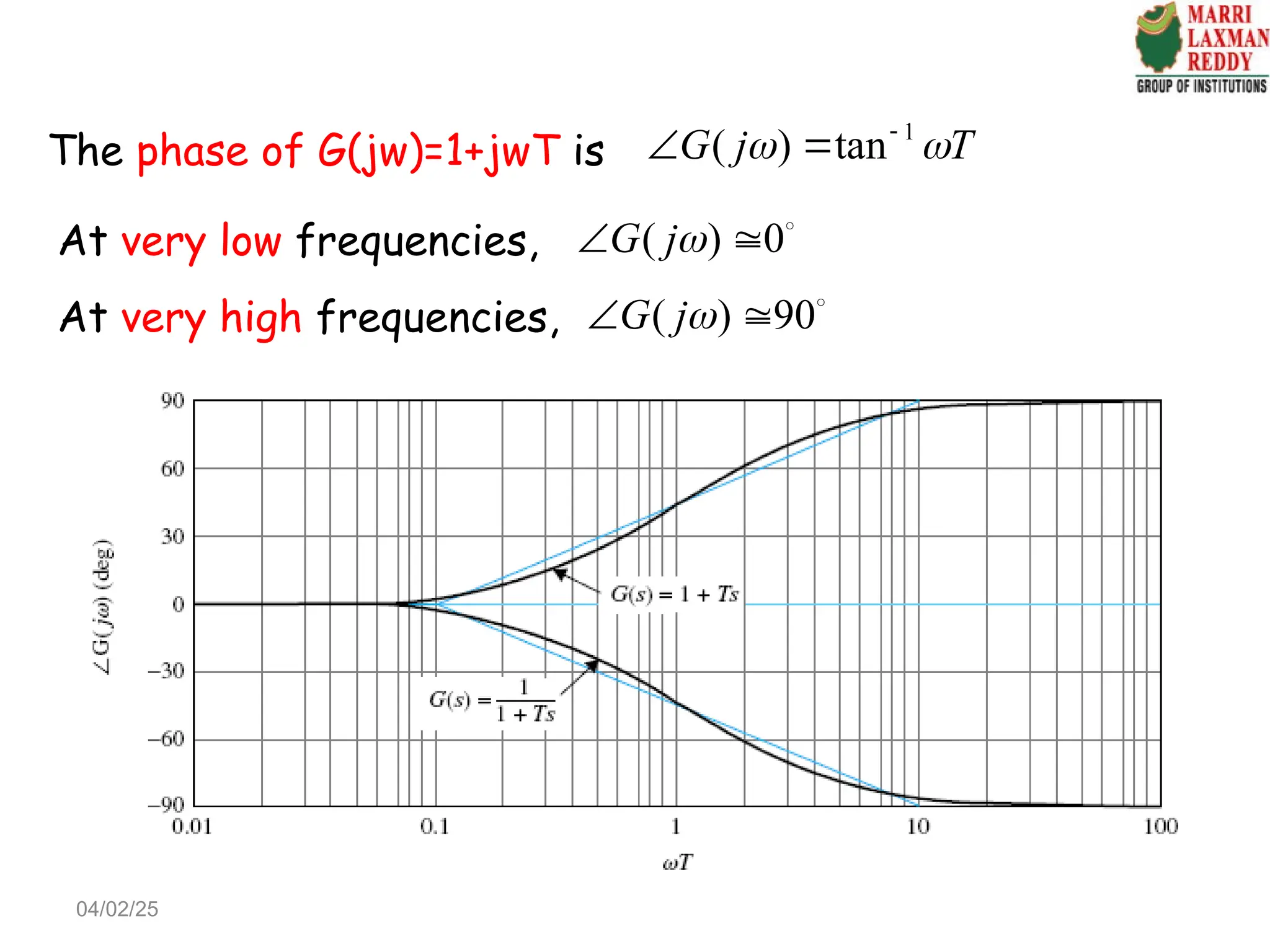
The phase of G(jw)=1+jwT is
1
( ) tan
G j T
 

 
At very low frequencies, ( ) 0
G j
  
At very high frequencies, ( ) 90
G j
  
04/02/25
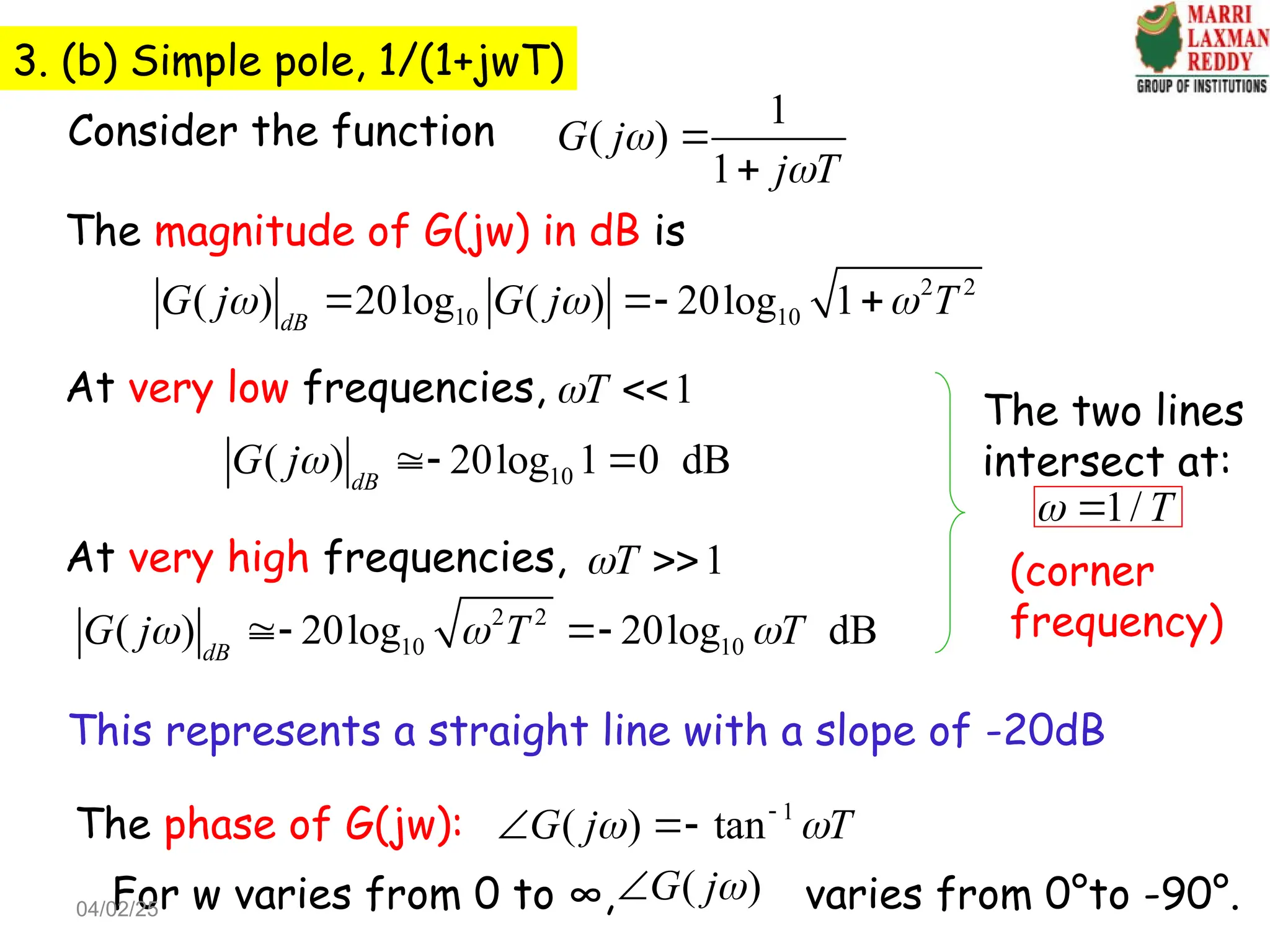
3. (b) Simple pole, 1/(1+jwT)
Consider the function
1
( )
1
G j
j T




The magnitude of G(jw) in dB is
2 2
10 10
( ) 20log ( ) 20log 1
dB
G j G j T
  
  
At very low frequencies, 1
T
 
10
( ) 20log 1 0 dB
dB
G j  
At very high frequencies, 1
T
 
2 2
10 10
( ) 20log 20log dB
dB
G j T T
  
 
This represents a straight line with a slope of -20dB
The two lines
intersect at:
1/ T
 
(corner
frequency)
The phase of G(jw): 1
( ) tan
G j T
 

 
For w varies from 0 to ∞, varies from 0°to -90°.
( )
G j

04/02/25
04/02/25
4. Complex poles and zeros
Consider the second-order transfer function
2
2 2 2 2
1
( )
2 1 (2 ) (1 )
n
n n n n
G s
s s s s

    
 
   
We are interested only in the case when ζ ≤ 1, since
otherwise G(s) would have two unequal real poles, and
the Bode plot can be obtained by considering G(s) as the
product of two transfer functions with simple poles.
By letting s=jw, G(s) becomes
2 2
1
( )
[1 ( )] 2 ( )
n n
G j
j

    

 
04/02/25
2 2
1
( )
[1 ( )] 2 ( )
n n
G j
j

    

 
The magnitude of G(jw) in dB is
10
2 2 2 2 2
10
( ) 20log ( )
20log [1 ( )] 4 ( )
dB
n n
G j G j
 
    

  
At very low frequencies, / 1
n
  
10
( ) 20log 1 0 dB
dB
G j  
At very high frequencies, / 1
n
  
4
10 10
( ) 20log ( ) 40log ( ) dB
n n
dB
G j    
 
This equation represents a straight line with a slope of
40 dB decade in the Bode plot coordinates.
The two lines
intersect at:
n
 

(corner
frequency)
04/02/25
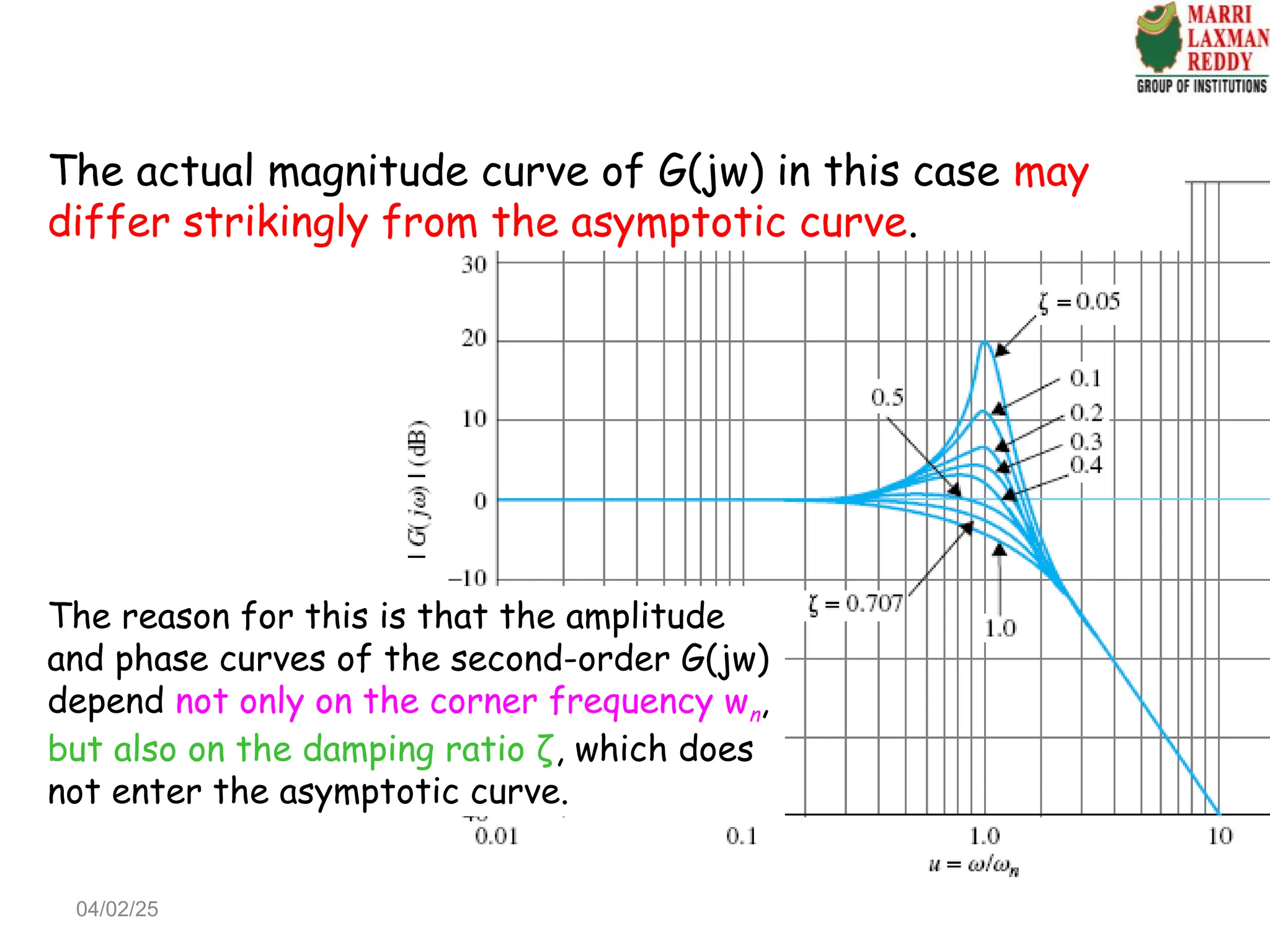
The reason for this is that the amplitude
and phase curves of the second-order G(jw)
depend not only on the corner frequency wn,
but also on the damping ratio ζ, which does
not enter the asymptotic curve.
The actual magnitude curve of G(jw) in this case may
differ strikingly from the asymptotic curve.
04/02/25
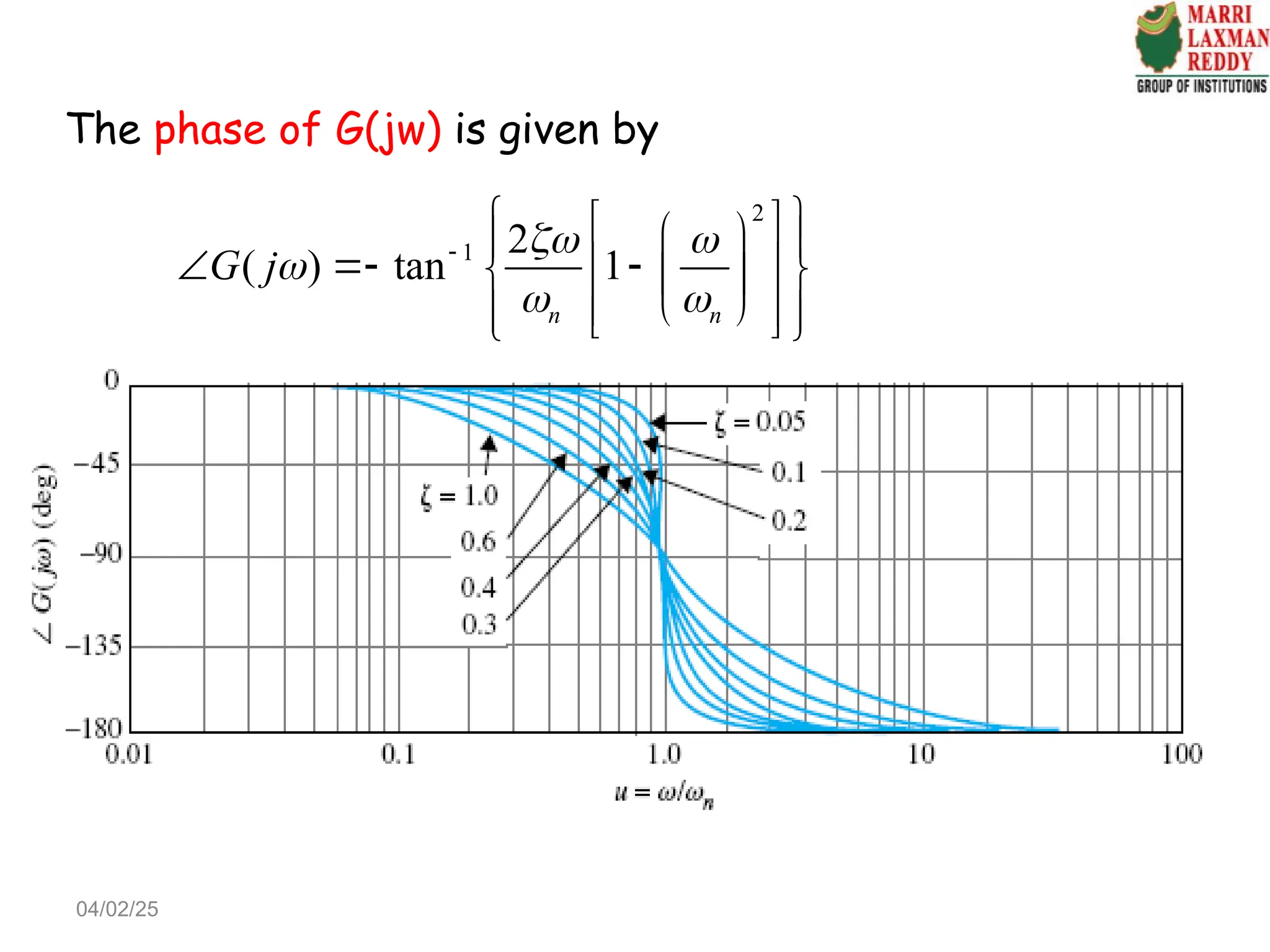
The phase of G(jw) is given by
2
1 2
( ) tan 1
n n
G j
 

 

 
 
 
 
  
 
 
 
 
 
 
 
 
04/02/25
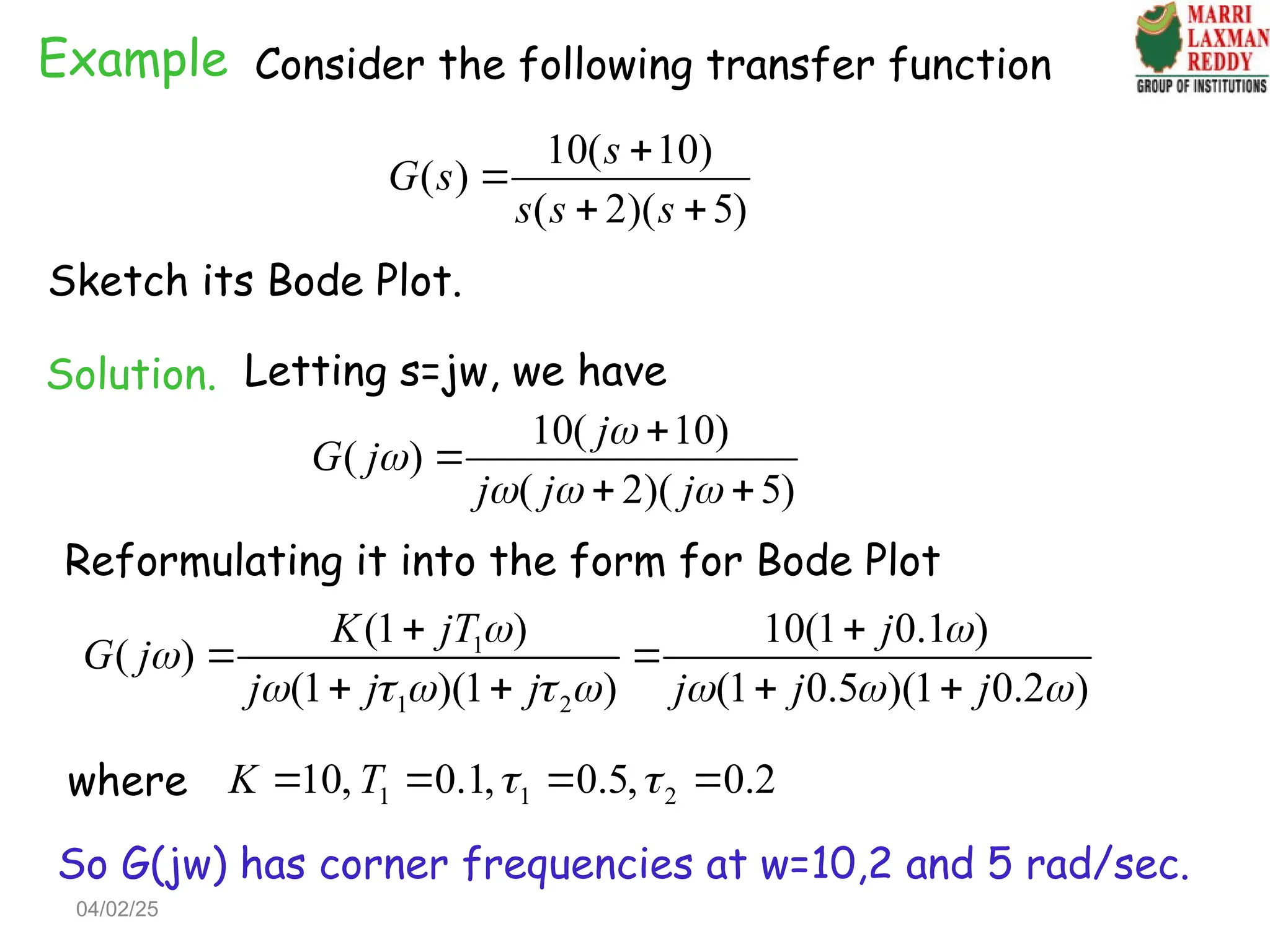
Example Consider the following transfer function
10( 10)
( )
( 2)( 5)
s
G s
s s s


 
Sketch its Bode Plot.
Solution. Letting s=jw, we have
10( 10)
( )
( 2)( 5)
j
G j
j j j


  


 
Reformulating it into the form for Bode Plot
1
1 2
(1 ) 10(1 0.1 )
( )
(1 )(1 ) (1 0.5 )(1 0.2 )
K jT j
G j
j j j j j j
 

       
 
 
   
1 1 2
10, 0.1, 0.5, 0.2
K T  
   
where
So G(jw) has corner frequencies at w=10,2 and 5 rad/sec.
04/02/25
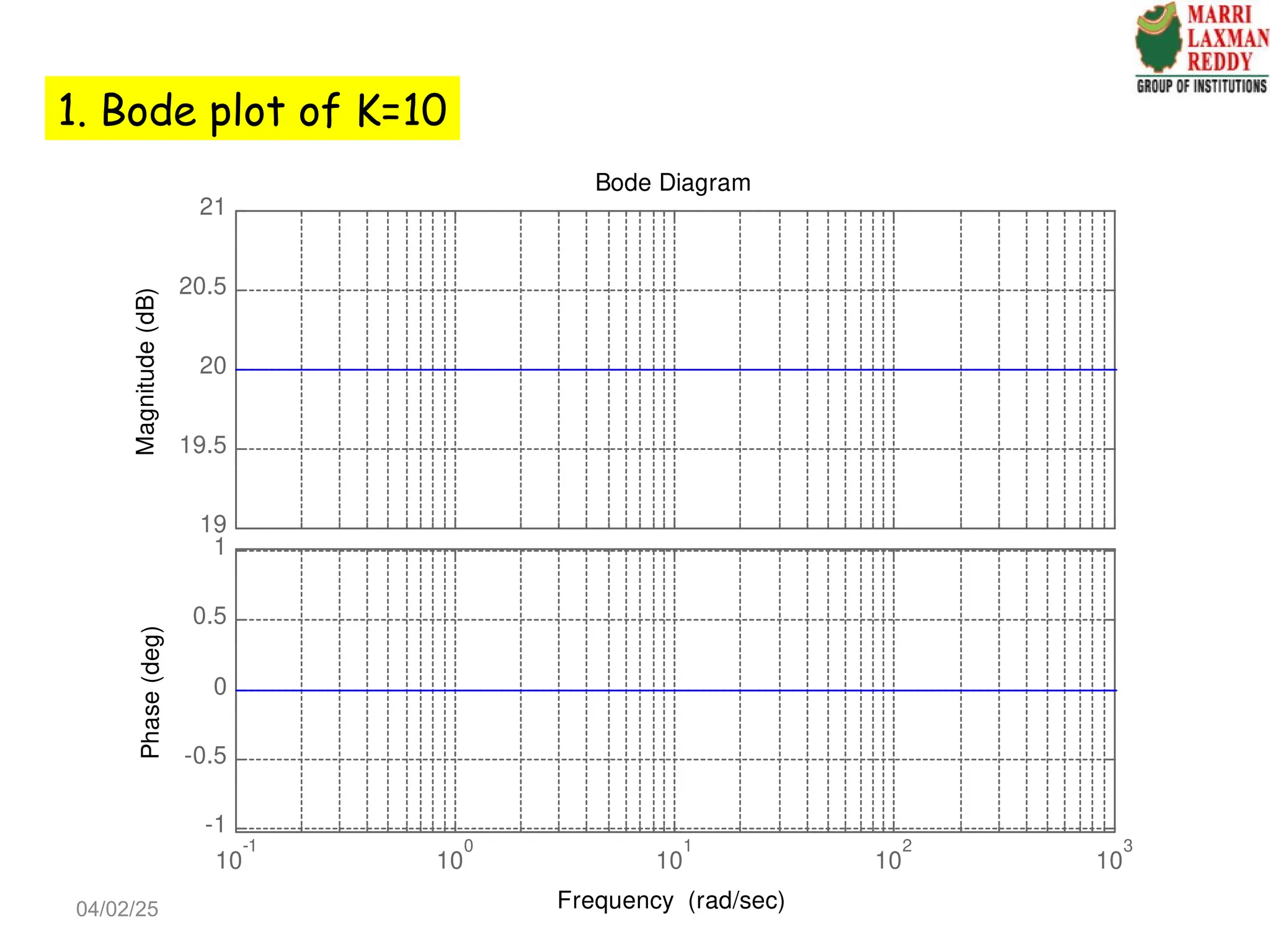
1. Bode plot of K=10
19
19.5
20
20.5
21
Magnitude
(dB)
10
-1
10
0
10
1
10
2
10
3
-1
-0.5
0
0.5
1
Phase
(deg)
Bode Diagram
Frequency (rad/sec)
04/02/25
-60
-40
-20
0
20
Magnitude
(dB)
10
-1
10
0
10
1
10
2
10
3
-91
-90.5
-90
-89.5
-89
Phase
(deg)
Bode Diagram
Frequency (rad/sec)
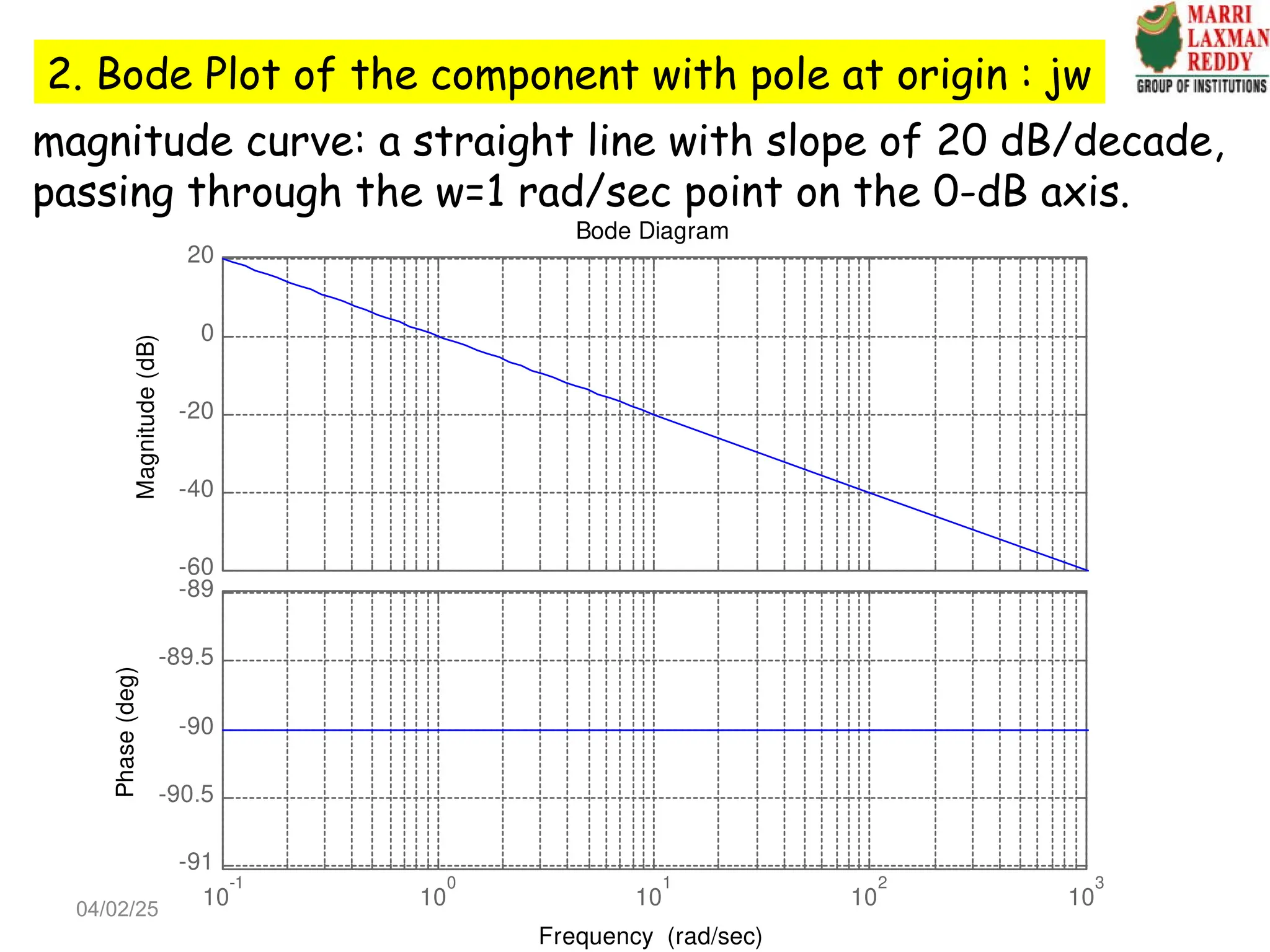
2. Bode Plot of the component with pole at origin : jw
magnitude curve: a straight line with slope of 20 dB/decade,
passing through the w=1 rad/sec point on the 0-dB axis.
04/02/25
20
30
40
50
60
Magnitude
(dB)
10
-1
10
0
10
1
10
2
10
3
0
45
90
Phase
(deg)
Bode Diagram
Frequency (rad/sec)
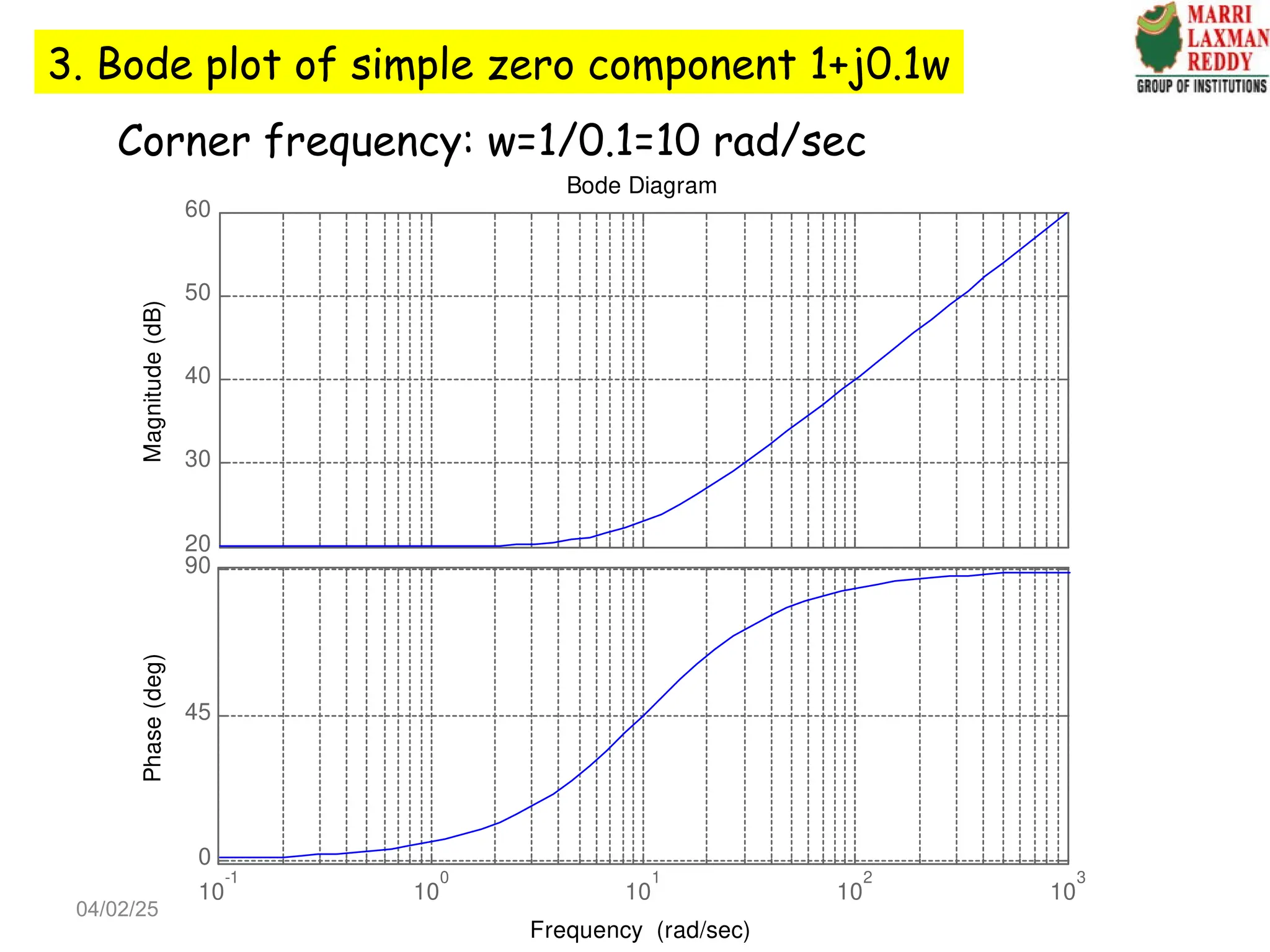
Corner frequency: w=1/0.1=10 rad/sec
3. Bode plot of simple zero component 1+j0.1w
04/02/25
-80
-60
-40
-20
0
Magnitude
(dB)
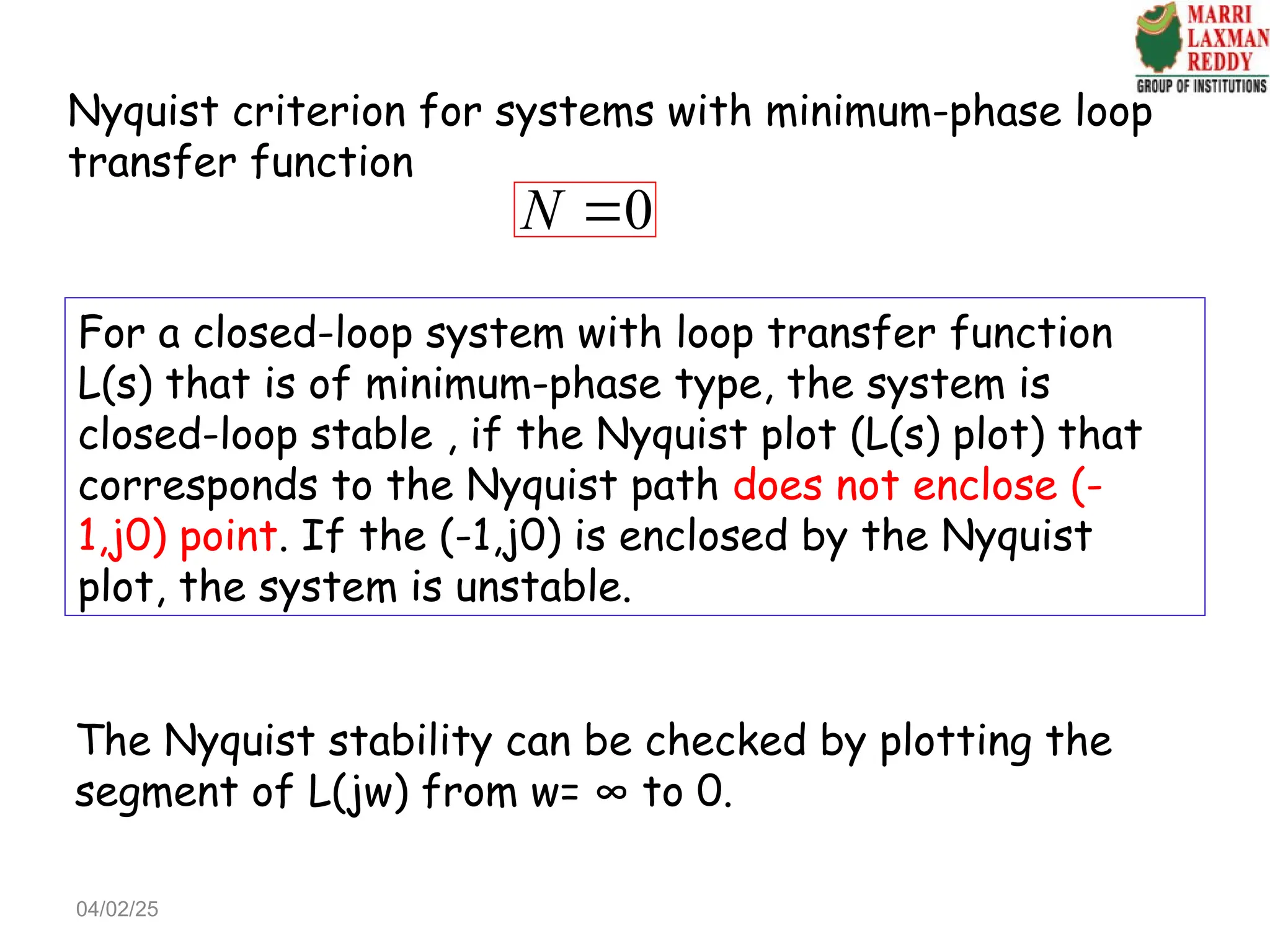
10
-1
10
0
10
1
10
2
10
3
-90
-45
0
Phase
(deg)
Bode Diagram
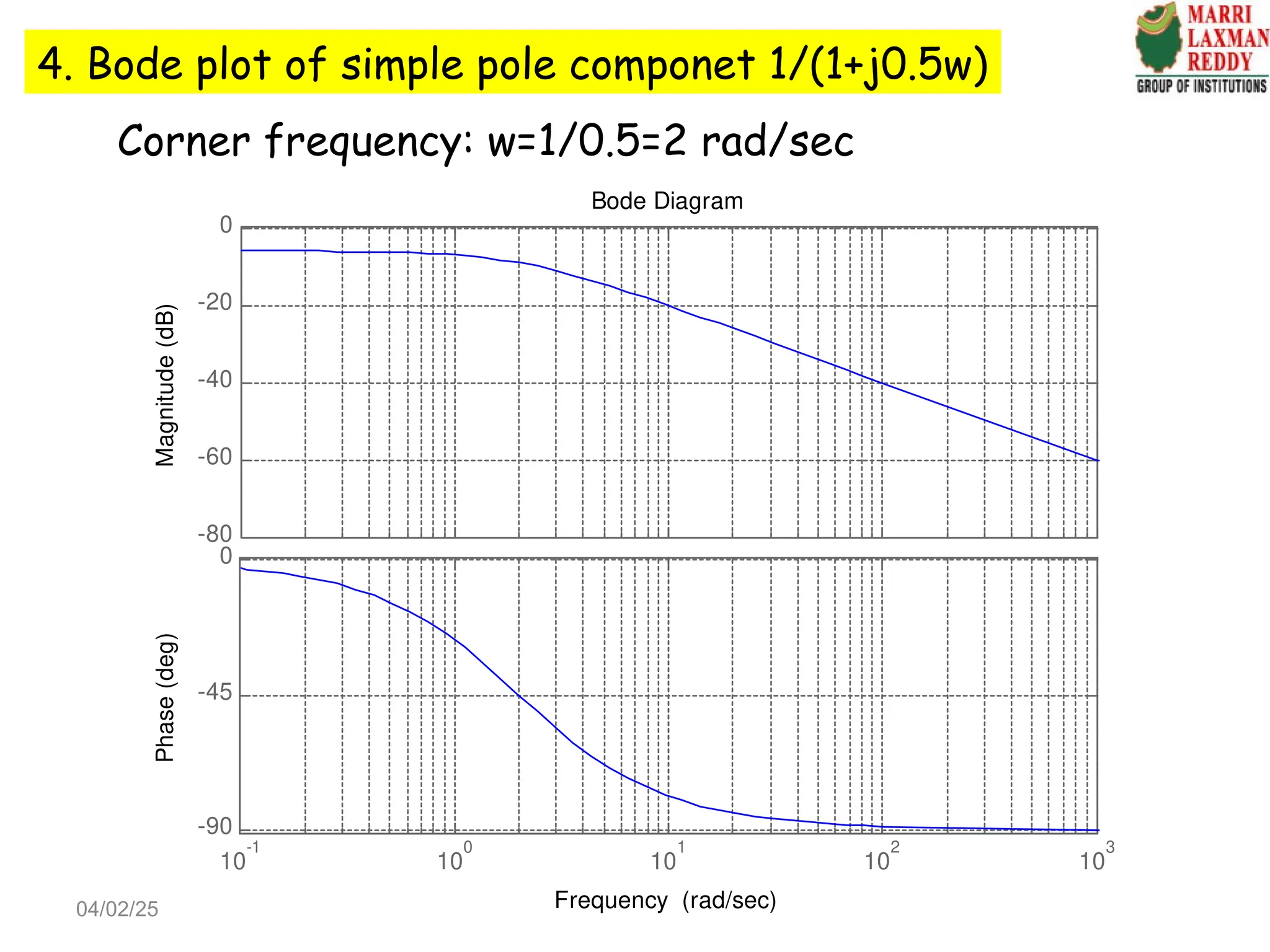
Frequency (rad/sec)
Corner frequency: w=1/0.5=2 rad/sec
4. Bode plot of simple pole componet 1/(1+j0.5w)
04/02/25
-60
-50
-40
-30
-20
-10
Magnitude
(dB)
10
-1
10
0
10
1
10
2
10
3
-90
-45
0
Phase
(deg)
Bode Diagram
Frequency (rad/sec)
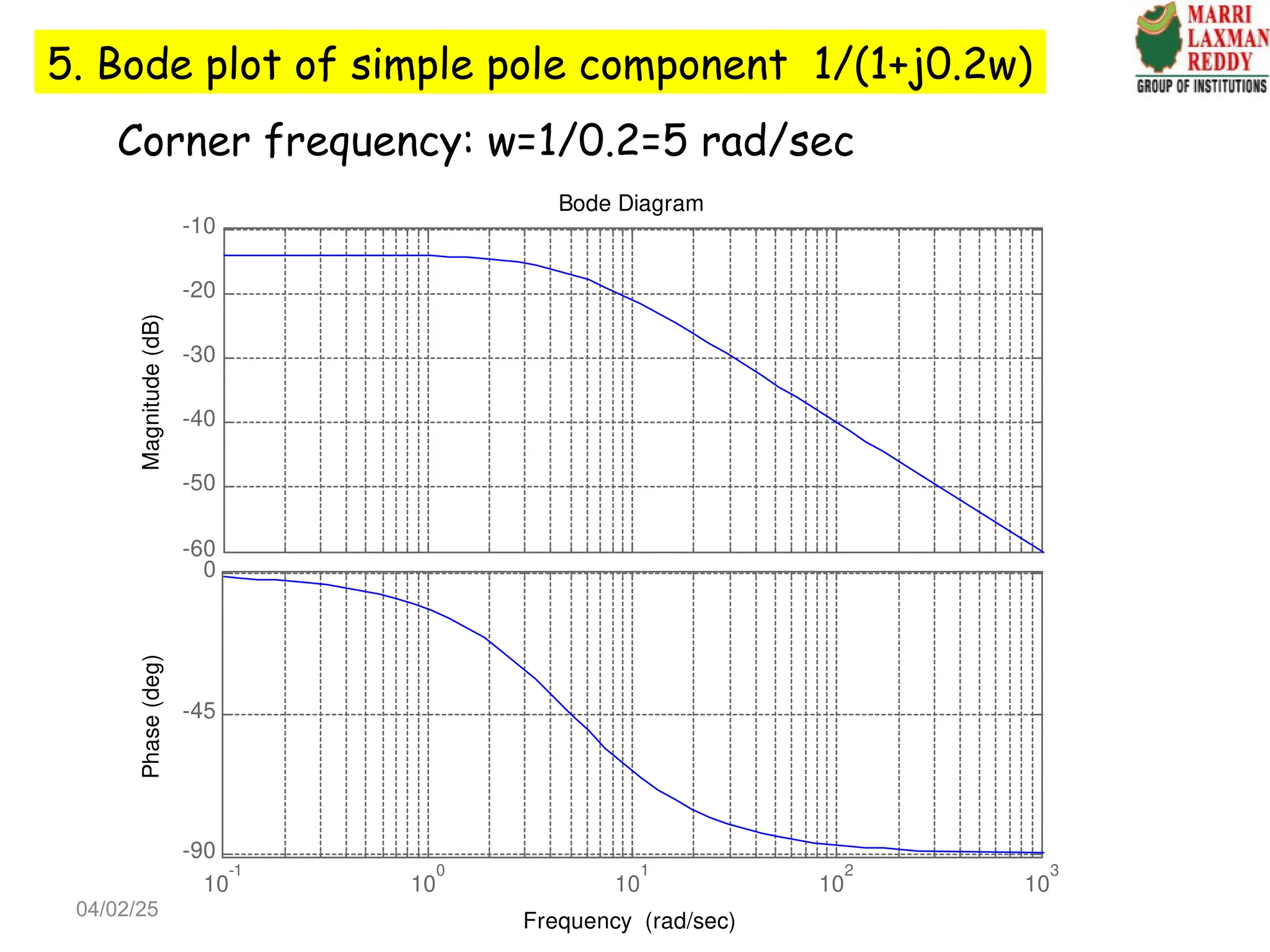
Corner frequency: w=1/0.2=5 rad/sec
5. Bode plot of simple pole component 1/(1+j0.2w)
04/02/25
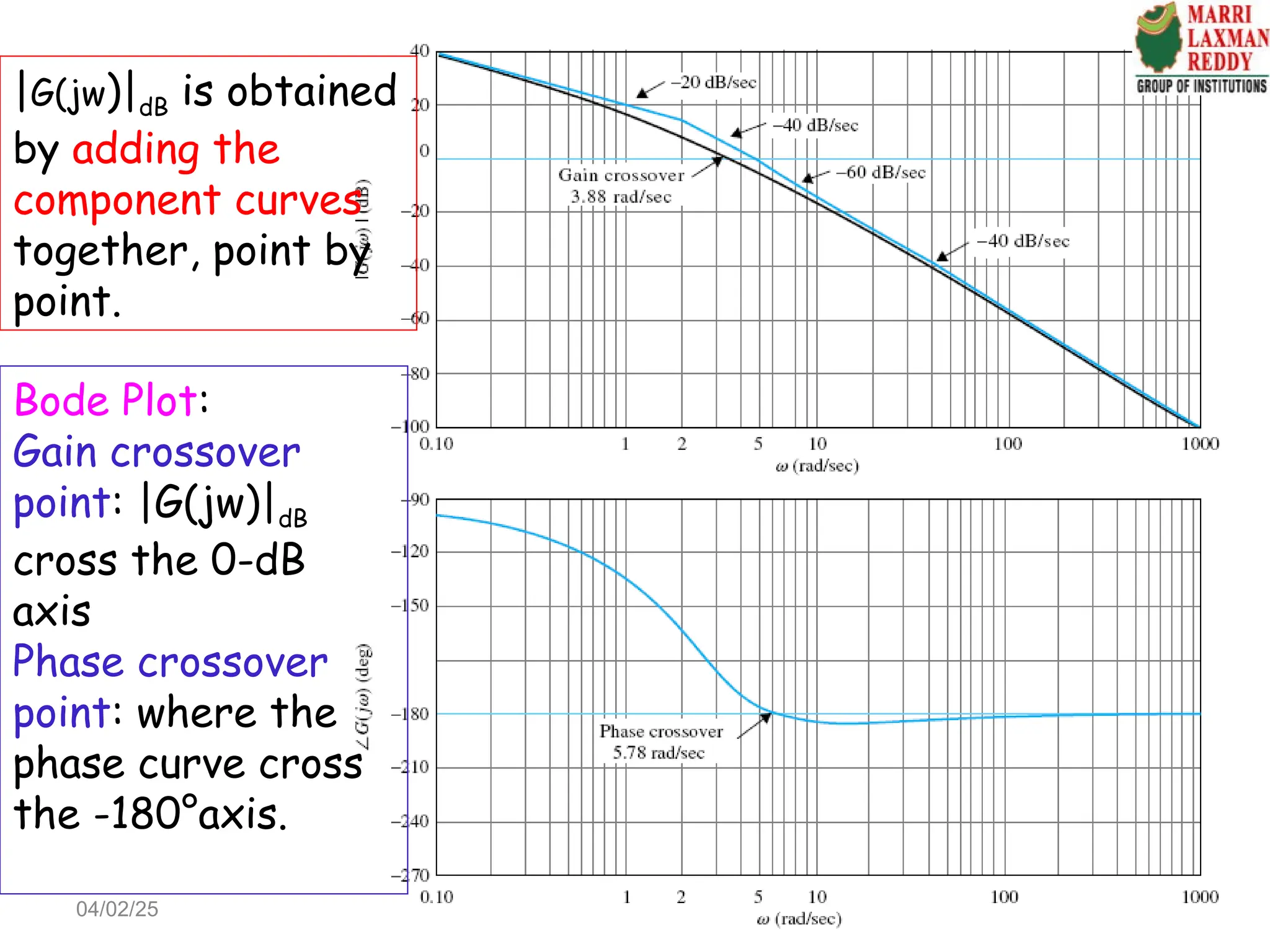
|G(jw)|dB is obtained
by adding the
component curves
together, point by
point.
Bode Plot:
Gain crossover
point: |G(jw)|dB
cross the 0-dB
axis
Phase crossover
point: where the
phase curve cross
the -180°axis.
04/02/25
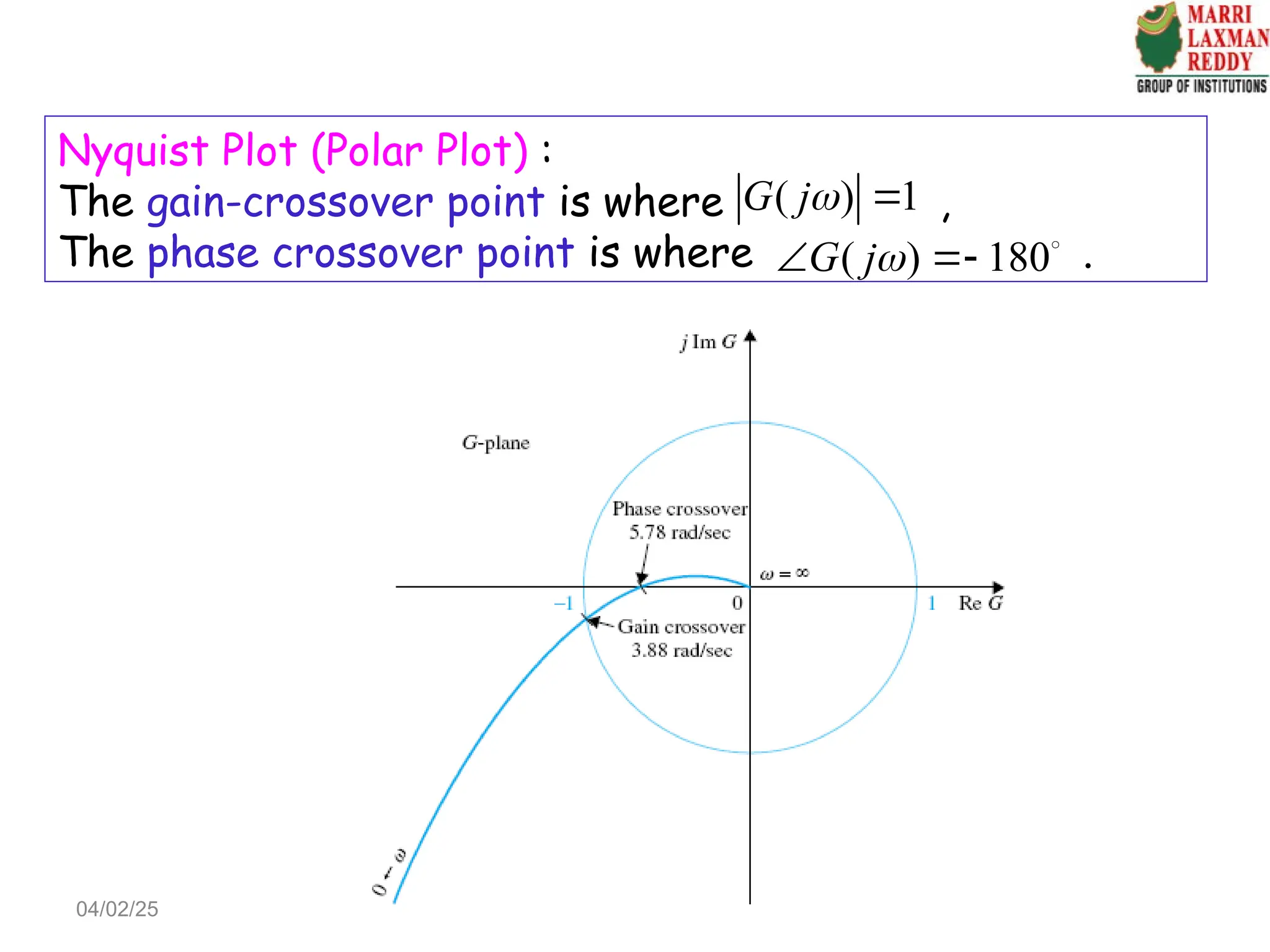
Nyquist Plot (Polar Plot) :
The gain-crossover point is where ,
The phase crossover point is where .
( ) 1
G j 
( ) 180
G j
  
04/02/25

555328898-Unit-4-1-PPT-CS.ppt introduction

  • 1.
  • 2.
    Content in Chapter5 5-1 Frequency Response (or Frequency Characteristics) 5-2 Nyquist plot and Nyquist stability criterion 5-3 Bode plot and Bode stability criterion 04/02/25
  • 3.
  • 4.
    A Perspective onthe Frequency-Response Design Method The design of feedback control systems in industry is probably accomplished using frequency-response methods more than any other. Advantages of frequency-response design: -It provides good designs in the face of uncertainty in the plant model -Experimental information can be used for design purposes. Raw measurements of the output amplitude and phase of a plant undergoing a sinusoidal input excitation are sufficient to design a suitable feedback control. -No intermediate processing of the data (such as finding poles and zeros) is required to arrive at the system model. 04/02/25
  • 5.
    Frequency response 04/02/25 The frequencyresponse of a system is defined as the steady-state response of the system to a sinusoidal input signal. 0 ( ) sin r t R t   0 ( ) sin( ) y t t Y     For a LTI system, when the input to it is a sinusoid signal, the resulting output , as well as signals throughout the system, is sinusoidal in the steady-state; G(s) H(s)  The output differs from the input waveform only in amplitude and phase.
  • 6.
    The closed-loop transferfunction of the LTI system: ( ) ( ) ( ) ( ) 1 ( ) ( ) Y s G s M s R s G s H s    For frequency-domain analysis, we replace s by jω: ( ) ( ) ( ) ( ) 1 ( ) ( ) Y j G j M j R j G j H j          04/02/25 The frequency-domain transfer function M(jω) may be expressed in terms of its magnitude and phase: ( ) ( ) ( ) M j M j M j      magnitude phase
  • 7.
    The magnitude ofM(jω) is ( ) ( ) 1 ( ) ( ) ( ) 1 ( ) ( ) G j M j G j H j G j G j H j            The phase of M(jω) is   ( ) ( ) ( ) 1 ( ) ( ) M M j j G j G j H j             ( ) M j A 0  c   0 ( ) M j   Gain-phase characteristics of an ideal low-pass filter ( ) 0 c c A M j           Gain characteristic Phase characteristic 04/02/25
  • 8.
    Example. Frequency responseof a Capacitor Consider the capacitor described by the equation dv i C dt  where v is the input and i is the output. Determine the sinusoidal steady-state response of the capacitor. Solution. The transfer function of the capacitor is ( ) ( ) ( ) I s M s Cs V s   So ( ) M j Cj    Computing the magnitude and phase, we find that ( ) M j Cj C      ( ) 90 M M j      04/02/25
  • 9.
    ( ) M jCj C      ( ) 90 M M j      ( ) ( ) ( ) I j M j V j     Gain characteristic: Phase characteristic: For a unit-amplitude sinusoidal input v, the output i will be a sinusoid with magnitude Cω, and the phase of the output will lead the input by 90°. Note that for this example the magnitude is proportional to the input frequency while the phase is independent of frequency. Output: 04/02/25
  • 10.
    Resonant peak r M Resonantfrequency r  Bandwidth BW 0 ( ) M j  BW r  0.707 r M ( ) M j    0 Cutoff rate Typical gain-phase characteristic of a control system Frequency-Domain Specifications ( ) 0 r d M j d      04/02/25
  • 11.
    Frequency response ofa prototype second-order system Closed-loop transfer function: 2 2 2 ( ) ( ) ( ) 2 n n n Y s M s R s s s        Its frequency-domain transfer function: 2 2 2 ( ) ( ) ( ) ( ) 2 ( ) n n n Y j M j R j j j             Define n u    2 1 ( ) 1 2 M ju j u u     04/02/25
  • 12.
    The magnitude ofM(ju) is 2 2 2 1/2 1 ( ) [(1 ) (2 ) ] M ju u u     The phase of M(ju) is 1 2 2 ( ) ( ) tan 1 M u M j j u          The resonant frequency of M(ju) is ( ) 0 d M ju du  2 1 2 r u    With , we have r r n u    2 1 2 r n      Since frequency is a real quantity, it requires 2 1 2 0    So 0.707   2 1 2 1 r M     Resonant peak 04/02/25
  • 13.
    According to thedefinition of Bandwidth 2 2 2 1/2 1 1 ( ) 0.707 [(1 ) (2 ) ] 2 M ju u u       2 2 4 2 (1 2 ) 4 4 2 u         With , we have n u    2 4 2 1/2 [(1 2 ) 4 4 2] n BW          04/02/25
  • 14.
    Resonant peak 2 1 2 1 r M    Resonant frequency 2 1 2 r n      For a prototype second-order system ( ) 0.707   Bandwidth 2 4 2 1/2 [(1 2 ) 4 4 2] n BW          depends on only. For 0, the system is unstable; For 0< 0.707, ; For 0.707, 1 r r r M M M            depends on both and . For 0< 0.707, fixed, ; For 0.707, 0. r n n r r               is directly proportional to , For 0 0.707, fixed, ; n n n n BW BW BW BW                04/02/25
  • 15.
    Correlation between polelocations, unit-step response and the magnitude of the frequency response 2 2 2 2 n n n s s      ( ) r t ( ) y t 0 1    j  0 n   1 cos     0 ( ) M j 0dB 0.3dB BW  2 4 2 1/2 [(1 2 ) 4 4 2] n BW          2 1 0.4167 2.917 r n t       0 ( ) y t 1.0 0.9 0.1 t 2 / 1 max overshoot e      04/02/25
  • 16.
    Example. The specificationson a second-order unity- feedback control system with the closed-loop transfer function 2 2 2 ( ) ( ) ( ) 2 n n n Y s M s R s s s        are that the maximum overshoot must not exceed 10 percent, and the rise time be less than 0.1 sec. Find the corresponding limiting values of Mr and BW analytically. Solution. Maximum overshoot: 2 1 % 100% 10% e         Rise time: 2 1 0.4167 2.917 0.1 (0 1) r n t           0.6   2 2.917 0.4167 1 0.1 0 n        2 1,2 0.4167 0.4167 4 2.917 (1 0.1 ) 2 2.917 n          18 n   04/02/25
  • 17.
    Resonant peak 2 ( 1 2 1 0.707) r M       0.6  18 n   For 0< 0.707, ; For 0.707, 1 r r M M         1 1.04 r M   0.6   Bandwidth 2 4 2 1/2 [(1 2 ) 4 4 2] n BW          is directly proportional to , For 0 0.707, fixed, ; n n n n BW BW BW BW                0.6 0.707    1 1.15 n BW    1.15 n n BW     18 n   18 BW  Based on time-domain analysis, we obtain and Frequency-domain specifications: 04/02/25
  • 18.
    ( ) R s( ) Y s 2 ( 2 ) n n s s    1 z T s  ( ) R s ( ) Y s 2 ( 2 ) n n s s    Closed-loop TF : Open-loop TF : 2 2 2 ( ) ( ) ( ) ( ) 1 ( ) 2 n n n Y s G s M s R s G s s s          Adding a zero at 1 z s T  2 ( ) ( 2 ) (1 ) z n n T s G s s s      Open-loop TF : Closed-loop TF : 2 ( ) ( 2 ) n n G s s s     2 2 2 2 1 ( ) ( ) (2 ) z z n n n n s s T s T s           The additional zero changes both numerator and denominator. Effects of adding a zero to the OL TF 04/02/25
  • 19.
    As analyzing theprototype second-order system, using similar but more complicate calculation, we obtain Bandwidth 2 4 1/2 ( 1/ 2 4 ) n BW b b      where 2 2 3 2 4 2 4 4 2 n n z n n z b T T          For fixed ωn and ζ, we analyze the effect of . z T 04/02/25
  • 20.
    -80 -60 -40 -20 0 20 Magnitude (dB) 10 -1 10 0 10 1 10 2 -180 -135 -90 -45 0 Phase (deg) Bode Diagram Frequency (rad/sec) Tz =0 Tz =0.2 Tz =1 Tz =5 Thegeneral effect of adding a zero the open-loop transfer function is to increase the bandwidth of the closed-loop system. 1 0.2 n     04/02/25
  • 21.
    ( ) R s( ) Y s 2 ( 2 ) n n s s    1 1 p T s  ( ) R s ( ) Y s 2 ( 2 ) n n s s    Closed-loop TF : 2 2 2 ( ) ( ) ( ) ( ) 1 ( ) 2 n n n Y s G s M s R s G s s s          2 ( ) ( 2 (1 ) ) n n p G s s T s s      Open-loop TF : Open-loop TF : 2 ( ) ( 2 ) n n G s s s     Closed-loop TF : 2 3 2 2 ( ) (1 2 ) 2 n p n p n n s T s T s s           Effects of adding a pole to the OL TF Adding a pole at 1 p s T  04/02/25
  • 22.
    -150 -100 -50 0 50 Magnitude (dB) 10 -2 10 -1 10 0 10 1 10 2 -270 -225 -180 -135 -90 -45 0 Phase (deg) Bode Diagram Frequency (rad/sec) Tp =0 Tp =0.5 Tp =1 Tp =5 Theeffect of adding a pole the open-loop transfer function is to make the closed-loop system less stable, while decreasing the bandwidth. 1 0.707 n     04/02/25
  • 23.
    5-2 Nyquist Plotand Nyquist Criterion 04/02/25
  • 24.
    Nyquist Criterion What isNyquist criterion used for? G(s) H(s)  ( ) R s ( ) Y s Nyquist criterion is a semigraphical method that determines the stability of a closed-loop system; Nyquist criterion allows us to determine the stability of a closed-loop system from the frequency-response of the loop function G(jw)H(j(w) 04/02/25
  • 25.
    Review about stability Closed-loopTF: ( ) ( ) 1 ( ) ( ) G s M s G s H s   Characteristic equation (CE): ( ) 1 ( ) ( ) 0 s G s H s     Stability conditions: Open-loop stability: poles of the loop TF G(s)H(s) are all in the left-half s-plane. Closed-loop stability: poles of the closed-loop TF or roots of the CE are all in the left-half s-plane. 04/02/25
  • 26.
    Definition of Encircledand Enclosed Encircled: A point or region in a complex function plane is said to be encircled by a closed path if it is found inside the path. Enclosed: A point or region in a complex function plane is said to be encircled by a closed path if it is encircled in the countclockwise(CCW) direction. A B  Point A is encircled in the closed path; Point A is also enclosed in the closed path; 04/02/25
  • 27.
    Number of Encirclementsand Enclosures B A D C Point A is encircled once; Point B is encircled twice. Point C is enclosed once; Point D is enclosed twice. 04/02/25
  • 28.
    Mapping from thecomplex s-plane to the Δ(s) -plane Exercise 1: Consider a function Δ(s) =s-1, please map a circle with a radius 1 centered at 1 from s-plane to the Δ(s)-plane . 1 2 3 4 2; 1 0; 1 s s j s s j       1 2 3 4 ( ) 1; ( ) ( ) 1; ( ) s s j s s j         Δ( s)-plane Im j Re[ ( )] s  1 ( ) s  2 ( ) s  3 ( ) s  4 ( ) s  0 1 s-plane j  1 s 2 s 3 s 4 s 2 1 1  0 Mapping 04/02/25
  • 29.
    Principle the Argument Letbe a single-valued function that has a finite number of poles in the s-plane. Suppose that an arbitrary closed path is chosen in the s- plane so that the path does not go through any one of the poles or zeros of ; The corresponding locus mapped in the -plane will encircle the origin as many times as the difference between the number of zeros and poles (P) of that are encircled by the s-plane locus . N Z P   In equation form: ( ) s  s  ( ) s    ( ) s  s  ( ) s  N - number of encirclements of the origin by the -plane locus ( ) s  Z - number of zeros of encircled by the s-plane locus ( ) s  P - number of poles of encircled by the s-plane locus ( ) s  04/02/25
  • 30.
    Nyquist Path A curvecomposed of the imaginary axis and an arc of infinite radius such that the curve completely encloses the right half of the s-plane . Nyquist path is in the CCW direction s  j  s-plane 0 R   s  Note Nyquist path does not pass through any poles or zeros of Δ(s); if Δ(s) has any pole or zero in the right- half plane, it will be encircled by . s  Since in mathematics, CCW is traditionally defined to be the positive sense. 04/02/25
  • 31.
    Nyquist Criterion andNyquist Diagram j  s-plane 0 R   s  ( ) 1 ( ) ( ) s G s H s    Δ( s)-plane 1 Nyquist Path Nyquist Diagram: Plot the loop function to determine the closed-loop stability G( s)H(s)-plane 0 1  Critical point: (-1+j0) 04/02/25
  • 32.
    Nyquist Criterion andG(s)H(s) Plot j  s-plane 0 R   s  ( ) ( ) G s H s G( s)H(s)-plane 0 1  Nyquist Path G(s)H(s) Plot The Nyquist Path is shown in the left figure. This path is mapped through the loop tranfer function G(s)H(S) to the G(s)H(s) plot in the right figure. The Nyquist Creterion follows: N Z P   04/02/25
  • 33.
    Nyquist Criterion andNyquist Plot j  s-plane 0 R   s  ( ) ( ) G s H s G( s)H(s)-plane 0 1  Nyquist Path Nyquist Plot The condition of closed-loop stability according to the Nyquist Creterion is: N P  N - number of encirclements of (-1,j0) by the G(s)H(s) plot Z - number of zeros of that are inside the right-half plane ( ) s  P - number of poles of that are inside the right-half plane ( ) s  04/02/25
  • 34.
    1 1 1 ( )( ) ( ) 1 ( ) ( ) ( ) n m i i j i n i j s p K s z s G s H s s p               1 1 ( ) ( ) ( ) ( ) m i i n i j K s z G s H s s p        has the same poles as , so P can be obtained by counting the number of poles of in the right- half plane. ( ) s  ( ) ( ) G s H s ( ) ( ) G s H s 04/02/25
  • 35.
    -2 -1 01 2 3 4 5 -4 -3 -2 -1 0 1 2 3 4 Nyquist Diagram Real Axis Imaginary Axis An example Consider the system with the loop function 3 5 ( ) ( ) ( 1) G s H s s   Matlab program for Nyquist plot (G(s)H(s) plot) >>num=5; >>den=[1 3 3 1]; >>nyquist(num,den); Question 1: is the closed-loop system stable? Question 2: what if 3 5 ( ) ( ) ? ( 1) K G s H s s   N=0, P=0, N=-P, stable 04/02/25
  • 36.
    Root Locus Real Axis Imaginary Axis -4-3 -2 -1 0 1 2 -3 -2 -1 0 1 2 3 * 3 3 5 1 ( ) ( ) ( 1) ( 1) K G s H s K s s     1. With root locus technique: For K* varies from 0 to ∞, we draw the RL >>num=1; >>den=[1 3 3 1]; >>rlocus(num,den); When K*=8 (K=1.6), the RL cross the jw-axis, the closed-loop system is marginally stable. For K*>8 (K>1.6), the closed-loop system has two roots in the RHP and is unstable. * K   * K   * K   * 0 K  * 8 K  04/02/25
  • 37.
    2. With Nyquistplot and Nyquist criterion: -2 -1 0 1 2 3 4 5 -4 -3 -2 -1 0 1 2 3 4 Nyquist Diagram Real Axis Imaginary Axis >>K=1; >>num=5*K; >>den=[1 3 3 1]; >>nyquist(num,den); Nyquist plot does not encircle (-1,j0), so N=0 K=1 3 5 ( ) ( ) ( 1) K G s H s s   No pole of G(s)H(s) in RHP, so P=0; Thus N=-P The closed-loop system is stable 04/02/25
  • 38.
    -2 -1 01 2 3 4 5 6 7 8 -6 -4 -2 0 2 4 6 Nyquist Diagram Real Axis Imaginary Axis 2. With Nyquist plot and Nyquist criterion: >>K=1.6; >>num=5*K; >>den=[1 3 3 1]; >>nyquist(num,den); The Nyquist plot just go through (-1,j0) K=1.6 3 5 ( ) ( ) ( 1) K G s H s s   No pole of G(s)H(s) in RHP, so P=0; The closed-loop system is marginally stable 04/02/25
  • 39.
    -5 0 510 15 20 -15 -10 -5 0 5 10 15 Nyquist Diagram Real Axis Imaginary Axis 2. With Nyquist plot and Nyquist criterion: >>K=4; >>num=5*K; >>den=[1 3 3 1]; >>nyquist(num,den); Nyquist plot encircles (-1,j0) twice, so N=2 K=4 3 5 ( ) ( ) ( 1) K G s H s s   No pole of G(s)H(s) in RHP, so P=0; Thus Z=N+P=2 The closed-loop system has two poles in RHP and is unstable 04/02/25
  • 40.
    Nyquist Criterion forSystems with Minimum-Phase Transfer Functions What is called a minimum-phase transfer function? A minimum-phase transfer function does not have poles or zeros in the right-half s-plane or on the jw-axis, except at s=0. 1 10( 1) ( ) ( 10) s G s s    2 10( 1) ( ) ( 10) s G s s    Consider the transfer functions Both transfer functions have the same magnitude for all frequencies 1 2 ( ) ( ) G j G j    But the phases of the two transfer functions are drastically different. 04/02/25
  • 41.
    0 5 10 15 20 Magnitude (dB) 10 -2 10 -1 10 0 10 1 10 2 10 3 0 45 90 135 180 Phase (deg) Bode Diagram Frequency (rad/sec) 12 ( ) ( ) G j G j    1( ) G j  2 ( ) G j  A minimum-phase system (all zeros in the LHP) with a given magnitude curve will produce the smallest change in the associated phase, as shown in G1. 04/02/25
  • 42.
    Consider the looptransfer function: ( ) ( ) ( ) L s G s H s  If L(s) is minimum-phase, that is, L(s) does not have any poles or zeros in the right-half plane or on the jw-axis, except at s=0 Then P=0, where P is the number of poles of Δ(s)=1+G(s)H(s), which has the same poles as L(s). Thus, the Nyquist criterion (N=-P) for a system with L(s) being minimum-phase is simplified to 0 N  04/02/25
  • 43.
    For a closed-loopsystem with loop transfer function L(s) that is of minimum-phase type, the system is closed-loop stable , if the Nyquist plot (L(s) plot) that corresponds to the Nyquist path does not enclose (- 1,j0) point. If the (-1,j0) is enclosed by the Nyquist plot, the system is unstable. The Nyquist stability can be checked by plotting the segment of L(jw) from w= ∞ to 0. 0 N  Nyquist criterion for systems with minimum-phase loop transfer function 04/02/25
  • 44.
    Example Consider asingle-loop feedback system with the loop transfer function ( ) ( ) ( ) ( 2)( 10) K L s G s H s s s s     Analyze the stability of the closed-loop system. Solution. Since L(s) is minimum-phase, we can analyze the closed-loop stability by investigating whether the Nyquist plot enclose the critical point (-1,j0) for L(jw)/K first. ( ) 1 ( 2)( 10) L j K j j j        w=∞: ( ) 0 270 L j K      w=0+ : ( 0) 90 L j K    0   Im j Real 0   Im[ ( ) ] 0 L j K   04/02/25
  • 45.
    1 Im[ ( )] Im[ ] 0 ( 2)( 10) L j K j j j         20 / rad s   The frequency is positive, so 20 / rad s   1 ( 20) 0.004167 20( 20 2)( 20 10) L j K j j j     1. 240 ( 20) 1 K L j     the Nyquist plot does not enclose (-1,jw); 2. 240 ( 20) 1 K L j    the Nyquist plot goes through (-1,jw); 3. 240 ( 20) 1 K L j     the Nyquist plot encloses (-1,jw). stable marginally stable unstable 04/02/25
  • 46.
    -30 -25 -20-15 -10 -5 0 5 10 -20 -15 -10 -5 0 5 10 15 20 Root Locus Real Axis Imaginary Axis 1 ( ) ( ) ( ) ( 2)( 10) L s G s H s K s s s     >>z=[] >>p=[0, -2, -10]; >>k=1 >>sys=zpk(z,p,k); >>rlocus(sys); 240 K  By root locus technique 04/02/25
  • 47.
    Relative Stability Gain Marginand Phase Margin 0   Im j Real 0   1  For a stable system, relative stability describes how stable the system is. In time-domain, the relative stability is measured by maximum overshoot and damping ratio. In frequency-domain, the relative stability is measured by resonance peak and how close the Nyquist plot of L(jw) is to the (-1,j0) point. The relative stability of the blue curve is higher than the green curve. 04/02/25
  • 48.
    Gain Margin (GM) (forminimum-phase loop transfer functions) 0   Im j Real 0   p  Phase crossover Phase crossover frequency ωp ( ) 180 p L j    For a closed-loop system with L(jw) as its loop transfer function, it gain margin is defined as 10 10 1 gain margin (GM) = 20log ( ) 20log ( ) dB p p L j L j    ( ) p L j L(jw)-plane 04/02/25
  • 49.
    10 (stable When ( )1 , log ( ) GM 0 ) 0 L j L j       (closer to the or ( ) GM igin) (more stable) L j    (closer to -1) (les ( s stab e ) G l ) M L j    10 (unstabl When ( ) 1 , lo e) GM< ) 0 0 g ( L j L j      10 (marginally s When ( ) 1 , log table) GM ) 0 0 ( = L j L j      Gain margin represents the amount of gain in decibels (dB) that can be added to the loop before the closed-loop system becomes unstable. 10 10 1 gain margin (GM) = 20log ( ) 20log ( ) dB p p L j L j    04/02/25
  • 50.
    Phase Margin (PM) (forminimum-phase loop transfer functions) Gain margin alone is inadequate to indicate relative stability when system parameters other the loop gain are subject to variation. ( ) 1 g L j  0 Im j Real A B 1  With the same gain margin, system represented by plot A is more stable than plot B. Gain crossover frequency ωg ( ) 1 g L j  Phase margin: phase margin (PM) = ( ) 180 g L j    ( ) g L j  PM 04/02/25
  • 51.
    Example Consider thetransfer function 10 ( ) ( 1) G s s s   Draw its Nyquist plot when w varies from 0 to ∞. Solution. Substituting s=jw into G(s) yields: 10 ( ) ( 1) G j j j      The magnitude and phase of G(jw) at w=0 and w=∞ are computed as follows. 0 0 0 0 0 0 10 10 lim ( ) lim lim ( 1) 10 10 lim ( ) lim lim 90 ( 1) G j j j G j j j j                                 2 10 lim ( ) lim 0 ( 1) 10 10 lim ( ) lim lim 180 ( 1) G j j j G j j j                                   Thus the properties of the Nyquist plot of G(jw) at w=0 and w=∞ are ascertained. Next we determine the intersection… 04/02/25
  • 52.
    If the Nyquistplot of G(jw) intersects with the real axis, we have Im[ ( )] 0 G j  2 4 2 4 2 10 10 10 ( ) ( 1) G j j j j                 4 2 10 0        This means that the G(jw) plot intersects only with the real axis of the G(jw)-plane at the origin. Similarly, intersection of G(jw) with the imaginary axis:   which corresponds to the origin of the G(jw)-plane. The conclusion is that the Nyquist plot of G(jw) does not intersect any one of the axes at any finite nonzero frequency. Re[ ( )] 0 G j  At w=0, Re[ ( )] 10 G j  At w=∞, Re[ ( )] 0 G j  04/02/25
  • 53.
    Example Consider asystem with a loop transfer function as 2500 ( ) ( 5)( 50) L s s s s    Determine its gain margin and phase margin. Solution. Phase crossover frequency ωp: Im[ ( )] 0 15.88 rad/sec p L j     10 GM = 20log ( ) 14.80 dB p L j   Gain margin: Gain crossover frequency ωg: ( ) 1 6.22 rad/sec g g L j     Phase margin: PM = ( ) 180 31.72 g L j      0   Im j 0   1  ( ) 0.182 p L j  15.88 p   6.22 g   31.72 0.182  04/02/25
  • 54.
    Advantages of Nyquistplot: -By Nyquist plot of the loop transfer function, the closed-loop stability can be easily determined with reference to the critical point (-1,j0). -It can analyze systems with either minimum phase or nonminimum phase loop transfer function. Disadvantages of Nyquist plot: -By Nyquist plot only, it is not convenient to carry out controller design. 04/02/25
  • 55.
  • 56.
    Bode Plot The Bodeplot of the function G(jw) is composed of two plots: -- the amplitude of G(jw) in decibels (dB) versus log10w or w -- the phase of G(jw) in degrees as a function of log10w or w. Without loss of generality, the following transfer function is used to illustrate the construction of the Bode Plot 1 2 2 2 1 (1 )(1 ) ( ) (1 )(1 2 / / ) j n n K T s T s G s s s s s           where K, T1, T2, τ1, ζ, ωn are real constants. It is assumed that the second-order polynomial in the denominator has complex conjugate zeros. 04/02/25
  • 57.
    The magnitude ofG(jw) in dB is obtained by multiplying the logarithm (base 10) of |G(jw)| by 20; we have 1 2 2 2 1 (1 )(1 ) ( ) ( )(1 )(1 2 / / ) n n K jT jT G j j j j                 Substituting s=jw into G(s) yields 10 10 10 1 10 2 2 2 10 10 1 10 ( ) 20log ( ) 20log 20log 1 20log 1 20log 20log 1 20log 1 2 / / dB n n G j G j K jT jT j j j                        The phase of G(jw) is 1 2 2 2 1 ( ) (1 ) (1 ) (1 ) (1 2 / / ) n n G j K jT jT j j j                          04/02/25
  • 58.
    In general, thefunction G(jw) may be of higher order and have many more factored terms. However, the above two equations indicate that additional terms in G(jw) would simply produce more similar terms in the magnitude and phase expressions, so the basic method of construction of the Bode plot would be the same. In general, G(jw) can contain just four simple types of factors: 1. Constant factor: K 2. Poles or zeros at the origin of order p: (jw)±p 3. Poles or zeros at s =-1/T of order q: (1+jwT )±q 4. Complex poles and zeros of order r: (1 + j2ζω/ωn-ω2 /ω2 n) 04/02/25
  • 59.
    1. Real constantK 20 20log constant dB K K   0 0 180 0 K K K         04/02/25
  • 60.
    2. Poles orzeros at the origin, ( ) p j  Magnitude of ( ) in dB: p j  20 20 ( ) 20log ( ) 20 log dB p p dB j j p        For a given p, it is a straight line with the slope:   10 10 20 log 20 dB/decade log d p p d     At =1, ( ) 0. p dB j     Thus a unit change in corresponds to a change of ±20 dB in the magnitude. 10 log  So these lines pass through the 0dB axis at ω =1. 04/02/25
  • 61.
    Phase of () : 90 p j p      Magnitude of ( ) : p j  20 20 log dB p   04/02/25
  • 62.
    3. (a) Simplezero 1+jwT Consider the function ( ) 1 G j j T     where T is a positive real constant. The magnitude of G(jw) in dB is 2 2 10 10 ( ) 20log ( ) 20log 1 dB G j G j T       At very low frequencies, 1 T   10 ( ) 20log 1 0 dB dB G j   ( is neglected when compared with 1.) 2 2 T  At very high frequencies, 1 T   2 2 10 10 ( ) 20log 20log dB dB G j T T      This represents a straight line with a slope of 20dB The two lines intersect at: 1/ T   (corner frequency) 04/02/25
  • 63.
    The steps ofmaking of sketch of 1 dB j T   Step 1: Locate the corner frequency w=1/T on the frequency axis; Step 2: Draw the 20dB/decade line and the horizontal line at 0 dB with the two lines intersecting at w=1/T. Step 3: Sketch a smooth curve by locating the 3-dB point at the corner frequency and the 1-dB points at 1 octave above and below the corner frequency. 04/02/25
  • 64.
    The phase ofG(jw)=1+jwT is 1 ( ) tan G j T      At very low frequencies, ( ) 0 G j    At very high frequencies, ( ) 90 G j    04/02/25
  • 65.
    3. (b) Simplepole, 1/(1+jwT) Consider the function 1 ( ) 1 G j j T     The magnitude of G(jw) in dB is 2 2 10 10 ( ) 20log ( ) 20log 1 dB G j G j T       At very low frequencies, 1 T   10 ( ) 20log 1 0 dB dB G j   At very high frequencies, 1 T   2 2 10 10 ( ) 20log 20log dB dB G j T T      This represents a straight line with a slope of -20dB The two lines intersect at: 1/ T   (corner frequency) The phase of G(jw): 1 ( ) tan G j T      For w varies from 0 to ∞, varies from 0°to -90°. ( ) G j  04/02/25
  • 66.
  • 67.
    4. Complex polesand zeros Consider the second-order transfer function 2 2 2 2 2 1 ( ) 2 1 (2 ) (1 ) n n n n n G s s s s s             We are interested only in the case when ζ ≤ 1, since otherwise G(s) would have two unequal real poles, and the Bode plot can be obtained by considering G(s) as the product of two transfer functions with simple poles. By letting s=jw, G(s) becomes 2 2 1 ( ) [1 ( )] 2 ( ) n n G j j          04/02/25
  • 68.
    2 2 1 ( ) [1( )] 2 ( ) n n G j j          The magnitude of G(jw) in dB is 10 2 2 2 2 2 10 ( ) 20log ( ) 20log [1 ( )] 4 ( ) dB n n G j G j            At very low frequencies, / 1 n    10 ( ) 20log 1 0 dB dB G j   At very high frequencies, / 1 n    4 10 10 ( ) 20log ( ) 40log ( ) dB n n dB G j       This equation represents a straight line with a slope of 40 dB decade in the Bode plot coordinates. The two lines intersect at: n    (corner frequency) 04/02/25
  • 69.
    The reason forthis is that the amplitude and phase curves of the second-order G(jw) depend not only on the corner frequency wn, but also on the damping ratio ζ, which does not enter the asymptotic curve. The actual magnitude curve of G(jw) in this case may differ strikingly from the asymptotic curve. 04/02/25
  • 70.
    The phase ofG(jw) is given by 2 1 2 ( ) tan 1 n n G j                                  04/02/25
  • 71.
    Example Consider thefollowing transfer function 10( 10) ( ) ( 2)( 5) s G s s s s     Sketch its Bode Plot. Solution. Letting s=jw, we have 10( 10) ( ) ( 2)( 5) j G j j j j          Reformulating it into the form for Bode Plot 1 1 2 (1 ) 10(1 0.1 ) ( ) (1 )(1 ) (1 0.5 )(1 0.2 ) K jT j G j j j j j j j                    1 1 2 10, 0.1, 0.5, 0.2 K T       where So G(jw) has corner frequencies at w=10,2 and 5 rad/sec. 04/02/25
  • 72.
    1. Bode plotof K=10 19 19.5 20 20.5 21 Magnitude (dB) 10 -1 10 0 10 1 10 2 10 3 -1 -0.5 0 0.5 1 Phase (deg) Bode Diagram Frequency (rad/sec) 04/02/25
  • 73.
    -60 -40 -20 0 20 Magnitude (dB) 10 -1 10 0 10 1 10 2 10 3 -91 -90.5 -90 -89.5 -89 Phase (deg) Bode Diagram Frequency (rad/sec) 2.Bode Plot of the component with pole at origin : jw magnitude curve: a straight line with slope of 20 dB/decade, passing through the w=1 rad/sec point on the 0-dB axis. 04/02/25
  • 74.
    20 30 40 50 60 Magnitude (dB) 10 -1 10 0 10 1 10 2 10 3 0 45 90 Phase (deg) Bode Diagram Frequency (rad/sec) Cornerfrequency: w=1/0.1=10 rad/sec 3. Bode plot of simple zero component 1+j0.1w 04/02/25
  • 75.
    -80 -60 -40 -20 0 Magnitude (dB) 10 -1 10 0 10 1 10 2 10 3 -90 -45 0 Phase (deg) Bode Diagram Frequency (rad/sec) Cornerfrequency: w=1/0.5=2 rad/sec 4. Bode plot of simple pole componet 1/(1+j0.5w) 04/02/25
  • 76.
    -60 -50 -40 -30 -20 -10 Magnitude (dB) 10 -1 10 0 10 1 10 2 10 3 -90 -45 0 Phase (deg) Bode Diagram Frequency (rad/sec) Cornerfrequency: w=1/0.2=5 rad/sec 5. Bode plot of simple pole component 1/(1+j0.2w) 04/02/25
  • 77.
    |G(jw)|dB is obtained byadding the component curves together, point by point. Bode Plot: Gain crossover point: |G(jw)|dB cross the 0-dB axis Phase crossover point: where the phase curve cross the -180°axis. 04/02/25
  • 78.
    Nyquist Plot (PolarPlot) : The gain-crossover point is where , The phase crossover point is where . ( ) 1 G j  ( ) 180 G j    04/02/25

Editor's Notes

  • #4 For systems with poorly known or changing high-frequency resonances, we can temper their feedback compensation to alleviate the effects
  • #64 Since the phase of G(jw) varies from 0°to 90°, we can draw a line from 0°at 1 decade below the corner frequency to 90°at 1 decade above the corner frequency.
  • #73 The pole at s= 0 gives a magnitude curve that is a straight line with slope of 20 dB/decade, passing through the w=1 rad/sec point on the 0-dB axis.