Unit 3 : Internal Control 
By RADHIKA
Internal Control 
Introduction: 
Internal control, as defined in accounting and auditing, is a 
process for assuring achievement of an organization's objectives 
in operational effectiveness and efficiency, reliable financial 
reporting, and compliance with laws, regulations and policies. A 
broad concept, internal control involves everything that controls 
risks to an organization.
Meaning 
It is a means by which an organization's resources are 
directed, monitored, and measured. It plays an important role 
in detecting and preventing fraud and protecting the 
organization's resources, both physical (e.g., machinery and 
property) and intangible (e.g., reputation or intellectual 
property such as trademarks).
Definition 
“Internal Control is best regarded as indicating the whole 
system of controls, financial and otherwise, established by the 
management in the conduct of a business, including internal 
check, internal audit and other forms of control.”
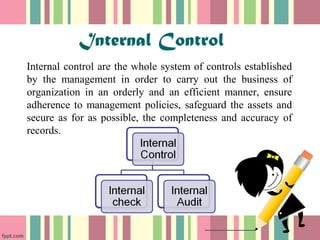
Internal Control 
Internal control are the whole system of controls established 
by the management in order to carry out the business of 
organization in an orderly and an efficient manner, ensure 
adherence to management policies, safeguard the assets and 
secure as for as possible, the completeness and accuracy of 
records.
Internal check 
Internal check is a part of internal control system. It ensures 
that all financial transactions are properly recorded. It also 
ensures efficiency of the accounting system followed by the 
organization and enables easy preparation of financial 
statements. It achieves its main object of minimizing errors 
and frauds. A sound system of internal check increases the 
reliability of financial statements. Internal check discourages 
fraud and collusion among employees by instilling 
a fear of detection in their minds. Internal 
check assigns responsibilities to persons 
and enables maintenance of records and documents 
properly and thereby ensures smooth flow of work.
Internal Audit 
An essential part of internal control is the Internal Audit, 
which operates as a separate unit under the CEO and reports 
its observations to the Board of Directors. The Internal Audit 
supports the Group's management in directing operations by 
inspecting and evaluating the efficiency of business 
operations, risk management and internal control, and by 
producing information and recommendations to enhance 
efficiency. The Internal Audit also inspects 
the processes of business operations and 
financial reporting.
Nature Of Internal Control 
 On behalf of the management performance of Audit staff… 
 Internal control is exercise.. 
 If the Internal Control is effective, it helps to the internal 
auditor to select the sample size for conducting audit. 
 If the Internal control is weak, auditor may decide to conduct 
more extensive scrutiny of transactions. 
 He may decide to place greater reliance on direct 
confirmation by concern persons. 
 Internal control is essential prerequisite for 
efficient and effective management.
Cont. 
 Every management should establish a system of internal 
control appropriate to the size in nature of business of the 
entity. 
 The system of internal control extends beyond those matters, 
which relate directly to the function of the accounting system.
Scope Of Internal Control 
Internal controls encompass a set of rules, policies, and 
procedures an organization implements to provide reasonable 
assurance that : 
(a) its financial reports are reliable, 
(b) its operations are effective and efficient, and 
(c) its activities comply with applicable laws and regulations. 
These represent the three main objectives of the 
internal control system. The organization's board 
of directors, management, and other personnel are 
responsible for the internal control system.
Cont. 
 Risk assessment 
 Control activities 
 Performance Reviews 
 The information and communication system 
 Monitoring
Cont. 
 Internal Control classified in to two broad categories. 
(i) Accounting control 
(ii) Administrative control
Internal Auditing 
"Internal auditing is an independent, objective assurance and 
consulting activity designed to add value and improve an 
organisation's operations. It helps an organisation accomplish 
its objectives by bringing a systematic, disciplined approach to 
evaluate and improve the effectiveness of risk management, 
control, and governance processes."
Cont. 
Internal audit is an objective activity of security and 
consultation aimed to add value and improve the control 
system of the organization. In a world of increasing demand 
for transparency, personal responsibility and operational 
efficiency, the internal audit is a main pillar of advanced 
management as it assists to evaluate and improve the 
organization performance and management.
Characteristics 
1.Division Of Work 
2. Provision Of Check 
3. Use Of Devices 
4. Self-balancing System 
5. Change In Work 
6. Specialization 
7. Control
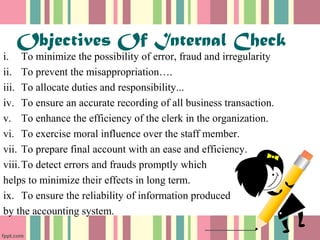
Objectives Of Internal Check 
i. To minimize the possibility of error, fraud and irregularity 
ii. To prevent the misappropriation…. 
iii. To allocate duties and responsibility... 
iv. To ensure an accurate recording of all business transaction. 
v. To enhance the efficiency of the clerk in the organization. 
vi. To exercise moral influence over the staff member. 
vii. To prepare final account with an ease and efficiency. 
viii.To detect errors and frauds promptly which 
helps to minimize their effects in long term. 
ix. To ensure the reliability of information produced 
by the accounting system.
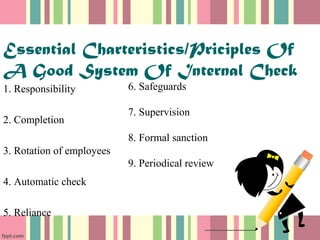
Essential Charteristics/Priciples Of 
A Good System Of Internal Check 
1. Responsibility 
2. Completion 
3. Rotation of employees 
4. Automatic check 
5. Reliance 
6. Safeguards 
7. Supervision 
8. Formal sanction 
9. Periodical review

Unit 3 internal control

  • 1.
    Unit 3 :Internal Control By RADHIKA
  • 2.
    Internal Control Introduction: Internal control, as defined in accounting and auditing, is a process for assuring achievement of an organization's objectives in operational effectiveness and efficiency, reliable financial reporting, and compliance with laws, regulations and policies. A broad concept, internal control involves everything that controls risks to an organization.
  • 3.
    Meaning It isa means by which an organization's resources are directed, monitored, and measured. It plays an important role in detecting and preventing fraud and protecting the organization's resources, both physical (e.g., machinery and property) and intangible (e.g., reputation or intellectual property such as trademarks).
  • 4.
    Definition “Internal Controlis best regarded as indicating the whole system of controls, financial and otherwise, established by the management in the conduct of a business, including internal check, internal audit and other forms of control.”
  • 5.
    Internal Control Internalcontrol are the whole system of controls established by the management in order to carry out the business of organization in an orderly and an efficient manner, ensure adherence to management policies, safeguard the assets and secure as for as possible, the completeness and accuracy of records.
  • 6.
    Internal check Internalcheck is a part of internal control system. It ensures that all financial transactions are properly recorded. It also ensures efficiency of the accounting system followed by the organization and enables easy preparation of financial statements. It achieves its main object of minimizing errors and frauds. A sound system of internal check increases the reliability of financial statements. Internal check discourages fraud and collusion among employees by instilling a fear of detection in their minds. Internal check assigns responsibilities to persons and enables maintenance of records and documents properly and thereby ensures smooth flow of work.
  • 7.
    Internal Audit Anessential part of internal control is the Internal Audit, which operates as a separate unit under the CEO and reports its observations to the Board of Directors. The Internal Audit supports the Group's management in directing operations by inspecting and evaluating the efficiency of business operations, risk management and internal control, and by producing information and recommendations to enhance efficiency. The Internal Audit also inspects the processes of business operations and financial reporting.
  • 8.
    Nature Of InternalControl  On behalf of the management performance of Audit staff…  Internal control is exercise..  If the Internal Control is effective, it helps to the internal auditor to select the sample size for conducting audit.  If the Internal control is weak, auditor may decide to conduct more extensive scrutiny of transactions.  He may decide to place greater reliance on direct confirmation by concern persons.  Internal control is essential prerequisite for efficient and effective management.
  • 9.
    Cont.  Everymanagement should establish a system of internal control appropriate to the size in nature of business of the entity.  The system of internal control extends beyond those matters, which relate directly to the function of the accounting system.
  • 10.
    Scope Of InternalControl Internal controls encompass a set of rules, policies, and procedures an organization implements to provide reasonable assurance that : (a) its financial reports are reliable, (b) its operations are effective and efficient, and (c) its activities comply with applicable laws and regulations. These represent the three main objectives of the internal control system. The organization's board of directors, management, and other personnel are responsible for the internal control system.
  • 11.
    Cont.  Riskassessment  Control activities  Performance Reviews  The information and communication system  Monitoring
  • 12.
    Cont.  InternalControl classified in to two broad categories. (i) Accounting control (ii) Administrative control
  • 13.
    Internal Auditing "Internalauditing is an independent, objective assurance and consulting activity designed to add value and improve an organisation's operations. It helps an organisation accomplish its objectives by bringing a systematic, disciplined approach to evaluate and improve the effectiveness of risk management, control, and governance processes."
  • 14.
    Cont. Internal auditis an objective activity of security and consultation aimed to add value and improve the control system of the organization. In a world of increasing demand for transparency, personal responsibility and operational efficiency, the internal audit is a main pillar of advanced management as it assists to evaluate and improve the organization performance and management.
  • 15.
    Characteristics 1.Division OfWork 2. Provision Of Check 3. Use Of Devices 4. Self-balancing System 5. Change In Work 6. Specialization 7. Control
  • 16.
    Objectives Of InternalCheck i. To minimize the possibility of error, fraud and irregularity ii. To prevent the misappropriation…. iii. To allocate duties and responsibility... iv. To ensure an accurate recording of all business transaction. v. To enhance the efficiency of the clerk in the organization. vi. To exercise moral influence over the staff member. vii. To prepare final account with an ease and efficiency. viii.To detect errors and frauds promptly which helps to minimize their effects in long term. ix. To ensure the reliability of information produced by the accounting system.
  • 17.
    Essential Charteristics/Priciples Of A Good System Of Internal Check 1. Responsibility 2. Completion 3. Rotation of employees 4. Automatic check 5. Reliance 6. Safeguards 7. Supervision 8. Formal sanction 9. Periodical review