SOCIAL AUDITING OF
                              NATURAL RESOURCE
                              MANAGEMENT FOR
                              DEVELOPMENT
                              PROJECTS
   "Role of Community
  Institutions and Civil
 Societies in Combating
                                   Center for Climate Change and
 Disasters and Climate            Environmental Advisory (CCCEA)
         Change“                  DR. MCR HRD Institute Campus,
                                             Hyderabad
10-07-2012 to 12-07-2012


               Dr. N. Sai Bhaskar Reddy            10th July 2012
               saibhaskarnakka@gmail.com
Social auditing
   Social auditing is a process that enables an
    organisation to assess and demonstrate its
    social, economic, and environmental benefits
    and limitations. It is a way of measuring the
    extent to which an organisation lives up to the
    shared values and objectives it has committed
    itself to.
Social Audit
ensure transparency and
 accountability in the system of
 Governance to promote people‟s participation.
It is not a fault finding tool but a system to understand,
   measure and assess the implementation of the schemes
   and plans to improve the effectiveness of the local
   governance.
It has been used as a process to empower people to
   question the systems, processes and authorities in order

   to assert their rights.
This course will give an outline of the different approaches
   to social accountability and will also give relevance to
   the term „accountability from below‟ in the present
Historical Roots
 1960-70‟s – a fresh wave of interest in social
 and ethical accounting, auditing and reporting
 (SEAAR).


 Concept of „stakeholders‟ emerges

 While most of the early theorizing about
 Social Auditing came from the US, most of the
 practical experimentation took place in
 Europe.
Basis of social audit
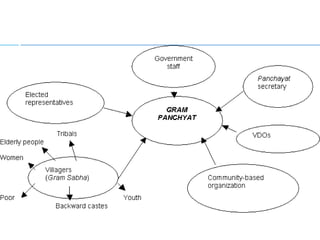
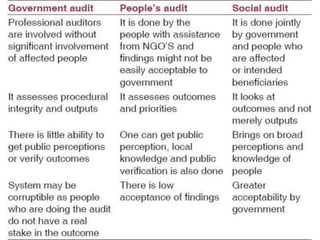
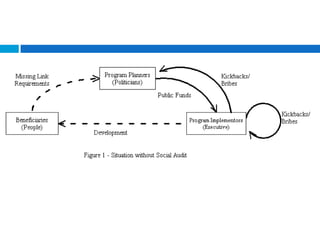
The main reason for the push for social audit is
 the huge disconnect between what the people
 need, what the government thinks it
 needs, and what is actually done. This lack of
 communication is represented by the following
 diagram in figure . Figure 2 explains the
 situation with social audit.
It is a process and not an event
   Thus, Social Audit is nothing but
    understanding, measuring, reporting, and most
    importantly improving the efficiency and
    effectiveness of the local governance.
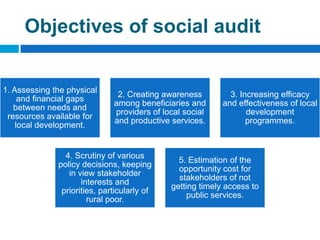
Objectives of social audit


1. Assessing the physical
                               2. Creating awareness         3. Increasing efficacy
     and financial gaps
                              among beneficiaries and      and effectiveness of local
   between needs and
                              providers of local social           development
 resources available for
                              and productive services.            programmes.
    local development.


                4. Scrutiny of various
                                               5. Estimation of the
              policy decisions, keeping
                                               opportunity cost for
                 in view stakeholder
                                               stakeholders of not
                     interests and
                                             getting timely access to
               priorities, particularly of
                                                  public services.
                       rural poor.
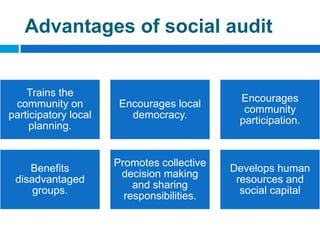
Advantages of social audit


    Trains the
                                             Encourages
 community on          Encourages local
                                              community
participatory local      democracy.
                                             participation.
     planning.


                      Promotes collective
    Benefits                                Develops human
                       decision making
 disadvantaged                               resources and
                          and sharing
     groups.                                  social capital
                        responsibilities.
   Social auditing provides an assessment of the
    impact of an organisation's non-financial
    objectives through systematically and regularly
    monitoring its performance and the views of its
    stakeholders.
   Social auditing requires the involvement of
    stakeholders. This may include employees,
    clients, volunteers, funders, contractors,
    suppliers and local residents interested in the
    organisation.
   Stakeholders are defined as those persons or
    organisations who have an interest in, or who
    have invested resources in, the organisation.
   Social audits are generated by the
    organisation themselves and those directly
    involved. A person or panel of people external
    to the organisation undertakes verification of
    the social audit's accuracy and objectivity.
What does Social Auditing
Involve?
   The social auditing process requires an
    intermittent but clear time commitment from a
    key person within the organisation. This social
    auditor liases with others in the organisation
    and designs, co-ordinates, analyses and
    documents the information collected during the
    process.
   Social auditing information is collected through
    research methods that include social
    bookkeeping, surveys and case studies. The
    objectives of the organisation are the starting
    point from which indicators of impact are
    determined, stakeholders identified and
    research tools designed in detail.
   The collection of information is an on-going
    process, often done in 12-month cycles and
    resulting in the organisation establishing social
    bookkeeping and the preparation of an annual
    social audit document/report.
   MNREGA‟s mandated use of social audits by the
    village assembly (gram sabha) goes beyond the
    right to information and serves to ensure
    accountability and corrective
    measures. Partnerships between government and
    civil society, the training of local resource persons,
    social mobilisations around the social audit forum
    and gram sabhas and the use of community-
    based organisations are just some ways in which
    social audits are sought to be made more
    effective
                    - Amita Sharma, Joint Secretary, Ministry of Rural
                       Development
Abstract of social auditing

  Decisions taken report


     Social Audit ppt
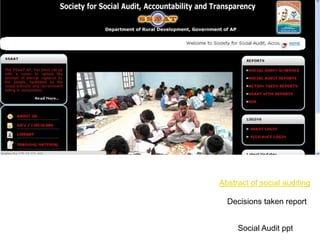
   Social audits like the hugely successful model
    in Andhra Pradesh, which has set up an
    independent and autonomous Society for
    Social Audit, Accountability and Transparency
    (SSAAT) to help ensure proper working of the
    MNREGA, have excited people in various
    countries, especially Africa.
What is Social Auditing ?

    SA is a management tool and accountability
     mechanism which can enhance an organization‟s
     capacity to:

    Evaluate their impact on stakeholders
    Determine how well they are living up to the values
     they espouse.
    Improve their strategic planning process by
     identifying potential problems before they come
     up; and
    Increase their accountability to the groups they
     serve and depend on.
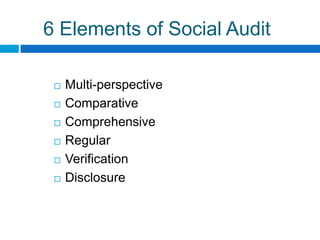
6 Elements of Social Audit

    Multi-perspective
    Comparative
    Comprehensive
    Regular
    Verification
    Disclosure
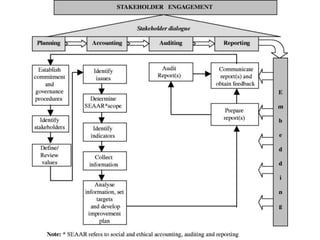
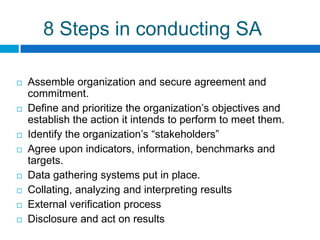
8 Steps in conducting SA

   Assemble organization and secure agreement and
    commitment.
   Define and prioritize the organization‟s objectives and
    establish the action it intends to perform to meet them.
   Identify the organization‟s “stakeholders”
   Agree upon indicators, information, benchmarks and
    targets.
   Data gathering systems put in place.
   Collating, analyzing and interpreting results
   External verification process
   Disclosure and act on results
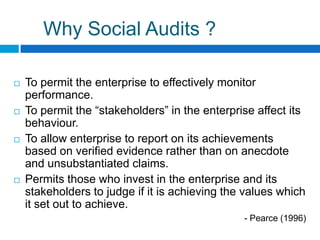
Why Social Audits ?

   To permit the enterprise to effectively monitor
    performance.
   To permit the “stakeholders” in the enterprise affect its
    behaviour.
   To allow enterprise to report on its achievements
    based on verified evidence rather than on anecdote
    and unsubstantiated claims.
   Permits those who invest in the enterprise and its
    stakeholders to judge if it is achieving the values which
    it set out to achieve.
                                                - Pearce (1996)
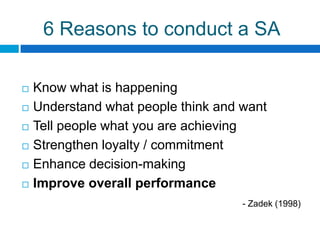
6 Reasons to conduct a SA

   Know what is happening
   Understand what people think and want
   Tell people what you are achieving
   Strengthen loyalty / commitment
   Enhance decision-making
   Improve overall performance
                                     - Zadek (1998)
Potential Issues

SA has excellent promise as a management tool but
 some potential problems remain:

    Reporting organization can deliberately limit audit scope in order to avoid
     controversies.
    Process can be managed internally to the disadvantage of some external
     stakeholders.
    Some significant stakeholders may be omitted.
    Organization may use arbitrary or inappropriate indicators to evaluate
     outcomes.
    The standards, independence and honesty of the auditor may be open to
     question.

    Therefore the need for Generally Accepted Assurance Standard (AA1000)
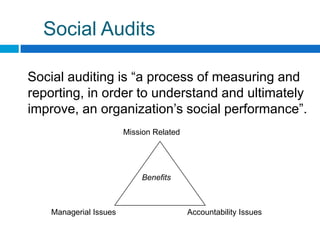
Social Audits

Social auditing is “a process of measuring and
reporting, in order to understand and ultimately
improve, an organization‟s social performance”.
                        Mission Related


                            Benefits


    Managerial Issues                     Accountability Issues
   India being a welfare state, several programs
    and policies are implemented for the benefit of
    people. Politicians and executives are usually
    the ones who control and implement these
    policies. Some policies are common to all and
    some are special that are meant to benefit the
    weaker sections of the society. To implement
    all such policies, funds are drawn from the
    state exchequer. The social control over
    withdrawal and usage of this fund is called
    Social Audit.
   Environmental accounting, which is a subset of
    social accounting, focuses on the cost structure
    and environmental performance of a company. It
    principally describes the preparation,
    presentation, and communication of information
    related to an organisation‟s interaction with
    the natural environment. Although environmental
    accounting is most commonly undertaken as
    voluntary self-reporting by companies, third-party
    reports by government agencies, NGOs and other
    bodies posit to pressure for environmental
    accountability.
   Accounting for impacts on the environment may
    occur within a company‟s financial
    statements, relating to liabilities, commitments
    and contingencies for the remediation of
    contaminated lands or other financial concerns
    arising from pollution. Such reporting essentially
    expresses financial issues arising from
    environmental legislation. More
    typically, environmental accounting describes the
    reporting of quantitative and detailed
    environmental data within the non-financial
    sections of the annual report or in separate
    (including online) environmental reports. Such
    reports may account for pollution
    emissions, resources used, or wildlife
    habitat damaged or re-established.
   In their reports, large companies commonly place primary
    emphasis on eco-efficiency, referring to the reduction of
    resource and energy use and waste production per unit of
    product or service. A complete picture which accounts for all
    inputs, outputs and wastes of the organisation, must not
    necessarily emerge. Whilst companies can often demonstrate
    great success in eco-efficiency, their ecological footprint, that
    is an estimate of total environmental impact, may move
    independently following changes in output.
   Legislation for compulsory environmental reporting exists in
    some form e.g.
    in Denmark, Netherlands, Australia and Korea. The United
    Nations has been highly involved in the adoption of
    environmental accounting practices, most notably in the
    United Nations Division for Sustainable Development
    publication Environmental Management Accounting
    Procedures and Principles (2002)
Appropriate institutional level
for social audit
   The most appropriate institutional level for social audit
    is the Gram Sabha, which has been given 'watchdog'
    powers and responsibilities by the Panchayati
    Raj Acts in most States to supervise and monitor the
    functioning of panchayat elected representatives and
    government functionaries, and examine the annual
    statement of accounts and audit reports. These are
    implied powers indirectly empowering Gram
    Sabhas to carry out social audits in addition to other
    functions. Members of the Gram Sabha and the
    village panchayat, intermediatepanchayat and district
    panchayat through their representatives, can raise
    issues of social concern and public interest and
    demand an explanation
Right to information for Gram
      Sabha members
   Some States have already passed Right to Information
    Acts. Notwithstanding some weaknesses, the Acts have
    opened the way for transparency in administration from
    the State to the panchayat level.
   The Right to Information Acts specify the modalities for
    obtaining information and provide penalties or failing to
    furnish or supplying false information. The Acts facilitate
    social legislation such as on minimum wages and
    gender rights and, more importantly, pave the way for
    public debate on government development projects.
   However, none of the Acts have defined the right to
    information to include inspection of works and
    documents, and the taking of notes and extracts. This is
    needed to make the social audit by the Gram
    Sabha more effective.
Empowerment of people
   Social audit is most effective when the actual
    beneficiaries of an activity are involved in
    it. However, people can only get involved in
    the process when they are given appropriate
    authority and rights. To this end, the 73rd
    amendment of the constitution has empowered
    the Gram Sabha to conduct social audit. This
    is relevant only in the villages. In the cities, the
    Right to Information Act empowers the people
    to inspect public records.
Proper Documentation
   Every thing right from the requirement
    gathering to planning to implementation must
    be properly documented. Some of the
    documents that should be made mandatory
    are:
    Applications, tenders, and proposals
   Financial statements, income - expense
    statements.
   Registers of workers
   Inspection reports.
Accessibility of Documents
Merely generating documents is useless if they
 are not easily accessible. In this information
 age, all the documents must be put on line.
Punitive Action
   The final and most important provision, about
    which nothing is being done yet, is to have
    punitive actions for non-conformance of the
    process of social audit. Unless there is legal
    punishment, there will be no incentive for the
    people in authority to implement the processes
    in a fair manner.
Generic Steps for Social
      Audit
   Clarity of purpose and goal of the local elected body.
   Identify stakeholders with a focus on their specific roles and duties. Social
    auditing aims to ensure a say for all stakeholders. It is particularly important
    that marginalized social groups, which are normally excluded, have a say on
    local development issues and activities and have their views on the actual
    performance of local elected bodies.
   Definition of performance indicators which must be understood and accepted
    by all. Indicator data must be collected by stakeholders on a regular basis.
   Regular meetings to review and discuss data/information on performance
    indicators.
   Follow-up of social audit meeting with the panchayat body reviewing
    stakeholders‟ actions, activities and viewpoints, making commitments on
    changes and agreeing on future action as recommended by the
    stakeholders.
   Establishment of a group of trusted local people including elderly people,
    teachers and others who are committed and independent, to be involved in
    the verification and to judge if the decisions based upon social audit have
    been implemented.
   The findings of the social audit should be shared with all local stakeholders.
Hindrances in Social Audit
    Mindset of people. Even after 50 yrs of independence
    people do not understand the concept of govt. for the
    people, of the people, and by the people. Most of the
    people still think themselves as being ruled by the
    politicians, while politicians think that they are the rulers.
    Due to this reason, common people do not get involved
    in the developmental activities.
   Lack of any legal proceedings for not following social
    audit principles. Unless there is a stringent penalty on
    authorities for not implementing social audit, they will not
    give up control because it reduces their kickbacks and
    authority.
   Lack of education among the common masses. Since
Benefits of Social Audit
   Involvement of people in developmental
    activities ensures that money is spent where is
    it actually needed.
   Reduction of wastages.
   Reduction in corruption.
   Awareness among people.
   Promotes integrity and a sense of community
    among people.
   Improves the standard of governance.
   Social Audit and Action taken report NREGA
     http://nrega.nic.in/circular/so_audit_Ajmer.pdf
References
   http://hanumant.com/SocialAudit.html
   http://www.fao.org/docrep/006/ad346e/ad346e
    09.htm
   http://www.caledonia.org.uk/socialland/social.h
    tm
   http://www.indianexpress.com/news/indias-
    social-audit-of-schemes-draws-world-
    attention/705883/0

Social Audit nrm and development

  • 1.
    SOCIAL AUDITING OF NATURAL RESOURCE MANAGEMENT FOR DEVELOPMENT PROJECTS "Role of Community Institutions and Civil Societies in Combating Center for Climate Change and Disasters and Climate Environmental Advisory (CCCEA) Change“ DR. MCR HRD Institute Campus, Hyderabad 10-07-2012 to 12-07-2012 Dr. N. Sai Bhaskar Reddy 10th July 2012 saibhaskarnakka@gmail.com
  • 2.
    Social auditing  Social auditing is a process that enables an organisation to assess and demonstrate its social, economic, and environmental benefits and limitations. It is a way of measuring the extent to which an organisation lives up to the shared values and objectives it has committed itself to.
  • 3.
    Social Audit ensure transparencyand accountability in the system of Governance to promote people‟s participation. It is not a fault finding tool but a system to understand, measure and assess the implementation of the schemes and plans to improve the effectiveness of the local governance. It has been used as a process to empower people to question the systems, processes and authorities in order to assert their rights. This course will give an outline of the different approaches to social accountability and will also give relevance to the term „accountability from below‟ in the present
  • 4.
    Historical Roots 1960-70‟s– a fresh wave of interest in social and ethical accounting, auditing and reporting (SEAAR). Concept of „stakeholders‟ emerges While most of the early theorizing about Social Auditing came from the US, most of the practical experimentation took place in Europe.
  • 5.
    Basis of socialaudit The main reason for the push for social audit is the huge disconnect between what the people need, what the government thinks it needs, and what is actually done. This lack of communication is represented by the following diagram in figure . Figure 2 explains the situation with social audit.
  • 6.
    It is aprocess and not an event  Thus, Social Audit is nothing but understanding, measuring, reporting, and most importantly improving the efficiency and effectiveness of the local governance.
  • 7.
    Objectives of socialaudit 1. Assessing the physical 2. Creating awareness 3. Increasing efficacy and financial gaps among beneficiaries and and effectiveness of local between needs and providers of local social development resources available for and productive services. programmes. local development. 4. Scrutiny of various 5. Estimation of the policy decisions, keeping opportunity cost for in view stakeholder stakeholders of not interests and getting timely access to priorities, particularly of public services. rural poor.
  • 8.
    Advantages of socialaudit Trains the Encourages community on Encourages local community participatory local democracy. participation. planning. Promotes collective Benefits Develops human decision making disadvantaged resources and and sharing groups. social capital responsibilities.
  • 9.
    Social auditing provides an assessment of the impact of an organisation's non-financial objectives through systematically and regularly monitoring its performance and the views of its stakeholders.
  • 10.
    Social auditing requires the involvement of stakeholders. This may include employees, clients, volunteers, funders, contractors, suppliers and local residents interested in the organisation.  Stakeholders are defined as those persons or organisations who have an interest in, or who have invested resources in, the organisation.
  • 11.
    Social audits are generated by the organisation themselves and those directly involved. A person or panel of people external to the organisation undertakes verification of the social audit's accuracy and objectivity.
  • 12.
    What does SocialAuditing Involve?  The social auditing process requires an intermittent but clear time commitment from a key person within the organisation. This social auditor liases with others in the organisation and designs, co-ordinates, analyses and documents the information collected during the process.
  • 13.
    Social auditing information is collected through research methods that include social bookkeeping, surveys and case studies. The objectives of the organisation are the starting point from which indicators of impact are determined, stakeholders identified and research tools designed in detail.
  • 14.
    The collection of information is an on-going process, often done in 12-month cycles and resulting in the organisation establishing social bookkeeping and the preparation of an annual social audit document/report.
  • 15.
    MNREGA‟s mandated use of social audits by the village assembly (gram sabha) goes beyond the right to information and serves to ensure accountability and corrective measures. Partnerships between government and civil society, the training of local resource persons, social mobilisations around the social audit forum and gram sabhas and the use of community- based organisations are just some ways in which social audits are sought to be made more effective - Amita Sharma, Joint Secretary, Ministry of Rural Development
  • 16.
    Abstract of socialauditing Decisions taken report Social Audit ppt
  • 20.
    Social audits like the hugely successful model in Andhra Pradesh, which has set up an independent and autonomous Society for Social Audit, Accountability and Transparency (SSAAT) to help ensure proper working of the MNREGA, have excited people in various countries, especially Africa.
  • 21.
    What is SocialAuditing ? SA is a management tool and accountability mechanism which can enhance an organization‟s capacity to:  Evaluate their impact on stakeholders  Determine how well they are living up to the values they espouse.  Improve their strategic planning process by identifying potential problems before they come up; and  Increase their accountability to the groups they serve and depend on.
  • 22.
    6 Elements ofSocial Audit  Multi-perspective  Comparative  Comprehensive  Regular  Verification  Disclosure
  • 23.
    8 Steps inconducting SA  Assemble organization and secure agreement and commitment.  Define and prioritize the organization‟s objectives and establish the action it intends to perform to meet them.  Identify the organization‟s “stakeholders”  Agree upon indicators, information, benchmarks and targets.  Data gathering systems put in place.  Collating, analyzing and interpreting results  External verification process  Disclosure and act on results
  • 24.
    Why Social Audits?  To permit the enterprise to effectively monitor performance.  To permit the “stakeholders” in the enterprise affect its behaviour.  To allow enterprise to report on its achievements based on verified evidence rather than on anecdote and unsubstantiated claims.  Permits those who invest in the enterprise and its stakeholders to judge if it is achieving the values which it set out to achieve. - Pearce (1996)
  • 25.
    6 Reasons toconduct a SA  Know what is happening  Understand what people think and want  Tell people what you are achieving  Strengthen loyalty / commitment  Enhance decision-making  Improve overall performance - Zadek (1998)
  • 26.
    Potential Issues SA hasexcellent promise as a management tool but some potential problems remain:  Reporting organization can deliberately limit audit scope in order to avoid controversies.  Process can be managed internally to the disadvantage of some external stakeholders.  Some significant stakeholders may be omitted.  Organization may use arbitrary or inappropriate indicators to evaluate outcomes.  The standards, independence and honesty of the auditor may be open to question. Therefore the need for Generally Accepted Assurance Standard (AA1000)
  • 27.
    Social Audits Social auditingis “a process of measuring and reporting, in order to understand and ultimately improve, an organization‟s social performance”. Mission Related Benefits Managerial Issues Accountability Issues
  • 28.
    India being a welfare state, several programs and policies are implemented for the benefit of people. Politicians and executives are usually the ones who control and implement these policies. Some policies are common to all and some are special that are meant to benefit the weaker sections of the society. To implement all such policies, funds are drawn from the state exchequer. The social control over withdrawal and usage of this fund is called Social Audit.
  • 30.
    Environmental accounting, which is a subset of social accounting, focuses on the cost structure and environmental performance of a company. It principally describes the preparation, presentation, and communication of information related to an organisation‟s interaction with the natural environment. Although environmental accounting is most commonly undertaken as voluntary self-reporting by companies, third-party reports by government agencies, NGOs and other bodies posit to pressure for environmental accountability.
  • 31.
    Accounting for impacts on the environment may occur within a company‟s financial statements, relating to liabilities, commitments and contingencies for the remediation of contaminated lands or other financial concerns arising from pollution. Such reporting essentially expresses financial issues arising from environmental legislation. More typically, environmental accounting describes the reporting of quantitative and detailed environmental data within the non-financial sections of the annual report or in separate (including online) environmental reports. Such reports may account for pollution emissions, resources used, or wildlife habitat damaged or re-established.
  • 32.
    In their reports, large companies commonly place primary emphasis on eco-efficiency, referring to the reduction of resource and energy use and waste production per unit of product or service. A complete picture which accounts for all inputs, outputs and wastes of the organisation, must not necessarily emerge. Whilst companies can often demonstrate great success in eco-efficiency, their ecological footprint, that is an estimate of total environmental impact, may move independently following changes in output.  Legislation for compulsory environmental reporting exists in some form e.g. in Denmark, Netherlands, Australia and Korea. The United Nations has been highly involved in the adoption of environmental accounting practices, most notably in the United Nations Division for Sustainable Development publication Environmental Management Accounting Procedures and Principles (2002)
  • 33.
    Appropriate institutional level forsocial audit  The most appropriate institutional level for social audit is the Gram Sabha, which has been given 'watchdog' powers and responsibilities by the Panchayati Raj Acts in most States to supervise and monitor the functioning of panchayat elected representatives and government functionaries, and examine the annual statement of accounts and audit reports. These are implied powers indirectly empowering Gram Sabhas to carry out social audits in addition to other functions. Members of the Gram Sabha and the village panchayat, intermediatepanchayat and district panchayat through their representatives, can raise issues of social concern and public interest and demand an explanation
  • 34.
    Right to informationfor Gram Sabha members  Some States have already passed Right to Information Acts. Notwithstanding some weaknesses, the Acts have opened the way for transparency in administration from the State to the panchayat level.  The Right to Information Acts specify the modalities for obtaining information and provide penalties or failing to furnish or supplying false information. The Acts facilitate social legislation such as on minimum wages and gender rights and, more importantly, pave the way for public debate on government development projects.  However, none of the Acts have defined the right to information to include inspection of works and documents, and the taking of notes and extracts. This is needed to make the social audit by the Gram Sabha more effective.
  • 35.
    Empowerment of people  Social audit is most effective when the actual beneficiaries of an activity are involved in it. However, people can only get involved in the process when they are given appropriate authority and rights. To this end, the 73rd amendment of the constitution has empowered the Gram Sabha to conduct social audit. This is relevant only in the villages. In the cities, the Right to Information Act empowers the people to inspect public records.
  • 36.
    Proper Documentation  Every thing right from the requirement gathering to planning to implementation must be properly documented. Some of the documents that should be made mandatory are: Applications, tenders, and proposals  Financial statements, income - expense statements.  Registers of workers  Inspection reports.
  • 37.
    Accessibility of Documents Merelygenerating documents is useless if they are not easily accessible. In this information age, all the documents must be put on line.
  • 38.
    Punitive Action  The final and most important provision, about which nothing is being done yet, is to have punitive actions for non-conformance of the process of social audit. Unless there is legal punishment, there will be no incentive for the people in authority to implement the processes in a fair manner.
  • 39.
    Generic Steps forSocial Audit  Clarity of purpose and goal of the local elected body.  Identify stakeholders with a focus on their specific roles and duties. Social auditing aims to ensure a say for all stakeholders. It is particularly important that marginalized social groups, which are normally excluded, have a say on local development issues and activities and have their views on the actual performance of local elected bodies.  Definition of performance indicators which must be understood and accepted by all. Indicator data must be collected by stakeholders on a regular basis.  Regular meetings to review and discuss data/information on performance indicators.  Follow-up of social audit meeting with the panchayat body reviewing stakeholders‟ actions, activities and viewpoints, making commitments on changes and agreeing on future action as recommended by the stakeholders.  Establishment of a group of trusted local people including elderly people, teachers and others who are committed and independent, to be involved in the verification and to judge if the decisions based upon social audit have been implemented.  The findings of the social audit should be shared with all local stakeholders.
  • 40.
    Hindrances in SocialAudit  Mindset of people. Even after 50 yrs of independence people do not understand the concept of govt. for the people, of the people, and by the people. Most of the people still think themselves as being ruled by the politicians, while politicians think that they are the rulers. Due to this reason, common people do not get involved in the developmental activities.  Lack of any legal proceedings for not following social audit principles. Unless there is a stringent penalty on authorities for not implementing social audit, they will not give up control because it reduces their kickbacks and authority.  Lack of education among the common masses. Since
  • 41.
    Benefits of SocialAudit  Involvement of people in developmental activities ensures that money is spent where is it actually needed.  Reduction of wastages.  Reduction in corruption.  Awareness among people.  Promotes integrity and a sense of community among people.  Improves the standard of governance.
  • 42.
    Social Audit and Action taken report NREGA  http://nrega.nic.in/circular/so_audit_Ajmer.pdf
  • 43.
    References  http://hanumant.com/SocialAudit.html  http://www.fao.org/docrep/006/ad346e/ad346e 09.htm  http://www.caledonia.org.uk/socialland/social.h tm  http://www.indianexpress.com/news/indias- social-audit-of-schemes-draws-world- attention/705883/0