Prepared & Presented by
Ms. Himani R.
Unit 2
Internal Control
Layout
 Internal control: Meaning &
Objectives
 Internal check: Meaning, objectives
and principles
Wage payments, Cash sales, Cash
purchases
 Internal Audit: Meaning,
Advantages & Disadvantages
 Difference between internal check &2 Prepared by: Ms. Himani R.
Internal control
 “The whole system of controls, financial and
otherwise, established by the management in
order to carry on the business of the company in
an orderly manner, safeguard its assets and
secure the accuracy and reliability of its
records.”
 The objectives of internal control are:
 To avoid inefficiency, wastage and fraud
 To attain the maximum accuracy & reliability in
maintaining the books of accounts
 To measure how far the policies of the
business are being implemented3 Prepared by: Ms. Himani R.
Internal check
 Internal check is a part of internal control.
 No employee is allowed to do a job from
the beginning to the end and also not
allowed to deal with one book throughout
the year.
 “A system of internal check is an
arrangement of staff duties whereby, no
one person is allowed to carry through
and to record every aspect of a
transaction, so that without collusion
between two or more persons, fraud is4 Prepared by: Ms. Himani R.
Objectives of internal check
 To ensure proper division of work
 Since the work is divided into small units
the responsibility of each individual can
be fixed.
 To minimize the frauds and errors in the
beginning of the audit
 To cross-check the work done by each
employee
 The auditor can go for selective checking
instead of detailed checking5 Prepared by: Ms. Himani R.
Principles of internal check
 The work should be allocated among the staff
of the business according to the duties,
responsibility and rights in such a manner,
that there is no room for interference.
 No single person should have an independent
control over all important aspects of the
business.
 The duties among the staff of the business
should be changed from time to time so that
no staff should be engaged in a particular job
for a long time.
 Every member of the staff should be
encouraged to go on leave at least once in a
6 Prepared by: Ms. Himani R.
Continued
 An efficient system of internal check should
provide for an automatic checking of the work
of an assistant by the other.
 The division of work should not be much
expensive.
 The financial and administrative power should
be assigned very judiciously to different
officers.
 Person having physically custody of asset
must not be permitted to have an access to
the books of account.7 Prepared by: Ms. Himani R.
Internal check as regards Cash
Sales
 In big business houses, where daily
transactions of cash sales are larger in
number, there are many chances of
fraud and irregularities.
 Cash sales may take 3 forms:
 Sales at counter: 4 copies of cash
memo: Salesman, Cashier, Counter,
Customer
 Sales by travelling agents: to push sales
to the new ones and collect debts from
the old ones
8 Prepared by: Ms. Himani R.
Internal check as regards Cash
purchases
 Common mistakes: Fictitious payments, Same invoice
recorded twice, To inflate profit goods purchased may
not be entered, Goods not received may also be
entered
 Purchases should be recorded separately for better
control. Work connected with the purchases:
 Assessment of the requirements
 Enquiry
 Placing orders
 Receipt of goods
 Recording and making payments
 Goods received note should be prepared with the
following details: Date of receiving, Name of the
supplier, Invoice note number, description and code
9 Prepared by: Ms. Himani R.
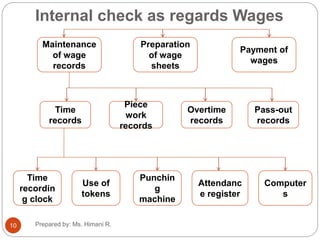
Internal check as regards Wages
Time
recordin
g clock
Attendanc
e register
Punchin
g
machine
Use of
tokens
Pass-out
records
Payment of
wages
Preparation
of wage
sheets
Maintenance
of wage
records
Overtime
records
Piece
work
records
Time
records
Computer
s
10 Prepared by: Ms. Himani R.
Internal audit/ Operations audit
 An internal audit is conducted for a
systematic examination of the records,
procedures and operations of an org.
 2 types of internal audit: Mgt. &
Propriety audit
 Definition: “Internal auditing is an
independent appraisal activity within an
org for the review of operations as a
service to mgt. It is a managerial control
which functions by measuring and11 Prepared by: Ms. Himani R.
Objects of internal audit
 Reliability and integrity of information
 Compliance with plans, policies,
procedures, laws and regulations
 Safeguarding of business assets
 Economical and efficient use of
resources
 Accomplishment of established
objectives and goals for operations
12 Prepared by: Ms. Himani R.
 Advantages:
Continuous check on accounting records
and accounting staff
Errors and frauds will be detected at an
early stage
Final accounts will be made easily
Business activities are continuously
reviewed
Facilitates adoption of standard
accounting practices
 Disadvantages:
Adverse effect on accounting staff13 Prepared by: Ms. Himani R.
Internal check v/s Internal audit
 Evaluation of
accounting and
clerical accuracy
 Work is mechanically
checked in the
process of being
performed
 Requires no
separate staff so no
additional financial
burden
 Aims at minimizing
errors & frauds
 Evaluation of
effectiveness of
management control
 Like a post-mortem
examination, where
work is already done
 Requires separate
staff so additional
financial burden is
there
 Aims at discovering
errors & frauds14 Prepared by: Ms. Himani R.
Internal audit Statutory audit
Appointed by
management
Appointed by
shareholders/ BODs/
Central Govt.
Appointing is optional Appointing is
compulsory
He may/may not be a
CA
Should necessarily be a
CA
He is an employee of
the Co.
He is an outsider
A type of continuous
audit
Conducted at the end of
a financial year
Evaluates activities of
mgt
Evaluates final accounts
15 Prepared by: Ms. Himani R.
16 Prepared by: Ms. Himani R.

Internal Control

  • 1.
    Prepared & Presentedby Ms. Himani R. Unit 2 Internal Control
  • 2.
    Layout  Internal control:Meaning & Objectives  Internal check: Meaning, objectives and principles Wage payments, Cash sales, Cash purchases  Internal Audit: Meaning, Advantages & Disadvantages  Difference between internal check &2 Prepared by: Ms. Himani R.
  • 3.
    Internal control  “Thewhole system of controls, financial and otherwise, established by the management in order to carry on the business of the company in an orderly manner, safeguard its assets and secure the accuracy and reliability of its records.”  The objectives of internal control are:  To avoid inefficiency, wastage and fraud  To attain the maximum accuracy & reliability in maintaining the books of accounts  To measure how far the policies of the business are being implemented3 Prepared by: Ms. Himani R.
  • 4.
    Internal check  Internalcheck is a part of internal control.  No employee is allowed to do a job from the beginning to the end and also not allowed to deal with one book throughout the year.  “A system of internal check is an arrangement of staff duties whereby, no one person is allowed to carry through and to record every aspect of a transaction, so that without collusion between two or more persons, fraud is4 Prepared by: Ms. Himani R.
  • 5.
    Objectives of internalcheck  To ensure proper division of work  Since the work is divided into small units the responsibility of each individual can be fixed.  To minimize the frauds and errors in the beginning of the audit  To cross-check the work done by each employee  The auditor can go for selective checking instead of detailed checking5 Prepared by: Ms. Himani R.
  • 6.
    Principles of internalcheck  The work should be allocated among the staff of the business according to the duties, responsibility and rights in such a manner, that there is no room for interference.  No single person should have an independent control over all important aspects of the business.  The duties among the staff of the business should be changed from time to time so that no staff should be engaged in a particular job for a long time.  Every member of the staff should be encouraged to go on leave at least once in a 6 Prepared by: Ms. Himani R.
  • 7.
    Continued  An efficientsystem of internal check should provide for an automatic checking of the work of an assistant by the other.  The division of work should not be much expensive.  The financial and administrative power should be assigned very judiciously to different officers.  Person having physically custody of asset must not be permitted to have an access to the books of account.7 Prepared by: Ms. Himani R.
  • 8.
    Internal check asregards Cash Sales  In big business houses, where daily transactions of cash sales are larger in number, there are many chances of fraud and irregularities.  Cash sales may take 3 forms:  Sales at counter: 4 copies of cash memo: Salesman, Cashier, Counter, Customer  Sales by travelling agents: to push sales to the new ones and collect debts from the old ones 8 Prepared by: Ms. Himani R.
  • 9.
    Internal check asregards Cash purchases  Common mistakes: Fictitious payments, Same invoice recorded twice, To inflate profit goods purchased may not be entered, Goods not received may also be entered  Purchases should be recorded separately for better control. Work connected with the purchases:  Assessment of the requirements  Enquiry  Placing orders  Receipt of goods  Recording and making payments  Goods received note should be prepared with the following details: Date of receiving, Name of the supplier, Invoice note number, description and code 9 Prepared by: Ms. Himani R.
  • 10.
    Internal check asregards Wages Time recordin g clock Attendanc e register Punchin g machine Use of tokens Pass-out records Payment of wages Preparation of wage sheets Maintenance of wage records Overtime records Piece work records Time records Computer s 10 Prepared by: Ms. Himani R.
  • 11.
    Internal audit/ Operationsaudit  An internal audit is conducted for a systematic examination of the records, procedures and operations of an org.  2 types of internal audit: Mgt. & Propriety audit  Definition: “Internal auditing is an independent appraisal activity within an org for the review of operations as a service to mgt. It is a managerial control which functions by measuring and11 Prepared by: Ms. Himani R.
  • 12.
    Objects of internalaudit  Reliability and integrity of information  Compliance with plans, policies, procedures, laws and regulations  Safeguarding of business assets  Economical and efficient use of resources  Accomplishment of established objectives and goals for operations 12 Prepared by: Ms. Himani R.
  • 13.
     Advantages: Continuous checkon accounting records and accounting staff Errors and frauds will be detected at an early stage Final accounts will be made easily Business activities are continuously reviewed Facilitates adoption of standard accounting practices  Disadvantages: Adverse effect on accounting staff13 Prepared by: Ms. Himani R.
  • 14.
    Internal check v/sInternal audit  Evaluation of accounting and clerical accuracy  Work is mechanically checked in the process of being performed  Requires no separate staff so no additional financial burden  Aims at minimizing errors & frauds  Evaluation of effectiveness of management control  Like a post-mortem examination, where work is already done  Requires separate staff so additional financial burden is there  Aims at discovering errors & frauds14 Prepared by: Ms. Himani R.
  • 15.
    Internal audit Statutoryaudit Appointed by management Appointed by shareholders/ BODs/ Central Govt. Appointing is optional Appointing is compulsory He may/may not be a CA Should necessarily be a CA He is an employee of the Co. He is an outsider A type of continuous audit Conducted at the end of a financial year Evaluates activities of mgt Evaluates final accounts 15 Prepared by: Ms. Himani R.
  • 16.
    16 Prepared by:Ms. Himani R.