Audit Techniques
BY
Atta-ur-Rahman Arif
INTRODUCTION
Audit techniques are tools, methods
or processes by means of which an
auditor collects necessary evidence
to support his opinion in respect of
the propositions or assertions
submitted by the client to him for his
examination.
AUDIT PROCEDURES
• Audit procedures are ways of
applying techniques to particular
phase of an audit.
• Generally, the attainment of the audit
objectives required the collection of
the evidence to support a decision.
Kinds of audit techniques
• Posting verification
• Extension verification
• Vouching
• Confirmations
• Physical examination
• Reconciliation
• Testing
Kinds of audit techniques
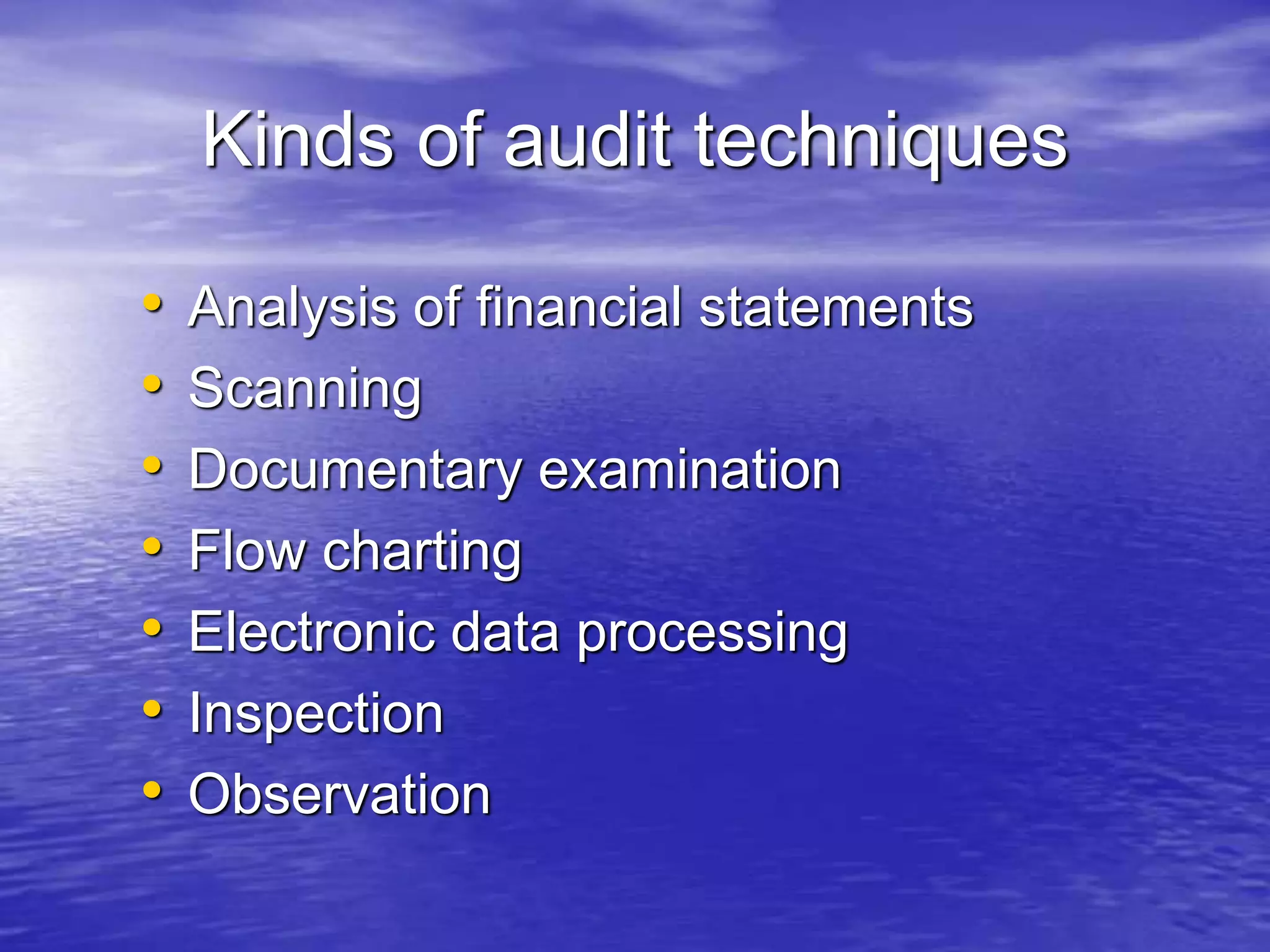
• Analysis of financial statements
• Scanning
• Documentary examination
• Flow charting
• Electronic data processing
• Inspection
• Observation
Kinds of audit techniques
• Enquiry
• Computations
• Management representations
• Sampling techniques
• Compliance test
• Substantive tests
• Analytical review
• Use of computer- assisted audit techniques
KINDS
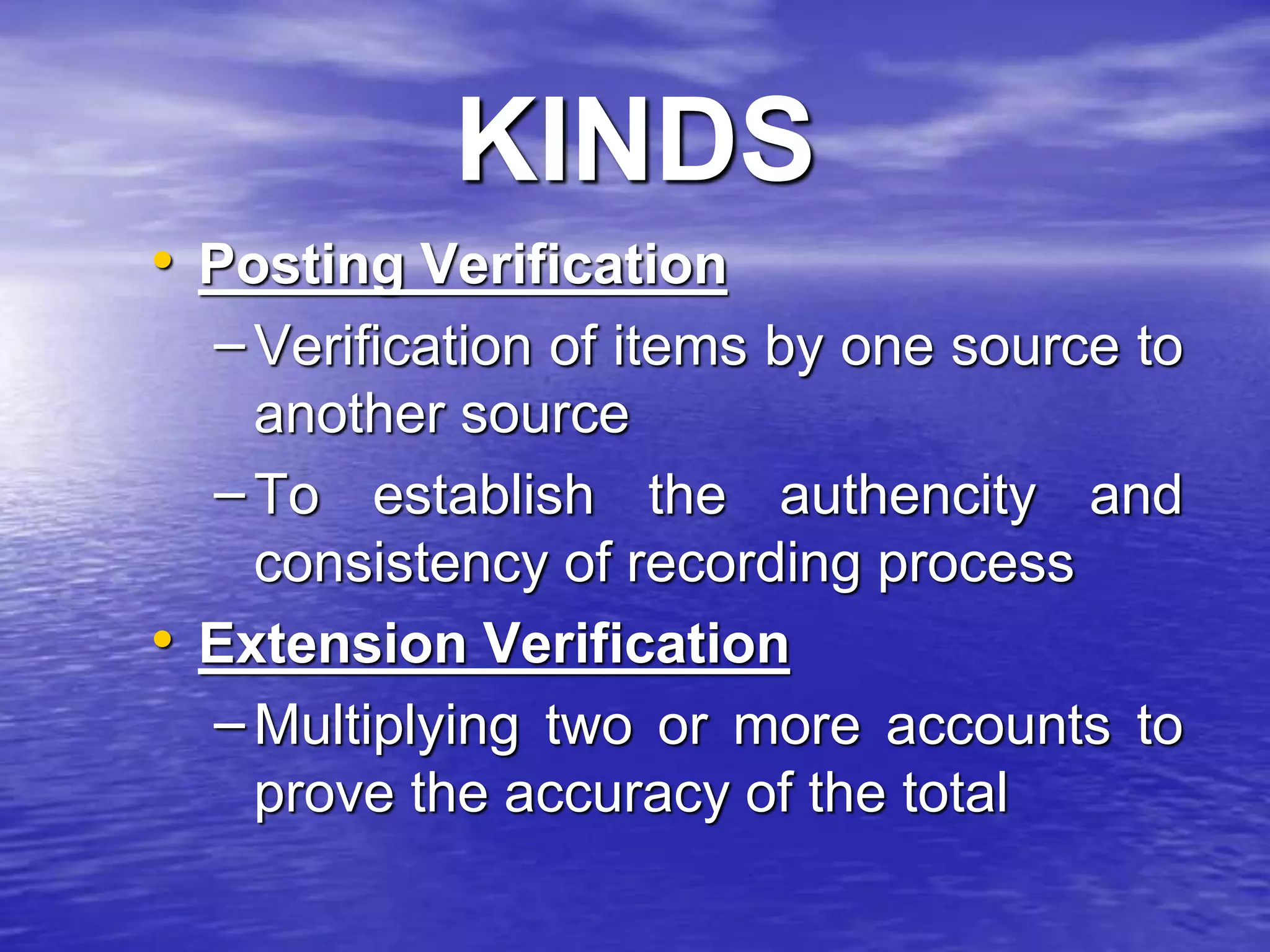
• Posting Verification
– Verification of items by one source to
another source
– To establish the authencity and
consistency of recording process
• Extension Verification
– Multiplying two or more accounts to
prove the accuracy of the total
KINDS
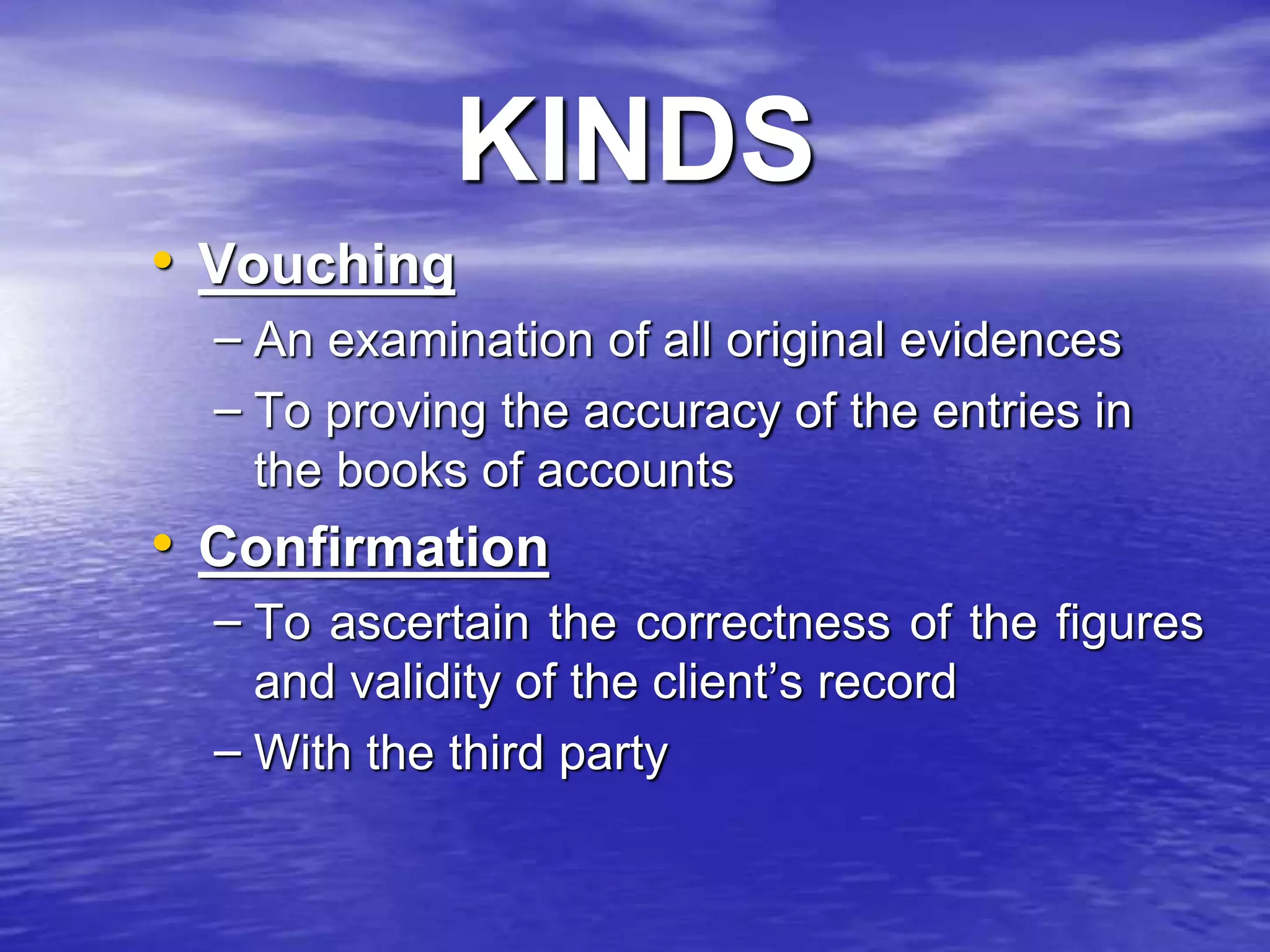
• Vouching
– An examination of all original evidences
– To proving the accuracy of the entries in
the books of accounts
• Confirmation
– To ascertain the correctness of the figures
and validity of the client’s record
– With the third party
KINDS
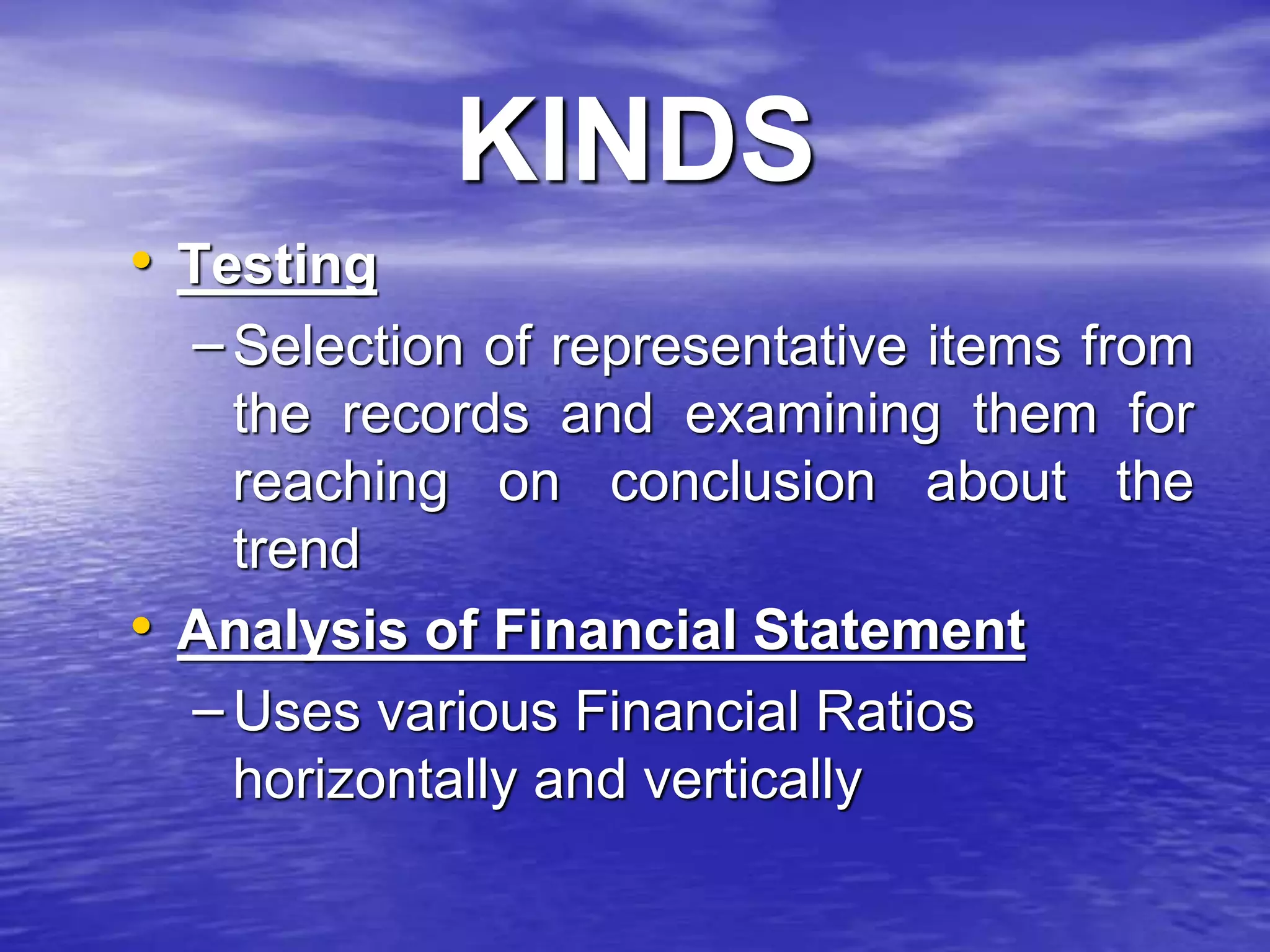
• Testing
– Selection of representative items from
the records and examining them for
reaching on conclusion about the
trend
• Analysis of Financial Statement
– Uses various Financial Ratios
horizontally and vertically
KINDS• Physical Examination
– Includes inspection, counting,
identification and measurement of
quantity
– May observe the process of
stocktaking
• Reconciliation
– Reconcile two or more related items if
they are not agree or match with each
other
KINDS
• TESTING
– Selection of representative items from
the records and examining them for
reaching a conclusion about trend of
activity.
– Items must be sufficiently
representative of whole data.
• Analysis of Financial Statements
– Financial ratios
– Horizontal and Vertical comparison
– Relationship with Industry averages
KINDS
• Documentary Examination
– Same as Vouching in nature
– To examine the adequacy and
reliability
• Scanning
– Make a wide search to find out which
of the entries are regular, consistent
and logical
KINDS
• Observation
– Observe the various policies and
procedures or plans followed by the
client
• Flow Charting
– To describe graphically the issue of
transactions through different stages
KINDS
• Inspection
– Arrange an inspection of the client’s
office, plant, branches etc.
– To obtain the understanding of plant
layout, manufacturing processes,
product, control and safeguard of
inventories etc.
– Should inspect before examination and
review
OTHERS
• Enquiry
• Computation
• Management Representation
• Sampling Techniques
• Compliance Techniques
• Substantive Testing
• Analytical Review
• Computer Assisted Accounting Techniques
Obtaining Management
Representation
• Important evidence in form of
– summary of oral discussions with
management
– Written representation from management
• Should be addressed to the auditor
contain Specified information
• Its procedure must be agreed with client
in early stage of audit.
Audit sampling techniques
• Audit sampling technique is the application
of a compliance or substantive procedure
to less than 100% of the items within an
account or class of transaction to enable
the auditor to obtain and evaluate
evidence of some characteristics of the
entire class and enable the auditor to form
a conclusion concerning the whole class.
Design of the sample
• Audit objectives
• Population
• Risk and assurance
• Tolerable errors
• Expecting errors in the population
• Sratification
Evaluation of the sample
• Analyse any errors detected in the sample
• Project the errors found in the sample to
the population
• Assess the sampling
Compliance test
• Compliance tests are the proceduers
desugned to obtain reasonable assurance
of the internal control, that it is effective
and reliable
• These tests include procedures requiring
inspections of documents suporting
transactions to gain evidence that control
have operated properly.
Substantive test
• Substantive tests are those tests of
transactions and balances and other
procedures which privides audit evidence
as to the completeness, accuracy and
validity of the information contain in the
accounting records or in the financial
statements., like analytical review
Methods of substantive test:
1. Inspection of the documents
2. Inspection of assets
3. Direct confirmations
4. Reperformance of
computations
6. audit techniques

6. audit techniques

  • 1.
  • 2.
    INTRODUCTION Audit techniques aretools, methods or processes by means of which an auditor collects necessary evidence to support his opinion in respect of the propositions or assertions submitted by the client to him for his examination.
  • 3.
    AUDIT PROCEDURES • Auditprocedures are ways of applying techniques to particular phase of an audit. • Generally, the attainment of the audit objectives required the collection of the evidence to support a decision.
  • 4.
    Kinds of audittechniques • Posting verification • Extension verification • Vouching • Confirmations • Physical examination • Reconciliation • Testing
  • 5.
    Kinds of audittechniques • Analysis of financial statements • Scanning • Documentary examination • Flow charting • Electronic data processing • Inspection • Observation
  • 6.
    Kinds of audittechniques • Enquiry • Computations • Management representations • Sampling techniques • Compliance test • Substantive tests • Analytical review • Use of computer- assisted audit techniques
  • 7.
    KINDS • Posting Verification –Verification of items by one source to another source – To establish the authencity and consistency of recording process • Extension Verification – Multiplying two or more accounts to prove the accuracy of the total
  • 8.
    KINDS • Vouching – Anexamination of all original evidences – To proving the accuracy of the entries in the books of accounts • Confirmation – To ascertain the correctness of the figures and validity of the client’s record – With the third party
  • 9.
    KINDS • Testing – Selectionof representative items from the records and examining them for reaching on conclusion about the trend • Analysis of Financial Statement – Uses various Financial Ratios horizontally and vertically
  • 10.
    KINDS• Physical Examination –Includes inspection, counting, identification and measurement of quantity – May observe the process of stocktaking • Reconciliation – Reconcile two or more related items if they are not agree or match with each other
  • 11.
    KINDS • TESTING – Selectionof representative items from the records and examining them for reaching a conclusion about trend of activity. – Items must be sufficiently representative of whole data. • Analysis of Financial Statements – Financial ratios – Horizontal and Vertical comparison – Relationship with Industry averages
  • 12.
    KINDS • Documentary Examination –Same as Vouching in nature – To examine the adequacy and reliability • Scanning – Make a wide search to find out which of the entries are regular, consistent and logical
  • 13.
    KINDS • Observation – Observethe various policies and procedures or plans followed by the client • Flow Charting – To describe graphically the issue of transactions through different stages
  • 14.
    KINDS • Inspection – Arrangean inspection of the client’s office, plant, branches etc. – To obtain the understanding of plant layout, manufacturing processes, product, control and safeguard of inventories etc. – Should inspect before examination and review
  • 15.
    OTHERS • Enquiry • Computation •Management Representation • Sampling Techniques • Compliance Techniques • Substantive Testing • Analytical Review • Computer Assisted Accounting Techniques
  • 16.
    Obtaining Management Representation • Importantevidence in form of – summary of oral discussions with management – Written representation from management • Should be addressed to the auditor contain Specified information • Its procedure must be agreed with client in early stage of audit.
  • 17.
    Audit sampling techniques •Audit sampling technique is the application of a compliance or substantive procedure to less than 100% of the items within an account or class of transaction to enable the auditor to obtain and evaluate evidence of some characteristics of the entire class and enable the auditor to form a conclusion concerning the whole class.
  • 18.
    Design of thesample • Audit objectives • Population • Risk and assurance • Tolerable errors • Expecting errors in the population • Sratification
  • 19.
    Evaluation of thesample • Analyse any errors detected in the sample • Project the errors found in the sample to the population • Assess the sampling
  • 20.
    Compliance test • Compliancetests are the proceduers desugned to obtain reasonable assurance of the internal control, that it is effective and reliable • These tests include procedures requiring inspections of documents suporting transactions to gain evidence that control have operated properly.
  • 21.
    Substantive test • Substantivetests are those tests of transactions and balances and other procedures which privides audit evidence as to the completeness, accuracy and validity of the information contain in the accounting records or in the financial statements., like analytical review
  • 22.
    Methods of substantivetest: 1. Inspection of the documents 2. Inspection of assets 3. Direct confirmations 4. Reperformance of computations