INTERNAL CONTROL
 Internal control is a process effected by plan
management, BOD and other personnel, and those
charged with governance, and designed to provide
reasonable assurance regarding the achievement of
objectives in the following categories :-
 reliability of financial reporting.
 Compliance with laws & regulations.
 Effectiveness & efficiency of operations.
 Internal Control is also necessary for survival of an
organization's success.
 A system of controls, financial and otherwise
established by management in order to carry on the
business of the company in an orderly and efficient
manner to ensure the adherence to management
policies, safeguard the assets, and secure as much as
possible the completeness of an internal control system
– De Paula
 Internal controls as a system comprising of controls
environment and procedures. It includes polices and
ways adapted by management of an enterprise to assist
it in achieving its objectives – The International
standards of Auditors.
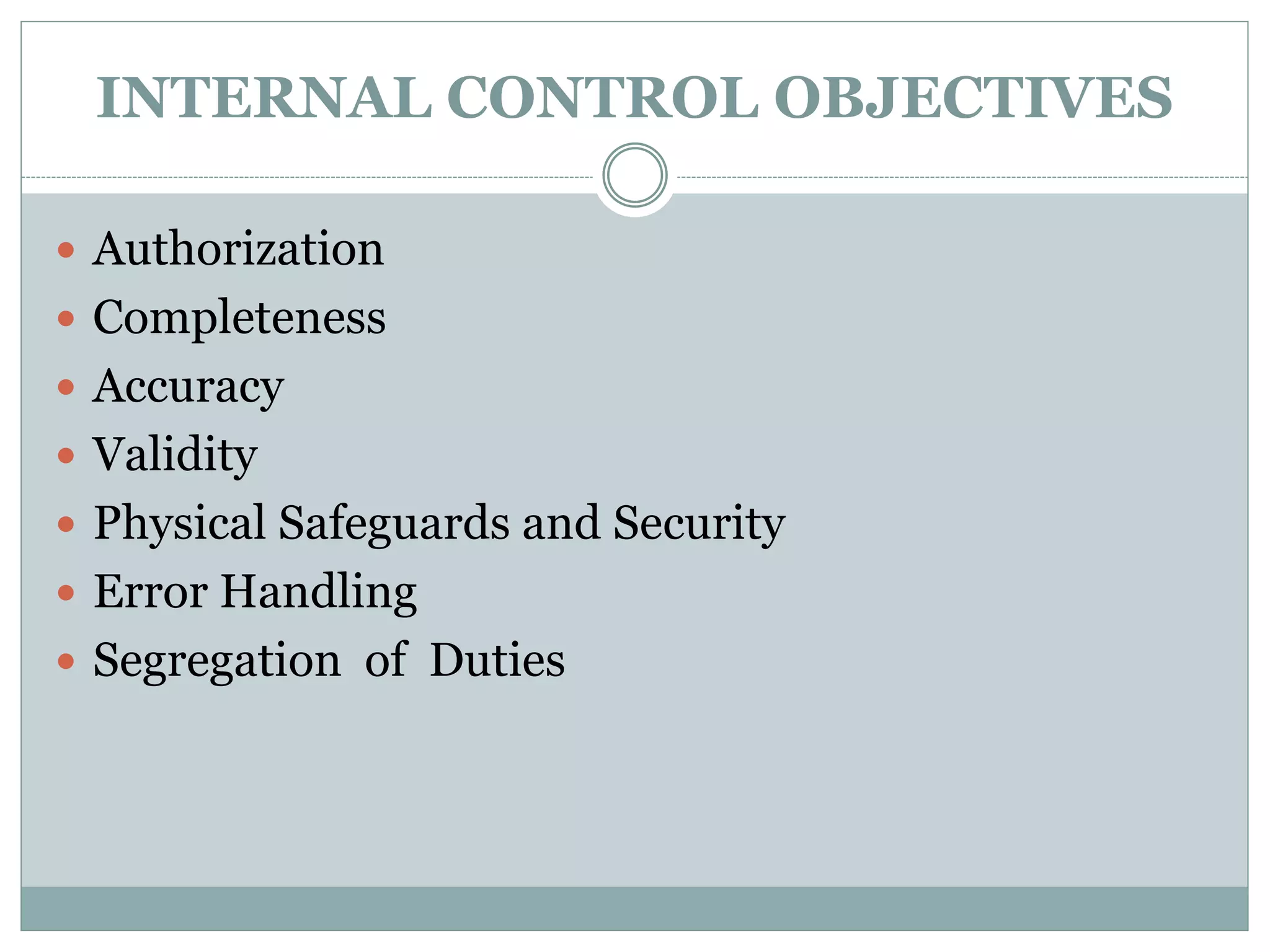
INTERNAL CONTROL OBJECTIVES
 Authorization
 Completeness
 Accuracy
 Validity
 Physical Safeguards and Security
 Error Handling
 Segregation of Duties
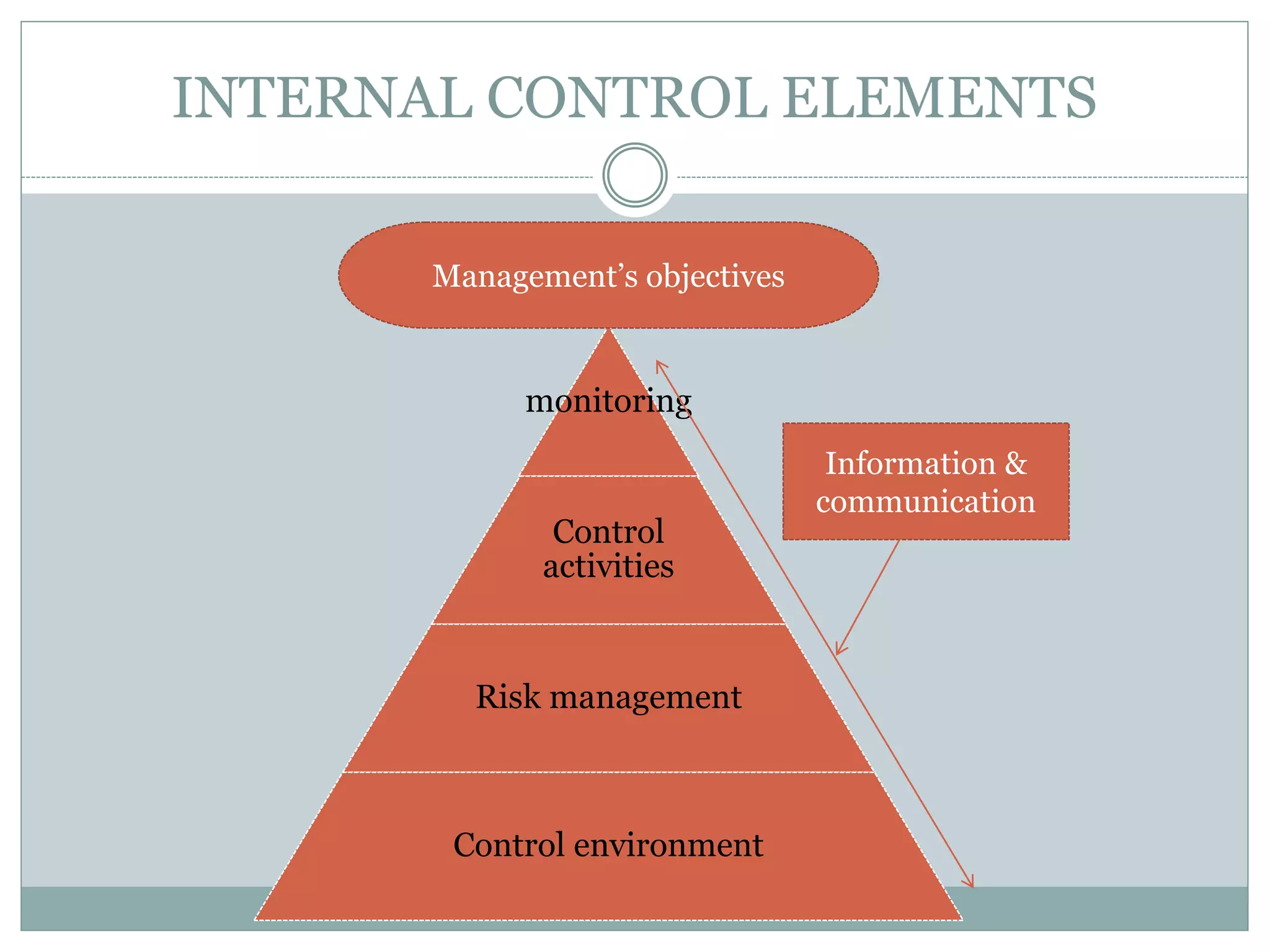
INTERNAL CONTROL ELEMENTS
monitoring
Control
activities
Risk management
Control environment
Management’s objectives
Information &
communication
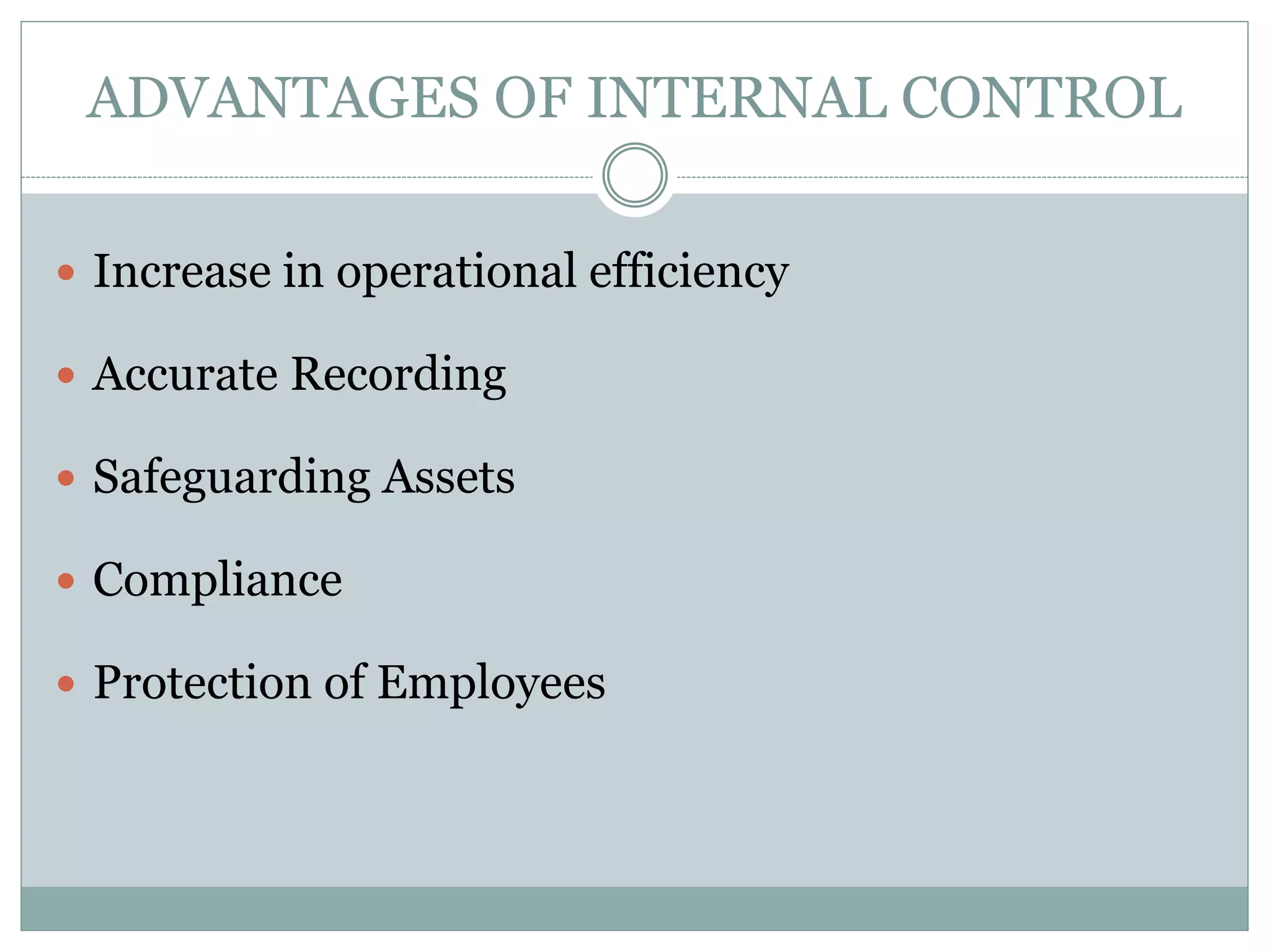
ADVANTAGES OF INTERNAL CONTROL
 Increase in operational efficiency
 Accurate Recording
 Safeguarding Assets
 Compliance
 Protection of Employees
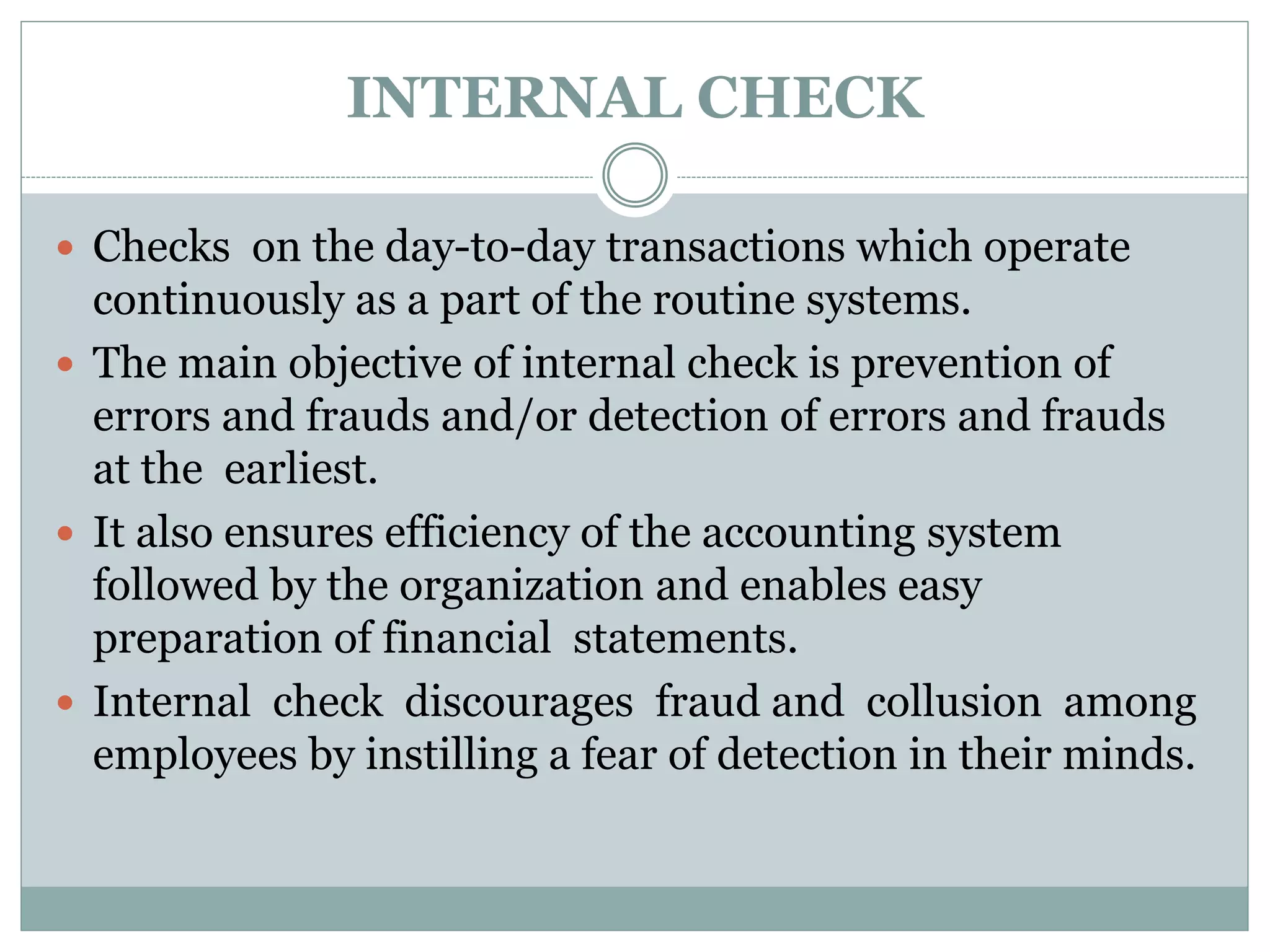
INTERNAL CHECK
 Checks on the day-to-day transactions which operate
continuously as a part of the routine systems.
 The main objective of internal check is prevention of
errors and frauds and/or detection of errors and frauds
at the earliest.
 It also ensures efficiency of the accounting system
followed by the organization and enables easy
preparation of financial statements.
 Internal check discourages fraud and collusion among
employees by instilling a fear of detection in their minds.
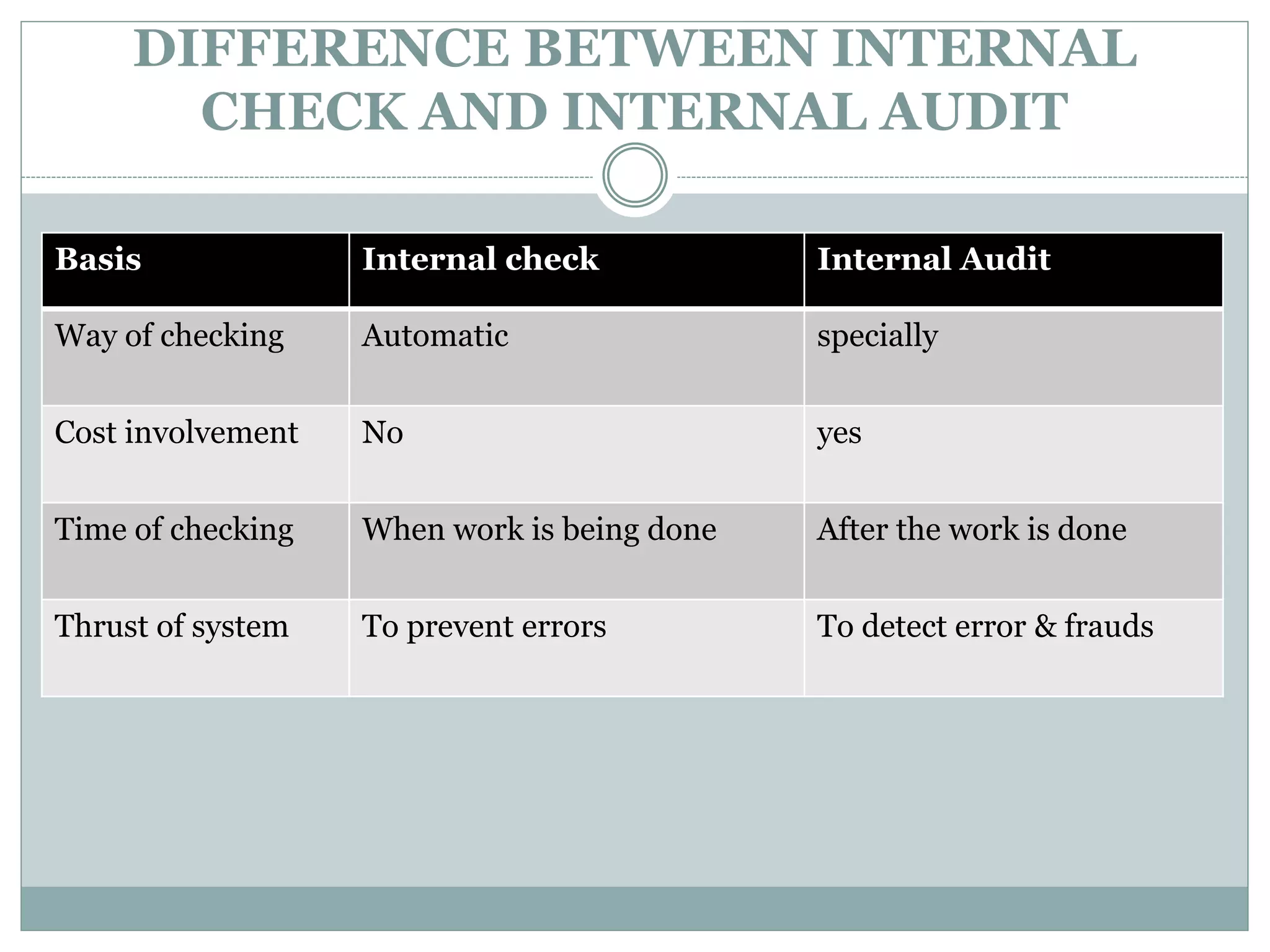
DIFFERENCE BETWEEN INTERNAL
CHECK AND INTERNAL AUDIT
Basis Internal check Internal Audit
Way of checking Automatic specially
Cost involvement No yes
Time of checking When work is being done After the work is done
Thrust of system To prevent errors To detect error & frauds
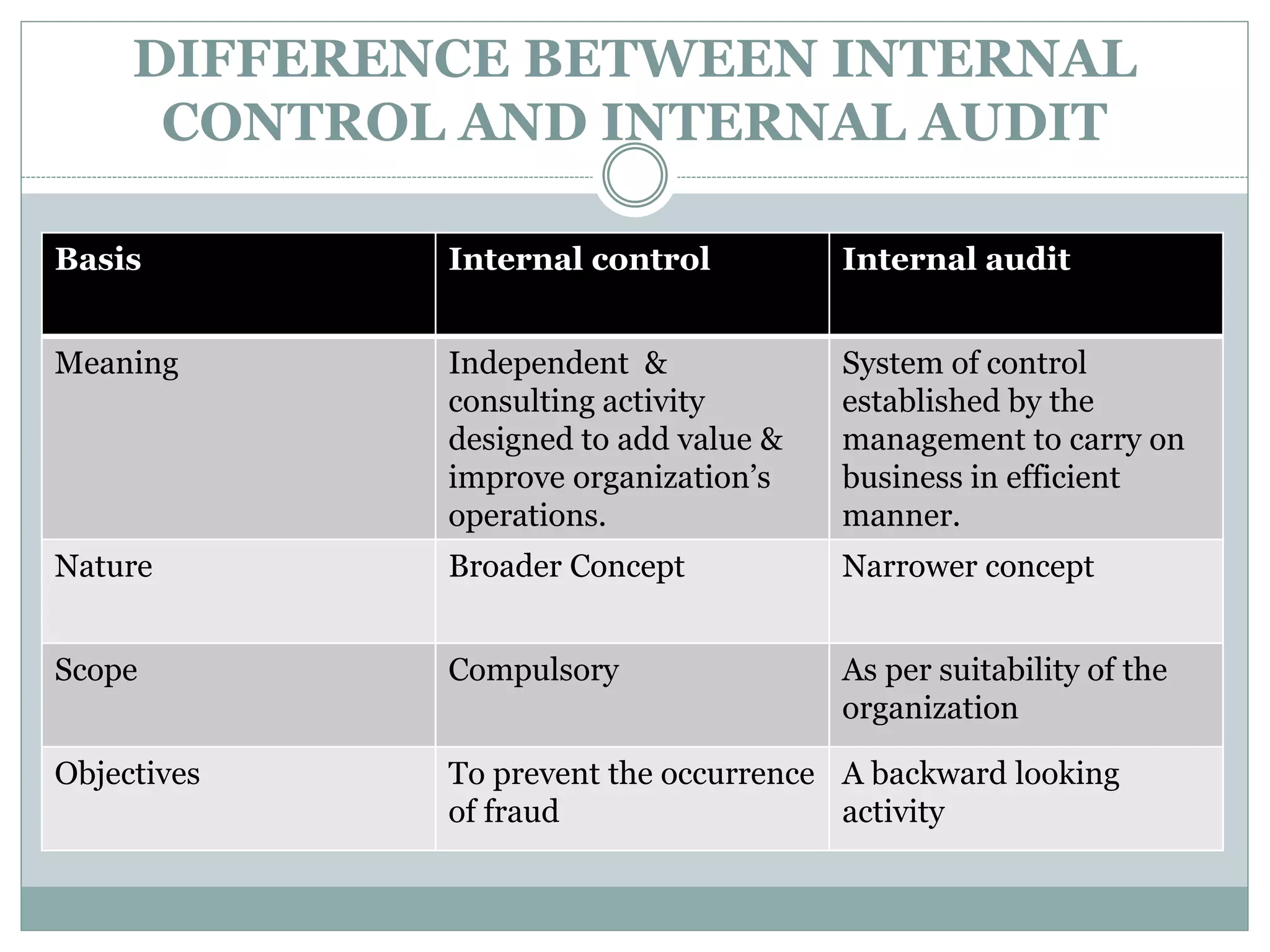
DIFFERENCE BETWEEN INTERNAL
CONTROL AND INTERNAL AUDIT
Basis Internal control Internal audit
Meaning Independent &
consulting activity
designed to add value &
improve organization’s
operations.
System of control
established by the
management to carry on
business in efficient
manner.
Nature Broader Concept Narrower concept
Scope Compulsory As per suitability of the
organization
Objectives To prevent the occurrence
of fraud
A backward looking
activity
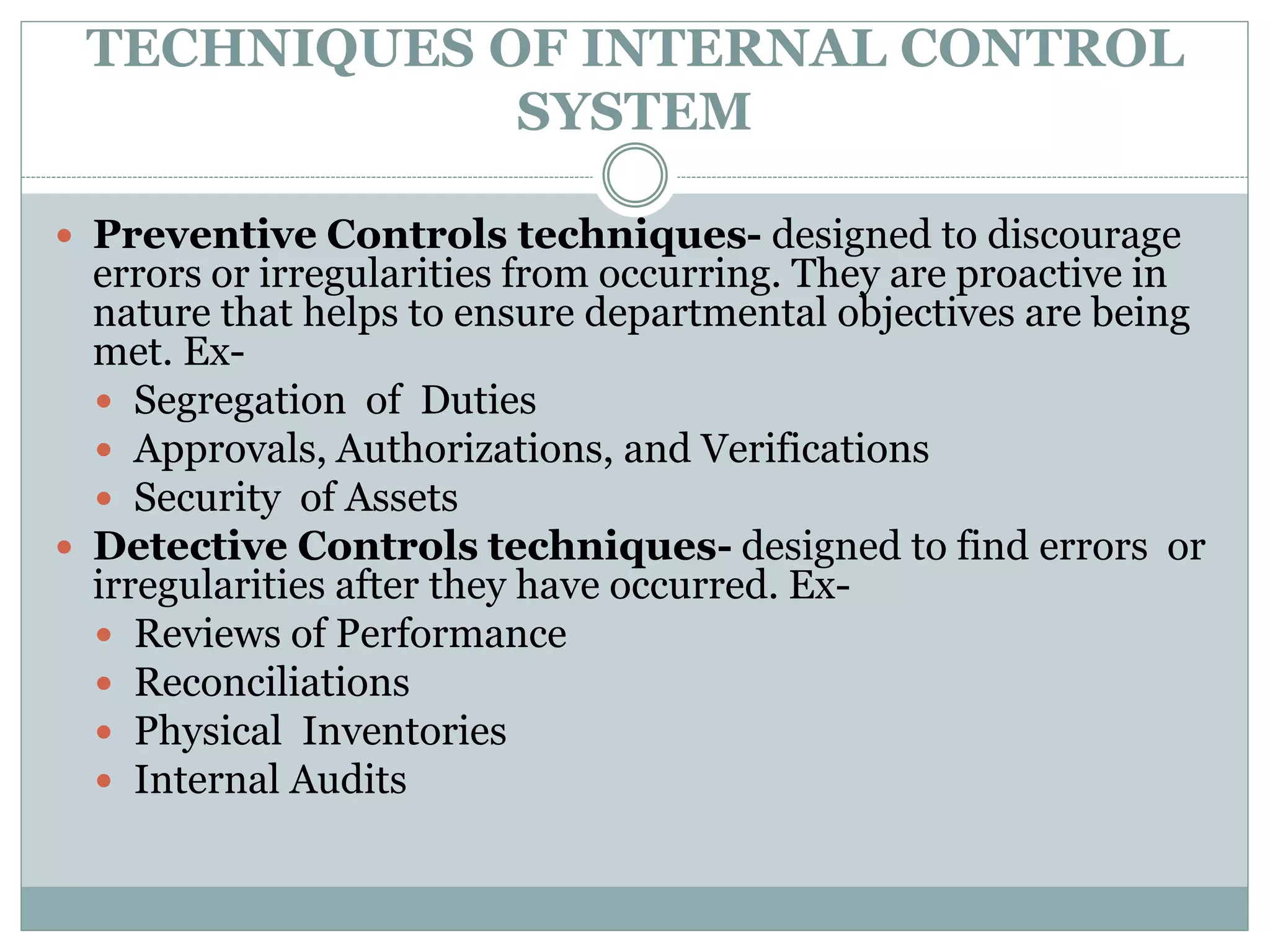
TECHNIQUES OF INTERNAL CONTROL
SYSTEM
 Preventive Controls techniques- designed to discourage
errors or irregularities from occurring. They are proactive in
nature that helps to ensure departmental objectives are being
met. Ex-
 Segregation of Duties
 Approvals, Authorizations, and Verifications
 Security of Assets
 Detective Controls techniques- designed to find errors or
irregularities after they have occurred. Ex-
 Reviews of Performance
 Reconciliations
 Physical Inventories
 Internal Audits
AUDIT TESTING
 An audit test is a procedure performed by either an
external or internal auditor in order to assess the
accuracy of various financial statement assertions. The
two common categorizations of audit tests are
substantive tests and tests of internal controls
 A substantive audit test is a direct test that validates a
financial statement balance, while internal control tests
are focused on key controls, such as management
reviews or standardized templates that are designed
to prevent and detect material misstatements
 Audit tests typically are performed on a sample basis
over an existing group of similar transactions. Sampling
approaches can either be statistical or non-statistical.
SAMPLING IN AUDIT TESTING
 a process of selecting a subset of a population of items for
the purpose of making inferences to the whole
population.
Need for Audit Sampling
1. Developing a consistent approach to audit areas;
2. Providing a framework within which sufficient audit
evidence is obtained;
3. Forcing clarification of audit thinking in determining
how the audit objectives will be met;
4. Minimizing the risk of over-auditing; and
5. Facilitating more expeditious review of working papers
STATISTICAL SAMPLING IN AUDIT
 Statistical sampling involves the random selection of a
number of items for inspection and is endorsed by the
accountancy bodies.
 In statistical sampling, each item has a calculable chance of
being selected.
 Statistical sampling allows an auditor’s judgment to be
concentrated on those areas of the audit where it is most
needed.
 It allows the quantification of key factors and the risk of
errors.
 This is not to suggest that statistical sampling methods
remove the need for professional judgment, but rather that
they allow elements of the evaluation process to be quantified,
measured and controlled.
INTER-FIRM COMPARISON
 It is technique of evaluating the performance, efficiency,
costs and profits of firms in an industry.
 It consists of voluntary exchange of information/data
concerning costs, prices, profits, productivity and overall
efficiency among firms engaged in similar type of operations
for the purpose of bringing improvement in efficiency and
indicating the weaknesses. Such a comparison will be possible
where uniform costing is in operation.
 An inter-firm comparison indicates the efficiency of
production and selling, adequacy of profits, weak spots in the
organization, etc. and thus demands from the firm’s
management an immediate suitable action.
 Such a comparison may be carried out in electrical industry,
printing firms, cotton spinning firms, pharmaceuticals, cycle
manufacturing, etc.
INTRA-FIRM COMPARISON
 comparison among different units/products/strategic
business unit (SBU) of a firm.
 This comparison is possible only when uniform
costing methods and practices are being adopted by all
units and SBUs.
 Intra firm comparison helps the management in
identifying the units/Strategic SBUs which have not been
performing as per the internal benchmark or standards
achieved by other units SBUs.
 This comparison is difficult sometime when the firm is
dealing in different product/sectors and their working
conditions are significantly different.
AUDIT IN DEPTH
 checking a transaction extensively from origin to
end.
 It is an audit technique which is used to evaluate the
effectiveness of internal control system in an
organization.
 It is used in investigation exercises whereby the
objective is to thorough examination of transactions
or records.
 Also known as vertical vouching as against
horizontal vouching.

Internal control

  • 1.
    INTERNAL CONTROL  Internalcontrol is a process effected by plan management, BOD and other personnel, and those charged with governance, and designed to provide reasonable assurance regarding the achievement of objectives in the following categories :-  reliability of financial reporting.  Compliance with laws & regulations.  Effectiveness & efficiency of operations.  Internal Control is also necessary for survival of an organization's success.
  • 2.
     A systemof controls, financial and otherwise established by management in order to carry on the business of the company in an orderly and efficient manner to ensure the adherence to management policies, safeguard the assets, and secure as much as possible the completeness of an internal control system – De Paula  Internal controls as a system comprising of controls environment and procedures. It includes polices and ways adapted by management of an enterprise to assist it in achieving its objectives – The International standards of Auditors.
  • 3.
    INTERNAL CONTROL OBJECTIVES Authorization  Completeness  Accuracy  Validity  Physical Safeguards and Security  Error Handling  Segregation of Duties
  • 4.
    INTERNAL CONTROL ELEMENTS monitoring Control activities Riskmanagement Control environment Management’s objectives Information & communication
  • 5.
    ADVANTAGES OF INTERNALCONTROL  Increase in operational efficiency  Accurate Recording  Safeguarding Assets  Compliance  Protection of Employees
  • 6.
    INTERNAL CHECK  Checkson the day-to-day transactions which operate continuously as a part of the routine systems.  The main objective of internal check is prevention of errors and frauds and/or detection of errors and frauds at the earliest.  It also ensures efficiency of the accounting system followed by the organization and enables easy preparation of financial statements.  Internal check discourages fraud and collusion among employees by instilling a fear of detection in their minds.
  • 7.
    DIFFERENCE BETWEEN INTERNAL CHECKAND INTERNAL AUDIT Basis Internal check Internal Audit Way of checking Automatic specially Cost involvement No yes Time of checking When work is being done After the work is done Thrust of system To prevent errors To detect error & frauds
  • 8.
    DIFFERENCE BETWEEN INTERNAL CONTROLAND INTERNAL AUDIT Basis Internal control Internal audit Meaning Independent & consulting activity designed to add value & improve organization’s operations. System of control established by the management to carry on business in efficient manner. Nature Broader Concept Narrower concept Scope Compulsory As per suitability of the organization Objectives To prevent the occurrence of fraud A backward looking activity
  • 9.
    TECHNIQUES OF INTERNALCONTROL SYSTEM  Preventive Controls techniques- designed to discourage errors or irregularities from occurring. They are proactive in nature that helps to ensure departmental objectives are being met. Ex-  Segregation of Duties  Approvals, Authorizations, and Verifications  Security of Assets  Detective Controls techniques- designed to find errors or irregularities after they have occurred. Ex-  Reviews of Performance  Reconciliations  Physical Inventories  Internal Audits
  • 10.
    AUDIT TESTING  Anaudit test is a procedure performed by either an external or internal auditor in order to assess the accuracy of various financial statement assertions. The two common categorizations of audit tests are substantive tests and tests of internal controls  A substantive audit test is a direct test that validates a financial statement balance, while internal control tests are focused on key controls, such as management reviews or standardized templates that are designed to prevent and detect material misstatements  Audit tests typically are performed on a sample basis over an existing group of similar transactions. Sampling approaches can either be statistical or non-statistical.
  • 11.
    SAMPLING IN AUDITTESTING  a process of selecting a subset of a population of items for the purpose of making inferences to the whole population. Need for Audit Sampling 1. Developing a consistent approach to audit areas; 2. Providing a framework within which sufficient audit evidence is obtained; 3. Forcing clarification of audit thinking in determining how the audit objectives will be met; 4. Minimizing the risk of over-auditing; and 5. Facilitating more expeditious review of working papers
  • 12.
    STATISTICAL SAMPLING INAUDIT  Statistical sampling involves the random selection of a number of items for inspection and is endorsed by the accountancy bodies.  In statistical sampling, each item has a calculable chance of being selected.  Statistical sampling allows an auditor’s judgment to be concentrated on those areas of the audit where it is most needed.  It allows the quantification of key factors and the risk of errors.  This is not to suggest that statistical sampling methods remove the need for professional judgment, but rather that they allow elements of the evaluation process to be quantified, measured and controlled.
  • 13.
    INTER-FIRM COMPARISON  Itis technique of evaluating the performance, efficiency, costs and profits of firms in an industry.  It consists of voluntary exchange of information/data concerning costs, prices, profits, productivity and overall efficiency among firms engaged in similar type of operations for the purpose of bringing improvement in efficiency and indicating the weaknesses. Such a comparison will be possible where uniform costing is in operation.  An inter-firm comparison indicates the efficiency of production and selling, adequacy of profits, weak spots in the organization, etc. and thus demands from the firm’s management an immediate suitable action.  Such a comparison may be carried out in electrical industry, printing firms, cotton spinning firms, pharmaceuticals, cycle manufacturing, etc.
  • 14.
    INTRA-FIRM COMPARISON  comparisonamong different units/products/strategic business unit (SBU) of a firm.  This comparison is possible only when uniform costing methods and practices are being adopted by all units and SBUs.  Intra firm comparison helps the management in identifying the units/Strategic SBUs which have not been performing as per the internal benchmark or standards achieved by other units SBUs.  This comparison is difficult sometime when the firm is dealing in different product/sectors and their working conditions are significantly different.
  • 15.
    AUDIT IN DEPTH checking a transaction extensively from origin to end.  It is an audit technique which is used to evaluate the effectiveness of internal control system in an organization.  It is used in investigation exercises whereby the objective is to thorough examination of transactions or records.  Also known as vertical vouching as against horizontal vouching.