BY
Atta-ur-Rahman Arif
MEANING
The information obtained by the auditor
in arriving at the conclusions on which
the audit opinion is based.
It comprise source documents and
accounting records underlying the
financial statements and corroborating
information from other sources.
OBJECTIVE
The auditor should obtain Sufficient
and Appropriate Audit Evidence to
be able to draw reasonable
conclusions on which to base the
audit opinion.
Sufficient and Appropriate Audit
Evidence
Sufficiency is the measure of quantity
of audit evidence.
Appropriateness is the measure the
quality of audit evidence and its
relevance to a particular assertion and
reliability.
Sufficient and Appropriate Audit
Evidence
 Factors which are influenced to the judgment of auditor
regarding sufficient appropriate audit evidence:
 Nature and level of Inherent Risk
 Nature of the Accounting and Internal Control System and
Control Risk
 Materiality of the item being examined
 Experience gained during previous audit
 Results of audit procedures
 Source and reliability of information available
Questions to form an opinion and reporting
Financial Statements
 Balance Sheet Items:
 Have all of the assets and liabilities been recorded?
 Do the recorded assets and liabilities exist?
 Are the Assets owned and liabilities are belongs to
Enterprise?
 Have the amounts arrived at in accordance with the
policies?
 Have all the items (A/L/E/R) properly disclosed?
Questions to form an opinion and
reporting Financial Statements
 Profit and Loss Accounts:
 Have all income and expenses been recorded?
 Did the recorded income and expense transactions in fact
occur?
 Have the income and expenses been measured in
accordance with the a/c policies?
 Have income and expenses been properly disclosed where
appropriate?
SOURCES
TEST OF CONTROL
Test performed to obtain audit evidence about the
suitability of design and effective operation of
the accounting and internal control systems.
SUBSTANTIVE PROCEDURES
Test performed to obtain audit evidence to detect
material misstatement in the financial statements by
tests of details of transactions and balances, and
analytical procedures.
FINANCIAL STATEMENTS
ASSERTIONS
 Assertions are the representations of the
management, explicit or otherwise, in the financial
statements.
 They can be categorized as follows:
1. Existence:
An asset or a liability exists at a given date.
2. Rights & Obligations
An asset or a liability pertains to the entity at a given
date.
3. Occurrence:
A transaction or event took place actually incurred
during the accounting period.
4. Completeness:
There are no unrecorded assets, liabilities, transactions
or events, or undisclosed items.
FINANCIAL STATEMENTS
ASSERTIONS
5. Valuation:
An asset or liability is recorded at an appropriate
carrying value.
6. Measurement:
A transaction or event is recorded at the proper amount
and revenue or expense is allocated to the proper period.
FINANCIAL STATEMENTS
ASSERTIONS
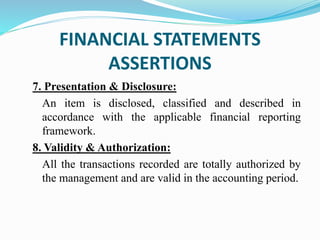
7. Presentation & Disclosure:
An item is disclosed, classified and described in
accordance with the applicable financial reporting
framework.
8. Validity & Authorization:
All the transactions recorded are totally authorized by
the management and are valid in the accounting period.
FINANCIAL STATEMENTS
ASSERTIONS
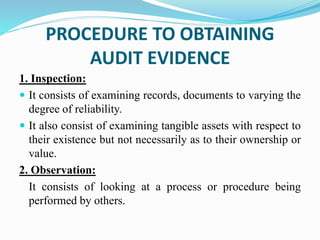
PROCEDURE TO OBTAINING
AUDIT EVIDENCE
1. Inspection:
 It consists of examining records, documents to varying the
degree of reliability.
 It also consist of examining tangible assets with respect to
their existence but not necessarily as to their ownership or
value.
2. Observation:
It consists of looking at a process or procedure being
performed by others.
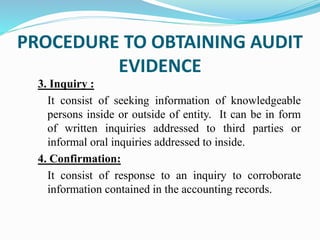
3. Inquiry :
It consist of seeking information of knowledgeable
persons inside or outside of entity. It can be in form
of written inquiries addressed to third parties or
informal oral inquiries addressed to inside.
4. Confirmation:
It consist of response to an inquiry to corroborate
information contained in the accounting records.
PROCEDURE TO OBTAINING AUDIT
EVIDENCE
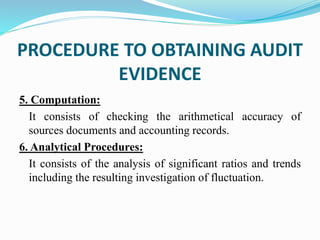
5. Computation:
It consists of checking the arithmetical accuracy of
sources documents and accounting records.
6. Analytical Procedures:
It consists of the analysis of significant ratios and trends
including the resulting investigation of fluctuation.
PROCEDURE TO OBTAINING AUDIT
EVIDENCE
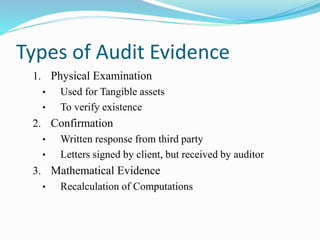
Types of Audit Evidence
1. Physical Examination
• Used for Tangible assets
• To verify existence
2. Confirmation
• Written response from third party
• Letters signed by client, but received by auditor
3. Mathematical Evidence
• Recalculation of Computations
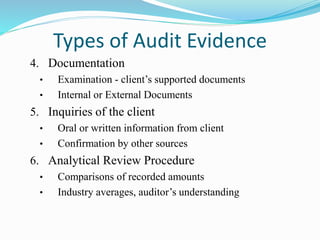
Types of Audit Evidence
4. Documentation
• Examination - client’s supported documents
• Internal or External Documents
5. Inquiries of the client
• Oral or written information from client
• Confirmation by other sources
6. Analytical Review Procedure
• Comparisons of recorded amounts
• Industry averages, auditor’s understanding
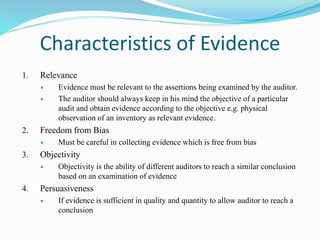
Characteristics of Evidence
1. Relevance
 Evidence must be relevant to the assertions being examined by the auditor.
 The auditor should always keep in his mind the objective of a particular
audit and obtain evidence according to the objective e.g. physical
observation of an inventory as relevant evidence.
2. Freedom from Bias
 Must be careful in collecting evidence which is free from bias
3. Objectivity
 Objectivity is the ability of different auditors to reach a similar conclusion
based on an examination of evidence
4. Persuasiveness
 If evidence is sufficient in quality and quantity to allow auditor to reach a
conclusion

9. audit evidence

  • 1.
  • 2.
    MEANING The information obtainedby the auditor in arriving at the conclusions on which the audit opinion is based. It comprise source documents and accounting records underlying the financial statements and corroborating information from other sources.
  • 3.
    OBJECTIVE The auditor shouldobtain Sufficient and Appropriate Audit Evidence to be able to draw reasonable conclusions on which to base the audit opinion.
  • 4.
    Sufficient and AppropriateAudit Evidence Sufficiency is the measure of quantity of audit evidence. Appropriateness is the measure the quality of audit evidence and its relevance to a particular assertion and reliability.
  • 5.
    Sufficient and AppropriateAudit Evidence  Factors which are influenced to the judgment of auditor regarding sufficient appropriate audit evidence:  Nature and level of Inherent Risk  Nature of the Accounting and Internal Control System and Control Risk  Materiality of the item being examined  Experience gained during previous audit  Results of audit procedures  Source and reliability of information available
  • 6.
    Questions to forman opinion and reporting Financial Statements  Balance Sheet Items:  Have all of the assets and liabilities been recorded?  Do the recorded assets and liabilities exist?  Are the Assets owned and liabilities are belongs to Enterprise?  Have the amounts arrived at in accordance with the policies?  Have all the items (A/L/E/R) properly disclosed?
  • 7.
    Questions to forman opinion and reporting Financial Statements  Profit and Loss Accounts:  Have all income and expenses been recorded?  Did the recorded income and expense transactions in fact occur?  Have the income and expenses been measured in accordance with the a/c policies?  Have income and expenses been properly disclosed where appropriate?
  • 8.
    SOURCES TEST OF CONTROL Testperformed to obtain audit evidence about the suitability of design and effective operation of the accounting and internal control systems. SUBSTANTIVE PROCEDURES Test performed to obtain audit evidence to detect material misstatement in the financial statements by tests of details of transactions and balances, and analytical procedures.
  • 9.
    FINANCIAL STATEMENTS ASSERTIONS  Assertionsare the representations of the management, explicit or otherwise, in the financial statements.  They can be categorized as follows: 1. Existence: An asset or a liability exists at a given date. 2. Rights & Obligations An asset or a liability pertains to the entity at a given date.
  • 10.
    3. Occurrence: A transactionor event took place actually incurred during the accounting period. 4. Completeness: There are no unrecorded assets, liabilities, transactions or events, or undisclosed items. FINANCIAL STATEMENTS ASSERTIONS
  • 11.
    5. Valuation: An assetor liability is recorded at an appropriate carrying value. 6. Measurement: A transaction or event is recorded at the proper amount and revenue or expense is allocated to the proper period. FINANCIAL STATEMENTS ASSERTIONS
  • 12.
    7. Presentation &Disclosure: An item is disclosed, classified and described in accordance with the applicable financial reporting framework. 8. Validity & Authorization: All the transactions recorded are totally authorized by the management and are valid in the accounting period. FINANCIAL STATEMENTS ASSERTIONS
  • 13.
    PROCEDURE TO OBTAINING AUDITEVIDENCE 1. Inspection:  It consists of examining records, documents to varying the degree of reliability.  It also consist of examining tangible assets with respect to their existence but not necessarily as to their ownership or value. 2. Observation: It consists of looking at a process or procedure being performed by others.
  • 14.
    3. Inquiry : Itconsist of seeking information of knowledgeable persons inside or outside of entity. It can be in form of written inquiries addressed to third parties or informal oral inquiries addressed to inside. 4. Confirmation: It consist of response to an inquiry to corroborate information contained in the accounting records. PROCEDURE TO OBTAINING AUDIT EVIDENCE
  • 15.
    5. Computation: It consistsof checking the arithmetical accuracy of sources documents and accounting records. 6. Analytical Procedures: It consists of the analysis of significant ratios and trends including the resulting investigation of fluctuation. PROCEDURE TO OBTAINING AUDIT EVIDENCE
  • 16.
    Types of AuditEvidence 1. Physical Examination • Used for Tangible assets • To verify existence 2. Confirmation • Written response from third party • Letters signed by client, but received by auditor 3. Mathematical Evidence • Recalculation of Computations
  • 17.
    Types of AuditEvidence 4. Documentation • Examination - client’s supported documents • Internal or External Documents 5. Inquiries of the client • Oral or written information from client • Confirmation by other sources 6. Analytical Review Procedure • Comparisons of recorded amounts • Industry averages, auditor’s understanding
  • 18.
    Characteristics of Evidence 1.Relevance  Evidence must be relevant to the assertions being examined by the auditor.  The auditor should always keep in his mind the objective of a particular audit and obtain evidence according to the objective e.g. physical observation of an inventory as relevant evidence. 2. Freedom from Bias  Must be careful in collecting evidence which is free from bias 3. Objectivity  Objectivity is the ability of different auditors to reach a similar conclusion based on an examination of evidence 4. Persuasiveness  If evidence is sufficient in quality and quantity to allow auditor to reach a conclusion