Internal Financial Control
www.apdoshi.com
Table of Contents
What is Internal Financial Control (IFC)?
What is Internal Financial Control Over Financial Reporting (ICFR)?
Who All Are Responsible?
Expressing an opinion on Internal Control – How will you do it?
How will IFC help beyond compliance
Key Objectives of Coverage
Key Highlights of the Guidance Note issued by ICAI
Penalties for Non compliance
How will A.P. Doshi & Co help for IFC ?
Why A.P. Doshi & Co. ?
Conclusion
What is Internal Financial Control (IFC)? (Section
134)
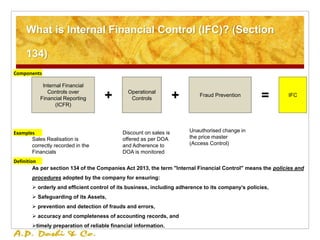
Internal Financial
Controls over
Financial Reporting
(ICFR)
+ Operational
Controls + Fraud Prevention
= IFC
Sales Realisation is
correctly recorded in the
Financials
Discount on sales is
offered as per DOA
and Adherence to
DOA is monitored
Unauthorised change in
the price master
(Access Control)
As per section 134 of the Companies Act 2013, the term "Internal Financial Control" means the policies and
procedures adopted by the company for ensuring:
 orderly and efficient control of its business, including adherence to its company’s policies,
 Safeguarding of its Assets,
 prevention and detection of frauds and errors,
 accuracy and completeness of accounting records, and
timely preparation of reliable financial information.
Components
Examples
Definition
What is Internal Financial Control over Financial
Reporting (ICFR) ? (Sec 143 - as per ICAI
Guidelines
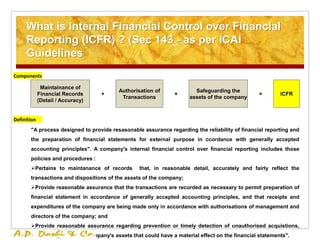
Maintainance of
Financial Records
(Detail / Accuracy)
+
Authorisation of
Transactions
+
Safeguarding the
assets of the company
= ICFR
"A process designed to provide resasonable assurance regarding the reliability of financial reporting and
the preparation of financial statements for external purpose in ccordance with generally accepted
accounting principles". A company's internal financial control over financial reporting includes those
policies and procedures :
Pertains to maintanance of records that, in reasonable detail, accurately and fairly reflect the
transactions and dispositions of the assets of the company;
Provide reasonable assurance that the transactions are recorded as necessary to permit preparation of
financial statement in accordance of generally accepted accounting principles, and that receipts and
expenditures of the company are being made only in accordance with authorisations of management and
directors of the company; and
Provide reasonable assurance regarding prevention or timely detection of unauthorised acquistions,
use, or disposition of company's assets that could have a material effect on the financial statements".
Components
Definition
The Companies Act 2013 – Who All Are
Responsible?
Section
134
Director’s
Responsibility
Statement
In the case of Listed Company, Director’s
Responsibility state that directors, have laid down IFC
to be followed by the company and that such controls
are adequate and operating effectively.
Section
143
Auditor Report The Auditor’s Report should also state whether the
company has adequate IFC system in place and
operating effectiveness of such controls.
Section
177
Audit
Committee
Audit Committee may call for comments of Auditor on
IFC before their submission to the board and may also
discuss any related issues with the internal & statutory
auditors and management of the company.
Sch IV Independent
Directors
The Independent Directors should satisfy themselves
on the integrity of financial information and ensure
that financial controls and systems of risk
management are robust and defensible
The Companies Act 2013 – Who All Are
Responsible?
Requirements
(Based on Previous Slide)
Public
Listed
Public Un-listed
Pvt Cos Paid Up
Share Capital >=
20Cr
Paid up Share
Capital >= 10
Cr
Turnover
>= 100Cr
Loans,
Borrowing in
aggregate >=
50Cr
1 Director's Responsibility
Statement (134)

2 Auditor's Report (143)     
3 Audit Committee (177)    
4 Independent Directors (Sch IV)    
5 Rule 8(5)(viii) of the companies
(Account) Rules 2014 - BOD
report - Financial Statement
only (ICFR only)
   
IFC
ICFR
ICFR
ICFR
ICFR
How will IFC help beyond compliance
?
 Help in business process re-designing to plug revenue leakages & cost containment
opportunities
 Helps in rationalizing the number of controls across organization – moving to smart and
automated controls
Helps in standardizing policies and procedures for multi-location / multi-business
companies
Foster a control conscious work culture for people behind controls
Provide assurance to the CEO / CFO as well as improves business performance
In some instances, also serves as base for blue print of optimal procedures while thinking
about ERP
Aimed at strengthening the process to further improve business, identify cost
containment opportunities as well as drive growth
Key Objectives of Coverage
 Assignment of responsibility, delegation of authority, segregation of duties and
establishment of related policies and procedures to provide a basis for
accountability and controls
 Assets and ownership interests exist at a specific date & Assets are the rights of the
entity at a specified date
 Enable proactive anti-fraud controls and a fraud risk management framework to
mitigate fraud risks to the company
 All transactions occurred during a specific period have been recorded & Assets,
liability, revenue and expense components are recorded at appropriate amounts
 Financial items are properly described, sorted and classified & Financial
information is provided as per the timelines defined by the relevant stakeholders
Key Highlights of the Guidance Note issued by
ICAI
Guidance note has indicated the presence of 5 internal
control components and operating together in an integrated
manner
There is no need to specifically adopt a particular
framework however the guidance note refers to SA
315 issued by ICAI at various places
Scope of internal financial controls is restricted to internal
controls over financial reporting only. However Boards still
need to comply provide their report on the operational
controls
Auditors reporting on internal controls over financial
reporting is applicable for all listed as well as unlisted
companies. No transition period for small and medium
enterprises
The auditor should report if the company has an adequate
internal control systems in place and whether they were
operating effectively as at the balance sheet date. Hence
does not apply to interim statements
The requirements are intended to apply in the case of
the consolidated financial statements. Foreign
subsidiaries may be excluded, however domestic
subsidiaries , JVs and associates registered as a
company under the companies act will be covered
Management should form a basis to document the
framework and substantiate the effectiveness of the
framework which forms a basis of evaluation by other
parties interacting with the entity, such as regulators,
auditors, or customers
Controls need to be defined at an Entity level as well
as Process level. IT and Fraud aspects need to be
covered in the framework. Once defined these
controls should confirm to their design and need to
operate effectively across all transactions.
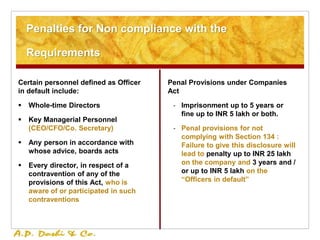
Penalties for Non compliance with the
Requirements
Certain personnel defined as Officer
in default include:
 Whole-time Directors
 Key Managerial Personnel
(CEO/CFO/Co. Secretary)
 Any person in accordance with
whose advice, boards acts
 Every director, in respect of a
contravention of any of the
provisions of this Act, who is
aware of or participated in such
contraventions
Penal Provisions under Companies
Act
‐ Imprisonment up to 5 years or
fine up to INR 5 lakh or both.
‐ Penal provisions for not
complying with Section 134 :
Failure to give this disclosure will
lead to penalty up to INR 25 lakh
on the company and 3 years and /
or up to INR 5 lakh on the
“Officers in default”
How will A.P. Doshi & Co help for IFC ?
 Perform a diagnostic review of existing Internal Control to evaluate whether it
meets the requirement of Companies Act, 2013 with respect to IFC and
identify the gaps & recommend how to fill the gap.
 Assisting in documentation of Internal Financial control at both levels at entity
level as well as process level including fraud controls (i.e. SOP Preparation)
 Assists post implementation to test the all implemented controls to check
whether it is being followed regularly and properly without any lapse. Apart
from this we shall provide training subsequent to IFC implementation.
 Helps management in complete implementation of of IFC framework from
planning to reporting by undertaking various activities as agreed by the
management.
 Helps in developing policies, Standard Operation Procedures with the help of
extensive templates.
Why A.P. Doshi & Co. ?
 Credibility: APD has extensive experience in carrying out IFC engagements
for clients with various business . We have a team of professionals with the
right skills and experience to cater to your requirements.
 Knowledge Centric: Our team possess an extensive knowledge of the typical
nature of exceptions noted during audit by auditors which can aid us to
identify the loopholes and crack the solutions at an early stage. Strong
analytical, problem solving and decision making skills to evaluate alternatives
and provide recommendations on business issues along with due care with
respect to compliance
 Ready Tools & Templates for Quick Development: APD’s ready process on
the internal control templates are delivered in both text and spreadsheet
formats so you can easily develop and print internal control checklists and
questionnaires assisting your organization in strengthening internal financial
control environment.
Contact Details
A . P. Doshi & Co. Chartered Accountants
D 613 / 614, Neelkanth Business Park,
Vidyavihar (West),Mumbai – 400 086.
# 022 2514 68 54 / 55 / 56
mitesh@apdoshi.com
amlesh@apdoshi.com
www.apdoshi.com
Thank You

Internal financial control

  • 1.
  • 2.
    Table of Contents Whatis Internal Financial Control (IFC)? What is Internal Financial Control Over Financial Reporting (ICFR)? Who All Are Responsible? Expressing an opinion on Internal Control – How will you do it? How will IFC help beyond compliance Key Objectives of Coverage Key Highlights of the Guidance Note issued by ICAI Penalties for Non compliance How will A.P. Doshi & Co help for IFC ? Why A.P. Doshi & Co. ? Conclusion
  • 3.
    What is InternalFinancial Control (IFC)? (Section 134) Internal Financial Controls over Financial Reporting (ICFR) + Operational Controls + Fraud Prevention = IFC Sales Realisation is correctly recorded in the Financials Discount on sales is offered as per DOA and Adherence to DOA is monitored Unauthorised change in the price master (Access Control) As per section 134 of the Companies Act 2013, the term "Internal Financial Control" means the policies and procedures adopted by the company for ensuring:  orderly and efficient control of its business, including adherence to its company’s policies,  Safeguarding of its Assets,  prevention and detection of frauds and errors,  accuracy and completeness of accounting records, and timely preparation of reliable financial information. Components Examples Definition
  • 4.
    What is InternalFinancial Control over Financial Reporting (ICFR) ? (Sec 143 - as per ICAI Guidelines Maintainance of Financial Records (Detail / Accuracy) + Authorisation of Transactions + Safeguarding the assets of the company = ICFR "A process designed to provide resasonable assurance regarding the reliability of financial reporting and the preparation of financial statements for external purpose in ccordance with generally accepted accounting principles". A company's internal financial control over financial reporting includes those policies and procedures : Pertains to maintanance of records that, in reasonable detail, accurately and fairly reflect the transactions and dispositions of the assets of the company; Provide reasonable assurance that the transactions are recorded as necessary to permit preparation of financial statement in accordance of generally accepted accounting principles, and that receipts and expenditures of the company are being made only in accordance with authorisations of management and directors of the company; and Provide reasonable assurance regarding prevention or timely detection of unauthorised acquistions, use, or disposition of company's assets that could have a material effect on the financial statements". Components Definition
  • 5.
    The Companies Act2013 – Who All Are Responsible? Section 134 Director’s Responsibility Statement In the case of Listed Company, Director’s Responsibility state that directors, have laid down IFC to be followed by the company and that such controls are adequate and operating effectively. Section 143 Auditor Report The Auditor’s Report should also state whether the company has adequate IFC system in place and operating effectiveness of such controls. Section 177 Audit Committee Audit Committee may call for comments of Auditor on IFC before their submission to the board and may also discuss any related issues with the internal & statutory auditors and management of the company. Sch IV Independent Directors The Independent Directors should satisfy themselves on the integrity of financial information and ensure that financial controls and systems of risk management are robust and defensible
  • 6.
    The Companies Act2013 – Who All Are Responsible? Requirements (Based on Previous Slide) Public Listed Public Un-listed Pvt Cos Paid Up Share Capital >= 20Cr Paid up Share Capital >= 10 Cr Turnover >= 100Cr Loans, Borrowing in aggregate >= 50Cr 1 Director's Responsibility Statement (134)  2 Auditor's Report (143)      3 Audit Committee (177)     4 Independent Directors (Sch IV)     5 Rule 8(5)(viii) of the companies (Account) Rules 2014 - BOD report - Financial Statement only (ICFR only)     IFC ICFR ICFR ICFR ICFR
  • 7.
    How will IFChelp beyond compliance ?  Help in business process re-designing to plug revenue leakages & cost containment opportunities  Helps in rationalizing the number of controls across organization – moving to smart and automated controls Helps in standardizing policies and procedures for multi-location / multi-business companies Foster a control conscious work culture for people behind controls Provide assurance to the CEO / CFO as well as improves business performance In some instances, also serves as base for blue print of optimal procedures while thinking about ERP Aimed at strengthening the process to further improve business, identify cost containment opportunities as well as drive growth
  • 8.
    Key Objectives ofCoverage  Assignment of responsibility, delegation of authority, segregation of duties and establishment of related policies and procedures to provide a basis for accountability and controls  Assets and ownership interests exist at a specific date & Assets are the rights of the entity at a specified date  Enable proactive anti-fraud controls and a fraud risk management framework to mitigate fraud risks to the company  All transactions occurred during a specific period have been recorded & Assets, liability, revenue and expense components are recorded at appropriate amounts  Financial items are properly described, sorted and classified & Financial information is provided as per the timelines defined by the relevant stakeholders
  • 9.
    Key Highlights ofthe Guidance Note issued by ICAI Guidance note has indicated the presence of 5 internal control components and operating together in an integrated manner There is no need to specifically adopt a particular framework however the guidance note refers to SA 315 issued by ICAI at various places Scope of internal financial controls is restricted to internal controls over financial reporting only. However Boards still need to comply provide their report on the operational controls Auditors reporting on internal controls over financial reporting is applicable for all listed as well as unlisted companies. No transition period for small and medium enterprises The auditor should report if the company has an adequate internal control systems in place and whether they were operating effectively as at the balance sheet date. Hence does not apply to interim statements The requirements are intended to apply in the case of the consolidated financial statements. Foreign subsidiaries may be excluded, however domestic subsidiaries , JVs and associates registered as a company under the companies act will be covered Management should form a basis to document the framework and substantiate the effectiveness of the framework which forms a basis of evaluation by other parties interacting with the entity, such as regulators, auditors, or customers Controls need to be defined at an Entity level as well as Process level. IT and Fraud aspects need to be covered in the framework. Once defined these controls should confirm to their design and need to operate effectively across all transactions.
  • 10.
    Penalties for Noncompliance with the Requirements Certain personnel defined as Officer in default include:  Whole-time Directors  Key Managerial Personnel (CEO/CFO/Co. Secretary)  Any person in accordance with whose advice, boards acts  Every director, in respect of a contravention of any of the provisions of this Act, who is aware of or participated in such contraventions Penal Provisions under Companies Act ‐ Imprisonment up to 5 years or fine up to INR 5 lakh or both. ‐ Penal provisions for not complying with Section 134 : Failure to give this disclosure will lead to penalty up to INR 25 lakh on the company and 3 years and / or up to INR 5 lakh on the “Officers in default”
  • 11.
    How will A.P.Doshi & Co help for IFC ?  Perform a diagnostic review of existing Internal Control to evaluate whether it meets the requirement of Companies Act, 2013 with respect to IFC and identify the gaps & recommend how to fill the gap.  Assisting in documentation of Internal Financial control at both levels at entity level as well as process level including fraud controls (i.e. SOP Preparation)  Assists post implementation to test the all implemented controls to check whether it is being followed regularly and properly without any lapse. Apart from this we shall provide training subsequent to IFC implementation.  Helps management in complete implementation of of IFC framework from planning to reporting by undertaking various activities as agreed by the management.  Helps in developing policies, Standard Operation Procedures with the help of extensive templates.
  • 12.
    Why A.P. Doshi& Co. ?  Credibility: APD has extensive experience in carrying out IFC engagements for clients with various business . We have a team of professionals with the right skills and experience to cater to your requirements.  Knowledge Centric: Our team possess an extensive knowledge of the typical nature of exceptions noted during audit by auditors which can aid us to identify the loopholes and crack the solutions at an early stage. Strong analytical, problem solving and decision making skills to evaluate alternatives and provide recommendations on business issues along with due care with respect to compliance  Ready Tools & Templates for Quick Development: APD’s ready process on the internal control templates are delivered in both text and spreadsheet formats so you can easily develop and print internal control checklists and questionnaires assisting your organization in strengthening internal financial control environment.
  • 13.
    Contact Details A .P. Doshi & Co. Chartered Accountants D 613 / 614, Neelkanth Business Park, Vidyavihar (West),Mumbai – 400 086. # 022 2514 68 54 / 55 / 56 mitesh@apdoshi.com amlesh@apdoshi.com www.apdoshi.com
  • 14.