WHAT IS TEMPERATURE?
Temperatureis a measure of the average kinetic
energy of the particles in a substance or object. It
indicates how hot or cold an object is relative to a
reference point, typically measured in degrees
Celsius (°C), Fahrenheit (°F), or Kelvin (K).
Temperature influences the physical and chemical
properties of materials and plays a significant role
in various natural and industrial processes.
4.
WHAT IS THEBEST
EXAMPLE OF
TEMPERATURE?
One of the best examples of temperature is the
measurement of body temperature in humans. Body
temperature is crucial for maintaining physiological
functions and is typically measured using a thermometer.
Normal body temperature varies slightly from person to
person but is generally around 37 degrees Celsius (98.6
degrees Fahrenheit).
5.
TEMPERATURE SCALE
• Celsius(°C): Freezing point of water at 0°C and boiling
point at 100°C.
• Fahrenheit (°F): Freezing point at 32°F and boiling point
at 212°F.
• Kelvin (K): Absolute temperature scale; 0 K is absolute
zero, where molecular motion stops.
TEMPERATURE
FORMULAS
The formula forcalculating heat is
Fahrenheit to Celsius
where C is the temperature in Celsius and F is the
temperature in Fahrenheit.
CELSIUS (ºC)
• TheCelsius scale is based on the properties of water.
• The scale assigns 0°C as the freezing point of water
and 100°C as the boiling point of water at standard
atmospheric pressure.
• The Celsius scale is widely used in scientific,
meteorological, and everyday applications.
• To convert temperatures between Celsius and
Fahrenheit, you can use the formula: F =
(C×9/5)+32F
11.
FAHRENHEIT (ºF)
• TheFahrenheit scale was developed by
Daniel Gabriel Fahrenheit in the early 18th century.
• On the Fahrenheit scale, 32°F represents the freezing
point of water and 212°F represents the boiling point of
water at standard atmospheric pressure.
• To convert temperatures between Fahrenheit and
Celsius, you can use the formula: C = (F−32)×5/9
12.
KELVIN (K)
• TheKelvin scale is based on absolute zero, the
theoretical lowest temperature where all molecular
motion ceases.
• Absolute zero is defined as 0 Kelvin (0 K), equivalent to
-273.15°C.
• Kelvin is the base unit of temperature in the
International System of Units (SI).
• To convert temperatures between Celsius and Kelvin,
you can use the formula: K = C+273.15
THE CONCEPT OFABSOLUTE
TEMPERATURE
• Absolute temperature is a temperature scale that
begins at absolute zero, the theoretical lowest
temperature at which all molecular motion ceases.
• The Kelvin (K) scale is the most common absolute
temperature scale used in scientific measurements.
15.
THE CONCEPT OFABSOLUTE
TEMPERATURE
• Absolute temperature is directly proportional to
the average kinetic energy of the particles in a
substance. As temperature increases, so does the
average kinetic energy of the particles.
• Unlike the Celsius and Fahrenheit scales, which
have arbitrary zero points, the Kelvin scale’s zero
point (0 K) corresponds to absolute zero.
16.
RELATIONSHIP BETWEEN
TEMPERATURE AND
KINETICENERGY
Temperature and kinetic energy are closely related
concepts in physics, particularly in the study of
thermodynamics. The relationship between temperature
and kinetic energy can be understood through the kinetic
theory of gases, which describes how the motion of
particles (atoms or molecules) in a substance contributes
to its temperature.
17.
KINETIC THEORY OF
GASES:
•According to the kinetic theory of gases, the
temperature of a gas is a measure of the average
kinetic energy of its particles.
• Kinetic energy is the energy associated with the
motion of an object, and in gases, this motion
primarily consists of translational motion
(movement of particles from one point to another).
18.
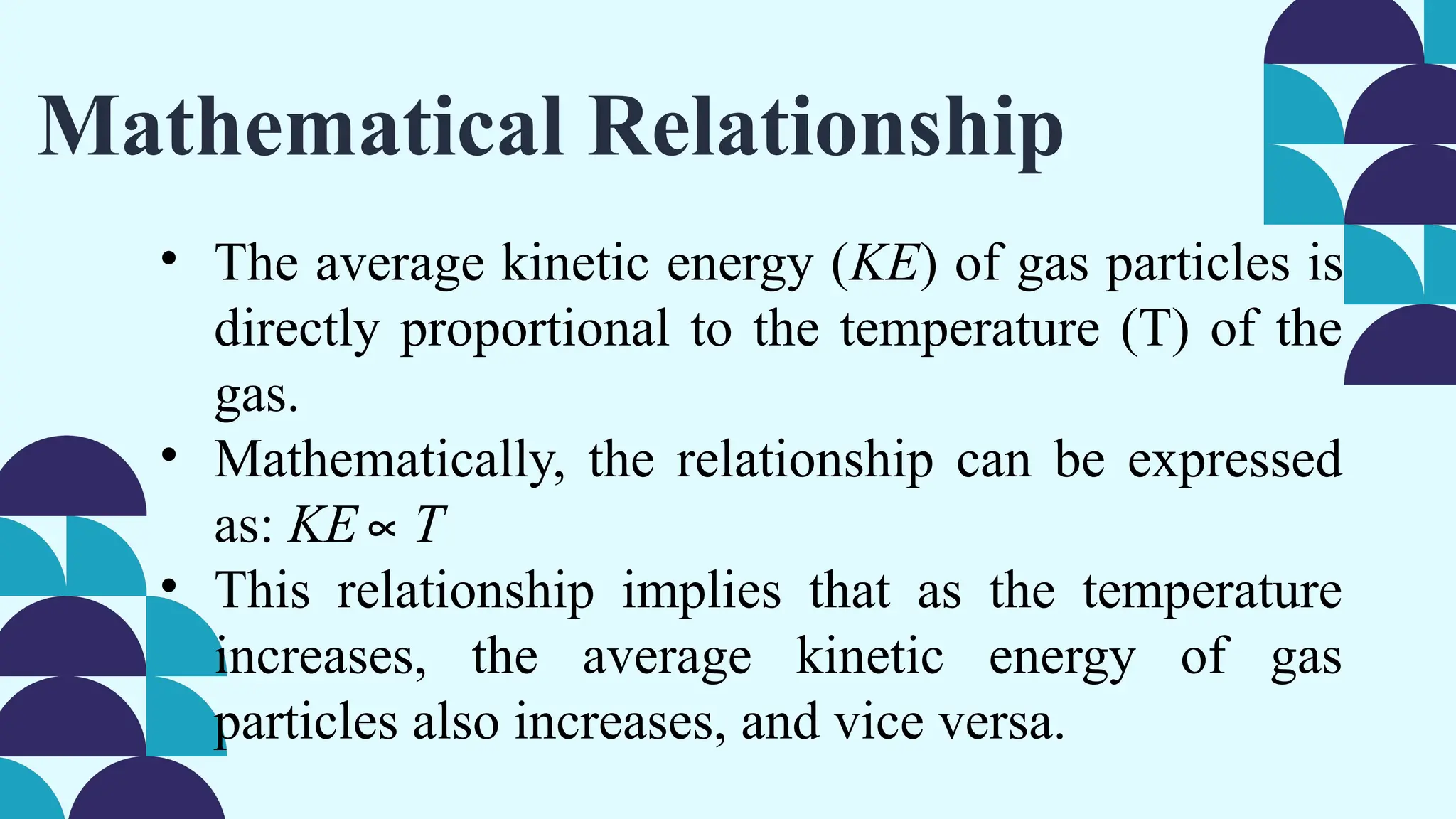
Mathematical Relationship
• Theaverage kinetic energy (KE) of gas particles is
directly proportional to the temperature (T) of the
gas.
• Mathematically, the relationship can be expressed
as: KE∝T
• This relationship implies that as the temperature
increases, the average kinetic energy of gas
particles also increases, and vice versa.
19.
IMPLICATIONS:
• Higher temperaturesresult in greater molecular
motion and collisions between particles, leading to
increased kinetic energy.
• The relationship between temperature and kinetic
energy is fundamental to understanding the
behavior of gases, such as pressure-volume-
temperature (PVT) relationships and the ideal gas
law.
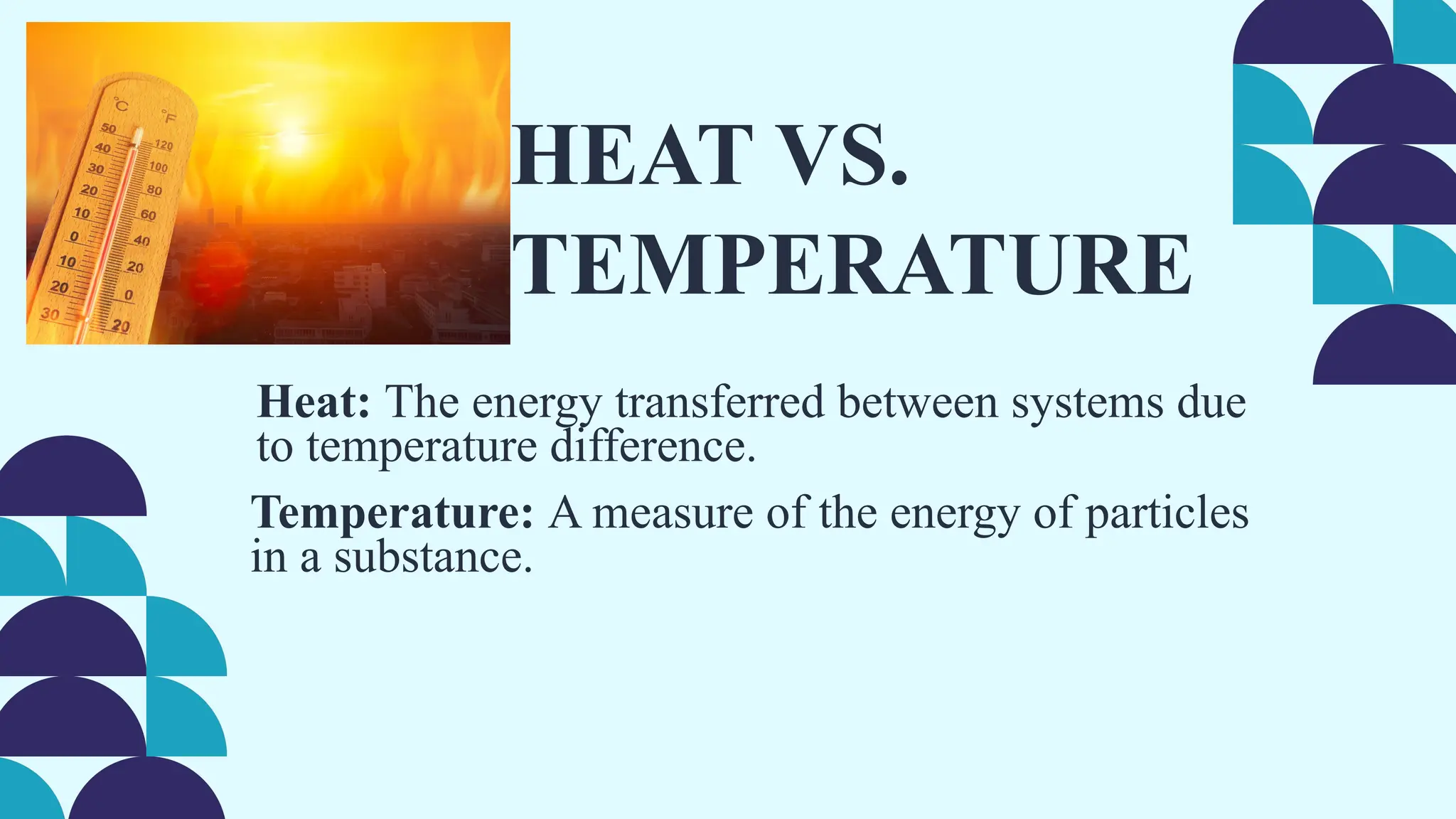
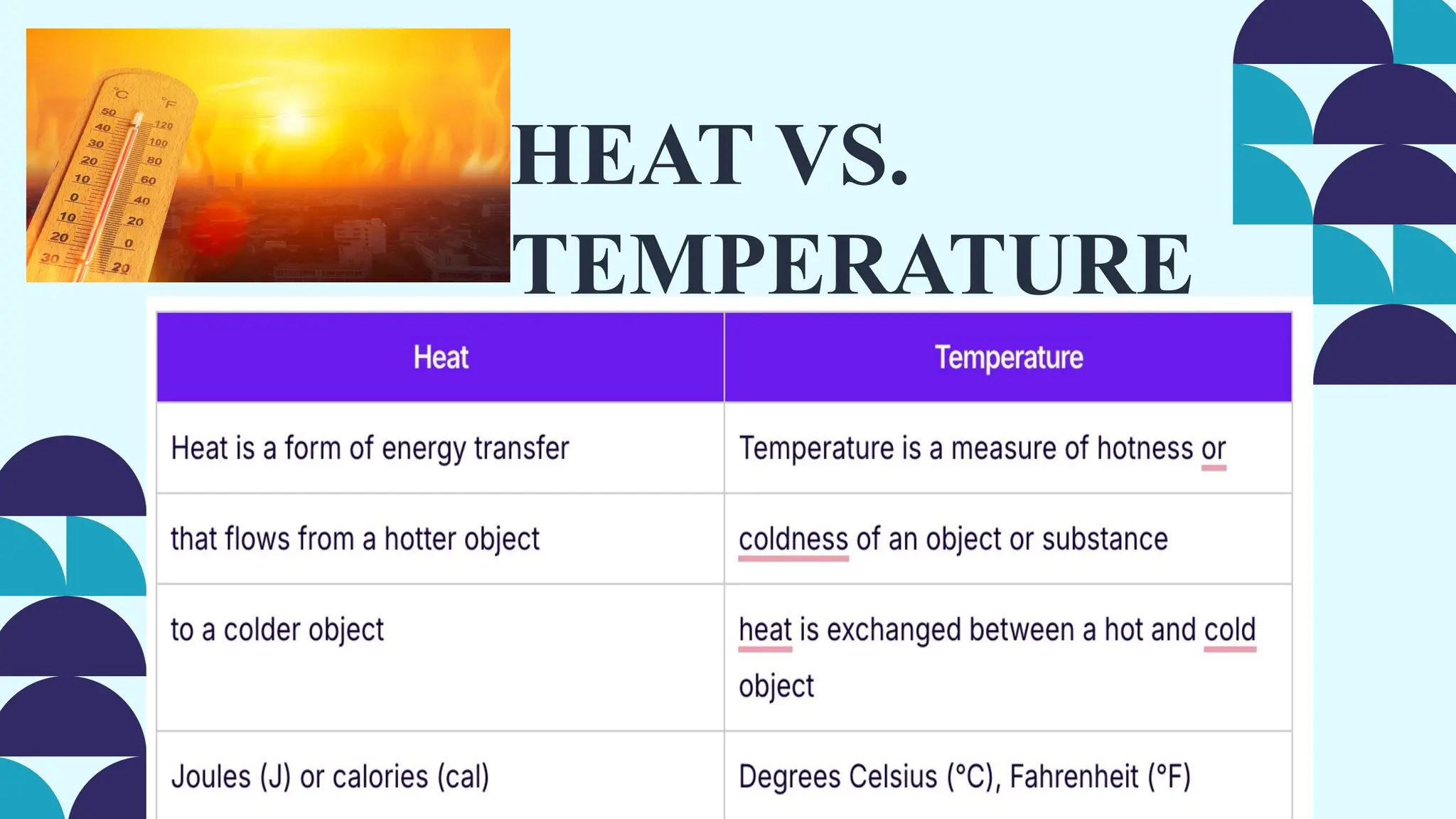
HEAT VS.
TEMPERATURE
Heat: Theenergy transferred between systems due
to temperature difference.
Temperature: A measure of the energy of particles
in a substance.
THERMAL EXPANSION
•Thermal equilibriumis a state in which two or
more objects or systems have the same
temperature and there is no net transfer of heat
between them.
•When two objects at different temperatures are brought
into contact, heat transfer occurs until thermal equilibrium
is reached.
•In thermal equilibrium, the rate of heat transfer from the
hotter object to the colder object is equal to the rate of heat
transfer in the opposite direction.
26.
EFFECTS OF
TEMPERATURE
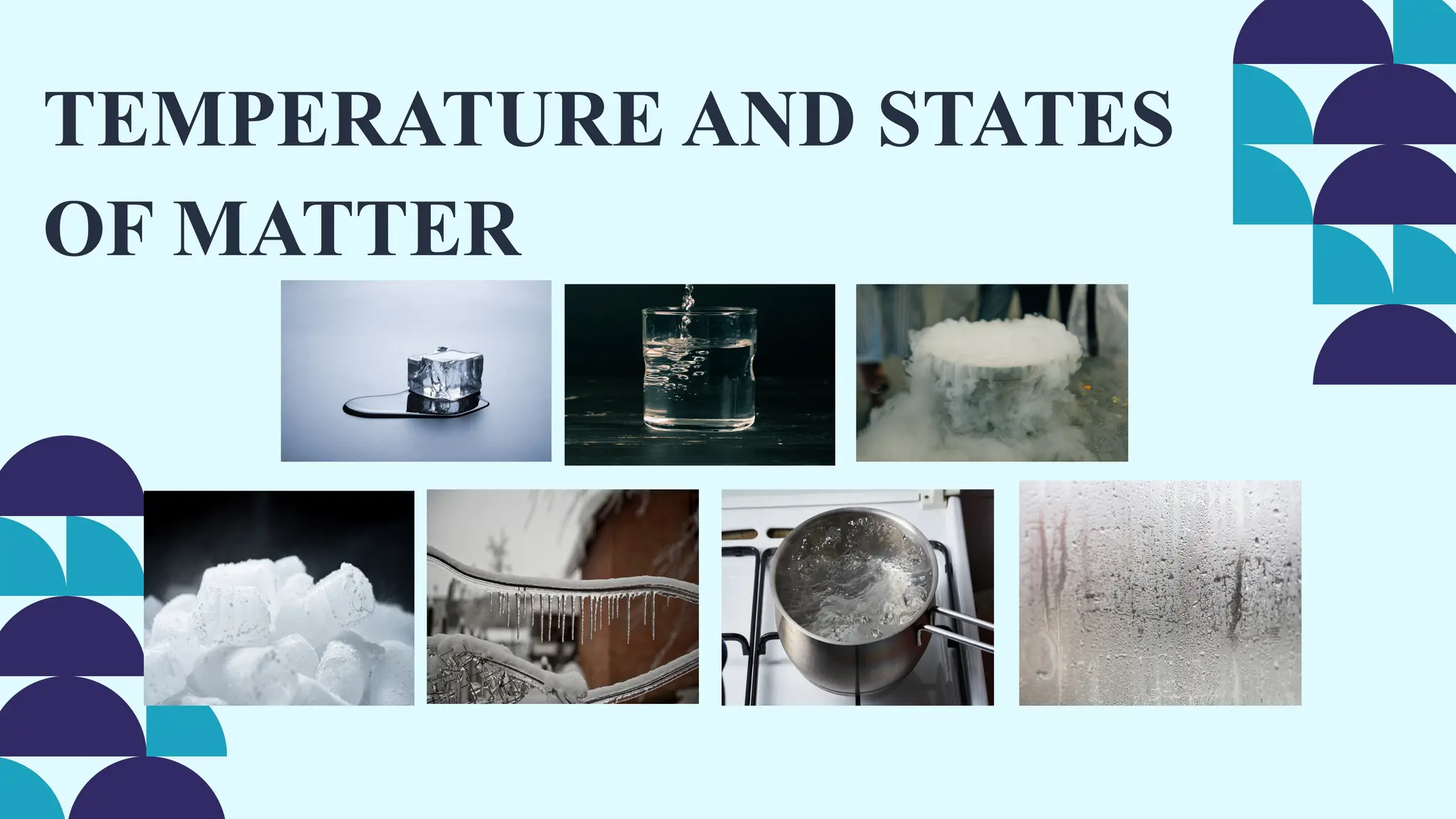
Physical Changes:Temperature influences the physical state of
matter, causing substances to change from solid to liquid to gas at
specific temperature points (melting, freezing, and boiling
points).
Chemical Reactions: Temperature affects the rate and outcome of
chemical reactions. Higher temperatures generally increase reaction
rates by providing more energy for molecules to collide and react.
However, extreme temperatures can also denature proteins and alter
reaction pathways.
27.
EFFECTS OF
TEMPERATURE
Biological Processes:Temperature profoundly influences
biological systems. Organisms have adapted to specific
temperature ranges, and deviations from these ranges can disrupt
biological processes
Weather Patterns: Temperature variations drive atmospheric
circulation and weather patterns on Earth. Differential heating of the
atmosphere by the Sun creates areas of high and low pressure, which
in turn influence wind patterns, precipitation, and climate systems.
28.
EFFECTS OF
TEMPERATURE
Ecosystem Dynamics:Temperature influences the distribution and
abundance of species in ecosystems. Changes in temperature can alter
habitat suitability, migration patterns, reproductive cycles, and food
availability, impacting ecosystem structure and function.
Material Properties: Temperature affects the mechanical, electrical,
and thermal properties of materials. For instance, metals expand when
heated and contract when cooled, affecting their dimensions and
structural integrity. Temperature also influences the conductivity and
resistance of materials.
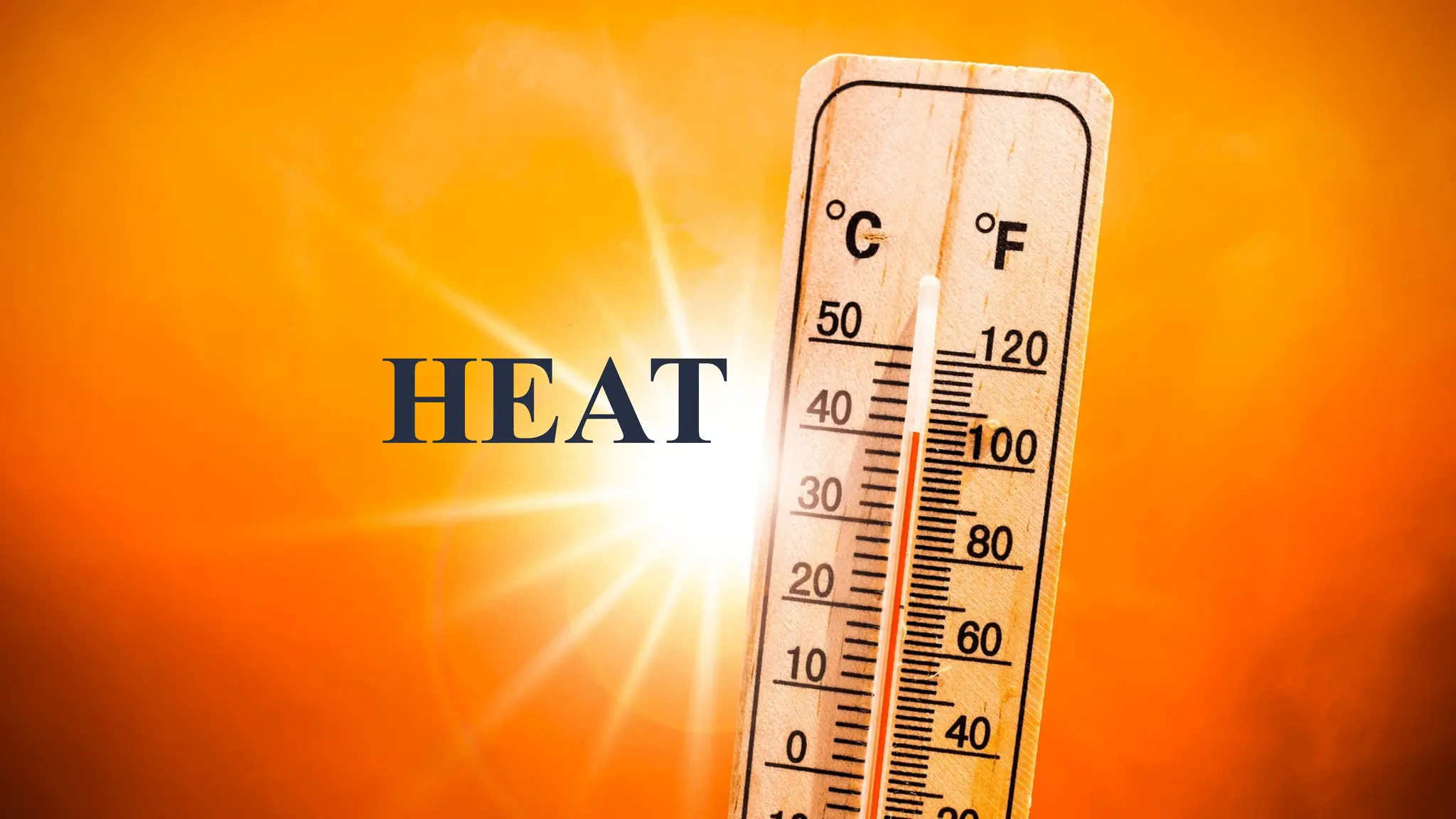
WHAT IS HEAT?
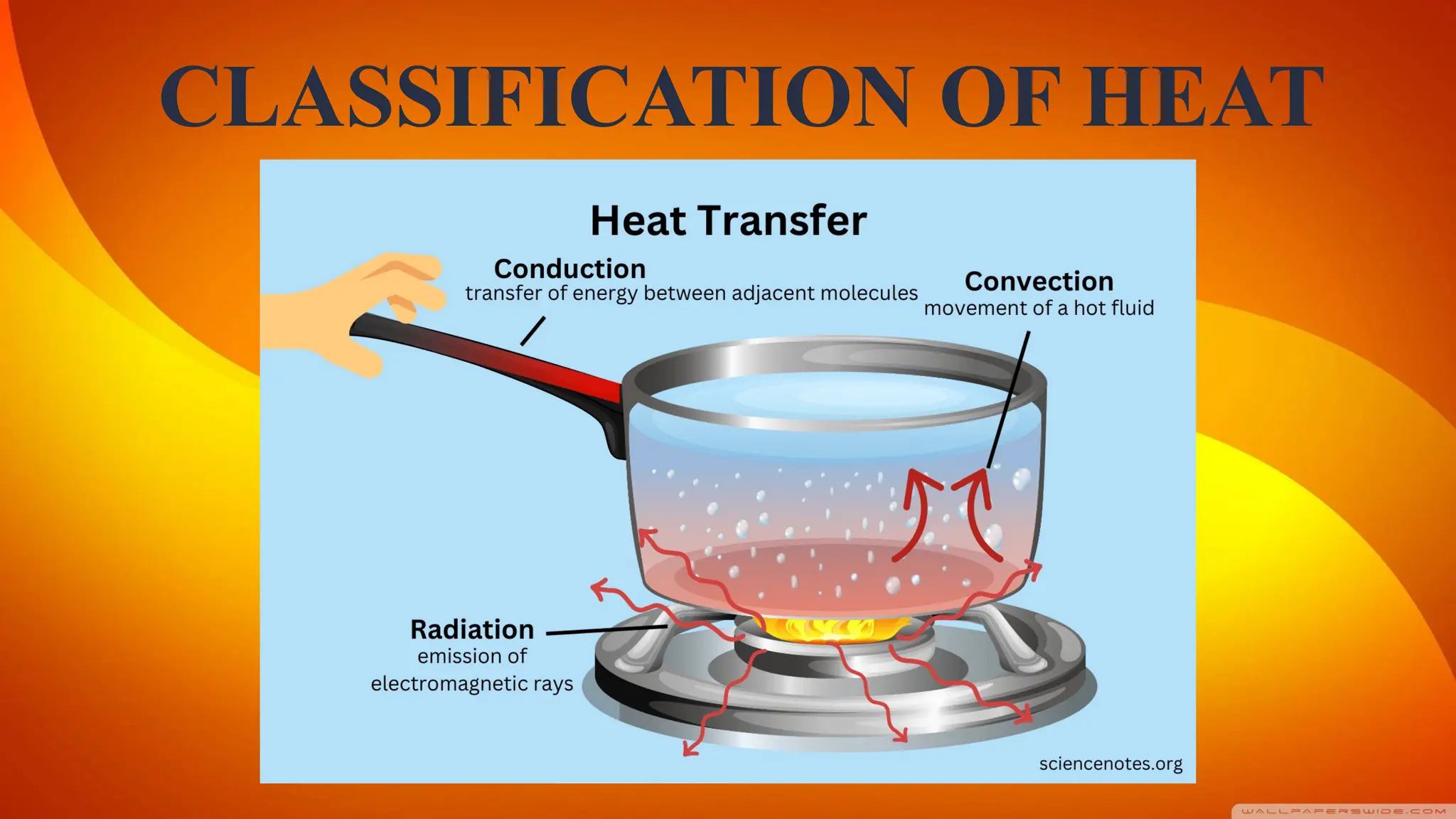
Heatis a form of energy that is transferred
between systems or objects with different
temperatures, flowing from the hotter system to
the cooler one until thermal equilibrium is
reached. This transfer occurs through conduction,
convection, or radiation and is measured in units
of joules or calories.
34.
HEAT FORMULA
• Q= Heat energy (in joules, J)
• m = Mass of the substance (in kilograms, kg)
• c = Specific heat capacity of the substance (in joules per kilogram per
degree Celsius, J/kg°C)
• ΔT = Change in temperature (in degrees Celsius, °C)
EXAMPLE OF HEAT
•Sunlight Warming the Earth
• Boiling Water
• Heating a Room with a Radiator
• Ironing Clothes
• Cooking Food
• Using a Hair Dryer
• Warming Hands by a Fire
• Melting Ice
• Refrigerator Coils Releasing Heat
• Hot Air Balloon Rising
• Toasting Bread
• Car Engine Heating Up
• Microwaving Food
• Using an Electric Blanket
• Steam from a Kettle
37.
CLASSIFICATION OF HEAT
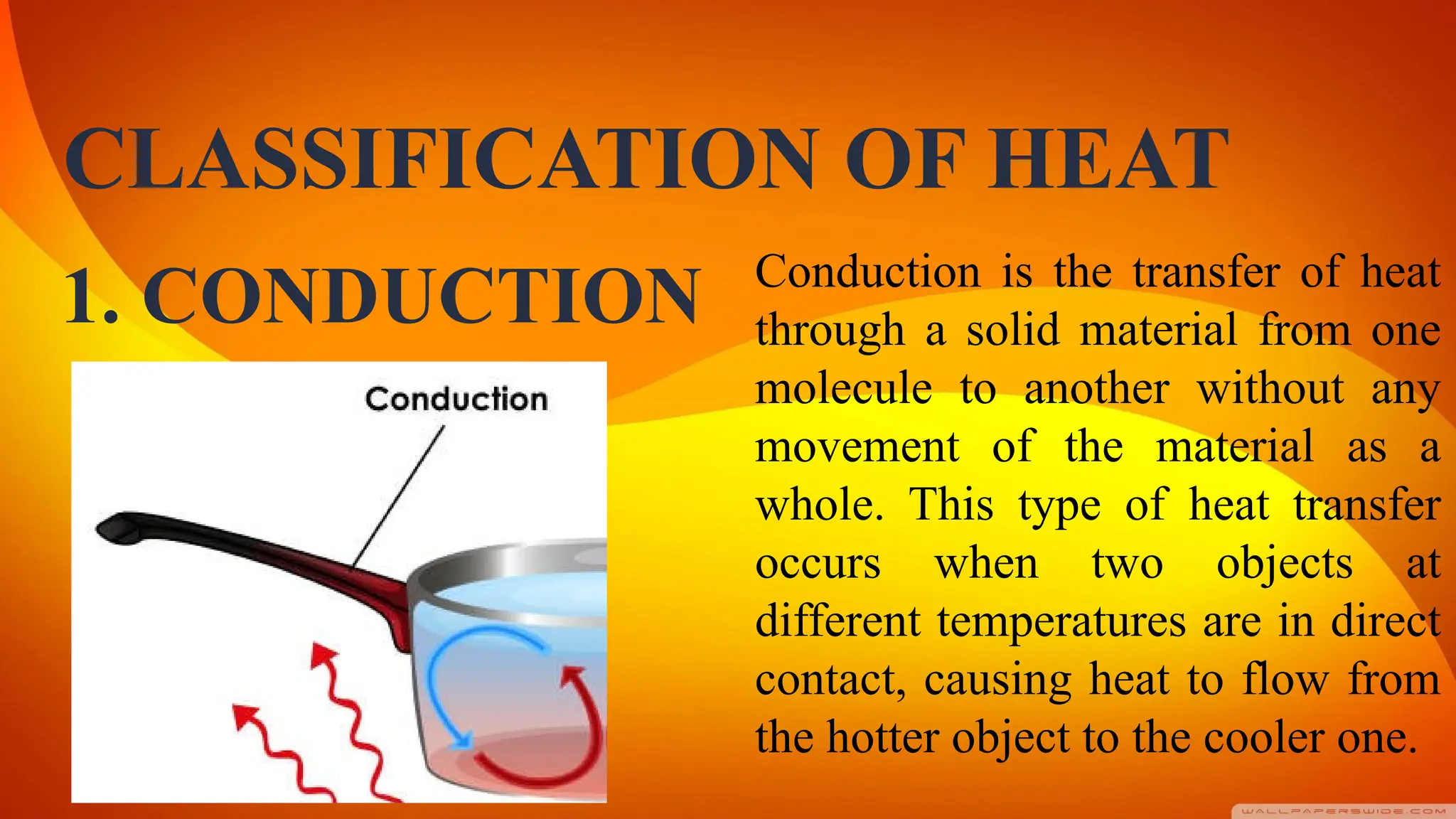
Conductionis the transfer of heat
through a solid material from one
molecule to another without any
movement of the material as a
whole. This type of heat transfer
occurs when two objects at
different temperatures are in direct
contact, causing heat to flow from
the hotter object to the cooler one.
1. CONDUCTION
38.
CLASSIFICATION OF HEAT
Conductionis the transfer of heat
through a solid material from one
molecule to another without any
movement of the material as a
whole. This type of heat transfer
occurs when two objects at
different temperatures are in direct
contact, causing heat to flow from
the hotter object to the cooler one.
1. CONDUCTION
39.
CLASSIFICATION OF HEAT
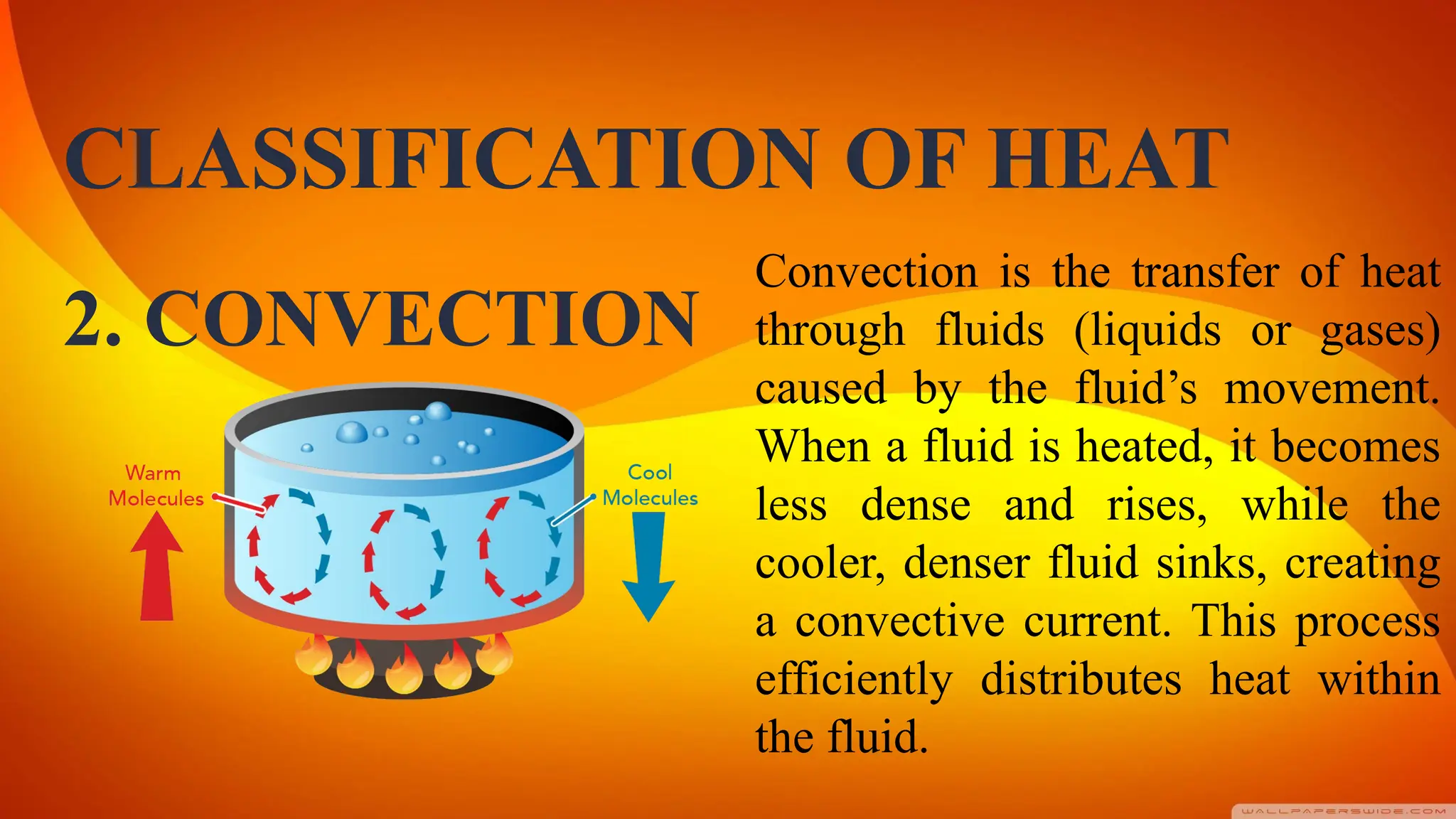
Convectionis the transfer of heat
through fluids (liquids or gases)
caused by the fluid’s movement.
When a fluid is heated, it becomes
less dense and rises, while the
cooler, denser fluid sinks, creating
a convective current. This process
efficiently distributes heat within
the fluid.
2. CONVECTION
40.
CLASSIFICATION OF HEAT
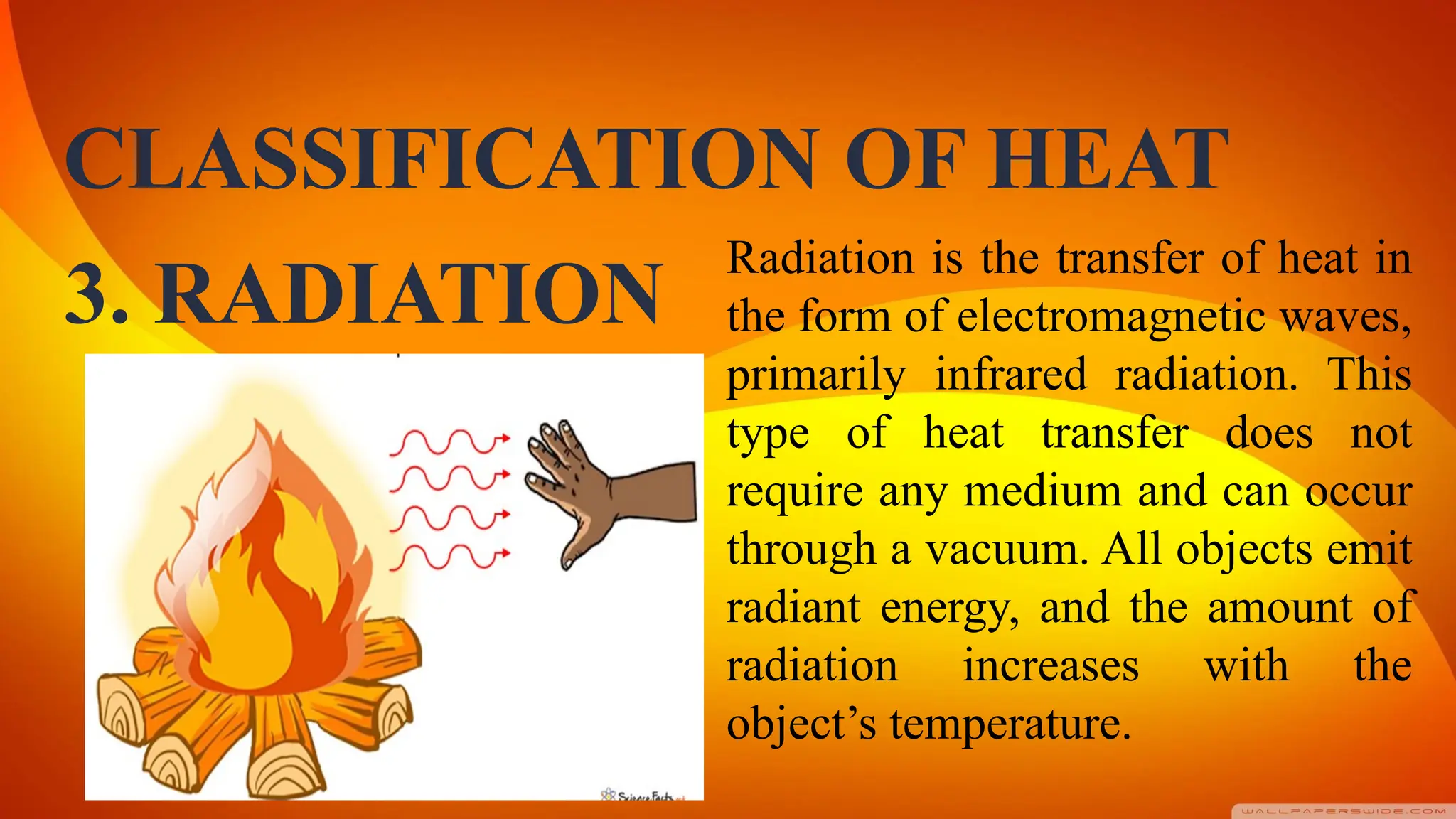
Radiationis the transfer of heat in
the form of electromagnetic waves,
primarily infrared radiation. This
type of heat transfer does not
require any medium and can occur
through a vacuum. All objects emit
radiant energy, and the amount of
radiation increases with the
object’s temperature.
3. RADIATION
SOURCES OF HEAT
1.SUN
• The sun is the most significant natural
source of heat for the Earth. It radiates
energy in the form of electromagnetic
waves, including visible light and
infrared radiation.
43.
SOURCES OF HEAT
2.EARTH
• The Earth itself is a source of heat,
primarily through geothermal energy. This
heat comes from the radioactive decay of
minerals and the residual heat from the
planet’s formation.
44.
SOURCES OF HEAT
3.CHEMICAL ENERGY
• Chemical energy is released during the
combustion of fossil fuels (such as coal, oil,
and natural gas) and biomass (like wood and
crop waste).
45.
SOURCES OF HEAT
4.ELECTRICAL ENERGY
• Electrical energy can be converted into heat
through resistance heating. Devices like
electric heaters, stoves, toasters, and
incandescent light bulbs use electrical
resistance to produce heat.
46.
SOURCES OF HEAT
5.ATOMIC ENERGY
• Atomic energy, or nuclear energy, is
produced through nuclear reactions, such as
fission and fusion. In nuclear power plants,
fission reactions split atomic nuclei, releasing
a tremendous amount of heat, which is then
used to generate electricity.
47.
SOURCES OF HEAT
5.AIR
• Air can be a source of heat through processes
like compression and friction. Compressing
air, such as in a bicycle pump or an air
compressor, increases its temperature.
Additionally, air friction, experienced by
objects moving rapidly through the
atmosphere, generates heat.
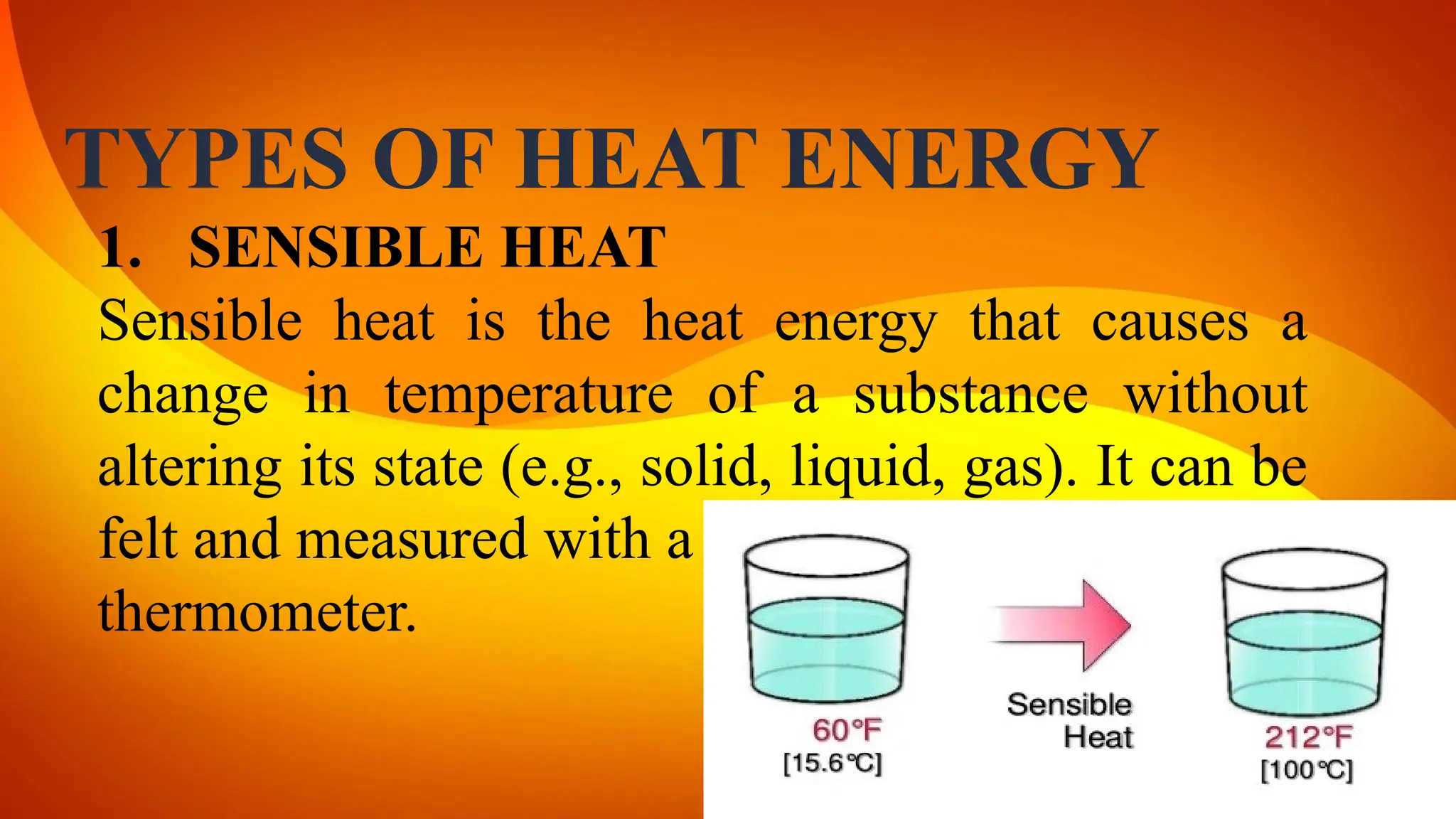
TYPES OF HEATENERGY
1. SENSIBLE HEAT
Sensible heat is the heat energy that causes a
change in temperature of a substance without
altering its state (e.g., solid, liquid, gas). It can be
felt and measured with a
thermometer.
50.
TYPES OF HEATENERGY
1. LATENT HEAT
Latent heat is the heat energy absorbed or
released during a phase change of a substance,
without changing its temperature. This includes
the heat required
for melting,
freezing, vaporization,
and condensation.
51.
TYPES OF HEATENERGY
3. RADIANT HEAT
Radiant heat, or thermal radiation, is the heat
energy transferred through electromagnetic
waves, primarily in the infrared spectrum. This
type of heat transfer does not require
a medium and can occur through a
vacuum. The warmth felt from the
sun or a fire is due to radiant heat.
52.
TYPES OF HEATENERGY
4. CONDUCTIVE HEAT
Conductive heat is the transfer of heat energy
through direct contact between molecules within a
solid or between solids in contact. Metals are
typically good conductors
of heat, as they allow energy
to pass through them
efficiently.
53.
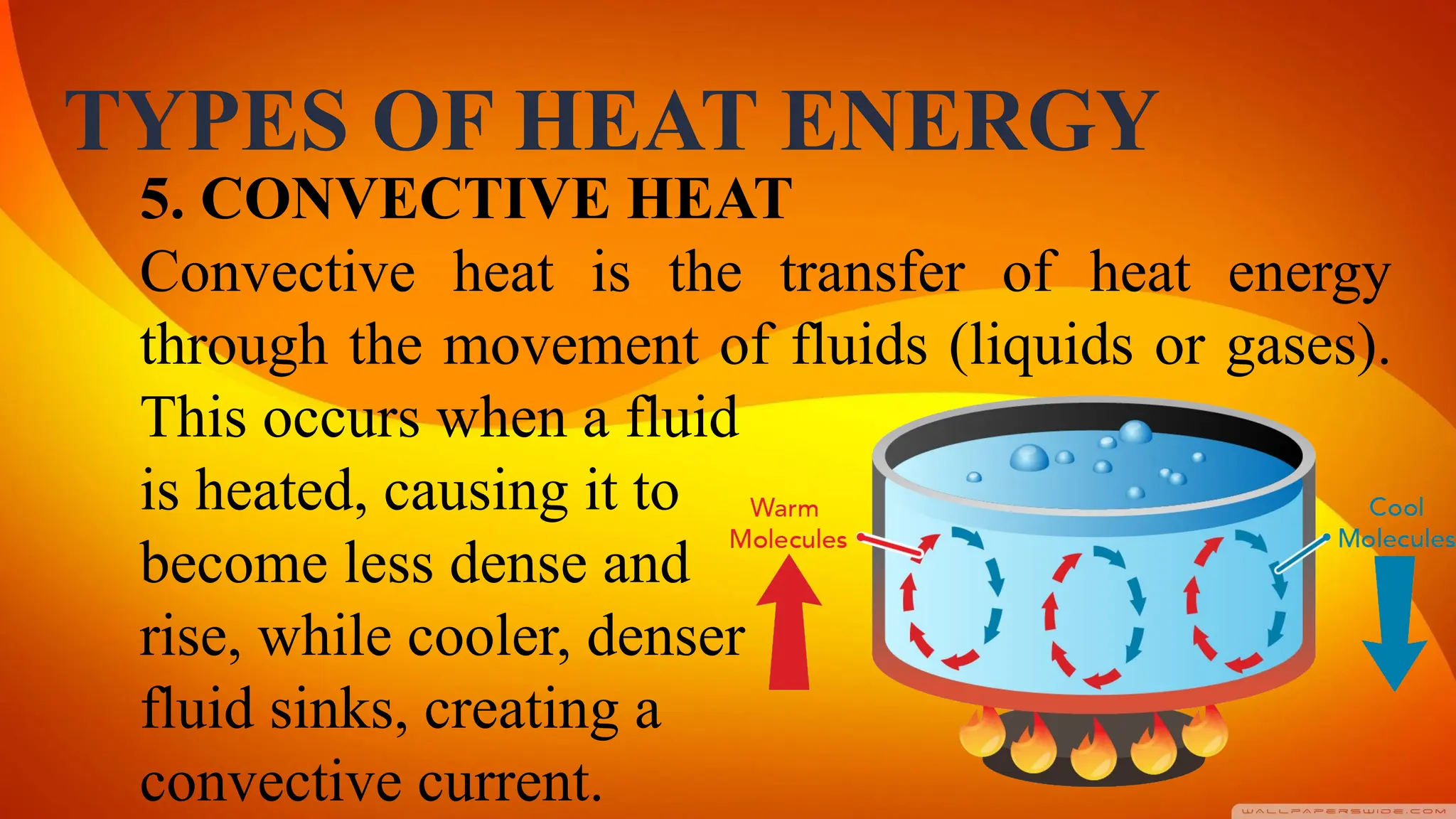
TYPES OF HEATENERGY
5. CONVECTIVE HEAT
Convective heat is the transfer of heat energy
through the movement of fluids (liquids or gases).
This occurs when a fluid
is heated, causing it to
become less dense and
rise, while cooler, denser
fluid sinks, creating a
convective current.
APPLICATION OF HEAT
IndustrialProcesses
• Manufacturing: Heat is essential in manufacturing
processes such as metalworking, welding, forging,
and casting.
• Chemical Processing: Many chemical reactions
require heat, such as those in the production of
plastics, pharmaceuticals, and petrochemicals.
• Food Processing: Heat is used in pasteurization,
sterilization, cooking, and drying of food products.
57.
APPLICATION OF HEAT
EnergyProduction
• Power Plants: Heat energy, often generated by
burning fossil fuels or through nuclear reactions, is
used to produce steam that drives turbines to generate
electricity.
• Renewable Energy: Solar thermal energy harnesses
sunlight to generate heat for electricity production or
direct heating applications.
58.
APPLICATION OF HEAT
HomeHeating and Cooking
• Heating Systems: Residential heating systems,
such as furnaces, boilers, and heat pumps, use
various sources of heat to maintain comfortable
indoor temperatures.
• Cooking Appliances: Stoves, ovens,
microwaves, and other kitchen appliances use
heat to cook food.
59.
APPLICATION OF HEAT
Transportation
•Internal Combustion Engines: Heat from the
combustion of fuel powers internal combustion
engines in cars, trucks, and airplanes.
• Thermal Management: Heat management
systems, including radiators and cooling
systems, are critical for maintaining optimal
operating temperatures in vehicles.
60.
APPLICATION OF HEAT
MedicalApplications
• Sterilization: Autoclaves use heat to sterilize medical
instruments and supplies.
• Therapeutic Treatments: Heat therapy, such as
heating pads and warm baths, is used to relieve pain
and promote healing.
• Medical Imaging: Techniques like MRI sometimes
require cooling of equipment, which indirectly involves
heat management.
WHAT IS IDEALGAS LAW?
The ideal gas law is a fundamental equation in
physics that describes the behavior of ideal
gases. It combines several gas laws into one
comprehensive formula, showing the
relationship between pressure, volume,
temperature, and the number of moles of a gas.
64.
FORMULA OF IDEAL
GASLAW
THE FORMULA FOR THE IDEAL GAS LAW IS:
PV = nRT
WHERE:
•P IS THE PRESSURE OF THE GAS.
•V IS THE VOLUME OF THE GAS.
•N IS THE NUMBER OF MOLES OF THE GAS.
•R IS THE UNIVERSAL GAS CONSTANT.
•T IS THE TEMPERATURE OF THE GAS IN KELVIN.
65.
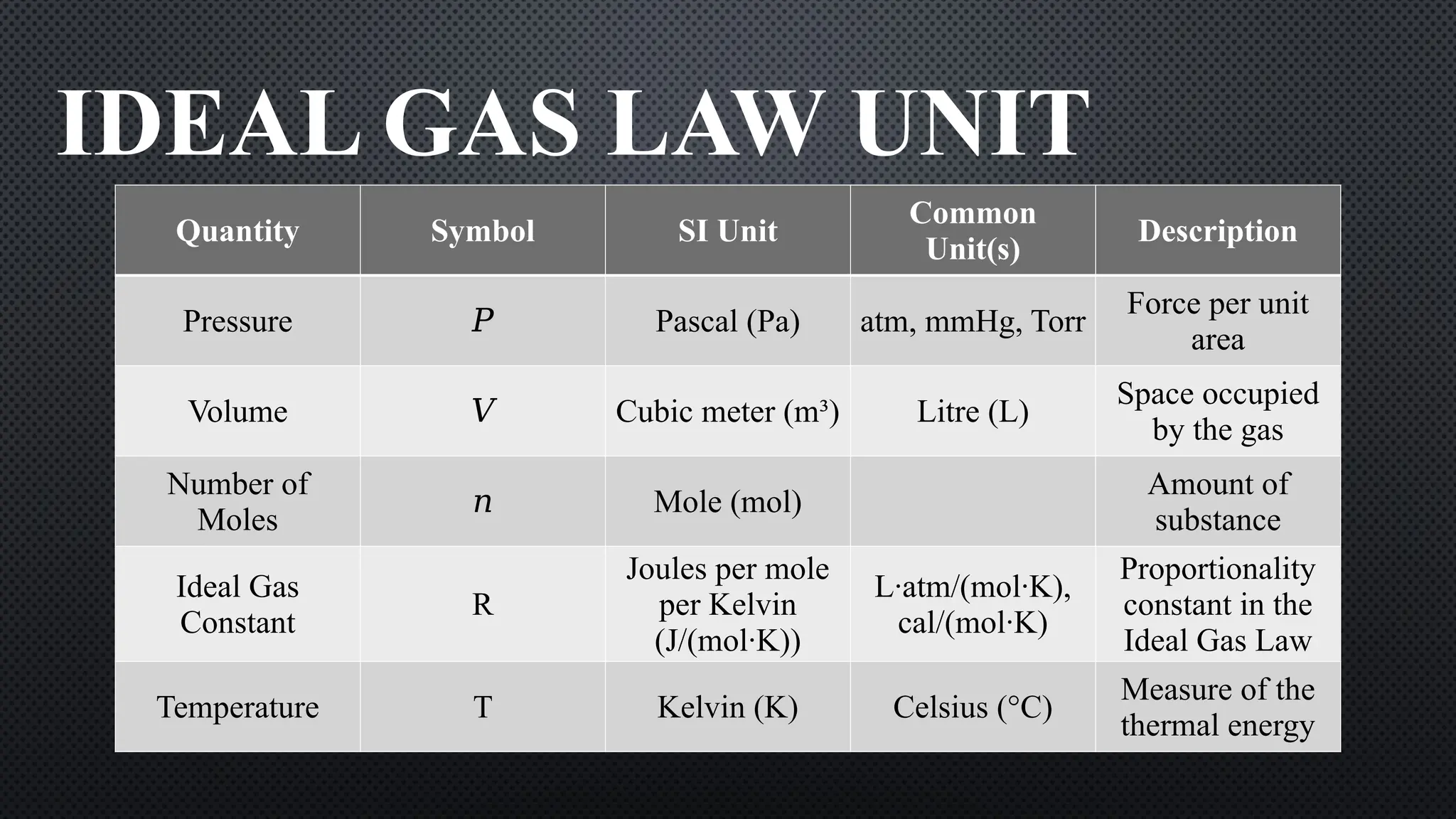
IDEAL GAS LAWUNIT
Quantity Symbol SI Unit
Common
Unit(s)
Description
Pressure 𝑃 Pascal (Pa) atm, mmHg, Torr
Force per unit
area
Volume 𝑉 Cubic meter (m³) Litre (L)
Space occupied
by the gas
Number of
Moles
𝑛 Mole (mol)
Amount of
substance
Ideal Gas
Constant
R
Joules per mole
per Kelvin
(J/(mol·K))
L·atm/(mol·K),
cal/(mol·K)
Proportionality
constant in the
Ideal Gas Law
Temperature T Kelvin (K) Celsius (°C)
Measure of the
thermal energy
66.
DERIVATION OF IDEAL
GASLAW
The Ideal Gas Law is derived from combining several
empirical gas laws: Boyle’s Law, Charles’s Law, and
Avogadro’s Law. These laws describe the relationships
between pressure, volume, temperature, and the number of
moles of a gas. Here is a step-by-step derivation.
67.
BOYLE’S LAW
Boyle’s Lawstates that the pressure of a gas is inversely
proportional to its volume when the temperature and the
number of moles are constant. 1/ or =
𝑃∝ 𝑉 𝑃𝑉 𝑘₁ where
𝑘₁
is a constant for a given amount of gas at a constant
temperature.
68.
CHARLE’S LAW
Charles’s Lawstates that the volume of a gas is directly
proportional to its temperature when the pressure and the
number of moles are constant. or / =
𝑉∝𝑇 𝑉 𝑇 𝑘₂ where
𝑘₂
is a constant for a given amount of gas at a constant
pressure.
69.
AVOGADRO’S LAW
Avogadro’s Lawstates that the volume of a gas is directly
proportional to the number of moles of gas when the
pressure and temperature are constant. or /n =
𝑉∝𝑛 𝑉 𝑘₃
where is a constant for a given pressure and
𝑘₃
temperature.
70.
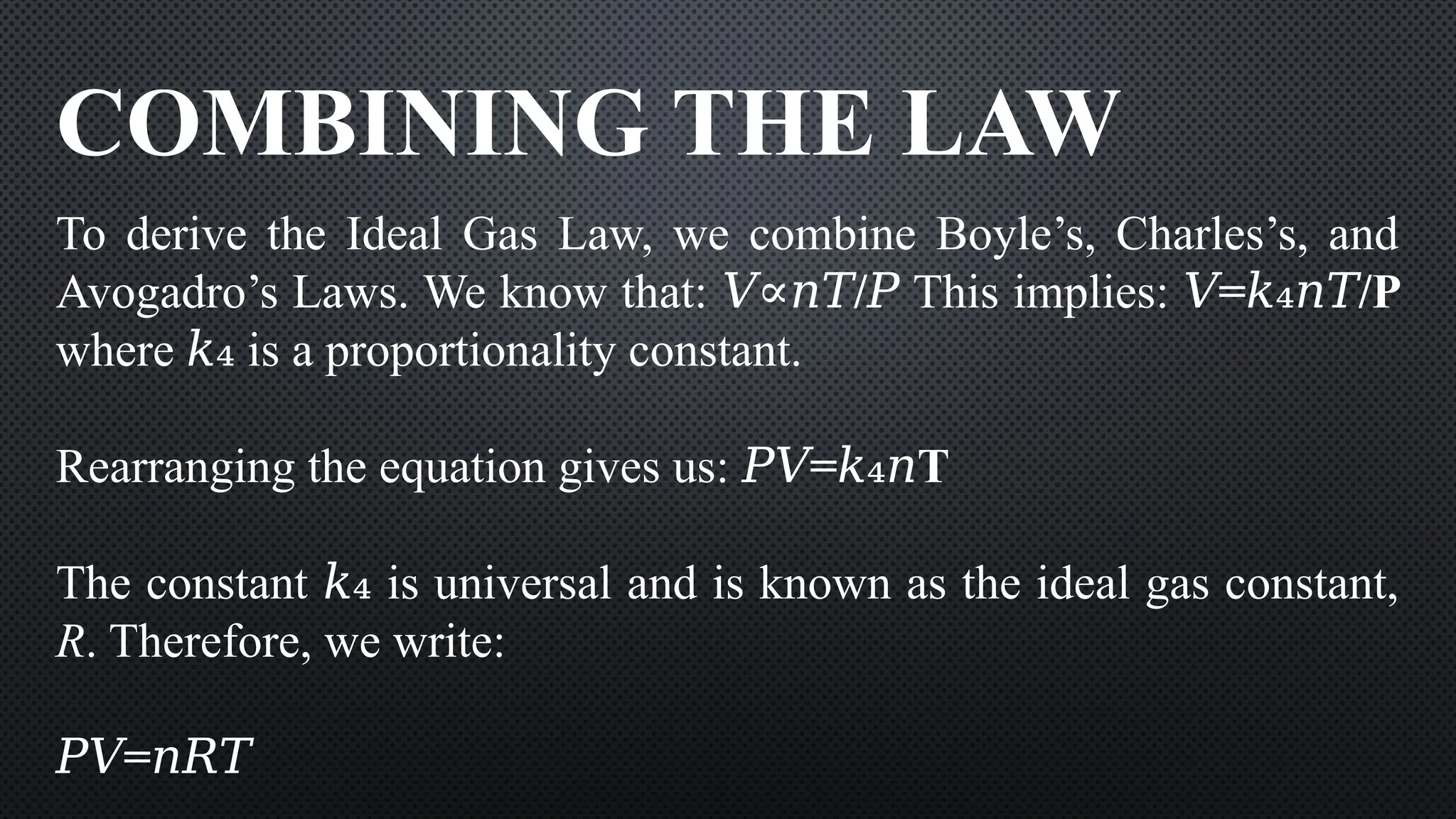
COMBINING THE LAW
Toderive the Ideal Gas Law, we combine Boyle’s, Charles’s, and
Avogadro’s Laws. We know that: /
𝑉∝𝑛𝑇 𝑃 This implies: = /P
𝑉 𝑘₄𝑛𝑇
where is a proportionality constant.
𝑘₄
Rearranging the equation gives us: = T
𝑃𝑉 𝑘₄𝑛
The constant is universal and is known as the ideal gas constant,
𝑘₄
R. Therefore, we write:
𝑃𝑉=𝑛𝑅𝑇
72.
USES OF IDEALGAS LAW
Determining Gas Properties: You can use the
Ideal Gas Law to calculate any one of the four
variables (pressure, volume, temperature, or
number of moles) if the other three are known.
This is useful in laboratory settings for various
experiments involving gases.
73.
USES OF IDEALGAS LAW
Chemical Reactions Involving Gases: In
stoichiometry, the Ideal Gas Law helps you
calculate the volumes of gases involved in
chemical reactions. Knowing the amount of
reactants or products allows you to predict the
volume of gas produced or consumed, aiding in
the design of chemical processes.
74.
USES OF IDEALGAS LAW
Diving and Hyperbaric Medicine: The Ideal
Gas Law explains how gases behave under
different pressures, which is crucial for
understanding the effects of pressure changes on
divers. It helps in treating conditions like
decompression sickness by predicting how gases
will dissolve and come out of solution in the
body.
75.
USES OF IDEALGAS LAW
Engineering Applications: Engineers use the
Ideal Gas Law in designing and operating
equipment such as internal combustion engines,
refrigeration systems, and air conditioning units.
It helps predict how gases will behave under
different conditions, ensuring optimal
performance of these systems.
76.
USES OF IDEALGAS LAW
Meteorology and Atmospheric Science: The
Ideal Gas Law is fundamental in modeling and
understanding atmospheric processes.
Meteorologists use it to predict changes in
weather patterns by relating the temperature,
pressure, and volume of air masses, which helps
in forecasting weather.
77.
USES OF IDEALGAS LAW
Respiratory Physiology: The Ideal Gas Law
aids in understanding how gases exchange in the
lungs. By relating the pressure and volume of
gases, you can predict how oxygen and carbon
dioxide will diffuse between the lungs and the
bloodstream, which is essential for studying
respiratory function and disorders.
78.
USES OF IDEALGAS LAW
Gas Storage and Transportation: The Ideal
Gas Law helps in designing storage and
transportation systems for gases. By
understanding how pressure and temperature
affect gas volume, you can optimize conditions
for safe and efficient storage and transport,
whether for industrial gases, natural gas, or
medical oxygen.
Editor's Notes
#2 Temperature is a measure of the average kinetic energy of the particles in a substance.
Fundamental concept in thermodynamics, affecting states of matter and energy transfer.
#4 Deviations from this range can indicate health conditions such as fever (elevated temperature) or hypothermia (low temperature). Monitoring body temperature is essential in medical settings for diagnosing illnesses and assessing overall health.
#6 Example: Convert 20°C to Fahrenheit.
F = (36)+32 = 68°F
#7 Example: Convert 68°F to Celsius.
C = (68−32)×5/9
C = (36)×95=20°C
#8 Example: Convert 20°C to Kelvin.
K = 20+273.15 = 293.15K
#11 The Fahrenheit scale is commonly used in the United States and some other countries, especially for weather forecasts.
#12 The Kelvin scale is widely used in scientific and engineering applications, especially in thermodynamics and physics.
#13 Units of Measurement: Degrees Celsius, Fahrenheit, Kelvin.
#14 The theoretical temperature at which a system has minimum thermal energy (0 K or -273.15°C).
Significance: No thermal motion; a fundamental limit in thermodynamics.
#15 The relationship between temperature in Kelvin (K) and Celsius (°C) is given by the equation: K=°C+273.15.
Question:
Why is the Kelvin scale considered an absolute temperature scale?
The Kelvin scale is considered an absolute temperature scale because its zero point, absolute zero, is the theoretical lowest temperature at which all molecular motion ceases.
#17 At higher temperatures, gas particles move faster on average and thus possess higher kinetic energy. Conversely, at lower temperatures, gas particles move more slowly and have lower kinetic energy.
#19 Experimental Confirmation:
Experimental observations support the relationship between temperature and kinetic energy. For example, heating a gas in a closed container causes an increase in pressure due to the greater kinetic energy of the gas particles.
#20 Solid, Liquid, Gas: How temperature affects the state of matter
Phase Changes: Melting, freezing, boiling, and condensation.
#24 Examples: Expansion of metals, liquids in thermometers.
#25 At thermal equilibrium, the temperatures of the objects are equal, and there is no further change in temperature over time.
#26 Temperature has a profound impact on various aspects of the natural world and human activities. Some of the effects of temperature include:
#29 What are some common applications of temperature measurement?
Temperature measurement is used in various fields, including weather forecasting, cooking, industrial processes, healthcare, and scientific research. It is essential for controlling processes, monitoring environmental conditions, and ensuring safety in many applications.
#32 Heat is a form of energy transfer between systems or objects with different temperatures, flowing from the hotter system to the cooler one. Heat Transfer occurs through conduction (direct contact), convection (fluid movement), and radiation (electromagnetic waves). The Heat Formula is Q=mcΔT, In the International System of Units of Heat (SI), heat is measured in joules (J).
#34 How is heat measured?
Heat is measured in joules (J) or calories (cal).
#37 Metals are excellent conductors of heat due to their free electrons that facilitate energy transfer.
#38 Metals are excellent conductors of heat due to their free electrons that facilitate energy transfer.
#39 Natural convection occurs due to density differences, while forced convection involves external forces like fans or pumps to move the fluid.
#40 The sun’s heat reaching the Earth is a prime example of radiative heat transfer.
#41 The sun’s heat reaching the Earth is a prime example of radiative heat transfer.
#42 This solar energy warms the planet, drives weather systems, and sustains life through photosynthesis in plants.
#43 Geothermal energy manifests in natural phenomena such as hot springs, geysers, and volcanic activity, and it can be harnessed for heating and electricity generation.
#44 When these substances burn, they undergo chemical reactions that release stored energy in the form of heat. This process is widely used in power plants, home heating, cooking, and industrial processes.
#45 When an electric current passes through a resistive material, it generates heat due to the material’s opposition to the flow of electrons.
#46 Fusion, which powers the sun, involves combining atomic nuclei to release energy, although practical fusion reactors are still in development.
#47 For example, meteors heat up and glow brightly due to air friction as they enter the Earth’s atmosphere.
#48 Heat energy can be categorized based on its transfer methods and sources. Here are the main types:
#49 Sensible heat is the heat that causes a change in an object's temperature without causing a change in its physical state (like melting or boiling). It's the heat you can "sense" or feel as a temperature difference.
When you heat water on a stove, the increase in temperature before it boils is an example of sensible heat.
#50 For instance, the energy absorbed by ice as it melts into water, or the energy released when steam condenses into liquid water, represents latent heat.
#51 Radiant heat is the transfer of heat energy through electromagnetic radiation, like the warmth you feel from the sun or a fire, without requiring a medium like air to travel, unlike convection or conduction.
#52 Touching a hot metal spoon in a pot of boiling water exemplifies conductive heat transfer.
#53 Boiling water, where the hot water rises to the surface and cooler water sinks to the bottom, demonstrates convective heat transfer.
#54 Boiling water, where the hot water rises to the surface and cooler water sinks to the bottom, demonstrates convective heat transfer.
#55 Boiling water, where the hot water rises to the surface and cooler water sinks to the bottom, demonstrates convective heat transfer.
#56 For example, meteors heat up and glow brightly due to air friction as they enter the Earth’s atmosphere.
#62 The Ideal Gas Law is a fundamental principle in physics that describes the behavior of ideal gases. It combines several individual gas laws into one comprehensive equation. This law is pivotal in understanding how gases respond to changes in pressure, volume, and temperature.