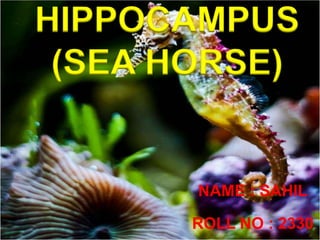
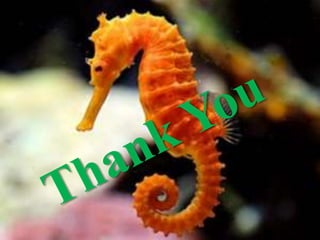
HIPPOCAMPUS
(SEA HORSE)
NAME : SAHIL
ROLL NO : 2330
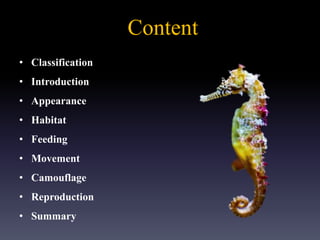
Content
• Classification
• Introduction
• Appearance
• Habitat
• Feeding
• Movement
• Camouflage
• Reproduction
• Summary
Introduction
_
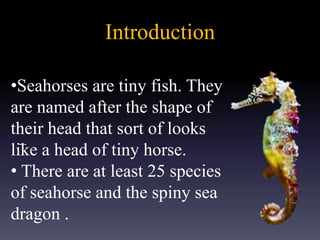
•Seahorses are tiny fish. They
are named after the shape of
their head that sort of looks
like a head of tiny horse.
• There are at least 25 species
of seahorse and the spiny sea
dragon .
Classification
_
Kingdom: Animalia
Phylum: Chordata
Class: Actinopterygii
Order: Syngnathiformes
Family: Syngnathidae
Genus: Hippocampus
Appearance
_
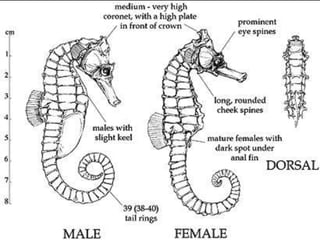
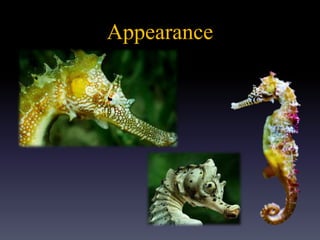
•Seahorse appear to be very different
from other fishes in the sea.
•They are tiny, have a horse -like head.
Monkey -like tail and kangaroo -like
pouch , their eyes are like a chameleon.
• They have thin skin stretched over a
series of bony plates that are visible as
rings around the trunk.
Appearance
_
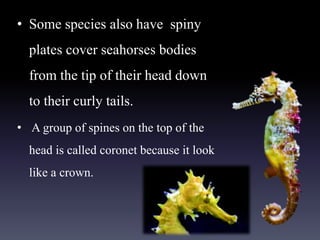
• Some species also have spiny
plates cover seahorses bodies
from the tip of their head down
to their curly tails.
• A group of spines on the top of the
head is called coronet because it look
like a crown.
Appearance
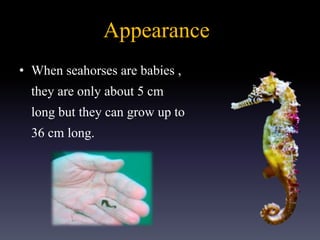
• When seahorses are babies ,
they are only about 5 cm
long but they can grow up to
36 cm long.
Habitat
• Seahorses are found in tropical and subtropical costal
and reef waters all over the pacific, Atlantic and Indian
oceans.
• Seahorses are also found in mangrove roots , sea grass
beds, mud slopes , open waters, eel grass
, kelp and rocks.
• The large belly seahorse is the only seahorse found in
new Zealand.
Eating
• Seahorses eat tiny organisms such as small
shrimp , as well as very small fish and
plankton.
• Sometimes they eat small fish larvae or
anything small enough for them to swallow.
• Seahorses eat sucking through their tube-like
snout.
Movement
• They move independently of each other and in
all directions.
• When there are storms, seahorses clim to pieces
of seaweed with their tails.
• The storms toss them off and washes them
ashore, so they cannot get back to the sea
until the tide comes in.
Camouflage
• Seahorses can come in all different colors, they
are master of camouflage.
• They can change color to blend in with their
habitat.
• Some are bright color to blend in with coral but
some are brownish color to blend in with rocks.
• Many species have blotchy skin patterns which
help obscure their outline they can change color
in a matter of minutes to match their surrounding.
Reproduction
 Male seahorse are responsible about pregnancy and giving
birth.
 Pregnancy lasts between two and four weeks, the length
decreasing with increasing Temperature.
 The reproductive process begins when male and female
seahorse do daily pre_ dawn dances.
 The reproduction ritual involves dancing, changing
color and entwining tails.
 Sometimes, more than one male seahorse
will compete to win the affections of a female.
Males can inflate their pouch by pumping
water through it to display its emptiness.
the purpose of courtship behavior is to entice
the female to deposit her eggs in it.
Summary
• Also known as Sea horse
• Found in tropical and subtropical costal and reef waters all
over the pacific, Atlantic and Indian oceans.
• Seahorses eat tiny organisms such as small shrimp , as well
as very small fish and
plankton.
• It shows camouflage.
Hippocampus.pptx sahil

Hippocampus.pptx sahil

  • 1.
    HIPPOCAMPUS (SEA HORSE) NAME :SAHIL ROLL NO : 2330
  • 2.
    Content • Classification • Introduction •Appearance • Habitat • Feeding • Movement • Camouflage • Reproduction • Summary
  • 3.
    Introduction _ •Seahorses are tinyfish. They are named after the shape of their head that sort of looks like a head of tiny horse. • There are at least 25 species of seahorse and the spiny sea dragon .
  • 4.
    Classification _ Kingdom: Animalia Phylum: Chordata Class:Actinopterygii Order: Syngnathiformes Family: Syngnathidae Genus: Hippocampus
  • 6.
    Appearance _ •Seahorse appear tobe very different from other fishes in the sea. •They are tiny, have a horse -like head. Monkey -like tail and kangaroo -like pouch , their eyes are like a chameleon. • They have thin skin stretched over a series of bony plates that are visible as rings around the trunk.
  • 7.
  • 8.
    • Some speciesalso have spiny plates cover seahorses bodies from the tip of their head down to their curly tails. • A group of spines on the top of the head is called coronet because it look like a crown.
  • 9.
    Appearance • When seahorsesare babies , they are only about 5 cm long but they can grow up to 36 cm long.
  • 10.
    Habitat • Seahorses arefound in tropical and subtropical costal and reef waters all over the pacific, Atlantic and Indian oceans. • Seahorses are also found in mangrove roots , sea grass beds, mud slopes , open waters, eel grass , kelp and rocks. • The large belly seahorse is the only seahorse found in new Zealand.
  • 11.
    Eating • Seahorses eattiny organisms such as small shrimp , as well as very small fish and plankton. • Sometimes they eat small fish larvae or anything small enough for them to swallow. • Seahorses eat sucking through their tube-like snout.
  • 12.
    Movement • They moveindependently of each other and in all directions. • When there are storms, seahorses clim to pieces of seaweed with their tails. • The storms toss them off and washes them ashore, so they cannot get back to the sea until the tide comes in.
  • 13.
    Camouflage • Seahorses cancome in all different colors, they are master of camouflage. • They can change color to blend in with their habitat. • Some are bright color to blend in with coral but some are brownish color to blend in with rocks. • Many species have blotchy skin patterns which help obscure their outline they can change color in a matter of minutes to match their surrounding.
  • 14.
    Reproduction  Male seahorseare responsible about pregnancy and giving birth.  Pregnancy lasts between two and four weeks, the length decreasing with increasing Temperature.  The reproductive process begins when male and female seahorse do daily pre_ dawn dances.  The reproduction ritual involves dancing, changing color and entwining tails.
  • 15.
     Sometimes, morethan one male seahorse will compete to win the affections of a female. Males can inflate their pouch by pumping water through it to display its emptiness. the purpose of courtship behavior is to entice the female to deposit her eggs in it.
  • 16.
    Summary • Also knownas Sea horse • Found in tropical and subtropical costal and reef waters all over the pacific, Atlantic and Indian oceans. • Seahorses eat tiny organisms such as small shrimp , as well as very small fish and plankton. • It shows camouflage.