Rational Root Theorem
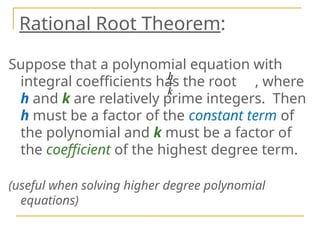
Rational Root Theorem:
Suppose that a polynomial equation with
integral coefficients has the root , where
h and k are relatively prime integers. Then
h must be a factor of the constant term of
the polynomial and k must be a factor of
the coefficient of the highest degree term.
(useful when solving higher degree polynomial
equations)
h
k
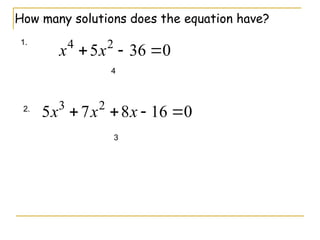
How many solutions does the equation have?
1. 4 2
5 36 0
x x
  
4
2. 3 2
5 7 8 16 0
x x x
   
3
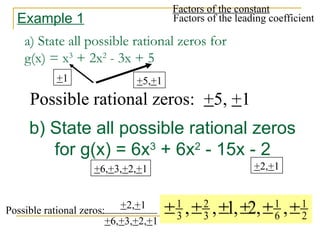
a) State all possible rational zeros for
g(x) = x3
+ 2x2
- 3x + 5
Possible rational zeros: +5, +1
b) State all possible rational zeros
for g(x) = 6x3
+ 6x2
- 15x - 2
+6,+3,+2,+1 +2,+1
+1 +5,+1
Factors of the constant
Factors of the leading coefficient
Possible rational zeros:
+2,+1
+6,+3,+2,+1 2
1
6
1
3
2
3
1
,
,
2
,
1
,
, 





Example 1
Solve using the Rational Root
Theorem:
 4x2
+ 3x – 1 = 0 (any rational root must have a numerator
that is a factor of -1 and a denominator
that is a factor of 4)
factors of -1: ±1
factors of 4: ±1,2,4
possible rational roots: (now use synthetic
division
to find rational roots)
1 1
1, ,
2 4

1 4 3 -1
4 7
4 7 6 no
-1 4 3 -1
-4 1
4 -1 0 !
yes
4 1 0
4 1
1
4
x
x
x
 


1
1,
4
x 
(note: not all possible rational roots are roots!)
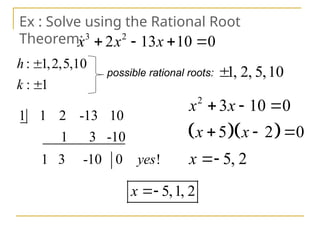
Ex : Solve using the Rational Root
Theorem:3 2
2 13 10 0
x x x
   
: 1,2,5,10
: 1
h
k


1 1 2 -13 10
1 3 -10
1 3 -10 0 !
yes
  
2
3 10 0
5 2 0
5, 2
x x
x x
x
  
  

5,1, 2
x 
1, 2, 5,10

possible rational roots:
Ex : Solve using the Rational Root
Theorem: 3 2
4 4 0
x x x
   
: 1,2,4
: 1
h
k


possible rational roots: 1, 2, 4

1 1 -4 -1 4
1 -3 -4
1 -3 -4 0 !
yes
  
2
3 4 0
4 1 0
1, 4
x x
x x
x
  
  

1,1, 4
x 
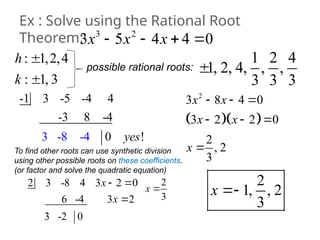
Ex : Solve using the Rational Root
Theorem: 3 2
3 5 4 4 0
x x x
   
: 1,2,4
: 1, 3
h
k


possible rational roots:
1 2 4
1, 2, 4, , ,
3 3 3

-1 3 -5 -4 4
-3 8
3 -8 -4
-4
0 !
yes
  
2
3 8 4 0
3 2 2 0
2
, 2
3
x x
x x
x
  
  

2
1, , 2
3
x 
To find other roots can use synthetic division
using other possible roots on these coefficients.
(or factor and solve the quadratic equation)
2 3 -8 4 3 2 0
6 -4 3 2
3 -2 0
x
x
 

2
3
x 
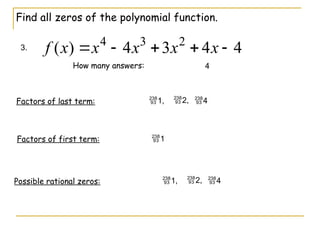
Find all zeros of the polynomial function.
3.
4 3 2
( ) 4 3 4 4
f x x x x x
    
Factors of last term:
Factors of first term: 1
Possible rational zeros:
How many answers: 4
1, 2, 4
1, 2, 4
1 1 –4 3 4
1
1
–3
–3
0
0
4
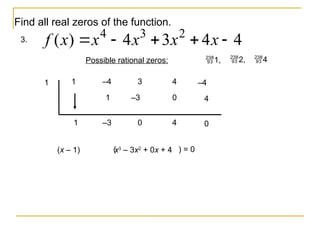
Find all real zeros of the function.
3.
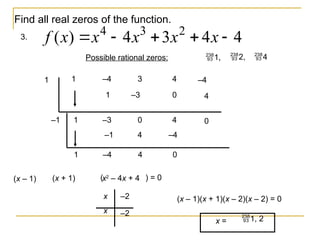
Possible rational zeros: 1, 2, 4
4 3 2
( ) 4 3 4 4
f x x x x x
    
–4
4
0
(x – 1) x3
– 3x2
+ 0x + 4
( ) = 0
1 1 –4 3 4
1
1
–3
–3
0
0
4
Find all real zeros of the function.
3.
Possible rational zeros: 1, 2, 4
4 3 2
( ) 4 3 4 4
f x x x x x
    
–4
4
0
–1
1
–1
–4
4
4
–4
0
(x + 1) x2
– 4x + 4
( ) = 0
(x – 1)
x
x
–2
–2
(x – 1)(x + 1)(x – 2)(x – 2) = 0
x = 1, 2
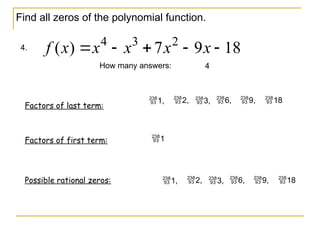
Find all zeros of the polynomial function.
4.
4 3 2
( ) 7 9 18
f x x x x x
    
1
How many answers: 4
1, 18
2, 9,
3, 6,
1, 18
2, 9,
3, 6,
Factors of last term:
Factors of first term:
Possible rational zeros:
1 1 –1 7 –9
1
1
0
0
7
7
–2
Find all real zeros of the function.
4.
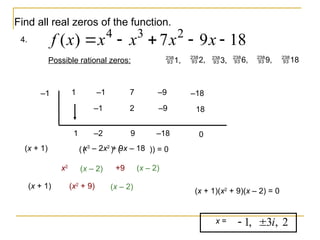
Possible rational zeros:

4 3 2
( ) 7 9 18
f x x x x x
    
1, 18
2, 9,
3, 6,
–18
–2
–20
–1 1 –1 7 –9
1
–1
–2
2
9
–9
–18
Find all real zeros of the function.
4.
Possible rational zeros:
4 3 2
( ) 7 9 18
f x x x x x
    
1, 18
2, 9,
3, 6,
–18
18
0
(x + 1)
(x + 1)(x2
+ 9)(x – 2) = 0
x3
– 2x2
+ 9x – 18
( ) = 0
( ) ( )
x2
(x – 2) +9 (x – 2)
(x2
+ 9) (x – 2)
(x + 1)
x = 1, 3 , 2
i
 
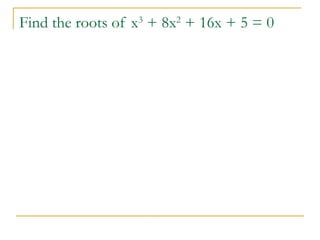
Find the roots of x3
+ 8x2
+ 16x + 5 = 0
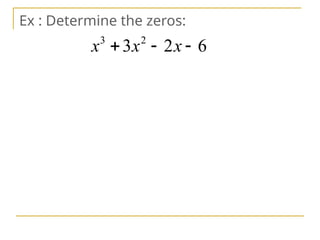
Ex : Determine the zeros:
3 2
3 2 6
x x x
  
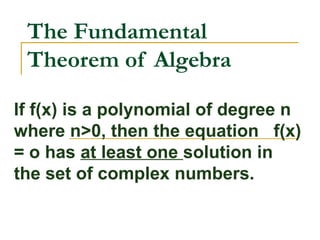
If f(x) is a polynomial of degree n
where n>0, then the equation f(x)
= o has at least one solution in
the set of complex numbers.
The Fundamental
Theorem of Algebra
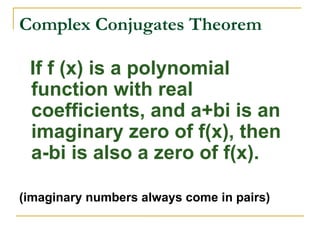
Complex Conjugates Theorem
If f (x) is a polynomial
function with real
coefficients, and a+bi is an
imaginary zero of f(x), then
a-bi is also a zero of f(x).
(imaginary numbers always come in pairs)
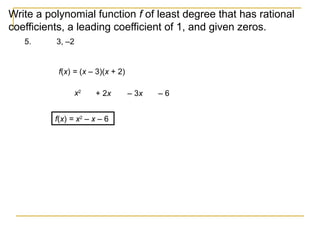
Write a polynomial function f of least degree that has rational
coefficients, a leading coefficient of 1, and given zeros.
5. 3, –2
f(x) = (x – 3)(x + 2)
x2
+ 2x – 3x – 6
f(x) = x2
– x – 6
Write a polynomial function f of least degree that has rational
coefficients, a leading coefficient of 1, and given zeros.
6. i, –2i
f(x) = (x – i)(x + i)(x + 2i)(x – 2i)
f(x) = x4
+ 5x2
+ 4
(x2
– i2
) (x2
– 4i2
)
(x2
+ 1) (x2
+ 4)
x4
+ 4x2
+ x2
+ 4
Some possibilities for zeros (roots)
Equation Real Zeros Imaginary Zeros
Linear 1 0
Quadratic 2 0
0 2
Cubic 3 0
1 2
Quartic 4 0
2 2
0 4
Quintic 5 0
3 2
1 4
Find the zeros.
f(x) = x 3
– x2
+ 4x – 4 = 0
g(x) = x 4
+ 2x 3
– 5x 2
– 4x + 6 = 0
Write a polynomial function of least degree with a leading coefficient of
1.
2, 3, -4
(x – 2)(x – 3)(x + 4) = 0
(x2
– 5x + 6)(x + 4) = 0
x 3
- x2
– 14x + 24 = 0
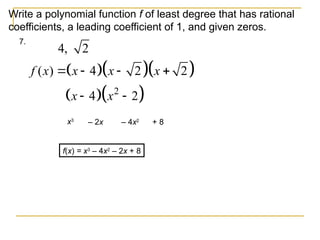
Write a polynomial function f of least degree that has rational
coefficients, a leading coefficient of 1, and given zeros.
7.
4, 2
   
( ) 4 2 2
f x x x x
   
  
2
4 2
x x
 
x3
– 2x – 4x2
+ 8
f(x) = x3
– 4x2
– 2x + 8
Write a polynomial function of least degree with a leading coefficient of
1.
7, i
(x – 7)(x – i)(x + i) = 0
(x – 7)(x 2
+ 1) = 0
x 3
– 7 x 2
+ x – 7 = 0
ASSIGNMENT:
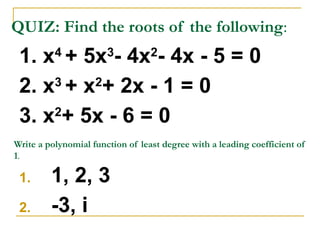
QUIZ: Find the roots of the following:
1. x4
+ 5x3
- 4x2
- 4x - 5 = 0
2. x3
+ x2
+ 2x - 1 = 0
3. x2
+ 5x - 6 = 0
1. 1, 2, 3
2. -3, i
Write a polynomial function of least degree with a leading coefficient of
1.
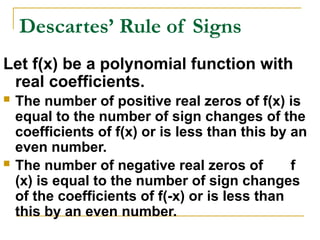
Descartes’ Rule of Signs
Let f(x) be a polynomial function with
real coefficients.
 The number of positive real zeros of f(x) is
equal to the number of sign changes of the
coefficients of f(x) or is less than this by an
even number.
 The number of negative real zeros of f
(x) is equal to the number of sign changes
of the coefficients of f(-x) or is less than
this by an even number.
huh
? ? ?
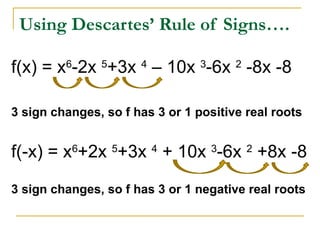
Using Descartes’ Rule of Signs….
f(x) = x6
-2x 5
+3x 4
– 10x 3
-6x 2
-8x -8
3 sign changes, so f has 3 or 1 positive real roots
f(-x) = x6
+2x 5
+3x 4
+ 10x 3
-6x 2
+8x -8
3 sign changes, so f has 3 or 1 negative real roots
g(x) = -x5
– 5x4
+ 7x3
– 4x2
– 8x + 9
 Determine the possible number of
positive real zeros, negative real zeros,
and imaginary zeros of the function
given above.
 g(x) = -x5
– 5x4
+ 7x3
– 4x2
– 8x + 9
 g(-x) = x5
– 5x4
- 7x3
– 4x2
+ 8x + 9
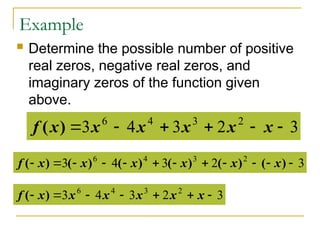
Example
 Determine the possible number of positive
real zeros, negative real zeros, and
imaginary zeros of the function given
above.
3
2
3
4
3 2
3
4
6





 x
x
x
x
x
x
f )
(
3
2
3
4
3 2
3
4
6











 )
(
)
(
)
(
)
(
)
(
)
( x
x
x
x
x
x
f
3
2
3
4
3 2
3
4
6






 x
x
x
x
x
x
f )
(
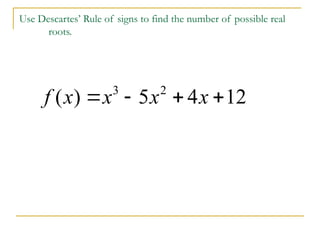
Use Descartes’ Rule of signs to find the number of possible real
roots.
3 2
( ) 5 4 12
f x x x x
   

RATIONAL ROOT THEOREM AND EXAMPLES .pptx

  • 1.
  • 2.
    Rational Root Theorem: Supposethat a polynomial equation with integral coefficients has the root , where h and k are relatively prime integers. Then h must be a factor of the constant term of the polynomial and k must be a factor of the coefficient of the highest degree term. (useful when solving higher degree polynomial equations) h k
  • 3.
    How many solutionsdoes the equation have? 1. 4 2 5 36 0 x x    4 2. 3 2 5 7 8 16 0 x x x     3
  • 4.
    a) State allpossible rational zeros for g(x) = x3 + 2x2 - 3x + 5 Possible rational zeros: +5, +1 b) State all possible rational zeros for g(x) = 6x3 + 6x2 - 15x - 2 +6,+3,+2,+1 +2,+1 +1 +5,+1 Factors of the constant Factors of the leading coefficient Possible rational zeros: +2,+1 +6,+3,+2,+1 2 1 6 1 3 2 3 1 , , 2 , 1 , ,       Example 1
  • 5.
    Solve using theRational Root Theorem:  4x2 + 3x – 1 = 0 (any rational root must have a numerator that is a factor of -1 and a denominator that is a factor of 4) factors of -1: ±1 factors of 4: ±1,2,4 possible rational roots: (now use synthetic division to find rational roots) 1 1 1, , 2 4  1 4 3 -1 4 7 4 7 6 no -1 4 3 -1 -4 1 4 -1 0 ! yes 4 1 0 4 1 1 4 x x x     1 1, 4 x  (note: not all possible rational roots are roots!)
  • 6.
    Ex : Solveusing the Rational Root Theorem:3 2 2 13 10 0 x x x     : 1,2,5,10 : 1 h k   1 1 2 -13 10 1 3 -10 1 3 -10 0 ! yes    2 3 10 0 5 2 0 5, 2 x x x x x        5,1, 2 x  1, 2, 5,10  possible rational roots:
  • 7.
    Ex : Solveusing the Rational Root Theorem: 3 2 4 4 0 x x x     : 1,2,4 : 1 h k   possible rational roots: 1, 2, 4  1 1 -4 -1 4 1 -3 -4 1 -3 -4 0 ! yes    2 3 4 0 4 1 0 1, 4 x x x x x        1,1, 4 x 
  • 8.
    Ex : Solveusing the Rational Root Theorem: 3 2 3 5 4 4 0 x x x     : 1,2,4 : 1, 3 h k   possible rational roots: 1 2 4 1, 2, 4, , , 3 3 3  -1 3 -5 -4 4 -3 8 3 -8 -4 -4 0 ! yes    2 3 8 4 0 3 2 2 0 2 , 2 3 x x x x x        2 1, , 2 3 x  To find other roots can use synthetic division using other possible roots on these coefficients. (or factor and solve the quadratic equation) 2 3 -8 4 3 2 0 6 -4 3 2 3 -2 0 x x    2 3 x 
  • 9.
    Find all zerosof the polynomial function. 3. 4 3 2 ( ) 4 3 4 4 f x x x x x      Factors of last term: Factors of first term: 1 Possible rational zeros: How many answers: 4 1, 2, 4 1, 2, 4
  • 10.
    1 1 –43 4 1 1 –3 –3 0 0 4 Find all real zeros of the function. 3. Possible rational zeros: 1, 2, 4 4 3 2 ( ) 4 3 4 4 f x x x x x      –4 4 0 (x – 1) x3 – 3x2 + 0x + 4 ( ) = 0
  • 11.
    1 1 –43 4 1 1 –3 –3 0 0 4 Find all real zeros of the function. 3. Possible rational zeros: 1, 2, 4 4 3 2 ( ) 4 3 4 4 f x x x x x      –4 4 0 –1 1 –1 –4 4 4 –4 0 (x + 1) x2 – 4x + 4 ( ) = 0 (x – 1) x x –2 –2 (x – 1)(x + 1)(x – 2)(x – 2) = 0 x = 1, 2
  • 12.
    Find all zerosof the polynomial function. 4. 4 3 2 ( ) 7 9 18 f x x x x x      1 How many answers: 4 1, 18 2, 9, 3, 6, 1, 18 2, 9, 3, 6, Factors of last term: Factors of first term: Possible rational zeros:
  • 13.
    1 1 –17 –9 1 1 0 0 7 7 –2 Find all real zeros of the function. 4. Possible rational zeros:  4 3 2 ( ) 7 9 18 f x x x x x      1, 18 2, 9, 3, 6, –18 –2 –20
  • 14.
    –1 1 –17 –9 1 –1 –2 2 9 –9 –18 Find all real zeros of the function. 4. Possible rational zeros: 4 3 2 ( ) 7 9 18 f x x x x x      1, 18 2, 9, 3, 6, –18 18 0 (x + 1) (x + 1)(x2 + 9)(x – 2) = 0 x3 – 2x2 + 9x – 18 ( ) = 0 ( ) ( ) x2 (x – 2) +9 (x – 2) (x2 + 9) (x – 2) (x + 1) x = 1, 3 , 2 i  
  • 15.
    Find the rootsof x3 + 8x2 + 16x + 5 = 0
  • 16.
    Ex : Determinethe zeros: 3 2 3 2 6 x x x   
  • 17.
    If f(x) isa polynomial of degree n where n>0, then the equation f(x) = o has at least one solution in the set of complex numbers. The Fundamental Theorem of Algebra
  • 18.
    Complex Conjugates Theorem Iff (x) is a polynomial function with real coefficients, and a+bi is an imaginary zero of f(x), then a-bi is also a zero of f(x). (imaginary numbers always come in pairs)
  • 19.
    Write a polynomialfunction f of least degree that has rational coefficients, a leading coefficient of 1, and given zeros. 5. 3, –2 f(x) = (x – 3)(x + 2) x2 + 2x – 3x – 6 f(x) = x2 – x – 6
  • 20.
    Write a polynomialfunction f of least degree that has rational coefficients, a leading coefficient of 1, and given zeros. 6. i, –2i f(x) = (x – i)(x + i)(x + 2i)(x – 2i) f(x) = x4 + 5x2 + 4 (x2 – i2 ) (x2 – 4i2 ) (x2 + 1) (x2 + 4) x4 + 4x2 + x2 + 4
  • 21.
    Some possibilities forzeros (roots) Equation Real Zeros Imaginary Zeros Linear 1 0 Quadratic 2 0 0 2 Cubic 3 0 1 2 Quartic 4 0 2 2 0 4 Quintic 5 0 3 2 1 4
  • 22.
    Find the zeros. f(x)= x 3 – x2 + 4x – 4 = 0 g(x) = x 4 + 2x 3 – 5x 2 – 4x + 6 = 0
  • 23.
    Write a polynomialfunction of least degree with a leading coefficient of 1. 2, 3, -4 (x – 2)(x – 3)(x + 4) = 0 (x2 – 5x + 6)(x + 4) = 0 x 3 - x2 – 14x + 24 = 0
  • 24.
    Write a polynomialfunction f of least degree that has rational coefficients, a leading coefficient of 1, and given zeros. 7. 4, 2     ( ) 4 2 2 f x x x x        2 4 2 x x   x3 – 2x – 4x2 + 8 f(x) = x3 – 4x2 – 2x + 8
  • 25.
    Write a polynomialfunction of least degree with a leading coefficient of 1. 7, i (x – 7)(x – i)(x + i) = 0 (x – 7)(x 2 + 1) = 0 x 3 – 7 x 2 + x – 7 = 0 ASSIGNMENT:
  • 26.
    QUIZ: Find theroots of the following: 1. x4 + 5x3 - 4x2 - 4x - 5 = 0 2. x3 + x2 + 2x - 1 = 0 3. x2 + 5x - 6 = 0 1. 1, 2, 3 2. -3, i Write a polynomial function of least degree with a leading coefficient of 1.
  • 27.
    Descartes’ Rule ofSigns Let f(x) be a polynomial function with real coefficients.  The number of positive real zeros of f(x) is equal to the number of sign changes of the coefficients of f(x) or is less than this by an even number.  The number of negative real zeros of f (x) is equal to the number of sign changes of the coefficients of f(-x) or is less than this by an even number.
  • 28.
  • 29.
    Using Descartes’ Ruleof Signs…. f(x) = x6 -2x 5 +3x 4 – 10x 3 -6x 2 -8x -8 3 sign changes, so f has 3 or 1 positive real roots f(-x) = x6 +2x 5 +3x 4 + 10x 3 -6x 2 +8x -8 3 sign changes, so f has 3 or 1 negative real roots
  • 30.
    g(x) = -x5 –5x4 + 7x3 – 4x2 – 8x + 9  Determine the possible number of positive real zeros, negative real zeros, and imaginary zeros of the function given above.  g(x) = -x5 – 5x4 + 7x3 – 4x2 – 8x + 9  g(-x) = x5 – 5x4 - 7x3 – 4x2 + 8x + 9
  • 31.
    Example  Determine thepossible number of positive real zeros, negative real zeros, and imaginary zeros of the function given above. 3 2 3 4 3 2 3 4 6       x x x x x x f ) ( 3 2 3 4 3 2 3 4 6             ) ( ) ( ) ( ) ( ) ( ) ( x x x x x x f 3 2 3 4 3 2 3 4 6        x x x x x x f ) (
  • 32.
    Use Descartes’ Ruleof signs to find the number of possible real roots. 3 2 ( ) 5 4 12 f x x x x    