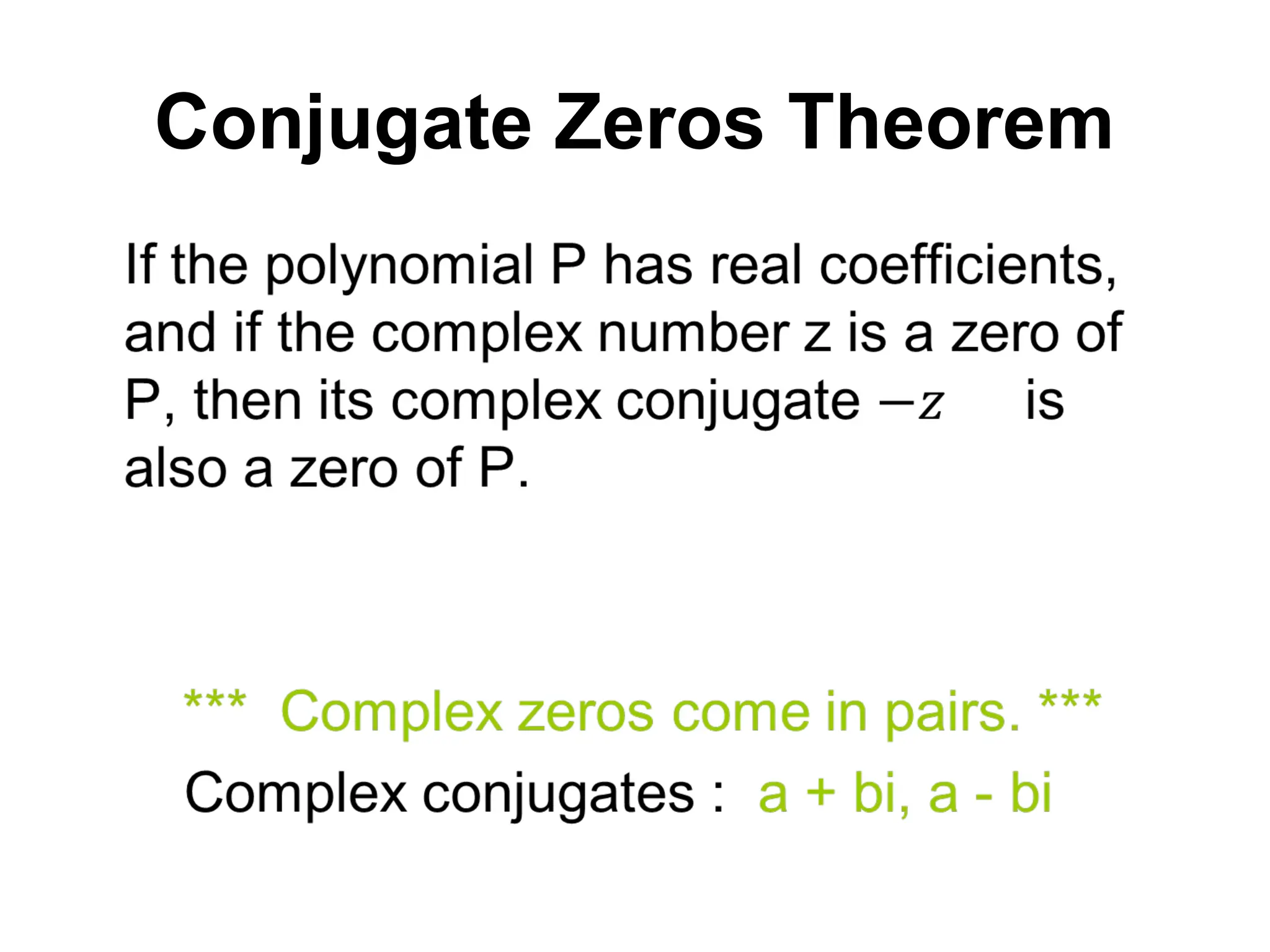
Finding the RationalZeros of a Polynomial
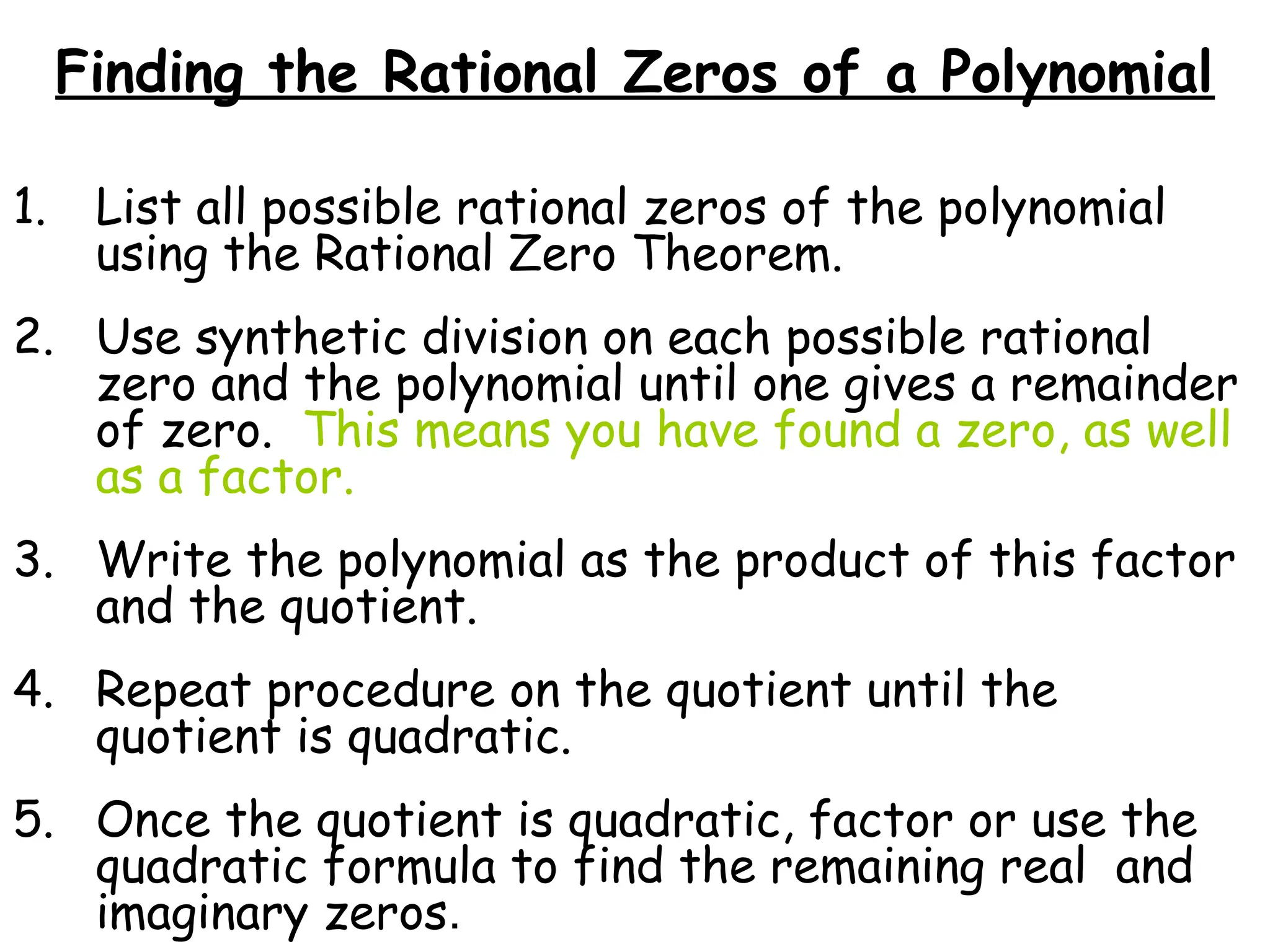
1. List all possible rational zeros of the polynomial
using the Rational Zero Theorem.
2. Use synthetic division on each possible rational
zero and the polynomial until one gives a remainder
of zero. This means you have found a zero, as well
as a factor.
3. Write the polynomial as the product of this factor
and the quotient.
4. Repeat procedure on the quotient until the
quotient is quadratic.
5. Once the quotient is quadratic, factor or use the
quadratic formula to find the remaining real and
imaginary zeros.
7.
The Rational ZeroTheorem
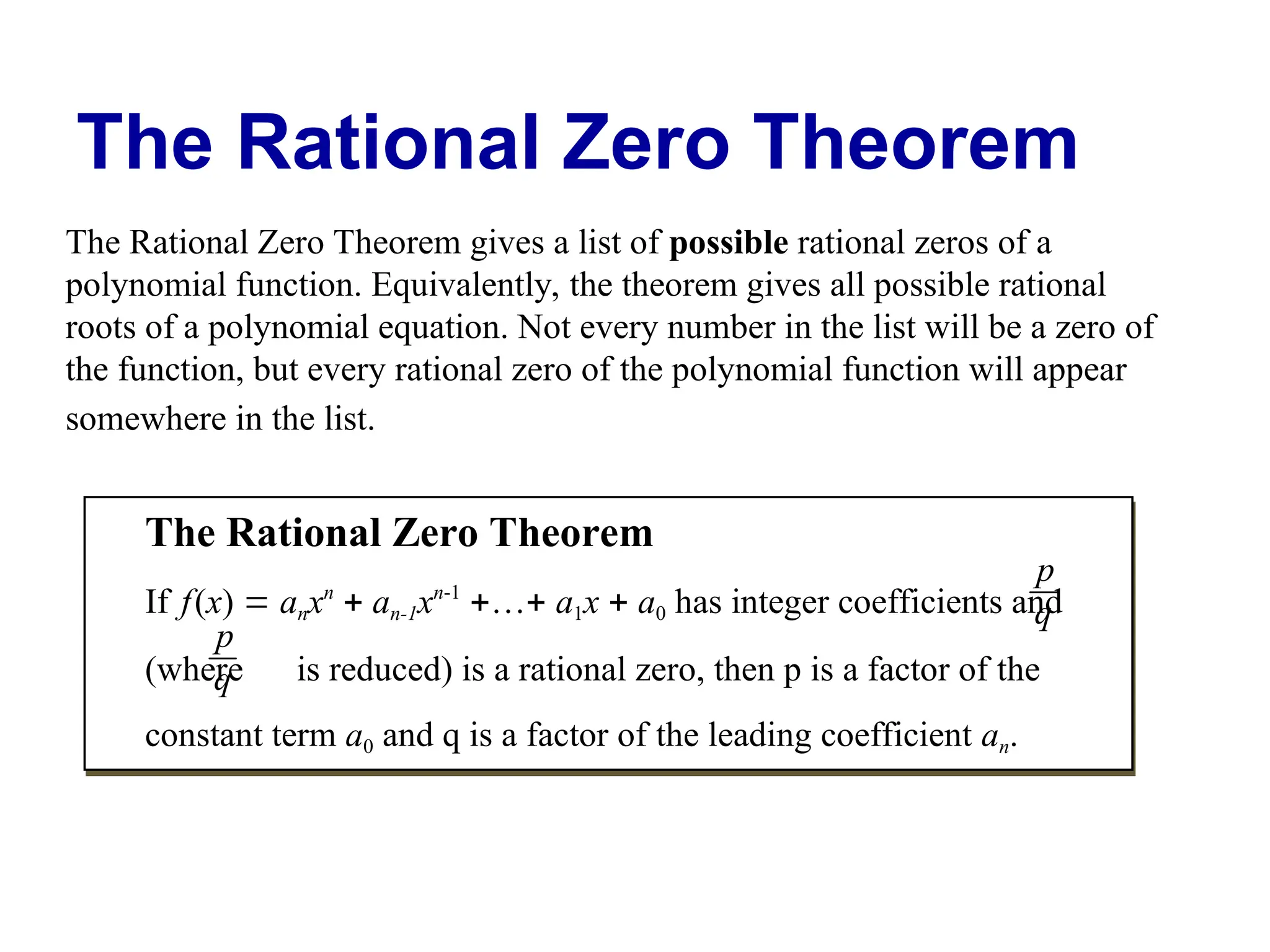
The Rational Zero Theorem gives a list of possible rational zeros of a
polynomial function. Equivalently, the theorem gives all possible rational
roots of a polynomial equation. Not every number in the list will be a zero of
the function, but every rational zero of the polynomial function will appear
somewhere in the list.
The Rational Zero Theorem
If f(x) anxn
an-1xn-1
… a1x a0 has integer coefficients and
(where is reduced) is a rational zero, then p is a factor of the
constant term a0 and q is a factor of the leading coefficient an.
p
q
p
q
8.
EXAMPLE: Using theRational Zero Theorem
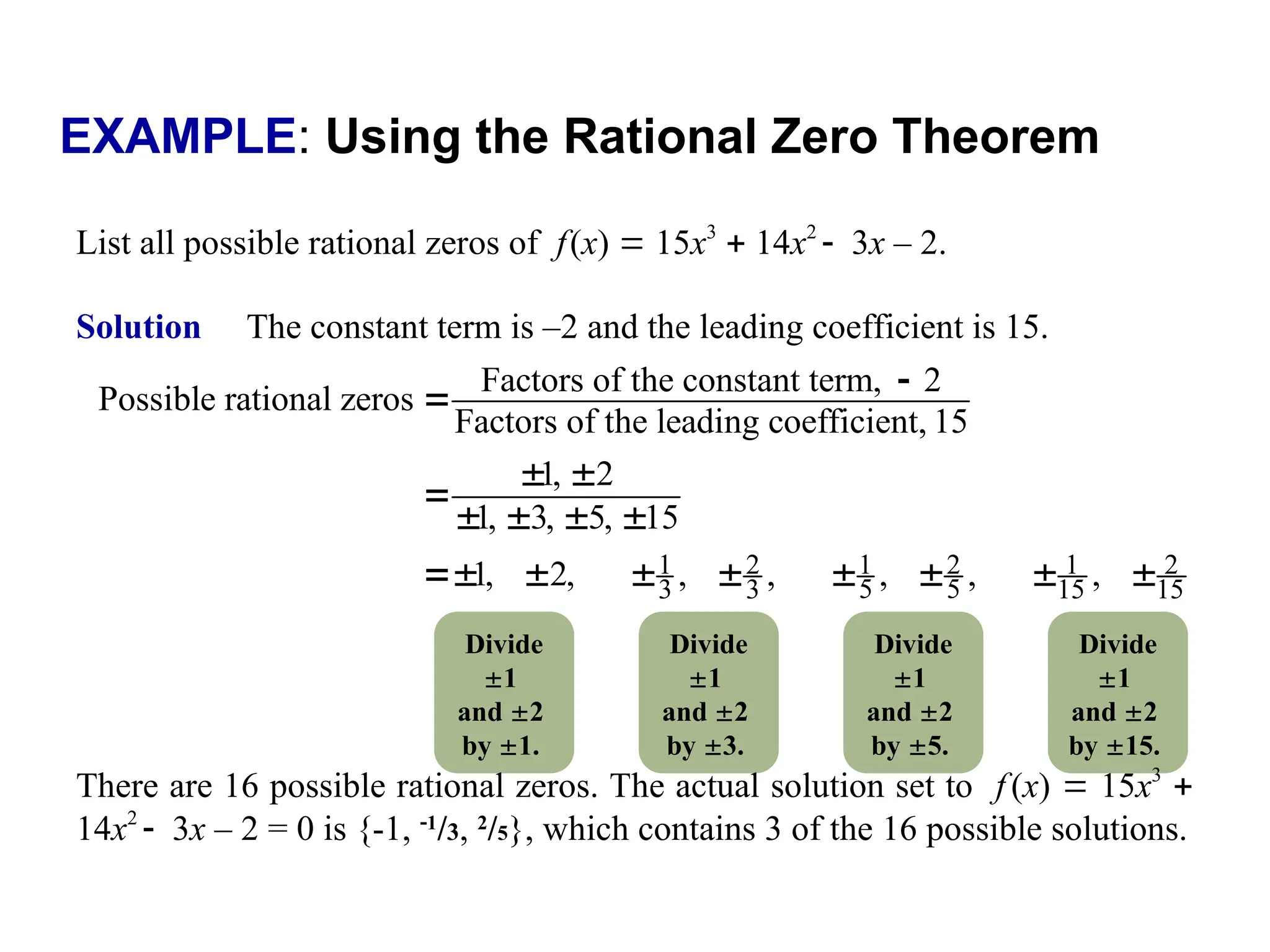
List all possible rational zeros of f(x) 15x3
14x2
3x – 2.
Solution The constant term is –2 and the leading coefficient is 15.
1 2 1 2 1 2
5 5
3 3 15 15
Factors of the constant term, 2
Possible rational zeros
Factors of the leading coefficient, 15
1, 2
1, 3, 5, 15
1, 2, , , , , ,
Divide
1
and 2
by 1.
Divide
1
and 2
by 3.
Divide
1
and 2
by 5.
Divide
1
and 2
by 15.
There are 16 possible rational zeros. The actual solution set to f (x) 15x3
14x2
3x – 2 = 0 is {-1, 1
/3, 2
/5}, which contains 3 of the 16 possible solutions.
9.
EXAMPLE: Solving aPolynomial Equation
Solve: x4
6x2
8x + 24 0.
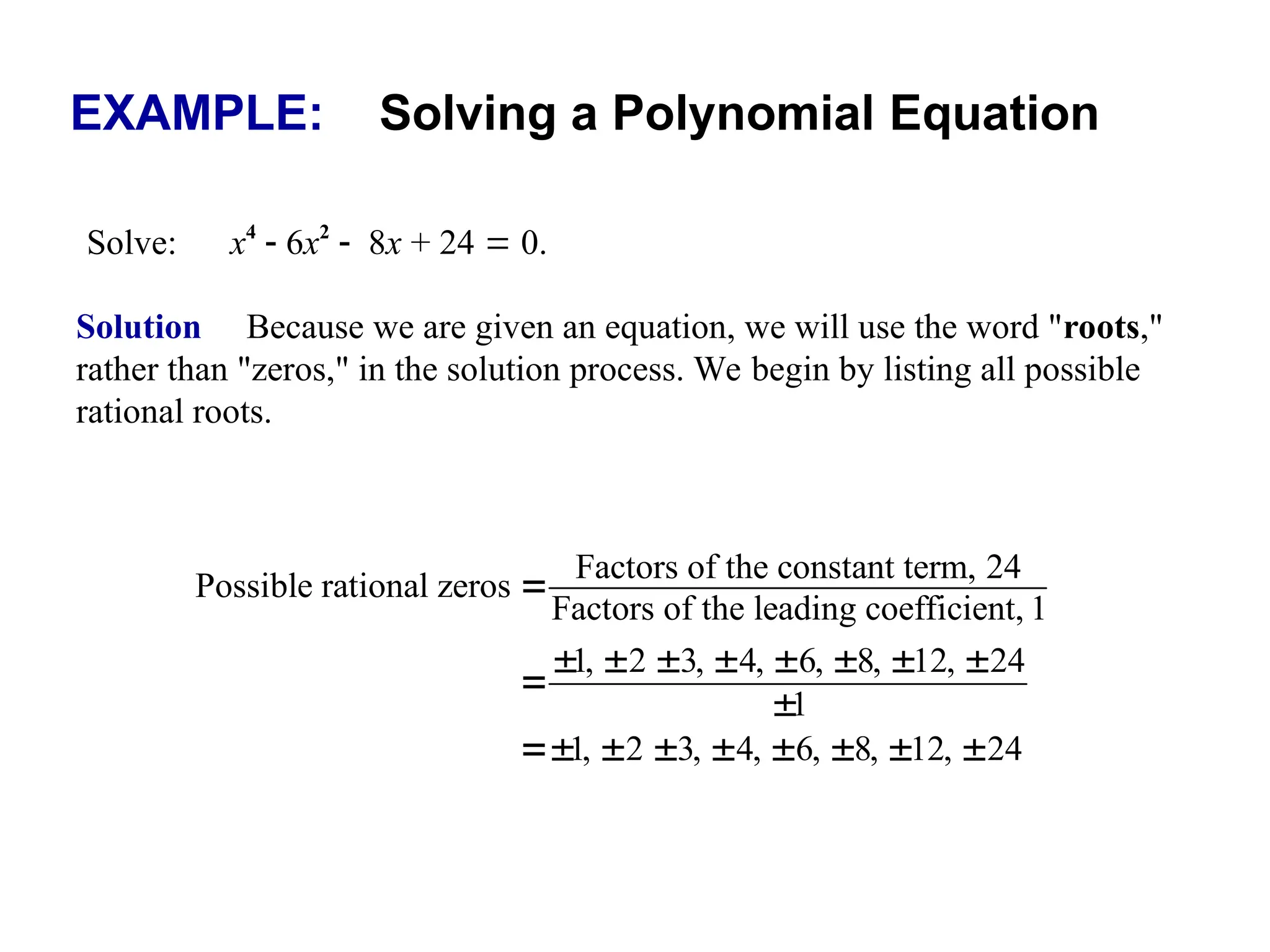
Solution Because we are given an equation, we will use the word "roots,"
rather than "zeros," in the solution process. We begin by listing all possible
rational roots.
Factors of the constant term, 24
Possible rational zeros
Factors of the leading coefficient, 1
1, 2 3, 4, 6, 8, 12, 24
1
1, 2 3, 4, 6, 8, 12, 24
10.
EXAMPLE: Solving aPolynomial Equation
Solve: x4
6x2
8x + 24 0.
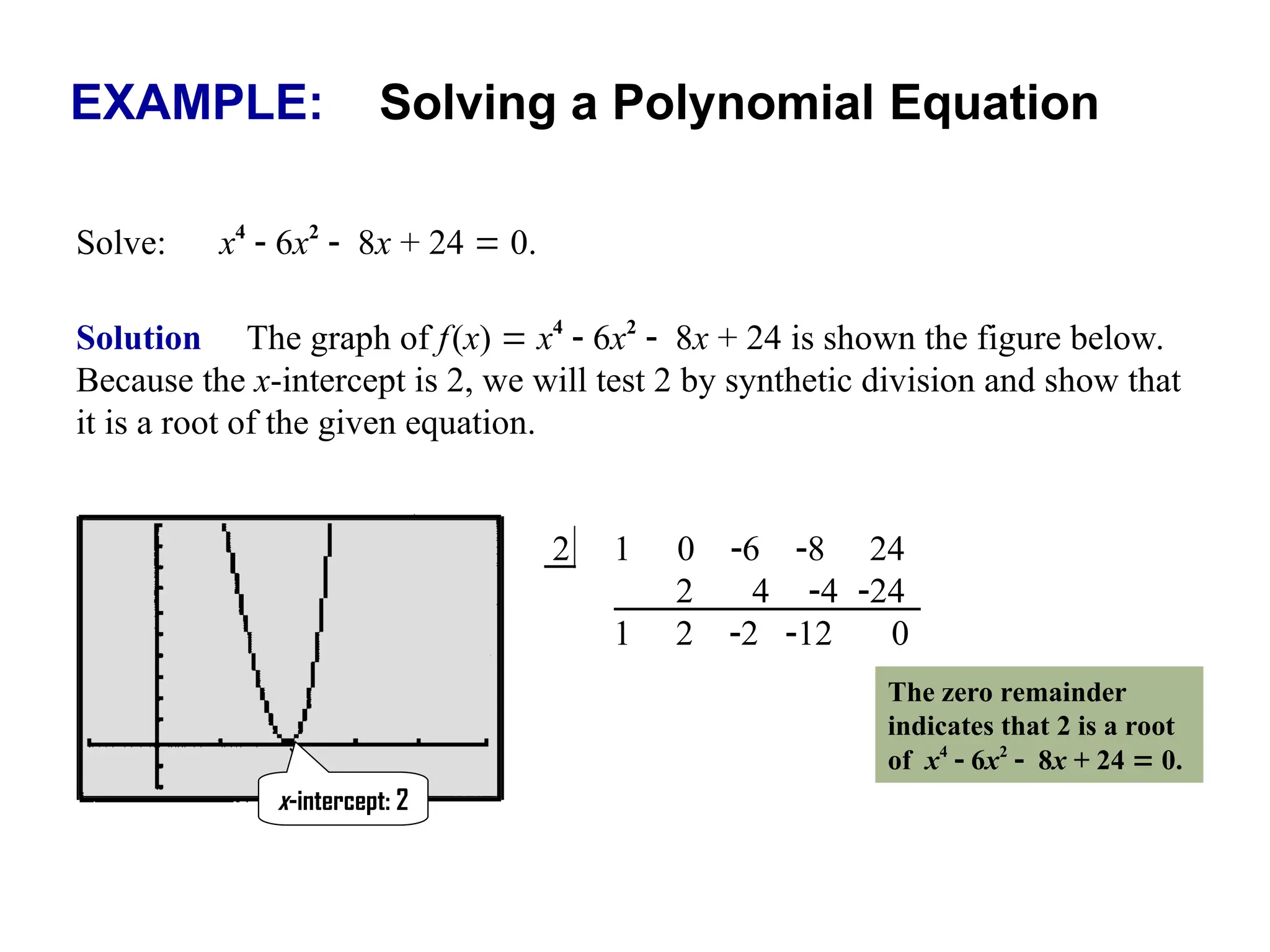
Solution The graph of f(x) x4
6x2
8x + 24 is shown the figure below.
Because the x-intercept is 2, we will test 2 by synthetic division and show that
it is a root of the given equation.
x-intercept: 2
The zero remainder
indicates that 2 is a root
of x4
6x2
8x + 24 0.
2 1 0 6 8 24
2 4 4 24
1 2 2 12 0
11.
EXAMPLE: Solving aPolynomial Equation
Solve: x4
6x2
8x + 24 0.
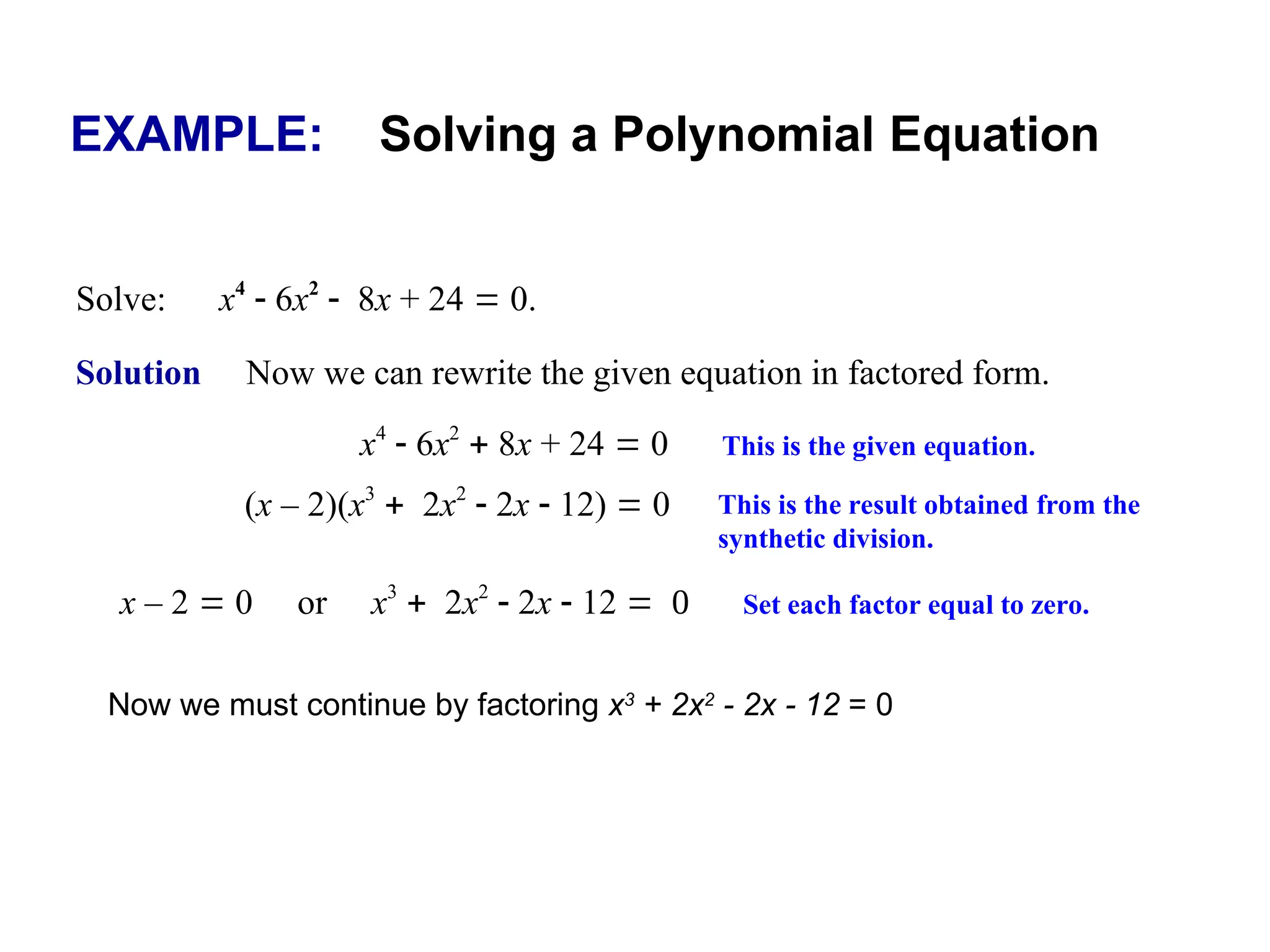
Solution Now we can rewrite the given equation in factored form.
(x – 2)(x3
2x2
2x 12) 0 This is the result obtained from the
synthetic division.
x – 2 0 or x3
2x2
2x 12 Set each factor equal to zero.
x4
6x2
8x + 24 0 This is the given equation.
Now we must continue by factoring x3
+ 2x2
- 2x - 12 = 0
12.
EXAMPLE: Solving aPolynomial Equation
Solve: x4
6x2
8x + 24 0.
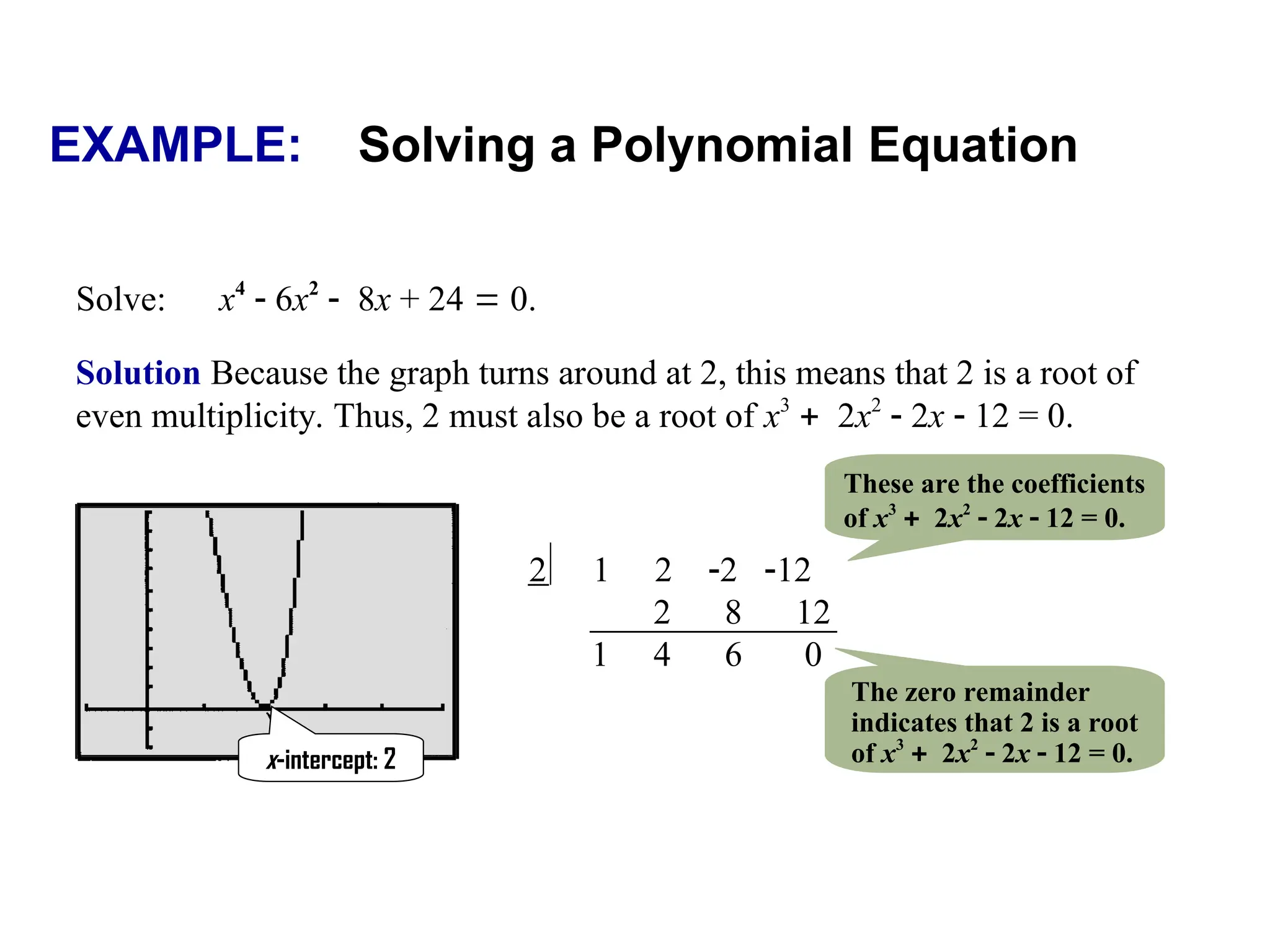
Solution Because the graph turns around at 2, this means that 2 is a root of
even multiplicity. Thus, 2 must also be a root of x3
2x2
2x 12 = 0.
x-intercept: 2
2 1 2 2 12
2 8 12
1 4 6 0
These are the coefficients
of x3
2x2
2x 12 = 0.
The zero remainder
indicates that 2 is a root
of x3
2x2
2x 12 = 0.
13.
EXAMPLE: Solving aPolynomial Equation
Solve: x4
6x2
8x + 24 0.
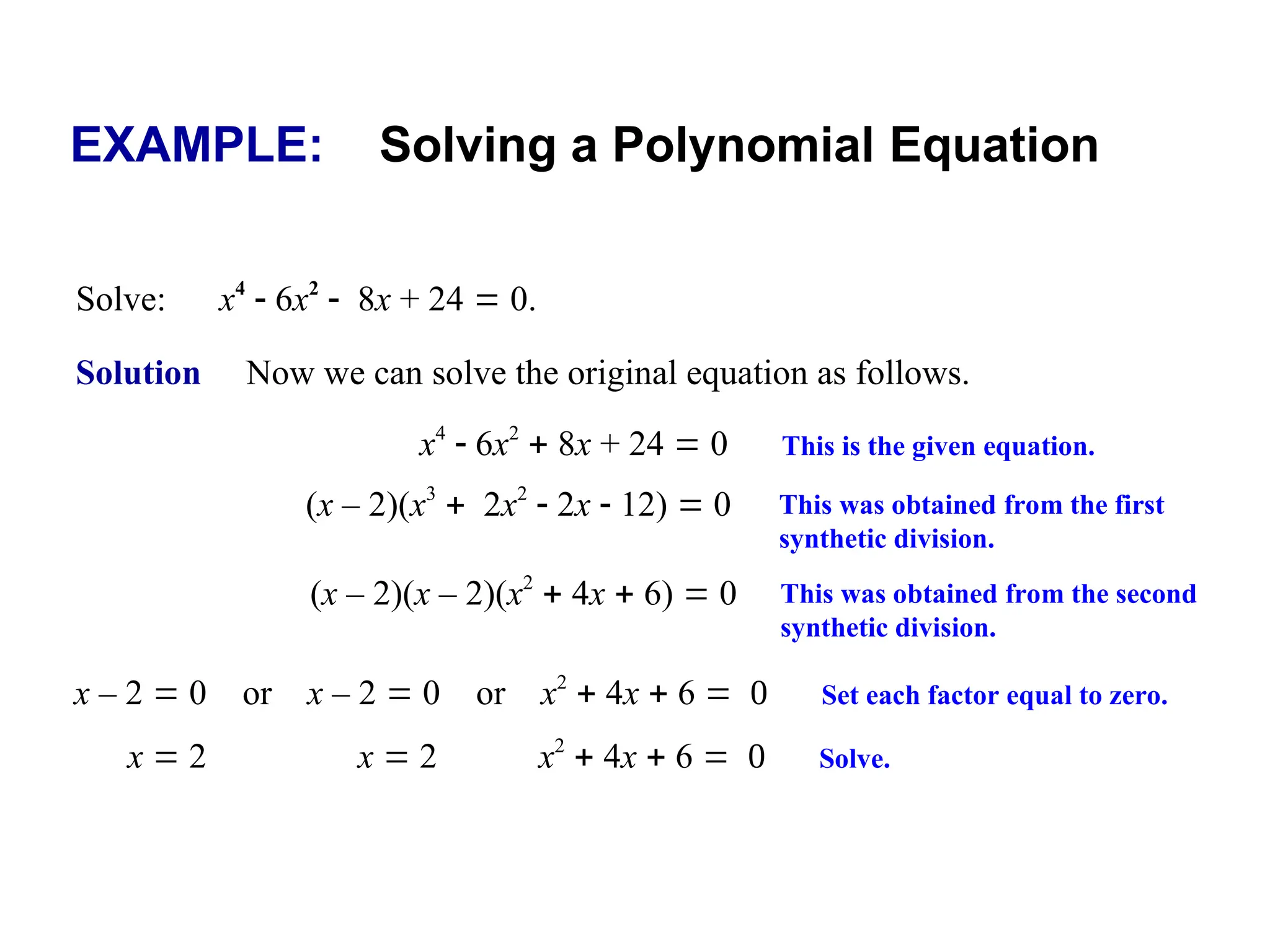
Solution Now we can solve the original equation as follows.
(x – 2)(x3
2x2
2x 12) 0 This was obtained from the first
synthetic division.
x4
6x2
8x + 24 0 This is the given equation.
(x – 2)(x – 2)(x2
4x 6) 0 This was obtained from the second
synthetic division.
x – 2 0 or x – 2 0 or x2
4x 6 Set each factor equal to zero.
x 2 x 2 x2
4x 6 Solve.
14.
EXAMPLE: Solving aPolynomial Equation
Solve: x4
6x2
8x + 24 0.
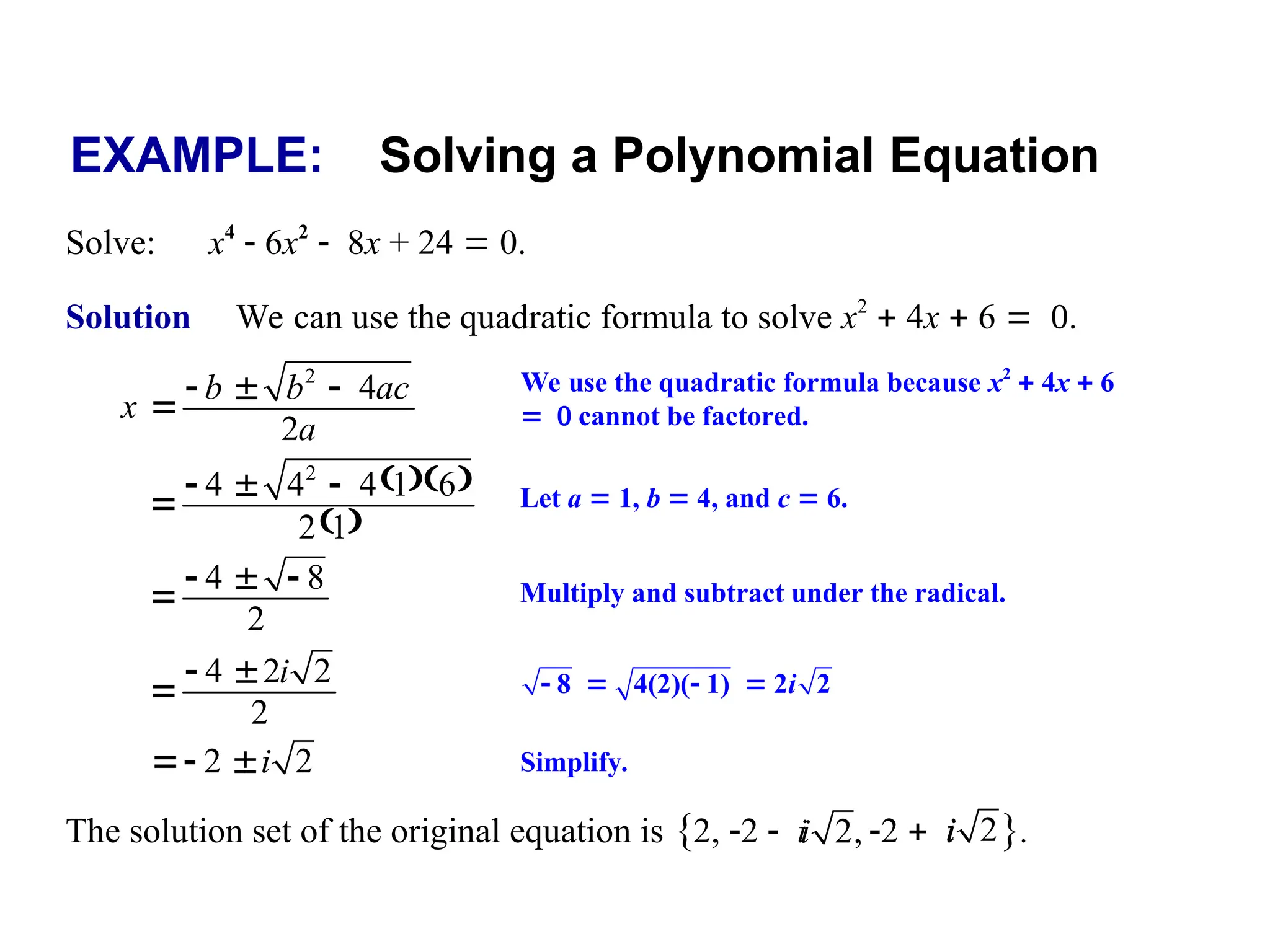
Solution We can use the quadratic formula to solve x2
4x 6
Let a 1, b 4, and c 6.
2
4 4 4 1 6
2 1
We use the quadratic formula because x2
4x 6
cannot be factored.
2
4
2
b b ac
x
a
Simplify.
2 2
i
Multiply and subtract under the radical.
4 8
2
4 2 2
2
i
8 4(2)( 1) 2 2
i
The solution set of the original equation is {2, 2 i 2 i }.
2,
i 2
i
15.
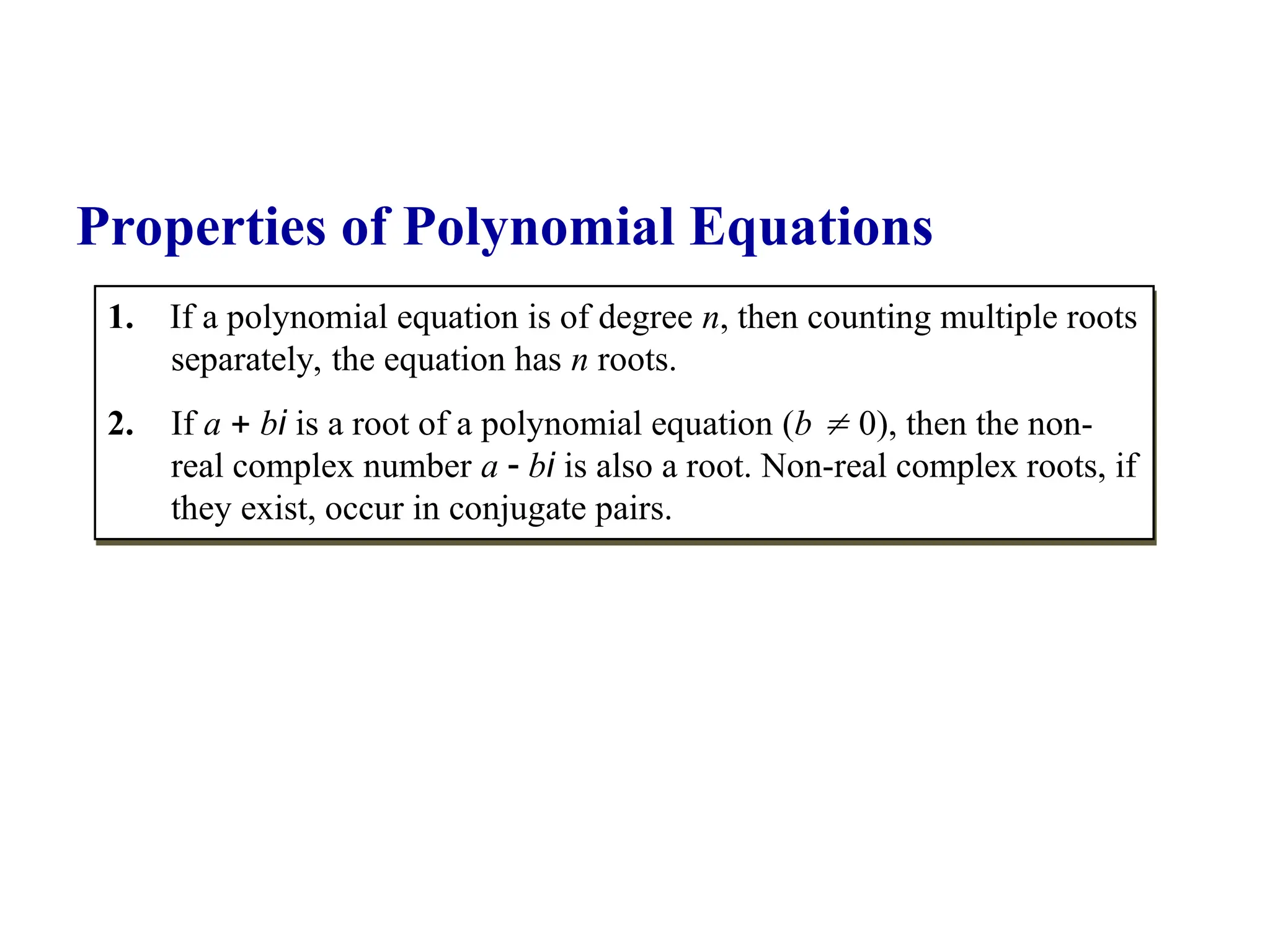
1. If apolynomial equation is of degree n, then counting multiple roots
separately, the equation has n roots.
2. If a bi is a root of a polynomial equation (b 0), then the non-
real complex number a bi is also a root. Non-real complex roots, if
they exist, occur in conjugate pairs.
Properties of Polynomial Equations
16.
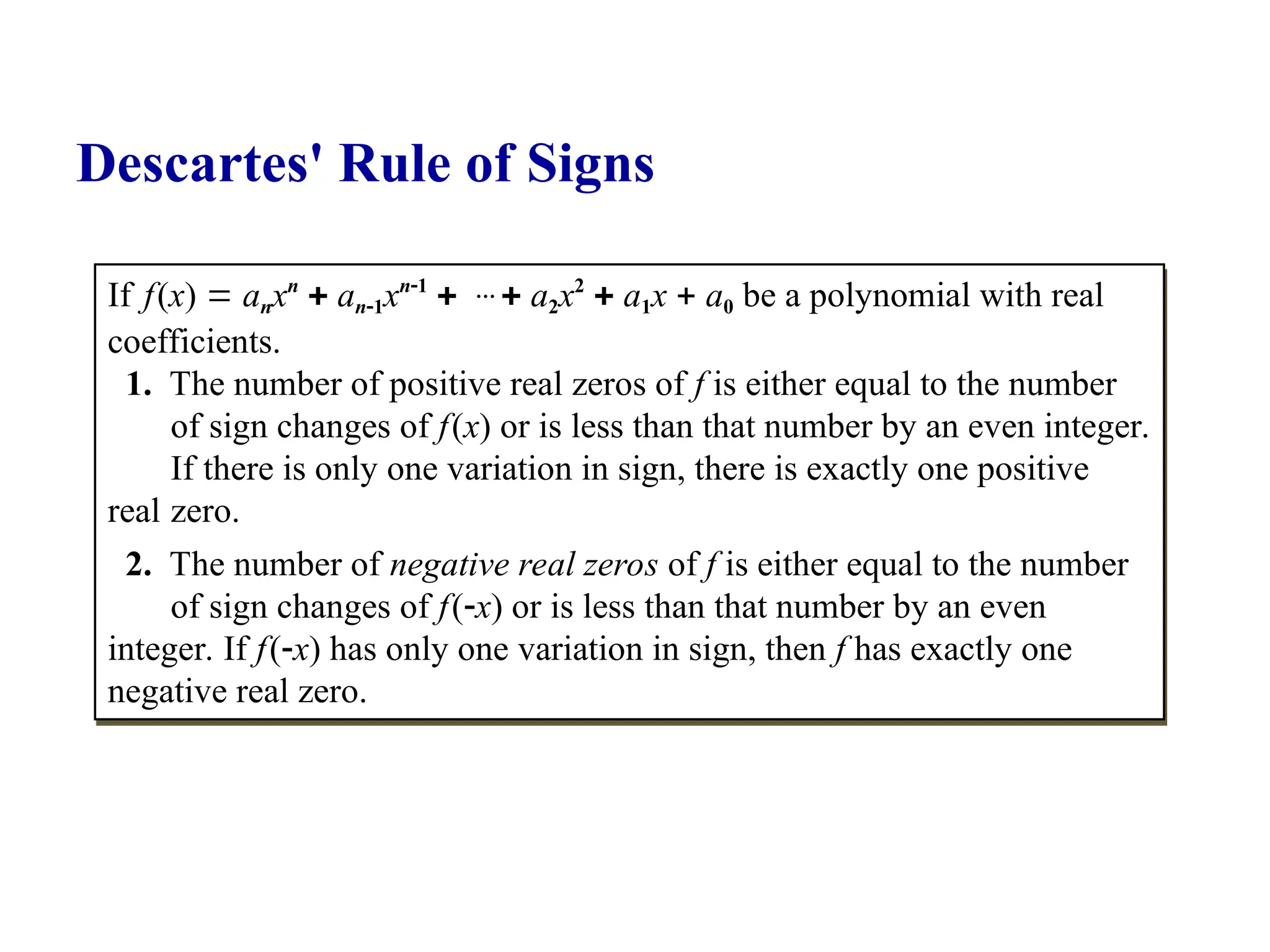
If f(x) anxn
an1xn1
… a2x2
a1x a0 be a polynomial with real
coefficients.
1. The number of positive real zeros of f is either equal to the number
of sign changes of f(x) or is less than that number by an even integer.
If there is only one variation in sign, there is exactly one positive
real zero.
2. The number of negative real zeros of f is either equal to the number
of sign changes of f(x) or is less than that number by an even
integer. If f(x) has only one variation in sign, then f has exactly one
negative real zero.
Descartes' Rule of Signs
17.
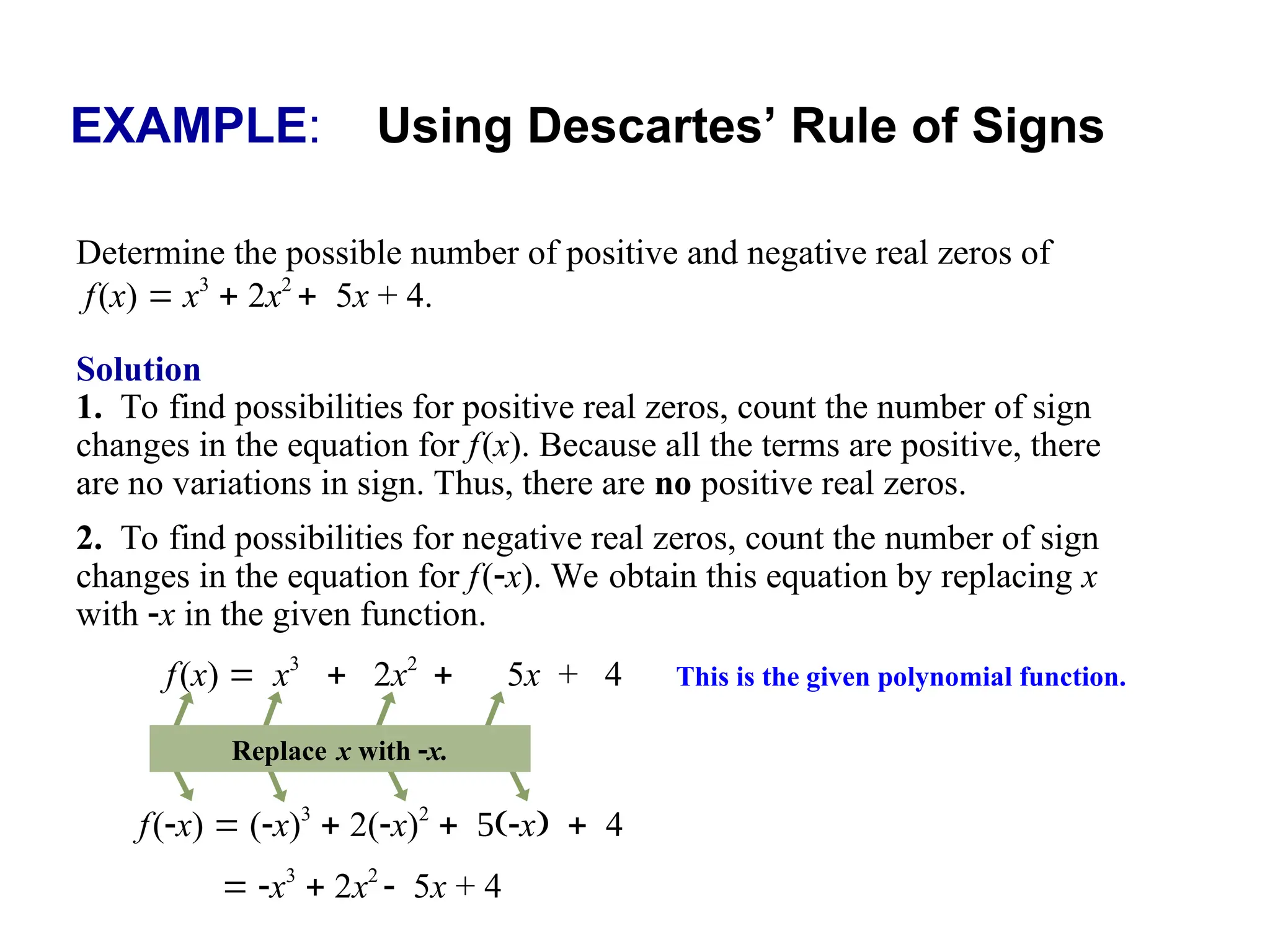
EXAMPLE: Using Descartes’Rule of Signs
Determine the possible number of positive and negative real zeros of
f(x) x3
2x2
5x + 4.
Solution
1. To find possibilities for positive real zeros, count the number of sign
changes in the equation for f(x). Because all the terms are positive, there
are no variations in sign. Thus, there are no positive real zeros.
2. To find possibilities for negative real zeros, count the number of sign
changes in the equation for f(x). We obtain this equation by replacing x
with x in the given function.
f(x) (x)3
2(x)2
x4
f(x) x3
2x2
5x + 4 This is the given polynomial function.
Replace x with x.
x3
2x2
5x + 4
18.
EXAMPLE: Using Descartes’Rule of Signs
Determine the possible number of positive and negative real zeros of
f(x) x3
2x2
5x + 4.
Solution
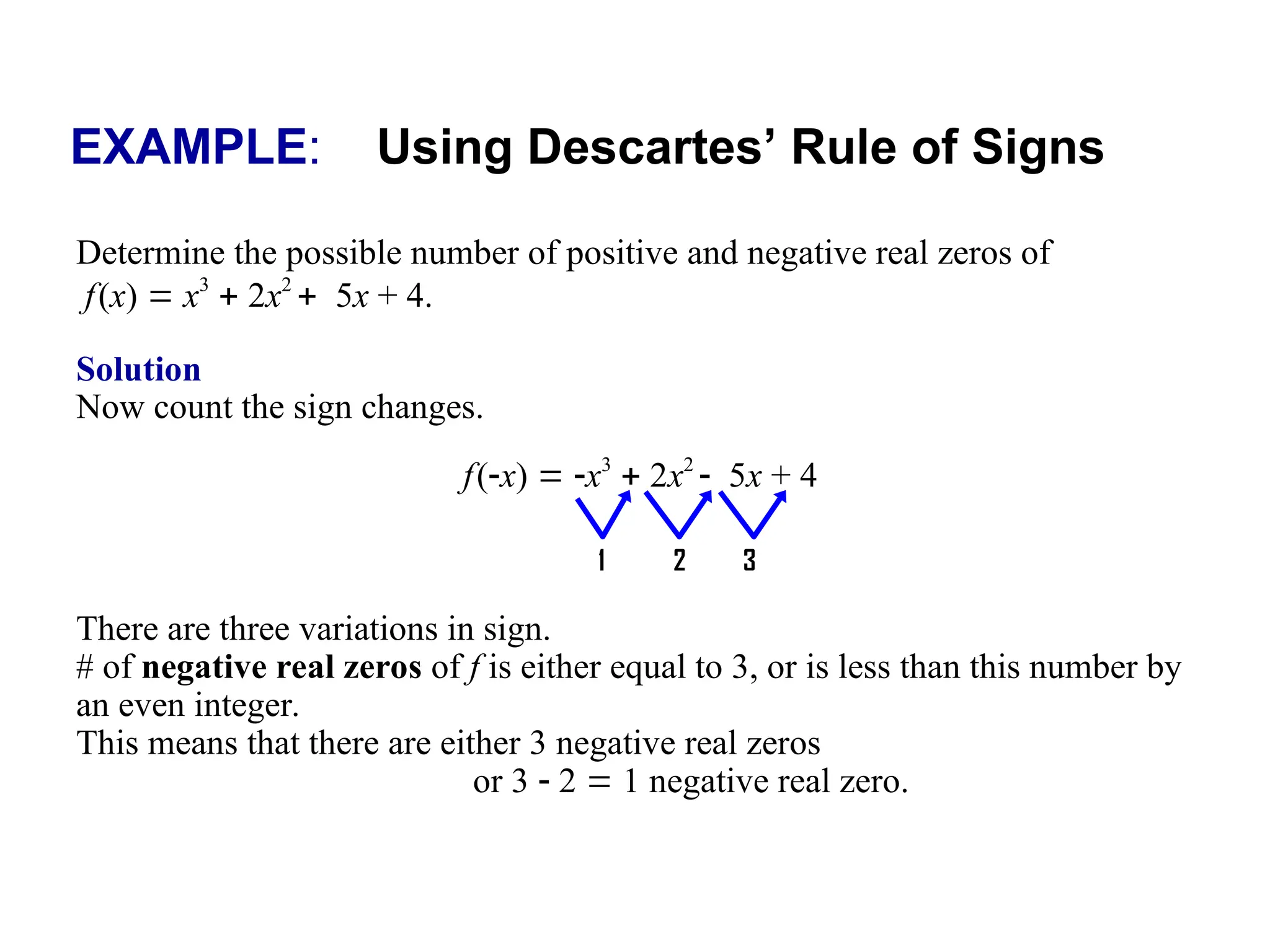
Now count the sign changes.
There are three variations in sign.
# of negative real zeros of f is either equal to 3, or is less than this number by
an even integer.
This means that there are either 3 negative real zeros
or 3 2 1 negative real zero.
f(x) x3
2x2
5x + 4
1 2 3