MIGRATION & DISPERSAL
RIYA DEY
MSc. 2nd semester
Jadavpur University
INDRODUCTION
There are several fundamental processes in biography:-
EVOLUTION SPECIATION EXTINCTION DISPERSAL
It means by which biotas respond to spatial and temporal
dynamics of geographic template.
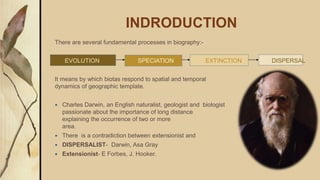
 Charles Darwin, an English naturalist, geologist and biologist was
passionate about the importance of long distance dispersal for
explaining the occurrence of two or more widely separated
area.
 There is a contradiction between extensionist and dispersalist.
 DISPERSALIST- Darwin, Asa Gray
 Extensionist- E Forbes, J. Hooker.
CONT…
 Migration : Migration is the movement of large numbers of a species from one place
to another, usually leaving none behind. Well-known examples include locust swarms & bird
migrations.
 Dispersal : Dispersal is the spreading of individuals away from others, often parents or
siblings, which are left behind in the original area. The movement of plant seeds is dispersal,
as is the movement of mammals away from their social group. It is confined to a particular
stage of an organism’s life history.
To the individual organism actually moving, there is no distinction between migration and
dispersal. Both are movements from an unfavourable situation towards the potentially
favourable.
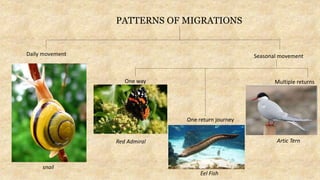
PATTERNS OF MIGRATIONS
Daily movement Seasonal movement
One way
One return journey
Multiple returns
snail
Red Admiral
Eel Fish
Artic Tern
DISPERSAL
 Dispersal is basically an ecological process which is a adaptive part of life history
of every species.
 A new location is always likely to be more favorable than an exact birthplace
because there is intraspecfics competition between parents and offspring.
 Usually biogeographers must look at dispersal as a historical process and must infer
the nature and timing of past long distance movements from indirect evidence i.e
distributions of living and fossil forms and genetic similarity among new isolated
biota.
 There is variation within populations in dispersal ability.
 A successful dispersal depends on
1. Long distance transport
2.withstanding unfavourable conditions during travel and upon early arrival
3. establishing a viable population.
TYPES OF DISPERSAL
Jump dispersal- long distance over inhospitable habitat
 Mostly by volant organisms.
 Example- island biogeography.
 Bats are often common island inhabitants.
 Nonvolant (non-flying) mammals, amphibians,
freshwater fish, and other forms are typically
island population
The Giant Tortoise is the inhabitat of
Galapagos island but it mostly arriving as
waifs on natural rafts of vegetation cast
adrift by violent storm
Conts….
Diffusion- It is much slower form of range expansion
than jump dispersal.
• It involves not just individuals but population.
• Ex.- House sparrow, Red Fox,
cattle egret ,armadillo (fauna)
purple loosestrife (flora).
CATTLE EGRET
• Native to Africa
• Colonized in north- east
part of South America in
the late 1800’s.
CONTS…
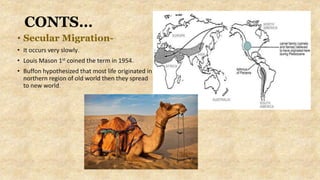
• Secular Migration-
• It occurs very slowly.
• Louis Mason 1st coined the term in 1954.
• Buffon hypothesized that most life originated in
northern region of old world then they spread
to new world.
MECHANISMS OF DISPERSAL
Two type of mechanism .
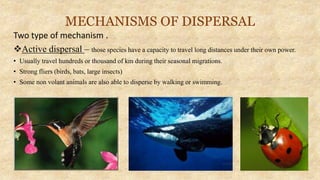
Active dispersal – those species have a capacity to travel long distances under their own power.
• Usually travel hundreds or thousand of km during their seasonal migrations.
• Strong fliers (birds, bats, large insects)
• Some non volant animals are also able to disperse by walking or swimming.
Golden plovers breed in the Arctic and
winter in southern South America, southern
Asia, Australia, and the Pacific islands.
Migrating individuals regularly fly nonstop
from Alaska to Hawaii, a distance of 4000 km.
CONTS…
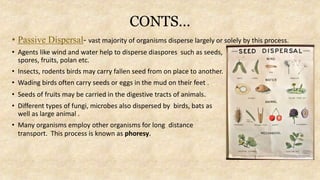
• Passive Dispersal- vast majority of organisms disperse largely or solely by this process.
• Agents like wind and water help to disperse diaspores such as seeds,
spores, fruits, polan etc.
• Insects, rodents birds may carry fallen seed from on place to another.
• Wading birds often carry seeds or eggs in the mud on their feet .
• Seeds of fruits may be carried in the digestive tracts of animals.
• Different types of fungi, microbes also dispersed by birds, bats as
well as large animal .
• Many organisms employ other organisms for long distance
transport. This process is known as phoresy.
BIOTIC EXCHANGE AND DISPERSAL ROUTE
• Corridors- It is a dispersal route that permits the movement of many or most species of a
particular taxon from one region to another. Ex - The Bering Land Bridge
• Filter- A filter is a dispersal route that exercises some selection
over the types of organisms that can pass through it.
E Example Arabian subcontinent
CONTS…..
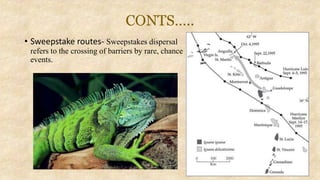
• Sweepstake routes- Sweepstakes dispersal
refers to the crossing of barriers by rare, chance
events.
BARRIERS TO DISPERSAL
• The nature of long-distance dispersal means that organisms often have to survive for periods of
time in environments that are hostile to them.
There are two types pf barriers.
Physiological barriers-
• Land water
• Salinity for aquatic organism
Ecological and behavioral barrier –
• Strong fliers that won’t cross water.
WHY WE STUDY DISPERSALAND MIGRATION?
 The study of dispersal and migration is very important .
 It includes advances in a variety of disciplines such as molecular biology and
genetics, biogeochemistry, remote sensing and telemetry.
 It helps the historical biogeographers to reconstruct the biogeographic
histories of lineages by analyzing genetic similarity of their extant
descendants.
 Biochemists are now capable of conducting analogous reconstructions by
measuring the levels of stable isotopes in the tissues of individuals that may
have dispersed long distance .
 some scientist are capitalizing on advances in remote sencing to visualize
the 3D movements of species through aerosphere.
REFERENCES
• www.glyndwr.ac.uk/en/migrationanddispersal/
• https://www.historicmysteries.com/camelops-north-american-camel/
• Biogeography (2006)

Migration, dispersal

  • 1.
    MIGRATION & DISPERSAL RIYADEY MSc. 2nd semester Jadavpur University
  • 2.
    INDRODUCTION There are severalfundamental processes in biography:- EVOLUTION SPECIATION EXTINCTION DISPERSAL It means by which biotas respond to spatial and temporal dynamics of geographic template.  Charles Darwin, an English naturalist, geologist and biologist was passionate about the importance of long distance dispersal for explaining the occurrence of two or more widely separated area.  There is a contradiction between extensionist and dispersalist.  DISPERSALIST- Darwin, Asa Gray  Extensionist- E Forbes, J. Hooker.
  • 3.
    CONT…  Migration :Migration is the movement of large numbers of a species from one place to another, usually leaving none behind. Well-known examples include locust swarms & bird migrations.  Dispersal : Dispersal is the spreading of individuals away from others, often parents or siblings, which are left behind in the original area. The movement of plant seeds is dispersal, as is the movement of mammals away from their social group. It is confined to a particular stage of an organism’s life history. To the individual organism actually moving, there is no distinction between migration and dispersal. Both are movements from an unfavourable situation towards the potentially favourable.
  • 4.
    PATTERNS OF MIGRATIONS Dailymovement Seasonal movement One way One return journey Multiple returns snail Red Admiral Eel Fish Artic Tern
  • 5.
    DISPERSAL  Dispersal isbasically an ecological process which is a adaptive part of life history of every species.  A new location is always likely to be more favorable than an exact birthplace because there is intraspecfics competition between parents and offspring.  Usually biogeographers must look at dispersal as a historical process and must infer the nature and timing of past long distance movements from indirect evidence i.e distributions of living and fossil forms and genetic similarity among new isolated biota.  There is variation within populations in dispersal ability.  A successful dispersal depends on 1. Long distance transport 2.withstanding unfavourable conditions during travel and upon early arrival 3. establishing a viable population.
  • 6.
    TYPES OF DISPERSAL Jumpdispersal- long distance over inhospitable habitat  Mostly by volant organisms.  Example- island biogeography.  Bats are often common island inhabitants.  Nonvolant (non-flying) mammals, amphibians, freshwater fish, and other forms are typically island population The Giant Tortoise is the inhabitat of Galapagos island but it mostly arriving as waifs on natural rafts of vegetation cast adrift by violent storm
  • 7.
    Conts…. Diffusion- It ismuch slower form of range expansion than jump dispersal. • It involves not just individuals but population. • Ex.- House sparrow, Red Fox, cattle egret ,armadillo (fauna) purple loosestrife (flora). CATTLE EGRET • Native to Africa • Colonized in north- east part of South America in the late 1800’s.
  • 8.
    CONTS… • Secular Migration- •It occurs very slowly. • Louis Mason 1st coined the term in 1954. • Buffon hypothesized that most life originated in northern region of old world then they spread to new world.
  • 9.
    MECHANISMS OF DISPERSAL Twotype of mechanism . Active dispersal – those species have a capacity to travel long distances under their own power. • Usually travel hundreds or thousand of km during their seasonal migrations. • Strong fliers (birds, bats, large insects) • Some non volant animals are also able to disperse by walking or swimming.
  • 10.
    Golden plovers breedin the Arctic and winter in southern South America, southern Asia, Australia, and the Pacific islands. Migrating individuals regularly fly nonstop from Alaska to Hawaii, a distance of 4000 km.
  • 11.
    CONTS… • Passive Dispersal-vast majority of organisms disperse largely or solely by this process. • Agents like wind and water help to disperse diaspores such as seeds, spores, fruits, polan etc. • Insects, rodents birds may carry fallen seed from on place to another. • Wading birds often carry seeds or eggs in the mud on their feet . • Seeds of fruits may be carried in the digestive tracts of animals. • Different types of fungi, microbes also dispersed by birds, bats as well as large animal . • Many organisms employ other organisms for long distance transport. This process is known as phoresy.
  • 12.
    BIOTIC EXCHANGE ANDDISPERSAL ROUTE • Corridors- It is a dispersal route that permits the movement of many or most species of a particular taxon from one region to another. Ex - The Bering Land Bridge • Filter- A filter is a dispersal route that exercises some selection over the types of organisms that can pass through it. E Example Arabian subcontinent
  • 13.
    CONTS….. • Sweepstake routes-Sweepstakes dispersal refers to the crossing of barriers by rare, chance events.
  • 14.
    BARRIERS TO DISPERSAL •The nature of long-distance dispersal means that organisms often have to survive for periods of time in environments that are hostile to them. There are two types pf barriers. Physiological barriers- • Land water • Salinity for aquatic organism Ecological and behavioral barrier – • Strong fliers that won’t cross water.
  • 15.
    WHY WE STUDYDISPERSALAND MIGRATION?  The study of dispersal and migration is very important .  It includes advances in a variety of disciplines such as molecular biology and genetics, biogeochemistry, remote sensing and telemetry.  It helps the historical biogeographers to reconstruct the biogeographic histories of lineages by analyzing genetic similarity of their extant descendants.  Biochemists are now capable of conducting analogous reconstructions by measuring the levels of stable isotopes in the tissues of individuals that may have dispersed long distance .  some scientist are capitalizing on advances in remote sencing to visualize the 3D movements of species through aerosphere.
  • 16.