Migration
in
Birds
Contents
 Introduction
 Why birds need to Migrate?
 What triggers migration?
 Patterns of Migration
 Types of Migration
 Migratory Adaptations in Birds
 Advantages & Disadvantages of Migration
 Conclusion
 References
Introduction
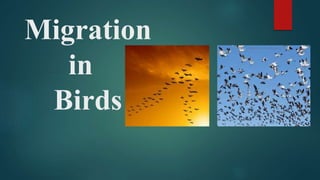
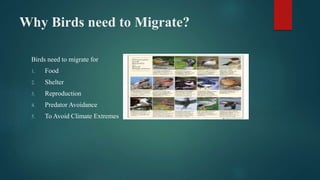
 Bird migration is the regular seasonal movement, often north and south along a
flyway, between breeding and wintering grounds
 The path followed is known as flyway
 Directed from Arctic to Antarctic and vice versa
 Quite ancient activity practiced by Birds
 Recorded as many as 3,000 years ago by Ancient Greek authors,
including Homer and Aristotle
Migration
 It is a collective term of Immigration and Emigration
 Immigration occurs when new individuals are introduced
 It results in the increase in population size
 Emigration is when individuals leave a population
 It results the decrease in population size
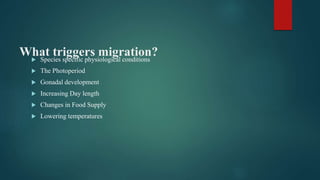
Why Birds need to Migrate?
Birds need to migrate for
1. Food
2. Shelter
3. Reproduction
4. Predator Avoidance
5. To Avoid Climate Extremes
What triggers migration? Species specific physiological conditions
 The Photoperiod
 Gonadal development
 Increasing Day length
 Changes in Food Supply
 Lowering temperatures
Patterns of Migration
 The Old birds that have traveled many times in their life forms the front line
 Then comes the Young ones Traveling for the first time
 Next are the females
 Injured and old Birds are present in the back rows
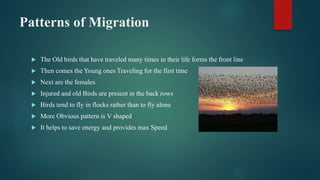
 Birds tend to fly in flocks rather than to fly alone
 More Obvious pattern is V shaped
 It helps to save energy and provides max Speed
Types of migration
 Distance based
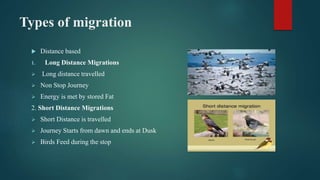
1. Long Distance Migrations
 Long distance travelled
 Non Stop Journey
 Energy is met by stored Fat
2. Short Distance Migrations
 Short Distance is travelled
 Journey Starts from dawn and ends at Dusk
 Birds Feed during the stop
How Birds find the flyway?
 Sun Compass Cues
The sun rises in the east, over headed at noon sets in the west
 Celestial Cues
Angle between the north star and horizon decreases towards the equator
 Magnetic Compasses
Birds orient themselves by using earth magnetic Field
Types of Migrations
 Seasonal migration is predictable based on seasonal changes
 Latitudinal: This migration is between areas of different latitudes from north to
south and vice versa
 Longitudinal movement between different longitudes from east to west or west
to east.
 Altitudinal Birds that breed in tall mountains often exhibit altitudinal migration
 Loop birds that follow an annual circle are loop migrants.
 Nomadic movement is less predictable and can be erratic depending on available
food and water resources.
Types of Migrations (Continue)
 Irruptive migrations that bring large numbers of birds into unusual areas, most
often in winter
 Dispersal juvenile birds are forced away from their hatching grounds and must
seek out their own territories as their parents continue to use the same range.
 A leap frog or skip migration is a unique pattern where a northern population
will migrate a greater distance to skip over a sedentary population of the same
species.
 Molt: Some birds migrate only to accommodate their annual molting periods.
Mechanics of Migration
 Long distance migrants store fat 50% of their body weight
 Some species start journey early and stop frequently to feed and rest
 In clear weather birds fly at altitude 1000 meters
 It helps them to prevent strike with any obstacle
 Many birds have specific migration routes
Disadvantages of Migration
 Many young are not, able to reach the destination because they die during the
course of the continuous and tiresome journey.
 Sudden changes in the climate such as storms and hurricanes, strong current of
wind, fog are the causes for the death of a sizeable number of migrants.
 Sometimes man-made high tours and light houses cause the death of migratory
birds.
 Man themselves are responsible for the death of the migrants. They shoot at these
poor birds just for their own leisure and amusement.
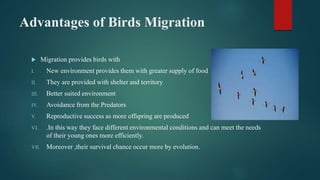
Advantages of Birds Migration
 Migration provides birds with
I. New environment provides them with greater supply of food
II. They are provided with shelter and territory
III. Better suited environment
IV. Avoidance from the Predators
V. Reproductive success as more offspring are produced
VI. .In this way they face different environmental conditions and can meet the needs
of their young ones more efficiently.
VII. Moreover ,their survival chance occur more by evolution.
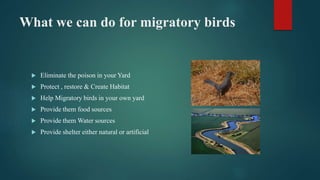
What we can do for migratory birds
 Eliminate the poison in your Yard
 Protect , restore & Create Habitat
 Help Migratory birds in your own yard
 Provide them food sources
 Provide them Water sources
 Provide shelter either natural or artificial
Conclusion
 Birds Migrate to survive
 Migration plays important role in their Evolution
 Several Climatic Factors triggers the process of Migration
 Migration is not always advantageous
 Birds have adapted themselves for Migrations either short or
long distances
 Not all the birds migrate but some of the individuals of a population migrates
References
 Newton, I. (2008). The Migration Ecology of Birds. Elsevier.
 Chan K (2001). "Partial migration in Australian landbirds: a
review". Emu. 101 (4): 281–292
 Edwards, Darryl B.; Forbes, Mark R. (2007). "Absence of protandry in the spring
migration of a population of Song Sparrows Melospiza melodia". Ibis. 149 (4):
715–720
 Berthold, Peter (2001). Bird Migration: A General Survey. Oxford University
Press. p. 67
 Guillemain, M.; Sadoul, N.; Simon, G. (2005). "European flyway permeability
and abmigration in Teal Anas crecca, an analysis based on ringing
recoveries". Ibis. 147: 688
THANK YOU

Migration in Birds

  • 1.
  • 2.
    Contents  Introduction  Whybirds need to Migrate?  What triggers migration?  Patterns of Migration  Types of Migration  Migratory Adaptations in Birds  Advantages & Disadvantages of Migration  Conclusion  References
  • 3.
    Introduction  Bird migrationis the regular seasonal movement, often north and south along a flyway, between breeding and wintering grounds  The path followed is known as flyway  Directed from Arctic to Antarctic and vice versa  Quite ancient activity practiced by Birds  Recorded as many as 3,000 years ago by Ancient Greek authors, including Homer and Aristotle
  • 4.
    Migration  It isa collective term of Immigration and Emigration  Immigration occurs when new individuals are introduced  It results in the increase in population size  Emigration is when individuals leave a population  It results the decrease in population size
  • 5.
    Why Birds needto Migrate? Birds need to migrate for 1. Food 2. Shelter 3. Reproduction 4. Predator Avoidance 5. To Avoid Climate Extremes
  • 6.
    What triggers migration?Species specific physiological conditions  The Photoperiod  Gonadal development  Increasing Day length  Changes in Food Supply  Lowering temperatures
  • 7.
    Patterns of Migration The Old birds that have traveled many times in their life forms the front line  Then comes the Young ones Traveling for the first time  Next are the females  Injured and old Birds are present in the back rows  Birds tend to fly in flocks rather than to fly alone  More Obvious pattern is V shaped  It helps to save energy and provides max Speed
  • 8.
    Types of migration Distance based 1. Long Distance Migrations  Long distance travelled  Non Stop Journey  Energy is met by stored Fat 2. Short Distance Migrations  Short Distance is travelled  Journey Starts from dawn and ends at Dusk  Birds Feed during the stop
  • 9.
    How Birds findthe flyway?  Sun Compass Cues The sun rises in the east, over headed at noon sets in the west  Celestial Cues Angle between the north star and horizon decreases towards the equator  Magnetic Compasses Birds orient themselves by using earth magnetic Field
  • 10.
    Types of Migrations Seasonal migration is predictable based on seasonal changes  Latitudinal: This migration is between areas of different latitudes from north to south and vice versa  Longitudinal movement between different longitudes from east to west or west to east.  Altitudinal Birds that breed in tall mountains often exhibit altitudinal migration  Loop birds that follow an annual circle are loop migrants.  Nomadic movement is less predictable and can be erratic depending on available food and water resources.
  • 11.
    Types of Migrations(Continue)  Irruptive migrations that bring large numbers of birds into unusual areas, most often in winter  Dispersal juvenile birds are forced away from their hatching grounds and must seek out their own territories as their parents continue to use the same range.  A leap frog or skip migration is a unique pattern where a northern population will migrate a greater distance to skip over a sedentary population of the same species.  Molt: Some birds migrate only to accommodate their annual molting periods.
  • 12.
    Mechanics of Migration Long distance migrants store fat 50% of their body weight  Some species start journey early and stop frequently to feed and rest  In clear weather birds fly at altitude 1000 meters  It helps them to prevent strike with any obstacle  Many birds have specific migration routes
  • 13.
    Disadvantages of Migration Many young are not, able to reach the destination because they die during the course of the continuous and tiresome journey.  Sudden changes in the climate such as storms and hurricanes, strong current of wind, fog are the causes for the death of a sizeable number of migrants.  Sometimes man-made high tours and light houses cause the death of migratory birds.  Man themselves are responsible for the death of the migrants. They shoot at these poor birds just for their own leisure and amusement.
  • 14.
    Advantages of BirdsMigration  Migration provides birds with I. New environment provides them with greater supply of food II. They are provided with shelter and territory III. Better suited environment IV. Avoidance from the Predators V. Reproductive success as more offspring are produced VI. .In this way they face different environmental conditions and can meet the needs of their young ones more efficiently. VII. Moreover ,their survival chance occur more by evolution.
  • 15.
    What we cando for migratory birds  Eliminate the poison in your Yard  Protect , restore & Create Habitat  Help Migratory birds in your own yard  Provide them food sources  Provide them Water sources  Provide shelter either natural or artificial
  • 16.
    Conclusion  Birds Migrateto survive  Migration plays important role in their Evolution  Several Climatic Factors triggers the process of Migration  Migration is not always advantageous  Birds have adapted themselves for Migrations either short or long distances  Not all the birds migrate but some of the individuals of a population migrates
  • 17.
    References  Newton, I.(2008). The Migration Ecology of Birds. Elsevier.  Chan K (2001). "Partial migration in Australian landbirds: a review". Emu. 101 (4): 281–292  Edwards, Darryl B.; Forbes, Mark R. (2007). "Absence of protandry in the spring migration of a population of Song Sparrows Melospiza melodia". Ibis. 149 (4): 715–720  Berthold, Peter (2001). Bird Migration: A General Survey. Oxford University Press. p. 67  Guillemain, M.; Sadoul, N.; Simon, G. (2005). "European flyway permeability and abmigration in Teal Anas crecca, an analysis based on ringing recoveries". Ibis. 147: 688
  • 18.