Ecological niches
 Niches: fundamental and realized
 Principle of competitive exclusion
 Realized niche as competitive refuge
 Niche crossovers
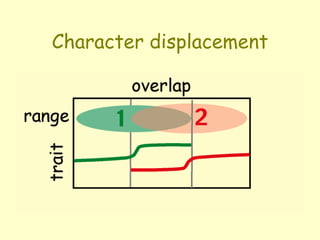
 Character displacement
 Adaptive radiation
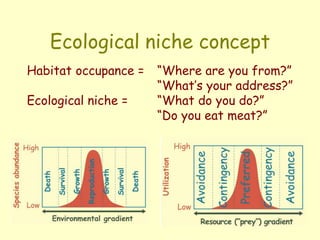
Ecological niche concept
Habitat occupance = “Where are you from?”
“What’s your address?”
Ecological niche = “What do you do?”
“Do you eat meat?”
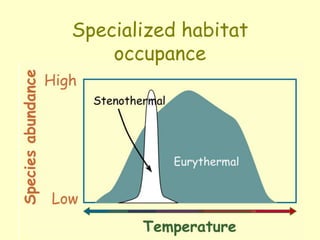
Specialized habitat
occupance
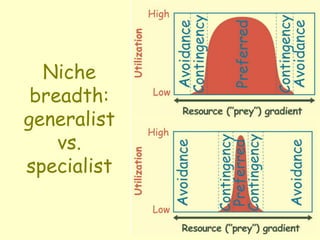
Niche
breadth:
generalist
vs.
specialist
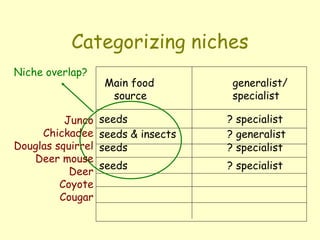
Categorizing niches
Junco
Chickadee
Douglas squirrel
Deer mouse
Deer
Coyote
Cougar
Main food generalist/
source specialist
seeds ? specialist
seeds & insects ? generalist
seeds ? specialist
seeds ? specialist
Niche overlap?
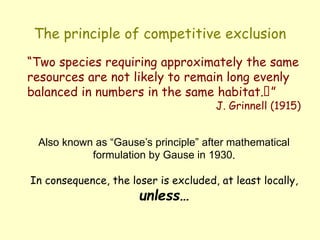
The principle of competitive exclusion
“Two species requiring approximately the same
resources are not likely to remain long evenly
balanced in numbers in the same habitat.”
J. Grinnell (1915)
Also known as “Gause’s principle” after mathematical
formulation by Gause in 1930.
In consequence, the loser is excluded, at least locally,
unless…
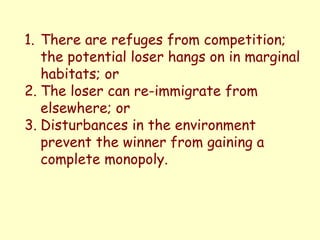
1. There are refuges from competition;
the potential loser hangs on in marginal
habitats; or
2. The loser can re-immigrate from
elsewhere; or
3. Disturbances in the environment
prevent the winner from gaining a
complete monopoly.
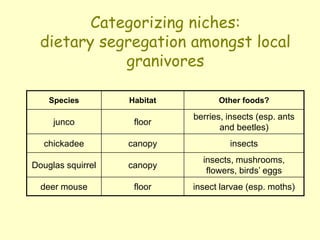
Categorizing niches:
dietary segregation amongst local
granivores
Species Habitat Other foods?
junco floor
berries, insects (esp. ants
and beetles)
chickadee canopy insects
Douglas squirrel canopy
insects, mushrooms,
flowers, birds’ eggs
deer mouse floor insect larvae (esp. moths)
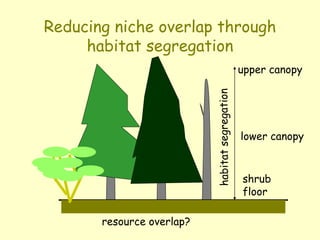
Reducing niche overlap through
habitat segregation
upper canopy
lower canopy
shrub
floor
resource overlap?
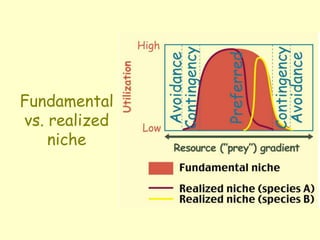
Fundamental
vs. realized
niche
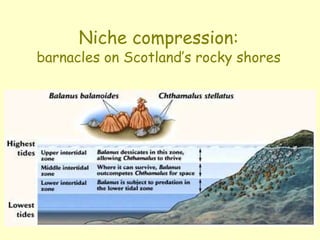
Niche compression
 Realized niches are narrower than
fundamental niches, therefore the
species occupies a narrower range of
habitats than it would in the absence
of competition.
 The realized niche can be regarded as
a ‘competitive refuge’.
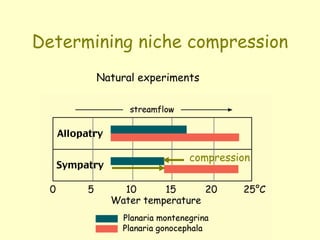
Determining niche compression
Natural experiments
compression
Niche compression:
barnacles on Scotland’s rocky shores
QuickTime™ and a
TIFF (Uncompressed) decompressor
are needed to see this picture.
Connell, J. 1961. Ecology 42, 710-72
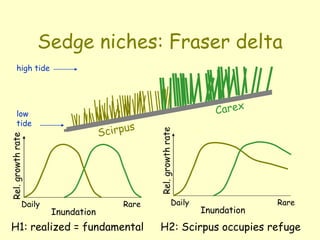
Sedge niches: Fraser delta
low
tide
high tide
Inundation
Daily Rare
Inundation
Daily Rare
H1: realized = fundamental H2: Scirpus occupies refuge
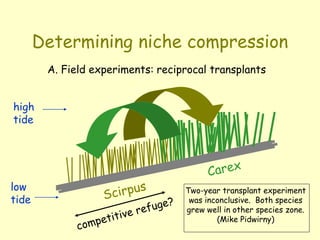
Determining niche compression
A. Field experiments: reciprocal transplants
low
tide
high
tide
Two-year transplant experiment
was inconclusive. Both species
grew well in other species zone.
(Mike Pidwirny)
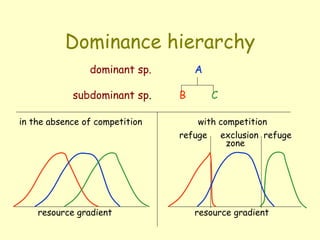
Dominance hierarchy
A
B C
dominant sp.
subdominant sp.
resource gradient
in the absence of competition with competition
refuge exclusion refuge
zone
resource gradient
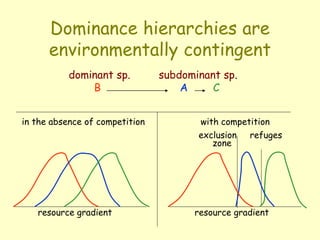
Dominance hierarchies are
environmentally contingent
dominant sp. subdominant sp.
B A C
resource gradient
in the absence of competition with competition
exclusion refuges
zone
resource gradient
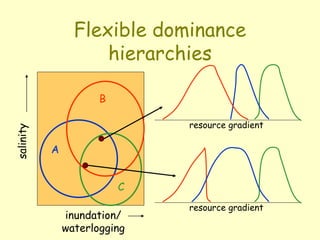
Flexible dominance
hierarchies
resource gradient
resource gradient
inundation/
waterlogging
salinity
B
A
C
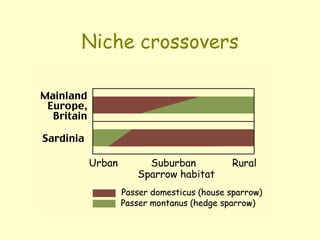
Niche crossovers
Character displacement
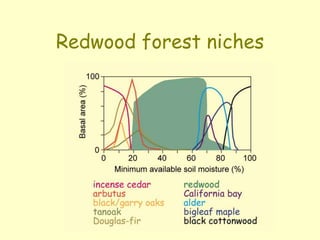
Redwood forest niches
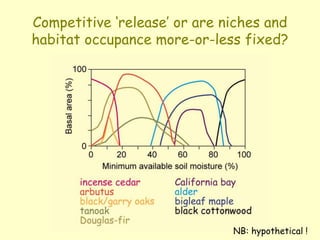
Competitive ‘release’ or are niches and
habitat occupance more-or-less fixed?
NB: hypothetical !
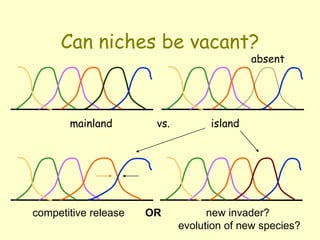
Can niches be vacant?
mainland vs. island
absent
new invader?
evolution of new species?
competitive release OR
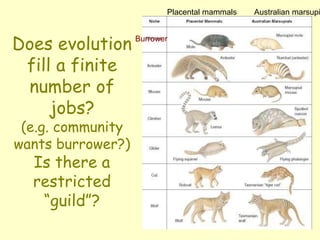
Does evolution
fill a finite
number of
jobs?
(e.g. community
wants burrower?)
Is there a
restricted
“guild”?
Burrower
Placental mammals Australian marsupi
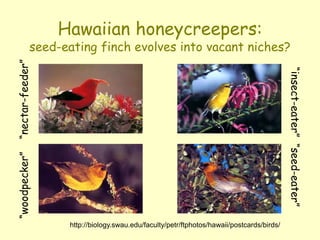
Hawaiian honeycreepers:
seed-eating finch evolves into vacant niches?
http://biology.swau.edu/faculty/petr/ftphotos/hawaii/postcards/birds/
“woodpecker”“nectar-feeder”
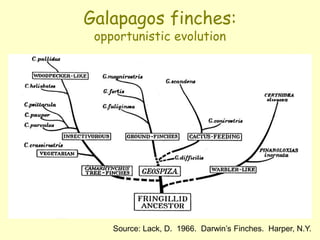
Galapagos finches:
opportunistic evolution
Source: Lack, D. 1966. Darwin’s Finches. Harper, N.Y.
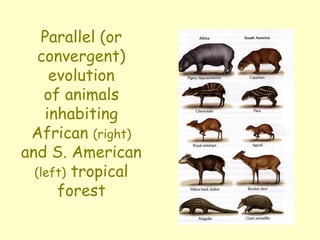
Parallel (or
convergent)
evolution
of animals
inhabiting
African (right)
and S. American
(left) tropical
forest
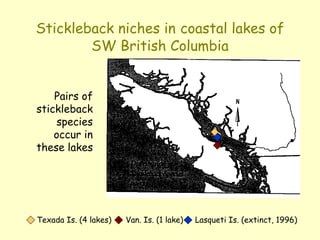
Stickleback niches in coastal lakes of
SW British Columbia
Texada Is. (4 lakes) Van. Is. (1 lake) Lasqueti Is. (extinct, 1996)
Pairs of
stickleback
species
occur in
these lakes
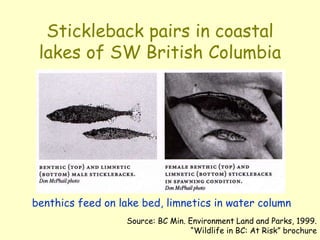
Stickleback pairs in coastal
lakes of SW British Columbia
Source: BC Min. Environment Land and Parks, 1999.
“Wildlife in BC: At Risk” brochure
benthics feed on lake bed, limnetics in water column
Stickleback pairs
• A single episode of colonization of coastal
lakes by a marine stickleback about 11 000
to 13 000 years ago (when sea level was
higher than at present.
• Lakes colonized independently
• Divergence into benthic and limnetic niches
in each lake
• Indicates “vacant niches” in each lake?
QuickTime™ and a
TIFF (Uncompressed) decompressor
are needed to see this picture.
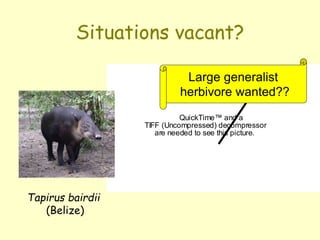
Tapirus bairdii
(Belize)
Situations vacant?
Large generalist
herbivore wanted??
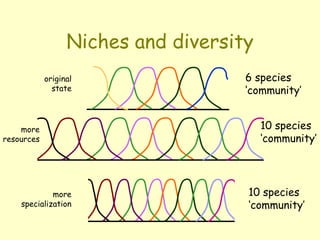
Niches and diversity
6 species
‘community’
10 species
‘community’
original
state
more
resources
10 species
‘community’
more
specialization
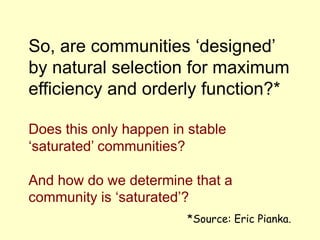
So, are communities ‘designed’
by natural selection for maximum
efficiency and orderly function?*
Does this only happen in stable
‘saturated’ communities?
And how do we determine that a
community is ‘saturated’?
*Source: Eric Pianka.
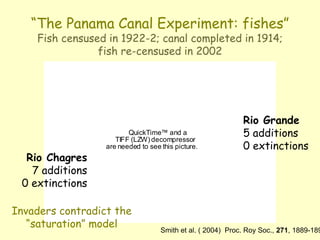
“The Panama Canal Experiment: fishes”
Fish censused in 1922-2; canal completed in 1914;
fish re-censused in 2002
QuickTime™ and a
TIFF (LZW) decompressor
are needed to see this picture.
Rio Chagres
7 additions
0 extinctions
Rio Grande
5 additions
0 extinctions
Invaders contradict the
“saturation” model
Smith et al. ( 2004) Proc. Roy Soc., 271, 1889-189
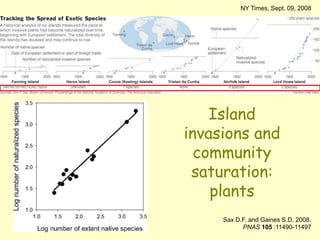
Island
invasions and
community
saturation:
plants
Sax D.F. and Gaines S.D. 2008.
PNAS 105 :11490-11497
NY Times, Sept. 09, 2008
Island invasions and community
saturation: plants
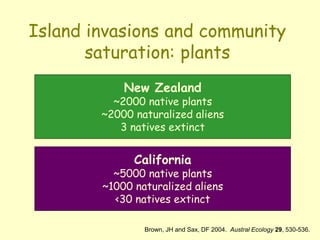
New Zealand
~2000 native plants
~2000 naturalized aliens
3 natives extinct
California
~5000 native plants
~1000 naturalized aliens
30 natives extinct
Brown, JH and Sax, DF 2004. Austral Ecology 29, 530-536.
Island invasions and community
saturation: fish
Hawaii
5 native freshwater fish species
40 naturalized aliens
no extinctions
124 watersheds in temperate
North America
Fish diversity increased in 100; declined in 20
Brown, JH and Sax, DF 2004. Austral Ecology 29, 530-536.
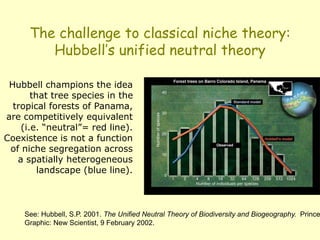
The challenge to classical niche theory:
Hubbell’s unified neutral theory
Hubbell champions the idea
that tree species in the
tropical forests of Panama,
are competitively equivalent
(i.e. “neutral”= red line).
Coexistence is not a function
of niche segregation across
a spatially heterogeneous
landscape (blue line).
See: Hubbell, S.P. 2001. The Unified Neutral Theory of Biodiversity and Biogeography. Prince
Graphic: New Scientist, 9 February 2002.
What is a “community”?*
*or is it a “commutiny”?
An ecological (or biological) community refers
to a group of interacting organisms living
together in a specific geographical area or
habitat.
An equivalent (and now somewhat
anachronistic) term is biocenosis (proposed
by Karl Möbius in 1877 to describe the
interacting organisms of the oyster- and
mussel-bearing tidal flats of the North Sea).
Community structure
Closed vs. open communities
Ecotones (community
boundaries)
The continuum concept
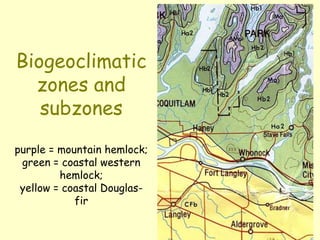
Biogeoclimatic zones
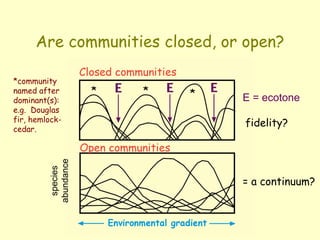
Are communities closed, or open?
E = ecotone
= a continuum?
* * *
*community
named after
dominant(s):
e.g. Douglas
fir, hemlock-
cedar.
fidelity?
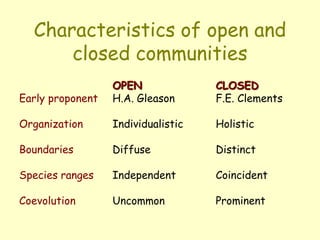
Characteristics of open and
closed communities
OPEN CLOSED
Early proponent H.A. Gleason F.E. Clements
Organization Individualistic Holistic
Boundaries Diffuse Distinct
Species ranges Independent Coincident
Coevolution Uncommon Prominent
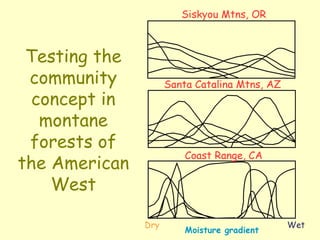
Testing the
community
concept in
montane
forests of
the American
West
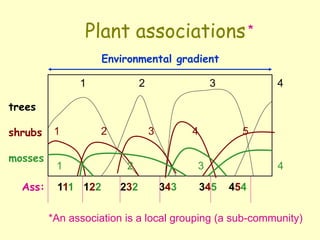
Plant associations
Environmental gradient
1 2 3 4
1 2 3 4 5
1 2 3 4
trees
shrubs
mosses
*
Ass: 111 122 232 343 345 454
*An association is a local grouping (a sub-community)
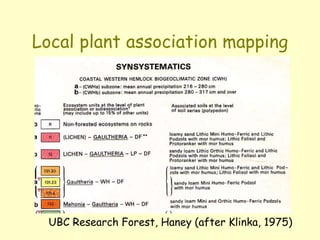
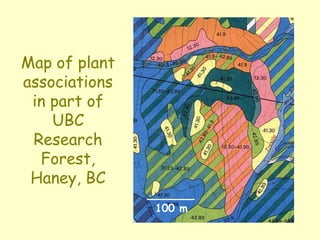
Local plant association mapping
UBC Research Forest, Haney (after Klinka, 1975)
Map of plant
associations
in part of
UBC
Research
Forest,
Haney, BC
100 m
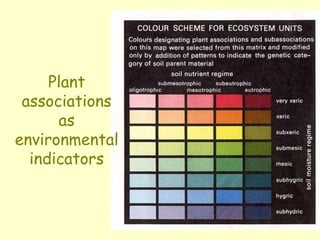
Plant
associations
as
environmental
indicators
Biogeoclimatic
zones and
subzones
purple = mountain hemlock;
green = coastal western
hemlock;
yellow = coastal Douglas-
fir
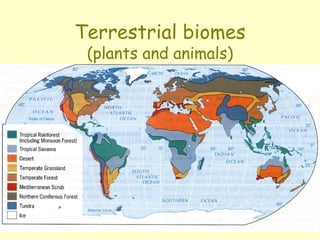
Terrestrial biomes
(plants and animals)
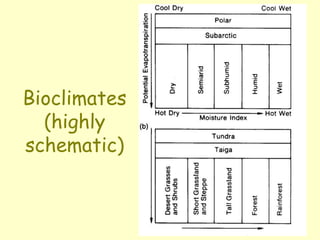
Bioclimates
(highly
schematic)

Niches

  • 1.
    Ecological niches  Niches:fundamental and realized  Principle of competitive exclusion  Realized niche as competitive refuge  Niche crossovers  Character displacement  Adaptive radiation
  • 2.
    Ecological niche concept Habitatoccupance = “Where are you from?” “What’s your address?” Ecological niche = “What do you do?” “Do you eat meat?”
  • 3.
  • 4.
  • 5.
    Categorizing niches Junco Chickadee Douglas squirrel Deermouse Deer Coyote Cougar Main food generalist/ source specialist seeds ? specialist seeds & insects ? generalist seeds ? specialist seeds ? specialist Niche overlap?
  • 6.
    The principle ofcompetitive exclusion “Two species requiring approximately the same resources are not likely to remain long evenly balanced in numbers in the same habitat.” J. Grinnell (1915) Also known as “Gause’s principle” after mathematical formulation by Gause in 1930. In consequence, the loser is excluded, at least locally, unless…
  • 7.
    1. There arerefuges from competition; the potential loser hangs on in marginal habitats; or 2. The loser can re-immigrate from elsewhere; or 3. Disturbances in the environment prevent the winner from gaining a complete monopoly.
  • 8.
    Categorizing niches: dietary segregationamongst local granivores Species Habitat Other foods? junco floor berries, insects (esp. ants and beetles) chickadee canopy insects Douglas squirrel canopy insects, mushrooms, flowers, birds’ eggs deer mouse floor insect larvae (esp. moths)
  • 9.
    Reducing niche overlapthrough habitat segregation upper canopy lower canopy shrub floor resource overlap?
  • 10.
  • 11.
    Niche compression  Realizedniches are narrower than fundamental niches, therefore the species occupies a narrower range of habitats than it would in the absence of competition.  The realized niche can be regarded as a ‘competitive refuge’.
  • 12.
  • 13.
    Niche compression: barnacles onScotland’s rocky shores
  • 14.
    QuickTime™ and a TIFF(Uncompressed) decompressor are needed to see this picture. Connell, J. 1961. Ecology 42, 710-72
  • 15.
    Sedge niches: Fraserdelta low tide high tide Inundation Daily Rare Inundation Daily Rare H1: realized = fundamental H2: Scirpus occupies refuge
  • 16.
    Determining niche compression A.Field experiments: reciprocal transplants low tide high tide Two-year transplant experiment was inconclusive. Both species grew well in other species zone. (Mike Pidwirny)
  • 17.
    Dominance hierarchy A B C dominantsp. subdominant sp. resource gradient in the absence of competition with competition refuge exclusion refuge zone resource gradient
  • 18.
    Dominance hierarchies are environmentallycontingent dominant sp. subdominant sp. B A C resource gradient in the absence of competition with competition exclusion refuges zone resource gradient
  • 19.
    Flexible dominance hierarchies resource gradient resourcegradient inundation/ waterlogging salinity B A C
  • 20.
  • 21.
  • 22.
  • 23.
    Competitive ‘release’ orare niches and habitat occupance more-or-less fixed? NB: hypothetical !
  • 24.
    Can niches bevacant? mainland vs. island absent new invader? evolution of new species? competitive release OR
  • 25.
    Does evolution fill afinite number of jobs? (e.g. community wants burrower?) Is there a restricted “guild”? Burrower Placental mammals Australian marsupi
  • 26.
    Hawaiian honeycreepers: seed-eating finchevolves into vacant niches? http://biology.swau.edu/faculty/petr/ftphotos/hawaii/postcards/birds/ “woodpecker”“nectar-feeder”
  • 27.
    Galapagos finches: opportunistic evolution Source:Lack, D. 1966. Darwin’s Finches. Harper, N.Y.
  • 28.
    Parallel (or convergent) evolution of animals inhabiting African(right) and S. American (left) tropical forest
  • 29.
    Stickleback niches incoastal lakes of SW British Columbia Texada Is. (4 lakes) Van. Is. (1 lake) Lasqueti Is. (extinct, 1996) Pairs of stickleback species occur in these lakes
  • 30.
    Stickleback pairs incoastal lakes of SW British Columbia Source: BC Min. Environment Land and Parks, 1999. “Wildlife in BC: At Risk” brochure benthics feed on lake bed, limnetics in water column
  • 31.
    Stickleback pairs • Asingle episode of colonization of coastal lakes by a marine stickleback about 11 000 to 13 000 years ago (when sea level was higher than at present. • Lakes colonized independently • Divergence into benthic and limnetic niches in each lake • Indicates “vacant niches” in each lake?
  • 32.
    QuickTime™ and a TIFF(Uncompressed) decompressor are needed to see this picture. Tapirus bairdii (Belize) Situations vacant? Large generalist herbivore wanted??
  • 33.
    Niches and diversity 6species ‘community’ 10 species ‘community’ original state more resources 10 species ‘community’ more specialization
  • 34.
    So, are communities‘designed’ by natural selection for maximum efficiency and orderly function?* Does this only happen in stable ‘saturated’ communities? And how do we determine that a community is ‘saturated’? *Source: Eric Pianka.
  • 35.
    “The Panama CanalExperiment: fishes” Fish censused in 1922-2; canal completed in 1914; fish re-censused in 2002 QuickTime™ and a TIFF (LZW) decompressor are needed to see this picture. Rio Chagres 7 additions 0 extinctions Rio Grande 5 additions 0 extinctions Invaders contradict the “saturation” model Smith et al. ( 2004) Proc. Roy Soc., 271, 1889-189
  • 36.
    Island invasions and community saturation: plants Sax D.F.and Gaines S.D. 2008. PNAS 105 :11490-11497 NY Times, Sept. 09, 2008
  • 37.
    Island invasions andcommunity saturation: plants New Zealand ~2000 native plants ~2000 naturalized aliens 3 natives extinct California ~5000 native plants ~1000 naturalized aliens 30 natives extinct Brown, JH and Sax, DF 2004. Austral Ecology 29, 530-536.
  • 38.
    Island invasions andcommunity saturation: fish Hawaii 5 native freshwater fish species 40 naturalized aliens no extinctions 124 watersheds in temperate North America Fish diversity increased in 100; declined in 20 Brown, JH and Sax, DF 2004. Austral Ecology 29, 530-536.
  • 39.
    The challenge toclassical niche theory: Hubbell’s unified neutral theory Hubbell champions the idea that tree species in the tropical forests of Panama, are competitively equivalent (i.e. “neutral”= red line). Coexistence is not a function of niche segregation across a spatially heterogeneous landscape (blue line). See: Hubbell, S.P. 2001. The Unified Neutral Theory of Biodiversity and Biogeography. Prince Graphic: New Scientist, 9 February 2002.
  • 40.
    What is a“community”?* *or is it a “commutiny”? An ecological (or biological) community refers to a group of interacting organisms living together in a specific geographical area or habitat. An equivalent (and now somewhat anachronistic) term is biocenosis (proposed by Karl Möbius in 1877 to describe the interacting organisms of the oyster- and mussel-bearing tidal flats of the North Sea).
  • 41.
    Community structure Closed vs.open communities Ecotones (community boundaries) The continuum concept Biogeoclimatic zones
  • 42.
    Are communities closed,or open? E = ecotone = a continuum? * * * *community named after dominant(s): e.g. Douglas fir, hemlock- cedar. fidelity?
  • 43.
    Characteristics of openand closed communities OPEN CLOSED Early proponent H.A. Gleason F.E. Clements Organization Individualistic Holistic Boundaries Diffuse Distinct Species ranges Independent Coincident Coevolution Uncommon Prominent
  • 44.
  • 45.
    Plant associations Environmental gradient 12 3 4 1 2 3 4 5 1 2 3 4 trees shrubs mosses * Ass: 111 122 232 343 345 454 *An association is a local grouping (a sub-community)
  • 46.
    Local plant associationmapping UBC Research Forest, Haney (after Klinka, 1975)
  • 47.
    Map of plant associations inpart of UBC Research Forest, Haney, BC 100 m
  • 48.
  • 49.
    Biogeoclimatic zones and subzones purple =mountain hemlock; green = coastal western hemlock; yellow = coastal Douglas- fir
  • 50.
  • 51.