Unit 1 
Network Models 
and 
Network Examples
Unit 1 - Part A 
Network Models
Alternative definition of Network : 
 A network is a combination of hardware and software 
that sends data from one location to another. 
• Hardware : The hardware consists of the physical 
equipment that carries signals from one point of the 
network to another. 
• Software : The software consists of instruction sets 
that make possible the services that we expect from a 
network.
Sections in Part – A [ Network Models ] 
 Layered Tasks 
 OSI Model 
~ Introduction 
~ Layers in OSI Model 
 TCP / IP Model 
 Addressing
2-1 LAYERED TASKS 
Understanding Layered Tasks . . . . . . . . . . . 
* We use the concept of layers in our daily life. 
* Example : 
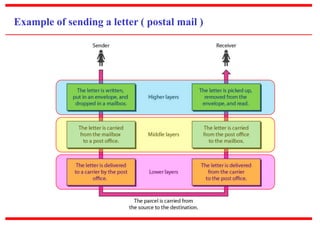
Consider two friends who communicate through postal mail. 
[ i.e. one friend sends a letter to another friend ]
Example of sending a letter ( postal mail )
Some notable points from the previous example . . . . . . 
 Components - The three vital components in any communication 
system are : Sender, Receiver and Carrier 
 Hierarchy - Layers do exist on both the sites and these layers are 
arranged in particular order. In other words, a particular 
hierarchy of layers exists. [ Order Matters ! ] 
 Services – Each layer at the sending site uses the services of the 
layer immediately below it; while each layer at the receiving site 
provides the services to the layer immediately above it.
2-2 a) THE OSI MODEL ( Introduction ) 
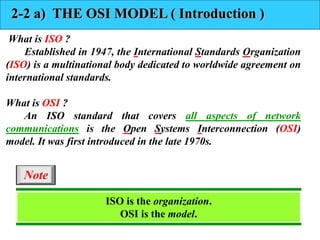
What is ISO ? 
Established in 1947, the International Standards Organization 
(ISO) is a multinational body dedicated to worldwide agreement on 
international standards. 
What is OSI ? 
An ISO standard that covers all aspects of network 
communications is the Open Systems Interconnection (OSI) 
model. It was first introduced in the late 1970s. 
ISO is the organization. 
OSI is the model. 
Note
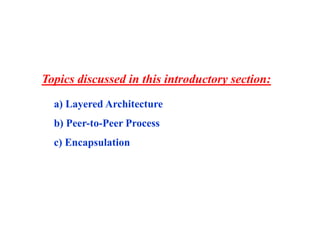
Topics discussed in this introductory section: 
a) Layered Architecture 
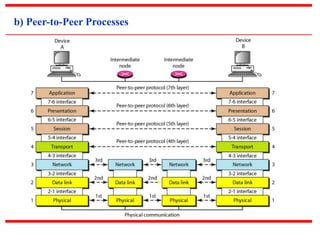
b) Peer-to-Peer Process 
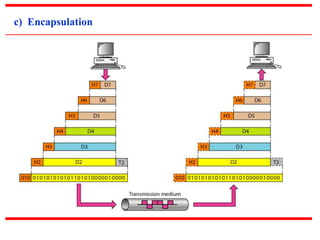
c) Encapsulation
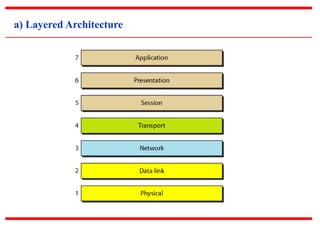
a) Layered Architecture
b) Peer-to-Peer Processes
c) Encapsulation
2-2 b) LAYERS IN THE OSI MODEL 
In this section we briefly describe the functions of each 
layer in the OSI model. 
Topics discussed in this section: 
1. Physical Layer 
2. Data Link Layer 
3. Network Layer 
4. Transport Layer 
5. Session Layer 
6. Presentation Layer 
7. Application Layer
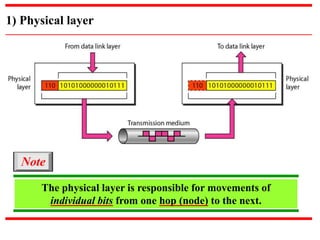
1) Physical layer 
Note 
The physical layer is responsible for movements of 
individual bits from one hop (node) to the next.
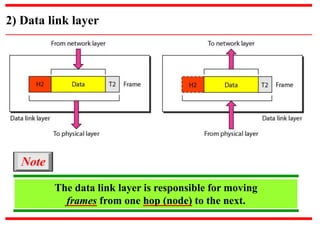
2) Data link layer 
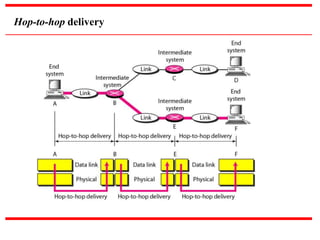
The data link layer is responsible for moving 
frames from one hop (node) to the next. 
Note
Hop-to-hop delivery
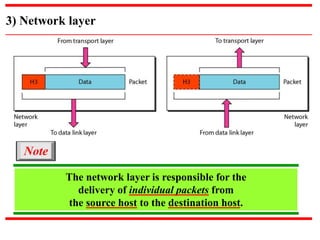
3) Network layer 
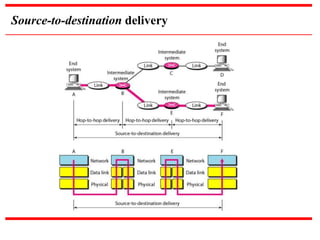
The network layer is responsible for the 
delivery of individual packets from 
the source host to the destination host. 
Note
Source-to-destination delivery
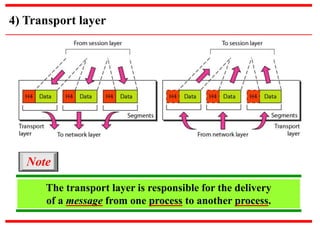
4) Transport layer 
Note 
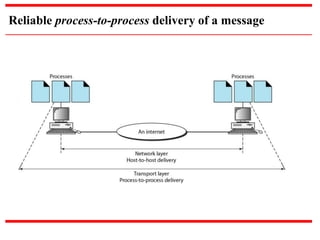
The transport layer is responsible for the delivery 
of a message from one process to another process.
Reliable process-to-process delivery of a message
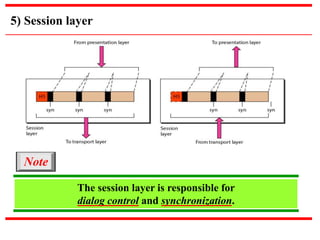
5) Session layer 
The session layer is responsible for 
dialog control and synchronization. 
Note
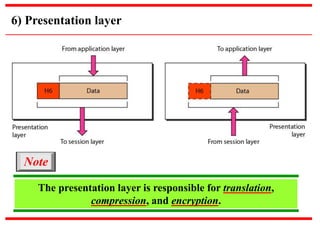
6) Presentation layer 
The presentation layer is responsible for translation, 
compression, and encryption. 
Note
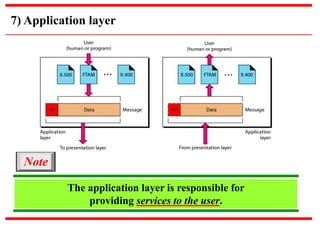
7) Application layer 
The application layer is responsible for 
providing services to the user. 
Note
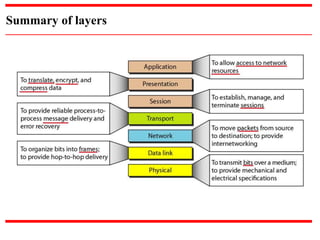
Summary of layers
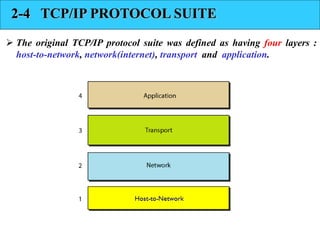
2-4 TCP/IP PROTOCOL SUITE 
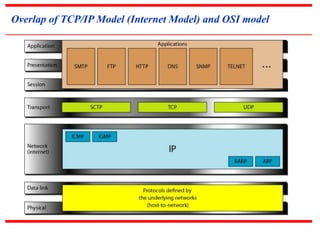
 The original TCP/IP protocol suite was defined as having four layers : 
host-to-network, network(internet), transport and application.
 The layers in the TCP/IP protocol suite do not exactly match 
those in the OSI model. 
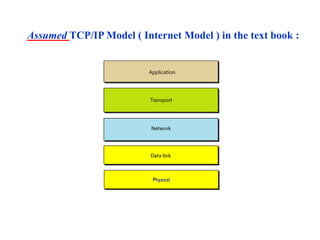
 However, when TCP/IP is compared to OSI, we can say 
that the TCP/IP protocol suite is made of five layers: 
physical, data link, network, transport, and application 
[next slide . . . . ]
Assumed TCP/IP Model ( Internet Model ) in the text book :
Overlap of TCP/IP Model (Internet Model) and OSI model
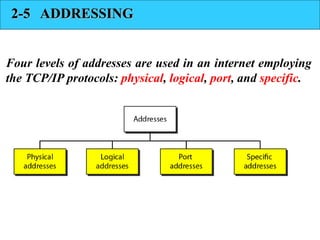
2-5 ADDRESSING 
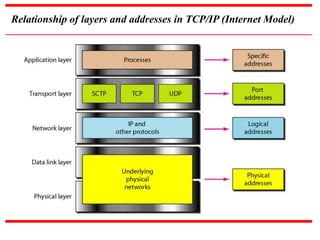
Four levels of addresses are used in an internet employing 
the TCP/IP protocols: physical, logical, port, and specific.
Relationship of layers and addresses in TCP/IP (Internet Model)
1. Physical Address : 
The physical address, also known as the link address, 
is the address of the node as defined by its LAN orWAN. 
~ It is included in the frame used by the data link layer. 
~ It is the lowest-level address.
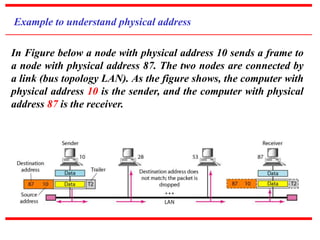
Example to understand physical address 
In Figure below a node with physical address 10 sends a frame to 
a node with physical address 87. The two nodes are connected by 
a link (bus topology LAN). As the figure shows, the computer with 
physical address 10 is the sender, and the computer with physical 
address 87 is the receiver.
2. Logical Address : 
A logical address in the Internet is currently 32-bit 
address that can uniquely define a host connected to the 
Internet. 
~ No two publicly addressed and visible hosts on the Internet 
can have the same IP address. 
[ Note : IP address is typical example of Logical Address on present day Internet ]
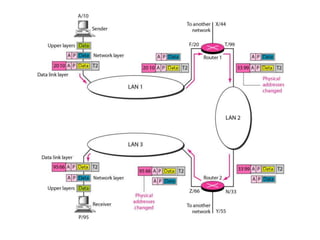
Example to understand logical address 
Figure in the next slide shows a part of an internet with 
two routers connecting three LANs. Each device 
(computer or router) has a pair of addresses (logical and 
physical) for each connection. In this case, each 
computer is connected to only one link and therefore has 
only one pair of addresses. Each router, however, is 
connected to three networks (only two are shown in the 
figure). So each router has three pairs of addresses, one 
for each connection.
3. Port Address : 
In TCP / IP model, the label assigned to a process is 
called a port address. 
~ A port in TCP / IP is 16-bits in length.
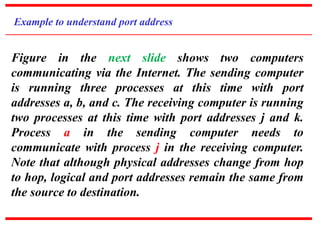
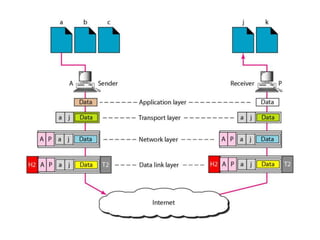
Example to understand port address 
Figure in the next slide shows two computers 
communicating via the Internet. The sending computer 
is running three processes at this time with port 
addresses a, b, and c. The receiving computer is running 
two processes at this time with port addresses j and k. 
Process a in the sending computer needs to 
communicate with process j in the receiving computer. 
Note that although physical addresses change from hop 
to hop, logical and port addresses remain the same from 
the source to destination.
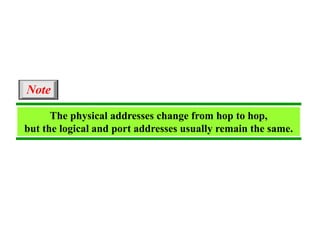
Note 
The physical addresses change from hop to hop, 
but the logical and port addresses usually remain the same.
4. Specific Address : 
User-friendly address designed at the level of application 
layer is known as specific address. 
Example : ~ email address (e.g. baforouzan@gmail.com ) 
~ website address. ( e.g. www.flipkart.com )

Unit 1 network models & typical examples(part a)

  • 1.
    Unit 1 NetworkModels and Network Examples
  • 2.
    Unit 1 -Part A Network Models
  • 3.
    Alternative definition ofNetwork :  A network is a combination of hardware and software that sends data from one location to another. • Hardware : The hardware consists of the physical equipment that carries signals from one point of the network to another. • Software : The software consists of instruction sets that make possible the services that we expect from a network.
  • 4.
    Sections in Part– A [ Network Models ]  Layered Tasks  OSI Model ~ Introduction ~ Layers in OSI Model  TCP / IP Model  Addressing
  • 5.
    2-1 LAYERED TASKS Understanding Layered Tasks . . . . . . . . . . . * We use the concept of layers in our daily life. * Example : Consider two friends who communicate through postal mail. [ i.e. one friend sends a letter to another friend ]
  • 6.
    Example of sendinga letter ( postal mail )
  • 7.
    Some notable pointsfrom the previous example . . . . . .  Components - The three vital components in any communication system are : Sender, Receiver and Carrier  Hierarchy - Layers do exist on both the sites and these layers are arranged in particular order. In other words, a particular hierarchy of layers exists. [ Order Matters ! ]  Services – Each layer at the sending site uses the services of the layer immediately below it; while each layer at the receiving site provides the services to the layer immediately above it.
  • 8.
    2-2 a) THEOSI MODEL ( Introduction ) What is ISO ? Established in 1947, the International Standards Organization (ISO) is a multinational body dedicated to worldwide agreement on international standards. What is OSI ? An ISO standard that covers all aspects of network communications is the Open Systems Interconnection (OSI) model. It was first introduced in the late 1970s. ISO is the organization. OSI is the model. Note
  • 9.
    Topics discussed inthis introductory section: a) Layered Architecture b) Peer-to-Peer Process c) Encapsulation
  • 10.
  • 11.
  • 12.
  • 13.
    2-2 b) LAYERSIN THE OSI MODEL In this section we briefly describe the functions of each layer in the OSI model. Topics discussed in this section: 1. Physical Layer 2. Data Link Layer 3. Network Layer 4. Transport Layer 5. Session Layer 6. Presentation Layer 7. Application Layer
  • 14.
    1) Physical layer Note The physical layer is responsible for movements of individual bits from one hop (node) to the next.
  • 15.
    2) Data linklayer The data link layer is responsible for moving frames from one hop (node) to the next. Note
  • 16.
  • 17.
    3) Network layer The network layer is responsible for the delivery of individual packets from the source host to the destination host. Note
  • 18.
  • 19.
    4) Transport layer Note The transport layer is responsible for the delivery of a message from one process to another process.
  • 20.
  • 21.
    5) Session layer The session layer is responsible for dialog control and synchronization. Note
  • 22.
    6) Presentation layer The presentation layer is responsible for translation, compression, and encryption. Note
  • 23.
    7) Application layer The application layer is responsible for providing services to the user. Note
  • 24.
  • 25.
    2-4 TCP/IP PROTOCOLSUITE  The original TCP/IP protocol suite was defined as having four layers : host-to-network, network(internet), transport and application.
  • 26.
     The layersin the TCP/IP protocol suite do not exactly match those in the OSI model.  However, when TCP/IP is compared to OSI, we can say that the TCP/IP protocol suite is made of five layers: physical, data link, network, transport, and application [next slide . . . . ]
  • 27.
    Assumed TCP/IP Model( Internet Model ) in the text book :
  • 28.
    Overlap of TCP/IPModel (Internet Model) and OSI model
  • 29.
    2-5 ADDRESSING Fourlevels of addresses are used in an internet employing the TCP/IP protocols: physical, logical, port, and specific.
  • 30.
    Relationship of layersand addresses in TCP/IP (Internet Model)
  • 31.
    1. Physical Address: The physical address, also known as the link address, is the address of the node as defined by its LAN orWAN. ~ It is included in the frame used by the data link layer. ~ It is the lowest-level address.
  • 32.
    Example to understandphysical address In Figure below a node with physical address 10 sends a frame to a node with physical address 87. The two nodes are connected by a link (bus topology LAN). As the figure shows, the computer with physical address 10 is the sender, and the computer with physical address 87 is the receiver.
  • 33.
    2. Logical Address: A logical address in the Internet is currently 32-bit address that can uniquely define a host connected to the Internet. ~ No two publicly addressed and visible hosts on the Internet can have the same IP address. [ Note : IP address is typical example of Logical Address on present day Internet ]
  • 34.
    Example to understandlogical address Figure in the next slide shows a part of an internet with two routers connecting three LANs. Each device (computer or router) has a pair of addresses (logical and physical) for each connection. In this case, each computer is connected to only one link and therefore has only one pair of addresses. Each router, however, is connected to three networks (only two are shown in the figure). So each router has three pairs of addresses, one for each connection.
  • 36.
    3. Port Address: In TCP / IP model, the label assigned to a process is called a port address. ~ A port in TCP / IP is 16-bits in length.
  • 37.
    Example to understandport address Figure in the next slide shows two computers communicating via the Internet. The sending computer is running three processes at this time with port addresses a, b, and c. The receiving computer is running two processes at this time with port addresses j and k. Process a in the sending computer needs to communicate with process j in the receiving computer. Note that although physical addresses change from hop to hop, logical and port addresses remain the same from the source to destination.
  • 39.
    Note The physicaladdresses change from hop to hop, but the logical and port addresses usually remain the same.
  • 40.
    4. Specific Address: User-friendly address designed at the level of application layer is known as specific address. Example : ~ email address (e.g. baforouzan@gmail.com ) ~ website address. ( e.g. www.flipkart.com )