Ch.2 Network Models Lecturer: Tae-Hyong Kim (D132) [email_address]
Contents Introduction Layered Tasks Internet Model OSI Model Assignment #1
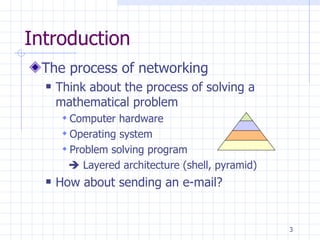
Introduction The process of networking Think about the process of solving a mathematical problem Computer hardware Operating system Problem solving program    Layered architecture (shell, pyramid) How about sending an e-mail?
Contents Introduction Layered Tasks Internet Model OSI Model Assignment #1
Sender, Receiver, and Carrier Sending a letter    There is a  Hierarchy !
Contents Introduction Layered Tasks Internet Model Peer-to-peer Processes Functions of Layers OSI Model Assignment #1
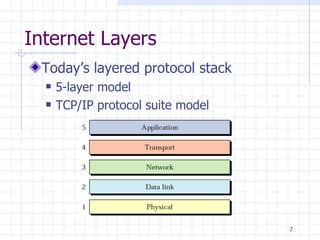
Internet Layers Today’s layered protocol stack 5-layer model TCP/IP protocol suite model
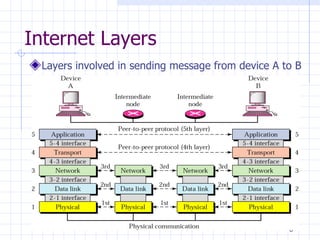
Internet Layers Layers involved in sending message from device A to B
Peer-to-Peer Processes Layered architecture concept Physical interaction Logical interaction
Interfaces and Organization Organization of the Layers: three subgroups Network support layers: Layers 1, 2, and 3 User support layer: layer 5 Transport layer: layer 4
Overall View of the Layers
Functions of Layers Physical Layer Data Link Layer Network Layer Transport Layer Application Layer
Physical Layer For transmitting individual bits from one node to the next Handles mechanical and electrical specification of the interface and transmission medium
Physical Layer Factors Physical characteristics of interfaces and media Representation of bits Data rate (transmission rate) Synchronization of bits
Data Link Layer For  hop-to-hop (node-to-node) delivery of frames makes the physical layer appear error free to the upper layer (network layer)
Data Link Layer Specific responsibilities Framing Physical addressing Flow control Error control Access control
Data Link Layer hop-to-hop delivery
Data Link Layer Physical Addresses
Network Layer For  Source-to-destination delivery of packets
Network Layer Specific responsibilities Logical addressing Routing
Network Layer Source-to-destination delivery
Network Layer Logical addresses (IP addresses)
Transport layer For  process-to-process delivery of a message
Transport layer Specific responsibility Port addressing Segmentation and reassembly Connection control Flow control Error control
Transport layer Process-to-process delivery
Transport layer Port addresses
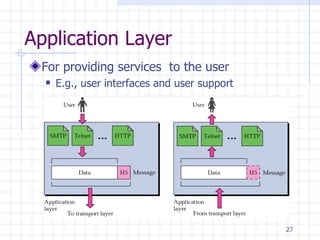
Application Layer For providing services  to the user E.g., user interfaces and user support
Application Layer Specific services : Human interface services Mail Services File transfer, access Remote log-in Accessing the World Wide Web
Summary of Layers
Summary of Addresses ex. e-mail address, URL
Review Questions 2-1 Match the following to one of five Internet layers Route determination Flow control Interface to transmission media Provides access to the end user
Review Questions 2-2 In the following figure, computer A sends a message to computer D via LAN1, router R1, and LAN2. Show the contents of the packets and frames at the network and data link layer for each hop interface.
Review Questions 2-3 Suppose a computer sends a frame to another computer on a bus topology LAN. The physical destination address of the frame is corrupted during the transmission. What happens to the frame? How can the sender be informed about the situation? Consider error control feature of data link layer
Contents Introduction Layered  Tasks Internet Model OSI Model Assignment #1
OSI Model Open System Interconnection model (in 1977) cf. ISO : a standard organization Standard : ISO 7498 (in 1984), ITU-T X.200 7-layer model
Session Layer Controls the network dialog establishes, maintains, and synchronizes the interaction between communicating systems
Session Layer Session The period of time for which two users remain logically connected ex. Session layer dialog
Session Layer Specific responsibility : User-oriented connection service Dialog control Synchronization
Presentation Layer concerned with  the syntax and semantics of the information exchange  between two systems
Presentation Layer Specific responsibility Code conversion Encryption/Decryption Compression
The Internet and OSI Models
TCP/IP protocol suite was developed prior to the OSI model. Not match exactly with those in the OSI model Around 1980, everyone was convinced that TCP/IP soon would be replaced by OSI protocols for layer 3-4. However, This did not happen Problem of the OSI model Repeated data exchanging between layers (much overhead) Conceptual and Theoretical model The Internet and OSI Models
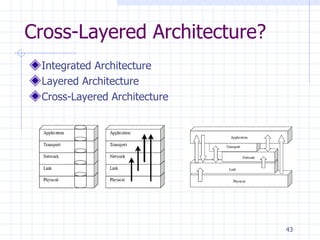
Integrated Architecture Layered Architecture Cross-Layered Architecture Cross-Layered Architecture?
Exercises 17, 18, 19, 20, 23, 24, 25 Explain why for each answer Due Date The next class Assignment #1

02 Network Models(강의용)