P13ITE05
High Speed Networks

UNIT - I

Dr.A.Kathirvel
Professor & Head/IT - VCEW
UNIT - I


Frame Relay Networks



Asynchronous transfer mode



ATM protocol architecture



ATM logical connection



ATM cell and service categories – AAL





High speed LANs: Fast, Gigabit ethernet, Fiber
channel
Wireless LANs
Introduction


Packet-Switching Networks






Switching Technique
Routing
X.25

Frame Relay Networks




Architecture
User Data Transfer
Call Control

3
Packet-Switching Networks







Basic technology the same as in the 1970s
One of the few effective technologies for long
distance data communications
Frame relay and ATM are variants of packetswitching
Advantages:
- flexibility, resource sharing, robust, responsive



Disadvantages:



Time delays in distributed network, overhead penalties
Need for routing and congestion control

4
Circuit-Switching




Long-haul telecom network designed for voice
Network resources dedicated to one call
Shortcomings when used for data:



Inefficient (high idle time)‫‏‬
Constant data rate

5
Packet-Switching






Data transmitted in short blocks, or packets
Packet length < 1000 octets
Each packet contains user data plus control
info (routing)‫‏‬
Store and forward

6
Figure 4.1 The Use of Packets

Chapter 4 Frame Relay

7
Figure 4.2 Packet
Switching: Datagram
Approach

Chapter 4 Frame Relay

8
Advantages over Circuit-Switching






Greater line efficiency (many packets can go
over shared link)‫‏‬
Data rate conversions
Non-blocking under heavy traffic (but
increased delays)‫‏‬

9
Disadvantages relative to Circuit-Switching








Packets incur additional delay with every node
they pass through
Jitter: variation in packet delay
Data overhead in every packet for routing
information, etc
Processing overhead for every packet at every
node traversed
10
Figure 4.3 Simple Switching Network

Chapter 4 Frame Relay

11
Switching Technique





Large messages broken up into smaller packets
Datagram
 Each packet sent independently of the others
 No call setup
 More reliable (can route around failed nodes or
congestion)‫‏‬
Virtual circuit
 Fixed route established before any packets sent
 No need for routing decision for each packet at
each node
12
Figure 4.4 Packet
Switching: VirtualCircuit Approach

Chapter 4 Frame Relay

13
Routing




Adaptive routing
Node/trunk failure
Congestion

14
X.25






3 levels
Physical level (X.21)‫‏‬
Link level (LAPB, a subset of HDLC)‫‏‬
Packet level (provides virtual circuit
service)‫‏‬

15
Figure 4.5 The Use of Virtual Circuits

Chapter 4 Frame Relay

16
Figure 4.6 User Data and X.25
Protocol Control Information

Chapter 4 Frame Relay

17
Frame Relay Networks








Designed to eliminate much of the overhead in X.25
Call control signaling on separate logical connection
from user data
Multiplexing/switching of logical connections at layer
2 (not layer 3)‫‏‬
No hop-by-hop flow control and error control
Throughput an order of magnitude higher than X.25

18
Figure 4.7 Comparison of X.25 and
Frame Relay Protocol Stacks

Chapter 4 Frame Relay

19
Figure 4.8 Virtual Circuits and Frame
Relay Virtual Connections

Chapter 4 Frame Relay

20
Frame Relay Architecture







X.25 has 3 layers: physical, link, network
Frame Relay has 2 layers: physical and data link (or
LAPF)‫‏‬
LAPF core: minimal data link control
 Preservation of order for frames
 Small probability of frame loss
LAPF control: additional data link or network layer
end-to-end functions
21
LAPF Core






Frame delimiting, alignment and transparency
Frame multiplexing/demultiplexing
Inspection of frame for length constraints
Detection of transmission errors
Congestion control

22
LAPF-core Formats

23
User Data Transfer




No control field, which is normally used for:
 Identify frame type (data or control)‫‏‬
 Sequence numbers
Implication:
 Connection setup/teardown carried on separate
channel
 Cannot do flow and error control

24
Frame Relay Call Control



Frame Relay Call Control
Data transfer involves:





Establish logical connection and DLCI
Exchange data frames
Release logical connection

25
Frame Relay Call Control
4 message types needed
 SETUP
 CONNECT
 RELEASE
 RELEASE COMPLETE

26
ATM Protocol Architecture




Fixed-size packets called cells
Streamlined: minimal error and flow control
2 protocol layers relate to ATM functions:





Common layer providing packet transfers
Service dependent ATM adaptation layer (AAL)‫‏‬

AAL maps other protocols to ATM

27
Protocol Model has 3 planes





User
Control
management

28
29
Logical Connections





VCC (Virtual Channel Connection): a logical
connection analogous to virtual circuit in X.25

VPC (Virtual Path Connection): a bundle of VCCs
with same endpoints

30
Figure 5.2

Chapter 2 Protocols and the TCP/IP Suite

31
Advantages of Virtual Paths







Simplified network architecture
Increased network performance and reliability
Reduced processing and short connection setup time
Enhanced network services

32
33
VCC Uses




Between end users
Between an end user and a network entity
Between 2 network entities

34
Figure 5.3

Chapter 2 Protocols and the TCP/IP Suite

35
VPC/VCC Characteristics







Quality of Service (QoS)‫‏‬
Switched and semi-permanent virtual channel
connections
Cell sequence integrity
Traffic parameter negotiation and usage monitoring
(VPC only) virtual channel identifier restriction
within a VPC

36
Control Signaling




A mechanism to establish and release VPCs
and VCCs
4 methods for VCCs:






Semi-permanent VCCs
Meta-signaling channel
User-to-network signaling virtual channel
User-to-user signaling virtual channel

37
Control Signaling



3 methods for VPCs
 Semi-permanent

 Customer

controlled
 Network controlled

38
ATM Cells







Fixed size
5-octet header
48-octet information field
Small cells reduce delay for high-priority cells
Fixed size facilitate switching in hardware

39
Header Format








Generic flow control
Virtual path identifier (VPI)‫‏‬
Virtual channel identifier (VCI)‫‏‬
Payload type
Cell loss priority
Header error control

40
Figure 5.4

Chapter 2 Protocols and the TCP/IP Suite

41
Generic Flow Control





Control traffic flow at user-network interface (UNI)
to alleviate short-term overload conditions
When GFC enabled at UNI, 2 procedures used:
 Uncontrolled

transmission
 Controlled transmission

42
43
Header Error Control







8-bit field calculated based on remaining 32 bits of
header
error detection
in some cases, error correction of single-bit errors in
header
2 modes:
 error

detection
 Error correction
44
Figure 5.5

Chapter 2 Protocols and the TCP/IP Suite

45
Figure 5.6

Chapter 2 Protocols and the TCP/IP Suite

46
Figure 5.7

Chapter 2 Protocols and the TCP/IP Suite

47
Service Categories


Real-time service
 Constant

bit rate (CBR)‫‏‬
 Real-time variable bit rate (rt-VBR)‫‏‬


Non-real-time service
 Non-real-time

variable bit rate (nrt-VBR)‫‏‬
 Available bit rate (ABR)‫‏‬
 Unspecified bit rate (UBR)‫‏‬
 Guaranteed frame rate (GFR)‫‏‬

48
Figure 5.8

Chapter 2 Protocols and the TCP/IP Suite

49
ATM Adaptation Layer (ATM)‫‏‬


Support non-ATM protocols
 e.g.,



PCM voice, LAPF

AAL Services
 Handle

transmission errors
 Segmentation/reassembly (SAR)‫‏‬
 Handle lost and misinserted cell conditions
 Flow control and timing control

50
Applications of AAL and ATM








Circuit emulation (e.g., T-1 synchronous TDM
circuits)‫‏‬
VBR voice and video
General data services
IP over ATM
Multiprotocol encapsulation over ATM (MPOA)‫‏‬
LAN emulation (LANE)‫‏‬
51
AAL Protocols


AAL layer has 2 sublayers:
 Convergence Sublayer (CS)‫‏‬
 Supports specific applications using AAL
 Segmentation and Reassembly Layer (SAR)‫‏‬
 Packages data from CS into cells and unpacks at
other end

52
Figure 5.9

Chapter 2 Protocols and the TCP/IP Suite

53
Figure 5.10

Chapter 2 Protocols and the TCP/IP Suite

54
AAL Type 1







Constant-bit-rate source
SAR simply packs bits into cells and unpacks
them at destination
One-octet header contains 3-bit SC field to
provide an 8-cell frame structure
No CS PDU since CS sublayer primarily for
clocking and synchronization

55
AAL Type 3/4



May be connectionless or connection oriented



May be message mode or streaming mode

56
57
Figure 5.12

Chapter 2 Protocols and the TCP/IP Suite

58
AAL Type 5



Streamlined transport for connection oriented
protocols
 Reduce

protocol processing overhead
 Reduce transmission overhead
 Ensure adaptability to existing transport protocols

59
Figure 5.13

Chapter 2 Protocols and the TCP/IP Suite

60
61
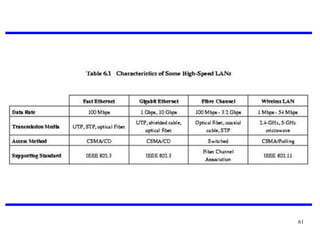
Emergence of High-Speed LANs


2 Significant trends
 Computing

power of PCs continues to grow

rapidly
 Network computing


Examples of requirements
 Centralized

server farms
 Power workgroups
 High-speed local backbone
62
Classical Ethernet






Bus topology LAN
10 Mbps
CSMA/CD medium access control protocol
2 problems:
A

transmission from any station can be received by
all stations
 How to regulate transmission

63
Solution to First Problem



Data transmitted in blocks called frames:
 User

data
 Frame header containing unique address of
destination station

64
Figure 6.1

Chapter 6 High-Speed LANs

65
CSMA/CD


Carrier Sense Multiple Access/ Carrier Detection



If the medium is idle, transmit.
If the medium is busy, continue to listen until the
channel is idle, then transmit immediately.
If a collision is detected during transmission,
immediately cease transmitting.
After a collision, wait a random amount of time, then
attempt to transmit again (repeat from step 1).





66
Figure 6.2

Chapter 6 High-Speed LANs

67
Figure 6.3

Chapter 6 High-Speed LANs

68
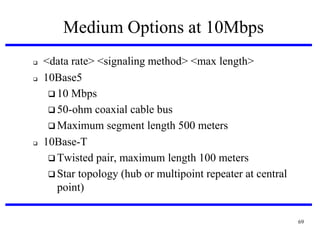
Medium Options at 10Mbps





<data rate> <signaling method> <max length>
10Base5
 10 Mbps
 50-ohm coaxial cable bus
 Maximum segment length 500 meters
10Base-T
 Twisted pair, maximum length 100 meters
 Star topology (hub or multipoint repeater at central
point)‫‏‬
69
Figure 6.4

Chapter 6 High-Speed LANs

70
Hubs and Switches










Hub
Transmission from a station received by central hub
and retransmitted on all outgoing lines
Only one transmission at a time
Layer 2 Switch
Incoming frame switched to one outgoing line
Many transmissions at same time
71
Figure 6.5

Chapter 6 High-Speed LANs

72
Bridge







Frame handling done
in software
Analyze and forward
one frame at a time
Store-and-forward

Layer 2 Switch







Frame handling done
in hardware
Multiple data paths
and can handle
multiple frames at a
time
Can do cut-through

73
Layer 2 Switches







Flat address space
Broadcast storm
Only one path between any 2 devices
Solution 1: subnetworks connected by routers
Solution 2: layer 3 switching, packetforwarding logic in hardware
74
Figure 6.6

Chapter 6 High-Speed LANs

75
Figure 6.7

Chapter 6 High-Speed LANs

76
Figure 6.8

Chapter 6 High-Speed LANs

77
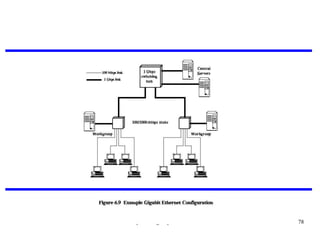
Figure 6.9

Chapter 6 High-Speed LANs

78
Figure 6.10

Chapter 6 High-Speed LANs

79
Figure 6.11

Chapter 6 High-Speed LANs

80
Benefits of 10 Gbps Ethernet over ATM








No expensive, bandwidth consuming conversion
between Ethernet packets and ATM cells
Network is Ethernet, end to end
IP plus Ethernet offers QoS and traffic policing
capabilities approach that of ATM
Wide variety of standard optical interfaces for 10
Gbps Ethernet
81
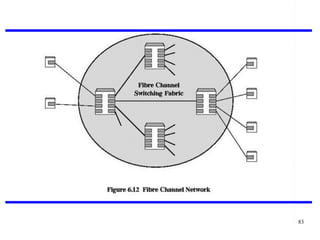
Fibre Channel


2 methods of communication with processor:
 I/O

channel
 Network communications


Fibre channel combines both
 Simplicity

and speed of channel communications
 Flexibility and interconnectivity of network
communications

82
Figure 6.12

Chapter 6 High-Speed LANs

83
I/O channel










Hardware based, high-speed, short distance
Direct point-to-point or multipoint communications
link
Data type qualifiers for routing payload
Link-level constructs for individual I/O operations
Protocol specific specifications to support e.g.
SCSI

84
Fibre Channel Network-Oriented Facilities





Full multiplexing between multiple destinations
Peer-to-peer connectivity between any pair of ports
Internetworking with other connection technologies

85
Fibre Channel Requirements












Full duplex links with 2 fibres/link
100 Mbps – 800 Mbps
Distances up to 10 km
Small connectors
high-capacity
Greater connectivity than existing multidrop channels
Broad availability
Support for multiple cost/performance levels
Support for multiple existing interface command sets

86
Figure 6.13

Chapter 6 High-Speed LANs

87
Fibre Channel Protocol Architecture







FC-0 Physical Media
FC-1 Transmission Protocol
FC-2 Framing Protocol
FC-3 Common Services
FC-4 Mapping

88
Wireless LAN Requirements











Throughput
Number of nodes
Connection to backbone
Service area
Battery power consumption
Transmission robustness and security
Collocated network operation
License-free operation
Handoff/roaming
Dynamic configuration
89
Figure 6.14

Chapter 6 High-Speed LANs

90
IEEE 802.11 Services







Association
Reassociation
Disassociation
Authentication
Privacy

91
Figure 6.15

Chapter 6 High-Speed LANs

92
Figure 6.16

Chapter 6 High-Speed LANs

93
Questions ?

94

HIGH SPEED NETWORKS