Save a tree. Please, don't print these slides unless it's necessary.
Accessing the WAN: Chapter 4
Abdelkhalik Elsaid Mosa
All pictures are copied from Cisco CCNA Exploration: Semester 4 – Accessing the WAN
If you found any mistake’s’ on these slides or if you
have any other questions or comments, please feel
free to email me at: abdu.elsaid@gmail.com or
abdu.elsaid@yahoo.com
Thanks,
Abdelkhalik Elsaid Mosa
Suez Canal University – Faculty of Computers & Informatics
Cisco Local Academy – Ismailia - Egypt
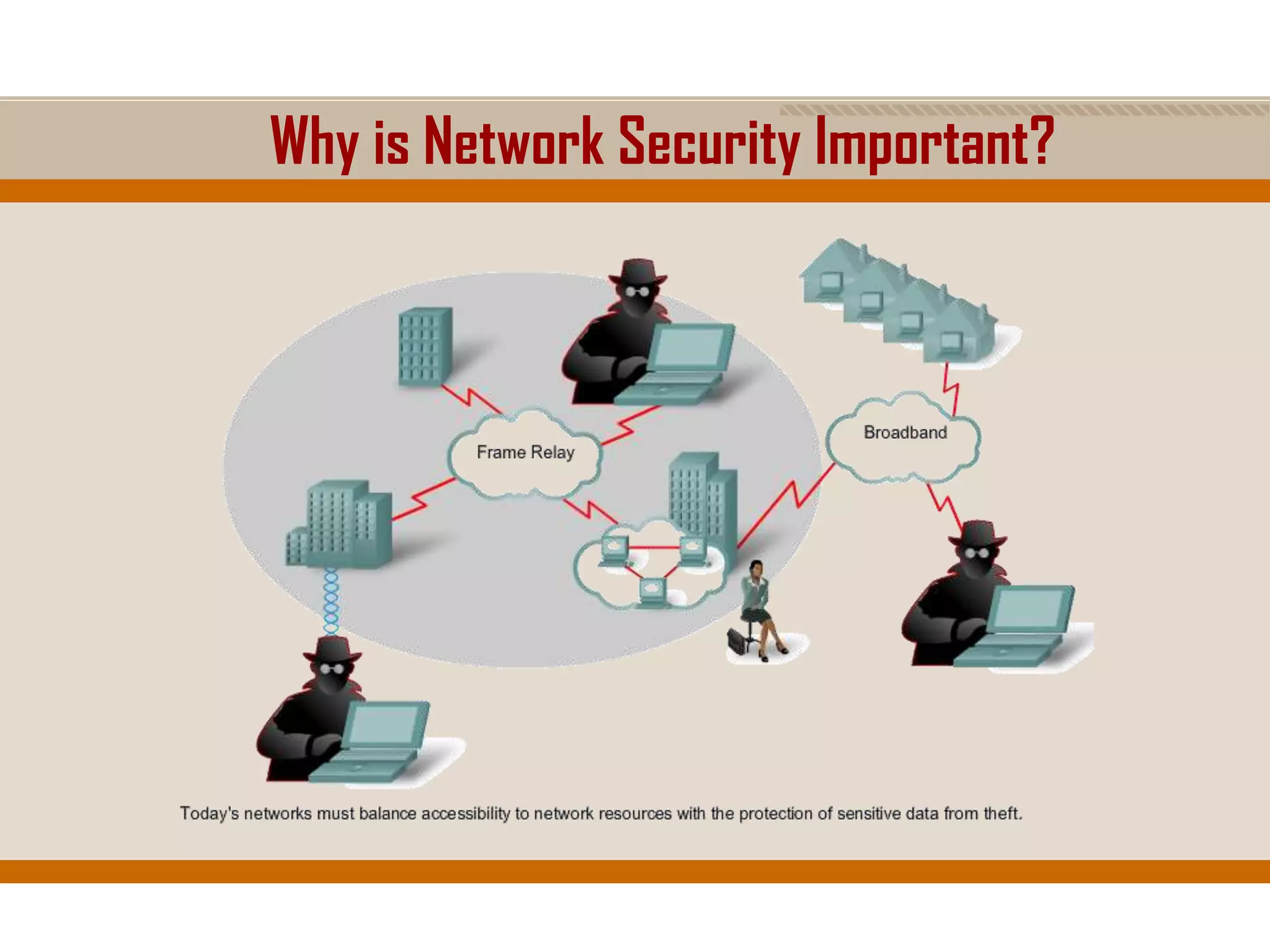
Why is Network Security Important?
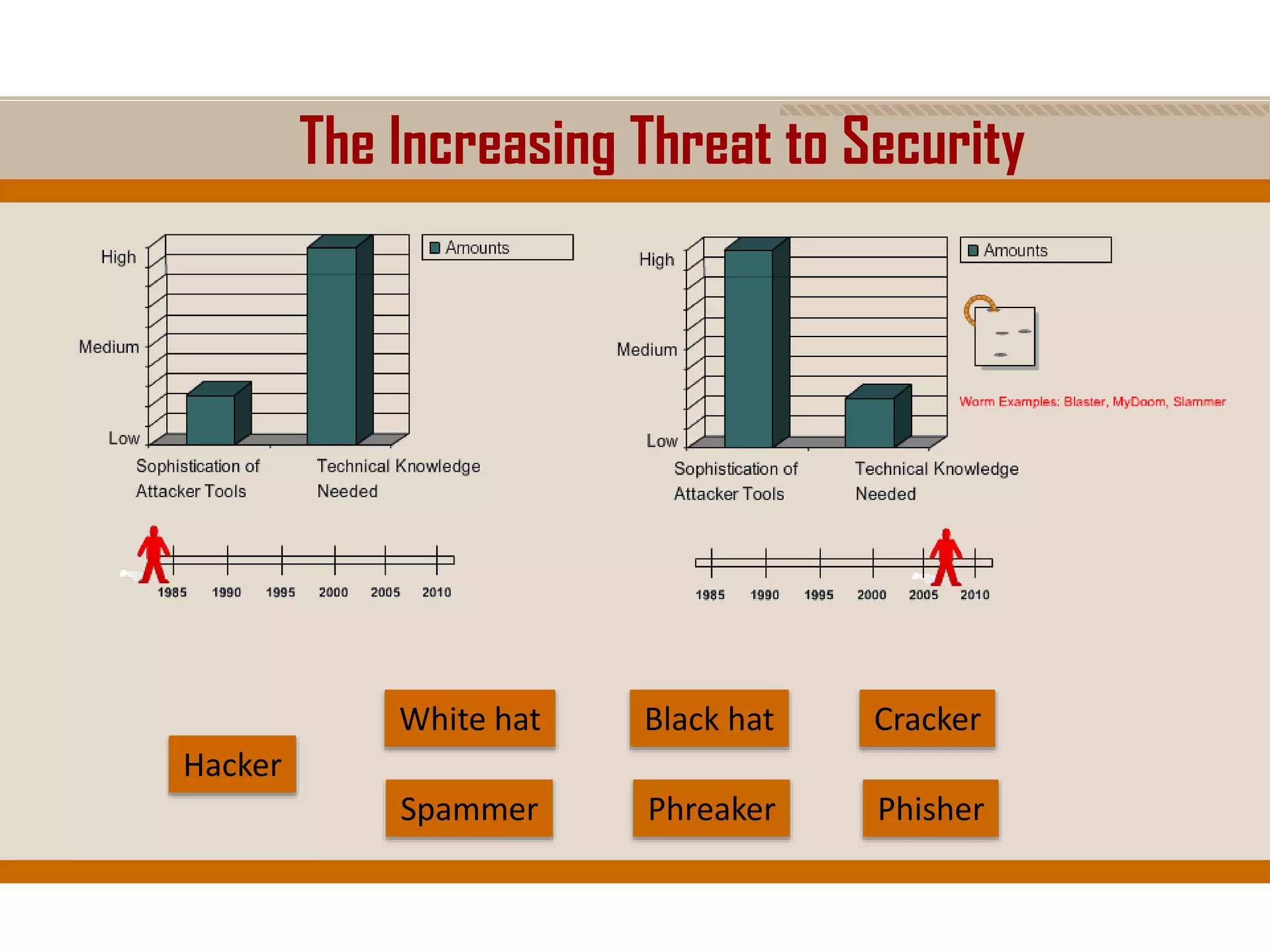
The Increasing Threat to Security
White hat
Hacker
Black hat Cracker
PhreakerSpammer Phisher
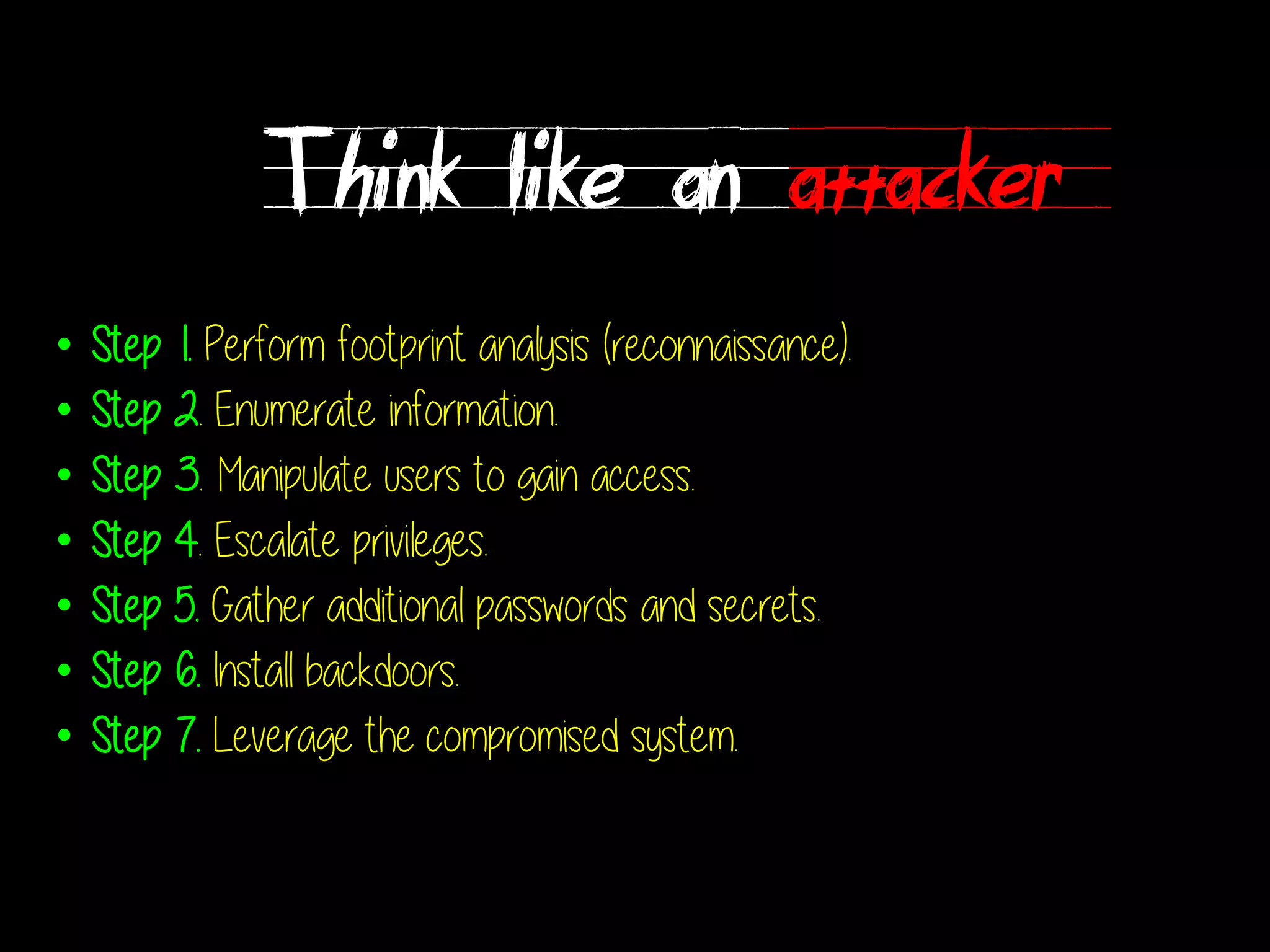
Think like an attacker
• Step 1. Perform footprint analysis (reconnaissance).
• Step 2. Enumerate information.
• Step 3. Manipulate users to gain access.
• Step 4. Escalate privileges.
• Step 5. Gather additional passwords and secrets.
• Step 6. Install backdoors.
• Step 7. Leverage the compromised system.
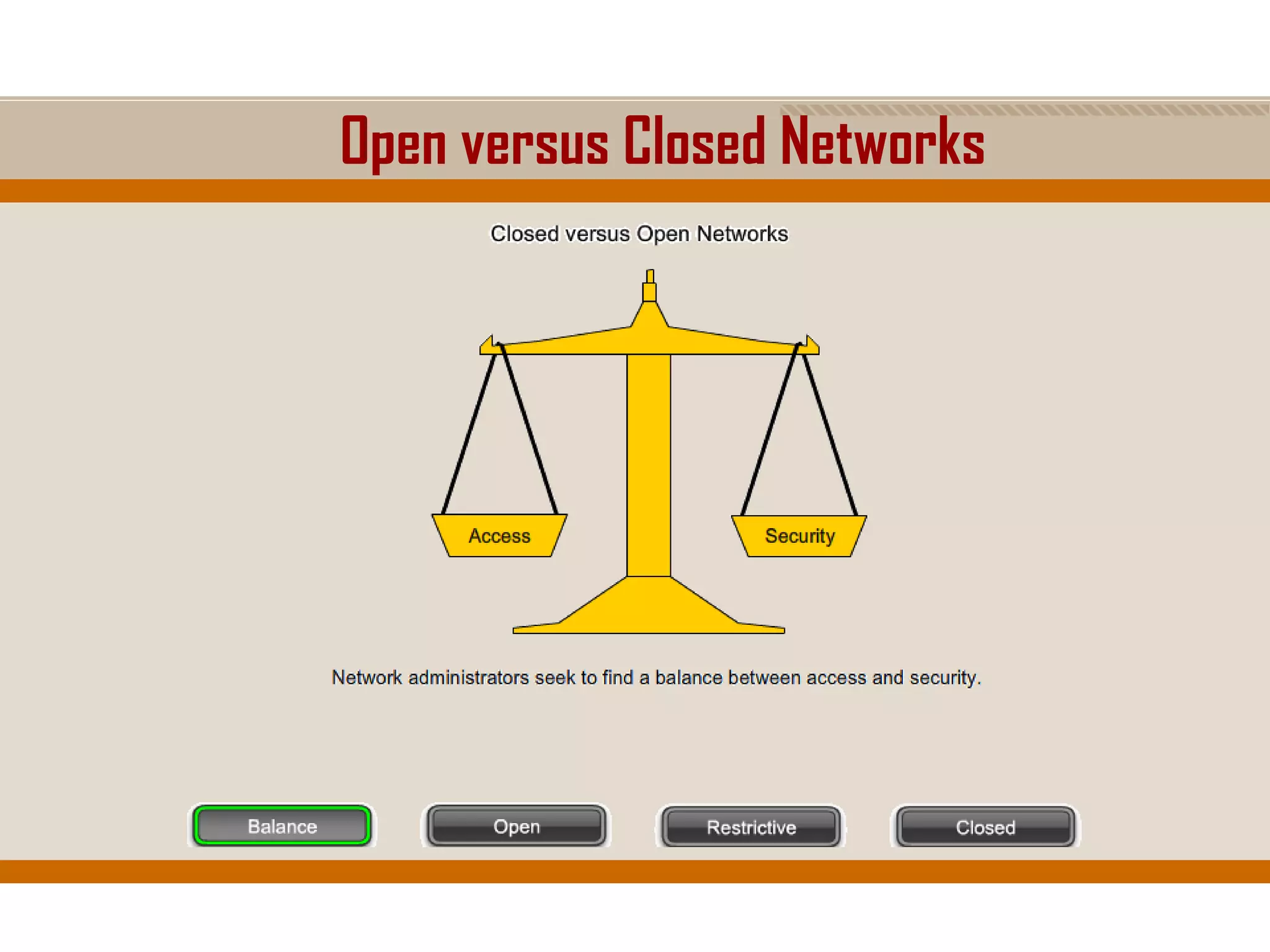
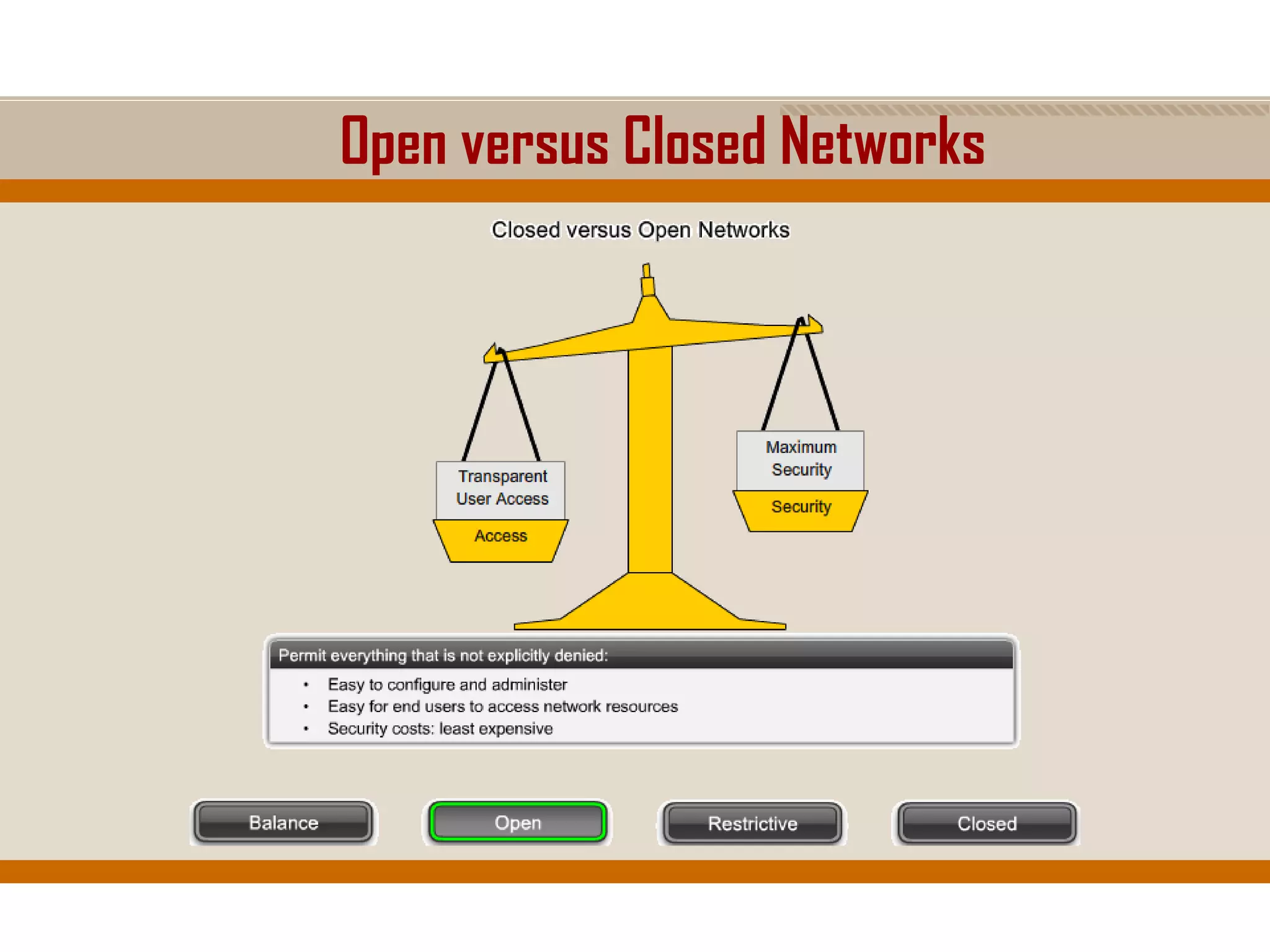
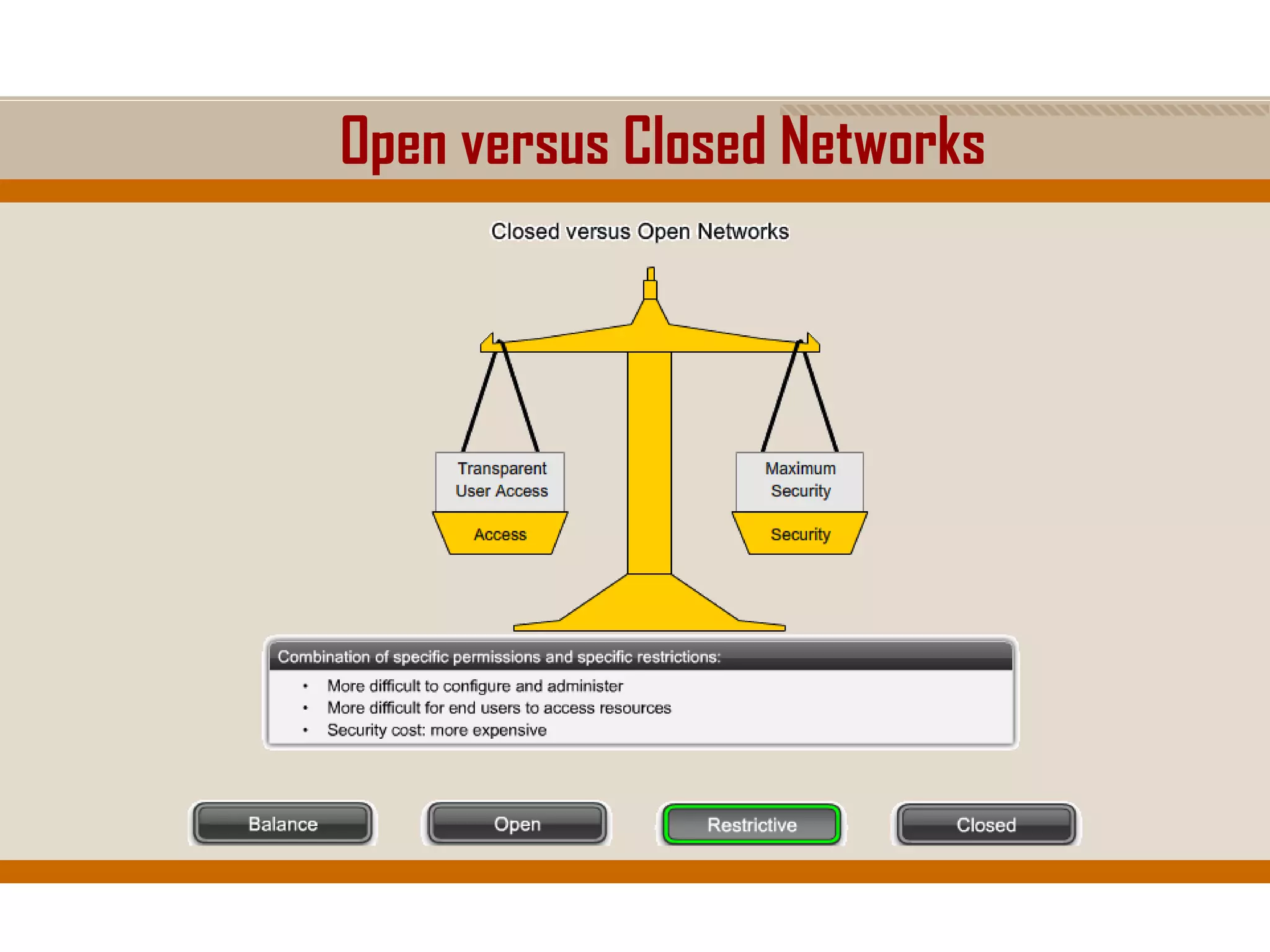
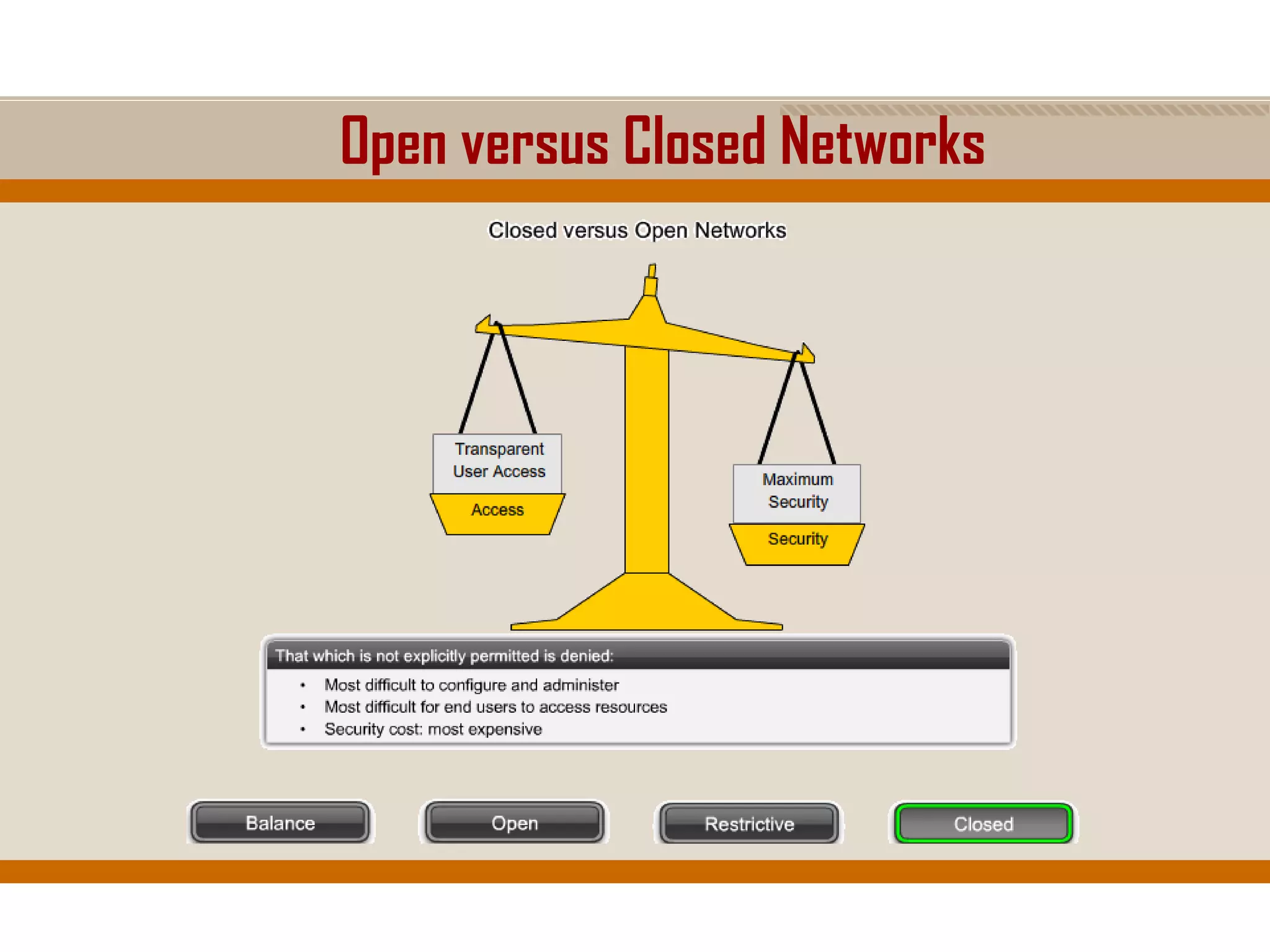
Open versus Closed Networks
Developing a Security Policy
• Security Policy is a formal statement of the rules by which people who are
given access to an organization's technology and information assets must
abide.
• A security policy meets these goals:
1. Informs users, staff, and managers of their obligatory requirements for
protecting technology and information assets.
2. Specifies the mechanisms through which these requirements can be met.
3. Provides a baseline from which to acquire, configure, and audit computer
systems and networks for compliance with the policy.
• ISO/IEC 27002: a guideline for developing organizational security standards.
Risk assessment - Security policy - Organization of information security - Asset
management - Human resources security - Physical and environmental security -
Communications and operations management - Access control - Information
systems acquisition, development, and maintenance - Information security
incident management - Business continuity management, Compliance
Common Security Threats: Vulnerabilities
• Threats are the people interested and qualified in taking
advantage of each security weakness.
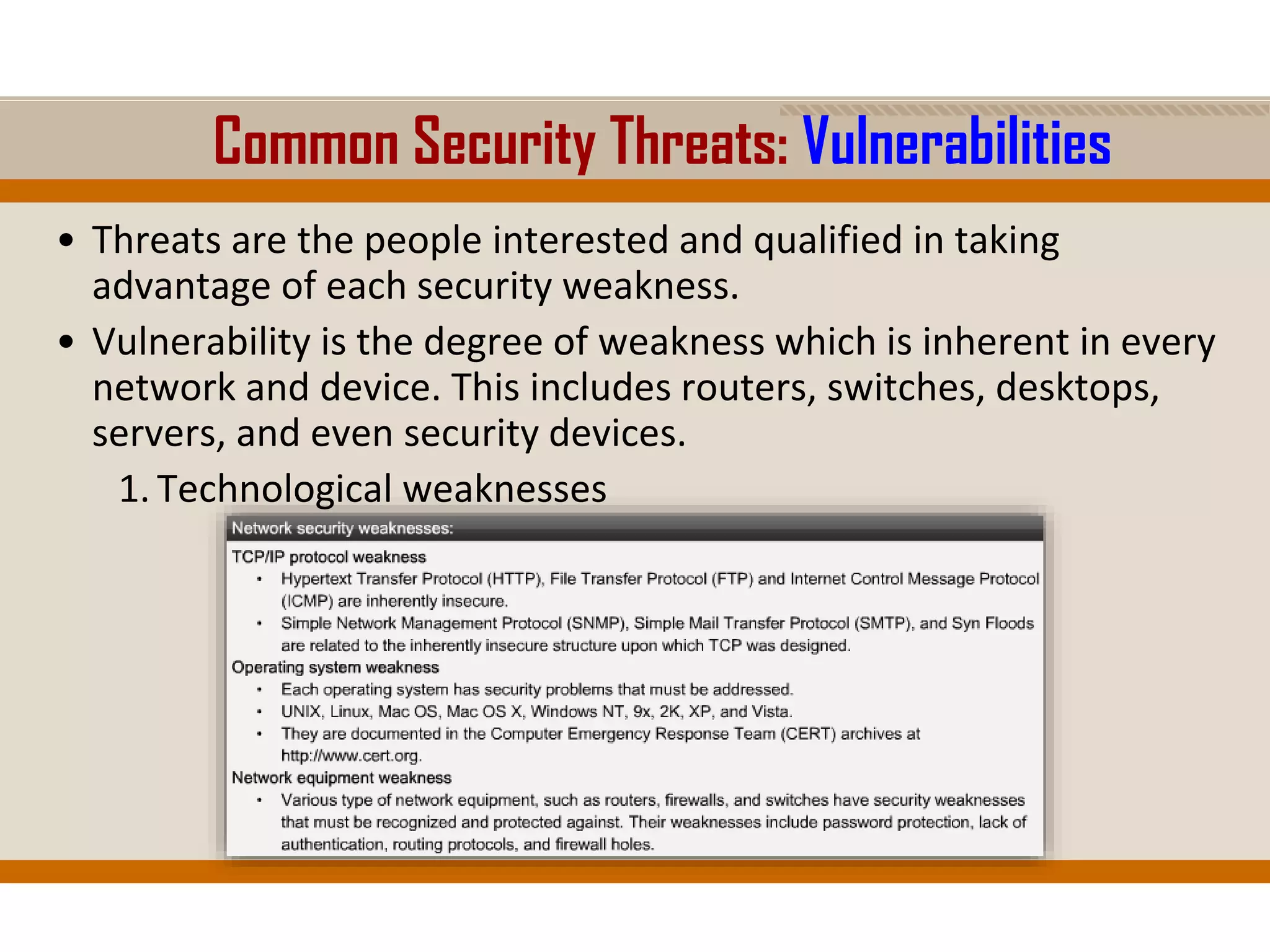
• Vulnerability is the degree of weakness which is inherent in every
network and device. This includes routers, switches, desktops,
servers, and even security devices.
1. Technological weaknesses
Common Security Threats: Vulnerabilities
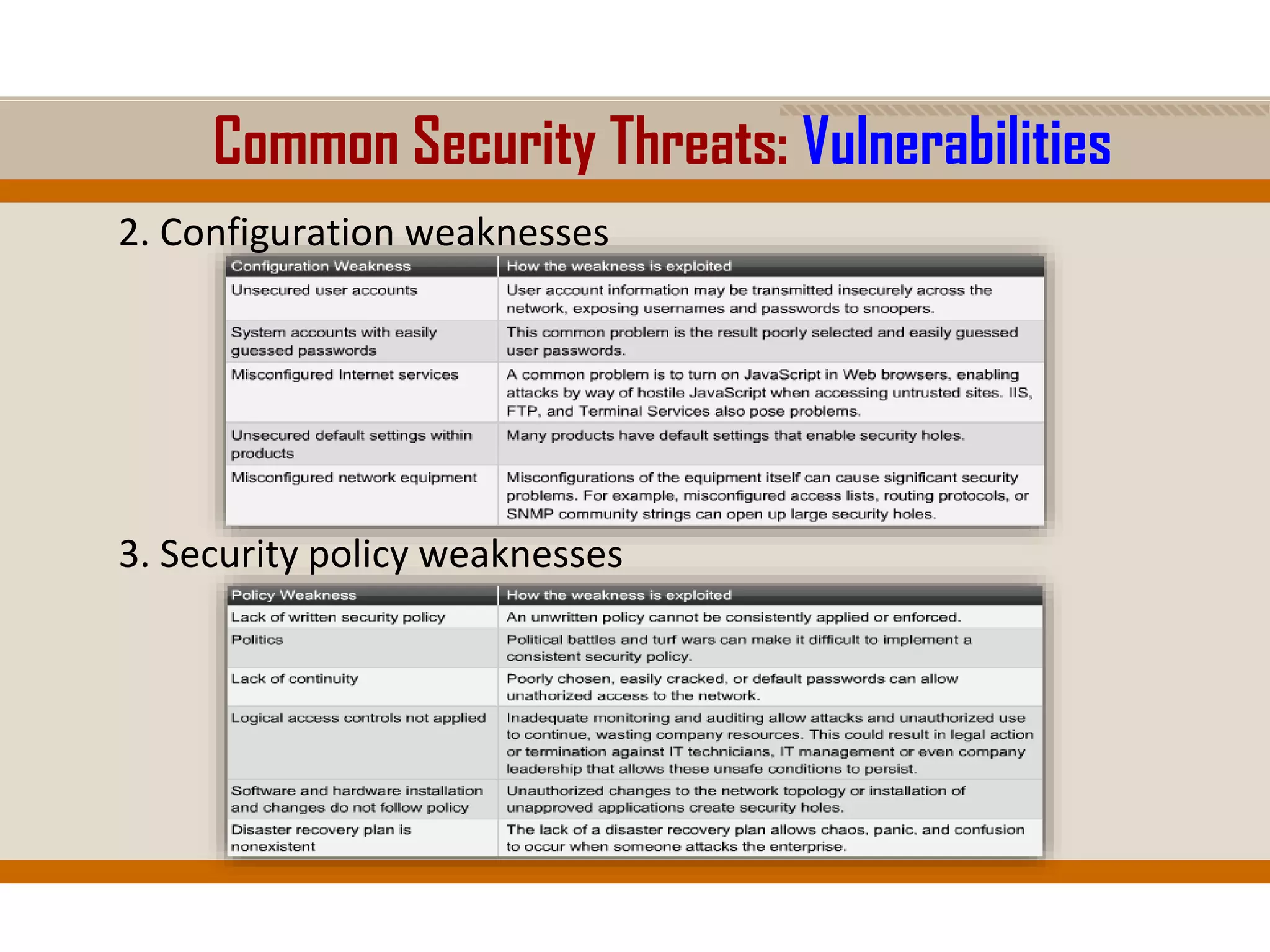
2. Configuration weaknesses
3. Security policy weaknesses
Common Security Threats: Threats to Physical Infrastructure
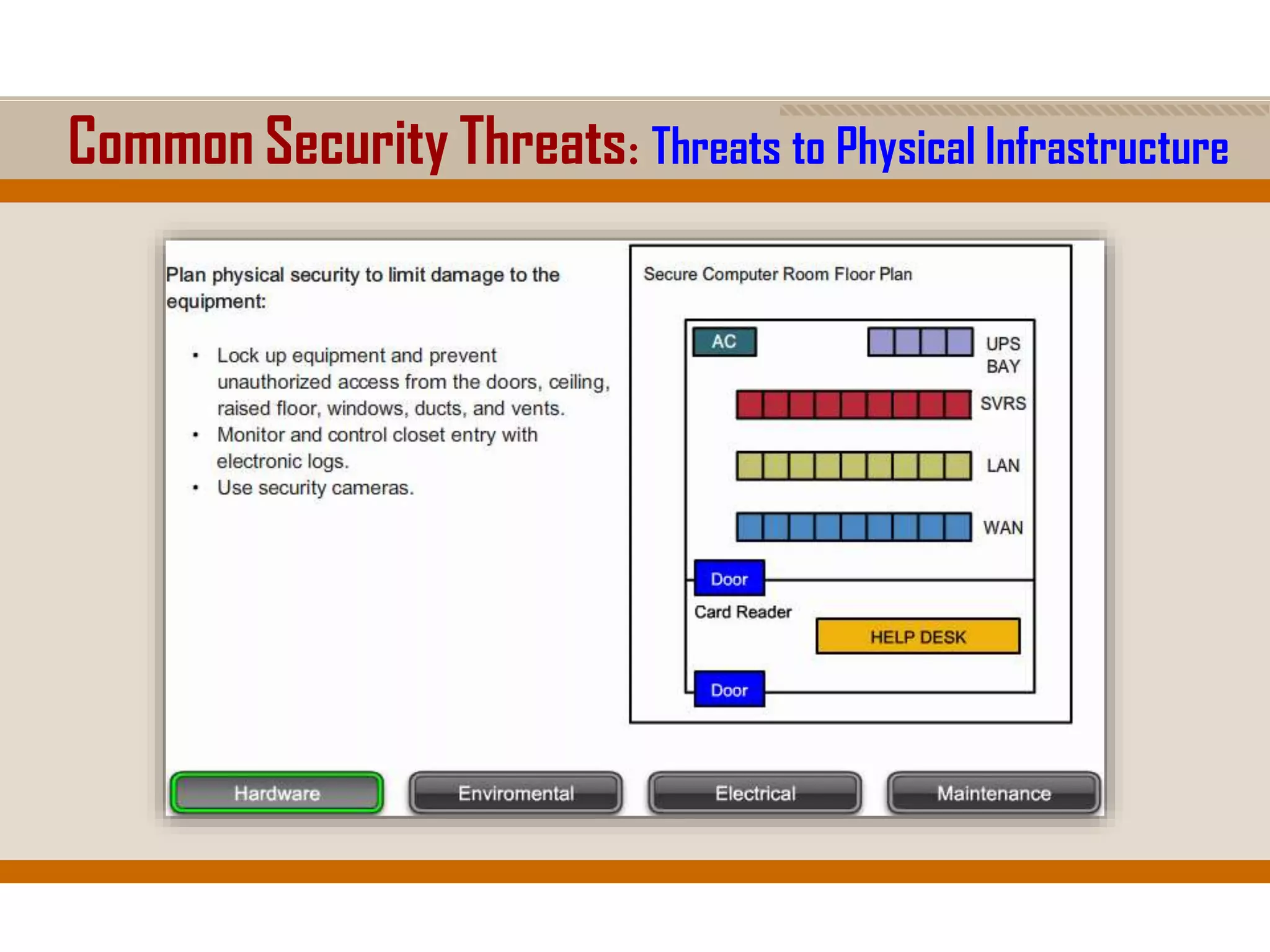
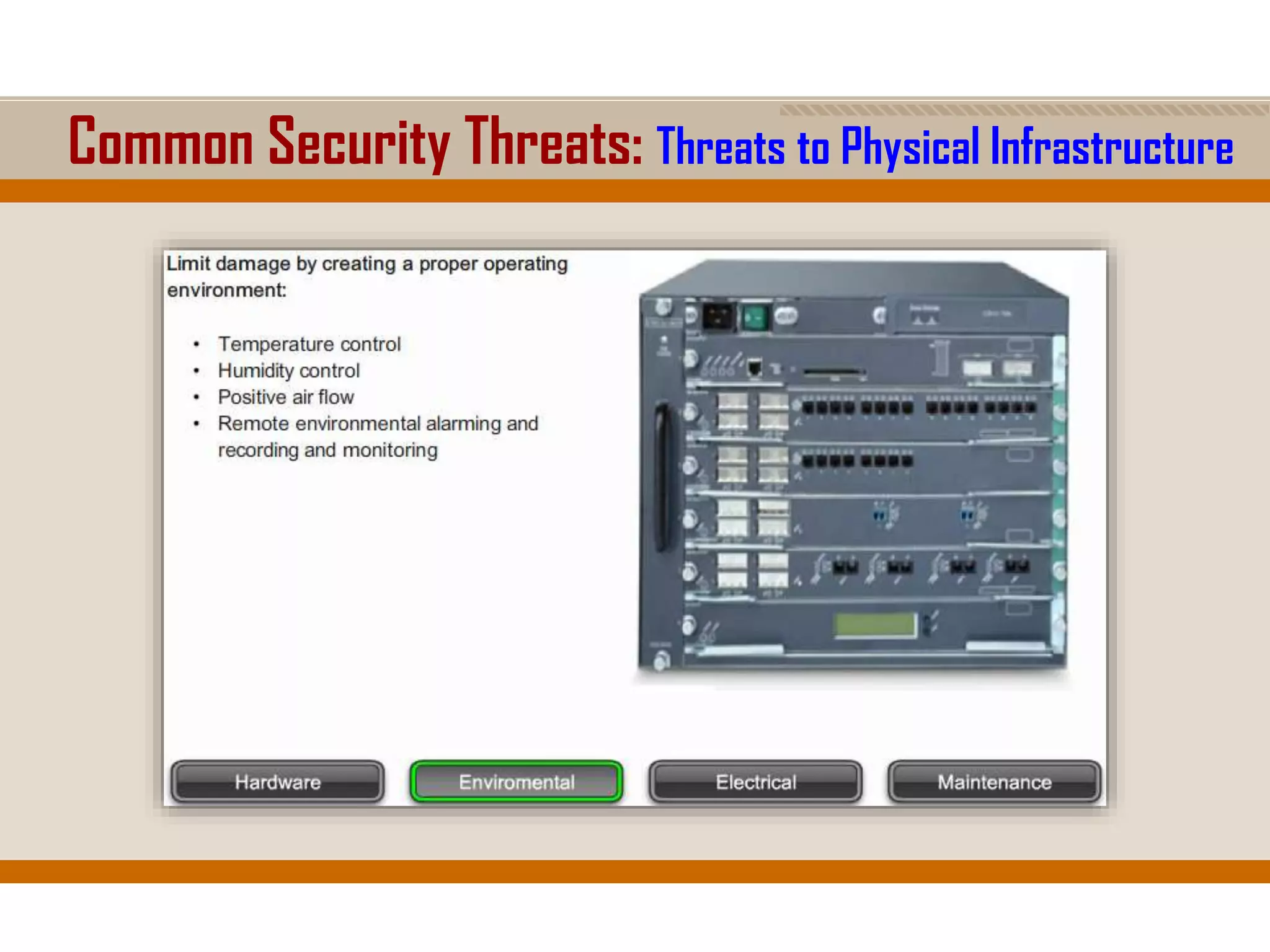
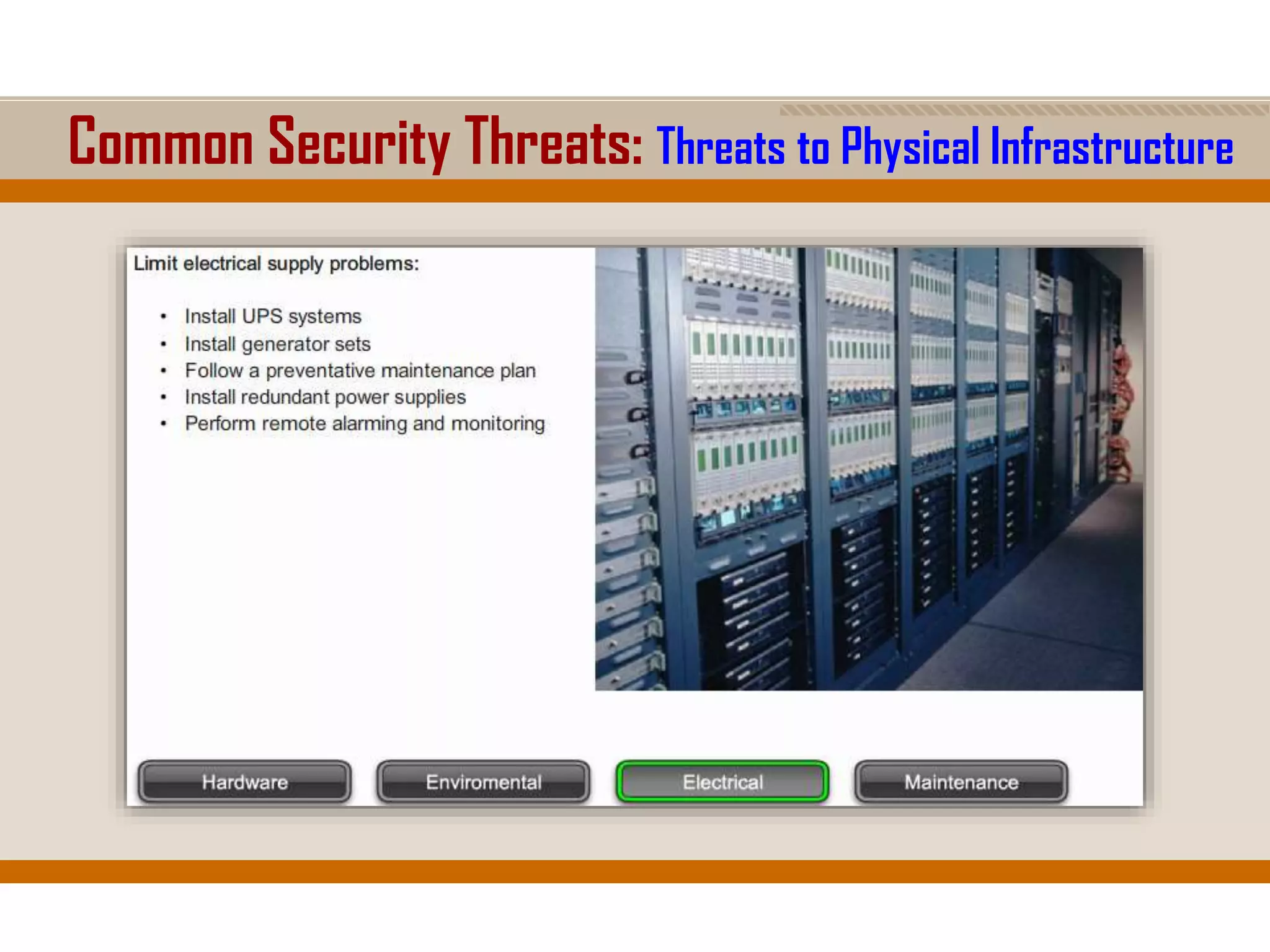
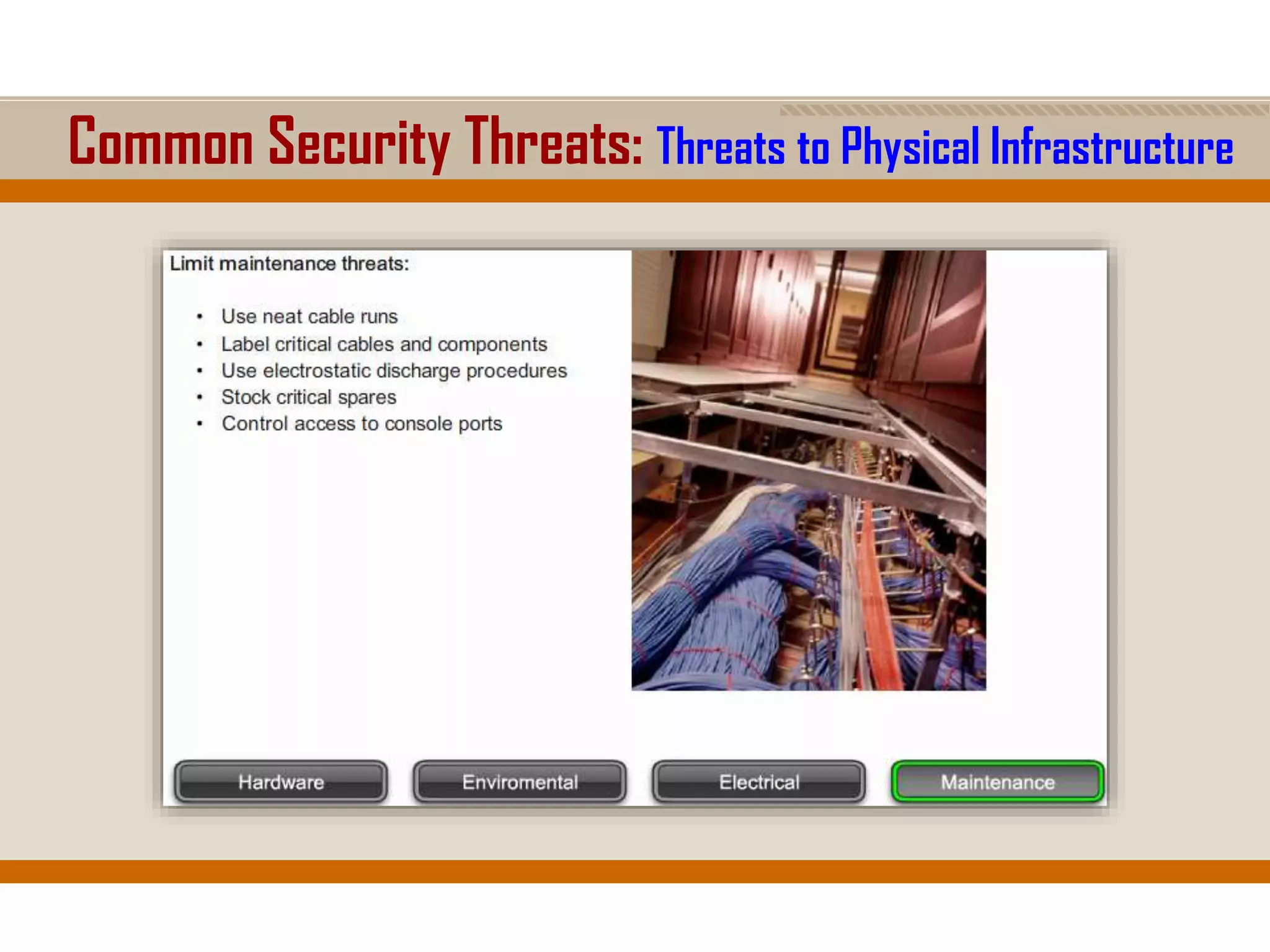
• The four classes of physical threats are:
1. Hardware threats-Physical damage to servers, routers,
switches, cabling plant, and workstations
2. Environmental threats-Temperature extremes (too hot or too
cold) or humidity extremes (too wet or too dry)
3. Electrical threats-Voltage spikes, insufficient supply voltage
(brownouts), unconditioned power (noise), and total power
loss
4. Maintenance threats-Poor handling of key electrical
components (electrostatic discharge), lack of critical spare
parts, poor cabling, and poor labeling
Common Security Threats: Threats to Physical Infrastructure
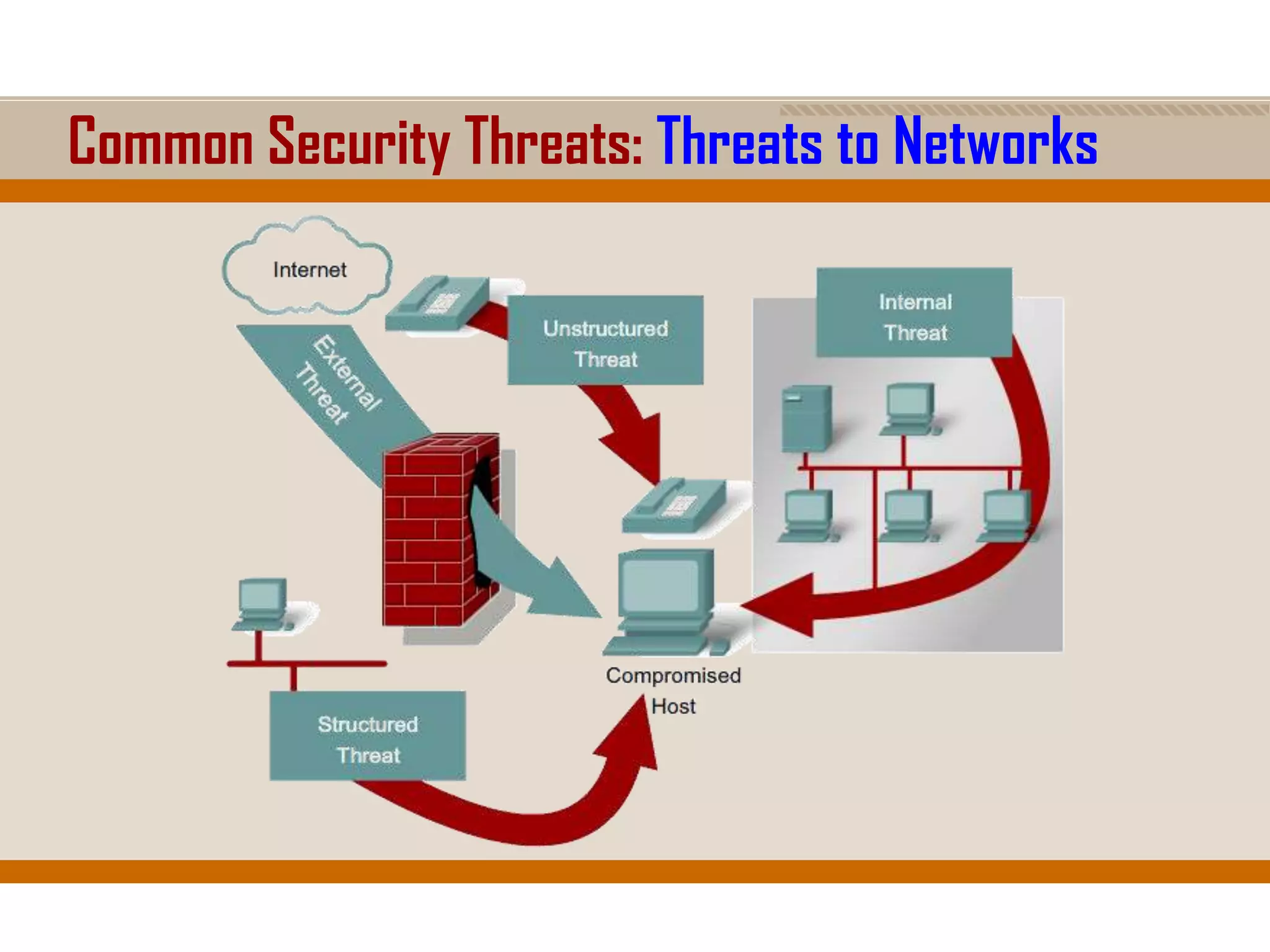
Common Security Threats: Threats to Networks
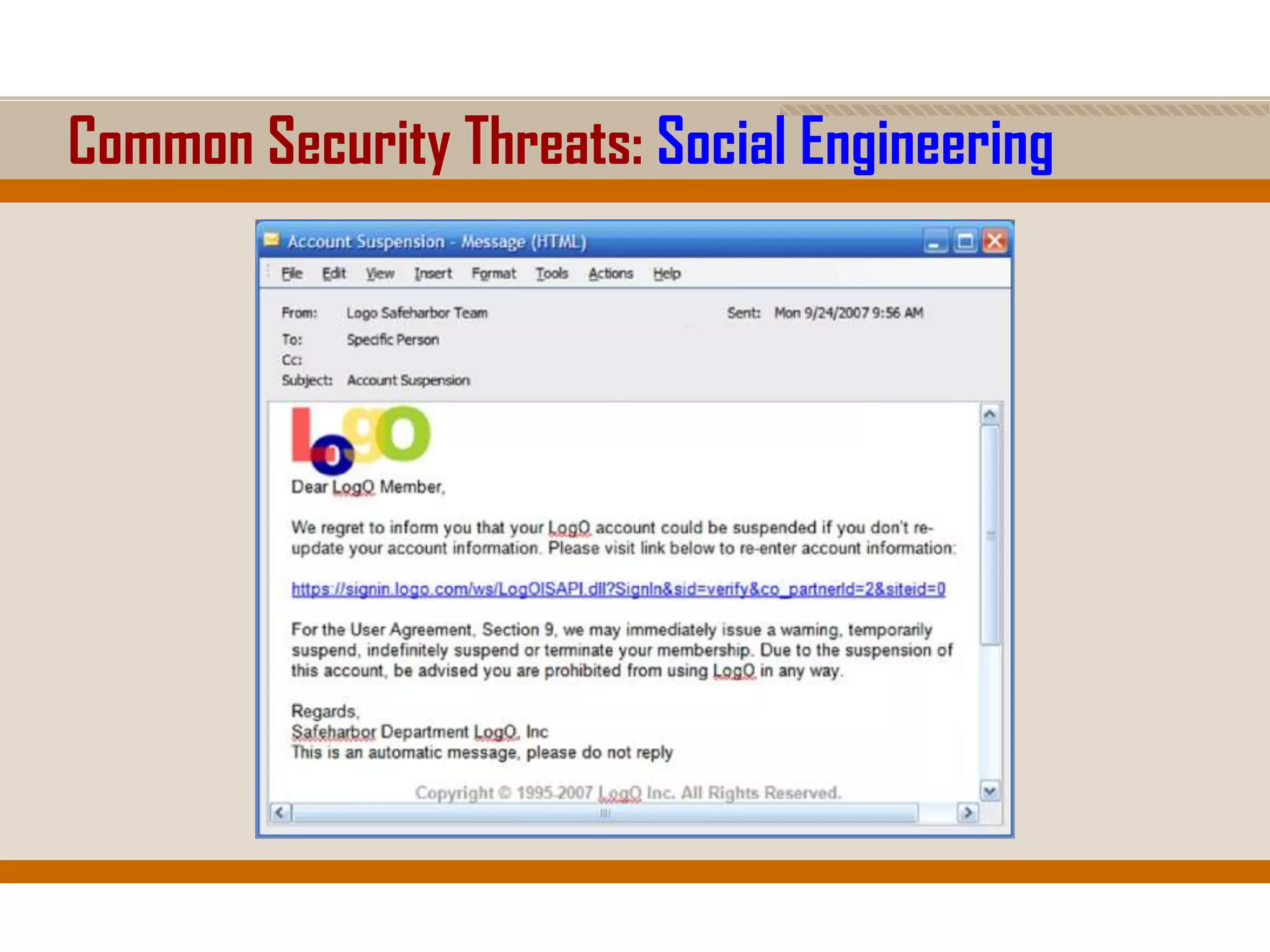
Common Security Threats: Social Engineering
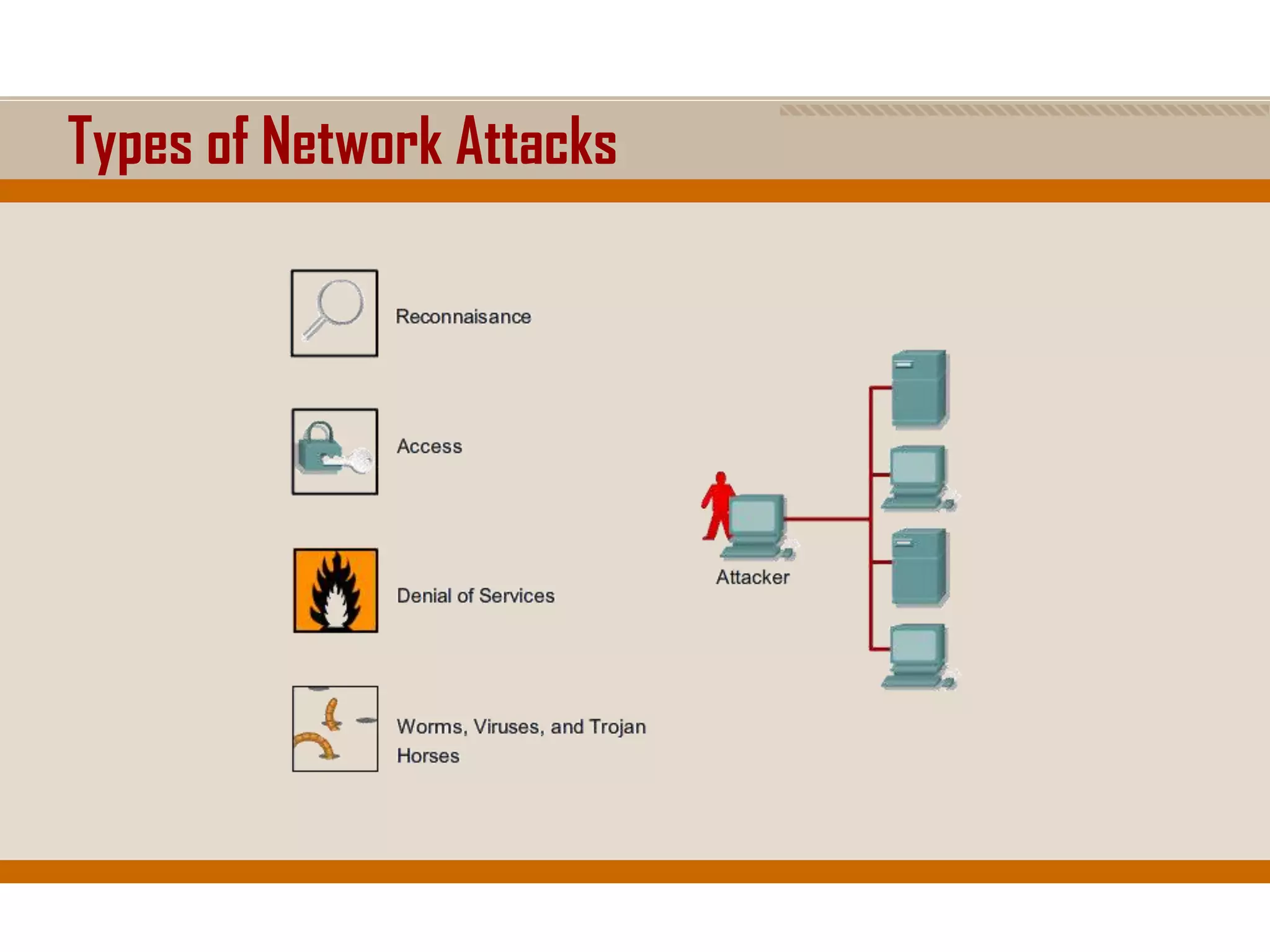
Types of Network Attacks
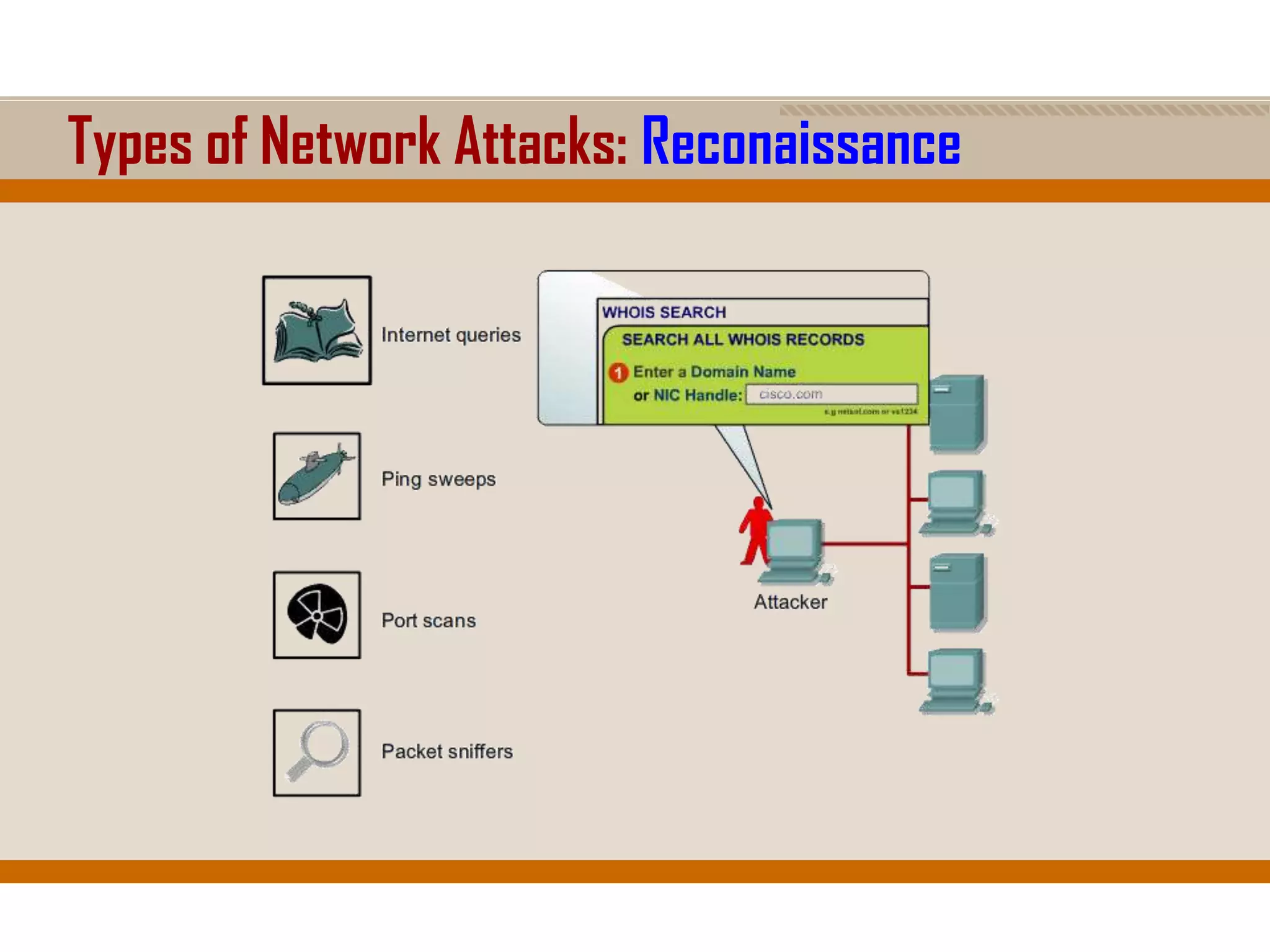
Types of Network Attacks: Reconaissance
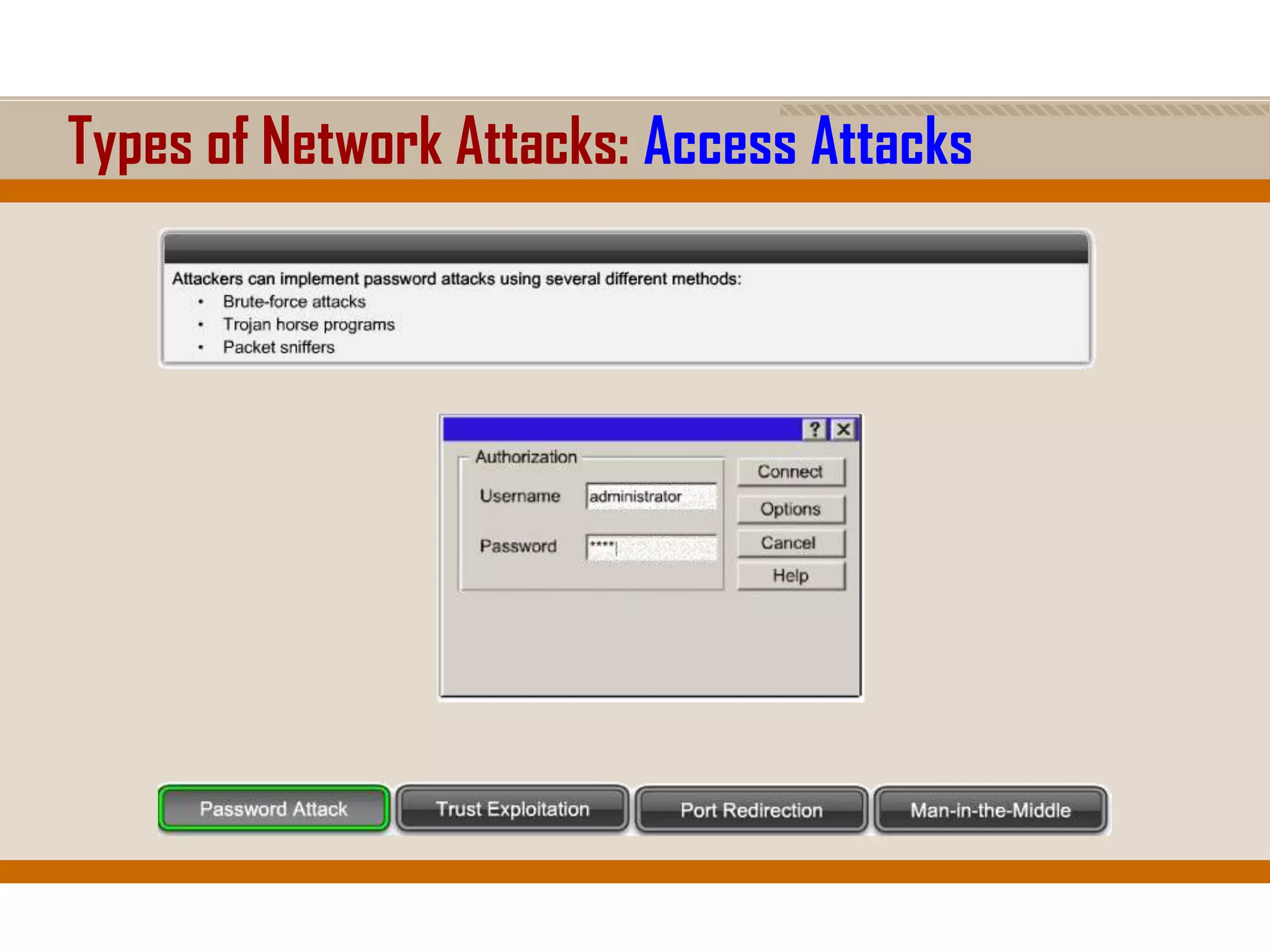
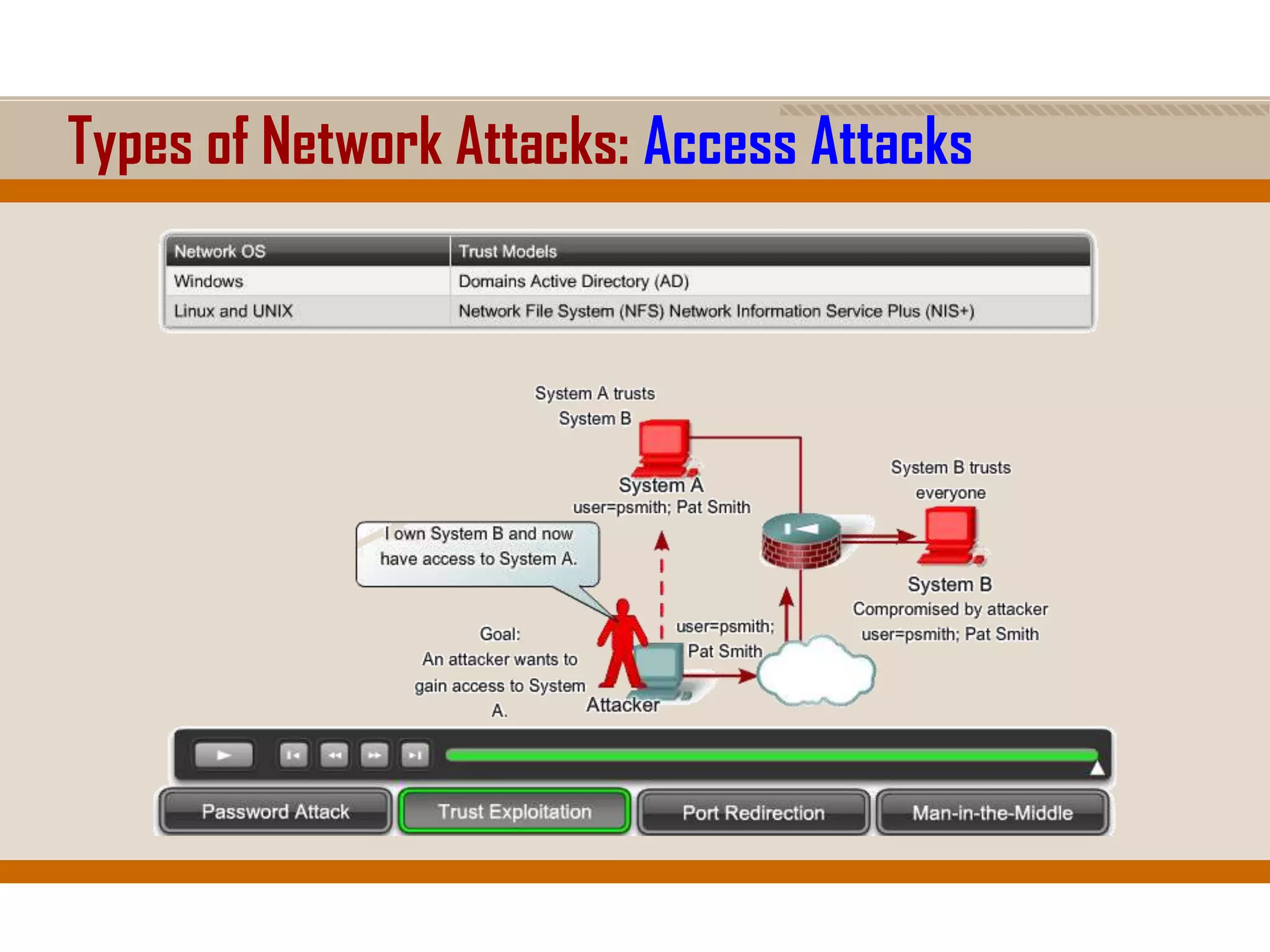
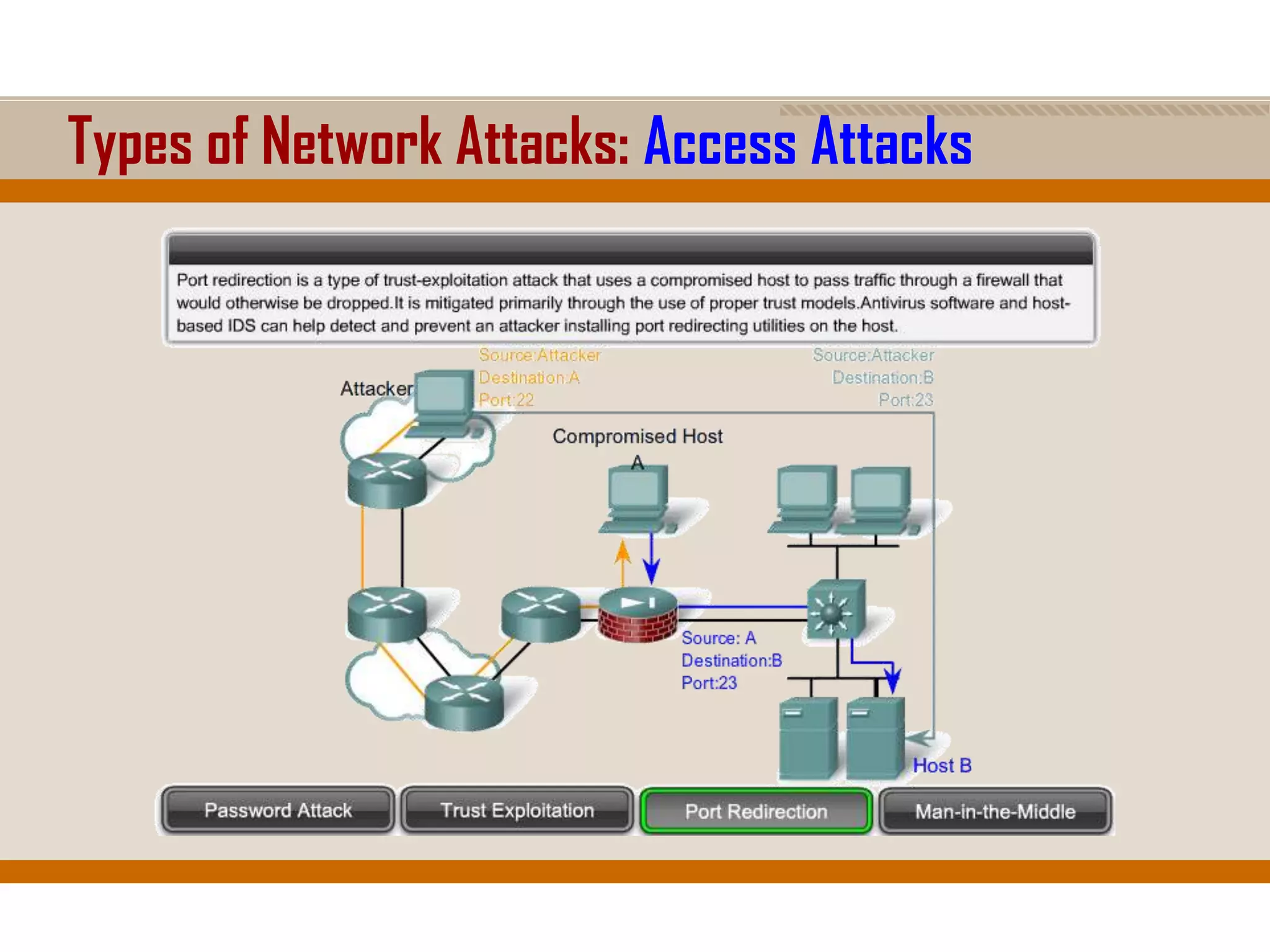
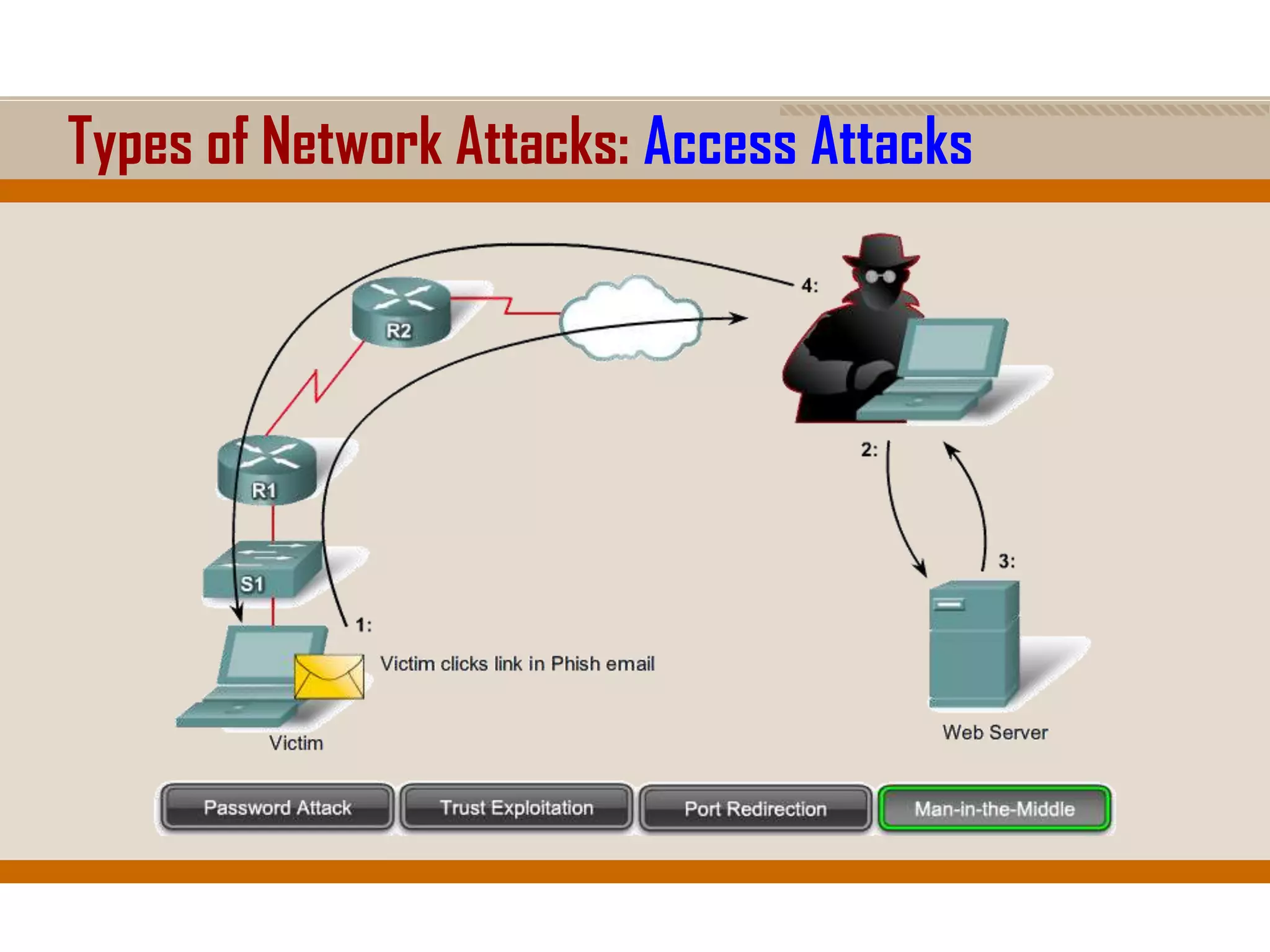
Types of Network Attacks: Access Attacks
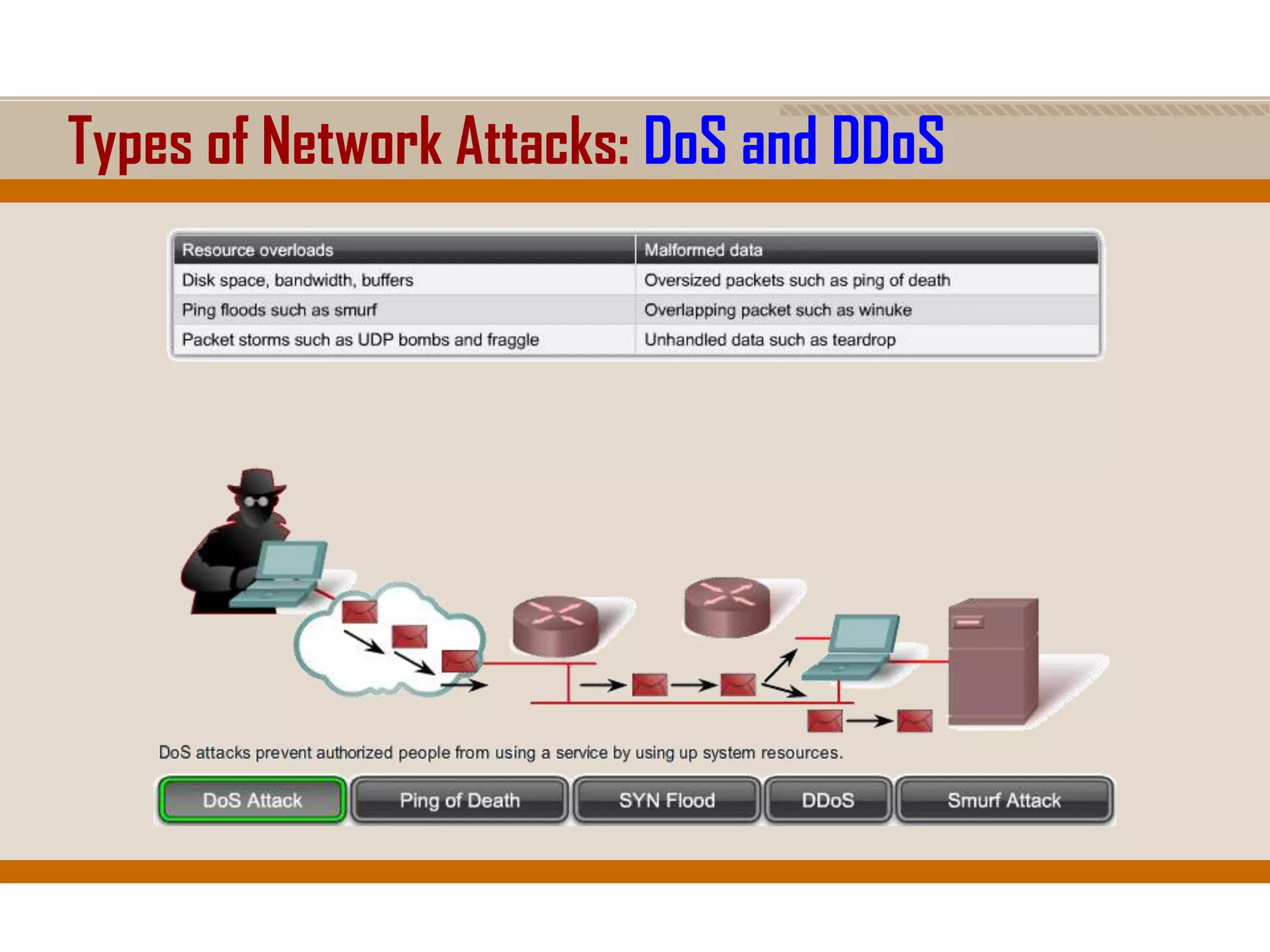
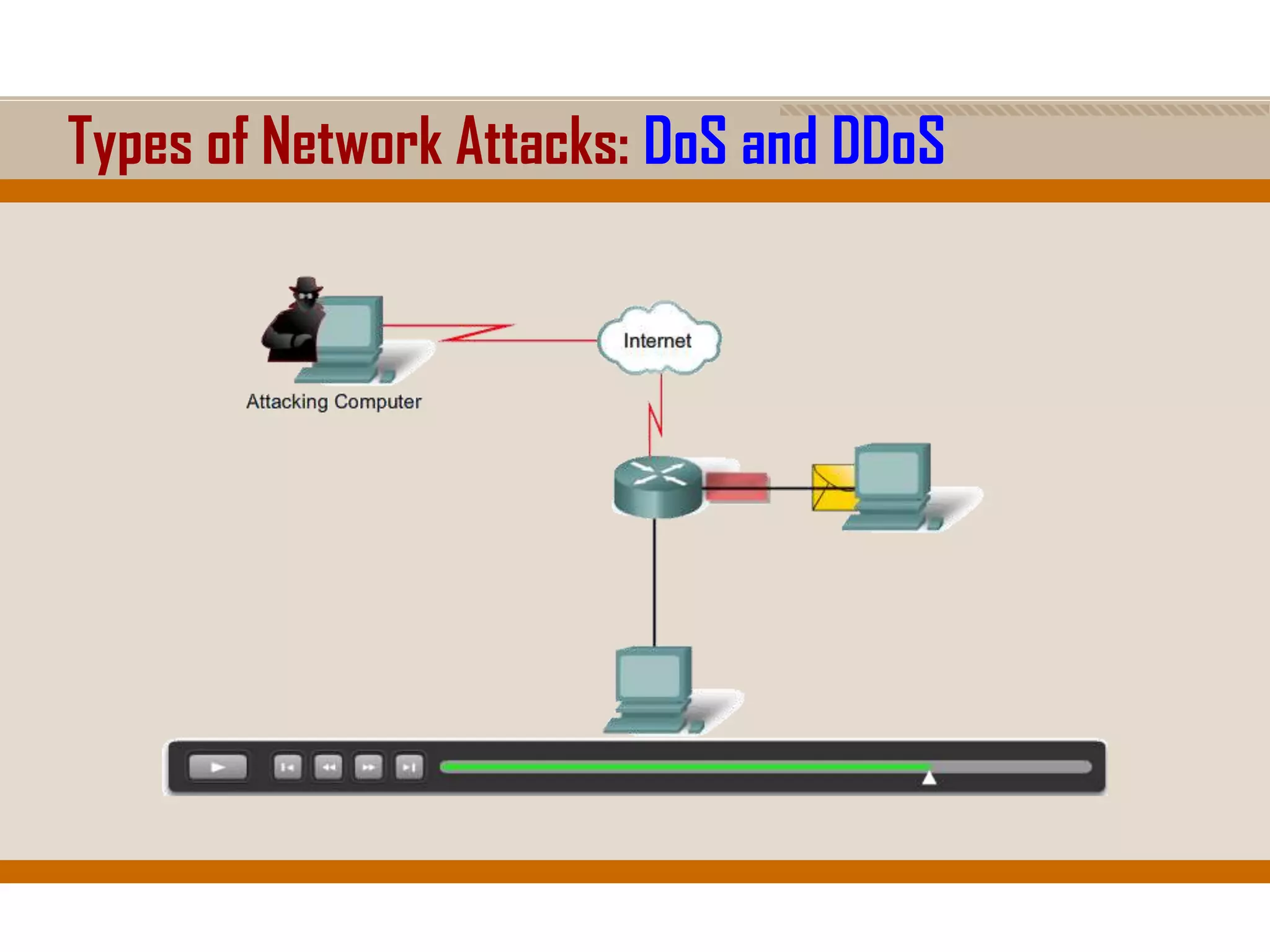
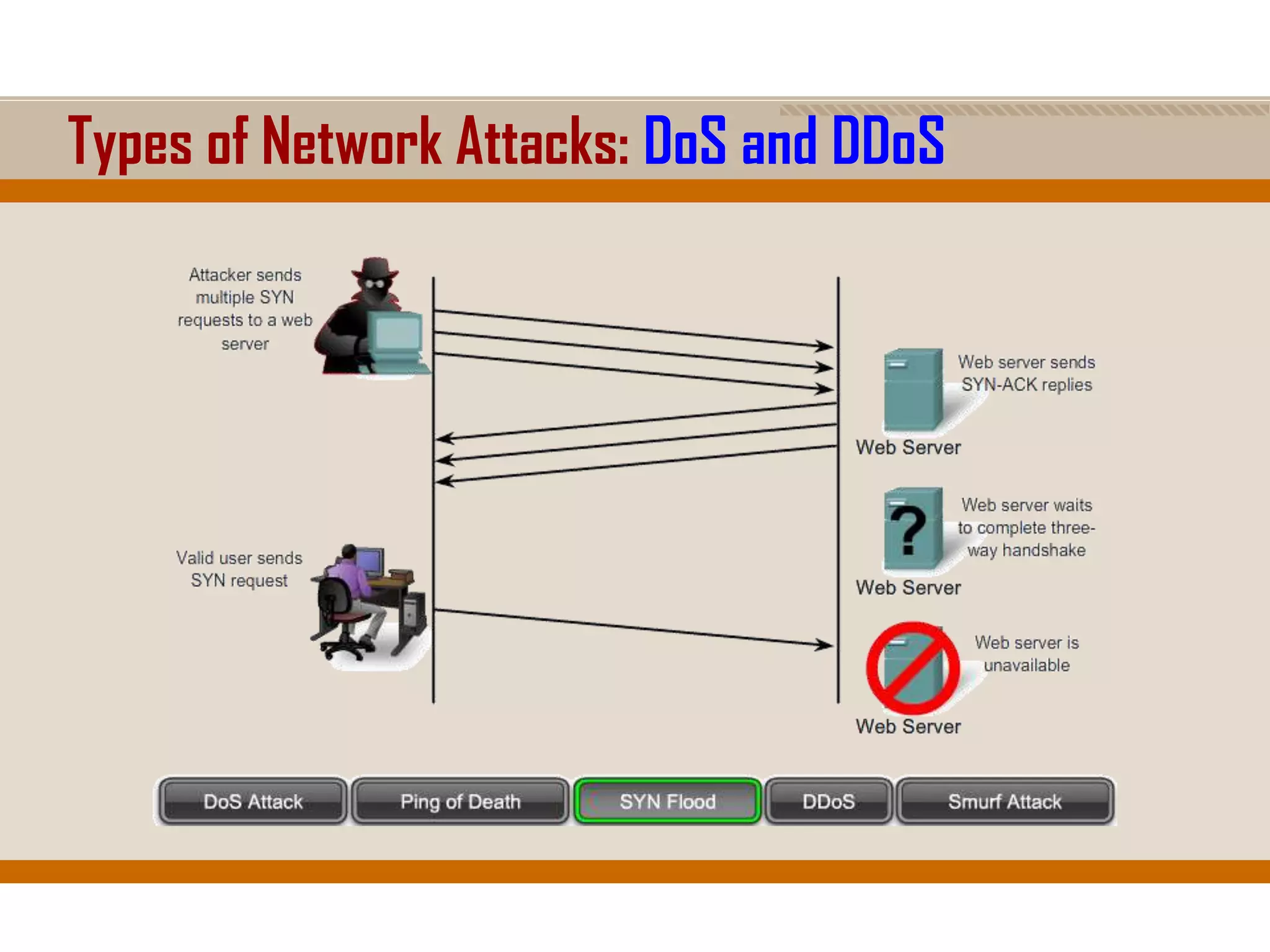
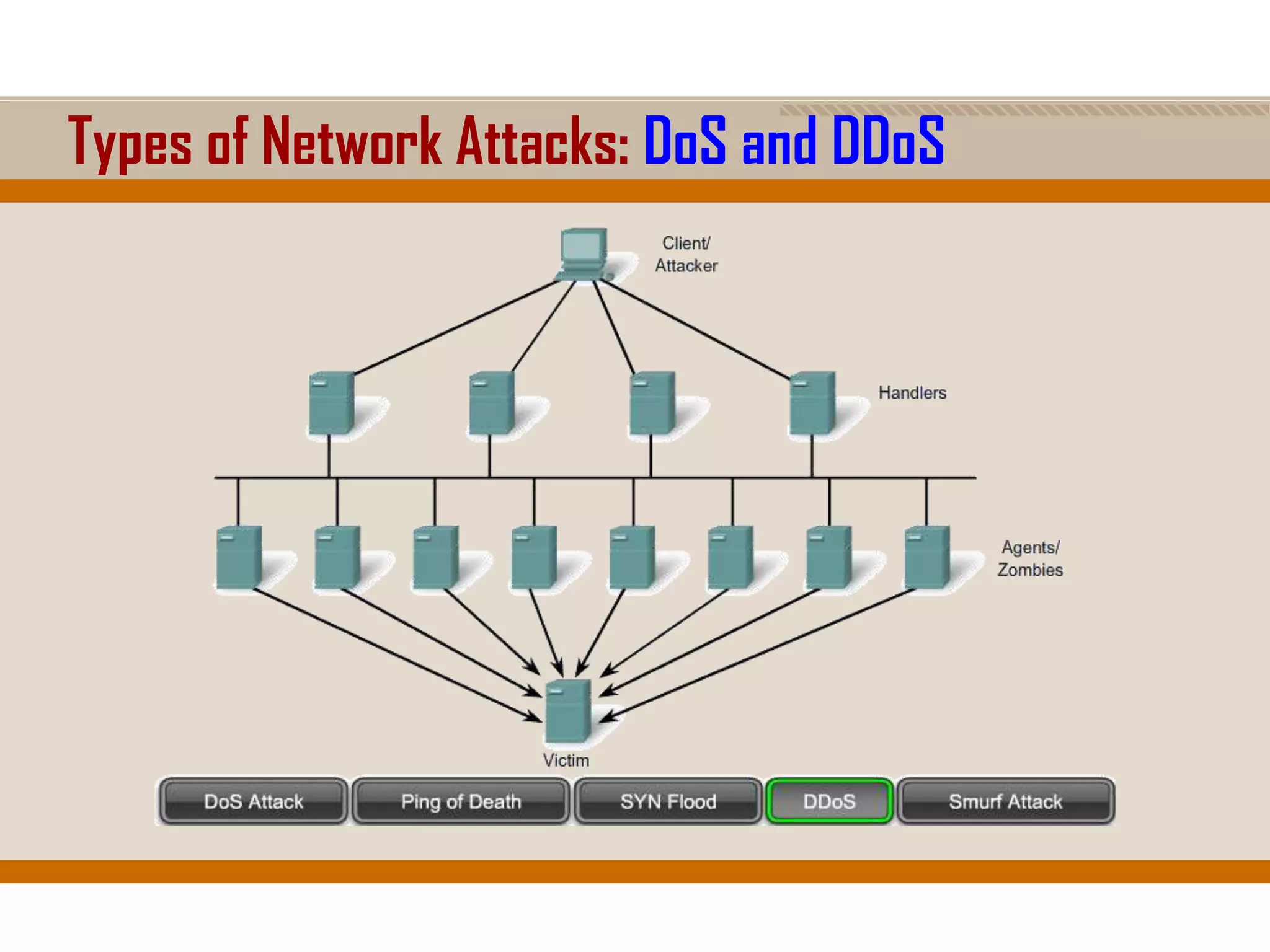
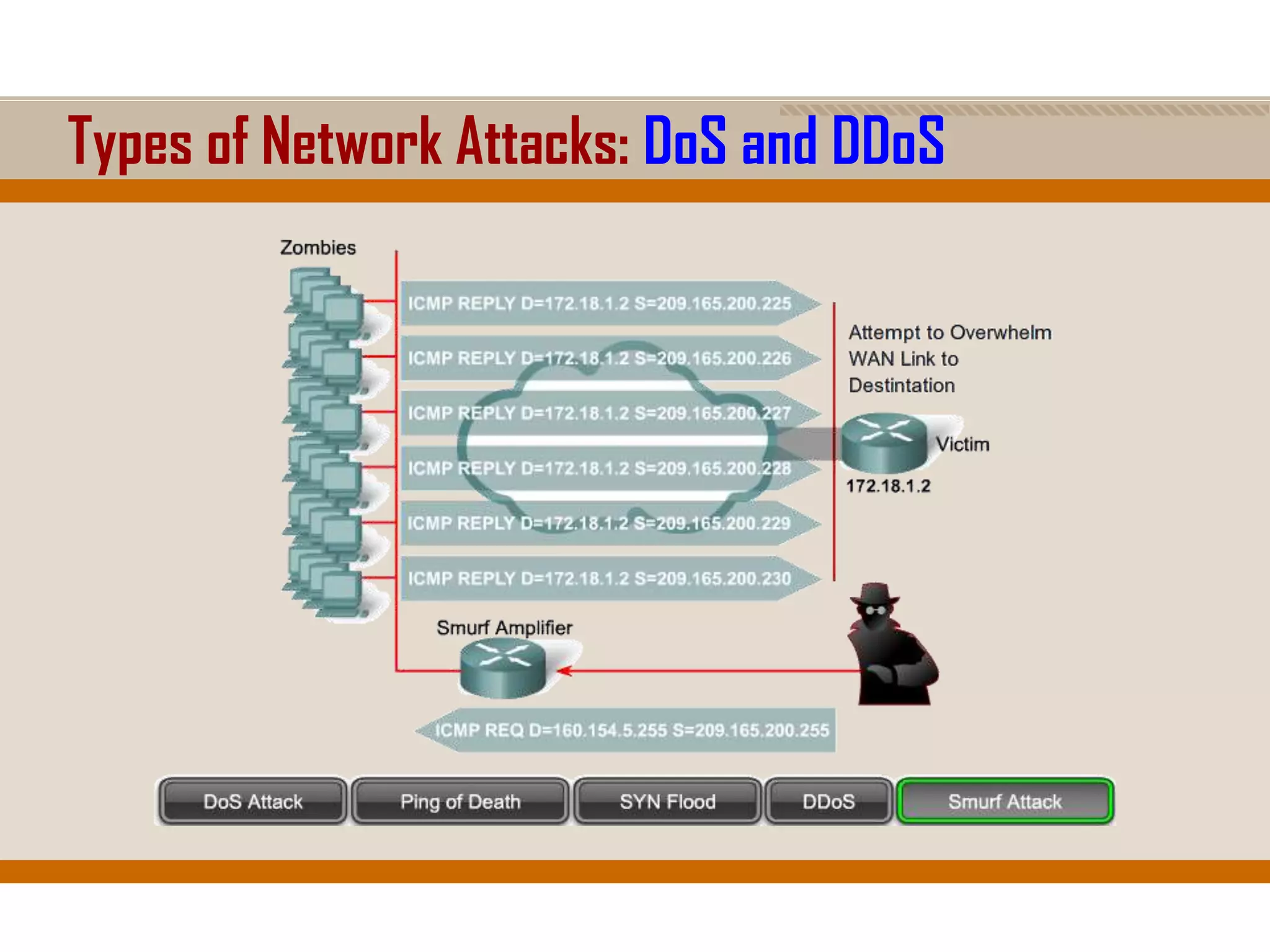
Types of Network Attacks: DoS and DDoS
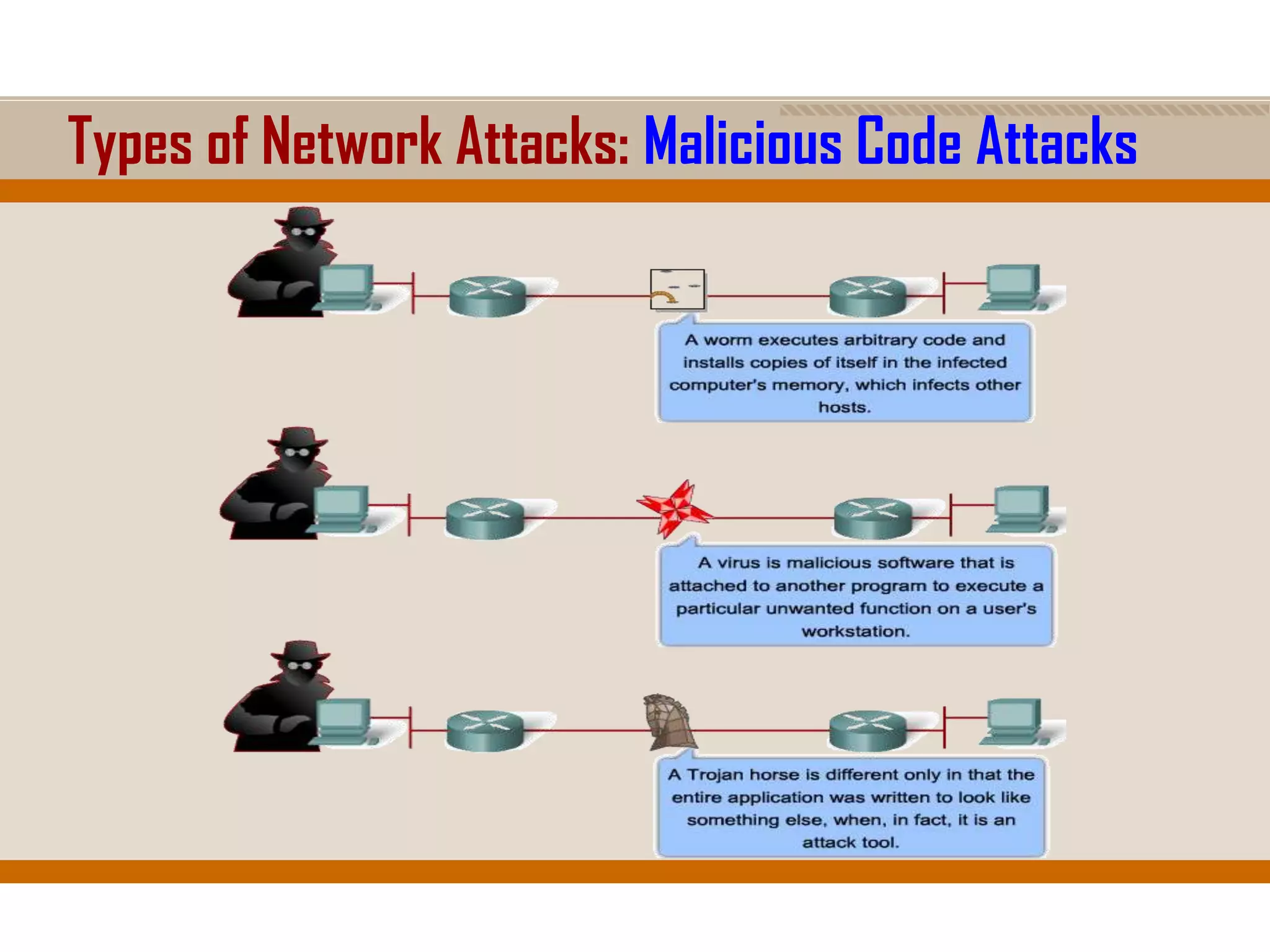
Types of Network Attacks: Malicious Code Attacks
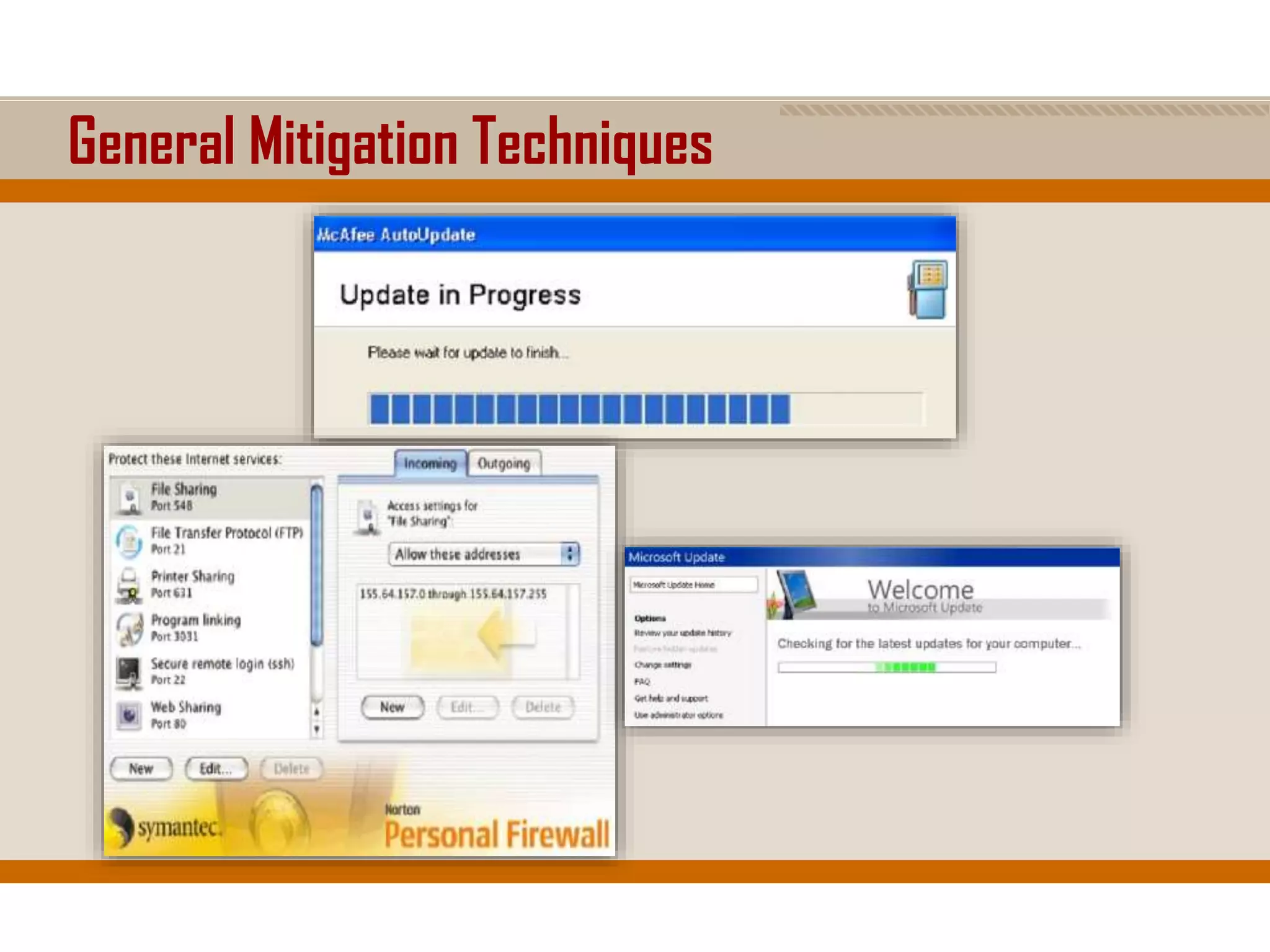
General Mitigation Techniques
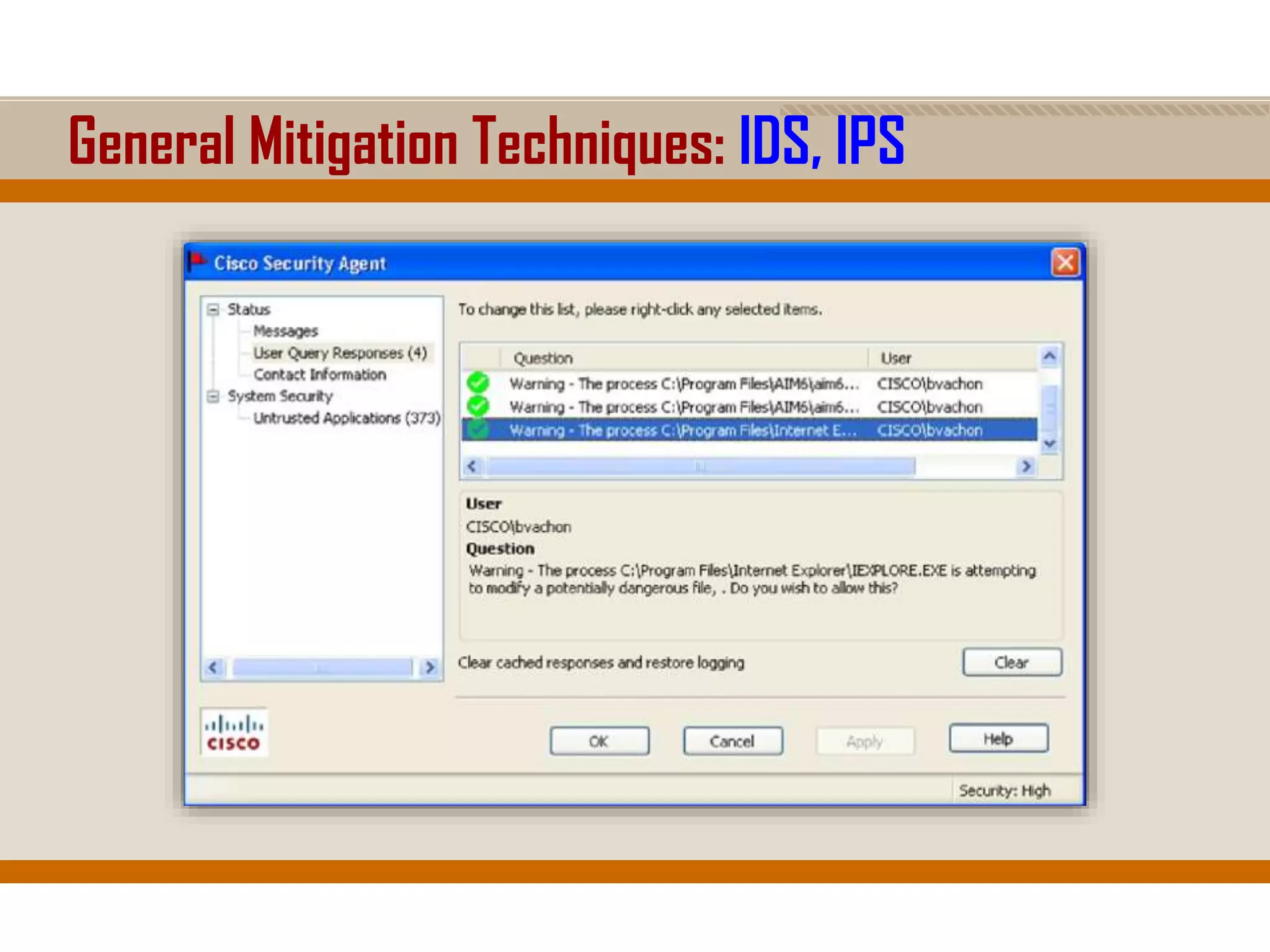
General Mitigation Techniques: IDS, IPS
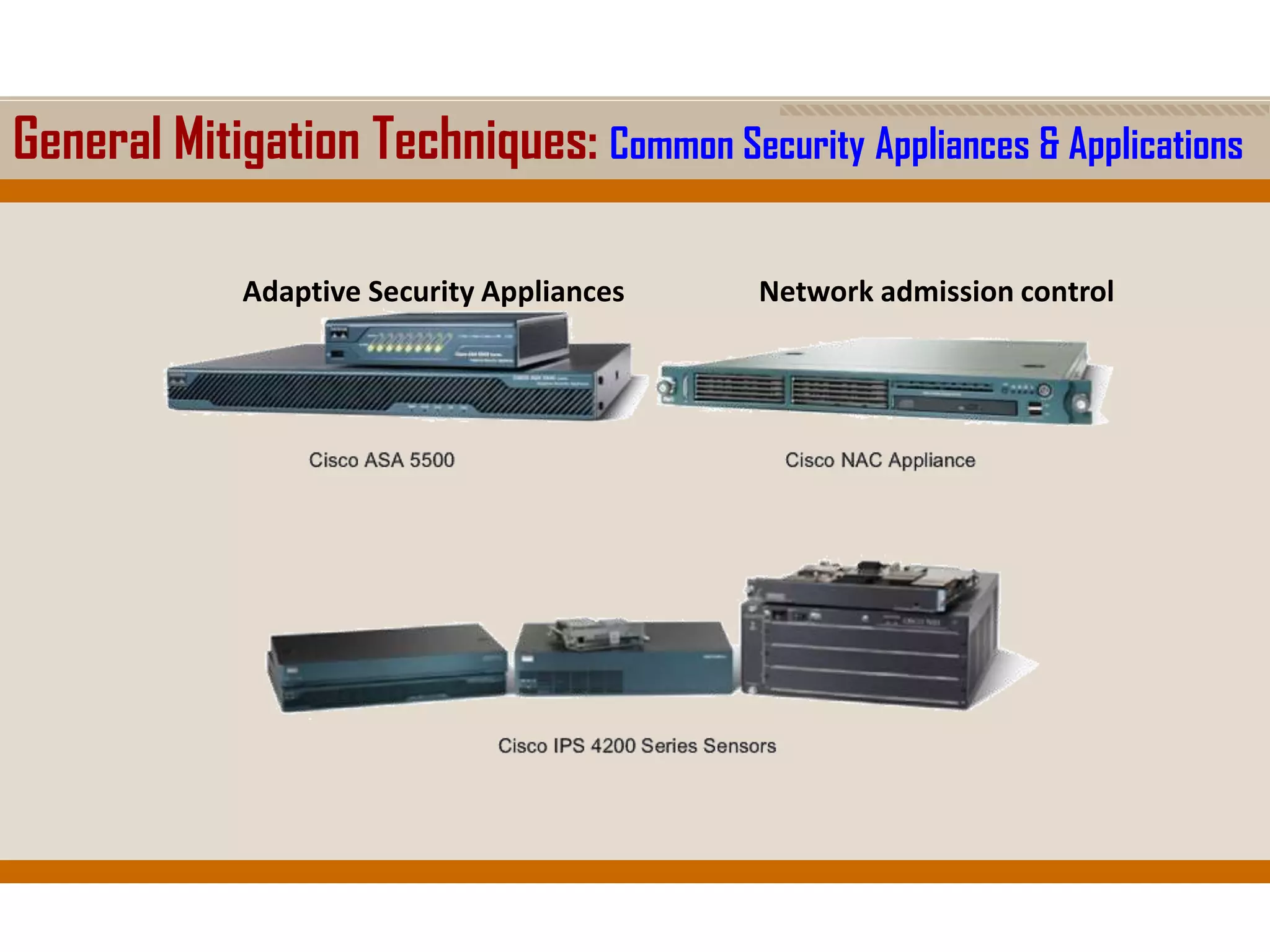
General Mitigation Techniques: Common Security Appliances & Applications
Network admission controlAdaptive Security Appliances
Accessing the WAN: Ch4 - Network Security

Accessing the WAN: Ch4 - Network Security

  • 1.
    Save a tree.Please, don't print these slides unless it's necessary. Accessing the WAN: Chapter 4 Abdelkhalik Elsaid Mosa All pictures are copied from Cisco CCNA Exploration: Semester 4 – Accessing the WAN
  • 2.
    If you foundany mistake’s’ on these slides or if you have any other questions or comments, please feel free to email me at: abdu.elsaid@gmail.com or abdu.elsaid@yahoo.com Thanks, Abdelkhalik Elsaid Mosa Suez Canal University – Faculty of Computers & Informatics Cisco Local Academy – Ismailia - Egypt
  • 3.
    Why is NetworkSecurity Important?
  • 4.
    The Increasing Threatto Security White hat Hacker Black hat Cracker PhreakerSpammer Phisher
  • 5.
    Think like anattacker • Step 1. Perform footprint analysis (reconnaissance). • Step 2. Enumerate information. • Step 3. Manipulate users to gain access. • Step 4. Escalate privileges. • Step 5. Gather additional passwords and secrets. • Step 6. Install backdoors. • Step 7. Leverage the compromised system.
  • 6.
  • 7.
  • 8.
  • 9.
  • 10.
    Developing a SecurityPolicy • Security Policy is a formal statement of the rules by which people who are given access to an organization's technology and information assets must abide. • A security policy meets these goals: 1. Informs users, staff, and managers of their obligatory requirements for protecting technology and information assets. 2. Specifies the mechanisms through which these requirements can be met. 3. Provides a baseline from which to acquire, configure, and audit computer systems and networks for compliance with the policy. • ISO/IEC 27002: a guideline for developing organizational security standards. Risk assessment - Security policy - Organization of information security - Asset management - Human resources security - Physical and environmental security - Communications and operations management - Access control - Information systems acquisition, development, and maintenance - Information security incident management - Business continuity management, Compliance
  • 11.
    Common Security Threats:Vulnerabilities • Threats are the people interested and qualified in taking advantage of each security weakness. • Vulnerability is the degree of weakness which is inherent in every network and device. This includes routers, switches, desktops, servers, and even security devices. 1. Technological weaknesses
  • 12.
    Common Security Threats:Vulnerabilities 2. Configuration weaknesses 3. Security policy weaknesses
  • 13.
    Common Security Threats:Threats to Physical Infrastructure • The four classes of physical threats are: 1. Hardware threats-Physical damage to servers, routers, switches, cabling plant, and workstations 2. Environmental threats-Temperature extremes (too hot or too cold) or humidity extremes (too wet or too dry) 3. Electrical threats-Voltage spikes, insufficient supply voltage (brownouts), unconditioned power (noise), and total power loss 4. Maintenance threats-Poor handling of key electrical components (electrostatic discharge), lack of critical spare parts, poor cabling, and poor labeling
  • 14.
    Common Security Threats:Threats to Physical Infrastructure
  • 15.
    Common Security Threats:Threats to Physical Infrastructure
  • 16.
    Common Security Threats:Threats to Physical Infrastructure
  • 17.
    Common Security Threats:Threats to Physical Infrastructure
  • 18.
    Common Security Threats:Threats to Networks
  • 19.
    Common Security Threats:Social Engineering
  • 20.
  • 21.
    Types of NetworkAttacks: Reconaissance
  • 22.
    Types of NetworkAttacks: Access Attacks
  • 23.
    Types of NetworkAttacks: Access Attacks
  • 24.
    Types of NetworkAttacks: Access Attacks
  • 25.
    Types of NetworkAttacks: Access Attacks
  • 26.
    Types of NetworkAttacks: DoS and DDoS
  • 27.
    Types of NetworkAttacks: DoS and DDoS
  • 28.
    Types of NetworkAttacks: DoS and DDoS
  • 29.
    Types of NetworkAttacks: DoS and DDoS
  • 30.
    Types of NetworkAttacks: DoS and DDoS
  • 31.
    Types of NetworkAttacks: Malicious Code Attacks
  • 32.
  • 33.
  • 34.
    General Mitigation Techniques:Common Security Appliances & Applications Network admission controlAdaptive Security Appliances