Centralisation versus
decentralisation and student
participation
Antoon Boon
Rector’s Office + Educational
Policy Unit
Rector’s Office

29/11/2005
Institutional background
• K.U. Leuven: process towards
decentralisation since 2001 :
- central level : responsible for general
policies;
- new decision making and coordination
level : groups of faculties;
- executive level : faculties/departments

Rector’s Office

29/11/2005

2
Legal background
• Decree (= Law) of 19 March 2004
concerning students’ rights, participation in
higher education and…
• Each institution has to choose between
one of the following models :
- co-decision;
- concertation.

Rector’s Office

29/11/2005

3
Legal background
• Co-decision model :
(representatively elected) students have
the right to be a member in each body
taking decisions concerning :
1° strategic policy of the institution :
a) enlargement, scaling down or closing of institution or important part thereof;
b) closing of cooperationships with other institutions; devolution of competencies to
other institutions or organisation of decentralised structures.
c) the programming of educational programmes ;
2° the general educational policy, in particular educational innovation and
improvement;
3° research policy ;
4° internationalisation policy ;
5° policy concerning allocation of budgets.

Rector’s Office

29/11/2005

4
Legal background
• Co-decision model :
(representatively elected) students have
the right to be a member in each body
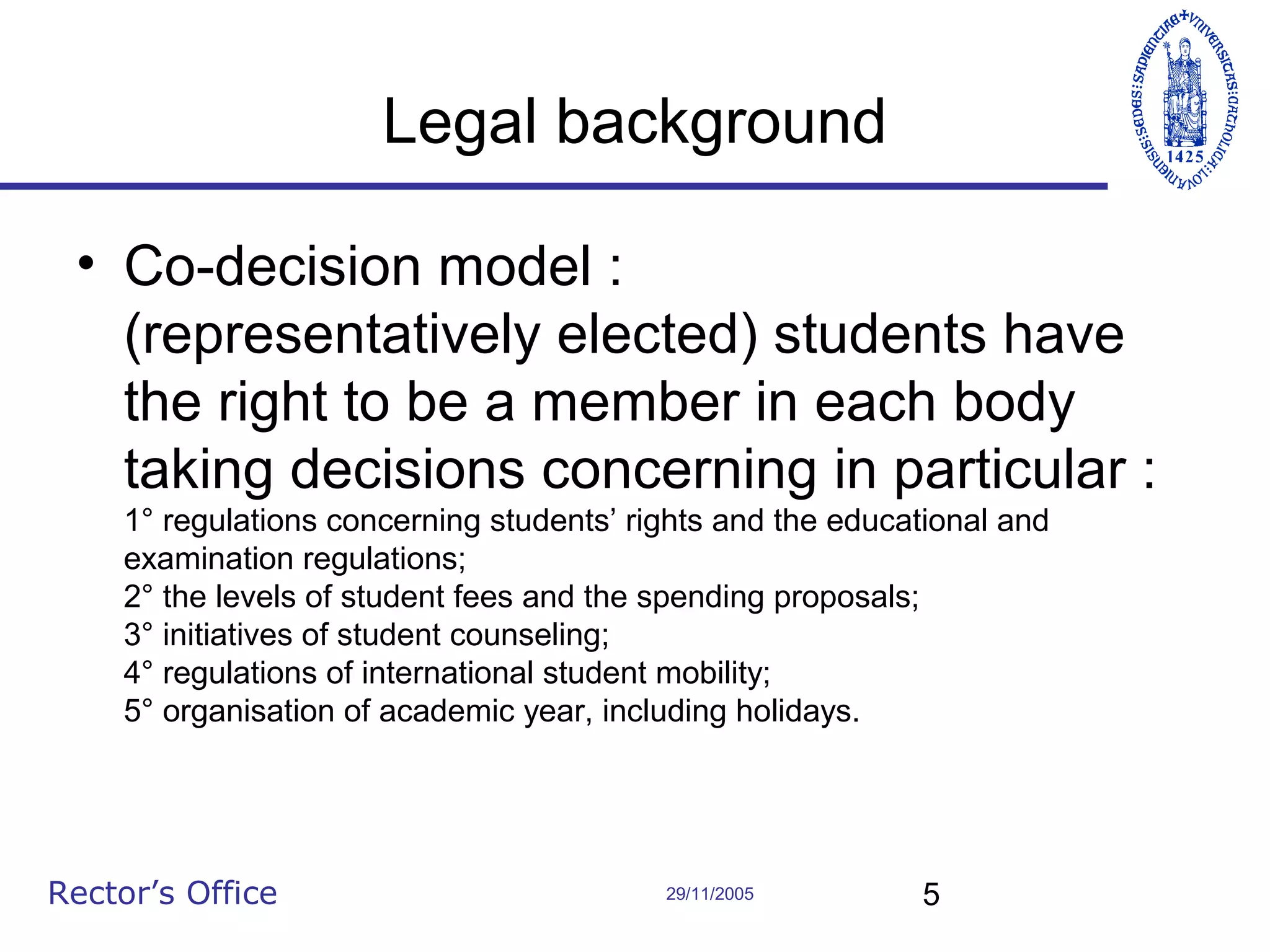
taking decisions concerning in particular :
1° regulations concerning students’ rights and the educational and
examination regulations;
2° the levels of student fees and the spending proposals;
3° initiatives of student counseling;
4° regulations of international student mobility;
5° organisation of academic year, including holidays.

Rector’s Office

29/11/2005

5
Legal background
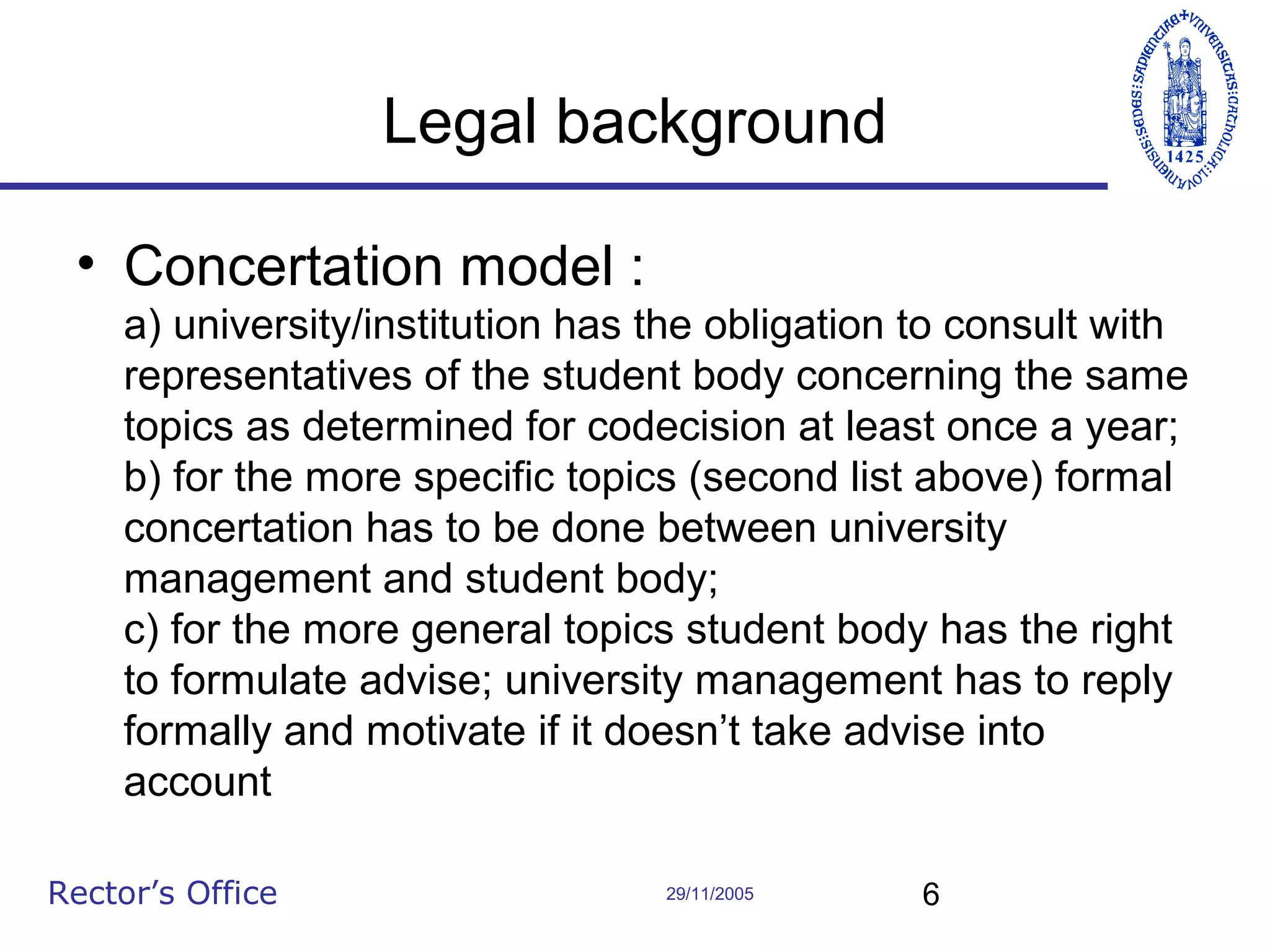
• Concertation model :
a) university/institution has the obligation to consult with
representatives of the student body concerning the same
topics as determined for codecision at least once a year;
b) for the more specific topics (second list above) formal
concertation has to be done between university
management and student body;
c) for the more general topics student body has the right
to formulate advise; university management has to reply
formally and motivate if it doesn’t take advise into
account
Rector’s Office

29/11/2005

6
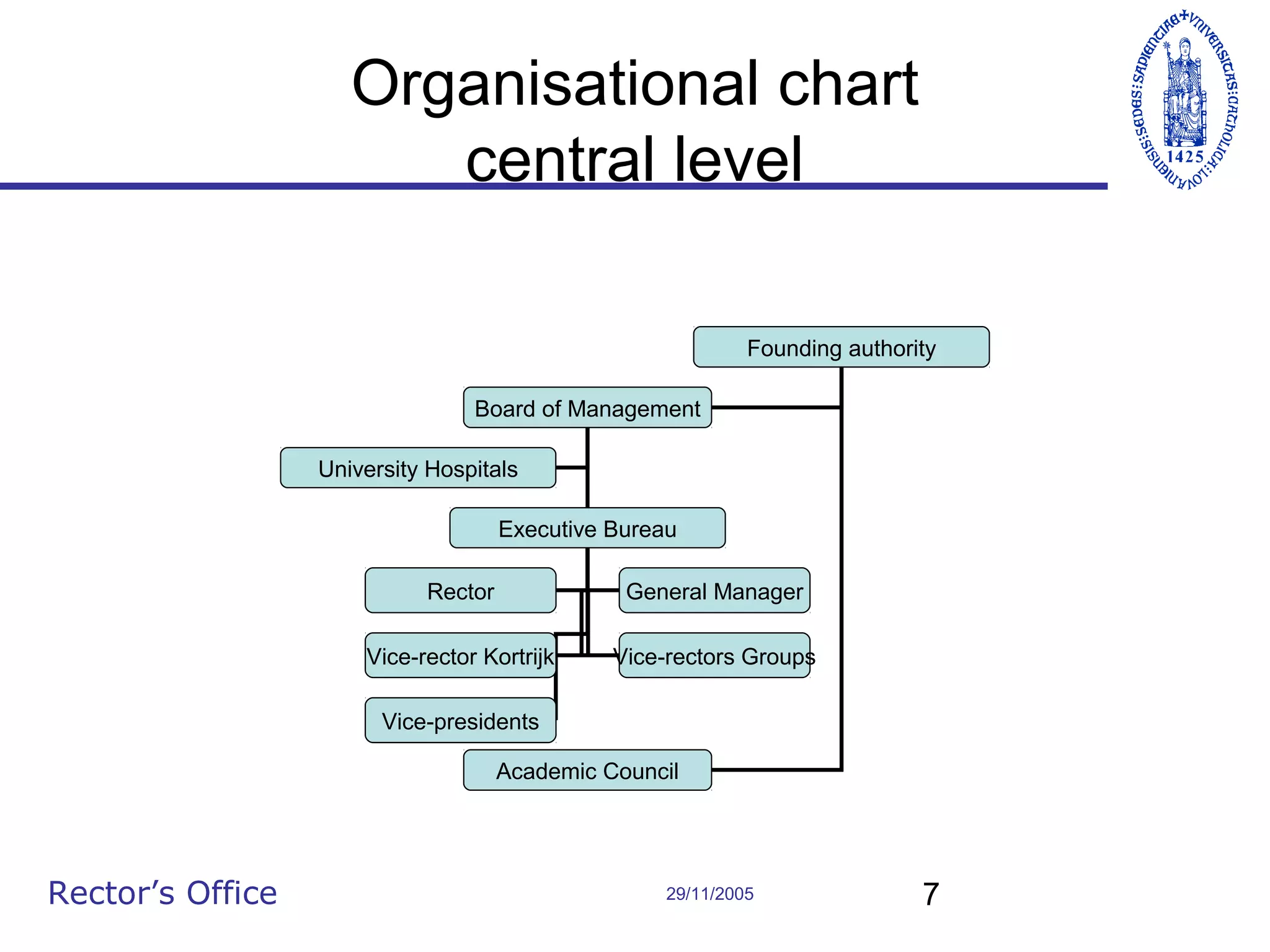
Organisational chart
central level
Founding authority
Board of Management
University Hospitals
Executive Bureau
Rector

General Manager

Vice-rector Kortrijk

Vice-rectors Groups

Vice-presidents
Academic Council

Rector’s Office

29/11/2005

7
Organisational chart
central level
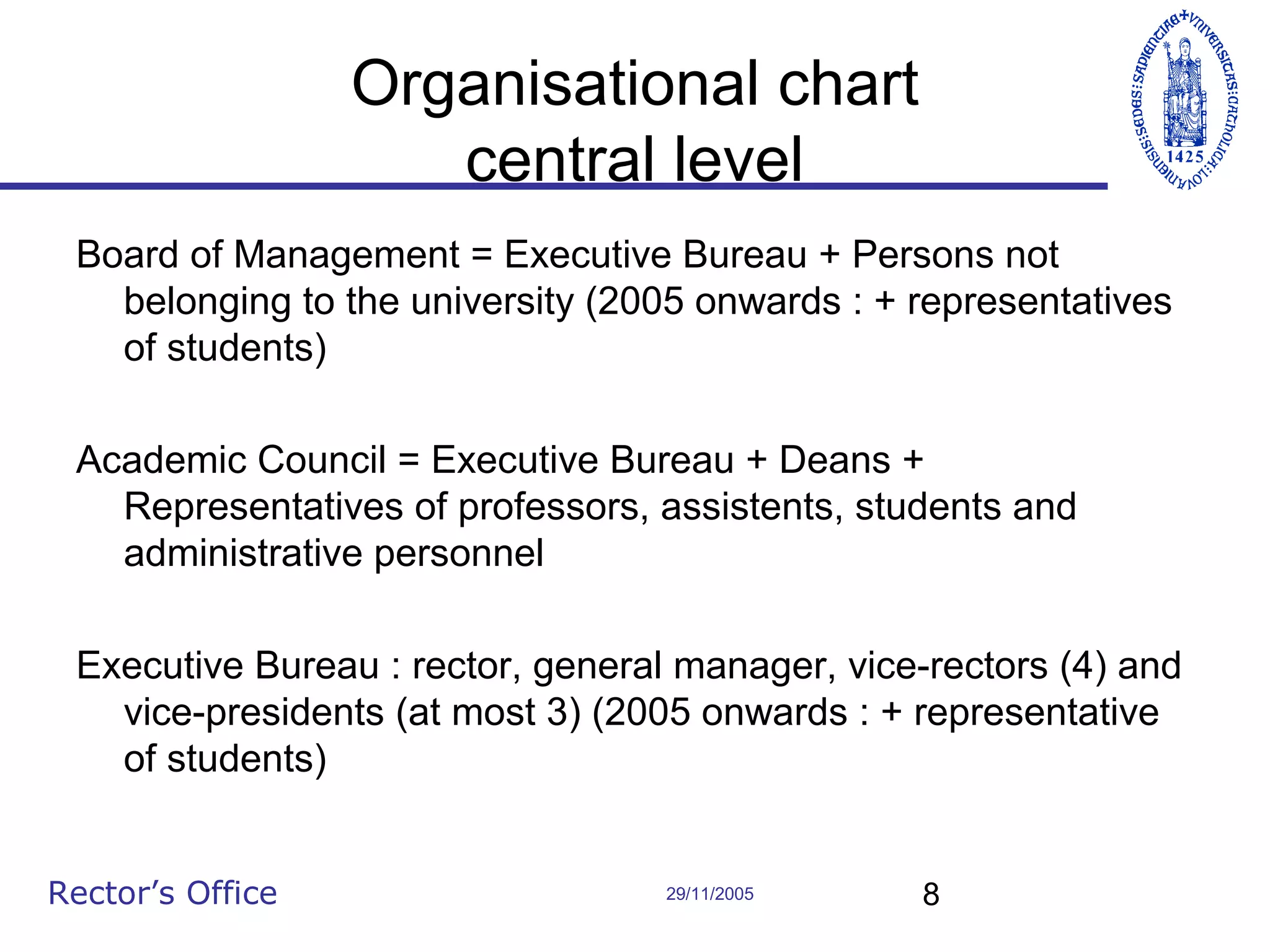
Board of Management = Executive Bureau + Persons not
belonging to the university (2005 onwards : + representatives
of students)
Academic Council = Executive Bureau + Deans +
Representatives of professors, assistents, students and
administrative personnel
Executive Bureau : rector, general manager, vice-rectors (4) and
vice-presidents (at most 3) (2005 onwards : + representative
of students)
Rector’s Office

29/11/2005

8
Organisational chart
relation central-decentral before 2005
Board of Management
- Academic Council
- Executive Bureau
Faculties
- Council (i.e. general parliament with all professors;
representatives of assistents, students)
- Bureau (dean, small selection of professors, possibility to
invite assistents or students for matters concerning them)
- Departments (with council and bureau) coordinating research
matters;
- Permanent educational committees (with programme director)
Rector’s Office

29/11/2005

9
Organisational chart
central-decentral since 2005
Board of Management
- Academic Council
- Executive Bureau
Groups
- Executive Committee (vice-rector, deans of faculties and
small selection of professors (elected or because of their
function); representatives of assistents and students
- Council (dean; representatives of professors (heads of
departments or elected), assistents and students) : controlling
function
- If need be : General assembly (dean, all professors,
representatives of assistents and students) : controlling
Rector’s Office

29/11/2005

10
Organisational chart
central-decentral since 2005
Group executive committee
- Council
- General assembly
Faculties (responsible for education; research in humanities) and
departments (responsible for research in exact and
biomedical sciences)
- Executive bureau
- Eventually council (with reduced power : controlling agency)
- Permanent educational committees (with programme director)

Rector’s Office

29/11/2005

11
Working principles : e.g. education
•

Academic Council :
- central policies (e.g. : bachelor-master reform; quality assurance
system; flexibilisation of curricula);
- final approval of concrete programme proposals by faculties (until
2005); final approval of programme proposals by groups (from 2005
onwards);
• Group executive committee :
- proposals for educational programmes (over faculties and groups)
(from 2005 onwards);
- approval of concrete proposals by faculties (from 2005 onwards);
• Faculties :
- proposals for educational programmes
- concrete implementation
Rector’s Office

29/11/2005

12
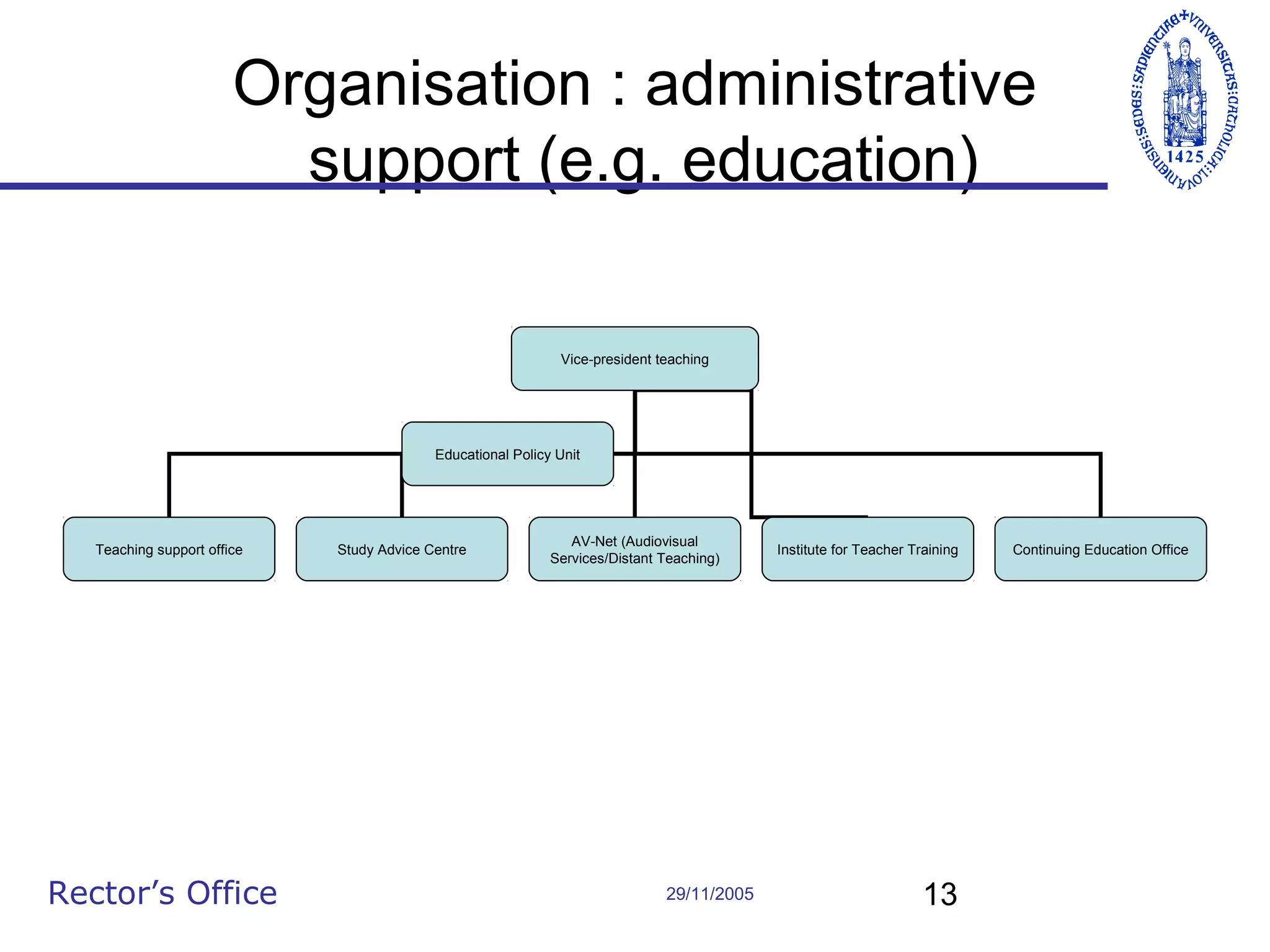
Organisation : administrative
support (e.g. education)
Vice-president teaching

Educational Policy Unit

Teaching support office

Rector’s Office

Study Advice Centre

AV-Net (Audiovisual
Services/Distant Teaching)

29/11/2005

Institute for Teacher Training

13

Continuing Education Office
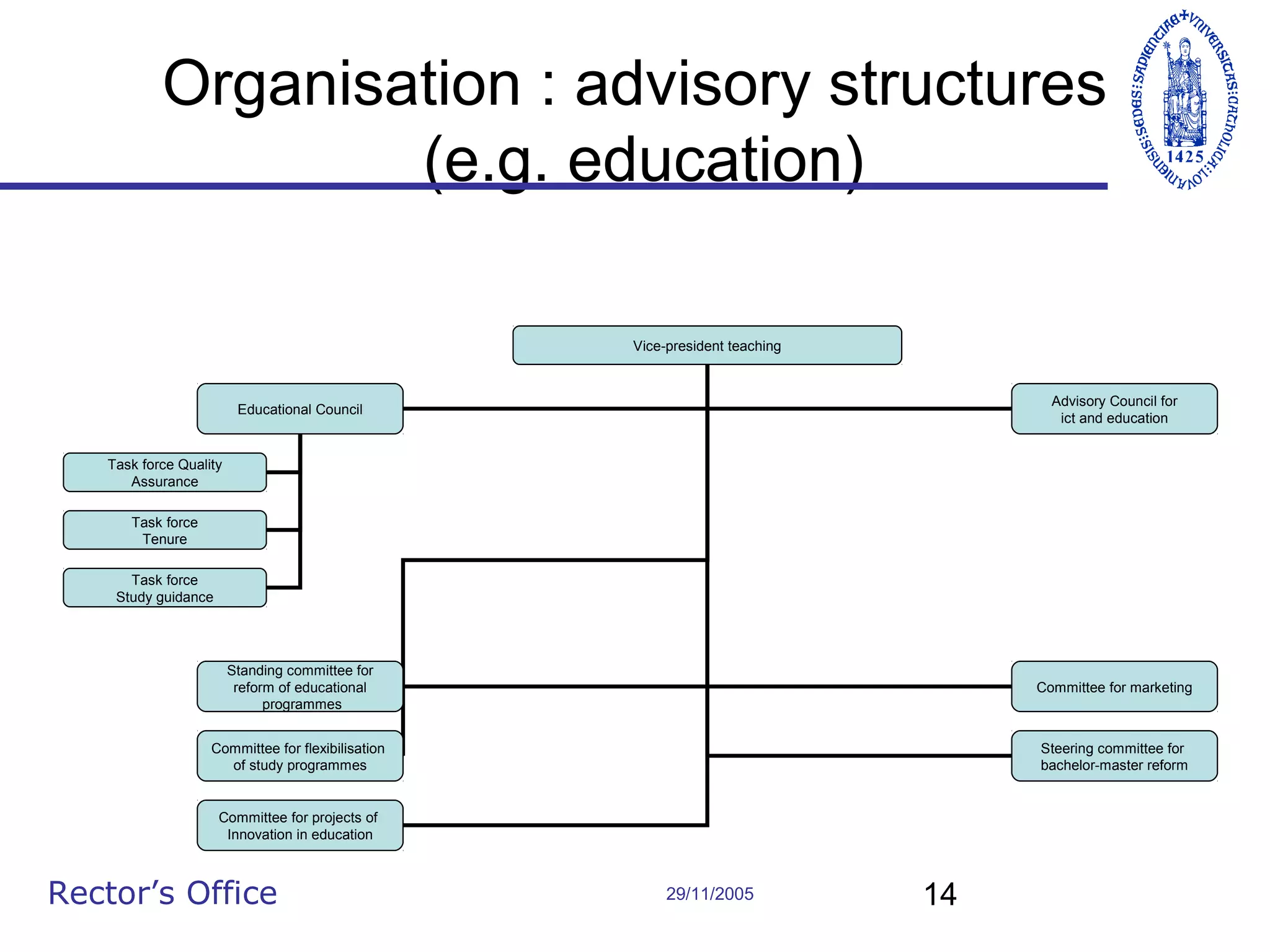
Organisation : advisory structures
(e.g. education)
Vice-president teaching

Educational Council

Advisory Council for
ict and education

Standing committee for
reform of educational
programmes

Committee for marketing

Committee for flexibilisation
of study programmes

Steering committee for
bachelor-master reform

Task force Quality
Assurance
Task force
Tenure
Task force
Study guidance

Committee for projects of
Innovation in education

Rector’s Office

29/11/2005

14
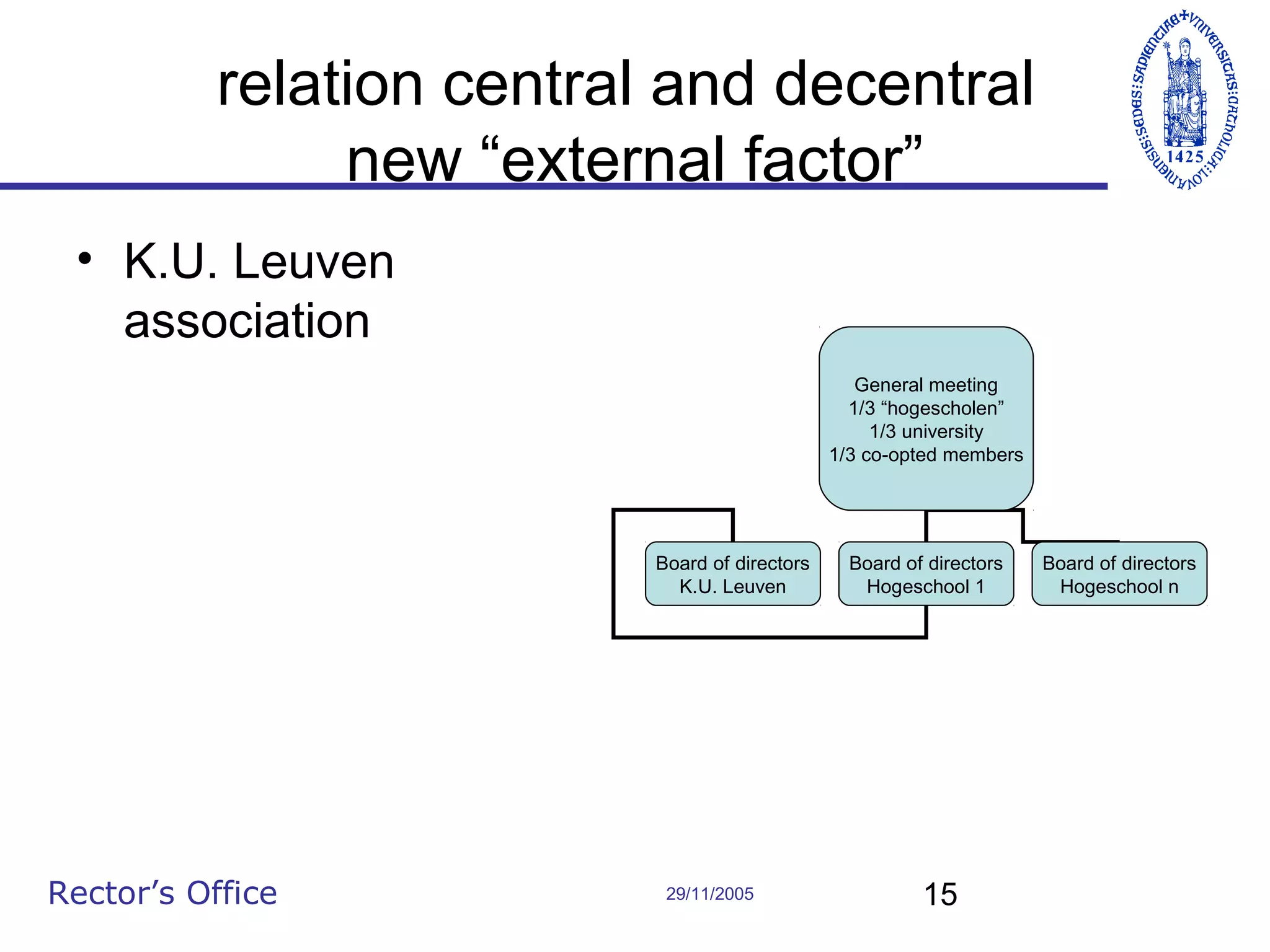
relation central and decentral
new “external factor”
• K.U. Leuven
association
General meeting
1/3 “hogescholen”
1/3 university
1/3 co-opted members

Board of directors
K.U. Leuven

Rector’s Office

29/11/2005

Board of directors
Hogeschool 1

15

Board of directors
Hogeschool n
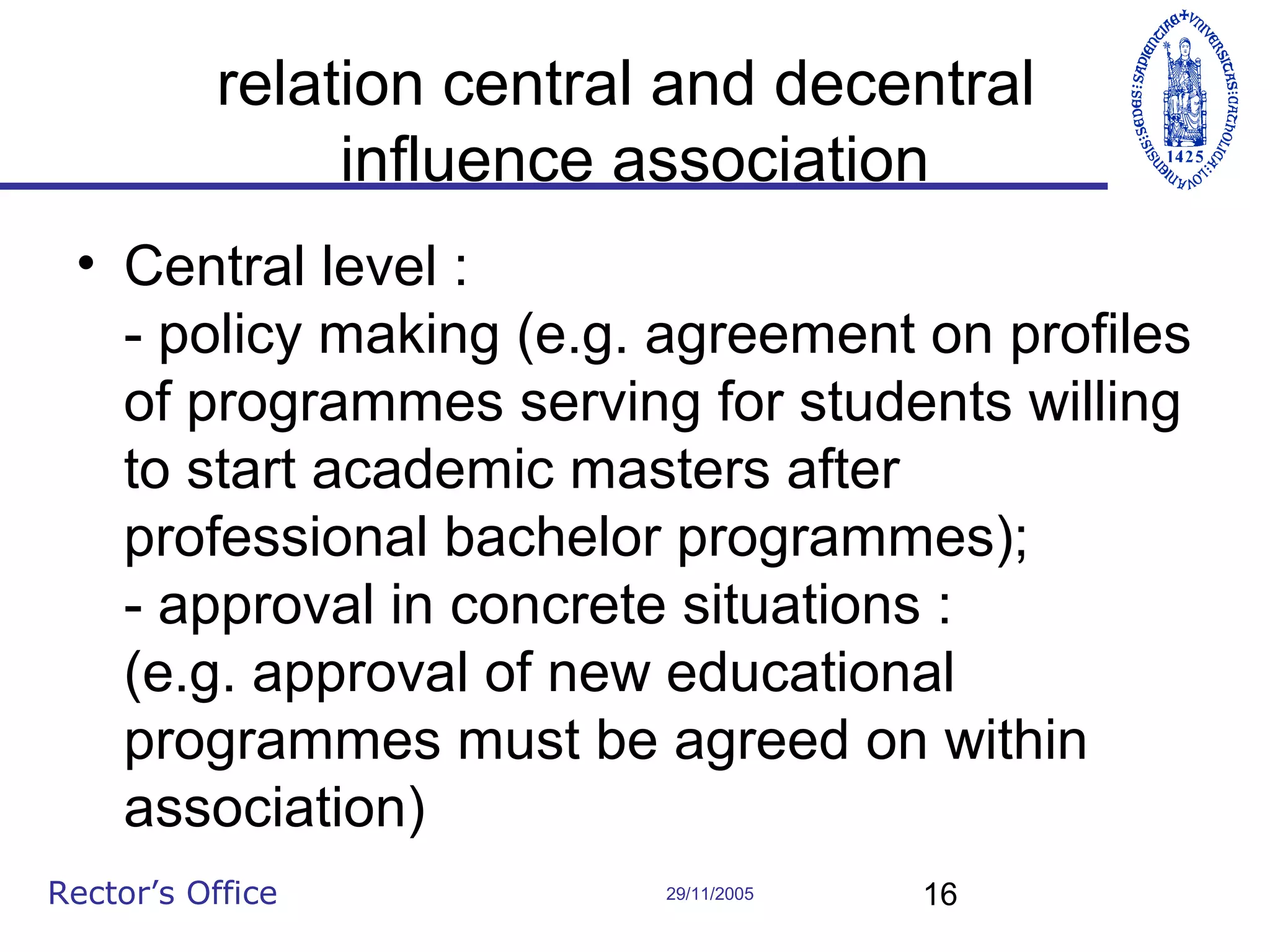
relation central and decentral
influence association
• Central level :
- policy making (e.g. agreement on profiles
of programmes serving for students willing
to start academic masters after
professional bachelor programmes);
- approval in concrete situations :
(e.g. approval of new educational
programmes must be agreed on within
association)
Rector’s Office

29/11/2005

16
relation central and decentral
influence association
• decentral level :
- policy making (e.g. development of new
programmes : influence of partners);
- approval in concrete situations :
(e.g. negotations on content and size of
step up programmes through working
committees)

Rector’s Office

29/11/2005

17
Organisational chart
conclusions
• One university
• One central policy
• Many realities

Rector’s Office

29/11/2005

18
Organisational chart
- student participation
• University and students have chosen for codecision model (less bureaucratic)
• Students are represented by elected
representatives at each level of the university
(board of management -> academic council ->
group structures -> faculty level)
• As co-managers students have agreed upon
discretion concerning personal matters

Rector’s Office

29/11/2005

19
Organisational chart
- student participation
• Two “exceptions” on co-decision practice :
- in agreement students can decide not to
participate on certain person-related decisions;
- for each decision body, other members
(students excluded) can decide to prepare
meeting separately

Rector’s Office

29/11/2005

20
Organisational chart
conclusions student participation
• Leuven was lagging behind in student
participation :
a) state organised universities : participation was
already obligatory;
b) “free” universities (although subsidised
equally) : freedom of organisation guaranteed by
constitution, but most had already implemented
participation at most levels
• From 2005 onwards students are full members
at all important decision levels
Rector’s Office

29/11/2005

21

Centralisation versus decentralisation and student participation

  • 1.
    Centralisation versus decentralisation andstudent participation Antoon Boon Rector’s Office + Educational Policy Unit Rector’s Office 29/11/2005
  • 2.
    Institutional background • K.U.Leuven: process towards decentralisation since 2001 : - central level : responsible for general policies; - new decision making and coordination level : groups of faculties; - executive level : faculties/departments Rector’s Office 29/11/2005 2
  • 3.
    Legal background • Decree(= Law) of 19 March 2004 concerning students’ rights, participation in higher education and… • Each institution has to choose between one of the following models : - co-decision; - concertation. Rector’s Office 29/11/2005 3
  • 4.
    Legal background • Co-decisionmodel : (representatively elected) students have the right to be a member in each body taking decisions concerning : 1° strategic policy of the institution : a) enlargement, scaling down or closing of institution or important part thereof; b) closing of cooperationships with other institutions; devolution of competencies to other institutions or organisation of decentralised structures. c) the programming of educational programmes ; 2° the general educational policy, in particular educational innovation and improvement; 3° research policy ; 4° internationalisation policy ; 5° policy concerning allocation of budgets. Rector’s Office 29/11/2005 4
  • 5.
    Legal background • Co-decisionmodel : (representatively elected) students have the right to be a member in each body taking decisions concerning in particular : 1° regulations concerning students’ rights and the educational and examination regulations; 2° the levels of student fees and the spending proposals; 3° initiatives of student counseling; 4° regulations of international student mobility; 5° organisation of academic year, including holidays. Rector’s Office 29/11/2005 5
  • 6.
    Legal background • Concertationmodel : a) university/institution has the obligation to consult with representatives of the student body concerning the same topics as determined for codecision at least once a year; b) for the more specific topics (second list above) formal concertation has to be done between university management and student body; c) for the more general topics student body has the right to formulate advise; university management has to reply formally and motivate if it doesn’t take advise into account Rector’s Office 29/11/2005 6
  • 7.
    Organisational chart central level Foundingauthority Board of Management University Hospitals Executive Bureau Rector General Manager Vice-rector Kortrijk Vice-rectors Groups Vice-presidents Academic Council Rector’s Office 29/11/2005 7
  • 8.
    Organisational chart central level Boardof Management = Executive Bureau + Persons not belonging to the university (2005 onwards : + representatives of students) Academic Council = Executive Bureau + Deans + Representatives of professors, assistents, students and administrative personnel Executive Bureau : rector, general manager, vice-rectors (4) and vice-presidents (at most 3) (2005 onwards : + representative of students) Rector’s Office 29/11/2005 8
  • 9.
    Organisational chart relation central-decentralbefore 2005 Board of Management - Academic Council - Executive Bureau Faculties - Council (i.e. general parliament with all professors; representatives of assistents, students) - Bureau (dean, small selection of professors, possibility to invite assistents or students for matters concerning them) - Departments (with council and bureau) coordinating research matters; - Permanent educational committees (with programme director) Rector’s Office 29/11/2005 9
  • 10.
    Organisational chart central-decentral since2005 Board of Management - Academic Council - Executive Bureau Groups - Executive Committee (vice-rector, deans of faculties and small selection of professors (elected or because of their function); representatives of assistents and students - Council (dean; representatives of professors (heads of departments or elected), assistents and students) : controlling function - If need be : General assembly (dean, all professors, representatives of assistents and students) : controlling Rector’s Office 29/11/2005 10
  • 11.
    Organisational chart central-decentral since2005 Group executive committee - Council - General assembly Faculties (responsible for education; research in humanities) and departments (responsible for research in exact and biomedical sciences) - Executive bureau - Eventually council (with reduced power : controlling agency) - Permanent educational committees (with programme director) Rector’s Office 29/11/2005 11
  • 12.
    Working principles :e.g. education • Academic Council : - central policies (e.g. : bachelor-master reform; quality assurance system; flexibilisation of curricula); - final approval of concrete programme proposals by faculties (until 2005); final approval of programme proposals by groups (from 2005 onwards); • Group executive committee : - proposals for educational programmes (over faculties and groups) (from 2005 onwards); - approval of concrete proposals by faculties (from 2005 onwards); • Faculties : - proposals for educational programmes - concrete implementation Rector’s Office 29/11/2005 12
  • 13.
    Organisation : administrative support(e.g. education) Vice-president teaching Educational Policy Unit Teaching support office Rector’s Office Study Advice Centre AV-Net (Audiovisual Services/Distant Teaching) 29/11/2005 Institute for Teacher Training 13 Continuing Education Office
  • 14.
    Organisation : advisorystructures (e.g. education) Vice-president teaching Educational Council Advisory Council for ict and education Standing committee for reform of educational programmes Committee for marketing Committee for flexibilisation of study programmes Steering committee for bachelor-master reform Task force Quality Assurance Task force Tenure Task force Study guidance Committee for projects of Innovation in education Rector’s Office 29/11/2005 14
  • 15.
    relation central anddecentral new “external factor” • K.U. Leuven association General meeting 1/3 “hogescholen” 1/3 university 1/3 co-opted members Board of directors K.U. Leuven Rector’s Office 29/11/2005 Board of directors Hogeschool 1 15 Board of directors Hogeschool n
  • 16.
    relation central anddecentral influence association • Central level : - policy making (e.g. agreement on profiles of programmes serving for students willing to start academic masters after professional bachelor programmes); - approval in concrete situations : (e.g. approval of new educational programmes must be agreed on within association) Rector’s Office 29/11/2005 16
  • 17.
    relation central anddecentral influence association • decentral level : - policy making (e.g. development of new programmes : influence of partners); - approval in concrete situations : (e.g. negotations on content and size of step up programmes through working committees) Rector’s Office 29/11/2005 17
  • 18.
    Organisational chart conclusions • Oneuniversity • One central policy • Many realities Rector’s Office 29/11/2005 18
  • 19.
    Organisational chart - studentparticipation • University and students have chosen for codecision model (less bureaucratic) • Students are represented by elected representatives at each level of the university (board of management -> academic council -> group structures -> faculty level) • As co-managers students have agreed upon discretion concerning personal matters Rector’s Office 29/11/2005 19
  • 20.
    Organisational chart - studentparticipation • Two “exceptions” on co-decision practice : - in agreement students can decide not to participate on certain person-related decisions; - for each decision body, other members (students excluded) can decide to prepare meeting separately Rector’s Office 29/11/2005 20
  • 21.
    Organisational chart conclusions studentparticipation • Leuven was lagging behind in student participation : a) state organised universities : participation was already obligatory; b) “free” universities (although subsidised equally) : freedom of organisation guaranteed by constitution, but most had already implemented participation at most levels • From 2005 onwards students are full members at all important decision levels Rector’s Office 29/11/2005 21

Editor's Notes