Presented by:
Dr. Aleena Bhari
Dr.Kawshik Ahmed
Intern doctors, Surgery department
Enam medical college and hospital
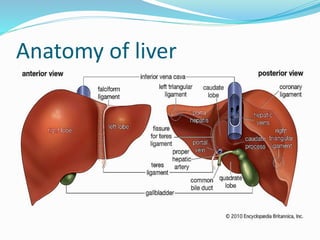
Anatomy of liver
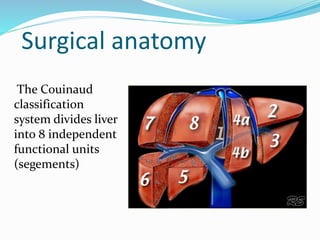
Surgical anatomy
The Couinaud
classification
system divides liver
into 8 independent
functional units
(segements)
Contd..
• The segments are numbered 1-8.
• The separation of segments is based on its own dual vascular
inflow,biliary drainage and lymphatic drainage.
• In general each segment is wedge shaped with apex directed
towards hepatic hilium(porta hepatis)
• Segment 1 is caudate lobe lies posterior around IVC
• Segment 1-5 makeup left hemiliver and remaining right .
• For liver to remain viable, resection occur along hepatic veins and
portal vein in the planes that define boundaries of these
segments.
INCIDENCE
 28/100000 in SEA
 10/100000 in SE
 5/100000 IN NE
 Incidence is increasing day by day due to -chronic
hepatitis B &C virus infection.
 -cirrhosis due to any cause.
 The disease is more common in male(4:1)usually in
middle age group(50years).
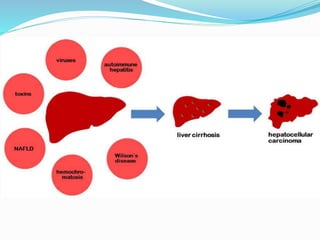
AETIOLOGICAL FACTORS
COMMON
 Viral infection-
HEPATITIS B&/C
 External source-
alcohol,aflatoxin.
 Cirrhosis from any cause.
 Non alcoholic
steatohepatitis(NASH)
 Wide spread infection
with liverflukes-
Clonorchis sinensis.
UNCOMMON
• Primary biliary cirrhosis
• Hemachromatosis
• alpha 1Antitrypsin
deficiency
• Wilson disease
Pathogenesis
 The exact pathogenesis is unknown.
 The disease seems to occur in stages:
Chronic liver injury > cell death >regeneration>
cellular metabolic dysfunction> release of
inflammatory mediators> increase risk of
transforming mutation of hepatocytes.
• Preneoplastic changes –hepatocytes dysplasia can
be seen.
Clinical presentation
Symptoms:
Asymptomatic in early stages,discovered only by
screening (ultrasound and AFP).
 Presents with abdominal mass which produces
discomfort &dragging sensation on exercise.
 Weakness,malaise,abdominal or chest
pain,vomiting,jaundice,haematemesis.
 Anorexia,weightloss –incase of metastasis.
Contd….
Sign:
 Jaundice
 Ascites
 Hepatomegaly
 Periumbilical collateral veins
 Variceal bleeding
 Easy bruising
 Hepatic encephalopathy
 Shock
Contd…
Local examination:
 Palpable mass in right upper abdomen which is
hard,irregular,tender/nontender.
 Hepatic bruit
SPREAD
Tend to spread by invasion into vasculature
mostly portal vein.
Highly metastasis to lymphnode.
Lung and bone metastasis in terminal cases.
Diagnosis:
Diagnosis of HCC is done by :
1. Clinical presentation
2.Investigation
3. Staging
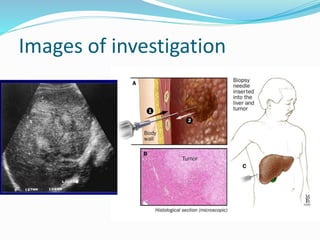
1.Investigation:
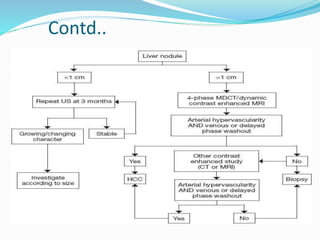
 Imaging:
- Ultrasonography
- CT Scan
- MRI
-Angiography
 Liver biposy :
-percutanous aspiration or core biopsy
Images of investigation
Contd..
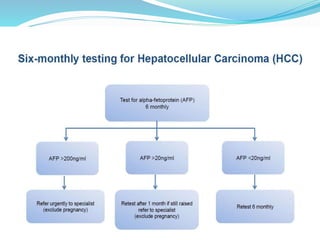
 Tumor markers:
-AFP measurement
-viral marker
 Liver radio isotope scans
 Liver function test:
-serum bilirubin
-AST
-ALT
-ALP
-Prothrombin time
-Serum albumin
Contd..
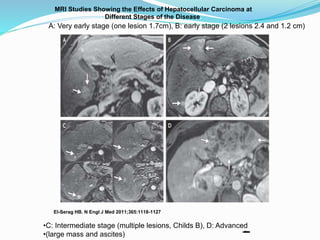
MRI Studies Showing the Effects of Hepatocellular Carcinoma at
Different Stages of the Disease.
El-Serag HB. N Engl J Med 2011;365:1118-1127
A: Very early stage (one lesion 1.7cm), B: early stage (2 lesions 2.4 and 1.2 cm)
•C: Intermediate stage (multiple lesions, Childs B), D: Advanced
•(large mass and ascites)
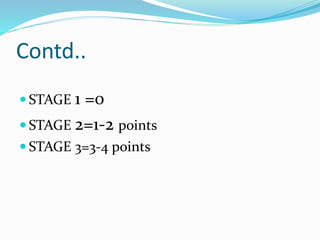
2.Staging: OKUDA staging system
Clinical parameters cut off value points
Tumor size >50%
<50%
1
0
Ascites Present
absent
1
0
Serum albumin(mg/dl) >3
<3
0
1
Serum total
bilirubin(mg/dl)
<3
>3
0
1
Contd..
 STAGE 1 =0
 STAGE 2=1-2 points
 STAGE 3=3-4 points
TNM STAGING
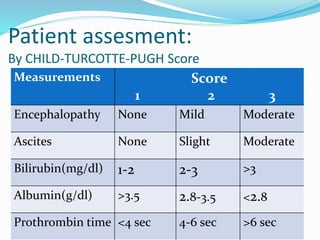
Patient assesment:
By CHILD-TURCOTTE-PUGH Score
Measurements Score
1 2 3
Encephalopathy None Mild Moderate
Ascites None Slight Moderate
Bilirubin(mg/dl) 1-2 2-3 >3
Albumin(g/dl) >3.5 2.8-3.5 <2.8
Prothrombin time <4 sec 4-6 sec >6 sec
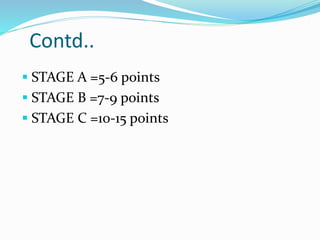
Contd..
 STAGE A =5-6 points
 STAGE B =7-9 points
 STAGE C =10-15 points
Interpretation:
Points Class 1 year survival 10 year survival
5-6 A 100% 85%
7-9 B 81% 57%
10-15 C 45% 35%
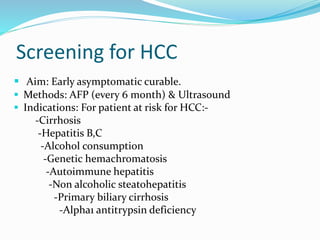
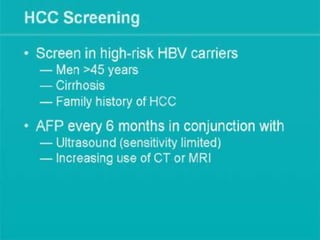
Screening for HCC
 Aim: Early asymptomatic curable.
 Methods: AFP (every 6 month) & Ultrasound
 Indications: For patient at risk for HCC:-
-Cirrhosis
-Hepatitis B,C
-Alcohol consumption
-Genetic hemachromatosis
-Autoimmune hepatitis
-Non alcoholic steatohepatitis
-Primary biliary cirrhosis
-Alpha1 antitrypsin deficiency
Treatment
A. Surgical approach
B. Non surgical therapy
A. Surgical approach
a. Segmental or local resection
b. Lobectomy or partial hepatectomy
c. Extended lobectomy
d. Liver transplantation
Contd..
First 3 for: Liver transplantation
for:
Single tumor within
single segment
Child Turcotte Stage A
Tumor size <5 cm
Multiple tumor size of
each <3cm
Single tumor size<5cm
Multiple tumor sizeof
each<3cm
No vascular invasion
No extrahepatic spread
Images of surgical treatment
B.Nonsurgical therapy
Majority of HCC not be amenable to surgical
resection because of :-
=Advanced stage of the carcinoma &
=Severity of the underlying liver disease
Contd..
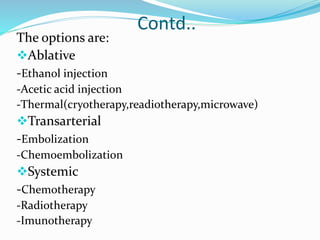
The options are:
Ablative
-Ethanol injection
-Acetic acid injection
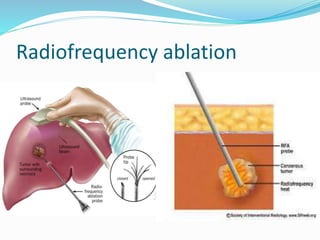
-Thermal(cryotherapy,readiotherapy,microwave)
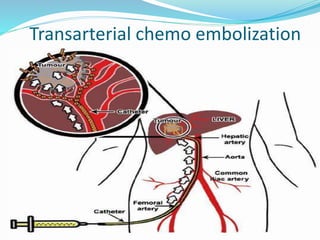
Transarterial
-Embolization
-Chemoembolization
Systemic
-Chemotherapy
-Radiotherapy
-Imunotherapy
Radiofrequency ablation
Transarterial chemo embolization
Prognosis after treatment:
o5 year survival rate:- 30-40% after liver
resection
o5year survival rate:- 75% in liver
transplantation
o2 year survival rate :- 60% in transarterial
chemoembolization
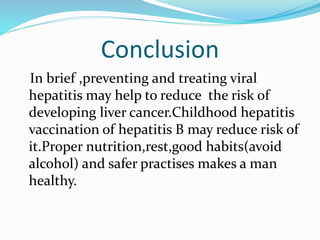
Conclusion
In brief ,preventing and treating viral
hepatitis may help to reduce the risk of
developing liver cancer.Childhood hepatitis
vaccination of hepatitis B may reduce risk of
it.Proper nutrition,rest,good habits(avoid
alcohol) and safer practises makes a man
healthy.
Hepatocellular carcinoma

Hepatocellular carcinoma

  • 1.
    Presented by: Dr. AleenaBhari Dr.Kawshik Ahmed Intern doctors, Surgery department Enam medical college and hospital
  • 2.
  • 3.
    Surgical anatomy The Couinaud classification systemdivides liver into 8 independent functional units (segements)
  • 4.
    Contd.. • The segmentsare numbered 1-8. • The separation of segments is based on its own dual vascular inflow,biliary drainage and lymphatic drainage. • In general each segment is wedge shaped with apex directed towards hepatic hilium(porta hepatis) • Segment 1 is caudate lobe lies posterior around IVC • Segment 1-5 makeup left hemiliver and remaining right . • For liver to remain viable, resection occur along hepatic veins and portal vein in the planes that define boundaries of these segments.
  • 8.
    INCIDENCE  28/100000 inSEA  10/100000 in SE  5/100000 IN NE  Incidence is increasing day by day due to -chronic hepatitis B &C virus infection.  -cirrhosis due to any cause.  The disease is more common in male(4:1)usually in middle age group(50years).
  • 9.
    AETIOLOGICAL FACTORS COMMON  Viralinfection- HEPATITIS B&/C  External source- alcohol,aflatoxin.  Cirrhosis from any cause.  Non alcoholic steatohepatitis(NASH)  Wide spread infection with liverflukes- Clonorchis sinensis. UNCOMMON • Primary biliary cirrhosis • Hemachromatosis • alpha 1Antitrypsin deficiency • Wilson disease
  • 11.
    Pathogenesis  The exactpathogenesis is unknown.  The disease seems to occur in stages: Chronic liver injury > cell death >regeneration> cellular metabolic dysfunction> release of inflammatory mediators> increase risk of transforming mutation of hepatocytes. • Preneoplastic changes –hepatocytes dysplasia can be seen.
  • 12.
    Clinical presentation Symptoms: Asymptomatic inearly stages,discovered only by screening (ultrasound and AFP).  Presents with abdominal mass which produces discomfort &dragging sensation on exercise.  Weakness,malaise,abdominal or chest pain,vomiting,jaundice,haematemesis.  Anorexia,weightloss –incase of metastasis.
  • 13.
    Contd…. Sign:  Jaundice  Ascites Hepatomegaly  Periumbilical collateral veins  Variceal bleeding  Easy bruising  Hepatic encephalopathy  Shock
  • 14.
    Contd… Local examination:  Palpablemass in right upper abdomen which is hard,irregular,tender/nontender.  Hepatic bruit
  • 15.
    SPREAD Tend to spreadby invasion into vasculature mostly portal vein. Highly metastasis to lymphnode. Lung and bone metastasis in terminal cases.
  • 16.
    Diagnosis: Diagnosis of HCCis done by : 1. Clinical presentation 2.Investigation 3. Staging
  • 17.
    1.Investigation:  Imaging: - Ultrasonography -CT Scan - MRI -Angiography  Liver biposy : -percutanous aspiration or core biopsy
  • 18.
  • 19.
    Contd..  Tumor markers: -AFPmeasurement -viral marker  Liver radio isotope scans  Liver function test: -serum bilirubin -AST -ALT -ALP -Prothrombin time -Serum albumin
  • 20.
  • 21.
    MRI Studies Showingthe Effects of Hepatocellular Carcinoma at Different Stages of the Disease. El-Serag HB. N Engl J Med 2011;365:1118-1127 A: Very early stage (one lesion 1.7cm), B: early stage (2 lesions 2.4 and 1.2 cm) •C: Intermediate stage (multiple lesions, Childs B), D: Advanced •(large mass and ascites)
  • 22.
    2.Staging: OKUDA stagingsystem Clinical parameters cut off value points Tumor size >50% <50% 1 0 Ascites Present absent 1 0 Serum albumin(mg/dl) >3 <3 0 1 Serum total bilirubin(mg/dl) <3 >3 0 1
  • 23.
    Contd..  STAGE 1=0  STAGE 2=1-2 points  STAGE 3=3-4 points
  • 24.
  • 25.
    Patient assesment: By CHILD-TURCOTTE-PUGHScore Measurements Score 1 2 3 Encephalopathy None Mild Moderate Ascites None Slight Moderate Bilirubin(mg/dl) 1-2 2-3 >3 Albumin(g/dl) >3.5 2.8-3.5 <2.8 Prothrombin time <4 sec 4-6 sec >6 sec
  • 26.
    Contd..  STAGE A=5-6 points  STAGE B =7-9 points  STAGE C =10-15 points
  • 27.
    Interpretation: Points Class 1year survival 10 year survival 5-6 A 100% 85% 7-9 B 81% 57% 10-15 C 45% 35%
  • 28.
    Screening for HCC Aim: Early asymptomatic curable.  Methods: AFP (every 6 month) & Ultrasound  Indications: For patient at risk for HCC:- -Cirrhosis -Hepatitis B,C -Alcohol consumption -Genetic hemachromatosis -Autoimmune hepatitis -Non alcoholic steatohepatitis -Primary biliary cirrhosis -Alpha1 antitrypsin deficiency
  • 31.
  • 32.
    A. Surgical approach a.Segmental or local resection b. Lobectomy or partial hepatectomy c. Extended lobectomy d. Liver transplantation
  • 33.
    Contd.. First 3 for:Liver transplantation for: Single tumor within single segment Child Turcotte Stage A Tumor size <5 cm Multiple tumor size of each <3cm Single tumor size<5cm Multiple tumor sizeof each<3cm No vascular invasion No extrahepatic spread
  • 34.
  • 35.
    B.Nonsurgical therapy Majority ofHCC not be amenable to surgical resection because of :- =Advanced stage of the carcinoma & =Severity of the underlying liver disease
  • 36.
    Contd.. The options are: Ablative -Ethanolinjection -Acetic acid injection -Thermal(cryotherapy,readiotherapy,microwave) Transarterial -Embolization -Chemoembolization Systemic -Chemotherapy -Radiotherapy -Imunotherapy
  • 37.
  • 38.
  • 39.
    Prognosis after treatment: o5year survival rate:- 30-40% after liver resection o5year survival rate:- 75% in liver transplantation o2 year survival rate :- 60% in transarterial chemoembolization
  • 42.
    Conclusion In brief ,preventingand treating viral hepatitis may help to reduce the risk of developing liver cancer.Childhood hepatitis vaccination of hepatitis B may reduce risk of it.Proper nutrition,rest,good habits(avoid alcohol) and safer practises makes a man healthy.

Editor's Notes

  • #22 Figure 4 MRI Studies Showing the Effects of Hepatocellular Carcinoma at Different Stages of the Disease. All MRI studies were performed with the use of intravenous contrast material and show areas of enhancement typically found in patients with hepatocellular carcinoma. Panel A shows a single mass measuring 1.7 cm in diameter (arrows), indicating very-early-stage hepatocellular carcinoma (defined as a single lesion measuring less than 2 cm in diameter). Panel B shows two lesions, measuring 2.4 and 1.2 cm in diameter (arrows), indicating early-stage hepatocellular carcinoma (defined as fewer than three nodules, each measuring less than 3 cm in diameter). Panel C shows multiple hepatocellular-carcinoma nodules (arrows) in a patient with Child–Pugh class B cirrhosis, indicating intermediate-stage disease. Panel D shows a large mass (more than 10 cm in diameter) and ascites (arrows), indicating advanced-stage hepatocellular carcinoma.