Approach To Acute Abdomen
Objectives :
 Define acute abdomen.
 Describe a general approach to acute abdomen.
 Discuss common causes of acute abdomen through case
scenarios.
Sources : Slides, Rasla ’s Notebook, Principles & Practice of Surgery by: O. James
Garden
Color Index: Slides & Rasla ’s | Textbook | Do tor’s Notes | Extra Explanation |
Important
2
3
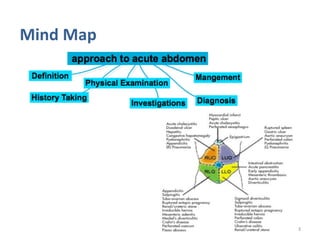
Mind Map
4
Acute Abdomen
 Definition:
Acute abdomen denotes any sudden onset, spontaneous non-traumatic disorder in the abdominal area that
requires urgent surgery in some cases (most of them).
 General Approach to Acute Abdomen:
• The standardized approach for all acute abdominal disorders is the (SOAP) approach:
 Subjective– History Taking
 Objective - Physical Examination
 Assessment – Investigations
 Plan – Treatment (based on the final diagnosis)
• The approach is not that different from an elective case, except in patients who are hemodynamically
unstable and will go into shock, resuscitation should be initiated first.
• Analgesia or painkillers are not preferable to be given until a diagnosis is made.
 History Taking:
Age:
Newborn child presents with acute abdominal pain; most likely, it is a digestive disease (bowel atresia - congenital
anomaly i hi h there is i o plete de elop e t of the i testi al tra t, t pi all ith losures a d dead
e ds that lo k flo through the i testi es. or e o iu ileus ( O stru tio of the i testi e -ileus- due to
overly thick meconium).
Children present with an acute abdominal pain, suspect mesenteric adenitis (inflammation of a gland or lymph node)
12year-old who present with an acute abdominal pain, suspect appendicitis.
Elderly patient with acute abdominal pain, obstruction due to cancer or acute diverticulitis is highly suspected.
5
Taking History Of Acute Abdomen
PAIN: (SOCRATES)
SITE: • Right upper quadrant  think about gall bladder(Cholecystitis ) or liver(hepatitis, Liver abscess) .
• Right lower quadrant most likely it is appendicitis.
• Left lower quadrant  think about diverticulitis.
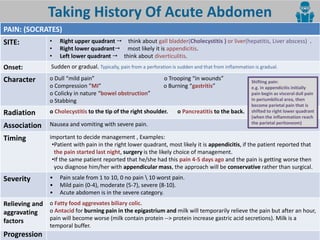
Onset: Sudden or gradual. Typically, pain from a perforation is sudden and that from inflammation is gradual.
Character o Dull ild pai o Troopi g i ou ds
o Co pressio MI o Bur i g gastritis
o Coli k i ature bowel obstruction
o Stabbing
Radiation o Cholecystitis to the tip of the right shoulder. o Pancreatitis to the back.
Association Nausea and vomiting with severe pain.
Timing important to decide management , Examples:
•Patient with pain in the right lower quadrant, most likely it is appendicitis, if the patient reported that
the pain started last night, surgery is the likely choice of management.
•If the same patient reported that he/she had this pain 4-5 days ago and the pain is getting worse then
you diagnose him/her with appendicular mass, the approach will be conservative rather than surgical.
Severity • Pain scale from 1 to 10, 0 no pain  10 worst pain.
• Mild pain (0-4), moderate (5-7), severe (8-10).
• Acute abdomen is in the severe category.
Relieving and
aggravating
factors
o Fatty food aggrevates biliary colic.
o Antacid for burning pain in the epigastrium and milk will temporarily relieve the pain but after an hour,
pain will become worse (milk contain protein --> protein increase gastric acid secretions). Milk is a
temporal buffer.
Progression
Shifting pain:
e.g. in appendicitis initially
pain begin as visceral dull pain
in periumbilical area, then
become parietal pain that is
shifted to right lower quadrant
(when the inflammation reach
the parietal peritoneom)
6
Taking History Of Acute Abdomen
VOMITING :
 Hematemesis
 Volume : small or large amount
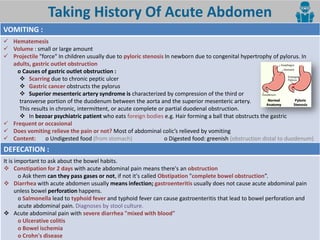
 Projectile "force" In children usually due to pyloric stenosis In newborn due to congenital hypertrophy of pylorus. In
adults, gastric outlet obstruction
o Causes of gastric outlet obstruction :
 Scarring due to chronic peptic ulcer
 Gastric cancer obstructs the pylorus
 Superior mesenteric artery syndrome is characterized by compression of the third or
transverse portion of the duodenum between the aorta and the superior mesenteric artery.
This results in chronic, intermittent, or acute complete or partial duodenal obstruction.
 In bezoar psychiatric patient who eats foreign bodies e.g. Hair forming a ball that obstructs the gastric
 Frequent or occasional
 Does vomiting relieve the pain or not? Most of a do i al oli ’s relie ed o iti g
 Content: o Undigested food (from stomach) o Digested food: greenish (obstruction distal to duodenum)
DEFECATION :
It is important to ask about the bowel habits.
 Constipation for 2 days with acute abdominal pain means there's an obstruction
o Ask them can they pass gases or not, if not it's called Obstipation "complete bowel obstruction .
 Diarrhea with acute abdomen usually means infection; gastroenteritis usually does not cause acute abdominal pain
unless bowel perforation happens.
o Salmonella lead to typhoid fever and typhoid fever can cause gastroenteritis that lead to bowel perforation and
acute abdominal pain. Diagnoses by stool culture.
 Acute abdominal pain with severe diarrhea "mixed with blood"
o Ulcerative colitis
o Bowel ischemia
o Crohn's disease
7
Taking History Of Acute Abdomen
FEVER:
Rigors with acute abdominal pain means Sepsis due to cholangitis
Rigor : e aggerated shi eri g hi h a o ur ith a high fe er
PAST HISTORY:
 Past abdominal surgery adhesion, bowel obstruction, bowel strangulation or ischemia
 Bowel obstruction due to hernia
 Peptic ulcer perforation*
 Similar episodes of Ulcerative Colitis or Crohn's disease but in less degree
 Gall stones Obstruction
o Acute cholecystitis (is a sudden inflammation of the gallbladder that causes severe
abdominal pain)
o Pancreatitis.
o Ascending cholangitis.
*Peptic ulcer perforation
is a hole in the wall often leads to catastrophic consequences. Erosion of the gastro-intestinal wall by the
ulcer leads to spillage of stomach or intestinal content into the abdominal cavity. Perforation at the anterior
surface of the stomach leads to acute peritonitis, initially chemical and later bacterial peritonitis. The first
sign is often sudden intense abdominal pain
YOU HAVE TO COMPLETE YOUR HISTORY by asking about medication , allergy, family history ..etc.
8
Physical Examination Of Acute Abdomen
 Physical Examination:
 General look:
Lying on bed and they look ill and in pain, uncomfortable moving, because they want to obtain a position
that relieves them from peritoneal irritation, sometimes they roll in bed in renal colic or sometimes in
Acute cholecystitis when gallbladder get contracted with stones :
• Anything related to stone make patient roll in bed
• Peritonitis pain usually patient are lying steady in bed with shallow breathing (because movement increase the pain)
 Vital signs:
Important to see the hemodynamic state of the patient wither if the patient is tachycardic, tachypenic or hypotensive.
If vital signs disturped (Hypotension) they must be treated immediately to prevent patient going into shock.
So if the patient in shock you have to cut the examination and go directly to resuscitate the patient by Airway, breathing
and circulation(ABC), when he/she get stable now examine him/her.
 Head and neck:
i. Check the eyes for jaundice. "jaundice+ fever+ abdominal pain to diagnose cholangitis
ii. JVP: in acute abdomen, patient will be hypovolemic hence the JVP will disappear
iii. Mucus membrane: sings of dryness
iv. Lymph node may present with lymphadenopathy
Virchow's nodes: enlarged left supraclavicular lymph nodes, usually in abdominal cancers
(specially gastric cancer which is called Troisier's sign)
 Chest: (because some chest problems presented with abdominal pain -e.g. Inferior MI, Lobar pneumonia-)
Pleural effusion caused by pneumonia.
In lower pneumonia or lobar pneumonia you'll hear crackles and bronchial breathing.
-Aortic dissection
-Inferior MI > referral pain in epigastrium area > examine the heart.
9
Physical Examination Of Acute Abdomen
 Physical Examination:
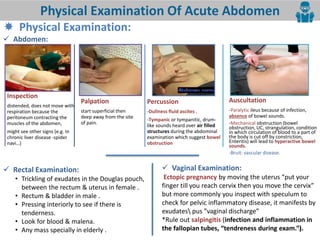
 Abdomen:
 Rectal Examination:
• Trickling of exudates in the Douglas pouch,
between the rectum & uterus in female .
• Rectum & bladder in male .
• Pressing interiorly to see if there is
tenderness.
• Look for blood & malena.
• Any mass specially in elderly .
 Vaginal Examination:
Ectopic pregnancy o i g the uterus put our
fi ger till ou rea h er i the ou o e the er i
but more commonly you inspect with speculum to
check for pelvic inflammatory disease, it manifests by
exudates pus agi al dis harge
*Rule out salpingitis (infection and inflammation in
the fallopian tubes, tendreness duri g e a . .
Inspection
distended, does not move with
respiration because the
peritoneum contracting the
muscles of the abdomen,
might see other signs (e.g. In
chronic liver disease -spider
navi…)
Palpation
start superficial then
deep away from the site
of pain.
Percussion
-Dullness fluid ascites .
-Tympanic or tympanitic, drum-
like sounds heard over air filled
structures during the abdominal
examination which suggest bowel
obstruction
Auscultation
-Paralytic ileus because of infection,
absence of bowel sounds.
-Mechanical obstruction (bowel
obstruction, UC, strangulation, condition
in which circulation of blood to a part of
the body is cut off by constriction,
Enteritis) will lead to hyperactive bowel
sounds.
-Bruit: vascular disease.
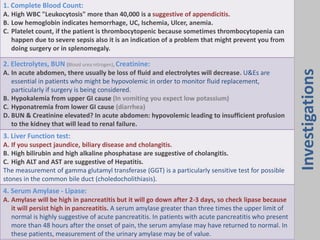
1. Complete Blood Count:
A. High WBC "Leukocytosis" more than 40,000 is a suggestive of appendicitis.
B. Low hemoglobin indicates hemorrhage, UC, Ischemia, Ulcer, anemia.
C. Platelet count, if the patient is thrombocytopenic because sometimes thrombocytopenia can
happen due to severe sepsis also it is an indication of a problem that might prevent you from
doing surgery or in splenomegaly.
2. Electrolytes, BUN (Blood urea nitrogen), Creatinine:
A. In acute abdomen, there usually be loss of fluid and electrolytes will decrease. U&Es are
essential in patients who might be hypovolemic in order to monitor fluid replacement,
particularly if surgery is being considered.
B. Hypokalemia from upper GI cause (In vomiting you expect low potassium)
C. Hyponatremia from lower GI cause (diarrhea)
D. BUN & Creatinine elevated? In acute abdomen: hypovolemic leading to insufficient profusion
to the kidney that will lead to renal failure.
3. Liver Function test:
A. If you suspect jaundice, biliary disease and cholangitis.
B. High bilirubin and high alkaline phosphatase are suggestive of cholangitis.
C. High ALT and AST are suggestive of Hepatitis.
The measurement of gamma glutamyl transferase (GGT) is a particularly sensitive test for possible
stones in the common bile duct (choledocholithiasis).
4. Serum Amylase - Lipase:
A. Amylase will be high in pancreatitis but it will go down after 2-3 days, so check lipase because
it will persist high in pancreatitis. A serum amylase greater than three times the upper limit of
normal is highly suggestive of acute pancreatitis. In patients with acute pancreatitis who present
more than 48 hours after the onset of pain, the serum amylase may have returned to normal. In
these patients, measurement of the urinary amylase may be of value.
Investigations
5. Lactate:
A. Product of anaerobic metabolism: if there is bowel ischemia.
6. Arterial blood gases [ABGs]: (remember.. Diarrhea : Acidosis, Vomiting : Alkalosis)
A. Reflex the respiratory and metabolic states.
B. Do it if ischemia is suspected, severe sepsis, metabolic acidosis and before anesthesia.
Serum calcium: Patients with hypercalcemia may complain of abdominal pain as a result of
abnormal gastrointestinal motility, nephrolithiasis, peptic ulcer disease, pancreatitis or malignancy.
A low calcium level is one of the poor prognostic factors in patients with severe acute pancreatitis.
Blood glucose: Measurement of blood glucose is important, as diabetic ketoacidosis may present
with acute abdominal pain, and also because any serious illness can result in poor glycemic control,
particularly in diabetic patients.
Urinalysis:
Dipstick testing: Haematuria may result from a wide range of conditions but in the context of acute
abdominal pain may indicate a urinary tract tumour, infection or nephrolithiasis. Glucose or ketones
in the urine indicate recent starvation or possible diabetic ketoacidosis. Protein, bilirubin or casts in
the urine suggest renal or liver disease.
7. Chest x-ray:
A. Perforation of hollow viscous (commonly duodenal ulcer perforation), see air under the
diaphragm (pneumoperitoneum) . Ask for upright chest x ray.
The erect chest X-ray (CXR) is the most appropriate investigation for the detection of free intra-
peritoneal gas and should be carried out in any patient who might have a perforation.
A visceral perforation is the most common cause of free intra-peritoneal gas.
Investigations
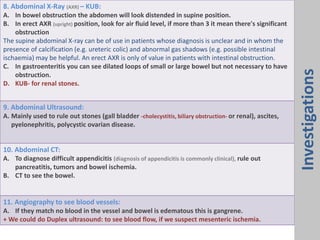
8. Abdominal X-Ray (AXR) – KUB:
A. In bowel obstruction the abdomen will look distended in supine position.
B. In erect AXR (upright) position, look for air fluid level, if more than 3 it mean there's significant
obstruction
The supine abdominal X-ray can be of use in patients whose diagnosis is unclear and in whom the
presence of calcification (e.g. ureteric colic) and abnormal gas shadows (e.g. possible intestinal
ischaemia) may be helpful. An erect AXR is only of value in patients with intestinal obstruction.
C. In gastroenteritis you can see dilated loops of small or large bowel but not necessary to have
obstruction.
D. KUB- for renal stones.
9. Abdominal Ultrasound:
A. Mainly used to rule out stones (gall bladder -cholecystitis, biliary obstruction- or renal), ascites,
pyelonephritis, polycystic ovarian disease.
10. Abdominal CT:
A. To diagnose difficult appendicitis (diagnosis of appendicitis is commonly clinical), rule out
pancreatitis, tumors and bowel ischemia.
B. CT to see the bowel.
11. Angiography to see blood vessels:
A. If they match no blood in the vessel and bowel is edematous this is gangrene.
+ We could do Duplex ultrasound: to see blood flow, if we suspect mesenteric ischemia.
Investigations
Diagnosis
Contrast radiology:
A. The contrast used is usually water-soluble, the main issue that requires the use of contrast X-
rays is determining the presence or absence of obstruction or perforation (In up to 50% of
patients with a perforated peptic ulcer, no free gas can be identified on plain radiography)
B. CT with rectal contrast is now more commonly performed for the assessment of patients with
large bowel obstruction.
C. CT without contrast is now more commonly used to detect renal tract calculi.
Endoscopic investigations:
Flexible sigmoidoscopy is commonly performed on patients who present with an acute abdomen
associated with rectal bleeding and in those patients with large bowel obstruction to evaluate the
anorectum. Additional information can be obtained from a colonoscopy. Furthermore, a sigmoid
volvulus can often be deflated by careful sigmoidoscopy. Upper gastrointestinal endoscopy is used
to investigate patients with acute upper abdominal pain in whom a perforated peptic ulcer has
been excluded.
• Acute Abdomen + Shock – Acute Pancreatitis/ Ruptured AAA (abdominal aortic aneurysm)
resuscitate & immediate surgery otherwise patient may die in minutes. Category A
• Generalized Peritonitis – Ruptured Viscus. Category B
• Localized Peritonitis, e.g. RLQ rebound tenderness means Acute
Appendicitis. Category C
• Bowel Obstruction (distention of the abdomen with no movement
during respiration). Category D
• Medical Causes: [Lobar Pneumonia, Acute Inferior MI "if the patient have epigastric pain and
you think of MI you can rule it out by doing ECG or Cardiac enzyme (troponin)"].
Investigations
Category A :
The most immediate
intervention
Category D :
is the least
Management
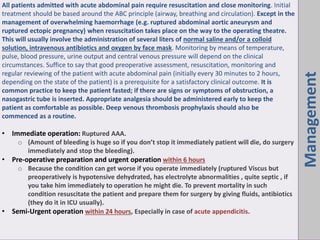
All patients admitted with acute abdominal pain require resuscitation and close monitoring. Initial
treatment should be based around the ABC principle (airway, breathing and circulation). Except in the
management of overwhelming haemorrhage (e.g. ruptured abdominal aortic aneurysm and
ruptured ectopic pregnancy) when resuscitation takes place on the way to the operating theatre.
This will usually involve the administration of several liters of normal saline and/or a colloid
solution, intravenous antibiotics and oxygen by face mask. Monitoring by means of temperature,
pulse, blood pressure, urine output and central venous pressure will depend on the clinical
circumstances. Suffice to say that good preoperative assessment, resuscitation, monitoring and
regular reviewing of the patient with acute abdominal pain (initially every 30 minutes to 2 hours,
depending on the state of the patient) is a prerequisite for a satisfactory clinical outcome. It is
common practice to keep the patient fasted; if there are signs or symptoms of obstruction, a
nasogastric tube is inserted. Appropriate analgesia should be administered early to keep the
patient as comfortable as possible. Deep venous thrombosis prophylaxis should also be
commenced as a routine.
• Immediate operation: Ruptured AAA.
o A ou t of bleedi g is huge so if ou do ’t stop it i ediatel patie t will die, do surger
immediately and stop the bleeding).
• Pre-operative preparation and urgent operation within 6 hours
o Because the condition can get worse if you operate immediately (ruptured Viscus but
preoperatively is hypotensive dehydrated, has electrolyte abnormalities , quite septic , if
you take him immediately to operation he might die. To prevent mortality in such
condition resuscitate the patient and prepare them for surgery by giving fluids, antibiotics
(they do it in ICU usually).
• Semi-Urgent operation within 24 hours, Especially in case of acute appendicitis.
Cont.
Management
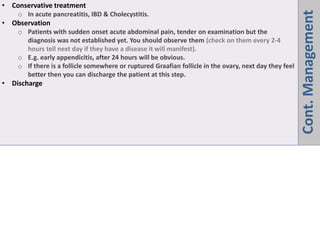
• Conservative treatment
o In acute pancreatitis, IBD & Cholecystitis.
• Observation
o Patients with sudden onset acute abdominal pain, tender on examination but the
diagnosis was not established yet. You should observe them (check on them every 2-4
hours tell next day if they have a disease it will manifest).
o E.g. early appendicitis, after 24 hours will be obvious.
o If there is a follicle somewhere or ruptured Graafian follicle in the ovary, next day they feel
better then you can discharge the patient at this step.
• Discharge
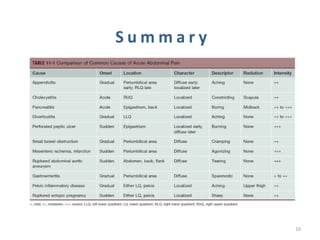
S u m m a r y
16
17
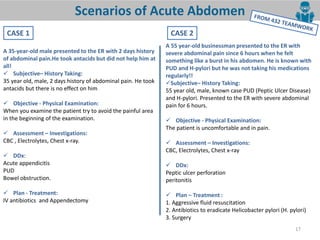
Scenarios of Acute Abdomen
A 35-year-old male presented to the ER with 2 days history
of abdominal pain.He took antacids but did not help him at
all!
 Subjective– History Taking:
35 year old, male, 2 days history of abdominal pain. He took
antacids but there is no effect on him
 Objective - Physical Examination:
When you examine the patient try to avoid the painful area
in the beginning of the examination.
 Assessment – Investigations:
CBC , Electrolytes, Chest x-ray.
 DDx:
Acute appendicitis
PUD
Bowel obstruction.
 Plan - Treatment:
IV antibiotics and Appendectomy
A 55 year-old businessman presented to the ER with
severe abdominal pain since 6 hours when he felt
something like a burst in his abdomen. He is known with
PUD and H-pylori but he was not taking his medications
regularly!!
Subjective– History Taking:
55 year old, male, known case PUD (Peptic Ulcer Disease)
and H-pylori. Presented to the ER with severe abdominal
pain for 6 hours.
 Objective - Physical Examination:
The patient is uncomfortable and in pain.
 Assessment – Investigations:
CBC, Electrolytes, Chest x-ray
 DDx:
Peptic ulcer perforation
peritonitis
 Plan – Treatment :
1. Aggressive fluid resuscitation
2. Antibiotics to eradicate Helicobacter pylori (H. pylori)
3. Surgery
CASE 1 CASE 2
18
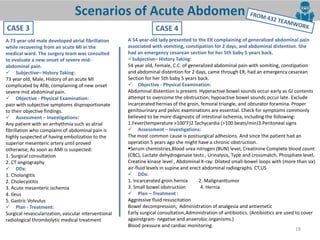
Scenarios of Acute Abdomen
A 73 year-old male developed atrial fibrillation
while recovering from an acute MI in the
medical ward. The surgery team was consulted
to evaluate a new onset of severe mid-
abdominal pain.
 Subjective– History Taking:
73 year old, Male, History of an acute MI
complicated by Afib, complaining of new onset
severe mid abdominal pain.
 Objective - Physical Examination:
pain with subjective symptoms disproportionate
to their objective findings.
 Assessment – Investigations:
Any patient with an arrhythmia such as atrial
fibrillation who complains of abdominal pain is
highly suspected of having embolization to the
superior mesenteric artery until proved
otherwise, As soon as AMI is suspected:
1. Surgical consultation
2. CT angiography
 DDx:
1. Cholangitis
2. Cholecystitis
3. Acute mesenteric ischemia
4. Ileus
5. Gastric Volvulus
 Plan - Treatment:
Surgical revascularization, vascular interventional
radiological thrombolytic medical treatment
A 54 year-old lady presented to the ER complaining of generalized abdominal pain
associated with vomiting, constipation for 2 days, and abdominal distention. She
had an emergency cesarean section for her 5th baby 5 years back.
Subjective– History Taking:
54 year old, Female, C.C. of generalized abdominal pain with vomiting, constipation
and abdominal distention for 2 days, came through ER, had an emergency cesarean
Section for her 5th baby 5 years back.
 Objective - Physical Examination:
Abdominal distention is present. Hyperactive bowel sounds occur early as GI contents
attempt to overcome the obstruction; hypoactive bowel sounds occur late. Exclude
incarcerated hernias of the groin, femoral triangle, and obturator foramina. Proper
genitourinary and pelvic examinations are essential. Check for symptoms commonly
believed to be more diagnostic of intestinal ischemia, including the following:
1.Fever(temperature >100°F)2.Tachycardia (>100 beats/min)3.Peritoneal signs
 Assessment – Investigations:
The most common cause is postsurgical adhesions. And since the patient had an
operation 5 years ago she might have a chronic obstruction.
Serum chemistries,Blood urea nitrogen (BUN) level, Creatinine Complete blood count
(CBC), Lactate dehydrogenase tests , Urinalysis, Type and crossmatch, Phosphate level,
Creatine kinase level , Abdominal X-ray: Dilated small-bowel loops with (more than six)
air-fluid levels in supine and erect abdominal radiographs. CT,US
 DDx:
1. Incarcerated groin hernia 2. Malignanttumor
3. Small bowel obstruction 4. Hernia
 Plan – Treatment :
Aggressive fluid resuscitation
Bowel decompression, Administration of analgesia and antiemetic
Early surgical consultation,Administration of antibiotics. (Antibiotics are used to cover
againstgram- negative and anaerobic organisms.)
Blood pressure and cardiac monitoring.
CASE 3 CASE 4
Thank You..
Done By :
ANJOD ALMUHAREB.
FAY ALRUWAIS.
Revised By:
Faisal S. AlGhamdi
surgery433@gmail.com
19

L20-Acute Abdomen.pdf

  • 1.
  • 2.
    Objectives :  Defineacute abdomen.  Describe a general approach to acute abdomen.  Discuss common causes of acute abdomen through case scenarios. Sources : Slides, Rasla ’s Notebook, Principles & Practice of Surgery by: O. James Garden Color Index: Slides & Rasla ’s | Textbook | Do tor’s Notes | Extra Explanation | Important 2
  • 3.
  • 4.
    4 Acute Abdomen  Definition: Acuteabdomen denotes any sudden onset, spontaneous non-traumatic disorder in the abdominal area that requires urgent surgery in some cases (most of them).  General Approach to Acute Abdomen: • The standardized approach for all acute abdominal disorders is the (SOAP) approach:  Subjective– History Taking  Objective - Physical Examination  Assessment – Investigations  Plan – Treatment (based on the final diagnosis) • The approach is not that different from an elective case, except in patients who are hemodynamically unstable and will go into shock, resuscitation should be initiated first. • Analgesia or painkillers are not preferable to be given until a diagnosis is made.  History Taking: Age: Newborn child presents with acute abdominal pain; most likely, it is a digestive disease (bowel atresia - congenital anomaly i hi h there is i o plete de elop e t of the i testi al tra t, t pi all ith losures a d dead e ds that lo k flo through the i testi es. or e o iu ileus ( O stru tio of the i testi e -ileus- due to overly thick meconium). Children present with an acute abdominal pain, suspect mesenteric adenitis (inflammation of a gland or lymph node) 12year-old who present with an acute abdominal pain, suspect appendicitis. Elderly patient with acute abdominal pain, obstruction due to cancer or acute diverticulitis is highly suspected.
  • 5.
    5 Taking History OfAcute Abdomen PAIN: (SOCRATES) SITE: • Right upper quadrant  think about gall bladder(Cholecystitis ) or liver(hepatitis, Liver abscess) . • Right lower quadrant most likely it is appendicitis. • Left lower quadrant  think about diverticulitis. Onset: Sudden or gradual. Typically, pain from a perforation is sudden and that from inflammation is gradual. Character o Dull ild pai o Troopi g i ou ds o Co pressio MI o Bur i g gastritis o Coli k i ature bowel obstruction o Stabbing Radiation o Cholecystitis to the tip of the right shoulder. o Pancreatitis to the back. Association Nausea and vomiting with severe pain. Timing important to decide management , Examples: •Patient with pain in the right lower quadrant, most likely it is appendicitis, if the patient reported that the pain started last night, surgery is the likely choice of management. •If the same patient reported that he/she had this pain 4-5 days ago and the pain is getting worse then you diagnose him/her with appendicular mass, the approach will be conservative rather than surgical. Severity • Pain scale from 1 to 10, 0 no pain 10 worst pain. • Mild pain (0-4), moderate (5-7), severe (8-10). • Acute abdomen is in the severe category. Relieving and aggravating factors o Fatty food aggrevates biliary colic. o Antacid for burning pain in the epigastrium and milk will temporarily relieve the pain but after an hour, pain will become worse (milk contain protein --> protein increase gastric acid secretions). Milk is a temporal buffer. Progression Shifting pain: e.g. in appendicitis initially pain begin as visceral dull pain in periumbilical area, then become parietal pain that is shifted to right lower quadrant (when the inflammation reach the parietal peritoneom)
  • 6.
    6 Taking History OfAcute Abdomen VOMITING :  Hematemesis  Volume : small or large amount  Projectile "force" In children usually due to pyloric stenosis In newborn due to congenital hypertrophy of pylorus. In adults, gastric outlet obstruction o Causes of gastric outlet obstruction :  Scarring due to chronic peptic ulcer  Gastric cancer obstructs the pylorus  Superior mesenteric artery syndrome is characterized by compression of the third or transverse portion of the duodenum between the aorta and the superior mesenteric artery. This results in chronic, intermittent, or acute complete or partial duodenal obstruction.  In bezoar psychiatric patient who eats foreign bodies e.g. Hair forming a ball that obstructs the gastric  Frequent or occasional  Does vomiting relieve the pain or not? Most of a do i al oli ’s relie ed o iti g  Content: o Undigested food (from stomach) o Digested food: greenish (obstruction distal to duodenum) DEFECATION : It is important to ask about the bowel habits.  Constipation for 2 days with acute abdominal pain means there's an obstruction o Ask them can they pass gases or not, if not it's called Obstipation "complete bowel obstruction .  Diarrhea with acute abdomen usually means infection; gastroenteritis usually does not cause acute abdominal pain unless bowel perforation happens. o Salmonella lead to typhoid fever and typhoid fever can cause gastroenteritis that lead to bowel perforation and acute abdominal pain. Diagnoses by stool culture.  Acute abdominal pain with severe diarrhea "mixed with blood" o Ulcerative colitis o Bowel ischemia o Crohn's disease
  • 7.
    7 Taking History OfAcute Abdomen FEVER: Rigors with acute abdominal pain means Sepsis due to cholangitis Rigor : e aggerated shi eri g hi h a o ur ith a high fe er PAST HISTORY:  Past abdominal surgery adhesion, bowel obstruction, bowel strangulation or ischemia  Bowel obstruction due to hernia  Peptic ulcer perforation*  Similar episodes of Ulcerative Colitis or Crohn's disease but in less degree  Gall stones Obstruction o Acute cholecystitis (is a sudden inflammation of the gallbladder that causes severe abdominal pain) o Pancreatitis. o Ascending cholangitis. *Peptic ulcer perforation is a hole in the wall often leads to catastrophic consequences. Erosion of the gastro-intestinal wall by the ulcer leads to spillage of stomach or intestinal content into the abdominal cavity. Perforation at the anterior surface of the stomach leads to acute peritonitis, initially chemical and later bacterial peritonitis. The first sign is often sudden intense abdominal pain YOU HAVE TO COMPLETE YOUR HISTORY by asking about medication , allergy, family history ..etc.
  • 8.
    8 Physical Examination OfAcute Abdomen  Physical Examination:  General look: Lying on bed and they look ill and in pain, uncomfortable moving, because they want to obtain a position that relieves them from peritoneal irritation, sometimes they roll in bed in renal colic or sometimes in Acute cholecystitis when gallbladder get contracted with stones : • Anything related to stone make patient roll in bed • Peritonitis pain usually patient are lying steady in bed with shallow breathing (because movement increase the pain)  Vital signs: Important to see the hemodynamic state of the patient wither if the patient is tachycardic, tachypenic or hypotensive. If vital signs disturped (Hypotension) they must be treated immediately to prevent patient going into shock. So if the patient in shock you have to cut the examination and go directly to resuscitate the patient by Airway, breathing and circulation(ABC), when he/she get stable now examine him/her.  Head and neck: i. Check the eyes for jaundice. "jaundice+ fever+ abdominal pain to diagnose cholangitis ii. JVP: in acute abdomen, patient will be hypovolemic hence the JVP will disappear iii. Mucus membrane: sings of dryness iv. Lymph node may present with lymphadenopathy Virchow's nodes: enlarged left supraclavicular lymph nodes, usually in abdominal cancers (specially gastric cancer which is called Troisier's sign)  Chest: (because some chest problems presented with abdominal pain -e.g. Inferior MI, Lobar pneumonia-) Pleural effusion caused by pneumonia. In lower pneumonia or lobar pneumonia you'll hear crackles and bronchial breathing. -Aortic dissection -Inferior MI > referral pain in epigastrium area > examine the heart.
  • 9.
    9 Physical Examination OfAcute Abdomen  Physical Examination:  Abdomen:  Rectal Examination: • Trickling of exudates in the Douglas pouch, between the rectum & uterus in female . • Rectum & bladder in male . • Pressing interiorly to see if there is tenderness. • Look for blood & malena. • Any mass specially in elderly .  Vaginal Examination: Ectopic pregnancy o i g the uterus put our fi ger till ou rea h er i the ou o e the er i but more commonly you inspect with speculum to check for pelvic inflammatory disease, it manifests by exudates pus agi al dis harge *Rule out salpingitis (infection and inflammation in the fallopian tubes, tendreness duri g e a . . Inspection distended, does not move with respiration because the peritoneum contracting the muscles of the abdomen, might see other signs (e.g. In chronic liver disease -spider navi…) Palpation start superficial then deep away from the site of pain. Percussion -Dullness fluid ascites . -Tympanic or tympanitic, drum- like sounds heard over air filled structures during the abdominal examination which suggest bowel obstruction Auscultation -Paralytic ileus because of infection, absence of bowel sounds. -Mechanical obstruction (bowel obstruction, UC, strangulation, condition in which circulation of blood to a part of the body is cut off by constriction, Enteritis) will lead to hyperactive bowel sounds. -Bruit: vascular disease.
  • 10.
    1. Complete BloodCount: A. High WBC "Leukocytosis" more than 40,000 is a suggestive of appendicitis. B. Low hemoglobin indicates hemorrhage, UC, Ischemia, Ulcer, anemia. C. Platelet count, if the patient is thrombocytopenic because sometimes thrombocytopenia can happen due to severe sepsis also it is an indication of a problem that might prevent you from doing surgery or in splenomegaly. 2. Electrolytes, BUN (Blood urea nitrogen), Creatinine: A. In acute abdomen, there usually be loss of fluid and electrolytes will decrease. U&Es are essential in patients who might be hypovolemic in order to monitor fluid replacement, particularly if surgery is being considered. B. Hypokalemia from upper GI cause (In vomiting you expect low potassium) C. Hyponatremia from lower GI cause (diarrhea) D. BUN & Creatinine elevated? In acute abdomen: hypovolemic leading to insufficient profusion to the kidney that will lead to renal failure. 3. Liver Function test: A. If you suspect jaundice, biliary disease and cholangitis. B. High bilirubin and high alkaline phosphatase are suggestive of cholangitis. C. High ALT and AST are suggestive of Hepatitis. The measurement of gamma glutamyl transferase (GGT) is a particularly sensitive test for possible stones in the common bile duct (choledocholithiasis). 4. Serum Amylase - Lipase: A. Amylase will be high in pancreatitis but it will go down after 2-3 days, so check lipase because it will persist high in pancreatitis. A serum amylase greater than three times the upper limit of normal is highly suggestive of acute pancreatitis. In patients with acute pancreatitis who present more than 48 hours after the onset of pain, the serum amylase may have returned to normal. In these patients, measurement of the urinary amylase may be of value. Investigations
  • 11.
    5. Lactate: A. Productof anaerobic metabolism: if there is bowel ischemia. 6. Arterial blood gases [ABGs]: (remember.. Diarrhea : Acidosis, Vomiting : Alkalosis) A. Reflex the respiratory and metabolic states. B. Do it if ischemia is suspected, severe sepsis, metabolic acidosis and before anesthesia. Serum calcium: Patients with hypercalcemia may complain of abdominal pain as a result of abnormal gastrointestinal motility, nephrolithiasis, peptic ulcer disease, pancreatitis or malignancy. A low calcium level is one of the poor prognostic factors in patients with severe acute pancreatitis. Blood glucose: Measurement of blood glucose is important, as diabetic ketoacidosis may present with acute abdominal pain, and also because any serious illness can result in poor glycemic control, particularly in diabetic patients. Urinalysis: Dipstick testing: Haematuria may result from a wide range of conditions but in the context of acute abdominal pain may indicate a urinary tract tumour, infection or nephrolithiasis. Glucose or ketones in the urine indicate recent starvation or possible diabetic ketoacidosis. Protein, bilirubin or casts in the urine suggest renal or liver disease. 7. Chest x-ray: A. Perforation of hollow viscous (commonly duodenal ulcer perforation), see air under the diaphragm (pneumoperitoneum) . Ask for upright chest x ray. The erect chest X-ray (CXR) is the most appropriate investigation for the detection of free intra- peritoneal gas and should be carried out in any patient who might have a perforation. A visceral perforation is the most common cause of free intra-peritoneal gas. Investigations
  • 12.
    8. Abdominal X-Ray(AXR) – KUB: A. In bowel obstruction the abdomen will look distended in supine position. B. In erect AXR (upright) position, look for air fluid level, if more than 3 it mean there's significant obstruction The supine abdominal X-ray can be of use in patients whose diagnosis is unclear and in whom the presence of calcification (e.g. ureteric colic) and abnormal gas shadows (e.g. possible intestinal ischaemia) may be helpful. An erect AXR is only of value in patients with intestinal obstruction. C. In gastroenteritis you can see dilated loops of small or large bowel but not necessary to have obstruction. D. KUB- for renal stones. 9. Abdominal Ultrasound: A. Mainly used to rule out stones (gall bladder -cholecystitis, biliary obstruction- or renal), ascites, pyelonephritis, polycystic ovarian disease. 10. Abdominal CT: A. To diagnose difficult appendicitis (diagnosis of appendicitis is commonly clinical), rule out pancreatitis, tumors and bowel ischemia. B. CT to see the bowel. 11. Angiography to see blood vessels: A. If they match no blood in the vessel and bowel is edematous this is gangrene. + We could do Duplex ultrasound: to see blood flow, if we suspect mesenteric ischemia. Investigations
  • 13.
    Diagnosis Contrast radiology: A. Thecontrast used is usually water-soluble, the main issue that requires the use of contrast X- rays is determining the presence or absence of obstruction or perforation (In up to 50% of patients with a perforated peptic ulcer, no free gas can be identified on plain radiography) B. CT with rectal contrast is now more commonly performed for the assessment of patients with large bowel obstruction. C. CT without contrast is now more commonly used to detect renal tract calculi. Endoscopic investigations: Flexible sigmoidoscopy is commonly performed on patients who present with an acute abdomen associated with rectal bleeding and in those patients with large bowel obstruction to evaluate the anorectum. Additional information can be obtained from a colonoscopy. Furthermore, a sigmoid volvulus can often be deflated by careful sigmoidoscopy. Upper gastrointestinal endoscopy is used to investigate patients with acute upper abdominal pain in whom a perforated peptic ulcer has been excluded. • Acute Abdomen + Shock – Acute Pancreatitis/ Ruptured AAA (abdominal aortic aneurysm) resuscitate & immediate surgery otherwise patient may die in minutes. Category A • Generalized Peritonitis – Ruptured Viscus. Category B • Localized Peritonitis, e.g. RLQ rebound tenderness means Acute Appendicitis. Category C • Bowel Obstruction (distention of the abdomen with no movement during respiration). Category D • Medical Causes: [Lobar Pneumonia, Acute Inferior MI "if the patient have epigastric pain and you think of MI you can rule it out by doing ECG or Cardiac enzyme (troponin)"]. Investigations Category A : The most immediate intervention Category D : is the least
  • 14.
    Management All patients admittedwith acute abdominal pain require resuscitation and close monitoring. Initial treatment should be based around the ABC principle (airway, breathing and circulation). Except in the management of overwhelming haemorrhage (e.g. ruptured abdominal aortic aneurysm and ruptured ectopic pregnancy) when resuscitation takes place on the way to the operating theatre. This will usually involve the administration of several liters of normal saline and/or a colloid solution, intravenous antibiotics and oxygen by face mask. Monitoring by means of temperature, pulse, blood pressure, urine output and central venous pressure will depend on the clinical circumstances. Suffice to say that good preoperative assessment, resuscitation, monitoring and regular reviewing of the patient with acute abdominal pain (initially every 30 minutes to 2 hours, depending on the state of the patient) is a prerequisite for a satisfactory clinical outcome. It is common practice to keep the patient fasted; if there are signs or symptoms of obstruction, a nasogastric tube is inserted. Appropriate analgesia should be administered early to keep the patient as comfortable as possible. Deep venous thrombosis prophylaxis should also be commenced as a routine. • Immediate operation: Ruptured AAA. o A ou t of bleedi g is huge so if ou do ’t stop it i ediatel patie t will die, do surger immediately and stop the bleeding). • Pre-operative preparation and urgent operation within 6 hours o Because the condition can get worse if you operate immediately (ruptured Viscus but preoperatively is hypotensive dehydrated, has electrolyte abnormalities , quite septic , if you take him immediately to operation he might die. To prevent mortality in such condition resuscitate the patient and prepare them for surgery by giving fluids, antibiotics (they do it in ICU usually). • Semi-Urgent operation within 24 hours, Especially in case of acute appendicitis.
  • 15.
    Cont. Management • Conservative treatment oIn acute pancreatitis, IBD & Cholecystitis. • Observation o Patients with sudden onset acute abdominal pain, tender on examination but the diagnosis was not established yet. You should observe them (check on them every 2-4 hours tell next day if they have a disease it will manifest). o E.g. early appendicitis, after 24 hours will be obvious. o If there is a follicle somewhere or ruptured Graafian follicle in the ovary, next day they feel better then you can discharge the patient at this step. • Discharge
  • 16.
    S u mm a r y 16
  • 17.
    17 Scenarios of AcuteAbdomen A 35-year-old male presented to the ER with 2 days history of abdominal pain.He took antacids but did not help him at all!  Subjective– History Taking: 35 year old, male, 2 days history of abdominal pain. He took antacids but there is no effect on him  Objective - Physical Examination: When you examine the patient try to avoid the painful area in the beginning of the examination.  Assessment – Investigations: CBC , Electrolytes, Chest x-ray.  DDx: Acute appendicitis PUD Bowel obstruction.  Plan - Treatment: IV antibiotics and Appendectomy A 55 year-old businessman presented to the ER with severe abdominal pain since 6 hours when he felt something like a burst in his abdomen. He is known with PUD and H-pylori but he was not taking his medications regularly!! Subjective– History Taking: 55 year old, male, known case PUD (Peptic Ulcer Disease) and H-pylori. Presented to the ER with severe abdominal pain for 6 hours.  Objective - Physical Examination: The patient is uncomfortable and in pain.  Assessment – Investigations: CBC, Electrolytes, Chest x-ray  DDx: Peptic ulcer perforation peritonitis  Plan – Treatment : 1. Aggressive fluid resuscitation 2. Antibiotics to eradicate Helicobacter pylori (H. pylori) 3. Surgery CASE 1 CASE 2
  • 18.
    18 Scenarios of AcuteAbdomen A 73 year-old male developed atrial fibrillation while recovering from an acute MI in the medical ward. The surgery team was consulted to evaluate a new onset of severe mid- abdominal pain.  Subjective– History Taking: 73 year old, Male, History of an acute MI complicated by Afib, complaining of new onset severe mid abdominal pain.  Objective - Physical Examination: pain with subjective symptoms disproportionate to their objective findings.  Assessment – Investigations: Any patient with an arrhythmia such as atrial fibrillation who complains of abdominal pain is highly suspected of having embolization to the superior mesenteric artery until proved otherwise, As soon as AMI is suspected: 1. Surgical consultation 2. CT angiography  DDx: 1. Cholangitis 2. Cholecystitis 3. Acute mesenteric ischemia 4. Ileus 5. Gastric Volvulus  Plan - Treatment: Surgical revascularization, vascular interventional radiological thrombolytic medical treatment A 54 year-old lady presented to the ER complaining of generalized abdominal pain associated with vomiting, constipation for 2 days, and abdominal distention. She had an emergency cesarean section for her 5th baby 5 years back. Subjective– History Taking: 54 year old, Female, C.C. of generalized abdominal pain with vomiting, constipation and abdominal distention for 2 days, came through ER, had an emergency cesarean Section for her 5th baby 5 years back.  Objective - Physical Examination: Abdominal distention is present. Hyperactive bowel sounds occur early as GI contents attempt to overcome the obstruction; hypoactive bowel sounds occur late. Exclude incarcerated hernias of the groin, femoral triangle, and obturator foramina. Proper genitourinary and pelvic examinations are essential. Check for symptoms commonly believed to be more diagnostic of intestinal ischemia, including the following: 1.Fever(temperature >100°F)2.Tachycardia (>100 beats/min)3.Peritoneal signs  Assessment – Investigations: The most common cause is postsurgical adhesions. And since the patient had an operation 5 years ago she might have a chronic obstruction. Serum chemistries,Blood urea nitrogen (BUN) level, Creatinine Complete blood count (CBC), Lactate dehydrogenase tests , Urinalysis, Type and crossmatch, Phosphate level, Creatine kinase level , Abdominal X-ray: Dilated small-bowel loops with (more than six) air-fluid levels in supine and erect abdominal radiographs. CT,US  DDx: 1. Incarcerated groin hernia 2. Malignanttumor 3. Small bowel obstruction 4. Hernia  Plan – Treatment : Aggressive fluid resuscitation Bowel decompression, Administration of analgesia and antiemetic Early surgical consultation,Administration of antibiotics. (Antibiotics are used to cover againstgram- negative and anaerobic organisms.) Blood pressure and cardiac monitoring. CASE 3 CASE 4
  • 19.
    Thank You.. Done By: ANJOD ALMUHAREB. FAY ALRUWAIS. Revised By: Faisal S. AlGhamdi surgery433@gmail.com 19