Diverticular Disease www.hi-dentfinishingschool.blogspot.com
 
Overview A  diverticulum  is an abnormal sac or pouch protruding from the wall of a hollow organ. Diverticula  ; pouches Diverticulosis  ;  condition of having diverticula Diverticulosis  is a common condition of Western society and seems to be an unfortunate product of the Industrial Revolution. Decreased consumption of unprocessed  cereals  along with the increased consumption of sugar and meat  The formation of diverticula is also related to  aging Rare in individuals younger than the age of 30 years, but at least two thirds of Americans will have developed colonic diverticula by the age of 80.
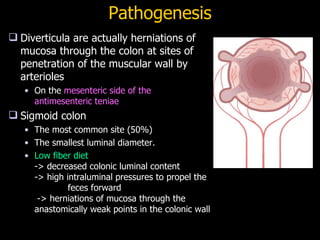
Pathogenesis Diverticula are actually herniations of mucosa through the colon at sites of penetration of the muscular wall by arterioles On the  mesenteric side of the antimesenteric teniae Sigmoid colon The most common site (50%) The smallest luminal diameter. Low fiber diet   -> decreased colonic luminal content  -> high intraluminal pressures to propel the  feces forward  -> herniations of mucosa through the anastomically weak points in the colonic wall
Diverticular bleeding The most common cause of hematochezia in patients over the age of 60 20% of patients with diverticulosis will have GI bleeding. Risk factor ; HT, Artherosclerosis, NSAID Usually self limited, but rebleeding risk (25%) Localization ; Colonoscopy, Angiography Surgery Unstable hemodynamics,  6-unit bleed within 24 hr Without localization ; Total colectomy
Diverticulitis Definition Inflammation of a diverticulum, is related to the retention of particulate material within the diverticular sac and the formation of a fecalith Actually an  extraluminal pericolic infection  caused by the extravasation of feces through the perforated diverticulum Presentation LLQ pain : may radiate to the suprapubic, groin, back Bowel habit change, Anorexia, Fever, Chill, Urinary urgency
Diverticulitis Physical Findings Dependent on the  site  of perforation, the amount of  contamination , and the presence or absence of  secondary infection  of adjacent organs Tenderness, Muscle guarding Tender mass : phlegmon or abscess Abdominal distension : ileus or obstruction Tender fluctuant pelvic mass on rectal or vaginal exam
Diverticulitis Diagnostic Tests CT The preferred test to confirm the suspected diagnosis  Location of infection, extent of inflammatory process, presence and location of an abscess, secondary complications sigmoid diverticula, thickened colonic wall >4 mm, inflammation within the pericolic fat ± the collection of contrast material or fluid MRI, US Water soluble contrast enema Distinguish acute diverticulitis from perforated cancer Risk of increasing the colonic pressure, extravasation of feces through the perforated diverticulitis
Uncomplicated Diverticulitis Disease not associated with free intraperitoneal perforation, fistula formation, or obstruction Nonoperative treatment   Bowel rest + Antibiotics ; 75% response Trimethoprim/sulfamethoxazole  or  ciprofloxacin  and  metronidazole  ; aerobic gram-negative rods and anaerobic bacteria   The addition of  ampicillin  to this regimen for nonresponders  ;  enterococci   Single-agent therapy ; a third-generation penicillin such as  piperacillin The usual course of antibiotics is 7 to 10 days
Uncomplicated Diverticulitis Investigative studies After the symptoms have subsided for at least 3 weeks To establish the presence of diverticula and to exclude cancer, which can mimic diverticulitis Colonoscopy > Barium enema Recurrent disease Second attack (<25%) -> Third attack (>50%) Elective resection  After infection control ; usually 4 to 6 weeks after the episode Laparoscopic resection ; growing trend Immunocompromised patient : after single attack
Complicated Diverticulitis Hinchey classification Stage I: Pericolic or mesenteric abscess  Stage II: Walled-off pelvic abscess  Stage III: Generalized purulent peritonitis  Stage IV: Generalized fecal peritonitis
Complicated Diverticulitis   Abscess Usually confined to the pelvis Significant pain, fever, and leukocytosis More than 2cm ; should be drained Percutaneous or transanal > laparotomy Elective surgery ; after 6weeks following drainage Complete removal of the entire abnormally thickened bowel
Complicated Diverticulitis Fistula Skin, bladder, vagina, or small bowel  Sigmoid-vesical fistula Pneumaturia, fecaluria,  and recurrent UTI (Urosepsis) CT ; may demonstrate air  in the bladder Barium enema, IVP, Cystoscopy Treatment  Initial treatment ; infection control and reduce the associated inflammation Rarely a cause for emergency surgery Diagnostic steps such as coloscopy should be taken to confirm the cause of the fistula before a definitive operation is undertaken.
Generalized Peritonitis Mechanism Perforation without sealing by the body’s normal defenses -> contaminated with feces Abscess burst into the unprotected peritoneal cavity  -> contaminated with enteric bacteria Immediate operative intervention Excise the segment of colon containing perforation and construct a colostomy using noninflammed colon Peritoneal cavity irrigation, iv antibiotics Colostomy repair Usually after a period of at least 10 weeks
Diverticulosis in Korea Characteristics Low incidence, but increasing Rt colon (over 60%) > Lt colon  Young Age, Man, Congenital, Solitary, True type, Uncomplicated type Differential Diagnosis from Acute Appendicitis RLQ pain ; first symptom site, long duration Nausea, vomiting ; absent or low Previous appendectomy Known diverticulosis (Barium enema, Colonoscopy) Fecalith  Age ; 30~40 year old (later than appendicitis) History of lower GI bleeding
References Sabiston Textbook of Surgery 17ed Harrison’s Principles of Internal Medicine 16th  Whetsone D, Hazey J, Pofahl WE 2nd, Roth JS. Current management of diverticulitis.  Curr Surg . 2004 Jul-Aug;61(4):361-5  Salem L, Veenstra DL, Sullivan SD, Flum DR. The timing of elective colectomy in diverticulitis: a decision analysis.  J Am Coll Surg . 2004 Dec;199(6):904-12.  Natarajan S, Ewings EL, Vega RJ. Laparoscopic sigmoid colectomy after acute diverticulitis: when to operate?  Surgery . 2004 Oct;136(4):725-30.  Park JK et al. Clinical analysis of right colon diverticulitis.  J Korean Surg Soc  2003 Jan;64:44-48 Chang JH et al. Surgical treatment of the colonic diverticulosis.  J Korean Surg Soc  2002 May;62:415-420
Thank you for your attentions.

Diverticulitis

  • 1.
  • 2.
  • 3.
    Overview A diverticulum is an abnormal sac or pouch protruding from the wall of a hollow organ. Diverticula ; pouches Diverticulosis ; condition of having diverticula Diverticulosis is a common condition of Western society and seems to be an unfortunate product of the Industrial Revolution. Decreased consumption of unprocessed cereals along with the increased consumption of sugar and meat The formation of diverticula is also related to aging Rare in individuals younger than the age of 30 years, but at least two thirds of Americans will have developed colonic diverticula by the age of 80.
  • 4.
    Pathogenesis Diverticula areactually herniations of mucosa through the colon at sites of penetration of the muscular wall by arterioles On the mesenteric side of the antimesenteric teniae Sigmoid colon The most common site (50%) The smallest luminal diameter. Low fiber diet -> decreased colonic luminal content -> high intraluminal pressures to propel the feces forward -> herniations of mucosa through the anastomically weak points in the colonic wall
  • 5.
    Diverticular bleeding Themost common cause of hematochezia in patients over the age of 60 20% of patients with diverticulosis will have GI bleeding. Risk factor ; HT, Artherosclerosis, NSAID Usually self limited, but rebleeding risk (25%) Localization ; Colonoscopy, Angiography Surgery Unstable hemodynamics, 6-unit bleed within 24 hr Without localization ; Total colectomy
  • 6.
    Diverticulitis Definition Inflammationof a diverticulum, is related to the retention of particulate material within the diverticular sac and the formation of a fecalith Actually an extraluminal pericolic infection caused by the extravasation of feces through the perforated diverticulum Presentation LLQ pain : may radiate to the suprapubic, groin, back Bowel habit change, Anorexia, Fever, Chill, Urinary urgency
  • 7.
    Diverticulitis Physical FindingsDependent on the site of perforation, the amount of contamination , and the presence or absence of secondary infection of adjacent organs Tenderness, Muscle guarding Tender mass : phlegmon or abscess Abdominal distension : ileus or obstruction Tender fluctuant pelvic mass on rectal or vaginal exam
  • 8.
    Diverticulitis Diagnostic TestsCT The preferred test to confirm the suspected diagnosis Location of infection, extent of inflammatory process, presence and location of an abscess, secondary complications sigmoid diverticula, thickened colonic wall >4 mm, inflammation within the pericolic fat ± the collection of contrast material or fluid MRI, US Water soluble contrast enema Distinguish acute diverticulitis from perforated cancer Risk of increasing the colonic pressure, extravasation of feces through the perforated diverticulitis
  • 9.
    Uncomplicated Diverticulitis Diseasenot associated with free intraperitoneal perforation, fistula formation, or obstruction Nonoperative treatment Bowel rest + Antibiotics ; 75% response Trimethoprim/sulfamethoxazole or ciprofloxacin and metronidazole ; aerobic gram-negative rods and anaerobic bacteria The addition of ampicillin to this regimen for nonresponders ; enterococci Single-agent therapy ; a third-generation penicillin such as piperacillin The usual course of antibiotics is 7 to 10 days
  • 10.
    Uncomplicated Diverticulitis Investigativestudies After the symptoms have subsided for at least 3 weeks To establish the presence of diverticula and to exclude cancer, which can mimic diverticulitis Colonoscopy > Barium enema Recurrent disease Second attack (<25%) -> Third attack (>50%) Elective resection After infection control ; usually 4 to 6 weeks after the episode Laparoscopic resection ; growing trend Immunocompromised patient : after single attack
  • 11.
    Complicated Diverticulitis Hincheyclassification Stage I: Pericolic or mesenteric abscess Stage II: Walled-off pelvic abscess Stage III: Generalized purulent peritonitis Stage IV: Generalized fecal peritonitis
  • 12.
    Complicated Diverticulitis Abscess Usually confined to the pelvis Significant pain, fever, and leukocytosis More than 2cm ; should be drained Percutaneous or transanal > laparotomy Elective surgery ; after 6weeks following drainage Complete removal of the entire abnormally thickened bowel
  • 13.
    Complicated Diverticulitis FistulaSkin, bladder, vagina, or small bowel Sigmoid-vesical fistula Pneumaturia, fecaluria, and recurrent UTI (Urosepsis) CT ; may demonstrate air in the bladder Barium enema, IVP, Cystoscopy Treatment Initial treatment ; infection control and reduce the associated inflammation Rarely a cause for emergency surgery Diagnostic steps such as coloscopy should be taken to confirm the cause of the fistula before a definitive operation is undertaken.
  • 14.
    Generalized Peritonitis MechanismPerforation without sealing by the body’s normal defenses -> contaminated with feces Abscess burst into the unprotected peritoneal cavity -> contaminated with enteric bacteria Immediate operative intervention Excise the segment of colon containing perforation and construct a colostomy using noninflammed colon Peritoneal cavity irrigation, iv antibiotics Colostomy repair Usually after a period of at least 10 weeks
  • 15.
    Diverticulosis in KoreaCharacteristics Low incidence, but increasing Rt colon (over 60%) > Lt colon Young Age, Man, Congenital, Solitary, True type, Uncomplicated type Differential Diagnosis from Acute Appendicitis RLQ pain ; first symptom site, long duration Nausea, vomiting ; absent or low Previous appendectomy Known diverticulosis (Barium enema, Colonoscopy) Fecalith Age ; 30~40 year old (later than appendicitis) History of lower GI bleeding
  • 16.
    References Sabiston Textbookof Surgery 17ed Harrison’s Principles of Internal Medicine 16th Whetsone D, Hazey J, Pofahl WE 2nd, Roth JS. Current management of diverticulitis. Curr Surg . 2004 Jul-Aug;61(4):361-5 Salem L, Veenstra DL, Sullivan SD, Flum DR. The timing of elective colectomy in diverticulitis: a decision analysis. J Am Coll Surg . 2004 Dec;199(6):904-12. Natarajan S, Ewings EL, Vega RJ. Laparoscopic sigmoid colectomy after acute diverticulitis: when to operate? Surgery . 2004 Oct;136(4):725-30. Park JK et al. Clinical analysis of right colon diverticulitis. J Korean Surg Soc 2003 Jan;64:44-48 Chang JH et al. Surgical treatment of the colonic diverticulosis. J Korean Surg Soc 2002 May;62:415-420
  • 17.
    Thank you foryour attentions.