ACUTE ABDOMEN
BY DR KD DELE
DEPARTMENT OF FAMILY MEDICINE
DORA NGINZA HOSPITAL
OUTLINE – ACUTE ABDOMINAL PAIN
• Definition
• Epidemiology
• Pathophysiology
• History / Physical Exam of Abdominal Pain
• Laboratory / Radiographic Test for Abdominal Pain
• Differential Diagnosis of an Acute Abdomen
• Indications for Surgical Exploration
• Treatment
• Disposition
DEFINITION AND EPIDEMIOLOGY
DEFINITION
• “An acute abdomen” denotes any sudden, spontaneous, nontraumatic
disorder whose chief manifestation is in the abdominal area and for
which urgent operation may be necessary.
• (alt) Sudden, spontaneous severe abdominal pain, tenderness and
muscular rigidity that is less than 24 hours in duration which may require
emergency surgery…
• Because there is frequently a progressive underlying intra-abdominal
disorder, undue delay in diagnosis and treatment adversely affects
outcome.
EPIDEMIOLOGY
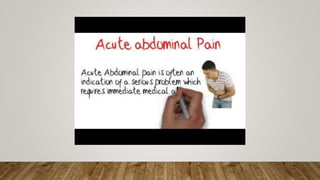
• Acute abdominal pain accounts for 7–10% of all Emergency
Department visits.
• The most frequent causes is nonspecific abdominal pain
(accounting for about one-thirds of all acute abdominal pain and is
more prevalent in women
• The diagnosis and treatment of acute abdominal pain is a
collaborative effort, often starting in the emergency department.
PATHOPHYSIOLOGY
PATHOPHYSIOLOGY
• Acute conditions of the abdomen are produced by inflammatory,
obstructive, or vascular mechanisms.
• They are manifested by sudden onset of abdominal pain,
gastrointestinal symptoms and varying degrees of local and
systemic reaction.
PATHOPHYSIOLOGY (CONT)
Inflammatory causes of an acute abdomen: These may be divided
into two subgroups:
• 1) Bacterial – examples would include acute appendicitis,
diverticulitis, and some cases of pelvic inflammatory disease.
• 2) Chemical – for example a perforation of a peptic ulcer, where
spillage of acid gastric contents causes an intense peritoneal
reaction.
PATHOPHYSIOLOGY (CONT)
Mechanical causes of an acute abdomen:
• These include such obstructive conditions as incarcerated hernia,
post-operative adhesions, intussusception, malrotation of the gut
with volvulus, congenital atresia or stenosis of the gut.
• The most common cause of large bowel mechanical obstruction is
carcinoma of the colon.
PATHOPHYSIOLOGY (CONT)
• Vascular: When the blood supply is cut off, necrosis of tissue results,
with gangrene of the bowel.
• Examples include mesenteric arterial thrombosis or embolism.
• Congenital defects: These can produce an acute abdominal surgical
emergency any time from birth
• Examples include duodenal atresia, omphalocele or diaphragmatic
hernia and others like chronic malrotation of the intestine.
HISTORY & PHYSICAL EXAMINATION OF
AN ACUTE ABDOMIN
PAIN!
• Pain is the most prominent presenting complaint in a patient with
an acute abdomen
• It is important to know the origin, location, progression, radiation
and character of abdominal pain in order to understand its
significance.
• Less likely causes can also be systemically eliminated using the
above
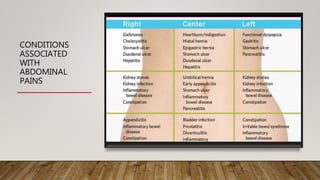
CONDITIONS
ASSOCIATED
WITH
ABDOMINAL
PAINS
ORIGIN OF PAIN
• Three types of pain identified: Visceral, Parietal and Referred
1. Visceral Pain
• Due to stretching of fibres innervating the walls of hollow or solid
organs.
• It occurs early and poorly localized
• It can be due to early ischemia or inflammation.
ORIGIN OF PAIN, CONT.
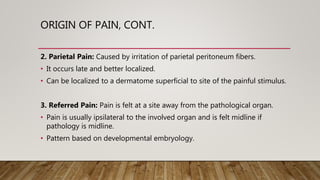
2. Parietal Pain: Caused by irritation of parietal peritoneum fibers.
• It occurs late and better localized.
• Can be localized to a dermatome superficial to site of the painful stimulus.
3. Referred Pain: Pain is felt at a site away from the pathological organ.
• Pain is usually ipsilateral to the involved organ and is felt midline if
pathology is midline.
• Pattern based on developmental embryology.
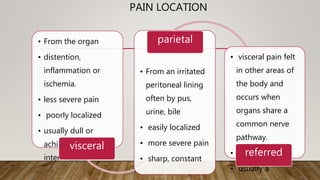
PAIN LOCATION
• From the organ
• distention,
inflammation or
ischemia.
• less severe pain
• poorly localized
• usually dull or
aching, constant or
intermittent
visceral
• From an irritated
peritoneal lining
often by pus,
urine, bile
• easily localized
• more severe pain
• sharp, constant
parietal
• visceral pain felt
in other areas of
the body and
occurs when
organs share a
common nerve
pathway.
• poorly localized
• usually a
referred
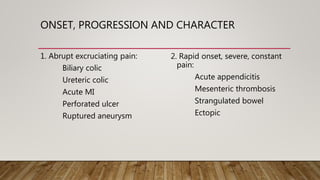
ONSET, PROGRESSION AND CHARACTER
1. Abrupt excruciating pain:
Biliary colic
Ureteric colic
Acute MI
Perforated ulcer
Ruptured aneurysm
2. Rapid onset, severe, constant
pain:
Acute appendicitis
Mesenteric thrombosis
Strangulated bowel
Ectopic
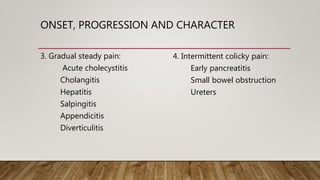
ONSET, PROGRESSION AND CHARACTER
3. Gradual steady pain:
Acute cholecystitis
Cholangitis
Hepatitis
Salpingitis
Appendicitis
Diverticulitis
4. Intermittent colicky pain:
Early pancreatitis
Small bowel obstruction
Ureters
VOMITING
• Reflex, or irritative non-specific vomiting
occurs in many conditions; and a
Prominent symptom in upper GI disease
• For Surgical abdomen, pain usually
precedes vomiting.
• Bowel obstruction: onset and character of
vomiting may suggest level
OTHERS INCLUDE:
Diarrhoea
• most common with acute gastroenteritis or food poisoning, but it
may occur with appendicitis or other focal inflammatory lesions of
the gut
Constipation or obstipation
• With complete small bowel obstruction - unrelenting constipation
(obstipation) after fecal material below obstruction has been
passed. Progressive constipation with carcinoma of the large bowel.
Gas stoppage with decreased or absent bowel sounds – paralytic
ileus
HISTORICAL FEATURES OF ABD PAIN
• Location, quality, severity, onset, and duration of pain, aggravating
and alleviating factors
• Gastrointestinal symptoms (Nausea/Vomiting/Diarrhoea)
• Genitourinary symptoms
• Vascular symptoms (Atrial fibrillation / Acute Myocardial Infarction /
Abdominal Aortic Aneurysm)
• Can overlap i.e. Nausea seen in both GI / GU pathologies.
PAST MEDICAL HSITORY
• Recent / current medications
• Past hospitalizations
• Past surgery
• Chronic disease
• Social history
• Occupation / Toxic exposure
(CO / lead)
• Gynaecological:
• Menstrual history
• Endometriosis
•Vaginal discharge
•Dysmenorrhea
• Travel history
• Drug and alcohol history
PHYSICAL EXAMINATION
• Note patients’ general appearance.
• Note that the intensity of the abdominal pain may have no
relationship to severity of illness.
• One of the initial steps is obtaining and interpreting the vitals.
• Patients with visceral pain are unable to lie still.
• Patients with peritonitis like to stay immobile.
PHYSICAL EXAMINATION CONT.
• Do not focus on the abdomen only – look for specific signs that confirm or rule out
other possibilities
General observation:
• Is the patient writhing (in visceral pain) or motionless (in parietal pain)?
Systemic signs:
• Pallor, Tachycardia, Hypothermia, Tachypnoea, Sweating, Fever, Associated
disorientation and lethargy
• Ps, fever is often mild or absent in established shock.
PHYSICAL EXAMINATION CONT.
• LOOK – INSPECT for abdominal distention, peristalsis, scars, masses, rash.
• PALPATION – to look for guarding, rigidity, rebound tenderness, organomegaly,
or hernias, Murphy’s
• PERCUSSION – tenderness, rebound, shifting dullness
• AUSCULATE for hyperactive, obstructive, absent, or normal bowel sounds.
• Women should have pelvic examination.
• Anyone with a rectum should have rectal examination (If no rectum check the
ostomy).
• Cough to elicit pain: parietal pain generally has pain on coughing
PHYSICAL EXAMINATION CONT
• Severe abdominal pain in patients who have been fairly well, and which
persists as long as six hours.
• Localized peritoneal inflammation – Persistent localized tenderness with
muscle spasm, indicative of. The tenderness may be best determined by
rectal or pelvic exam.
• Obstruction of a hollow viscus – Characteristic, severe, intermittent
cramping, colicky pain.
• Small bowel obstruction - Repeated vomiting of copious amounts of bile-
stained or faecal material.
PHYSICAL EXAMINATION CONT
• Small intestinal obstruction – Markedly hyperactive bowel sounds.
• Paralytic ileus – Decreased to absent bowel sounds.
• Paralytic ileus not secondary to other abdominal pathology is treated
non-surgically.
• Paralytic ileus as an end-result of mechanical small bowel obstruction or
perforated duodenal ulcer requires surgical intervention to relieve the
underlying pathology.
PHYSICAL EXAMINATION CONT
• Small bowel obstruction – distended loops of small bowel above the
level of obstruction in with absence of gas below by x-ray
• generalized distention of large and small bowel - paralytic ileus
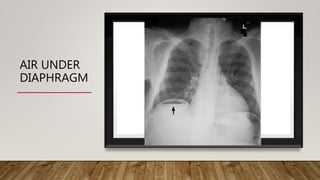
• Perforation of a hollow viscus – e.g. a duodenal ulcer – free air under
diaphragm in an upright X-ray film
• Acute pancreatitis – Markedly elevated serum amylase levels
PHYSICAL EXAMINATION CONT
• Palpation of a mass.
• In RLQ or RUQ - with intussusception.
• Adnexal mass by pelvic exam - ectopic pregnancy.
• Tender and thickened adnexae by pelvic in PID.
• An irreducible incarcerated inguinal hernia.
• A tender RLQ mass by abdominal palpation or rectal exam appendiceal
abscess.
LABORATORY / RADIOGRAPHIC TEST
FOR ABDOMINAL PAIN
LABORATORY TEST
• Full Blood Count (WCC is significant if raised)
• UEC / CMP
• ABG – in hypotension, generalised peritonitis, pancreatitis,
ischaemic bowel, septicaemia
• Amylase – mildly elevated with perforated peptic ulcer, strangulated
or ischaemic bowel, 3x normal for pancreatitis
• LFT – may distinguish medical from surgical conditions
LABORATORY TEST
• Urinalysis / Urine MC&S
• Blood glucose
• Cardiac Enzymes / Troponin
• b-HCG (ICON / Quantitative)
• Lactic acid
• Stool MC&S
• Group and Crossmatch blood if indicated
ERECT CHEST X-RAY
• Pre-operative assessment
• Exclude supra-diaphragmatic lesions that simulate acute abdomen
• Elevated hemidiaphragm or effusion = subphrenic inflammatory
lesions
• Air under diaphragm
AIR UNDER
DIAPHRAGM
ABDOMINAL X-RAY
• Supine views
• Size of bowel- distention
• Where is the bowel distended?
Centrally tends to be small
bowel
• Air fluid levels
• Haustra or vina coniventese
• Erect view
• little information except in
suspected obstruction
• Air in the rectum?
• Foreign body
• Renal or ureteric calculi
SMALL BOWEL
OBSTRUCTION
ULTRASONOGRAPHY
• Upper abdominal pain not resembling ulcer pain or bowel
obstruction
• Abdominal masses
• Helpful in acute appendicitis, pregnant or young woman with mid
or lower abdominal pain.
• CT more helpful in patients with  bowel gas
• CT scan in conjunction with ultrasound is superior in identifying any
abnormality seen on plain film.
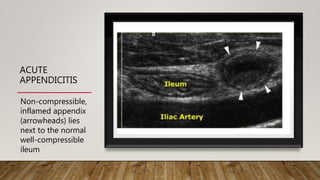
ACUTE
APPENDICITIS
Non-compressible,
inflamed appendix
(arrowheads) lies
next to the normal
well-compressible
ileum
OTHER IMAGING MODALITIES
Angiography
• If intestinal ischaemia or haemorrhage suspected
Contrast X-ray
• Gastrograffin for suspected upper GI perforation.
• Barium enema may identify site of large bowel obstruction,
intussusception or sigmoid volvulus.
CT SCAN
• Becoming more readily available
• Useful in patients who don’t have clear indication for surgery
• May prompt or postpone operation
ENDOSCOPY
Proctosigmoidoscopy
• Any patient with suspected large bowel obstruction, excessively
bloody stool or rectal mass.
• May reduce sigmoid volvulus
Gastroscopy and ERCP
• Usually less urgently performed
• More in patients with mostly inflammatory conditions.
LAPAROSCOPY
• Also a diagnostic tool
• Especially young females e.g. to distinguish appendicitis from other
non-surgical problems
DIFFERENTIAL DIAGNOSIS
DIFFERENTIAL DIAGNOSIS OF AN ACUTE ABDOMEN
• GIT disorders
• Liver Spleen and Biliary disorders
• Pancreatic disorders
• Urinary tract disorders
• Gynaecological disorders
• Vascular disorders
• Peritoneal disorders
• Retroperitoneal disorders
GIT DISORDERS
• Appendicitis – especially in children
• Small and large bowel obstruction
• Perforated peptic ulcer
• Incarcerated hernia
• Bowel perforation
• Diverticulitis
• Gastroenteritis
• Acute gastritis
• Parasitic infections
LIVER, SPLEEN, PANCREAS AND OTHER BILIARY
DISORDERS
• Acute cholecystitis
• Acute cholangitis
• Hepatic abscess
• Ruptured hepatic tumour
• Biliary colic
• Acute hepatitis
• Acute Pancreatitis
URINARY TRACT DISORDERS
• Ureteral or renal colic
• Acute pyelonephritis
• Acute cystitis
• Renal infarct
GYNECOLOGICAL DISORDERS
• Ruptured ectopic
• Dysmenorrhea
• Endometriosis
• Twisted ovarian tumors
• Ruptured ovarian follicle cyst
• Acute salpingitis
VASCULAR DISORDERS
• Ruptured aortic or visceral aneurysm
• Acute ischaemic colitis
• Mesenteric thrombosis
MEDICAL CAUSES OF ACUTE ABDOMEN
• Endocrine and metabolic
• Uremia
• Diabetic crisis
• Porphyria
• Acute hyperlipoproteinemia
• Haematologic disorders:
• Acute leukemia
• Sickle cell crisis
• Toxins and drugs:
• Lead and other heavy metal poisoning
• Narcotic withdrawal
• Black widow spider poisoning
INFECTIONS AND INFLAMMATORY DISORDERS
• Tabes dorsalis
• Herpes Zoster
• Acute Rheumatic fever
• Henoch-Schonlein purpura
• SLE
REFERRED PAIN
• Myocardial Infarction
• Acute pericarditis
• Pneumonia
• Pulmonary Embolism
• Pneumothorax
• Conditions of the hip and back
INDICATIONS FOR SURGICAL
EXPLORATION
INDICATIONS FOR SURGICAL EXPLORATION
• Surgery is sometimes necessary without precise diagnosis
• Physical findings that indicate laparotomy:
• Involuntary guarding or rigidity
• Increasing or severe localised tenderness
• Tense or progressive distension of abdomen
• Tense abdomen or rectal mass with ↑fever
• Rectal bleeding with shock or acidosis
INDICATIONS FOR SURGICAL EXPLORATION
(CONT.)
• Endoscopic findings:
• Perforated or uncontrollable bleeding lesion
• Radiological findings:
• Pneumoperitoneum
• Gross or progressive bowel distension (obstruction)
• Free extravasation of contrast (perforations)
• Mesenteric occlusion
INDICATIONS FOR SURGICAL EXPLORATION
(CONT.)
• Paracentesis
• Blood
• Bile
• Pus
• Bowel content
• urine
TREATMENT OF ACUTE ABDOMINAL
PAIN
TREAT HYPOTENSION
• If due to volume depletion from vomiting, diarrhea, decreased
oral intake or third spacing.
• Treatment would be isotonic crystalloid.
• If associated with abdominal sepsis (septic shock).
• Treatment would include isotonic crystalloid, antibiotics, and
vasopressors (levophed or dopamine).
PAIN MANAGEMENT
• Emergency Room physicians did not treat acute abdominal pain with
analgesics for fear of altering or obscuring the diagnosis.
• Current literature however favours the use of opioids judiciously in these
patients.
• Do not withhold analgesia
• Moderate doses don’t obscure or mask physical findings
• Abdominal masses may become apparent
• Pain in spite of adequate analgesia suggests serious condition
ANTIBIOTICS
• Must be consider when treating suspected abdominal sepsis or diffuse
peritonitis.
• Coverage should be aimed at anaerobes and aerobic gram negatives.
• If Spontaneous Bacterial Peritonitis: suspected, must cover for gram
positive aerobes.
• Examples of monotherapy are ceftriaxone, cefoxitin, cefotetan, ampicillin-
clavulanate, ampicillin-sulbactam, ticarcillin-clavulanate etc.
INDICATIONS FOR ADMISSIONS:
• Manage As indicated
• Other Indications for Admissions:
• Pts who appear ill.
• Very young / Elderly
• Immunocompromised
• Unclear diagnosis
• Intractable pain, nausea, or vomiting
• Altered mental status
• Those using drugs, alcohol, or that lack social support.
• Pts with poor follow-up and/or noncompliant.
• Non-specific abdominal pain
• If this is the working diagnosis, patients must be re-examined in
24 hours.
• This may be done in the outpatient setting.
THANK YOU FOR LISTENING

Acute Abdomen by Dr KD DELE

  • 1.
    ACUTE ABDOMEN BY DRKD DELE DEPARTMENT OF FAMILY MEDICINE DORA NGINZA HOSPITAL
  • 2.
    OUTLINE – ACUTEABDOMINAL PAIN • Definition • Epidemiology • Pathophysiology • History / Physical Exam of Abdominal Pain • Laboratory / Radiographic Test for Abdominal Pain • Differential Diagnosis of an Acute Abdomen • Indications for Surgical Exploration • Treatment • Disposition
  • 4.
  • 5.
    DEFINITION • “An acuteabdomen” denotes any sudden, spontaneous, nontraumatic disorder whose chief manifestation is in the abdominal area and for which urgent operation may be necessary. • (alt) Sudden, spontaneous severe abdominal pain, tenderness and muscular rigidity that is less than 24 hours in duration which may require emergency surgery… • Because there is frequently a progressive underlying intra-abdominal disorder, undue delay in diagnosis and treatment adversely affects outcome.
  • 6.
    EPIDEMIOLOGY • Acute abdominalpain accounts for 7–10% of all Emergency Department visits. • The most frequent causes is nonspecific abdominal pain (accounting for about one-thirds of all acute abdominal pain and is more prevalent in women • The diagnosis and treatment of acute abdominal pain is a collaborative effort, often starting in the emergency department.
  • 7.
  • 8.
    PATHOPHYSIOLOGY • Acute conditionsof the abdomen are produced by inflammatory, obstructive, or vascular mechanisms. • They are manifested by sudden onset of abdominal pain, gastrointestinal symptoms and varying degrees of local and systemic reaction.
  • 9.
    PATHOPHYSIOLOGY (CONT) Inflammatory causesof an acute abdomen: These may be divided into two subgroups: • 1) Bacterial – examples would include acute appendicitis, diverticulitis, and some cases of pelvic inflammatory disease. • 2) Chemical – for example a perforation of a peptic ulcer, where spillage of acid gastric contents causes an intense peritoneal reaction.
  • 10.
    PATHOPHYSIOLOGY (CONT) Mechanical causesof an acute abdomen: • These include such obstructive conditions as incarcerated hernia, post-operative adhesions, intussusception, malrotation of the gut with volvulus, congenital atresia or stenosis of the gut. • The most common cause of large bowel mechanical obstruction is carcinoma of the colon.
  • 11.
    PATHOPHYSIOLOGY (CONT) • Vascular:When the blood supply is cut off, necrosis of tissue results, with gangrene of the bowel. • Examples include mesenteric arterial thrombosis or embolism. • Congenital defects: These can produce an acute abdominal surgical emergency any time from birth • Examples include duodenal atresia, omphalocele or diaphragmatic hernia and others like chronic malrotation of the intestine.
  • 12.
    HISTORY & PHYSICALEXAMINATION OF AN ACUTE ABDOMIN
  • 13.
    PAIN! • Pain isthe most prominent presenting complaint in a patient with an acute abdomen • It is important to know the origin, location, progression, radiation and character of abdominal pain in order to understand its significance. • Less likely causes can also be systemically eliminated using the above
  • 14.
  • 15.
    ORIGIN OF PAIN •Three types of pain identified: Visceral, Parietal and Referred 1. Visceral Pain • Due to stretching of fibres innervating the walls of hollow or solid organs. • It occurs early and poorly localized • It can be due to early ischemia or inflammation.
  • 16.
    ORIGIN OF PAIN,CONT. 2. Parietal Pain: Caused by irritation of parietal peritoneum fibers. • It occurs late and better localized. • Can be localized to a dermatome superficial to site of the painful stimulus. 3. Referred Pain: Pain is felt at a site away from the pathological organ. • Pain is usually ipsilateral to the involved organ and is felt midline if pathology is midline. • Pattern based on developmental embryology.
  • 17.
    PAIN LOCATION • Fromthe organ • distention, inflammation or ischemia. • less severe pain • poorly localized • usually dull or aching, constant or intermittent visceral • From an irritated peritoneal lining often by pus, urine, bile • easily localized • more severe pain • sharp, constant parietal • visceral pain felt in other areas of the body and occurs when organs share a common nerve pathway. • poorly localized • usually a referred
  • 18.
    ONSET, PROGRESSION ANDCHARACTER 1. Abrupt excruciating pain: Biliary colic Ureteric colic Acute MI Perforated ulcer Ruptured aneurysm 2. Rapid onset, severe, constant pain: Acute appendicitis Mesenteric thrombosis Strangulated bowel Ectopic
  • 19.
    ONSET, PROGRESSION ANDCHARACTER 3. Gradual steady pain: Acute cholecystitis Cholangitis Hepatitis Salpingitis Appendicitis Diverticulitis 4. Intermittent colicky pain: Early pancreatitis Small bowel obstruction Ureters
  • 20.
    VOMITING • Reflex, orirritative non-specific vomiting occurs in many conditions; and a Prominent symptom in upper GI disease • For Surgical abdomen, pain usually precedes vomiting. • Bowel obstruction: onset and character of vomiting may suggest level
  • 21.
    OTHERS INCLUDE: Diarrhoea • mostcommon with acute gastroenteritis or food poisoning, but it may occur with appendicitis or other focal inflammatory lesions of the gut Constipation or obstipation • With complete small bowel obstruction - unrelenting constipation (obstipation) after fecal material below obstruction has been passed. Progressive constipation with carcinoma of the large bowel. Gas stoppage with decreased or absent bowel sounds – paralytic ileus
  • 22.
    HISTORICAL FEATURES OFABD PAIN • Location, quality, severity, onset, and duration of pain, aggravating and alleviating factors • Gastrointestinal symptoms (Nausea/Vomiting/Diarrhoea) • Genitourinary symptoms • Vascular symptoms (Atrial fibrillation / Acute Myocardial Infarction / Abdominal Aortic Aneurysm) • Can overlap i.e. Nausea seen in both GI / GU pathologies.
  • 23.
    PAST MEDICAL HSITORY •Recent / current medications • Past hospitalizations • Past surgery • Chronic disease • Social history • Occupation / Toxic exposure (CO / lead) • Gynaecological: • Menstrual history • Endometriosis •Vaginal discharge •Dysmenorrhea • Travel history • Drug and alcohol history
  • 24.
    PHYSICAL EXAMINATION • Notepatients’ general appearance. • Note that the intensity of the abdominal pain may have no relationship to severity of illness. • One of the initial steps is obtaining and interpreting the vitals. • Patients with visceral pain are unable to lie still. • Patients with peritonitis like to stay immobile.
  • 25.
    PHYSICAL EXAMINATION CONT. •Do not focus on the abdomen only – look for specific signs that confirm or rule out other possibilities General observation: • Is the patient writhing (in visceral pain) or motionless (in parietal pain)? Systemic signs: • Pallor, Tachycardia, Hypothermia, Tachypnoea, Sweating, Fever, Associated disorientation and lethargy • Ps, fever is often mild or absent in established shock.
  • 26.
    PHYSICAL EXAMINATION CONT. •LOOK – INSPECT for abdominal distention, peristalsis, scars, masses, rash. • PALPATION – to look for guarding, rigidity, rebound tenderness, organomegaly, or hernias, Murphy’s • PERCUSSION – tenderness, rebound, shifting dullness • AUSCULATE for hyperactive, obstructive, absent, or normal bowel sounds. • Women should have pelvic examination. • Anyone with a rectum should have rectal examination (If no rectum check the ostomy). • Cough to elicit pain: parietal pain generally has pain on coughing
  • 27.
    PHYSICAL EXAMINATION CONT •Severe abdominal pain in patients who have been fairly well, and which persists as long as six hours. • Localized peritoneal inflammation – Persistent localized tenderness with muscle spasm, indicative of. The tenderness may be best determined by rectal or pelvic exam. • Obstruction of a hollow viscus – Characteristic, severe, intermittent cramping, colicky pain. • Small bowel obstruction - Repeated vomiting of copious amounts of bile- stained or faecal material.
  • 28.
    PHYSICAL EXAMINATION CONT •Small intestinal obstruction – Markedly hyperactive bowel sounds. • Paralytic ileus – Decreased to absent bowel sounds. • Paralytic ileus not secondary to other abdominal pathology is treated non-surgically. • Paralytic ileus as an end-result of mechanical small bowel obstruction or perforated duodenal ulcer requires surgical intervention to relieve the underlying pathology.
  • 29.
    PHYSICAL EXAMINATION CONT •Small bowel obstruction – distended loops of small bowel above the level of obstruction in with absence of gas below by x-ray • generalized distention of large and small bowel - paralytic ileus • Perforation of a hollow viscus – e.g. a duodenal ulcer – free air under diaphragm in an upright X-ray film • Acute pancreatitis – Markedly elevated serum amylase levels
  • 30.
    PHYSICAL EXAMINATION CONT •Palpation of a mass. • In RLQ or RUQ - with intussusception. • Adnexal mass by pelvic exam - ectopic pregnancy. • Tender and thickened adnexae by pelvic in PID. • An irreducible incarcerated inguinal hernia. • A tender RLQ mass by abdominal palpation or rectal exam appendiceal abscess.
  • 31.
    LABORATORY / RADIOGRAPHICTEST FOR ABDOMINAL PAIN
  • 32.
    LABORATORY TEST • FullBlood Count (WCC is significant if raised) • UEC / CMP • ABG – in hypotension, generalised peritonitis, pancreatitis, ischaemic bowel, septicaemia • Amylase – mildly elevated with perforated peptic ulcer, strangulated or ischaemic bowel, 3x normal for pancreatitis • LFT – may distinguish medical from surgical conditions
  • 33.
    LABORATORY TEST • Urinalysis/ Urine MC&S • Blood glucose • Cardiac Enzymes / Troponin • b-HCG (ICON / Quantitative) • Lactic acid • Stool MC&S • Group and Crossmatch blood if indicated
  • 34.
    ERECT CHEST X-RAY •Pre-operative assessment • Exclude supra-diaphragmatic lesions that simulate acute abdomen • Elevated hemidiaphragm or effusion = subphrenic inflammatory lesions • Air under diaphragm
  • 35.
  • 36.
    ABDOMINAL X-RAY • Supineviews • Size of bowel- distention • Where is the bowel distended? Centrally tends to be small bowel • Air fluid levels • Haustra or vina coniventese • Erect view • little information except in suspected obstruction • Air in the rectum? • Foreign body • Renal or ureteric calculi
  • 37.
  • 38.
    ULTRASONOGRAPHY • Upper abdominalpain not resembling ulcer pain or bowel obstruction • Abdominal masses • Helpful in acute appendicitis, pregnant or young woman with mid or lower abdominal pain. • CT more helpful in patients with  bowel gas • CT scan in conjunction with ultrasound is superior in identifying any abnormality seen on plain film.
  • 39.
  • 40.
    OTHER IMAGING MODALITIES Angiography •If intestinal ischaemia or haemorrhage suspected Contrast X-ray • Gastrograffin for suspected upper GI perforation. • Barium enema may identify site of large bowel obstruction, intussusception or sigmoid volvulus.
  • 41.
    CT SCAN • Becomingmore readily available • Useful in patients who don’t have clear indication for surgery • May prompt or postpone operation
  • 42.
    ENDOSCOPY Proctosigmoidoscopy • Any patientwith suspected large bowel obstruction, excessively bloody stool or rectal mass. • May reduce sigmoid volvulus Gastroscopy and ERCP • Usually less urgently performed • More in patients with mostly inflammatory conditions.
  • 43.
    LAPAROSCOPY • Also adiagnostic tool • Especially young females e.g. to distinguish appendicitis from other non-surgical problems
  • 44.
  • 45.
    DIFFERENTIAL DIAGNOSIS OFAN ACUTE ABDOMEN • GIT disorders • Liver Spleen and Biliary disorders • Pancreatic disorders • Urinary tract disorders • Gynaecological disorders • Vascular disorders • Peritoneal disorders • Retroperitoneal disorders
  • 46.
    GIT DISORDERS • Appendicitis– especially in children • Small and large bowel obstruction • Perforated peptic ulcer • Incarcerated hernia • Bowel perforation • Diverticulitis • Gastroenteritis • Acute gastritis • Parasitic infections
  • 47.
    LIVER, SPLEEN, PANCREASAND OTHER BILIARY DISORDERS • Acute cholecystitis • Acute cholangitis • Hepatic abscess • Ruptured hepatic tumour • Biliary colic • Acute hepatitis • Acute Pancreatitis
  • 48.
    URINARY TRACT DISORDERS •Ureteral or renal colic • Acute pyelonephritis • Acute cystitis • Renal infarct
  • 49.
    GYNECOLOGICAL DISORDERS • Rupturedectopic • Dysmenorrhea • Endometriosis • Twisted ovarian tumors • Ruptured ovarian follicle cyst • Acute salpingitis
  • 50.
    VASCULAR DISORDERS • Rupturedaortic or visceral aneurysm • Acute ischaemic colitis • Mesenteric thrombosis
  • 51.
    MEDICAL CAUSES OFACUTE ABDOMEN • Endocrine and metabolic • Uremia • Diabetic crisis • Porphyria • Acute hyperlipoproteinemia • Haematologic disorders: • Acute leukemia • Sickle cell crisis
  • 52.
    • Toxins anddrugs: • Lead and other heavy metal poisoning • Narcotic withdrawal • Black widow spider poisoning
  • 53.
    INFECTIONS AND INFLAMMATORYDISORDERS • Tabes dorsalis • Herpes Zoster • Acute Rheumatic fever • Henoch-Schonlein purpura • SLE
  • 54.
    REFERRED PAIN • MyocardialInfarction • Acute pericarditis • Pneumonia • Pulmonary Embolism • Pneumothorax • Conditions of the hip and back
  • 55.
  • 56.
    INDICATIONS FOR SURGICALEXPLORATION • Surgery is sometimes necessary without precise diagnosis • Physical findings that indicate laparotomy: • Involuntary guarding or rigidity • Increasing or severe localised tenderness • Tense or progressive distension of abdomen • Tense abdomen or rectal mass with ↑fever • Rectal bleeding with shock or acidosis
  • 57.
    INDICATIONS FOR SURGICALEXPLORATION (CONT.) • Endoscopic findings: • Perforated or uncontrollable bleeding lesion • Radiological findings: • Pneumoperitoneum • Gross or progressive bowel distension (obstruction) • Free extravasation of contrast (perforations) • Mesenteric occlusion
  • 58.
    INDICATIONS FOR SURGICALEXPLORATION (CONT.) • Paracentesis • Blood • Bile • Pus • Bowel content • urine
  • 59.
    TREATMENT OF ACUTEABDOMINAL PAIN
  • 60.
    TREAT HYPOTENSION • Ifdue to volume depletion from vomiting, diarrhea, decreased oral intake or third spacing. • Treatment would be isotonic crystalloid. • If associated with abdominal sepsis (septic shock). • Treatment would include isotonic crystalloid, antibiotics, and vasopressors (levophed or dopamine).
  • 61.
    PAIN MANAGEMENT • EmergencyRoom physicians did not treat acute abdominal pain with analgesics for fear of altering or obscuring the diagnosis. • Current literature however favours the use of opioids judiciously in these patients. • Do not withhold analgesia • Moderate doses don’t obscure or mask physical findings • Abdominal masses may become apparent • Pain in spite of adequate analgesia suggests serious condition
  • 62.
    ANTIBIOTICS • Must beconsider when treating suspected abdominal sepsis or diffuse peritonitis. • Coverage should be aimed at anaerobes and aerobic gram negatives. • If Spontaneous Bacterial Peritonitis: suspected, must cover for gram positive aerobes. • Examples of monotherapy are ceftriaxone, cefoxitin, cefotetan, ampicillin- clavulanate, ampicillin-sulbactam, ticarcillin-clavulanate etc.
  • 63.
    INDICATIONS FOR ADMISSIONS: •Manage As indicated • Other Indications for Admissions: • Pts who appear ill. • Very young / Elderly • Immunocompromised • Unclear diagnosis • Intractable pain, nausea, or vomiting • Altered mental status • Those using drugs, alcohol, or that lack social support. • Pts with poor follow-up and/or noncompliant.
  • 64.
    • Non-specific abdominalpain • If this is the working diagnosis, patients must be re-examined in 24 hours. • This may be done in the outpatient setting.
  • 65.
    THANK YOU FORLISTENING