Circuit Analysis (EE-126)
Engr. Dr. Raja Masood Larik
rmlarik@neduet.edu.pk
• Class code: ak3xqba
MEET LINK: https://meet.google.com/lookup/g6rnx4hvb2
• B.E (Electrical Engineering), NED University of Engineering & Technology Karachi, Sindh-Pakistan. 1998.
• M.Engg (Electrical Engineering, CGPA 3.45/4.00), NED University of Engineering& Technology Karachi,
Sindh-Pakistan. 2006
• Doctor of Philosophy (Electrical Engineering) from University Technology Malaysia (UTM). CGPA
3.67/4.00 2019.
• Dr. Larik (Google Scholar Profile)
• https://scholar.google.com/citations?hl=en&user=7z1g_I0AAAAJ
Lecture Notes by Dr.R.M.Larik 1
• Engineering Circuit Analysis by William H. Hayt 8th edition (Text Book)
• Fundamentals of Electric circuits by Charles k Alexander (Reference Book)
• Introduction to Electric Circuits by Dorf, Richard C (Reference Book)
• Electric Circuits by Nilsson, James W (Reference BooK)
• Concepts in Electric circuits by Dr.Wasim Naseem (Reference BooK)
• Electric Circuits by Theodore F.Bogart (Reference BooK)
• Electric Circuits by H.Alex Romanowitz (Reference BooK)
Lecture Notes by Dr.R.M.Larik 2
1.Poly Phase Circuits
2.Magnetically Coupled Circuits
3.Two Port Networks
Poly Phase circuits
➢ Balance Three Phase Voltages
➢ Balance Wye Wye Connection
➢ Balanced Wye-Delta Connection
➢ Balanced Delta-Delta Connection
➢ Balanced Delta-Wye Connection
➢ Power in Balanced System
➢ Unbalanced Three Phase Systems
Lecture Notes by Dr.R.M.Larik 3
Poly Phase Circuits
Learning Outcomes
▪ Be Familiar with ac single and three phase system
▪ The basics of ac generation from source (Generators/alternator)
▪ The basic difference between balanced and unbalanced three-phase system
▪ To analyse three phase circuits
▪ Connection pattern for three phase i.e. star/delta
Lecture Notes by Dr.R.M.Larik 4
AC Generation
Three things must be present in order to produce electrical current:
a) Magnetic field
b) Conductor
c) Relative motion
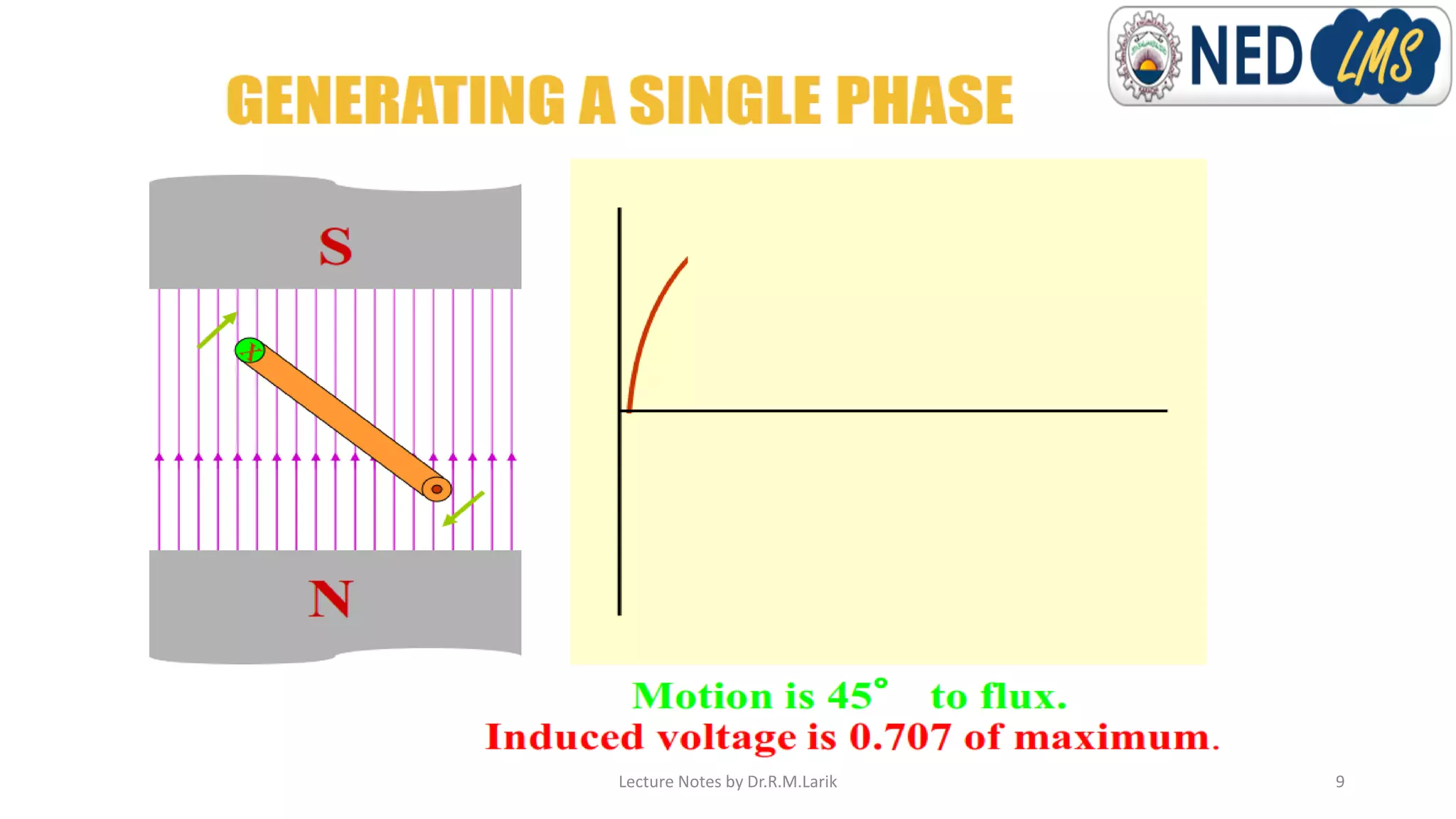
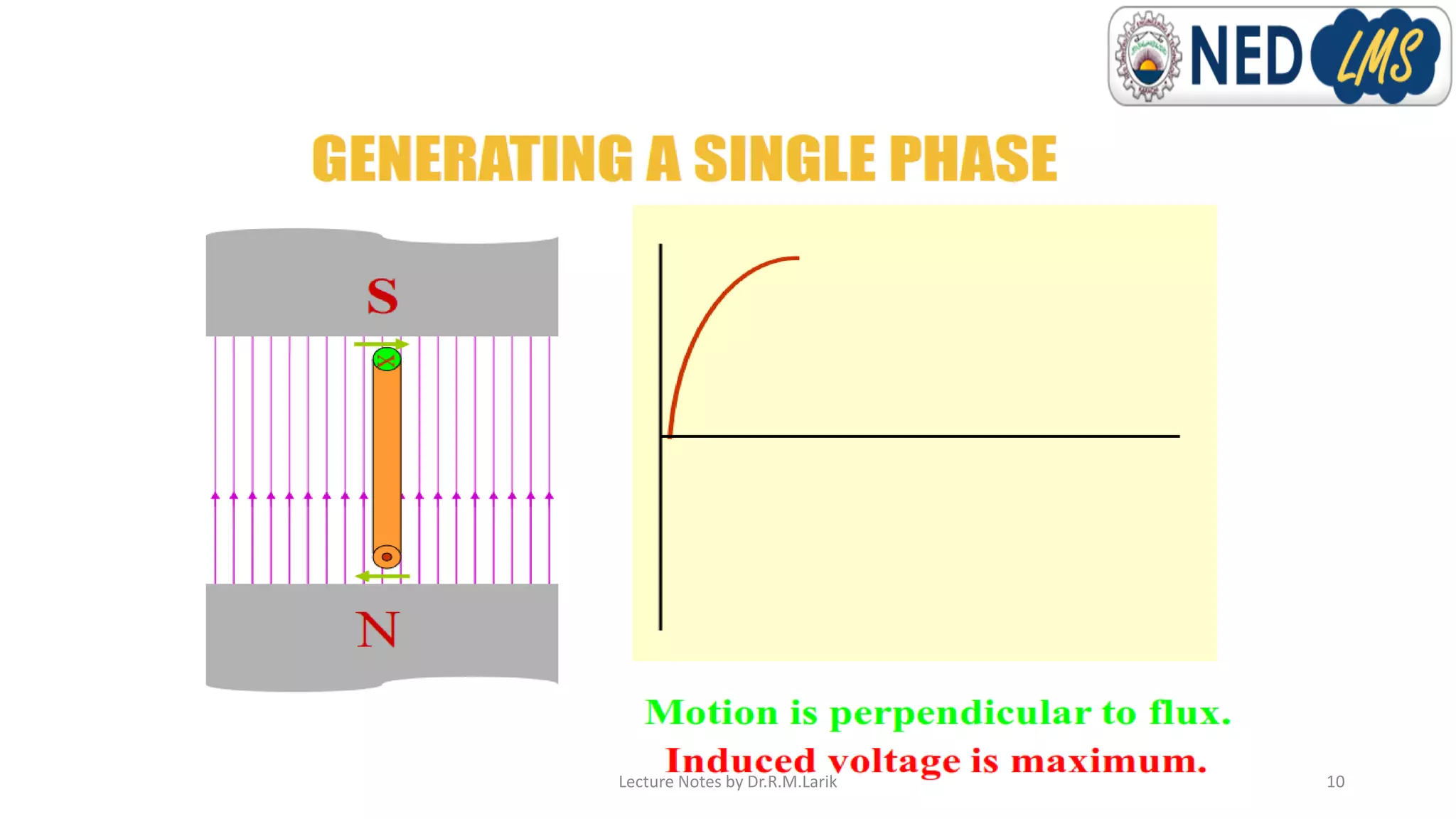
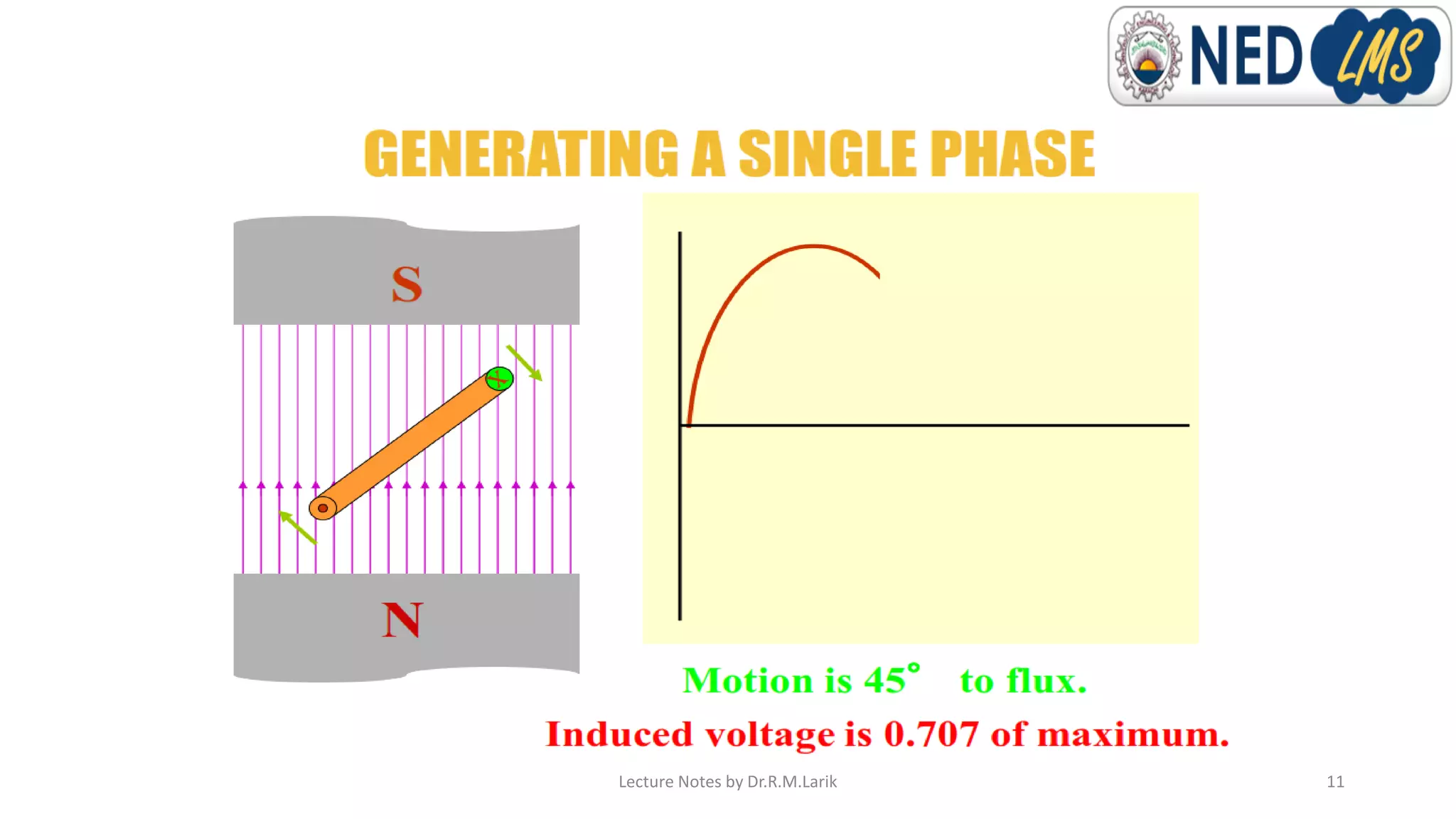
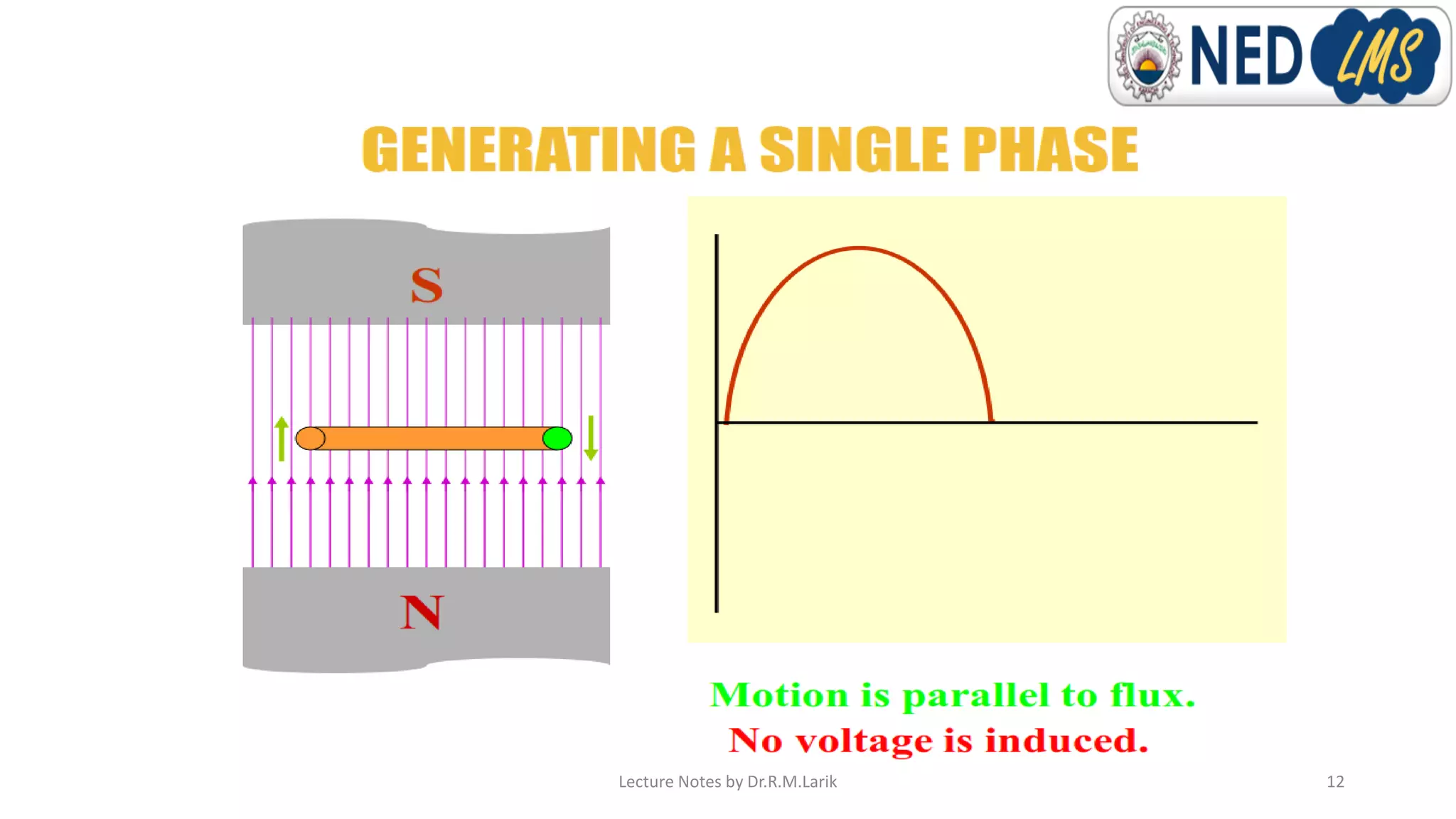
▪ Conductor cuts lines of magnetic flux, a voltage is induced in the conductor
Direction and Speed are important
Lecture Notes by Dr.R.M.Larik 5
What is 1 and 3 Phase?
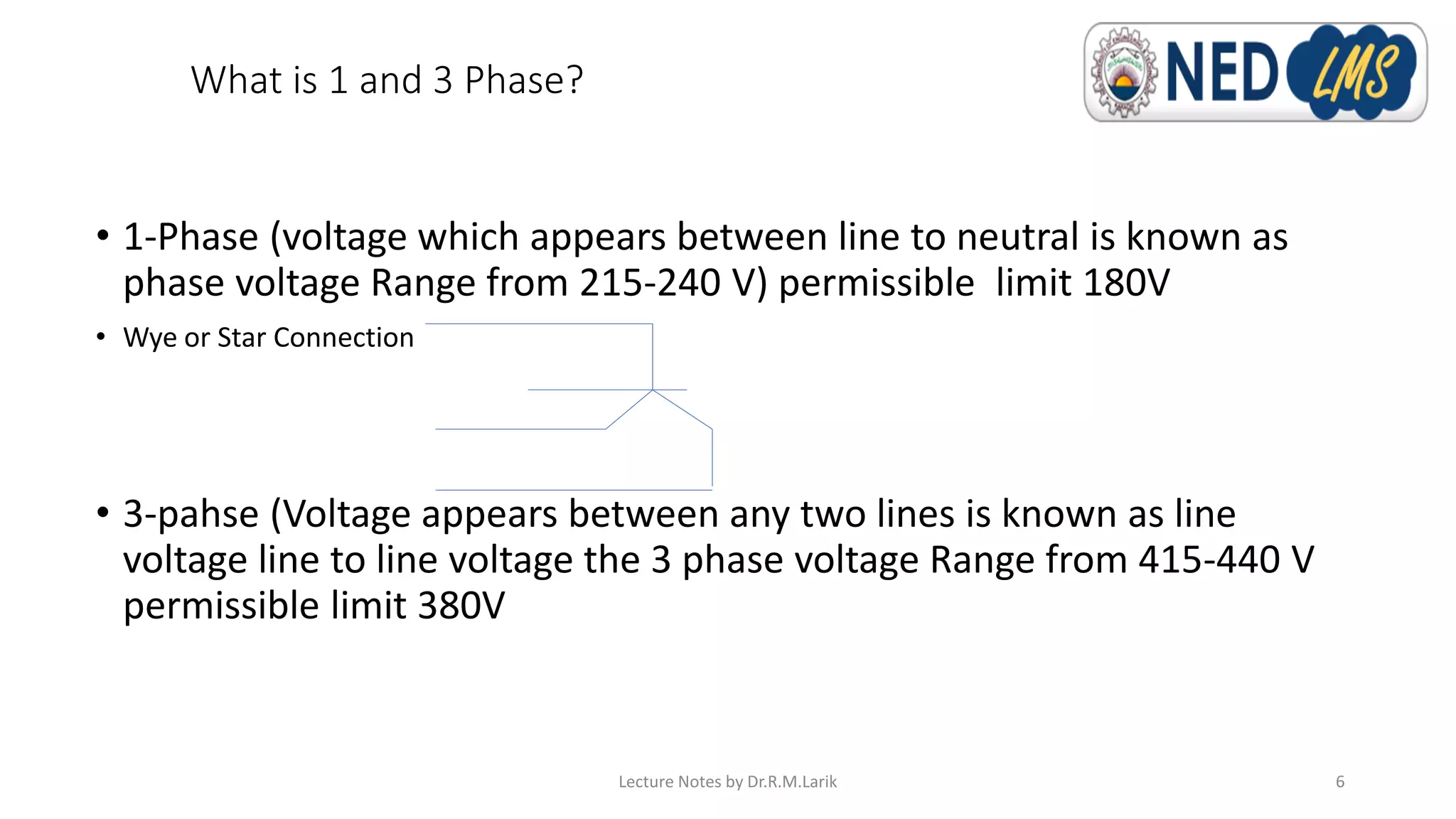
• 1-Phase (voltage which appears between line to neutral is known as
phase voltage Range from 215-240 V) permissible limit 180V
• Wye or Star Connection
• 3-pahse (Voltage appears between any two lines is known as line
voltage line to line voltage the 3 phase voltage Range from 415-440 V
permissible limit 380V
Lecture Notes by Dr.R.M.Larik 6
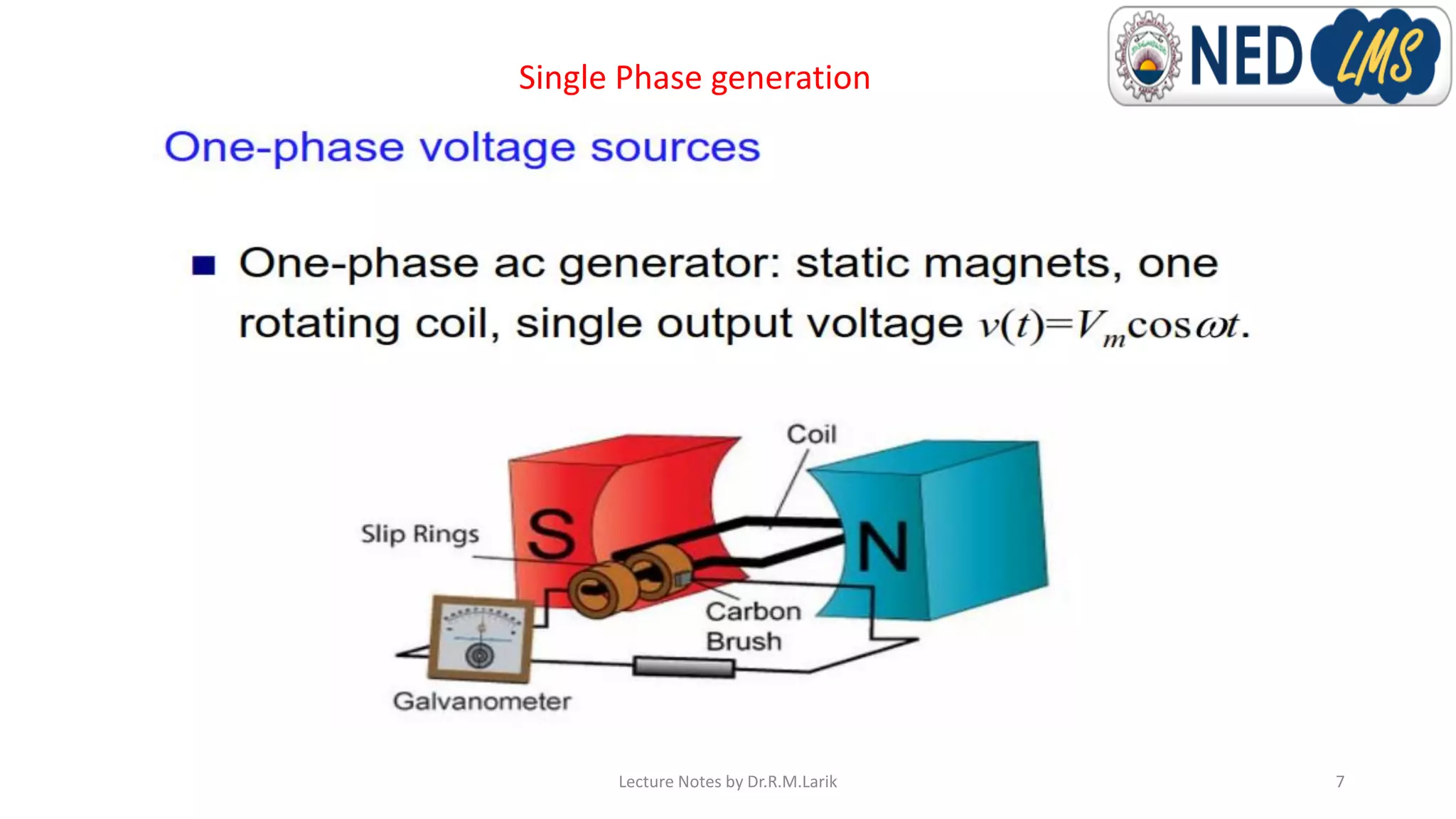
Single Phase generation
Lecture Notes by Dr.R.M.Larik 7
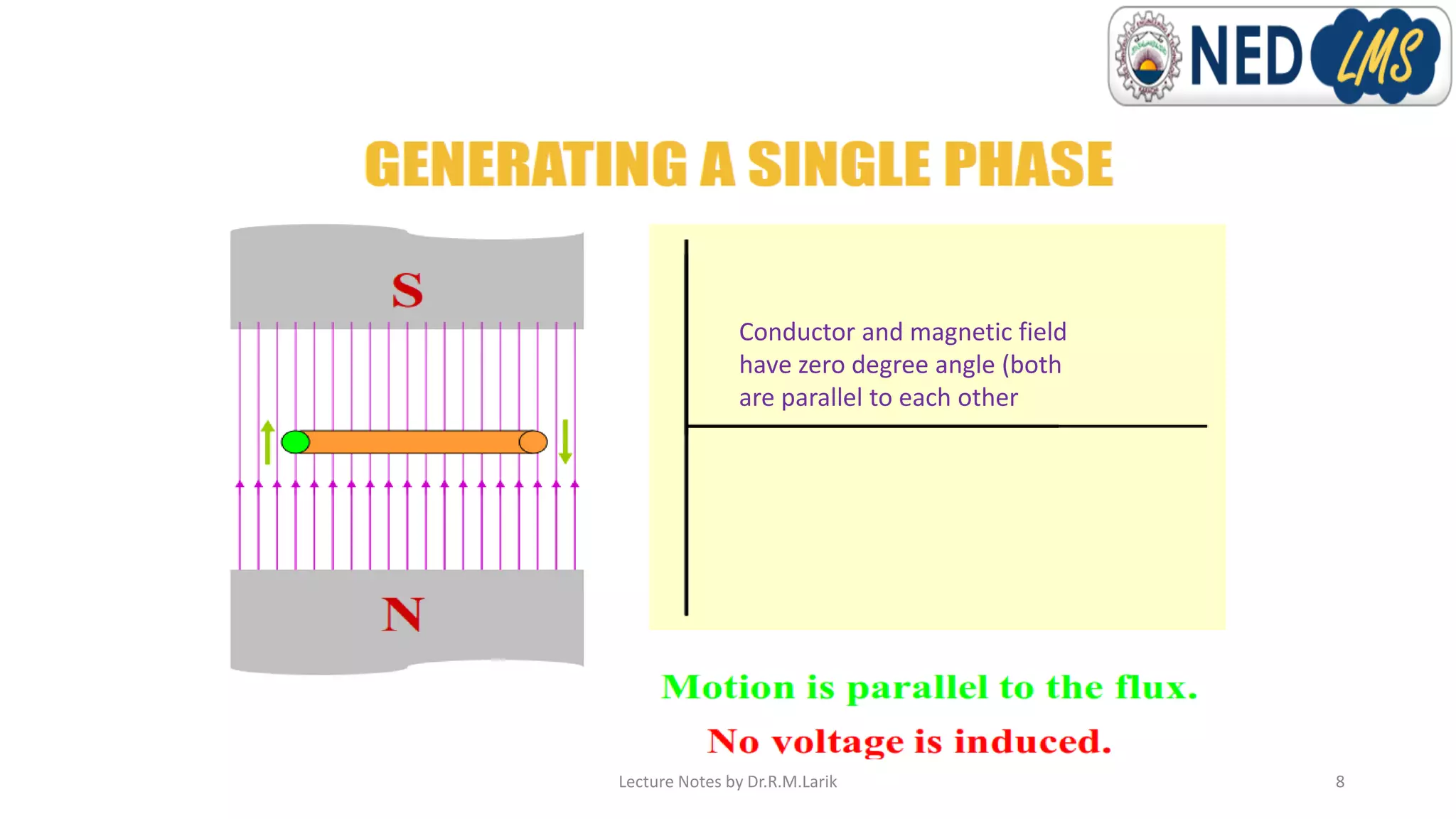
Conductor and magnetic field
have zero degree angle (both
are parallel to each other
Lecture Notes by Dr.R.M.Larik 8
Lecture Notes by Dr.R.M.Larik 9
Lecture Notes by Dr.R.M.Larik 10
Lecture Notes by Dr.R.M.Larik 11
Lecture Notes by Dr.R.M.Larik 12
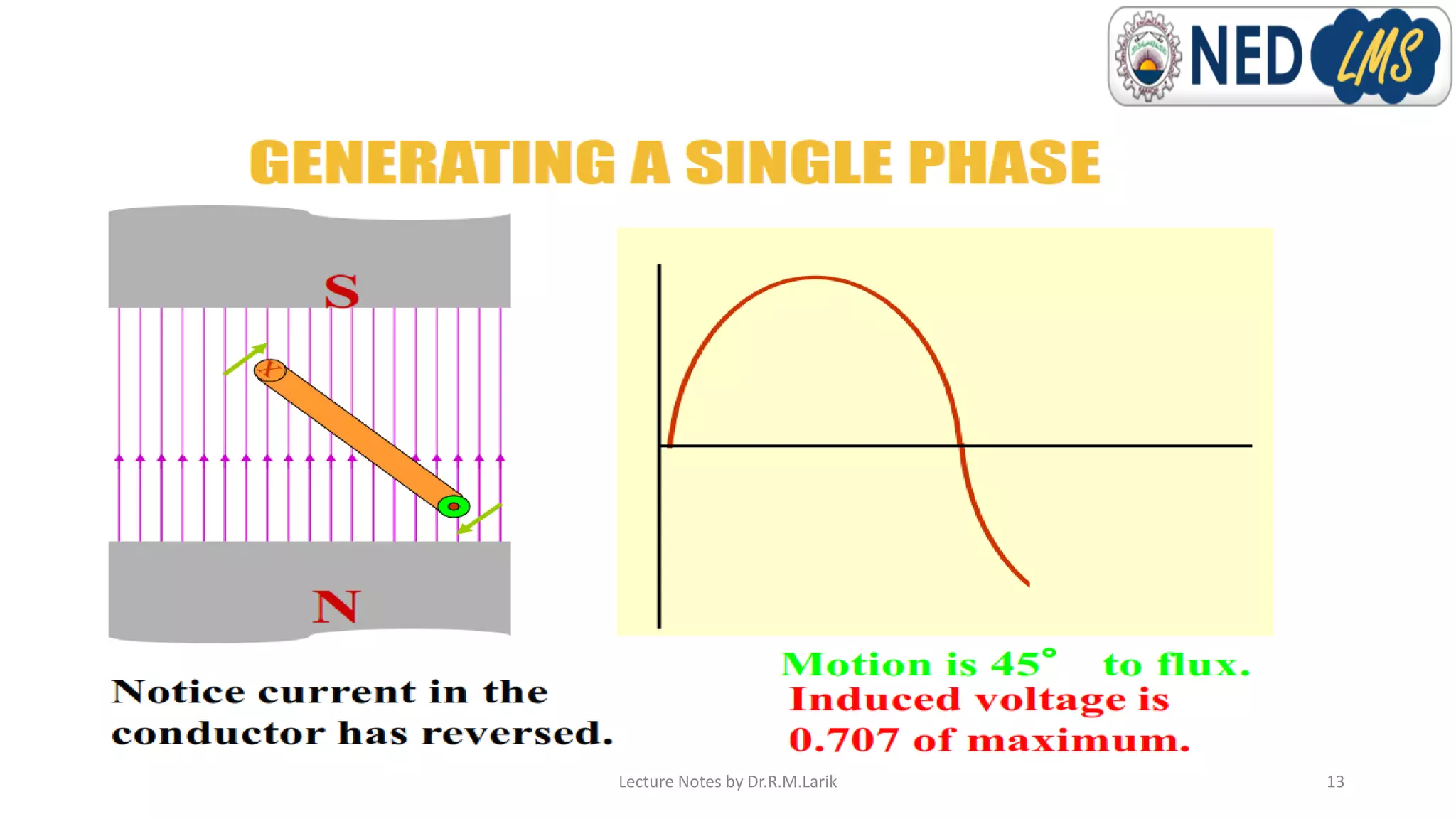
Lecture Notes by Dr.R.M.Larik 13
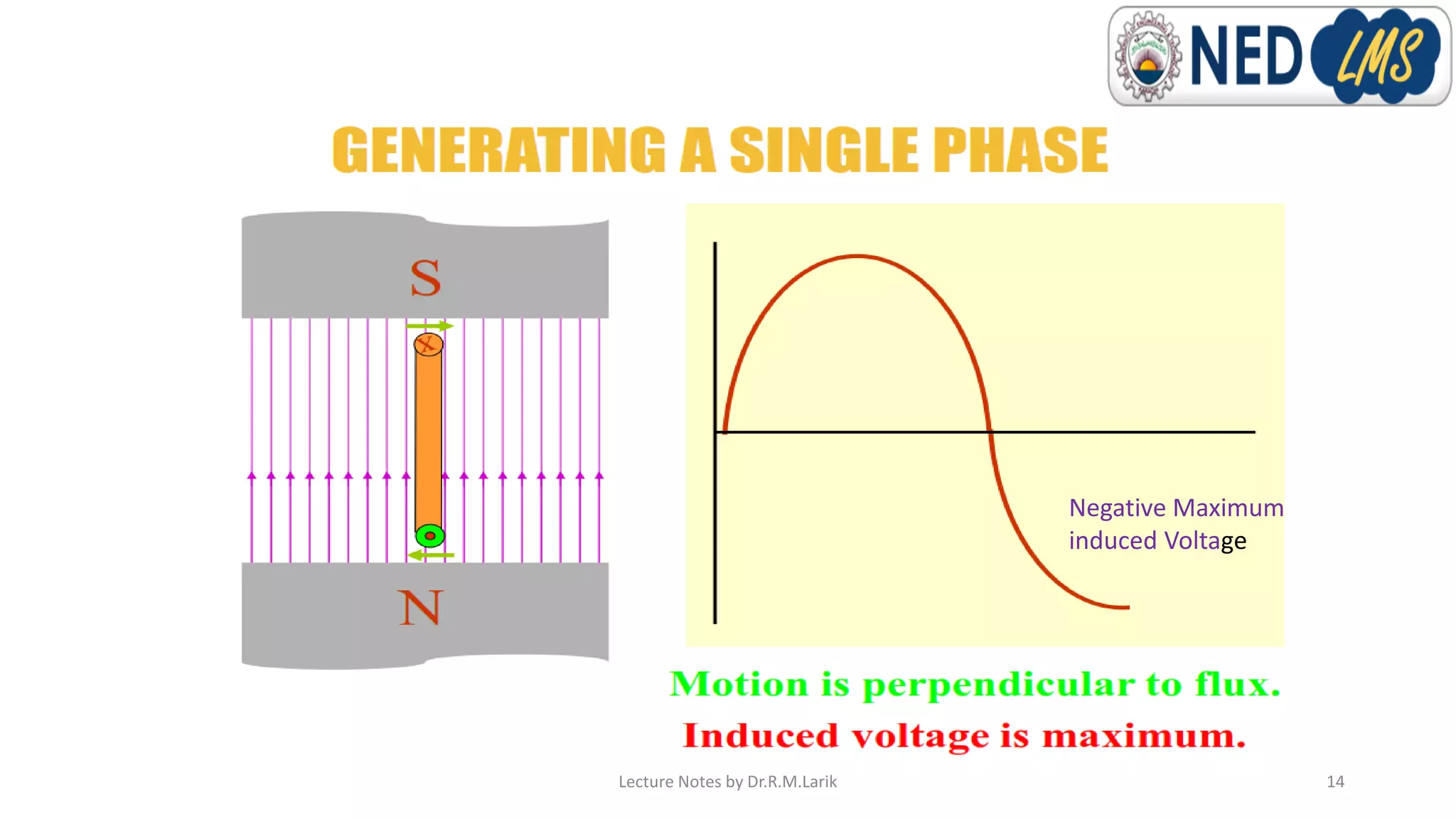
Negative Maximum
induced Voltage
Lecture Notes by Dr.R.M.Larik 14
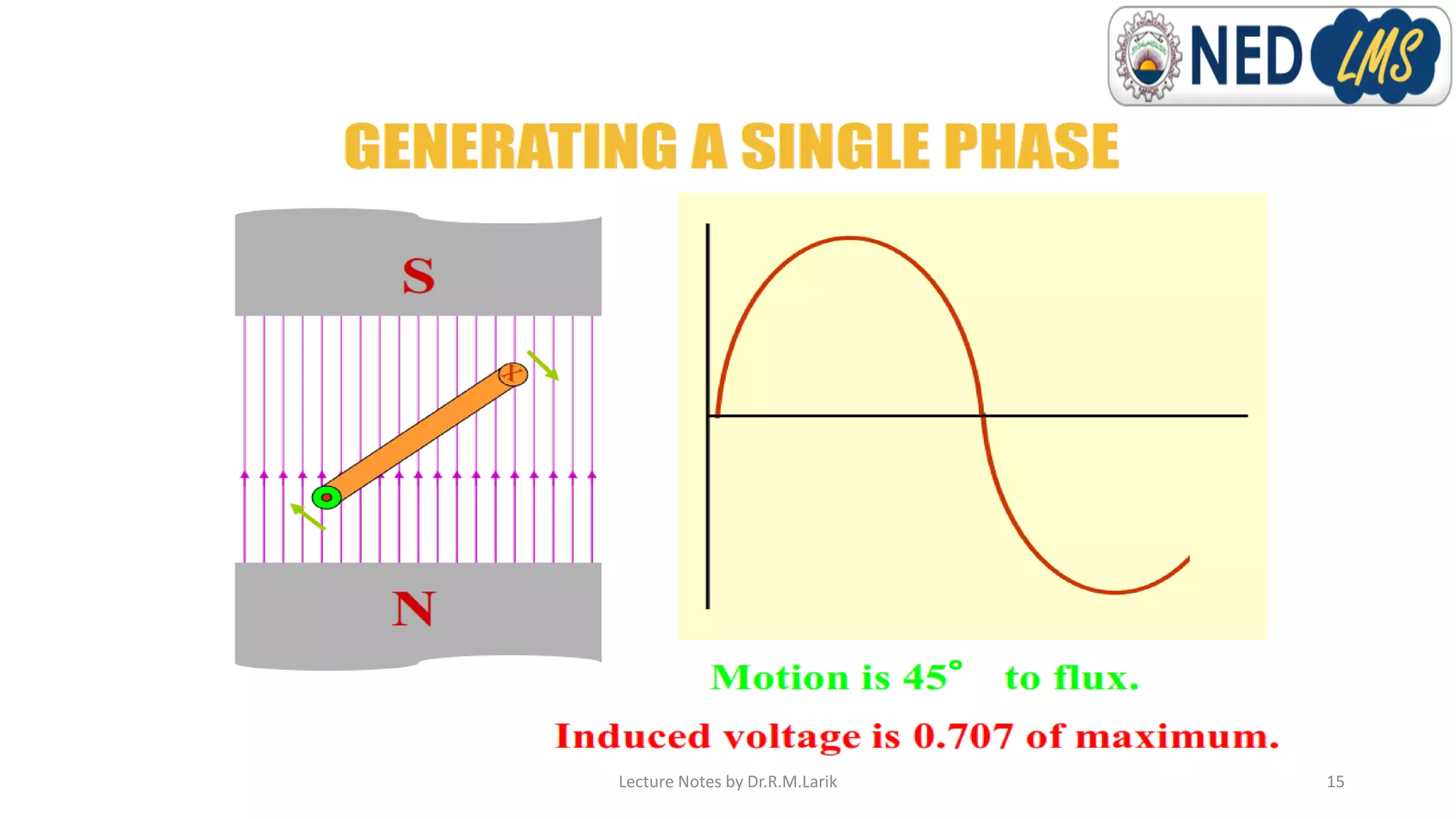
Lecture Notes by Dr.R.M.Larik 15
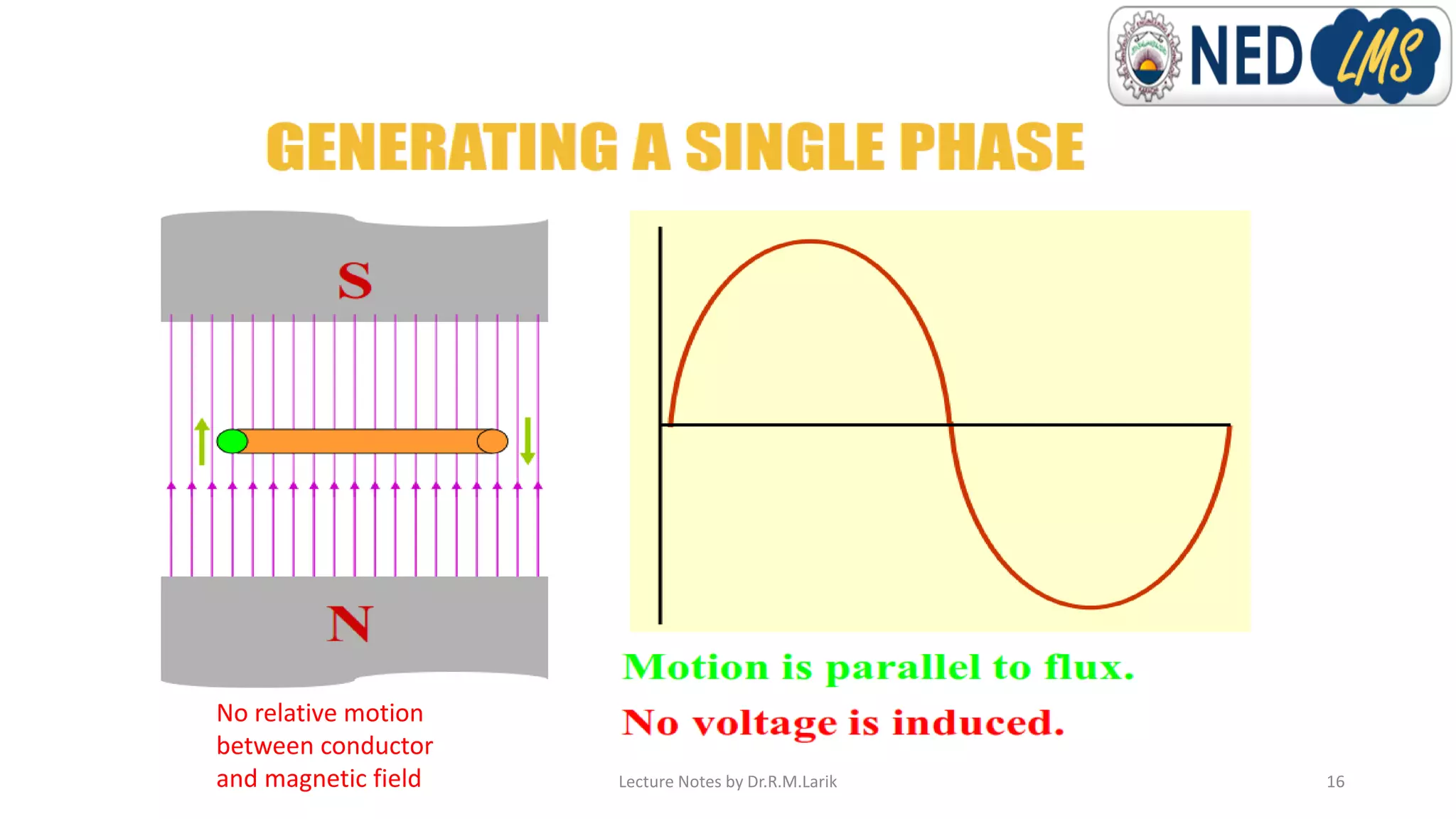
No relative motion
between conductor
and magnetic field Lecture Notes by Dr.R.M.Larik 16
Lecture Notes by Dr.R.M.Larik 17
Advantages and importance of three-phase systems
An AC generator designed to develop a single sinusoidal voltage for each rotation of the shaft (rotor)
is referred to as a single-phase AC generator.
If the number of coils on the rotor is increased in a specified manner, the result is a Polyphase AC
generator, which develops more power than one AC phase voltage per rotation of the rotor
In general, three-phase systems are preferred over single-phase systems for the transmission of
power for many reasons.
1. The instantaneous power in three-phase system can be constant (not pulsating as in a single phase
circuit).
2. For the same transmitted power, three-phase systems consume less wires.
3. The lighter lines are easier to install, and the supporting structures can be less massive and farther
apart.
4. In general, most larger motors are three phase because they are essentially self starting and do not
require a special design or additional starting circuitry.
For the above reasons, most of the power distribution systems in US and over the world, use three-
phase systems.
The first three-phase electrical system was patented in 1882 by John
Hopkinson - British physicist, electrical engineer, Fellow of the Royal Society.
Lecture Notes by Dr.R.M.Larik 18
Lecture Notes by Dr.R.M.Larik 19
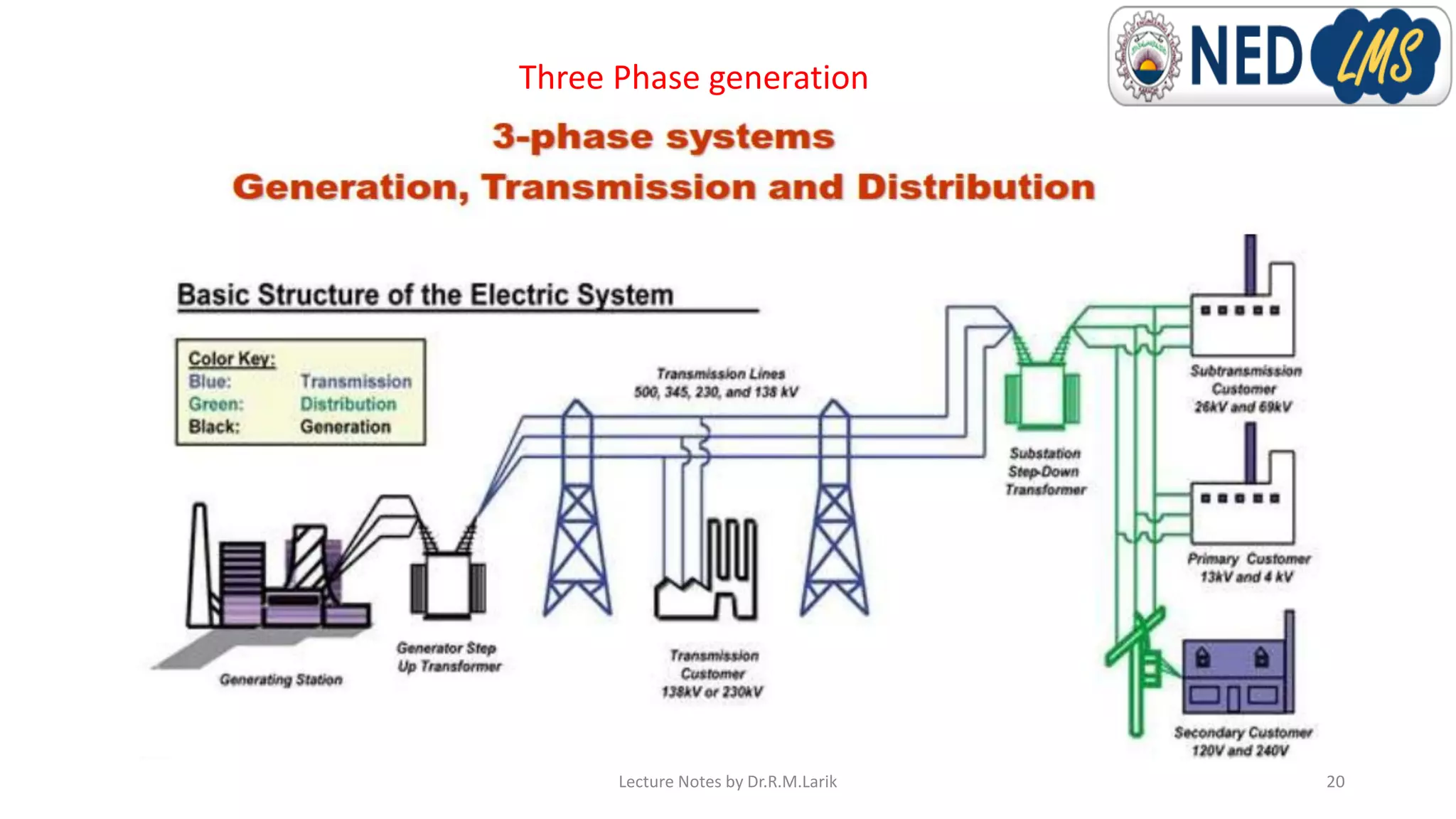
Three Phase generation
Lecture Notes by Dr.R.M.Larik 20
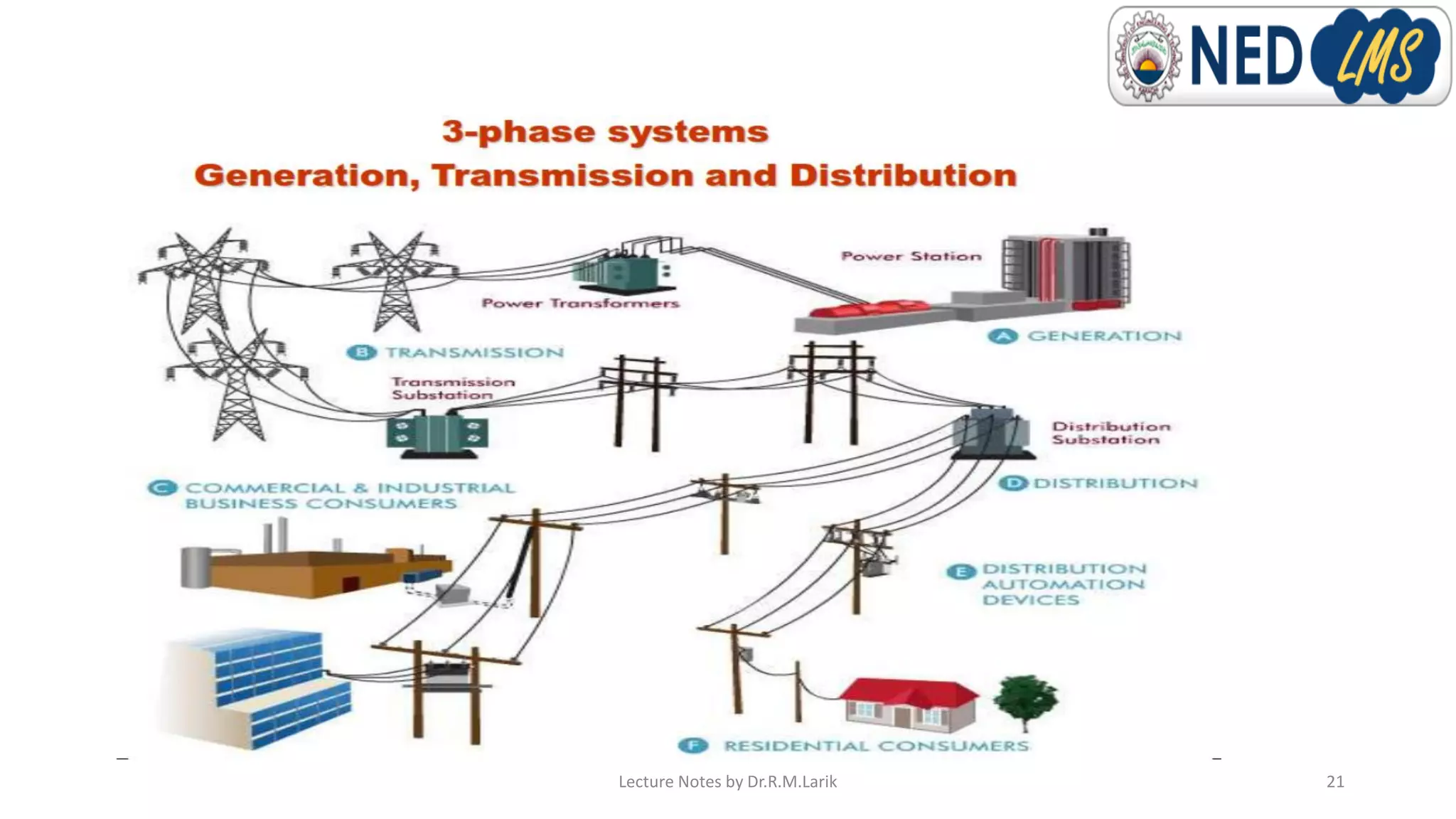
Lecture Notes by Dr.R.M.Larik 21
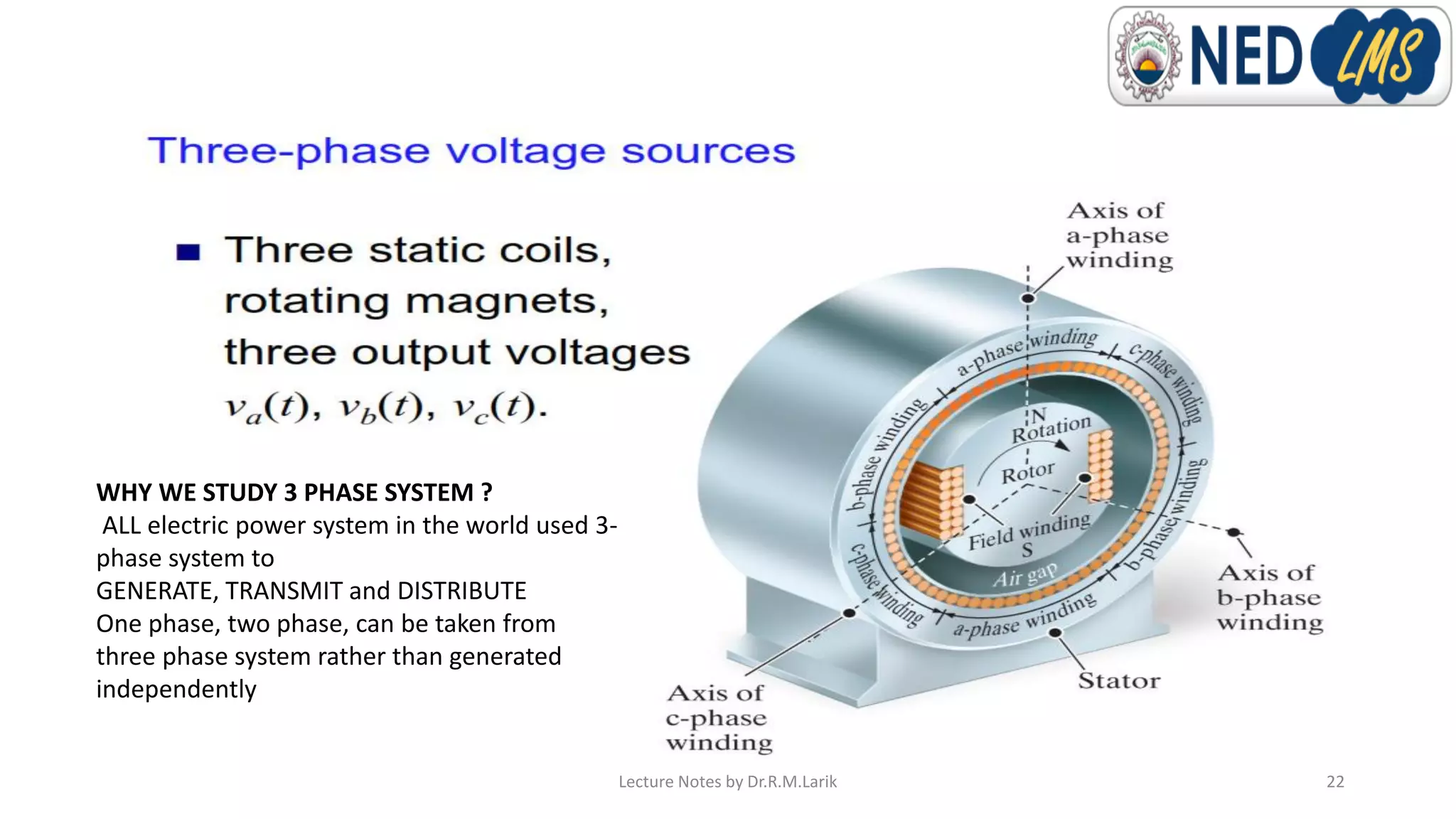
WHY WE STUDY 3 PHASE SYSTEM ?
ALL electric power system in the world used 3-
phase system to
GENERATE, TRANSMIT and DISTRIBUTE
One phase, two phase, can be taken from
three phase system rather than generated
independently
Lecture Notes by Dr.R.M.Larik 22
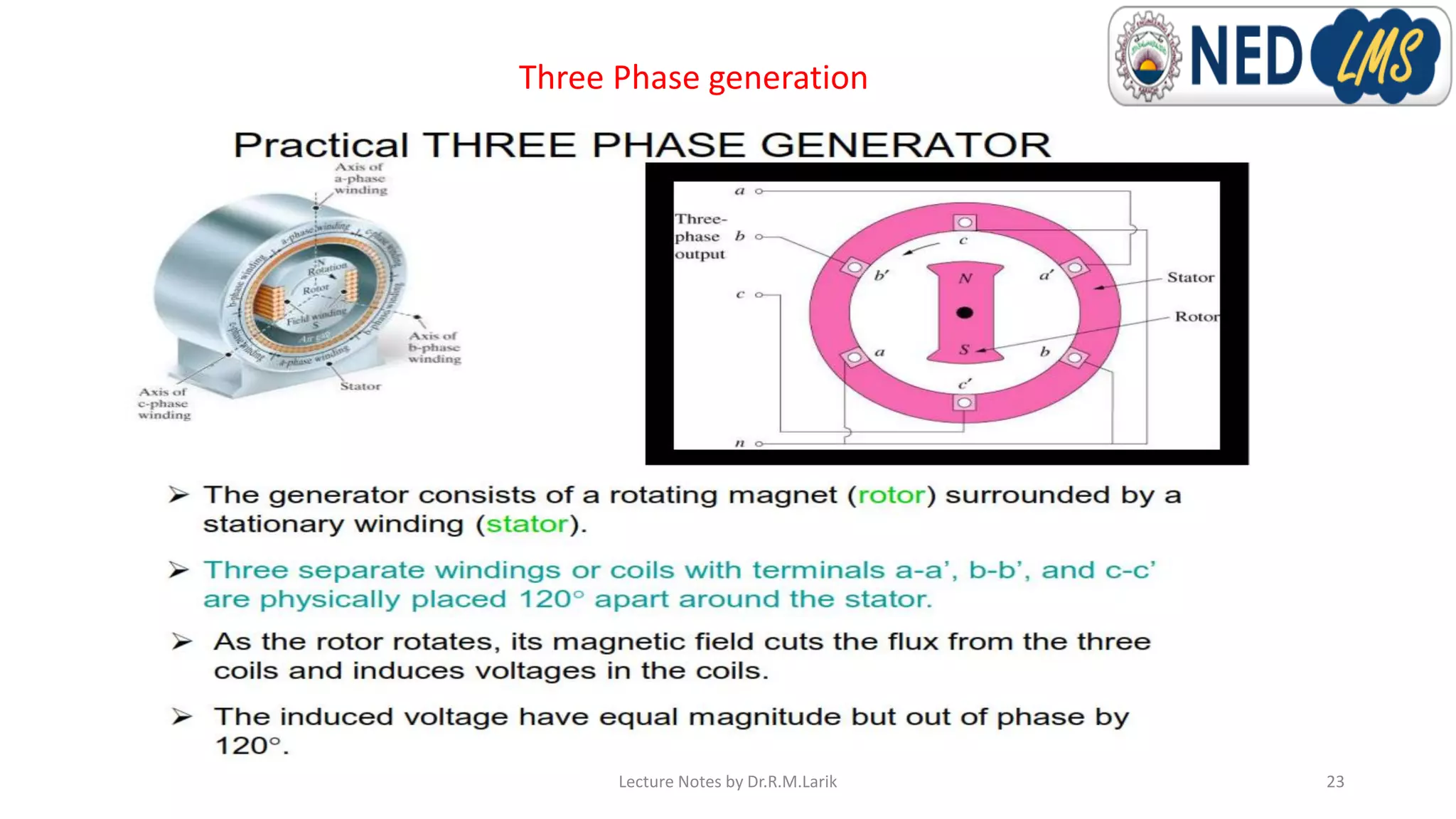
Three Phase generation
Lecture Notes by Dr.R.M.Larik 23
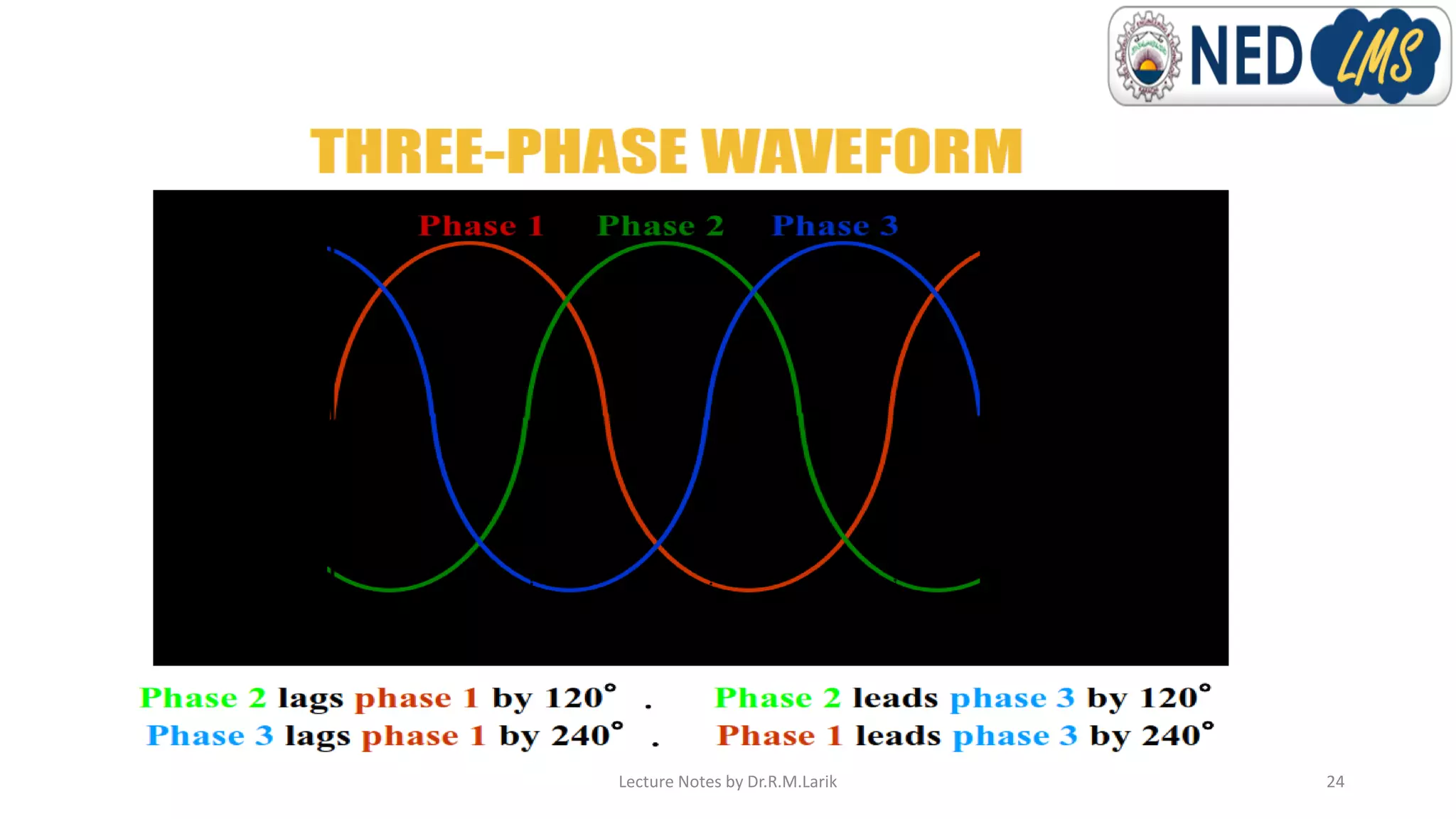
Lecture Notes by Dr.R.M.Larik 24
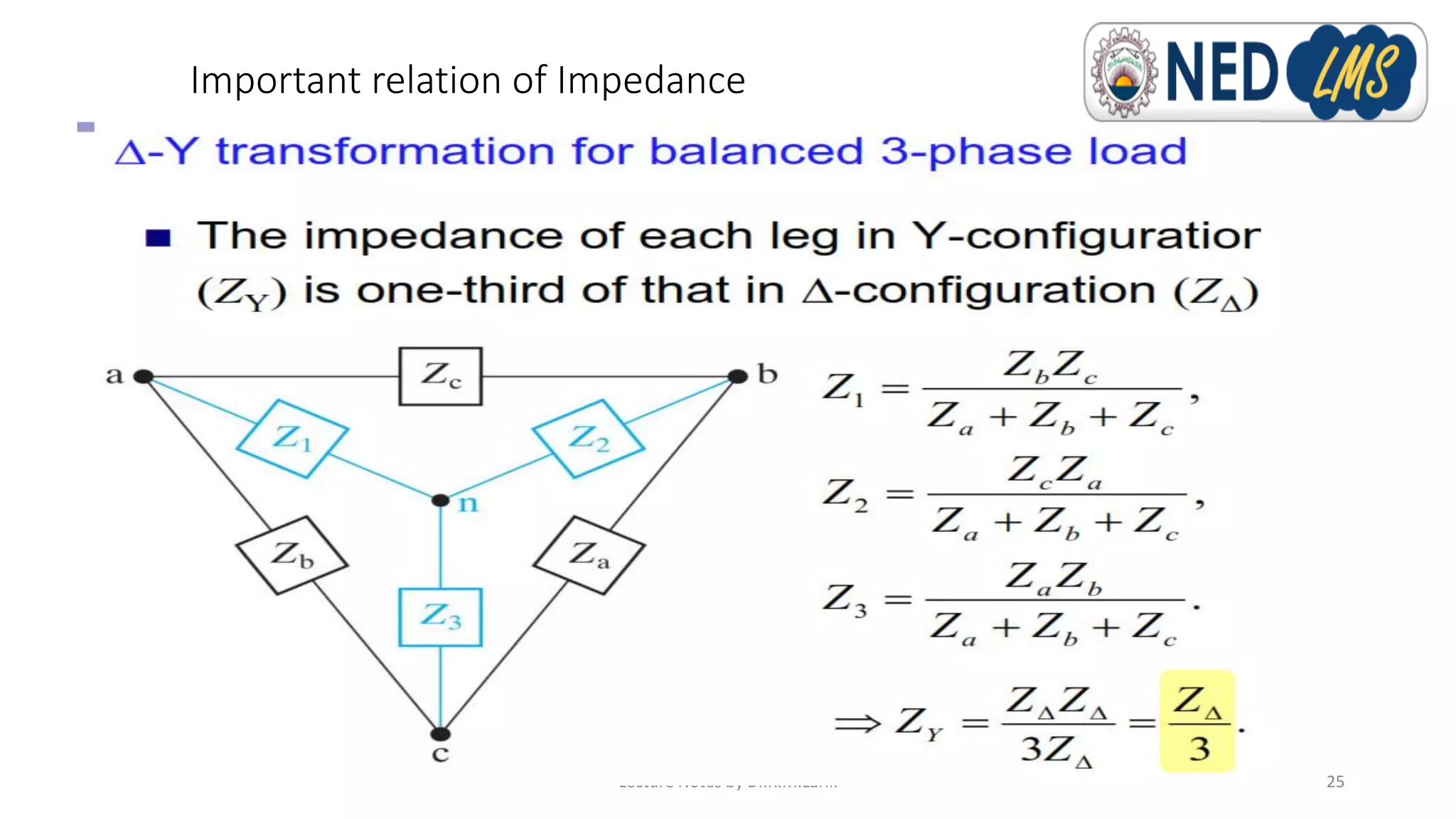
Important relation of Impedance
Lecture Notes by Dr.R.M.Larik 25
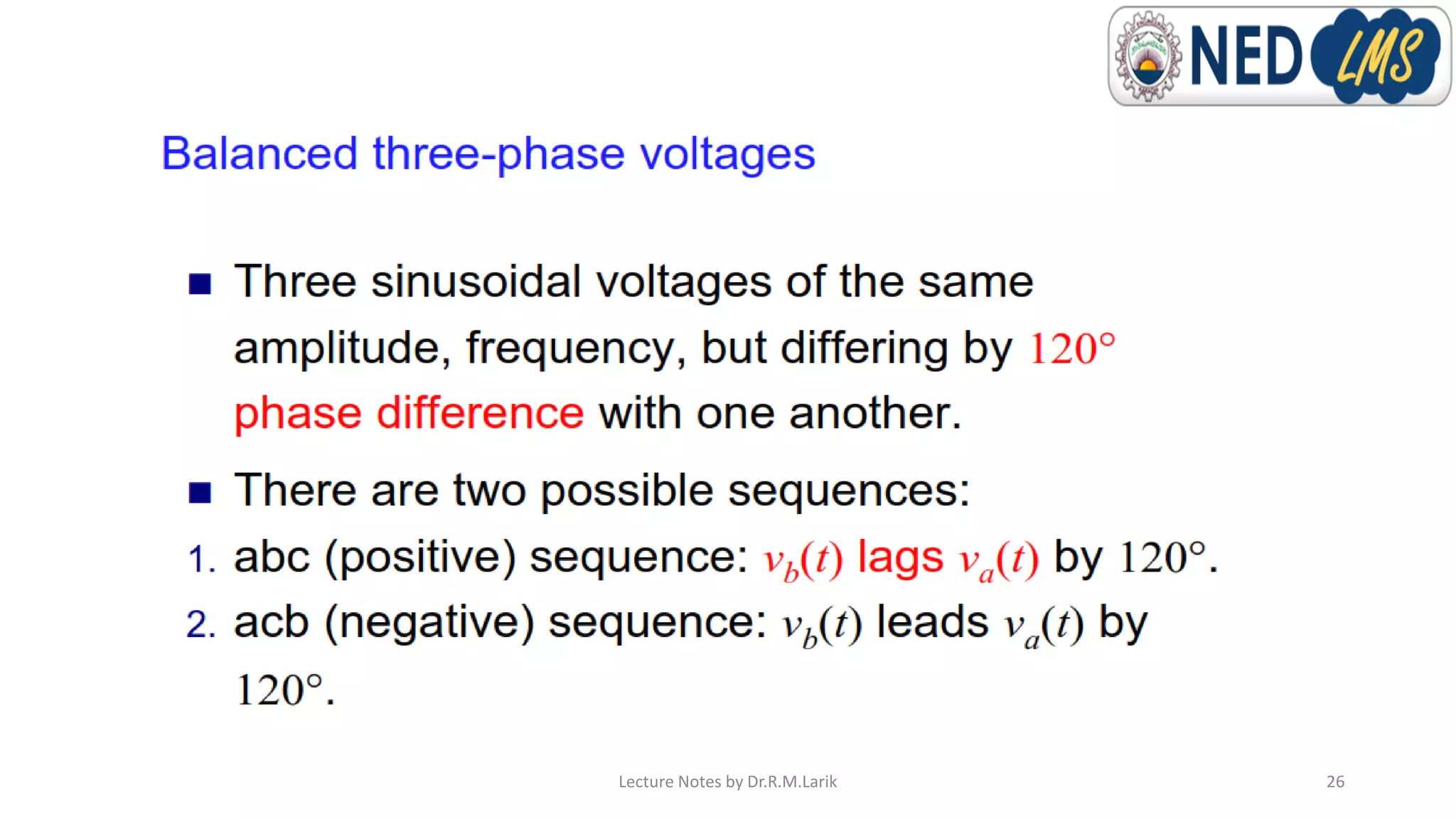
Lecture Notes by Dr.R.M.Larik 26
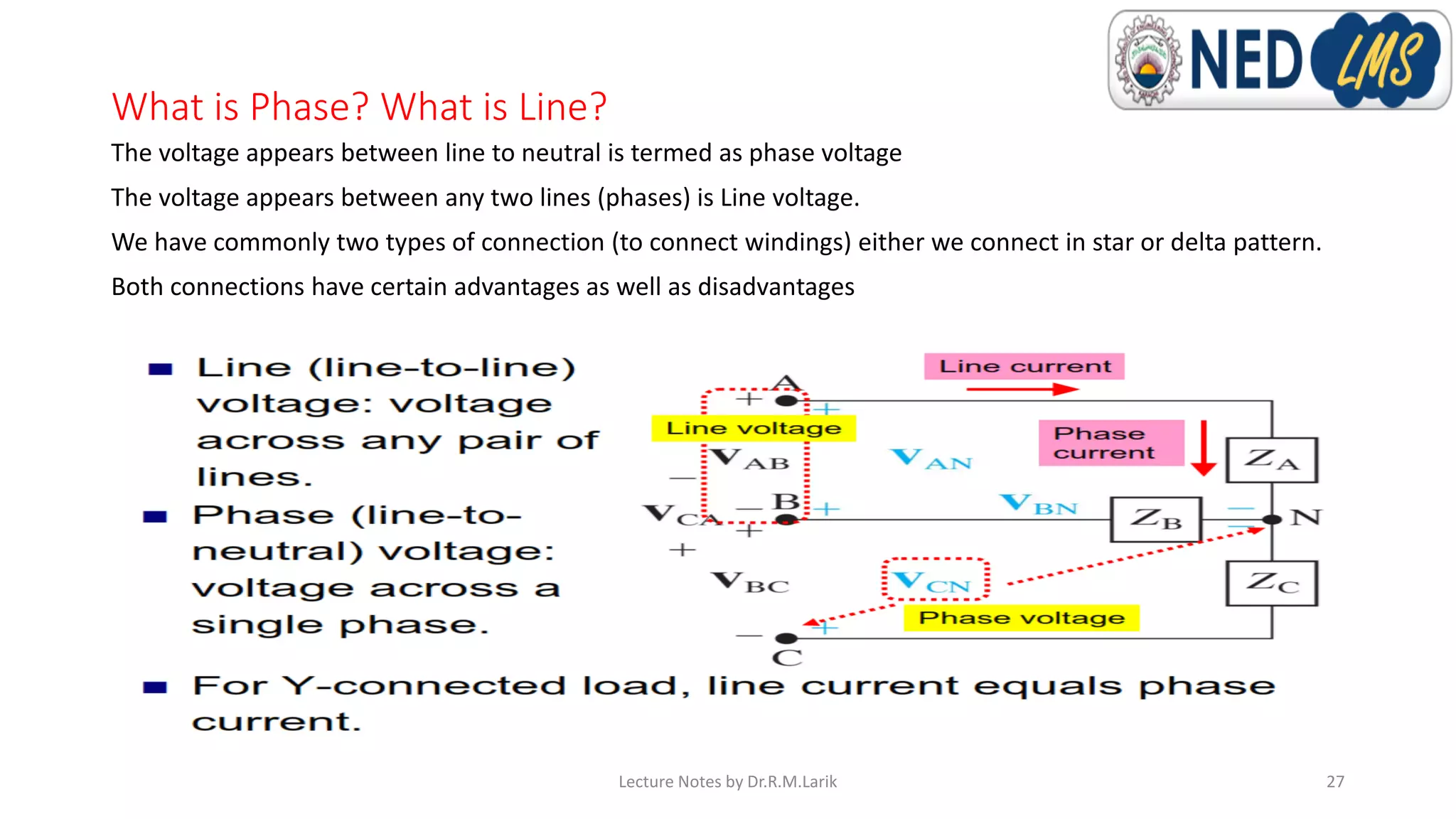
What is Phase? What is Line?
The voltage appears between line to neutral is termed as phase voltage
The voltage appears between any two lines (phases) is Line voltage.
We have commonly two types of connection (to connect windings) either we connect in star or delta pattern.
Both connections have certain advantages as well as disadvantages
Lecture Notes by Dr.R.M.Larik 27
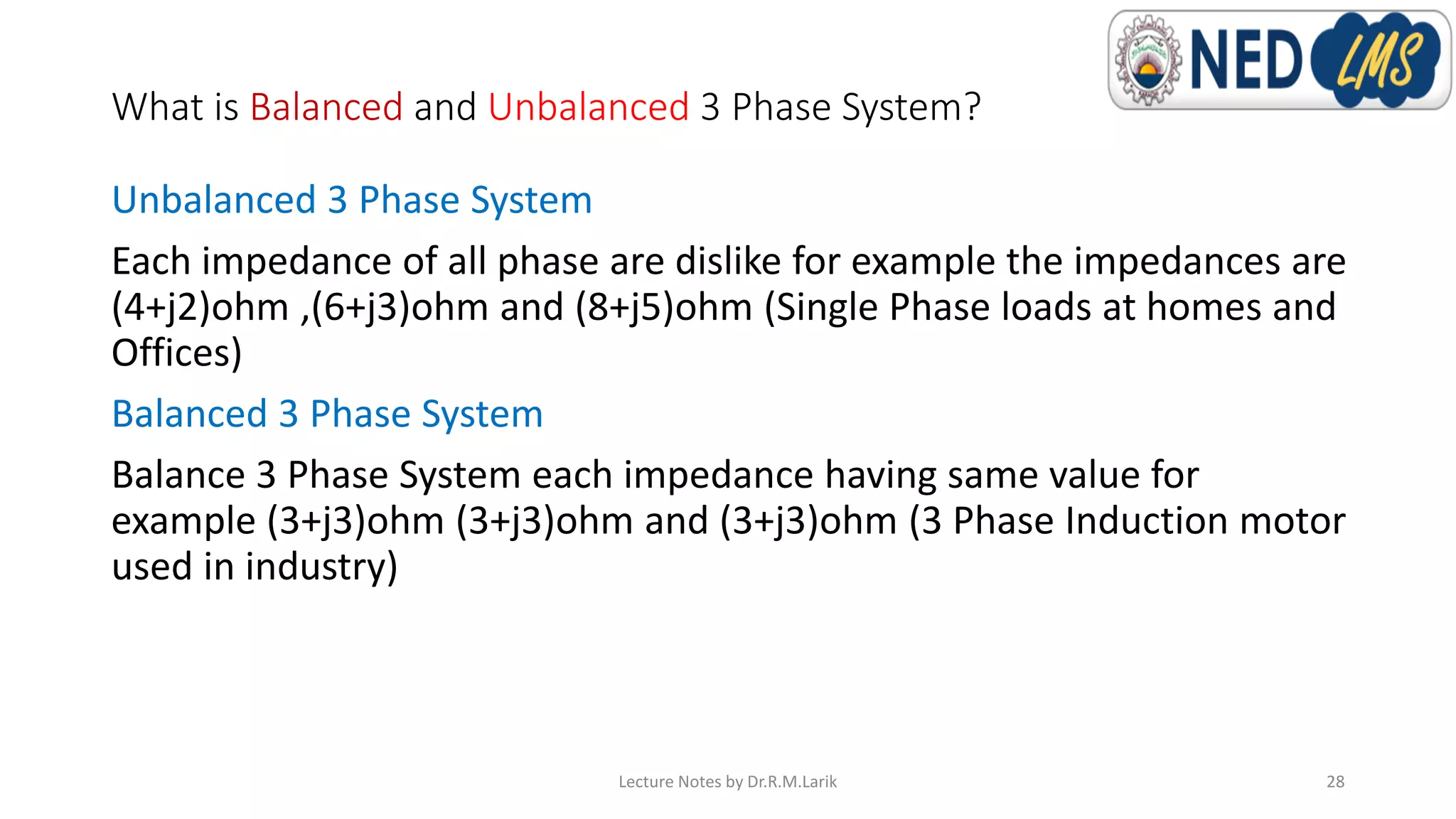
What is Balanced and Unbalanced 3 Phase System?
Unbalanced 3 Phase System
Each impedance of all phase are dislike for example the impedances are
(4+j2)ohm ,(6+j3)ohm and (8+j5)ohm (Single Phase loads at homes and
Offices)
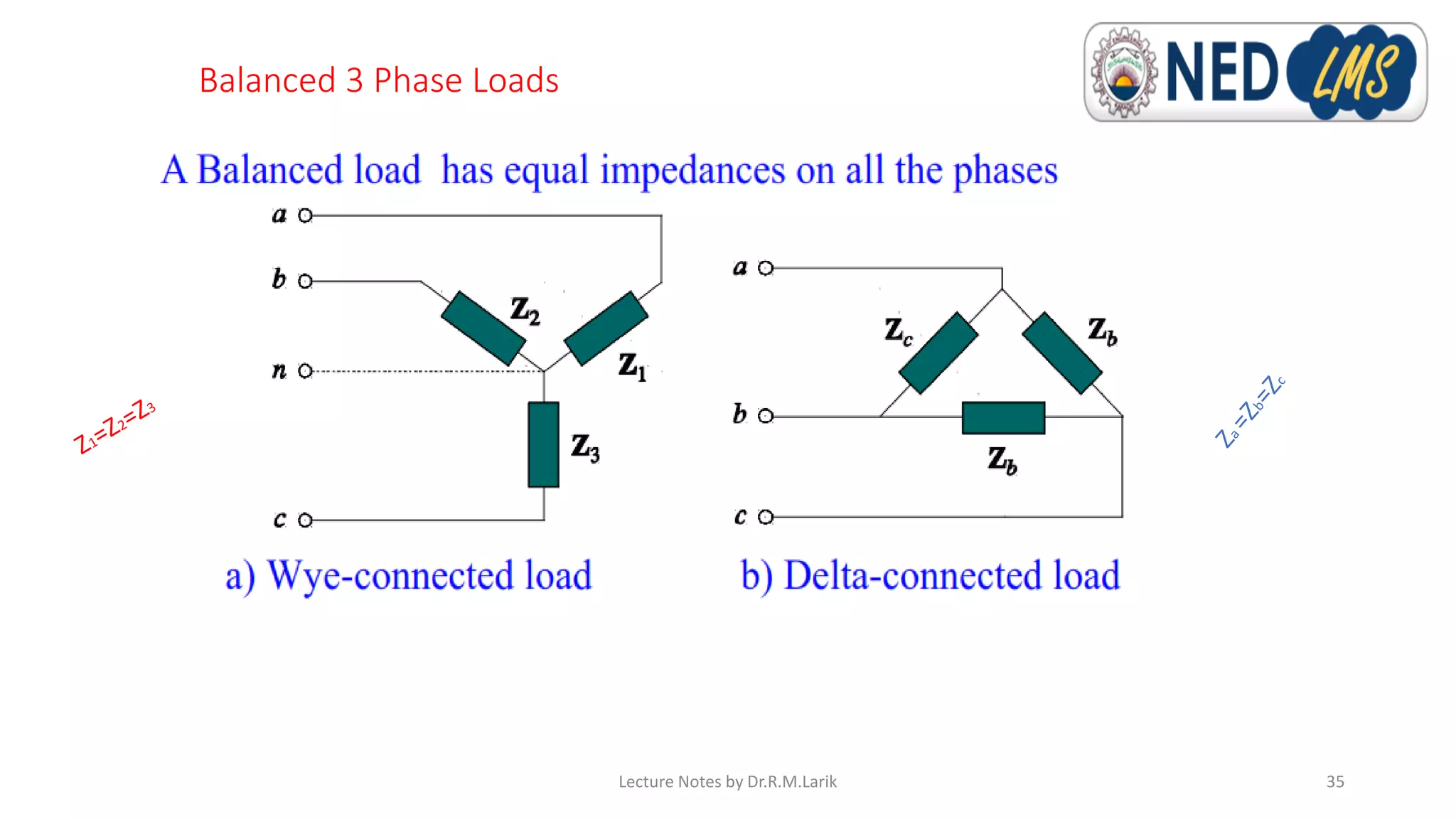
Balanced 3 Phase System
Balance 3 Phase System each impedance having same value for
example (3+j3)ohm (3+j3)ohm and (3+j3)ohm (3 Phase Induction motor
used in industry)
Lecture Notes by Dr.R.M.Larik 28
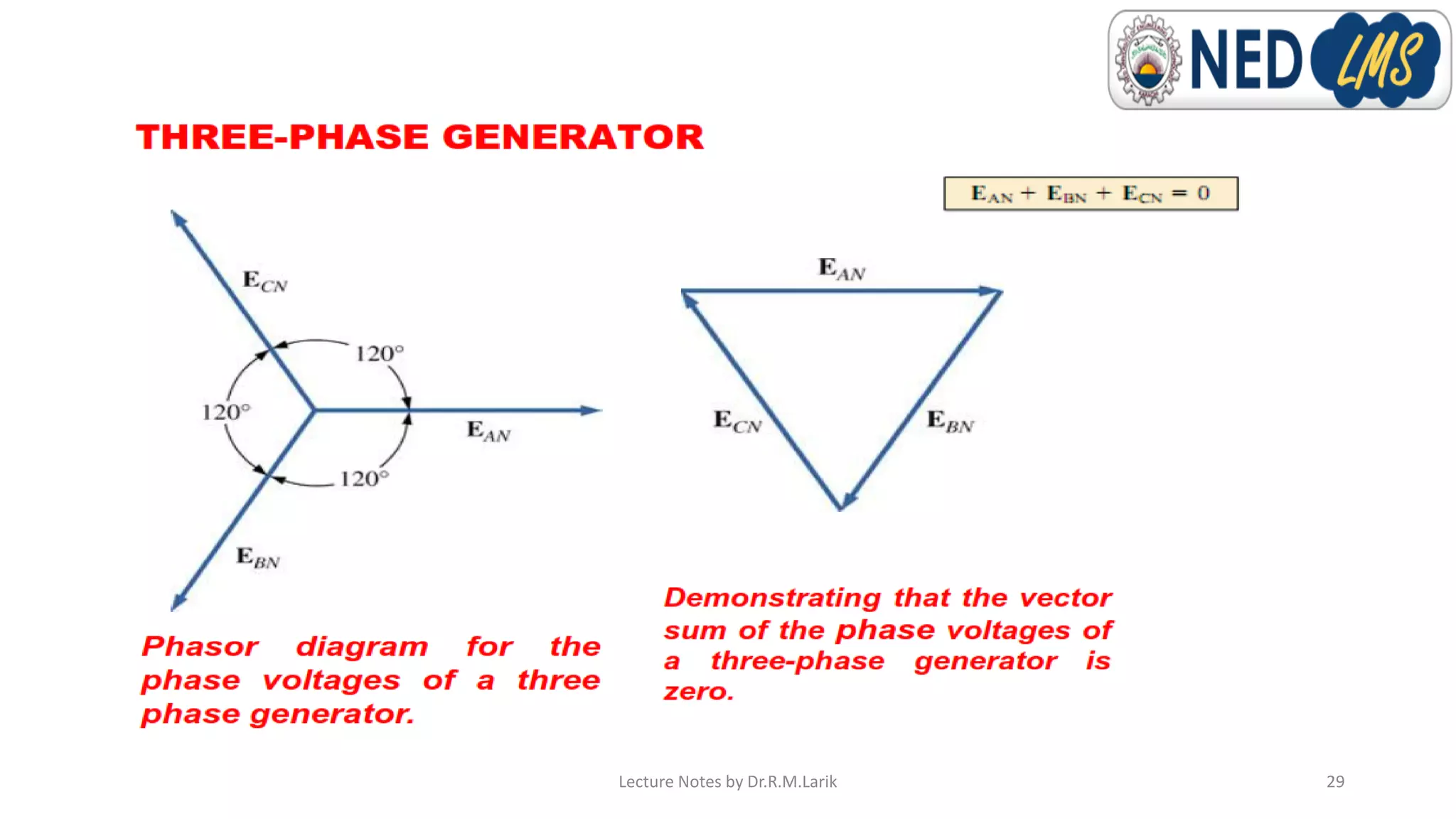
Lecture Notes by Dr.R.M.Larik 29
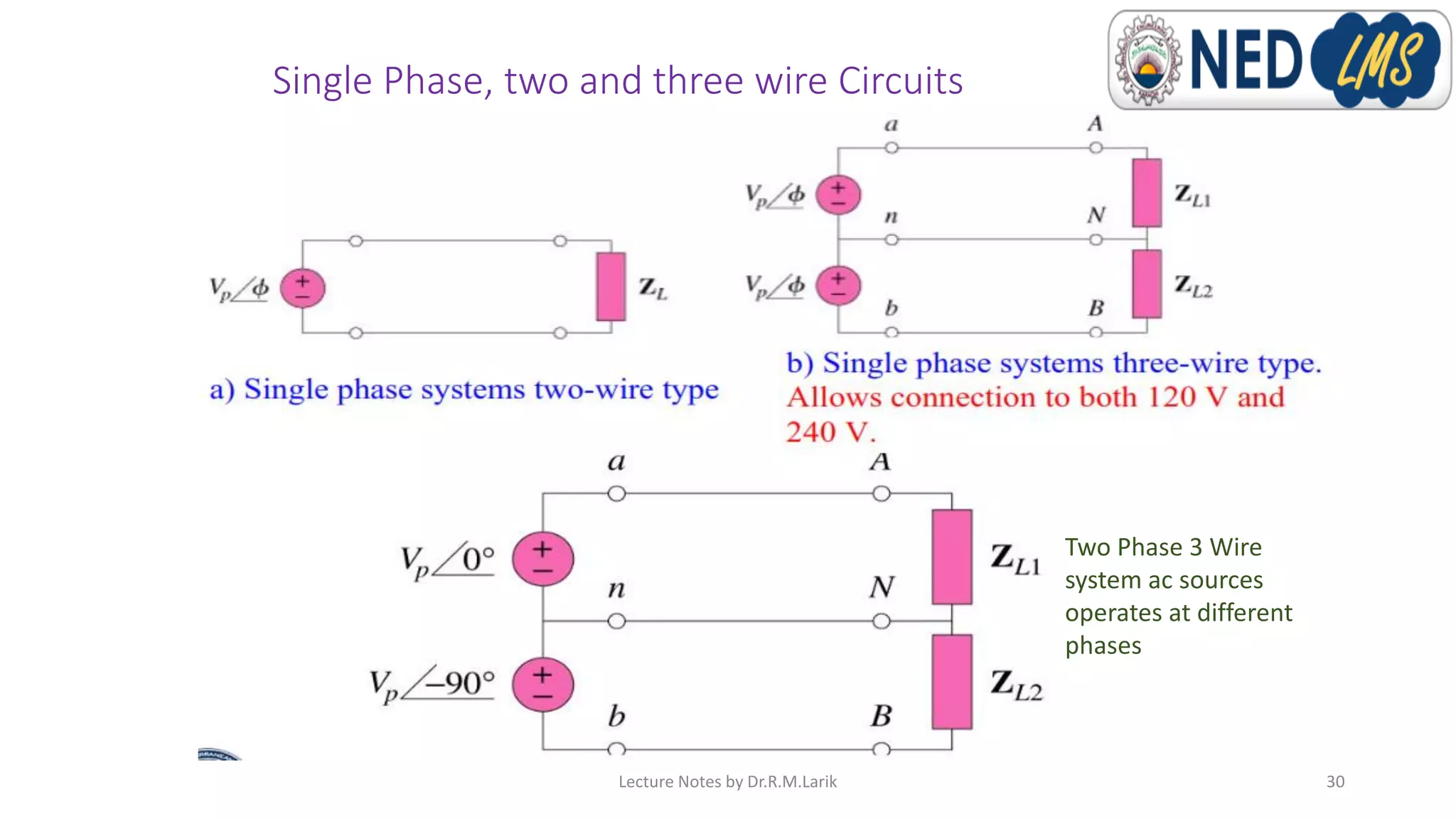
Single Phase, two and three wire Circuits
Lecture Notes by Dr.R.M.Larik
Two Phase 3 Wire
system ac sources
operates at different
phases
30
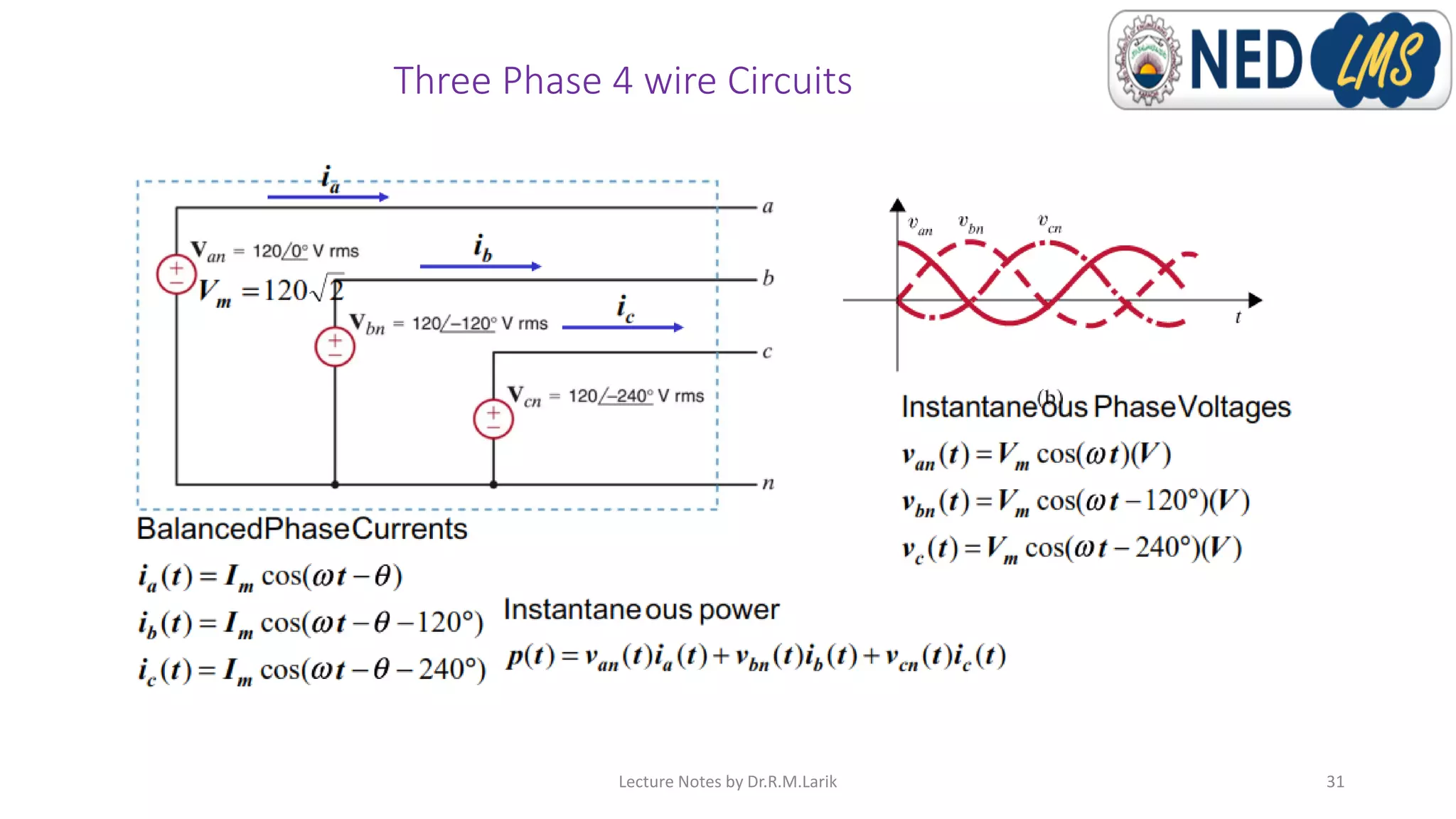
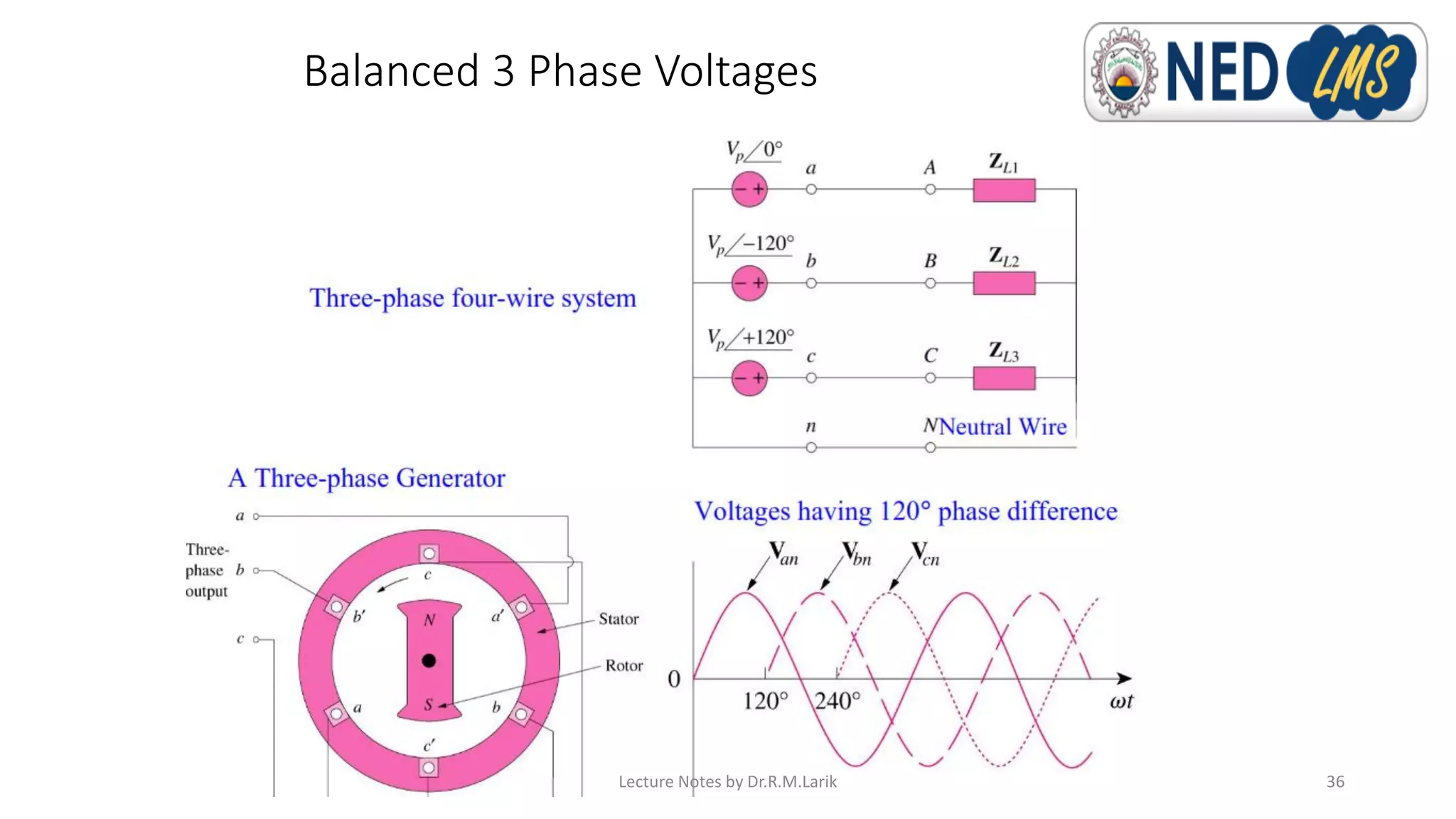
Three Phase 4 wire Circuits
Lecture Notes by Dr.R.M.Larik 31
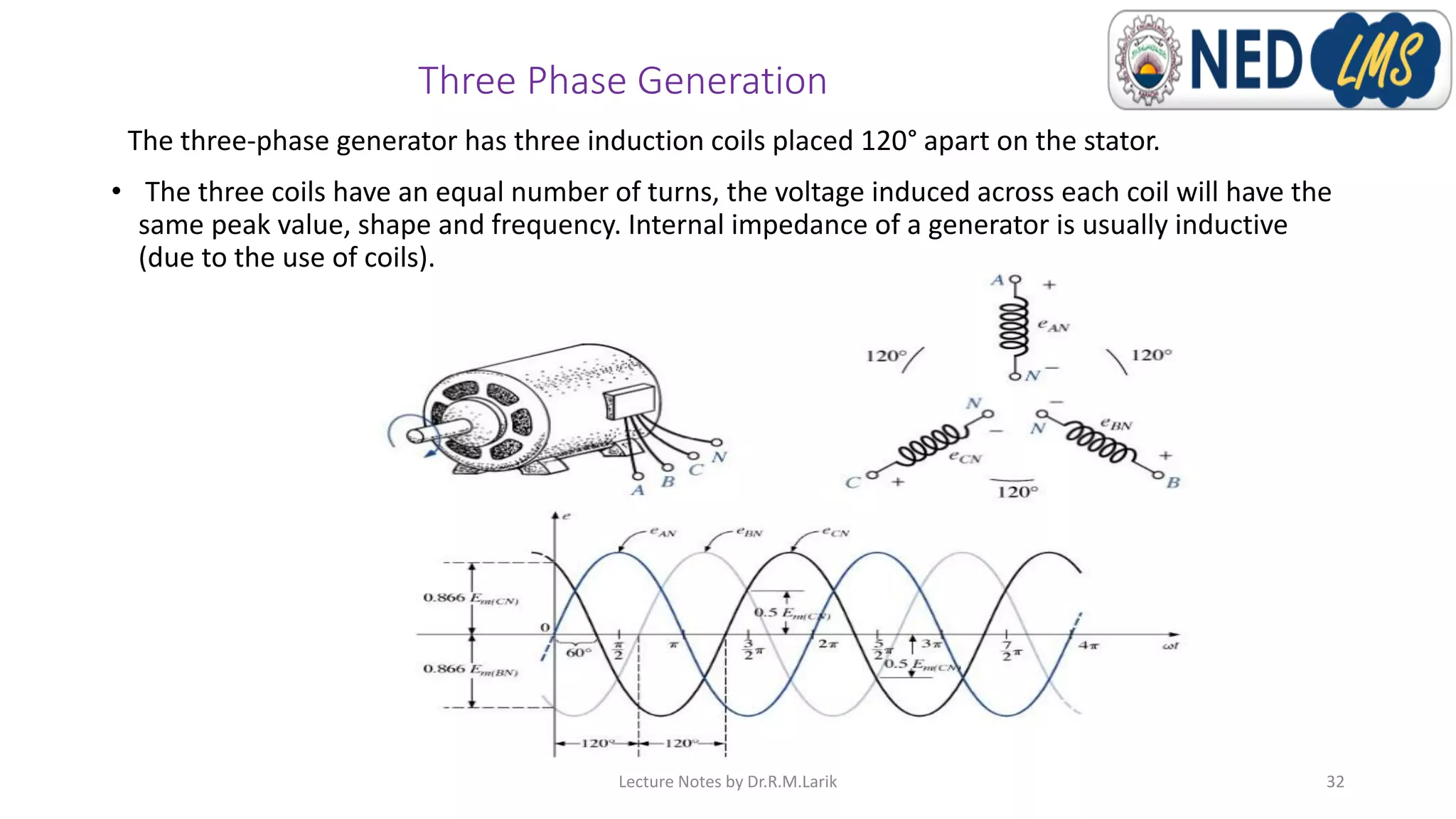
Three Phase Generation
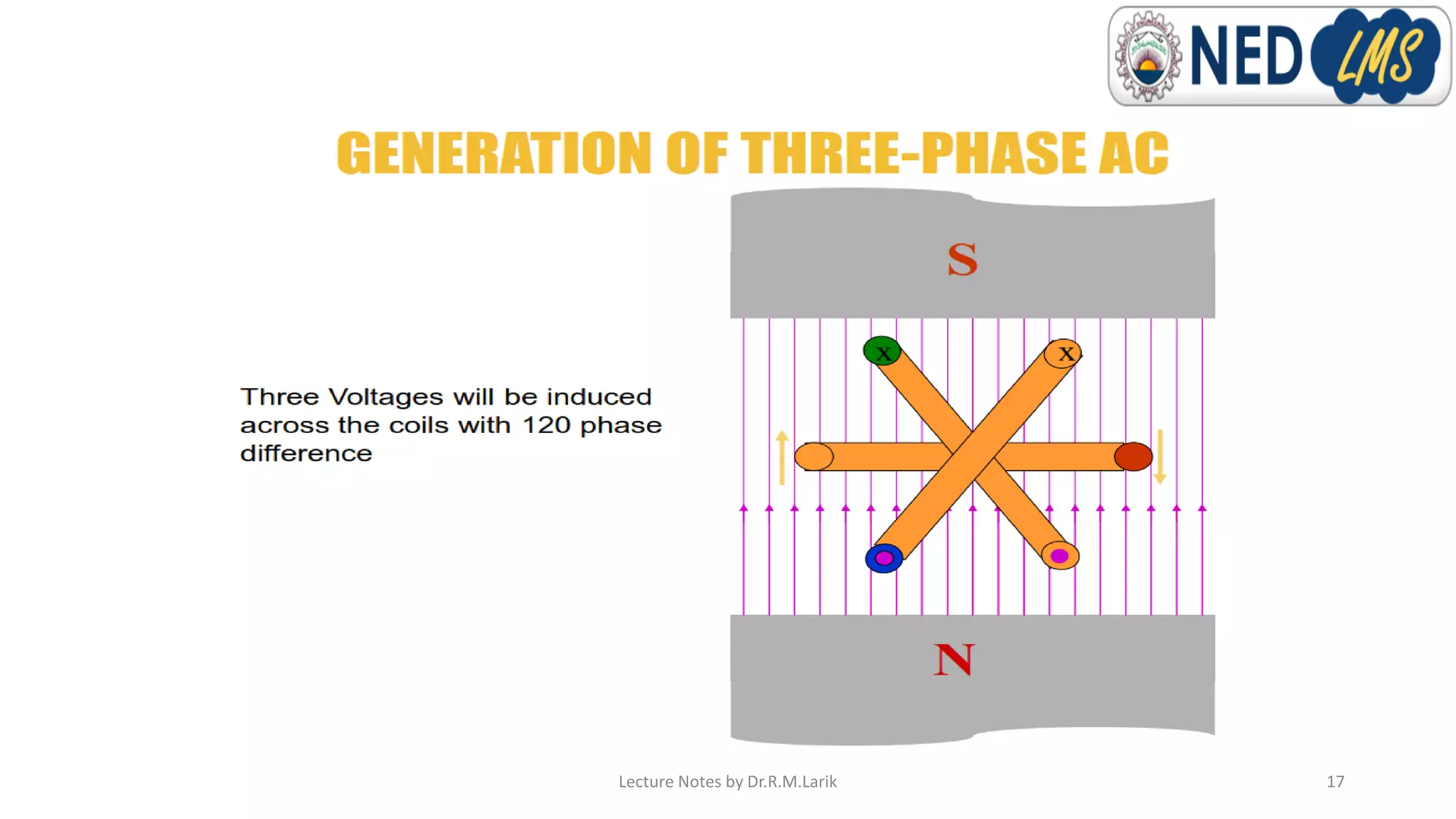
The three-phase generator has three induction coils placed 120° apart on the stator.
• The three coils have an equal number of turns, the voltage induced across each coil will have the
same peak value, shape and frequency. Internal impedance of a generator is usually inductive
(due to the use of coils).
Lecture Notes by Dr.R.M.Larik 32
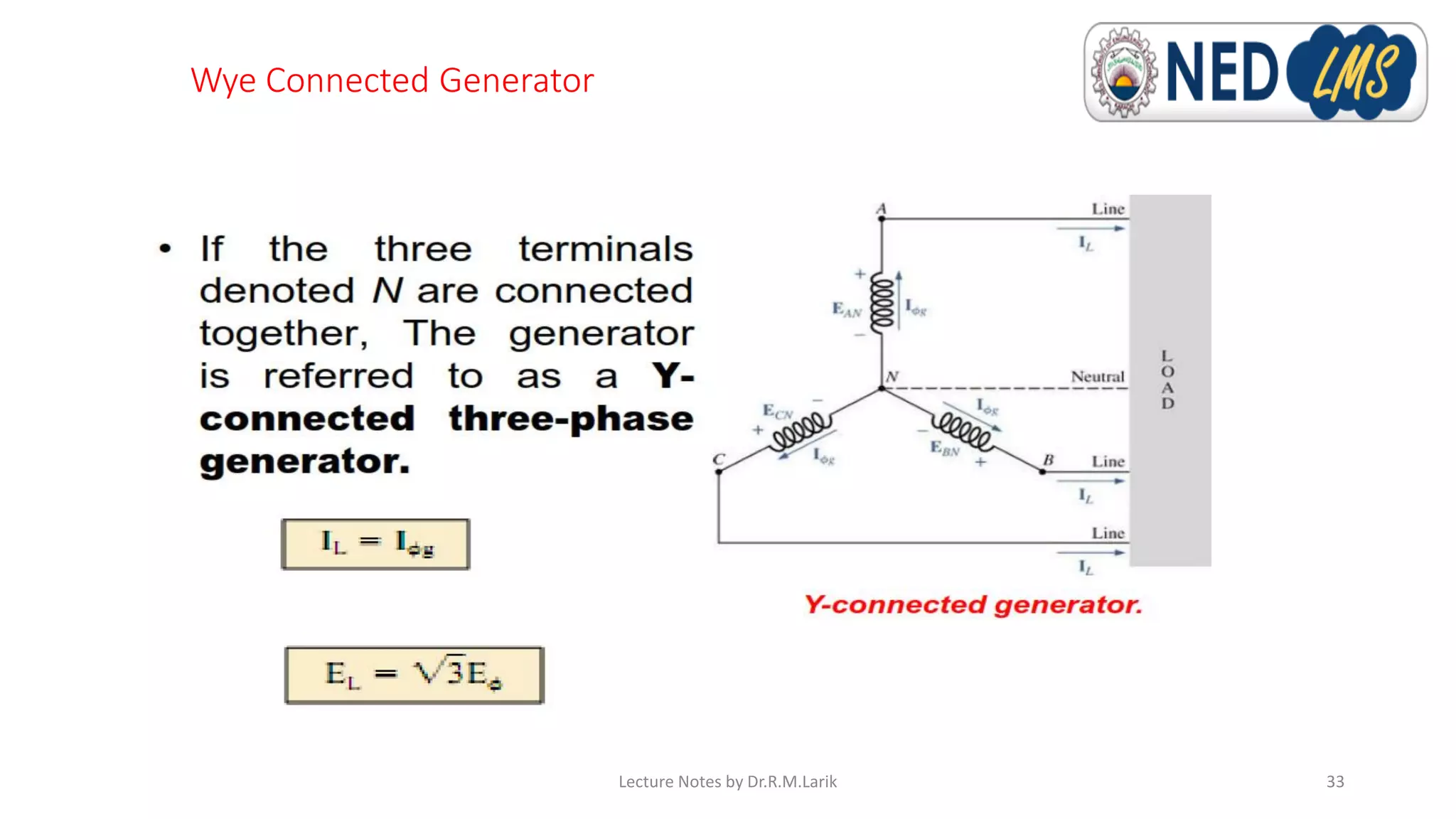
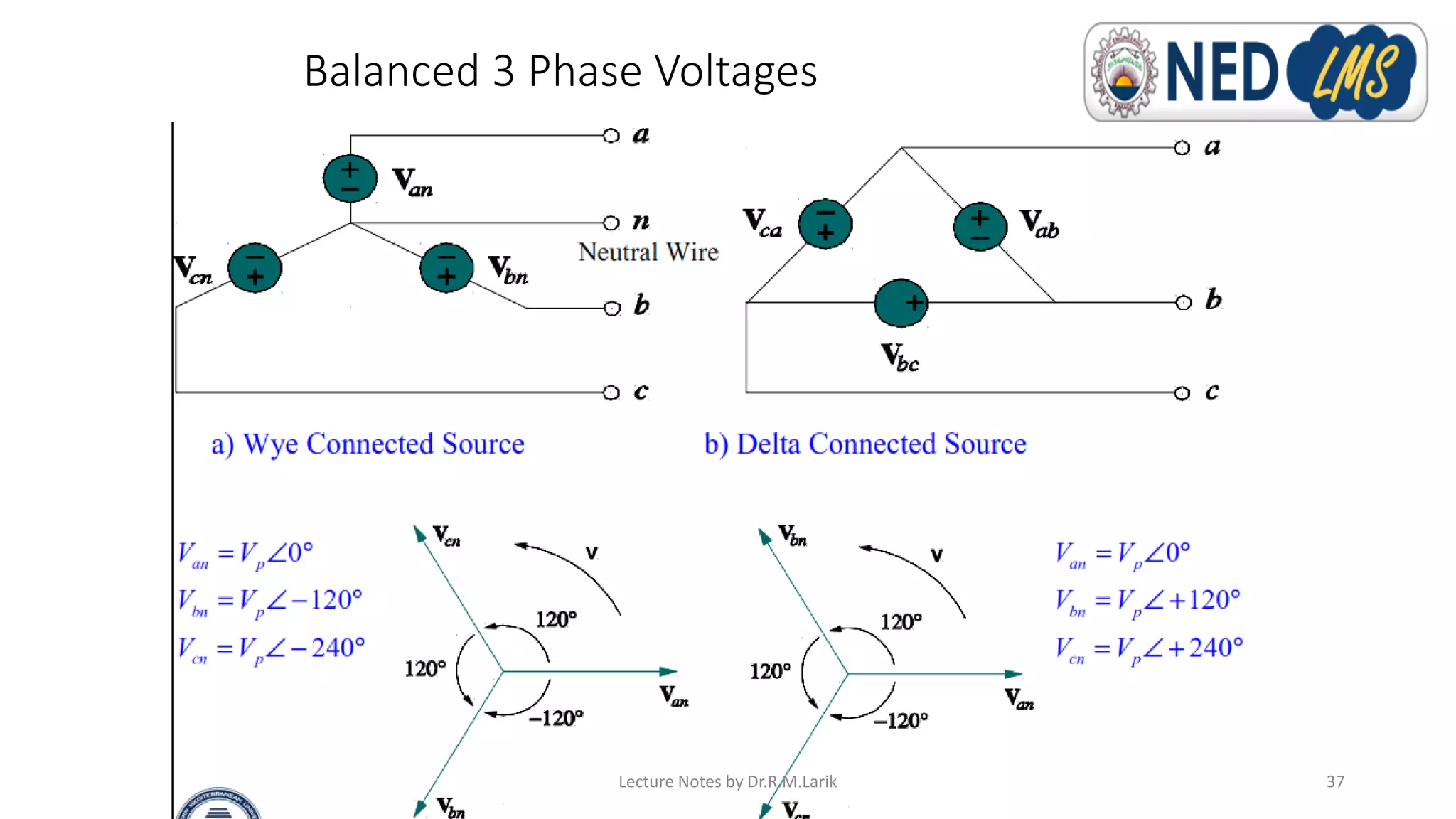
Wye Connected Generator
Lecture Notes by Dr.R.M.Larik 33
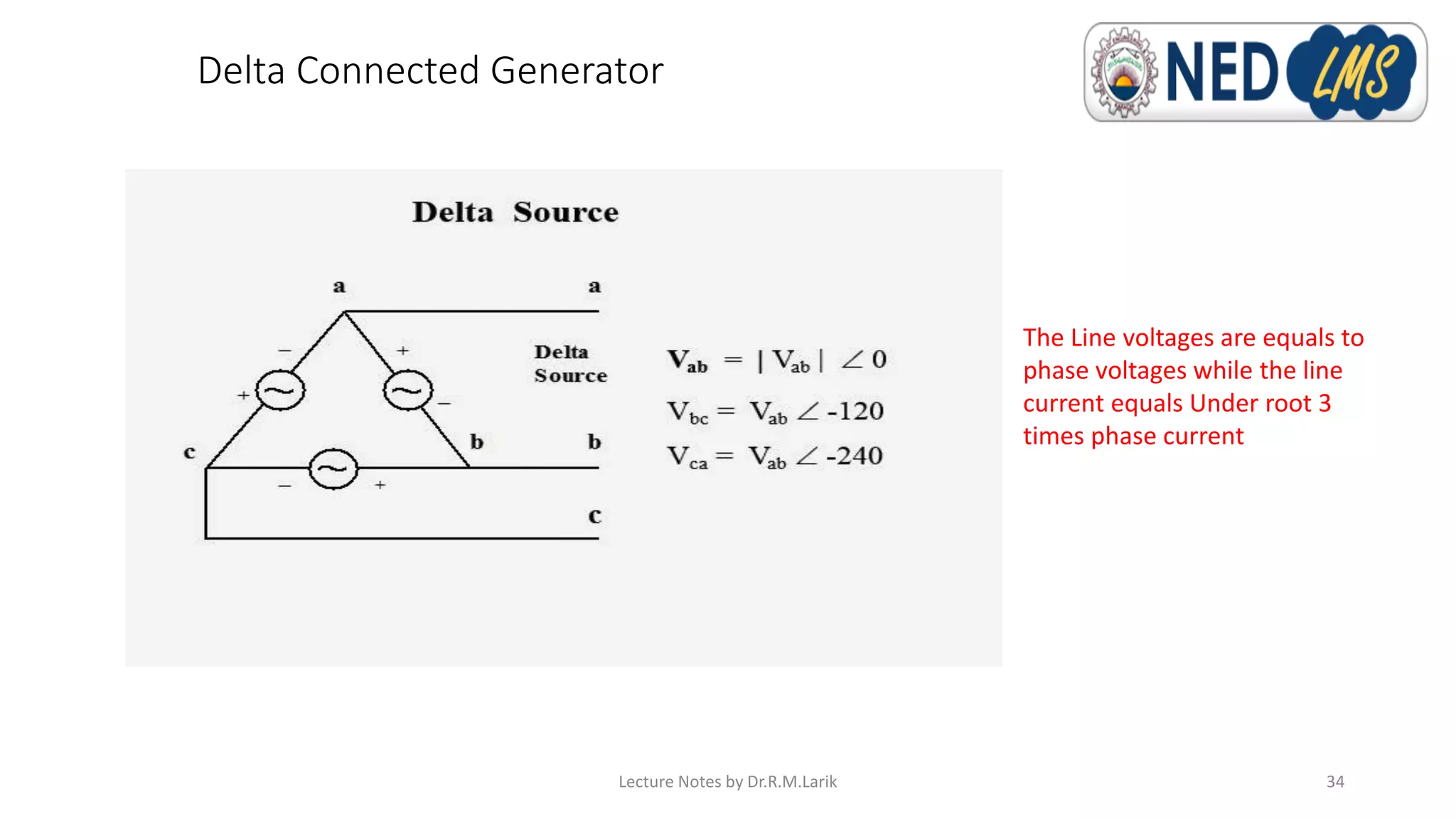
Delta Connected Generator
Lecture Notes by Dr.R.M.Larik
The Line voltages are equals to
phase voltages while the line
current equals Under root 3
times phase current
34
Balanced 3 Phase Loads
Lecture Notes by Dr.R.M.Larik 35
Balanced 3 Phase Voltages
Lecture Notes by Dr.R.M.Larik 36
Balanced 3 Phase Voltages
Lecture Notes by Dr.R.M.Larik 37
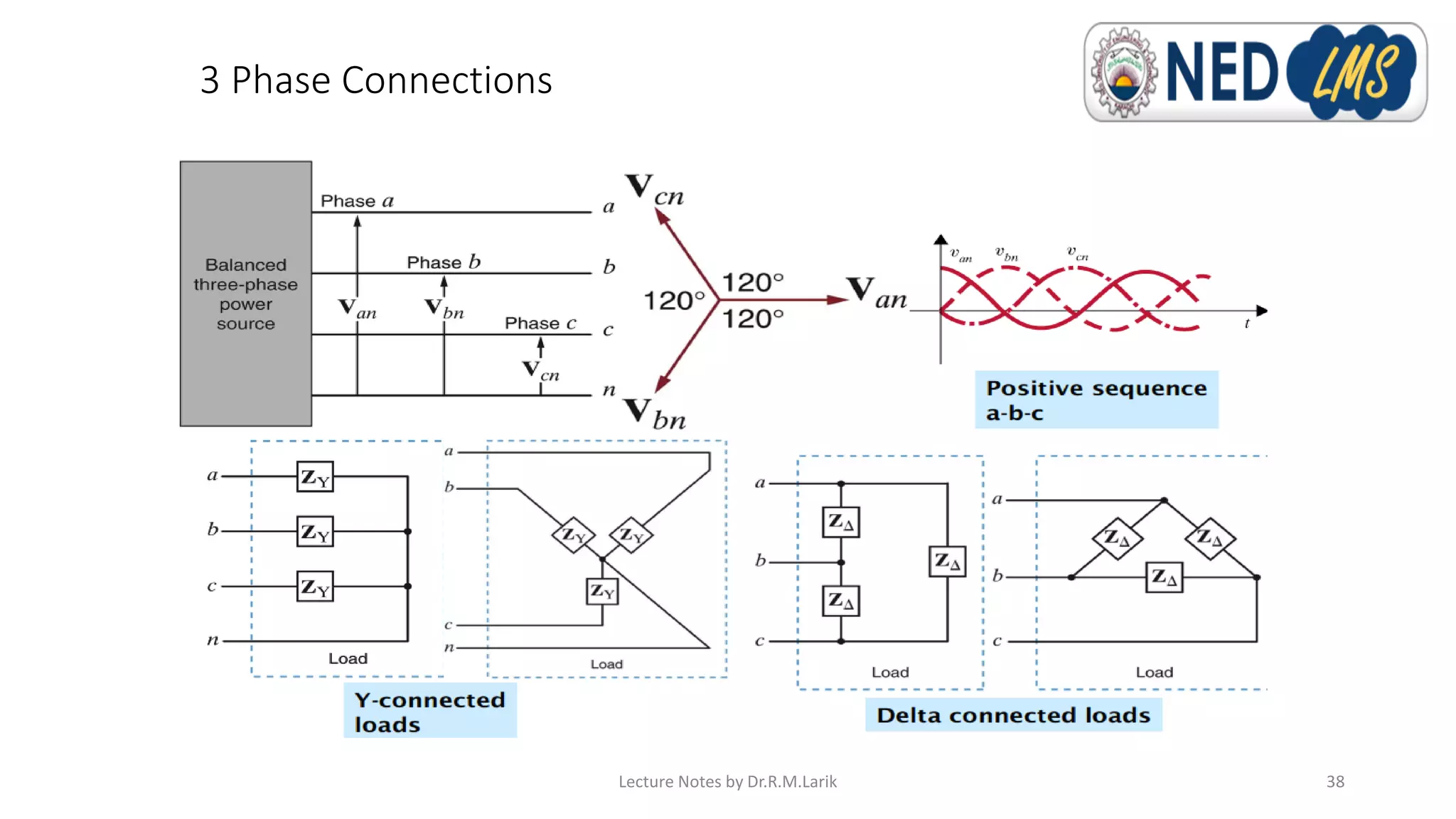
3 Phase Connections
Lecture Notes by Dr.R.M.Larik 38
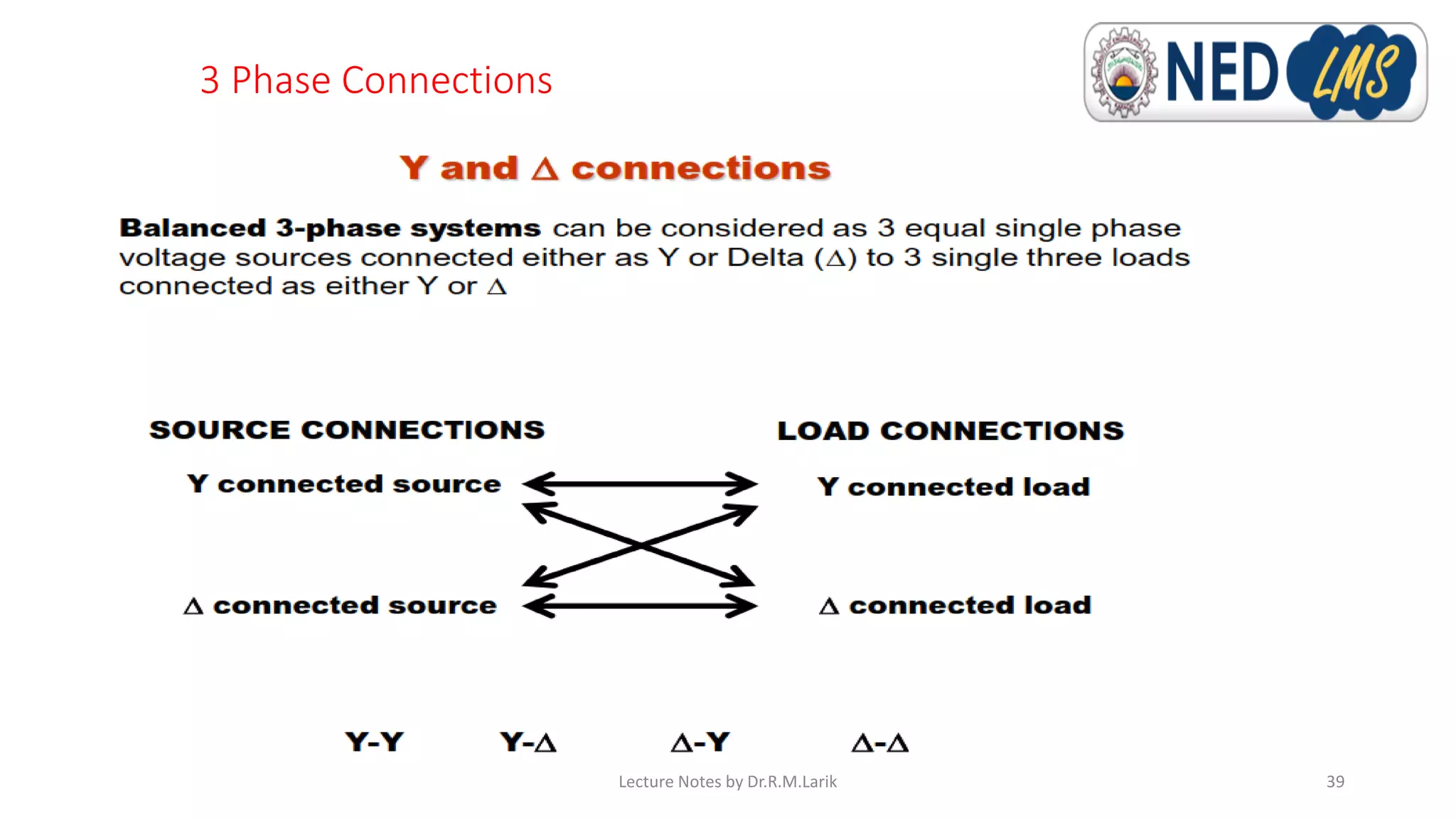
3 Phase Connections
Lecture Notes by Dr.R.M.Larik 39
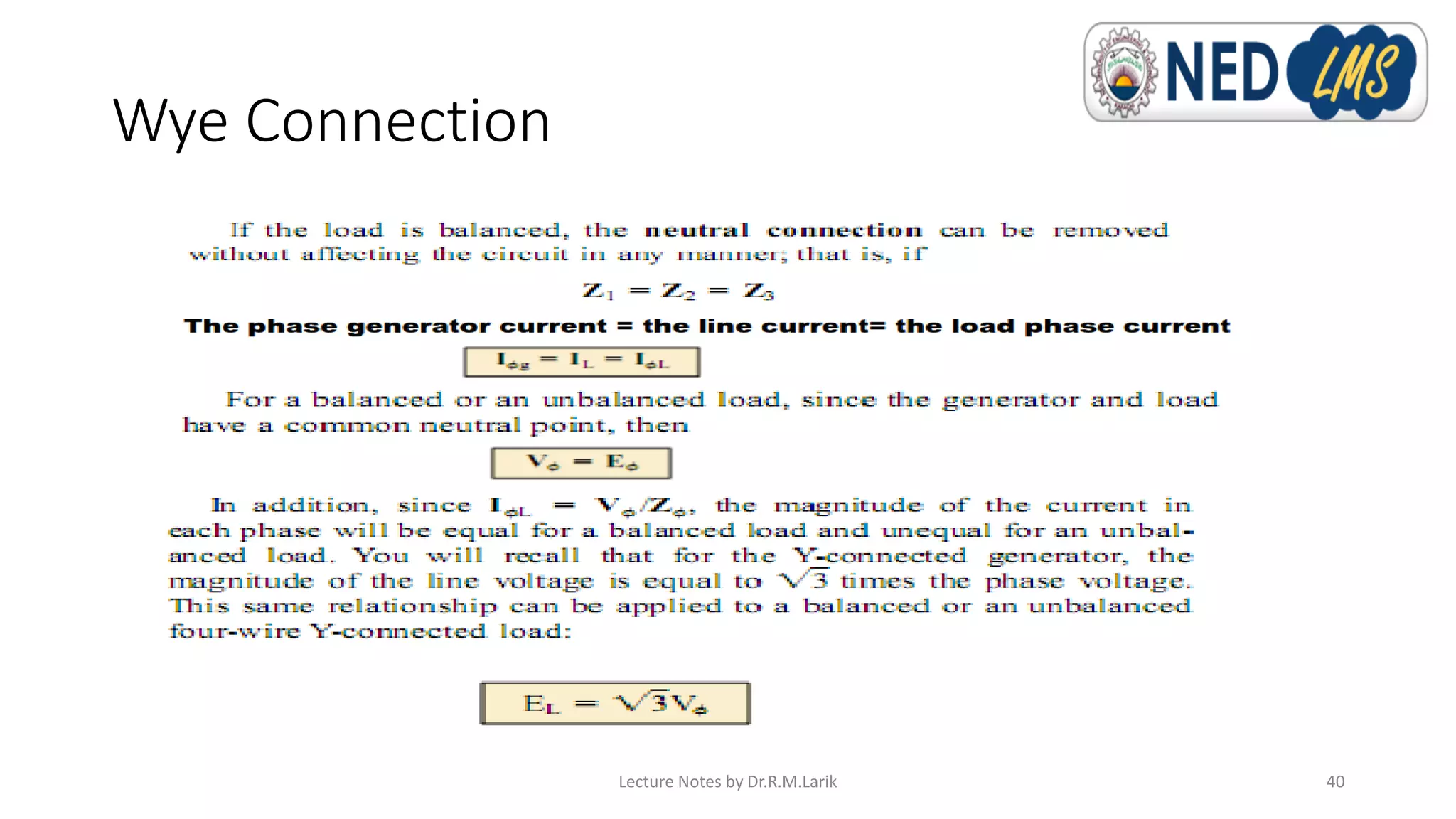
Wye Connection
Lecture Notes by Dr.R.M.Larik 40
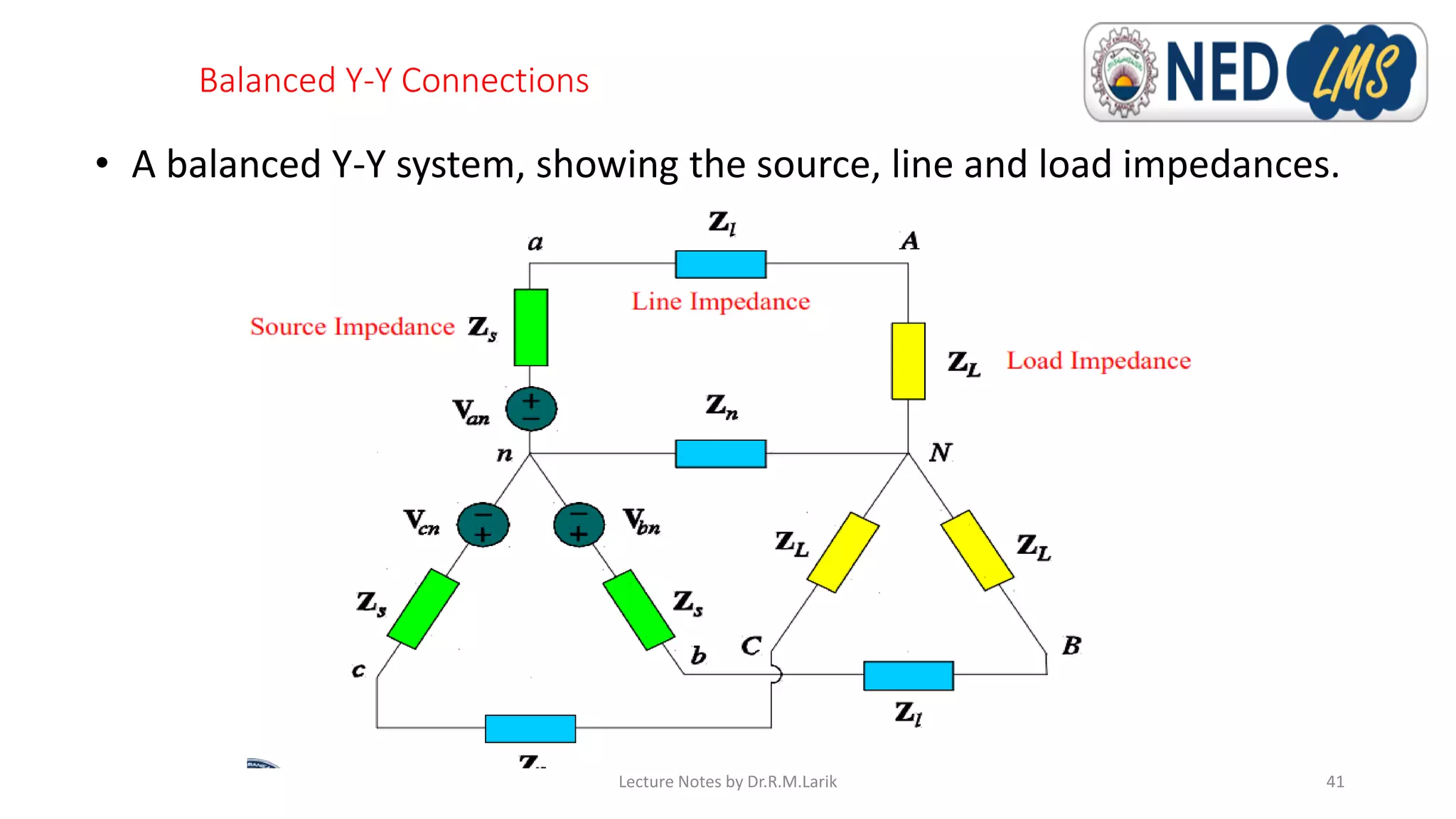
Balanced Y-Y Connections
Lecture Notes by Dr.R.M.Larik
• A balanced Y-Y system, showing the source, line and load impedances.
41
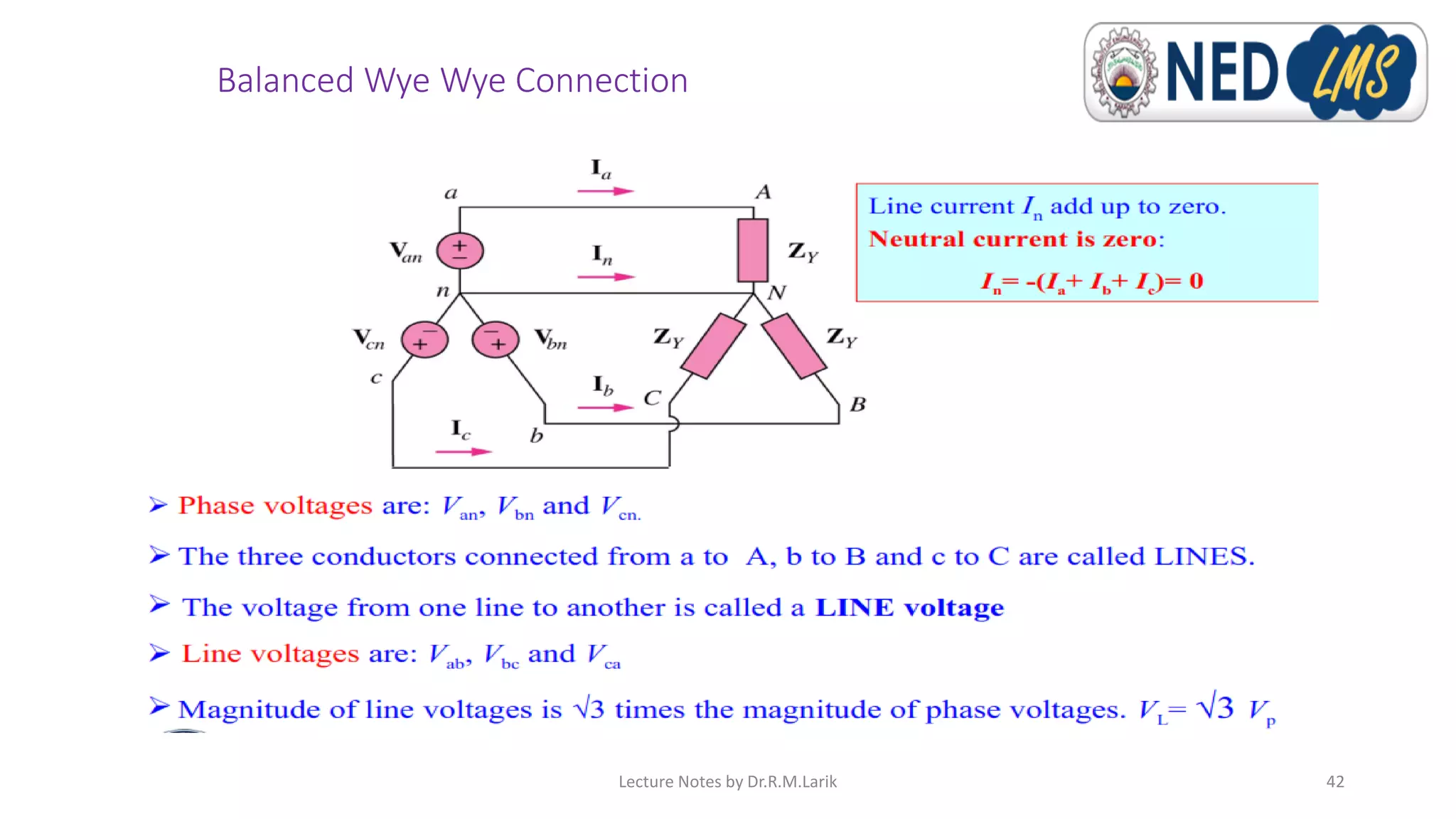
Balanced Wye Wye Connection
Lecture Notes by Dr.R.M.Larik 42
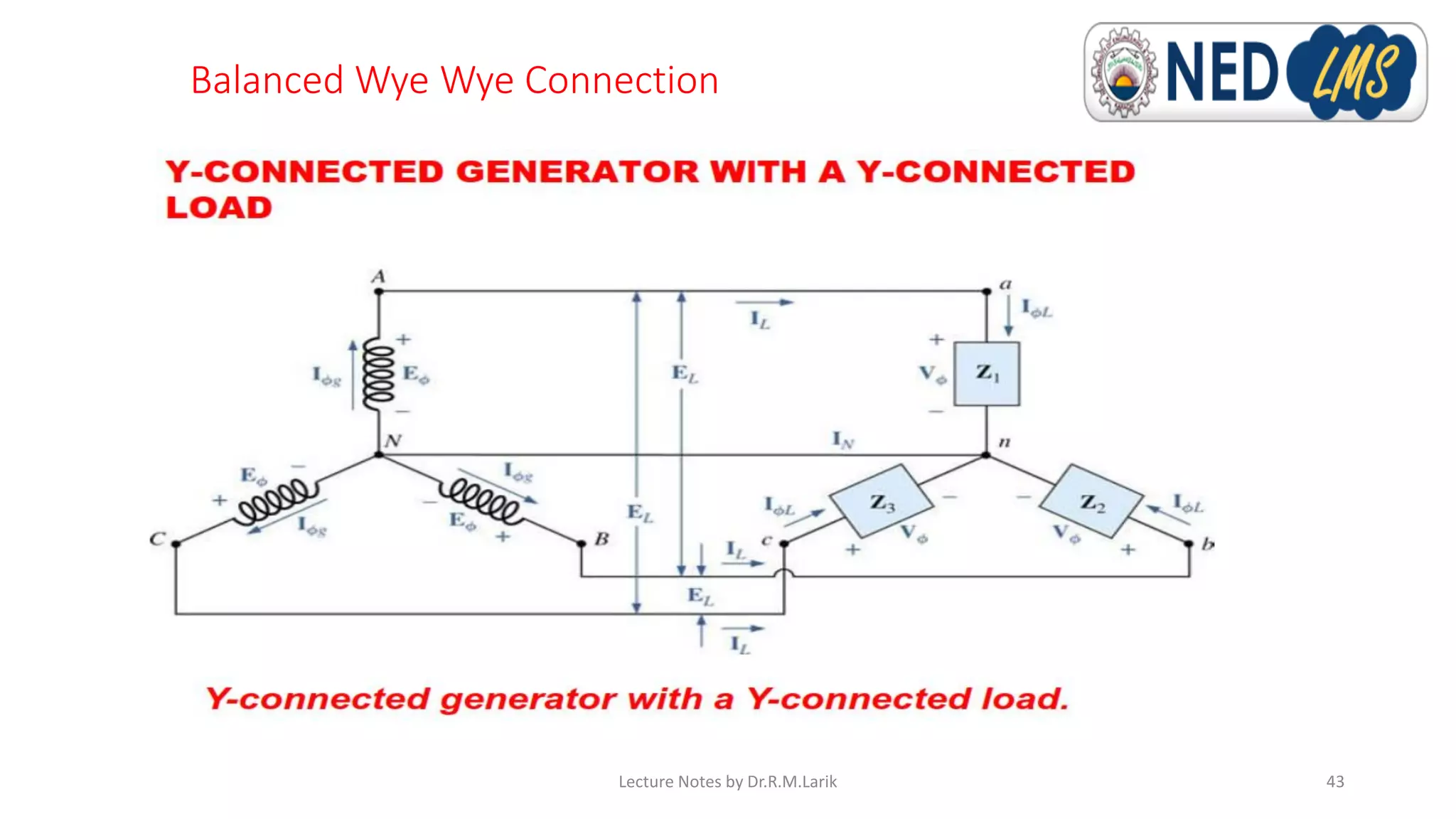
Balanced Wye Wye Connection
Lecture Notes by Dr.R.M.Larik 43
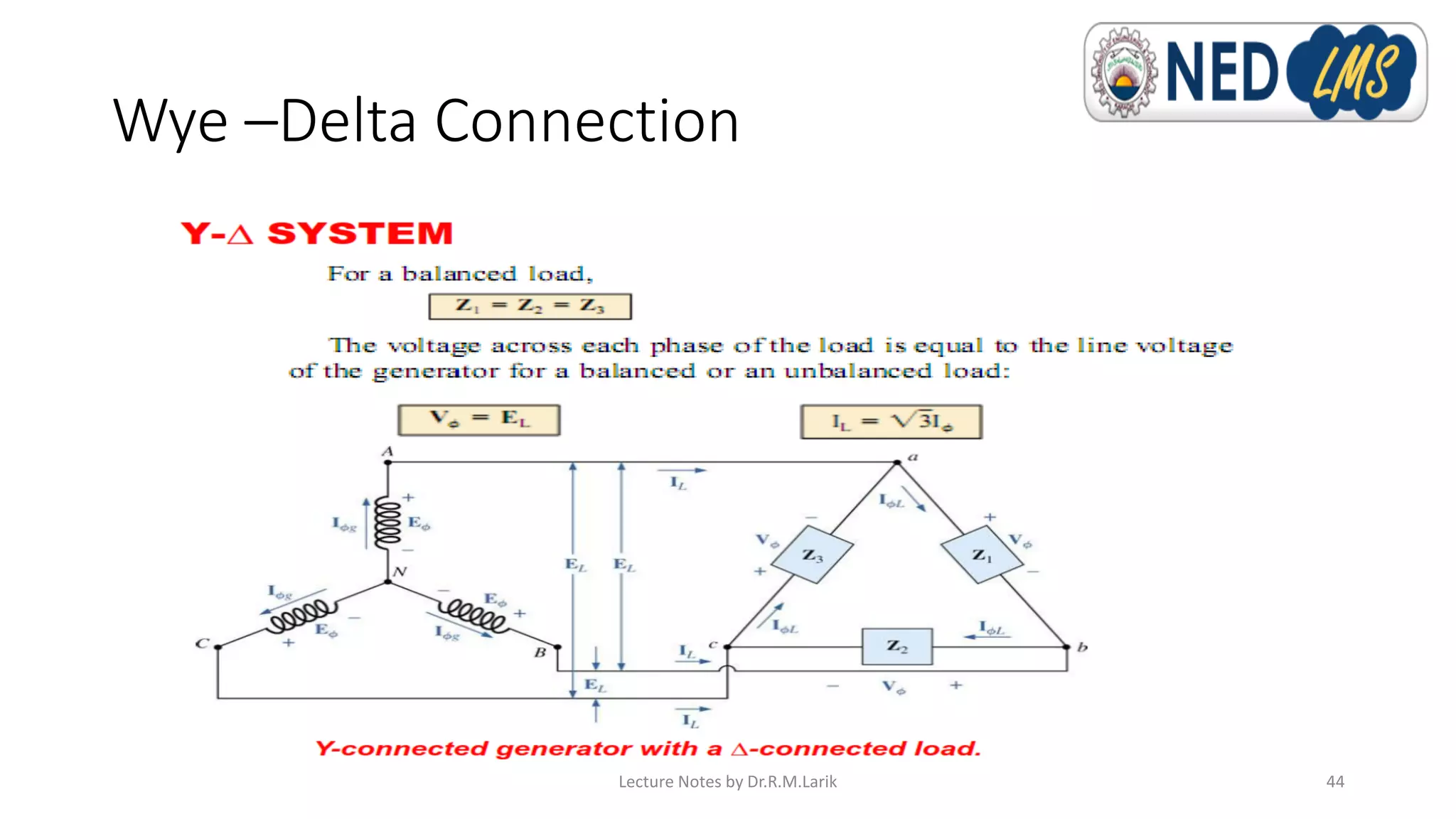
Wye –Delta Connection
Lecture Notes by Dr.R.M.Larik 44
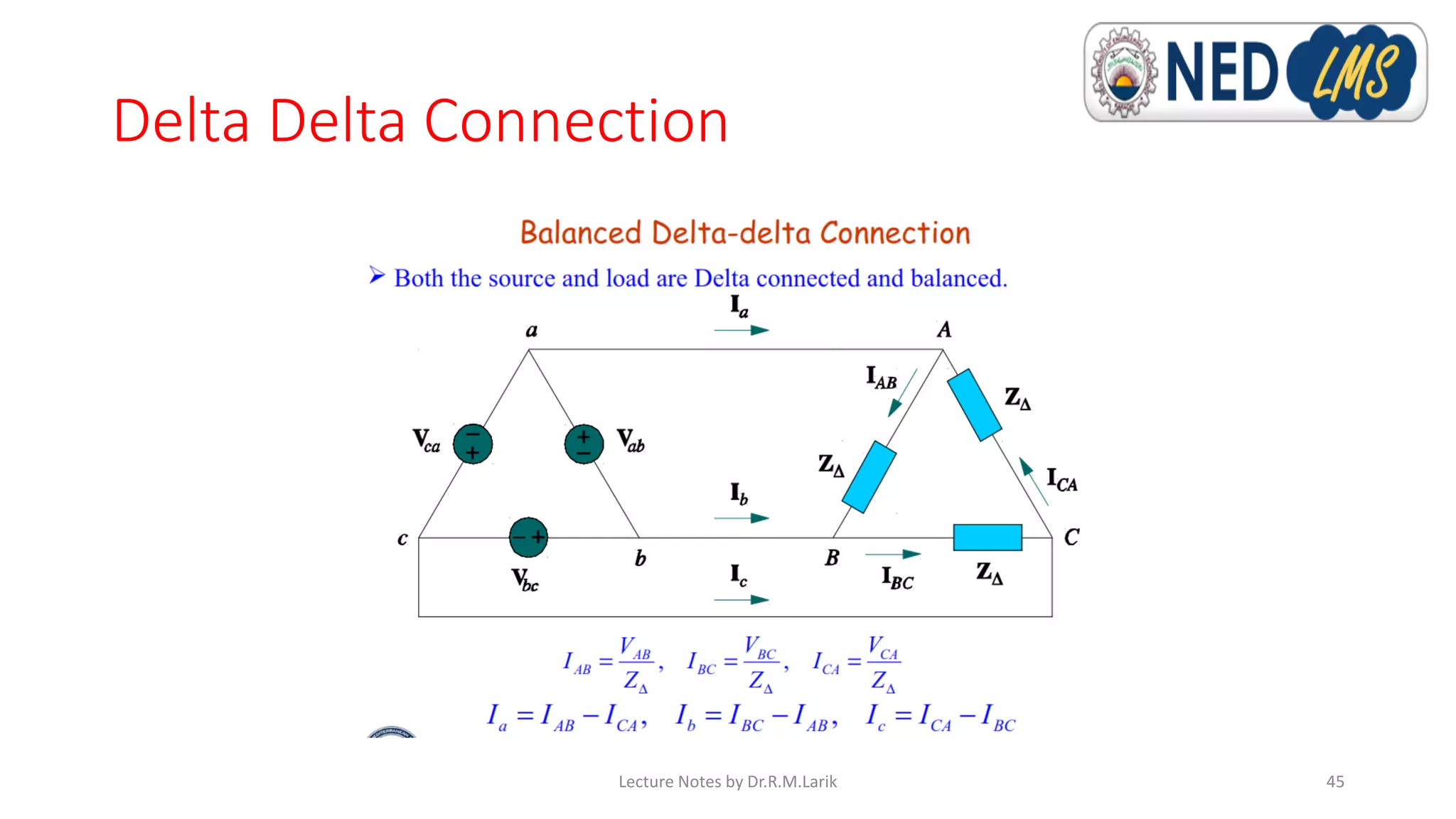
Delta Delta Connection
Lecture Notes by Dr.R.M.Larik 45
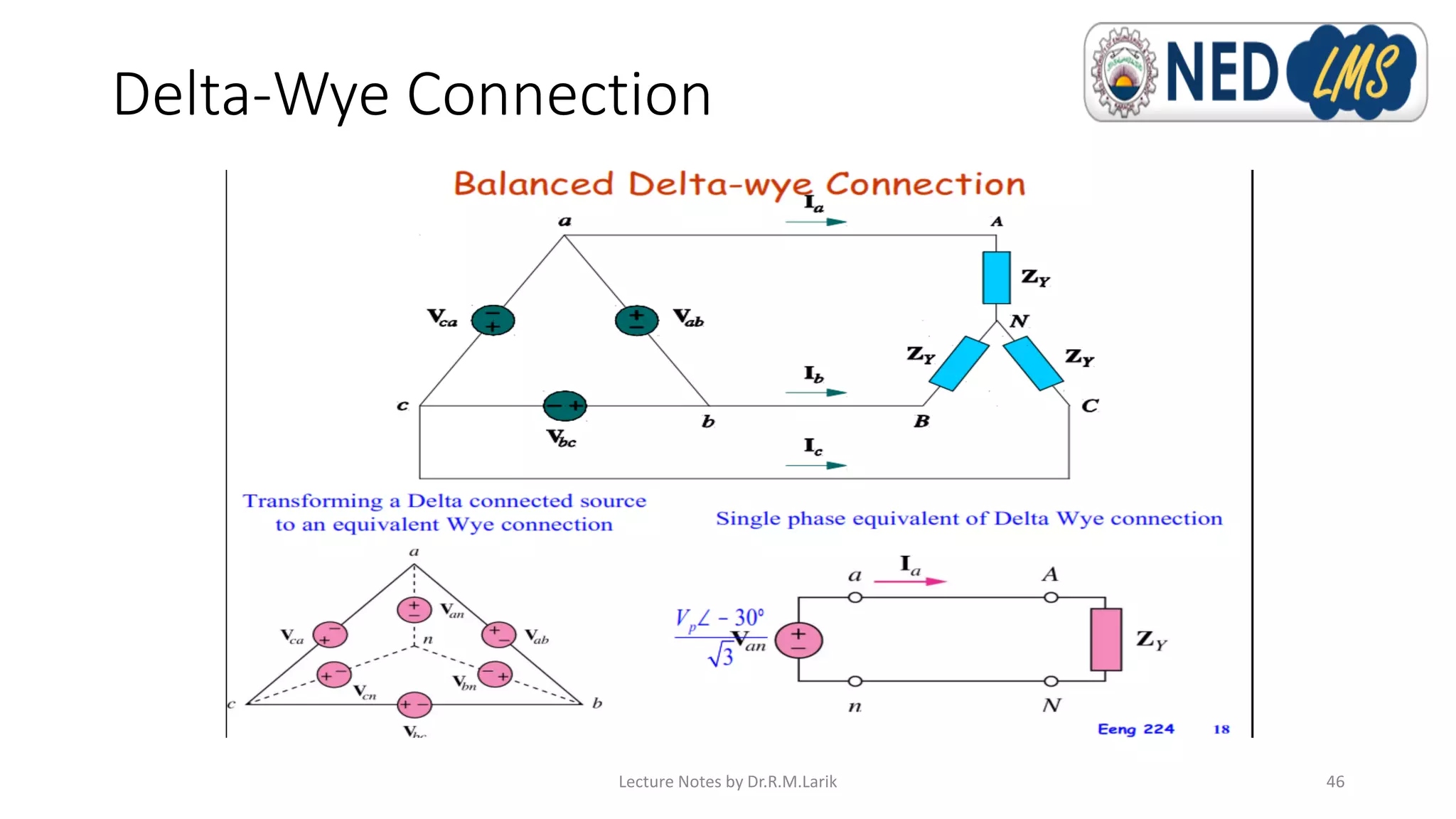
Delta-Wye Connection
Lecture Notes by Dr.R.M.Larik 46

Circuit Analysis

  • 1.
    Circuit Analysis (EE-126) Engr.Dr. Raja Masood Larik rmlarik@neduet.edu.pk • Class code: ak3xqba MEET LINK: https://meet.google.com/lookup/g6rnx4hvb2 • B.E (Electrical Engineering), NED University of Engineering & Technology Karachi, Sindh-Pakistan. 1998. • M.Engg (Electrical Engineering, CGPA 3.45/4.00), NED University of Engineering& Technology Karachi, Sindh-Pakistan. 2006 • Doctor of Philosophy (Electrical Engineering) from University Technology Malaysia (UTM). CGPA 3.67/4.00 2019. • Dr. Larik (Google Scholar Profile) • https://scholar.google.com/citations?hl=en&user=7z1g_I0AAAAJ Lecture Notes by Dr.R.M.Larik 1
  • 2.
    • Engineering CircuitAnalysis by William H. Hayt 8th edition (Text Book) • Fundamentals of Electric circuits by Charles k Alexander (Reference Book) • Introduction to Electric Circuits by Dorf, Richard C (Reference Book) • Electric Circuits by Nilsson, James W (Reference BooK) • Concepts in Electric circuits by Dr.Wasim Naseem (Reference BooK) • Electric Circuits by Theodore F.Bogart (Reference BooK) • Electric Circuits by H.Alex Romanowitz (Reference BooK) Lecture Notes by Dr.R.M.Larik 2
  • 3.
    1.Poly Phase Circuits 2.MagneticallyCoupled Circuits 3.Two Port Networks Poly Phase circuits ➢ Balance Three Phase Voltages ➢ Balance Wye Wye Connection ➢ Balanced Wye-Delta Connection ➢ Balanced Delta-Delta Connection ➢ Balanced Delta-Wye Connection ➢ Power in Balanced System ➢ Unbalanced Three Phase Systems Lecture Notes by Dr.R.M.Larik 3
  • 4.
    Poly Phase Circuits LearningOutcomes ▪ Be Familiar with ac single and three phase system ▪ The basics of ac generation from source (Generators/alternator) ▪ The basic difference between balanced and unbalanced three-phase system ▪ To analyse three phase circuits ▪ Connection pattern for three phase i.e. star/delta Lecture Notes by Dr.R.M.Larik 4
  • 5.
    AC Generation Three thingsmust be present in order to produce electrical current: a) Magnetic field b) Conductor c) Relative motion ▪ Conductor cuts lines of magnetic flux, a voltage is induced in the conductor Direction and Speed are important Lecture Notes by Dr.R.M.Larik 5
  • 6.
    What is 1and 3 Phase? • 1-Phase (voltage which appears between line to neutral is known as phase voltage Range from 215-240 V) permissible limit 180V • Wye or Star Connection • 3-pahse (Voltage appears between any two lines is known as line voltage line to line voltage the 3 phase voltage Range from 415-440 V permissible limit 380V Lecture Notes by Dr.R.M.Larik 6
  • 7.
    Single Phase generation LectureNotes by Dr.R.M.Larik 7
  • 8.
    Conductor and magneticfield have zero degree angle (both are parallel to each other Lecture Notes by Dr.R.M.Larik 8
  • 9.
    Lecture Notes byDr.R.M.Larik 9
  • 10.
    Lecture Notes byDr.R.M.Larik 10
  • 11.
    Lecture Notes byDr.R.M.Larik 11
  • 12.
    Lecture Notes byDr.R.M.Larik 12
  • 13.
    Lecture Notes byDr.R.M.Larik 13
  • 14.
  • 15.
    Lecture Notes byDr.R.M.Larik 15
  • 16.
    No relative motion betweenconductor and magnetic field Lecture Notes by Dr.R.M.Larik 16
  • 17.
    Lecture Notes byDr.R.M.Larik 17
  • 18.
    Advantages and importanceof three-phase systems An AC generator designed to develop a single sinusoidal voltage for each rotation of the shaft (rotor) is referred to as a single-phase AC generator. If the number of coils on the rotor is increased in a specified manner, the result is a Polyphase AC generator, which develops more power than one AC phase voltage per rotation of the rotor In general, three-phase systems are preferred over single-phase systems for the transmission of power for many reasons. 1. The instantaneous power in three-phase system can be constant (not pulsating as in a single phase circuit). 2. For the same transmitted power, three-phase systems consume less wires. 3. The lighter lines are easier to install, and the supporting structures can be less massive and farther apart. 4. In general, most larger motors are three phase because they are essentially self starting and do not require a special design or additional starting circuitry. For the above reasons, most of the power distribution systems in US and over the world, use three- phase systems. The first three-phase electrical system was patented in 1882 by John Hopkinson - British physicist, electrical engineer, Fellow of the Royal Society. Lecture Notes by Dr.R.M.Larik 18
  • 19.
    Lecture Notes byDr.R.M.Larik 19
  • 20.
    Three Phase generation LectureNotes by Dr.R.M.Larik 20
  • 21.
    Lecture Notes byDr.R.M.Larik 21
  • 22.
    WHY WE STUDY3 PHASE SYSTEM ? ALL electric power system in the world used 3- phase system to GENERATE, TRANSMIT and DISTRIBUTE One phase, two phase, can be taken from three phase system rather than generated independently Lecture Notes by Dr.R.M.Larik 22
  • 23.
    Three Phase generation LectureNotes by Dr.R.M.Larik 23
  • 24.
    Lecture Notes byDr.R.M.Larik 24
  • 25.
    Important relation ofImpedance Lecture Notes by Dr.R.M.Larik 25
  • 26.
    Lecture Notes byDr.R.M.Larik 26
  • 27.
    What is Phase?What is Line? The voltage appears between line to neutral is termed as phase voltage The voltage appears between any two lines (phases) is Line voltage. We have commonly two types of connection (to connect windings) either we connect in star or delta pattern. Both connections have certain advantages as well as disadvantages Lecture Notes by Dr.R.M.Larik 27
  • 28.
    What is Balancedand Unbalanced 3 Phase System? Unbalanced 3 Phase System Each impedance of all phase are dislike for example the impedances are (4+j2)ohm ,(6+j3)ohm and (8+j5)ohm (Single Phase loads at homes and Offices) Balanced 3 Phase System Balance 3 Phase System each impedance having same value for example (3+j3)ohm (3+j3)ohm and (3+j3)ohm (3 Phase Induction motor used in industry) Lecture Notes by Dr.R.M.Larik 28
  • 29.
    Lecture Notes byDr.R.M.Larik 29
  • 30.
    Single Phase, twoand three wire Circuits Lecture Notes by Dr.R.M.Larik Two Phase 3 Wire system ac sources operates at different phases 30
  • 31.
    Three Phase 4wire Circuits Lecture Notes by Dr.R.M.Larik 31
  • 32.
    Three Phase Generation Thethree-phase generator has three induction coils placed 120° apart on the stator. • The three coils have an equal number of turns, the voltage induced across each coil will have the same peak value, shape and frequency. Internal impedance of a generator is usually inductive (due to the use of coils). Lecture Notes by Dr.R.M.Larik 32
  • 33.
    Wye Connected Generator LectureNotes by Dr.R.M.Larik 33
  • 34.
    Delta Connected Generator LectureNotes by Dr.R.M.Larik The Line voltages are equals to phase voltages while the line current equals Under root 3 times phase current 34
  • 35.
    Balanced 3 PhaseLoads Lecture Notes by Dr.R.M.Larik 35
  • 36.
    Balanced 3 PhaseVoltages Lecture Notes by Dr.R.M.Larik 36
  • 37.
    Balanced 3 PhaseVoltages Lecture Notes by Dr.R.M.Larik 37
  • 38.
    3 Phase Connections LectureNotes by Dr.R.M.Larik 38
  • 39.
    3 Phase Connections LectureNotes by Dr.R.M.Larik 39
  • 40.
    Wye Connection Lecture Notesby Dr.R.M.Larik 40
  • 41.
    Balanced Y-Y Connections LectureNotes by Dr.R.M.Larik • A balanced Y-Y system, showing the source, line and load impedances. 41
  • 42.
    Balanced Wye WyeConnection Lecture Notes by Dr.R.M.Larik 42
  • 43.
    Balanced Wye WyeConnection Lecture Notes by Dr.R.M.Larik 43
  • 44.
    Wye –Delta Connection LectureNotes by Dr.R.M.Larik 44
  • 45.
    Delta Delta Connection LectureNotes by Dr.R.M.Larik 45
  • 46.