Voltage and Power Control
in Power Systems
Caner Göksel Sonuzun
Contents
• Introduction
• Voltage Control Power Systems
• Reactive Power
• Need for Reactive Power
• Need for Reactive Power Compensation
• Reactive Power Compensation Devices
• Voltage and Reactive Power Control Methods
Introduction
• Voltage ratings of the various buses in the power
system which includes generating station buses,
switching substation buses, receiving substation
buses and distribution substation buses should be
within the permissible limits for satisfactory operation
of all electrical equipments. The task of voltage
control is closely associated with fluctuating load
conditions and corresponding requirements of
reactive power compensation. Therefore several
voltage control methods are employed in power
system to keep the voltage levels within the
desirable limits.
Reactive Power
Power is referred as the product of voltage and
current
P = V x I
• In an ac transmission, when the voltage and current
go up and down at the same time, i.e. when
voltage and current are in phase or in synch, only
real power is transmitted and when there is a time
shift between voltage and current both active and
reactive power are transmitted.
Reactive Power
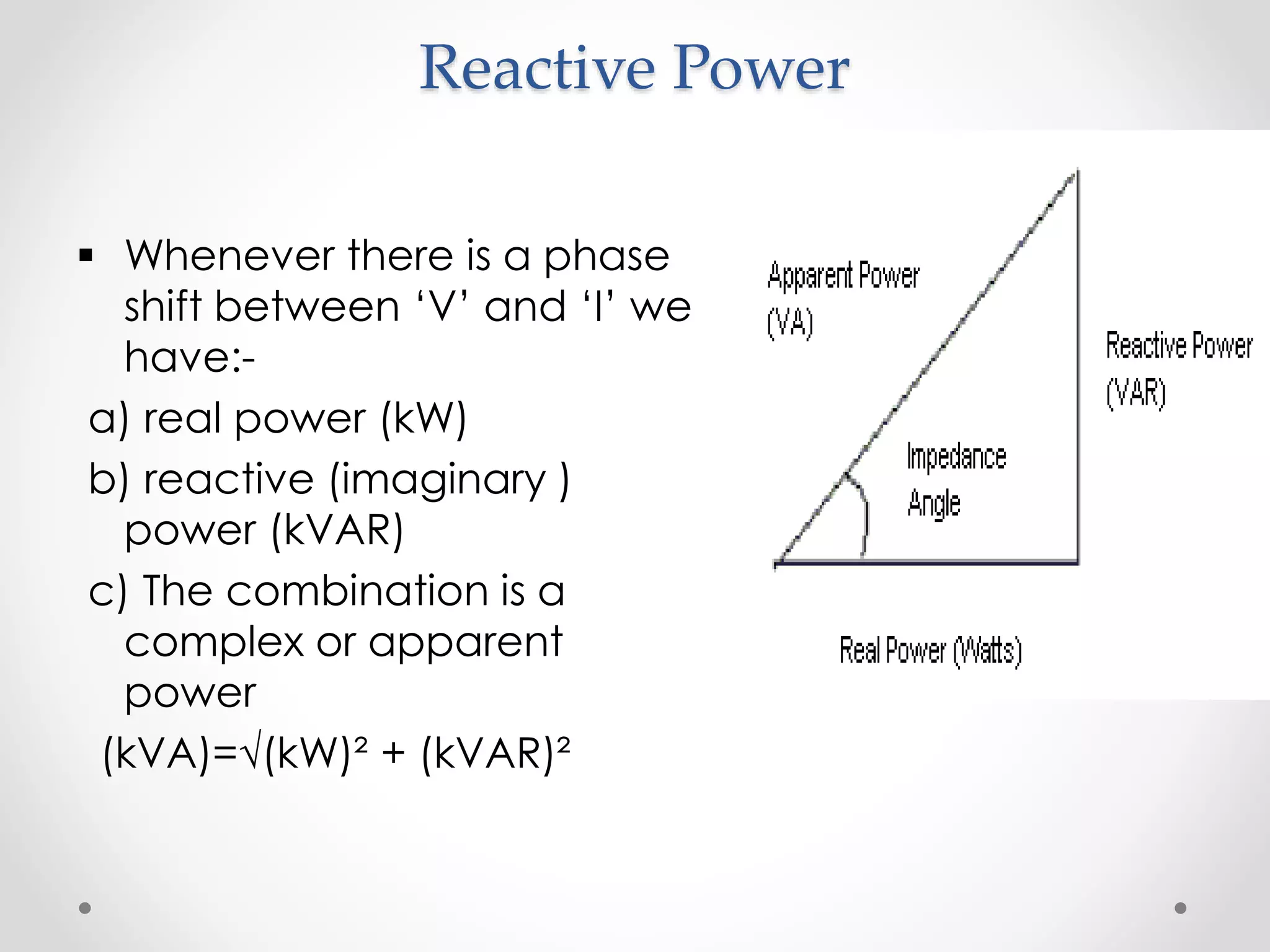
 Whenever there is a phase
shift between ‘V’ and ‘I’ we
have:-
a) real power (kW)
b) reactive (imaginary )
power (kVAR)
c) The combination is a
complex or apparent
power
(kVA)=√(kW)² + (kVAR)²
Need for Reactive Power
Reactive power (Vars) is required to maintain
the voltage to deliver active power (watts)
through transmission lines. Motor loads and
other loads require reactive power to convert
the flow of electrons into useful work. When
there is not enough reactive power, the voltage
sags down and it is not possible to push the
power demanded by loads through the lines.
Need for Reactive Power
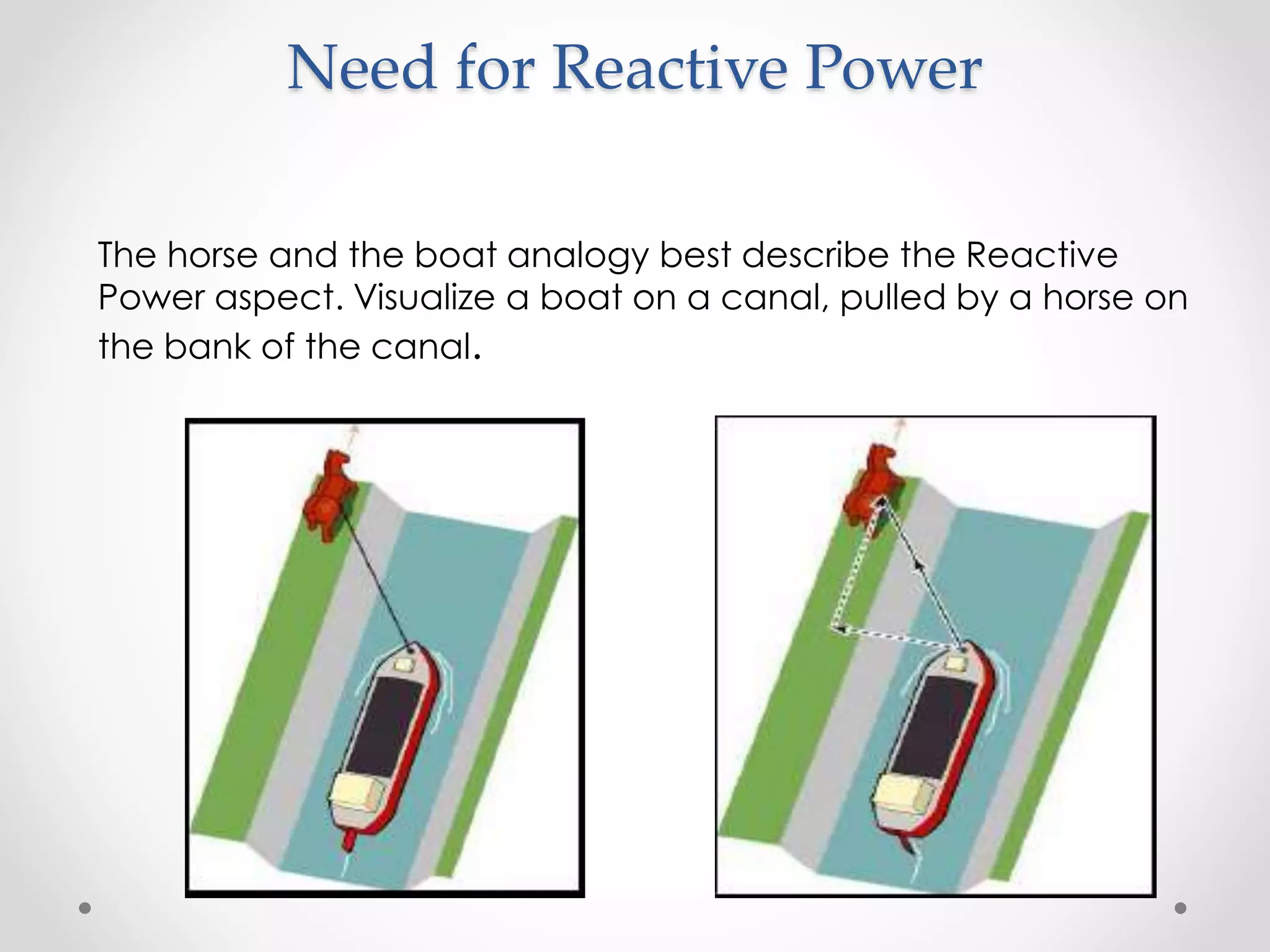
The horse and the boat analogy best describe the Reactive
Power aspect. Visualize a boat on a canal, pulled by a horse on
the bank of the canal.
Need for Reactive Power
• In the horse and boat analogy, the horse’s objective
(real power) is to move the boat straightly.
• The fact that the rope is being pulled from the flank of
the horse and not straight behind it, limits the horse’s
capacity to deliver real work of moving straightly.
• Therefore, the power required to keep the boat steady
in navigating straightly is delivered by the rudder
movement (reactive power).
• Without reactive power there can be no transfer of real
power, likewise without the support of rudder, the boat
cannot move in a straight line.
Need for Reactive Power
Compensation
• Reactive power generated by the ac power source
is stored in a capacitor or a reactor during a quarter
of a cycle and in the next quarter of the cycle it is
sent back to the power source. Therefore the
reactive power oscillates between the ac source
and the capacitor or reactor at a frequency
equals to two times the rated value (50 or 60 Hz). So

to avoid the circulation between the load and
source it needs to be compensated .
• Also to regulate the power factor of the system and
maintain the voltage stability we need to
compensate reactive power .
Reactive Power Compensation Devices
• Series Compensation (Capacitors or Reactors)
• Shunt Compensation (Capacitors or Reactors)
• Synchronous Condensors
• Static VAR Compensators
• Static Synchronous Compensator (STATCOM)
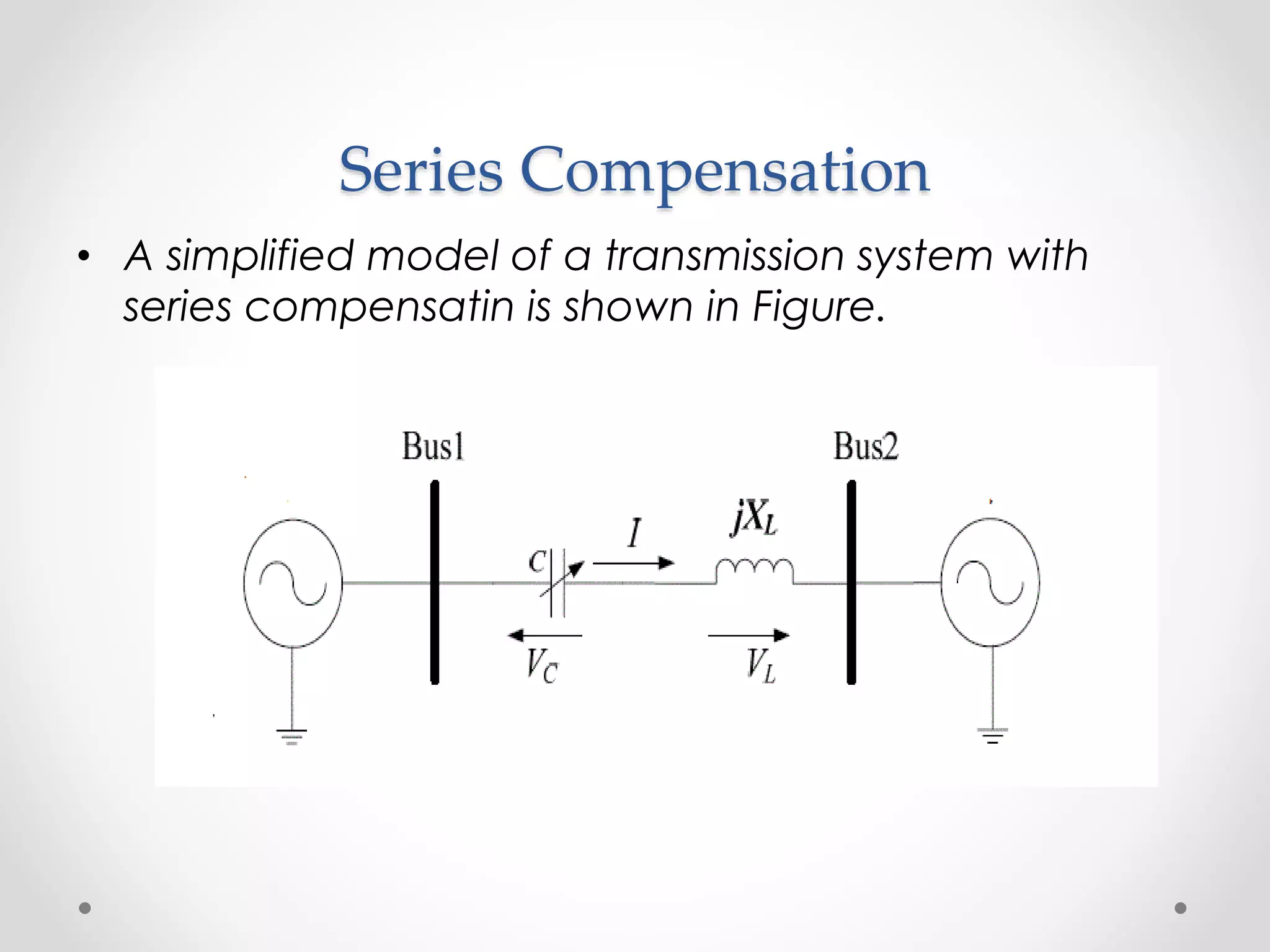
Series Compensation
When a device is connected in series with the
transmission line it is called a series compensator. A
series compensator can be connected anywhere in
the line.
There are two modes of operation – capacitive mode
of operation and inductive mode of operation.
Series Compensation
• A simplified model of a transmission system with
series compensatin is shown in Figure.
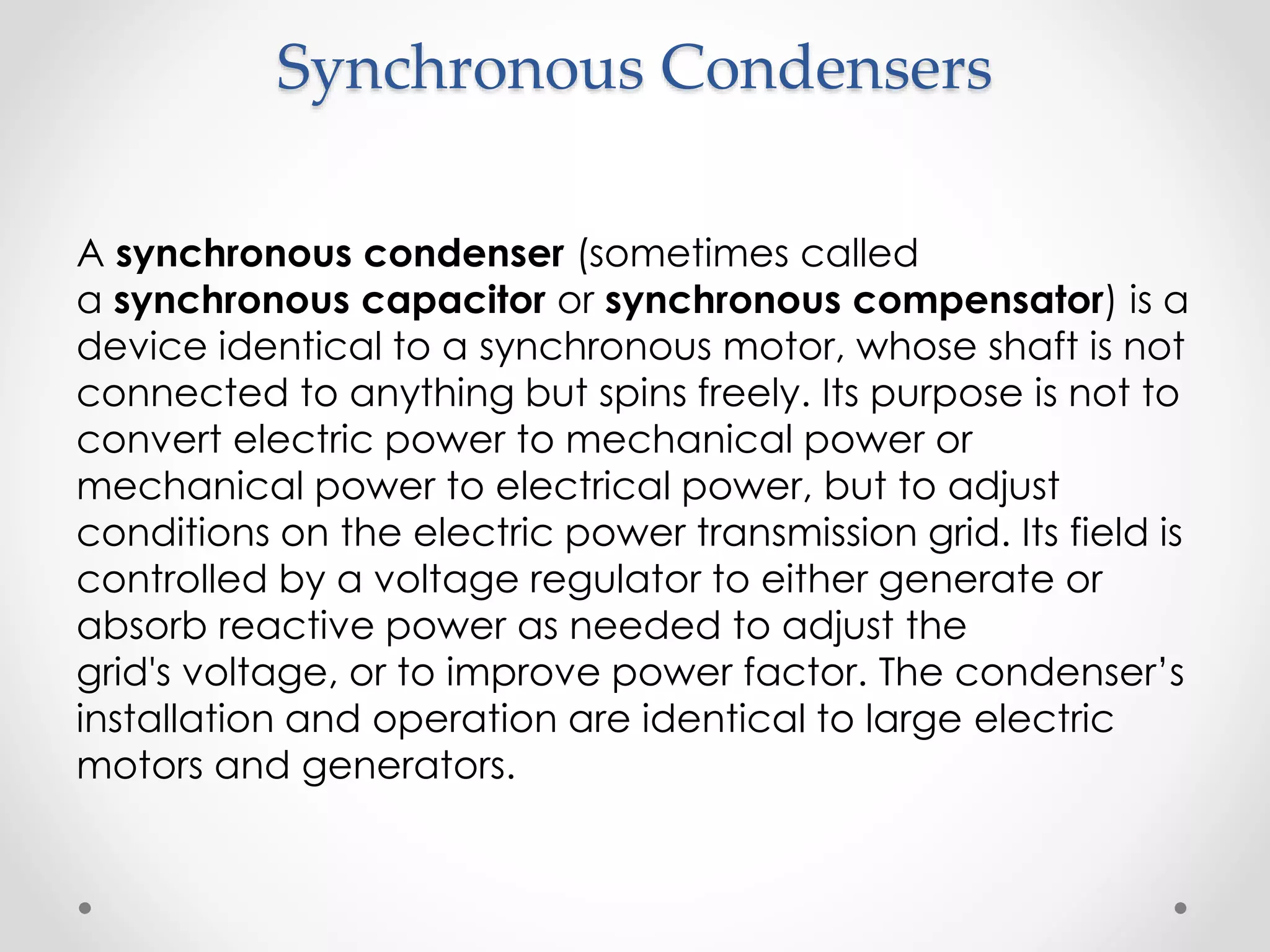
Shunt Compensation
• The device that is connected in parallel with the
transmission line is called the shunt compensator. A
shunt compensator is always connected in the
middle of the transmission line. It can be provided
by either a current source, voltage source or a
capacitor.
Shunt Compensation
• A simplified model of a transmission
system with shunt compensation is
shown in Figure.
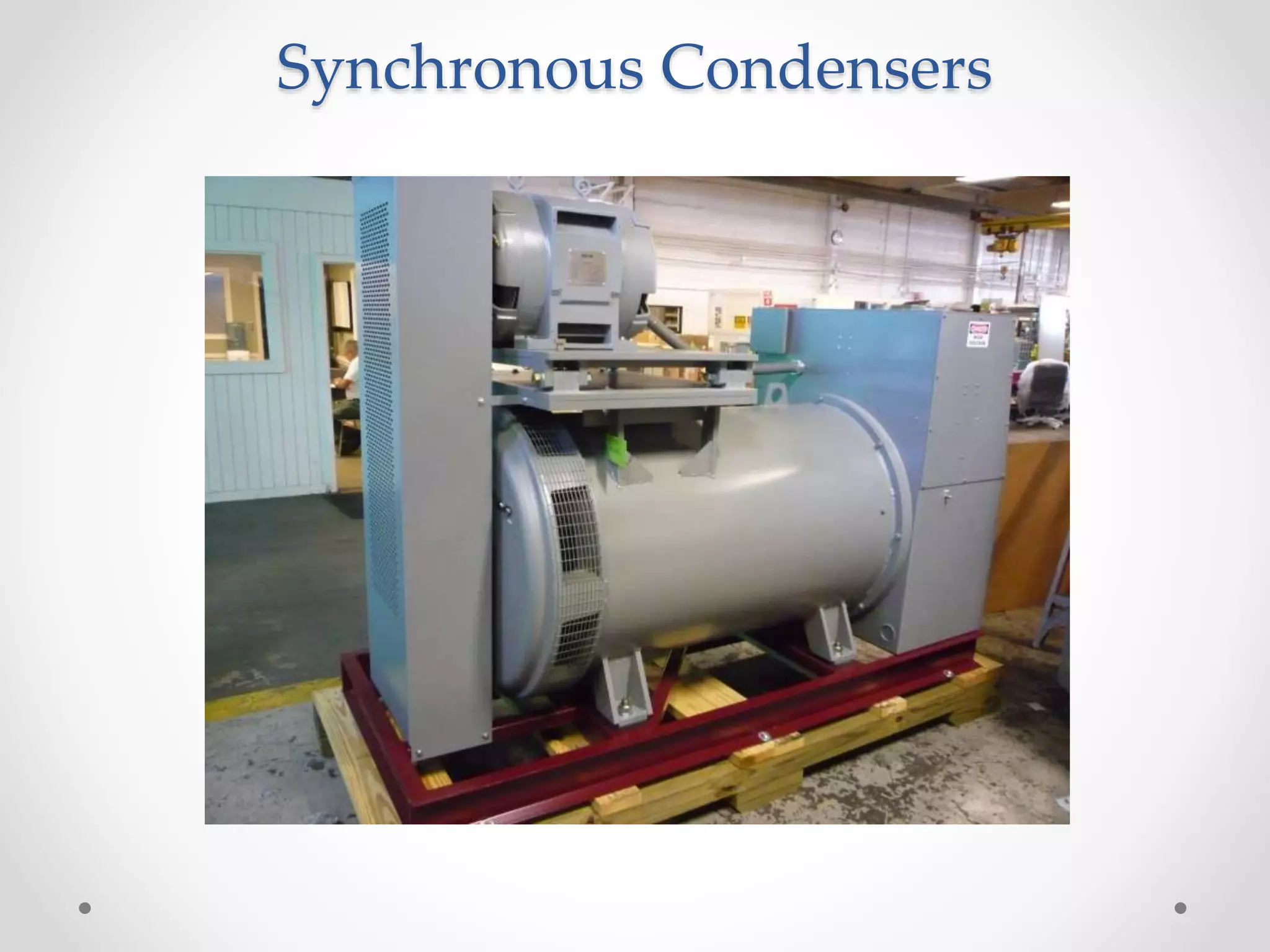
Synchronous Condensers
A synchronous condenser (sometimes called
a synchronous capacitor or synchronous compensator) is a
device identical to a synchronous motor, whose shaft is not
connected to anything but spins freely. Its purpose is not to
convert electric power to mechanical power or
mechanical power to electrical power, but to adjust
conditions on the electric power transmission grid. Its field is
controlled by a voltage regulator to either generate or
absorb reactive power as needed to adjust the
grid's voltage, or to improve power factor. The condenser’s
installation and operation are identical to large electric
motors and generators.
Synchronous Condensers
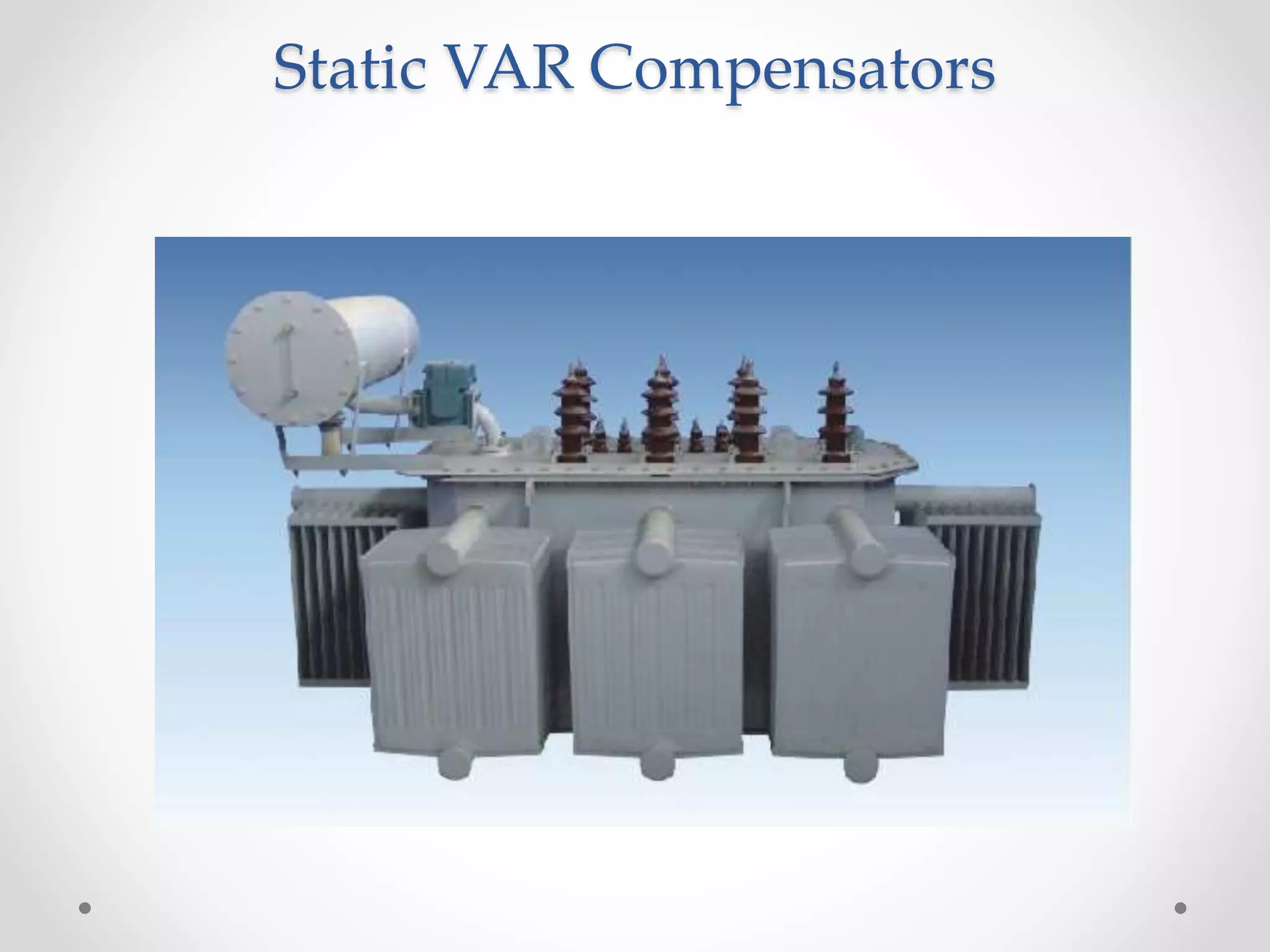
Static VAR Compensators
The static VAR compensator (SVC) is an advanced
reactive power compensating device, capable of rapidly
supplying capacitive or inductive power when required.
The SVC can not only improve power quality in the electric
distribution system to ensure the safe and reliable operation
of the system and equipment, but also create a certain
economic benefit for both the customers and the utility.
Unlike a synchronous condenser which is a rotating
electrical machine, a static VAR compensator has no
significant moving parts.
The SVC is an automated impedance matching device,
designed to bring the system closer to unity power factor.
Static VAR Compensators
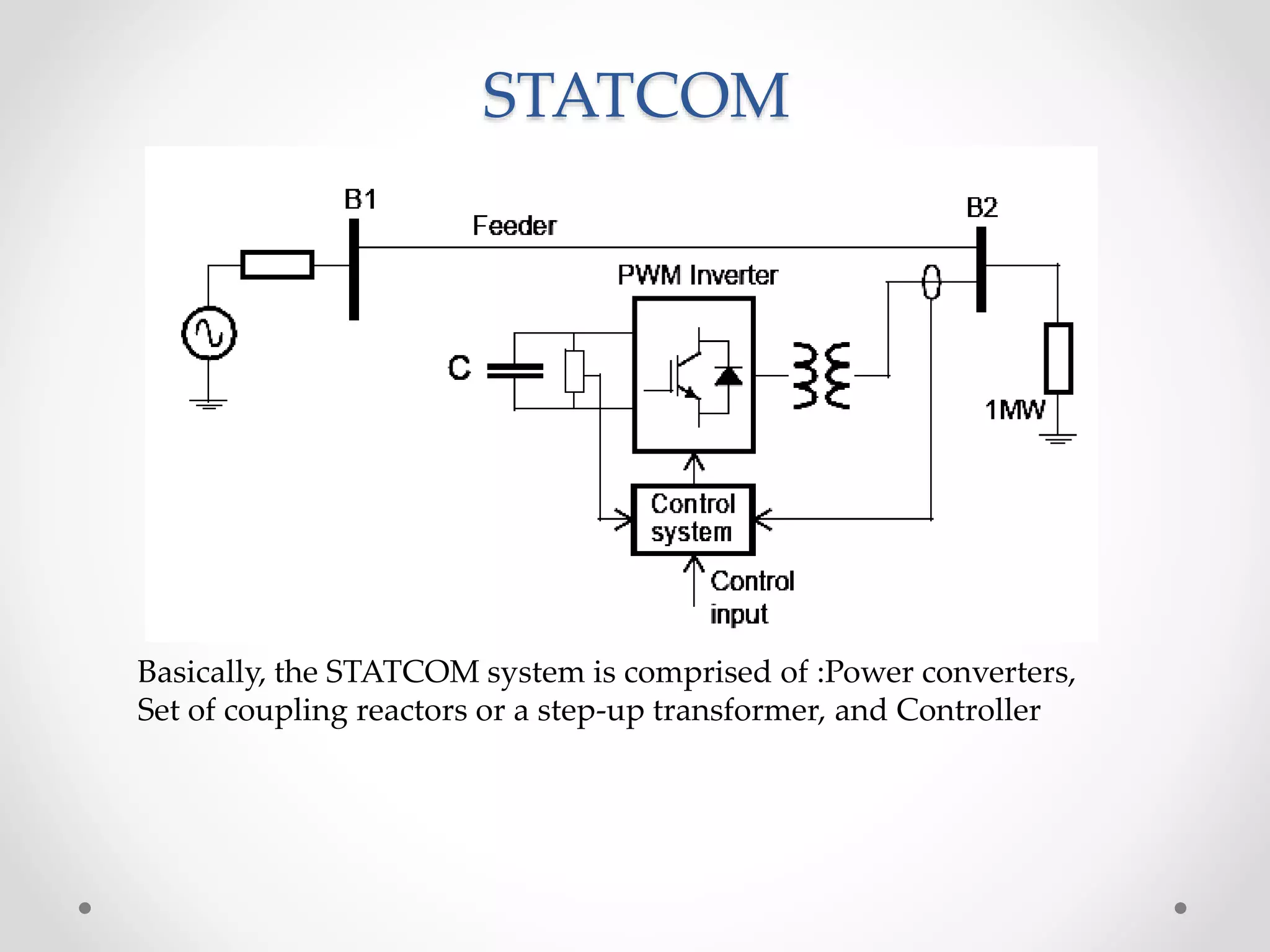
STATCOM
• A Static Synchronous Compensator (STATCOM), also
known as a "static synchronous condenser" ("STATCON"),
is a regulating device used on alternating current
electricity transmission networks. It is based on a power
electronics voltage-source converter and can act as
either a source or sink of reactive AC power to an
electricity network. If connected to a source of power it
can also provide active AC power. It is a member of the
FACTS family of devices.
STATCOM
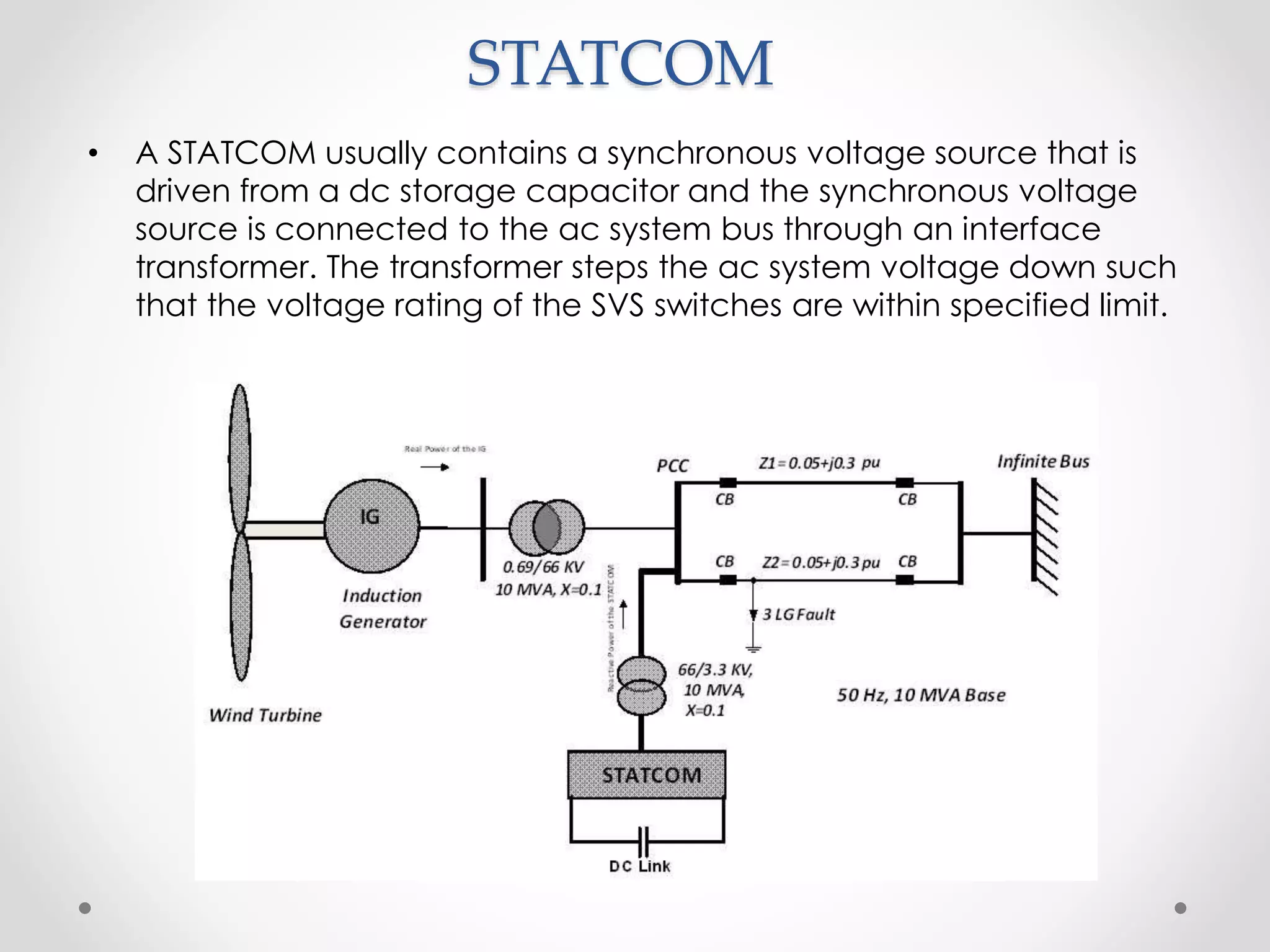
• A STATCOM usually contains a synchronous voltage source that is
driven from a dc storage capacitor and the synchronous voltage
source is connected to the ac system bus through an interface
transformer. The transformer steps the ac system voltage down such
that the voltage rating of the SVS switches are within specified limit.
STATCOM
Basically, the STATCOM system is comprised of :Power converters,
Set of coupling reactors or a step-up transformer, and Controller
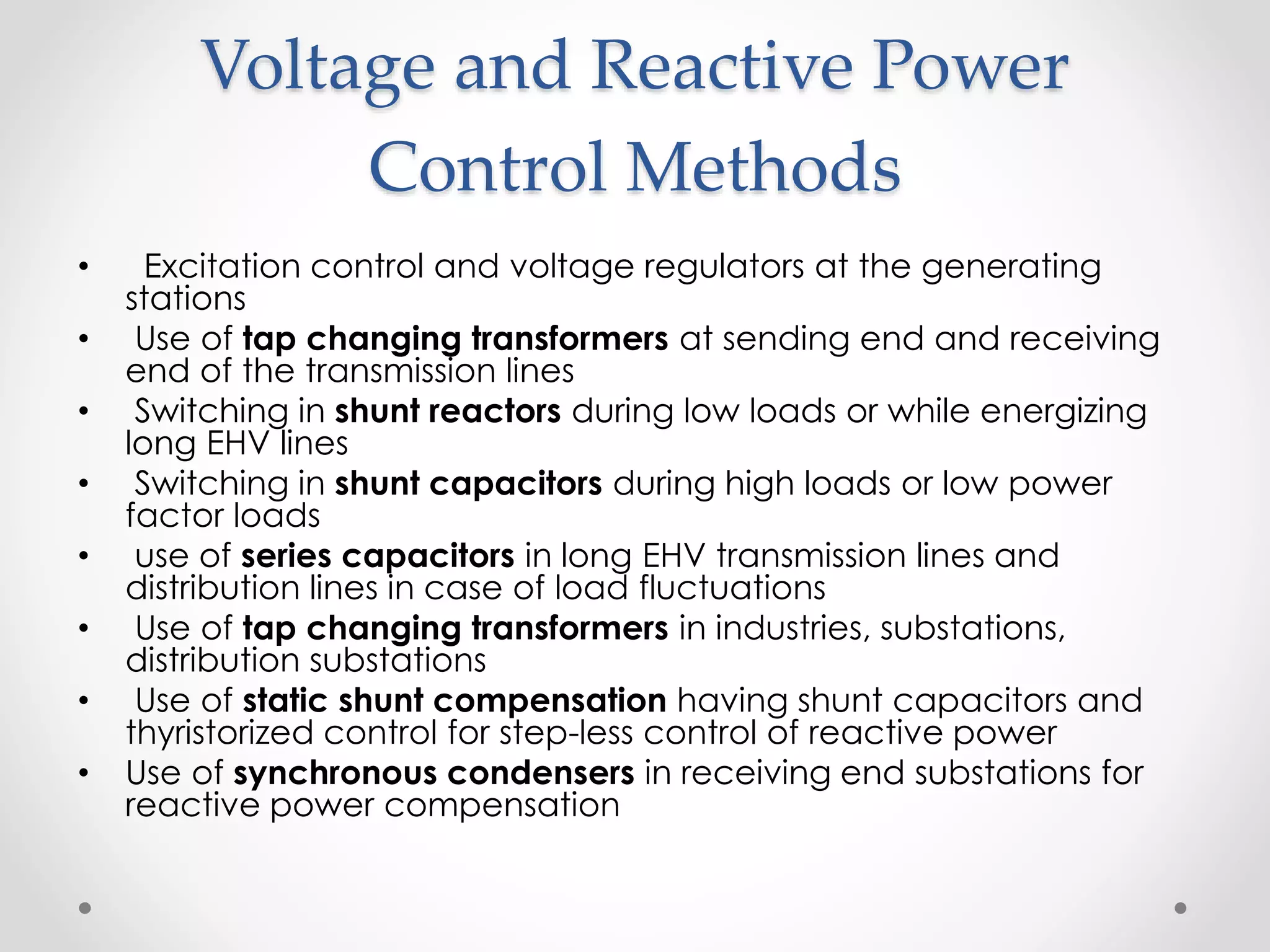
Voltage and Reactive Power
Control Methods
• Excitation control and voltage regulators at the generating
stations
• Use of tap changing transformers at sending end and receiving
end of the transmission lines
• Switching in shunt reactors during low loads or while energizing
long EHV lines
• Switching in shunt capacitors during high loads or low power
factor loads
• use of series capacitors in long EHV transmission lines and
distribution lines in case of load fluctuations
• Use of tap changing transformers in industries, substations,
distribution substations
• Use of static shunt compensation having shunt capacitors and
thyristorized control for step-less control of reactive power
• Use of synchronous condensers in receiving end substations for
reactive power compensation
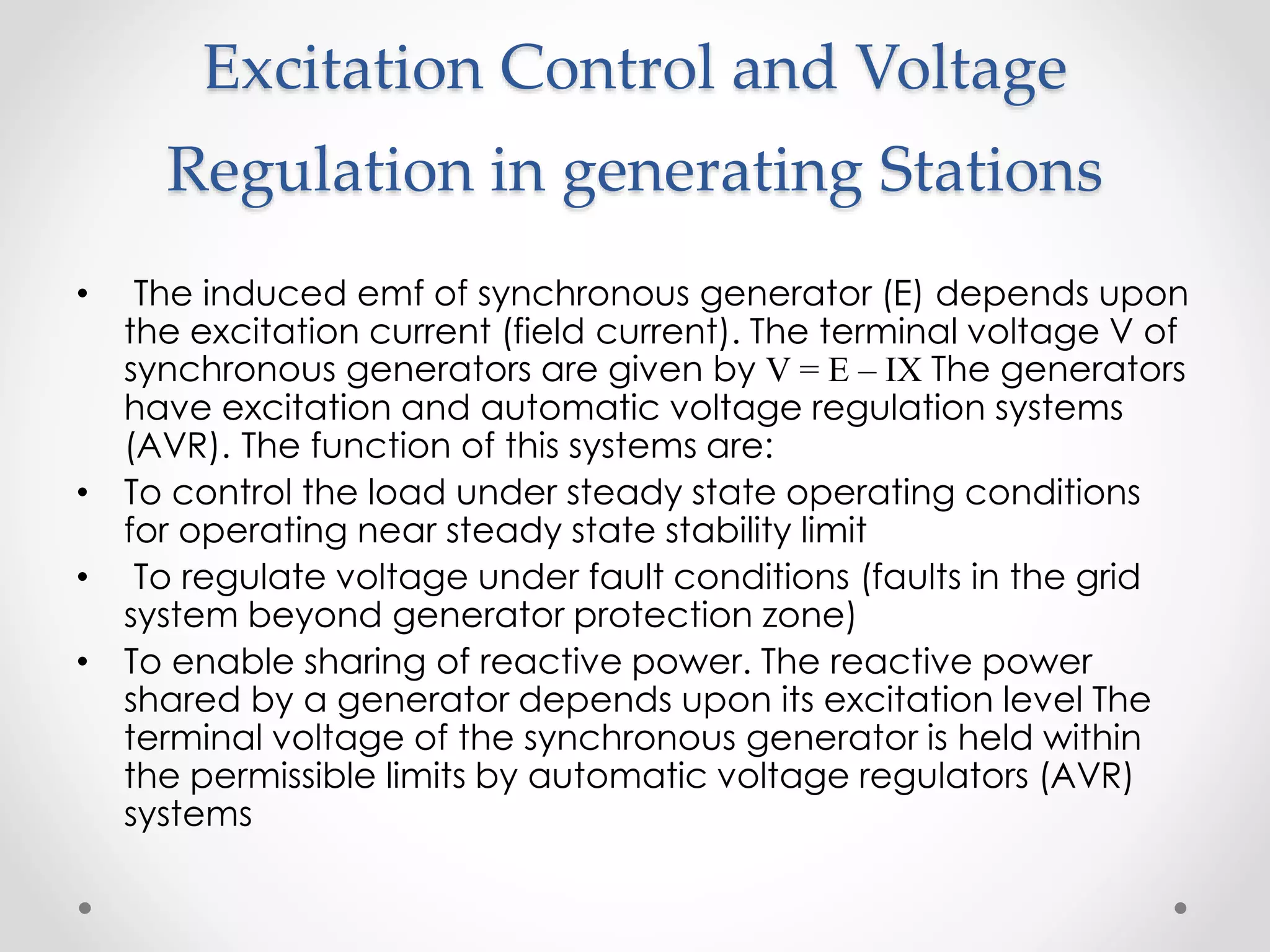
Excitation Control and Voltage
Regulation in generating Stations
• The induced emf of synchronous generator (E) depends upon
the excitation current (field current). The terminal voltage V of
synchronous generators are given by V = E – IX The generators
have excitation and automatic voltage regulation systems
(AVR). The function of this systems are:
• To control the load under steady state operating conditions
for operating near steady state stability limit
• To regulate voltage under fault conditions (faults in the grid
system beyond generator protection zone)
• To enable sharing of reactive power. The reactive power
shared by a generator depends upon its excitation level The
terminal voltage of the synchronous generator is held within
the permissible limits by automatic voltage regulators (AVR)
systems
Voltage Control by Tap changing in
transformers
• The voltage control of transmission and distribution
systems is obtained basically by tap-changing Tap
changers are either on-load or off load tap
changers. By changing the turns ratio of the
transformer the voltage ratio and the secondary
voltage is changed and voltage control is
obtained. Tap changing is widely used voltage
control method employed at every voltage level
• The voltage control of the range + 15 to -15 % can
be achieved by tap changing transformers
Off load tap changing voltage control
• Adjustment of voltage ratio can be made by off-
circuit tap changing. These adjustments are usually
for seasonal load variations of special operational
requirement of local substations and adjusting the
voltage in distribution transformer at consumer end.
On-Load tap changing voltage
control
• Such an arrangement of on-load tap changing is
employed for changing the turn-ratio of the
transformer to regulate the system voltage while the
transformer is delivering load.
Voltage Control by Shunt Reactors
• Shunt reactors are provided at sending end and
receiving end of the long EHV and UHV transmission
lines. They are switched in when the line is to be
charged or during line is on low load
• When the line is on no load or low load, shunt
capacitance predominates and receiving end
voltage is higher than the sending end voltage. This
phenomenon is called Ferranti effect.
Voltage Control by Shunt Reactors
• The receiving end voltage of 400kV, 1000 km long
line may be as high as 800kV. The shunt
capacitance of such lines is neutralized by
switching in the shunt reactor. During high loads, the
series inductive reactance of the line produces IXL
drop and the receive end voltage drops, the shunt
reactors are switched off. Shunt reactors may be
connected to the low voltage tertiary winding of a
transformer via a suitable circuit breaker, EHV shunt
reactors may be connected to the transmission line
without any circuit breaker.
Voltage Control by Shunt Capacitors
• Shunt capacitors are usually switched in during high
loads. Static shunt capacitors are installed near the load
terminals, in industries, substations, … Most of the
industrial loads (induction motors, transformers, welding
sets, furnaces) draws inductive current of poor power
factor (0.3 to 0.6 lag). The shunt capacitors provide
leading VARs there by the total KVA loading of
substation transformer and the current is reduced.
Thereby IXL drop in the line is reduced and voltage
regulation is improved. shunt capacitors are switched in
when KVA demand on the distribution line goes up and
voltage on the bus comes down. Switching in shunt
capacitor should improve the bus voltage if the
compensation is effective
Voltage Control by Static Shunt
Compensation:
• A step-less variable compensation is possible by
thyristorized control of shunt capacitor and
reactors. During heavy loads, the thyristors of the
capacitor control are made to conduct for longer
duration in each cycle. During low loads, the
thyristors in reactor circuit are made to conduct for
longer duration in each cycle. Thus a step-less
variation of shunt compensation is achieved by
means of static shut compensation
Voltage Control by Synchronous
Condensers:
• Synchronous condensers are over excited
synchronous motors installed in the power system to
deliver the reactive power. These synchronous
phase modifiers are located near the load improves
the voltage profile of the power system. The main
advantage of synchronous phase modifiers are the
ability to deliver the reactive power can be
adjusted unlike static shunt capacitors.
Voltage Control by Series Capacitors
• In Extra High Voltage (EHV) or Ultra High Voltage
System (UHV) systems series capacitors are
connected in series with the transmission line to
reduce the effect of inductive reactance XL
between the sending end and receiving end of the
line. One of the major drawbacks of series
capacitors is that high over voltages are produced
across the capacitor terminals under short circuit
condition. Series capacitors are usually employed
for increasing the power transfer capability of the
transmission line and not for voltage regulation.
Voltage Control by Flexible AC
transmission (FACT) devices
Very long high power transmission lines have high
series reactance XL and shut capacitance. It is difficult
to control the voltage, power flow and stability by
conventional manner. FACT devices play key role in
high power interconnected systems. In every
intermediate substation in transmission network FACT
devices are installed
• Controllable Series Capacitor banks
• Controllable shunt compensation
Thyristors are controlled by feedback control system.
Voltage power flow and voltage angle is controlled.
Thank you for listening…
Any questions?

Power systems voltage and power control

  • 1.
    Voltage and PowerControl in Power Systems Caner Göksel Sonuzun
  • 2.
    Contents • Introduction • VoltageControl Power Systems • Reactive Power • Need for Reactive Power • Need for Reactive Power Compensation • Reactive Power Compensation Devices • Voltage and Reactive Power Control Methods
  • 3.
    Introduction • Voltage ratingsof the various buses in the power system which includes generating station buses, switching substation buses, receiving substation buses and distribution substation buses should be within the permissible limits for satisfactory operation of all electrical equipments. The task of voltage control is closely associated with fluctuating load conditions and corresponding requirements of reactive power compensation. Therefore several voltage control methods are employed in power system to keep the voltage levels within the desirable limits.
  • 4.
    Reactive Power Power isreferred as the product of voltage and current P = V x I • In an ac transmission, when the voltage and current go up and down at the same time, i.e. when voltage and current are in phase or in synch, only real power is transmitted and when there is a time shift between voltage and current both active and reactive power are transmitted.
  • 5.
    Reactive Power  Wheneverthere is a phase shift between ‘V’ and ‘I’ we have:- a) real power (kW) b) reactive (imaginary ) power (kVAR) c) The combination is a complex or apparent power (kVA)=√(kW)² + (kVAR)²
  • 6.
    Need for ReactivePower Reactive power (Vars) is required to maintain the voltage to deliver active power (watts) through transmission lines. Motor loads and other loads require reactive power to convert the flow of electrons into useful work. When there is not enough reactive power, the voltage sags down and it is not possible to push the power demanded by loads through the lines.
  • 7.
    Need for ReactivePower The horse and the boat analogy best describe the Reactive Power aspect. Visualize a boat on a canal, pulled by a horse on the bank of the canal.
  • 8.
    Need for ReactivePower • In the horse and boat analogy, the horse’s objective (real power) is to move the boat straightly. • The fact that the rope is being pulled from the flank of the horse and not straight behind it, limits the horse’s capacity to deliver real work of moving straightly. • Therefore, the power required to keep the boat steady in navigating straightly is delivered by the rudder movement (reactive power). • Without reactive power there can be no transfer of real power, likewise without the support of rudder, the boat cannot move in a straight line.
  • 9.
    Need for ReactivePower Compensation • Reactive power generated by the ac power source is stored in a capacitor or a reactor during a quarter of a cycle and in the next quarter of the cycle it is sent back to the power source. Therefore the reactive power oscillates between the ac source and the capacitor or reactor at a frequency equals to two times the rated value (50 or 60 Hz). So to avoid the circulation between the load and source it needs to be compensated . • Also to regulate the power factor of the system and maintain the voltage stability we need to compensate reactive power .
  • 10.
    Reactive Power CompensationDevices • Series Compensation (Capacitors or Reactors) • Shunt Compensation (Capacitors or Reactors) • Synchronous Condensors • Static VAR Compensators • Static Synchronous Compensator (STATCOM)
  • 11.
    Series Compensation When adevice is connected in series with the transmission line it is called a series compensator. A series compensator can be connected anywhere in the line. There are two modes of operation – capacitive mode of operation and inductive mode of operation.
  • 12.
    Series Compensation • Asimplified model of a transmission system with series compensatin is shown in Figure.
  • 13.
    Shunt Compensation • Thedevice that is connected in parallel with the transmission line is called the shunt compensator. A shunt compensator is always connected in the middle of the transmission line. It can be provided by either a current source, voltage source or a capacitor.
  • 14.
    Shunt Compensation • Asimplified model of a transmission system with shunt compensation is shown in Figure.
  • 15.
    Synchronous Condensers A synchronouscondenser (sometimes called a synchronous capacitor or synchronous compensator) is a device identical to a synchronous motor, whose shaft is not connected to anything but spins freely. Its purpose is not to convert electric power to mechanical power or mechanical power to electrical power, but to adjust conditions on the electric power transmission grid. Its field is controlled by a voltage regulator to either generate or absorb reactive power as needed to adjust the grid's voltage, or to improve power factor. The condenser’s installation and operation are identical to large electric motors and generators.
  • 16.
  • 17.
    Static VAR Compensators Thestatic VAR compensator (SVC) is an advanced reactive power compensating device, capable of rapidly supplying capacitive or inductive power when required. The SVC can not only improve power quality in the electric distribution system to ensure the safe and reliable operation of the system and equipment, but also create a certain economic benefit for both the customers and the utility. Unlike a synchronous condenser which is a rotating electrical machine, a static VAR compensator has no significant moving parts. The SVC is an automated impedance matching device, designed to bring the system closer to unity power factor.
  • 18.
  • 19.
    STATCOM • A StaticSynchronous Compensator (STATCOM), also known as a "static synchronous condenser" ("STATCON"), is a regulating device used on alternating current electricity transmission networks. It is based on a power electronics voltage-source converter and can act as either a source or sink of reactive AC power to an electricity network. If connected to a source of power it can also provide active AC power. It is a member of the FACTS family of devices.
  • 20.
    STATCOM • A STATCOMusually contains a synchronous voltage source that is driven from a dc storage capacitor and the synchronous voltage source is connected to the ac system bus through an interface transformer. The transformer steps the ac system voltage down such that the voltage rating of the SVS switches are within specified limit.
  • 21.
    STATCOM Basically, the STATCOMsystem is comprised of :Power converters, Set of coupling reactors or a step-up transformer, and Controller
  • 22.
    Voltage and ReactivePower Control Methods • Excitation control and voltage regulators at the generating stations • Use of tap changing transformers at sending end and receiving end of the transmission lines • Switching in shunt reactors during low loads or while energizing long EHV lines • Switching in shunt capacitors during high loads or low power factor loads • use of series capacitors in long EHV transmission lines and distribution lines in case of load fluctuations • Use of tap changing transformers in industries, substations, distribution substations • Use of static shunt compensation having shunt capacitors and thyristorized control for step-less control of reactive power • Use of synchronous condensers in receiving end substations for reactive power compensation
  • 23.
    Excitation Control andVoltage Regulation in generating Stations • The induced emf of synchronous generator (E) depends upon the excitation current (field current). The terminal voltage V of synchronous generators are given by V = E – IX The generators have excitation and automatic voltage regulation systems (AVR). The function of this systems are: • To control the load under steady state operating conditions for operating near steady state stability limit • To regulate voltage under fault conditions (faults in the grid system beyond generator protection zone) • To enable sharing of reactive power. The reactive power shared by a generator depends upon its excitation level The terminal voltage of the synchronous generator is held within the permissible limits by automatic voltage regulators (AVR) systems
  • 24.
    Voltage Control byTap changing in transformers • The voltage control of transmission and distribution systems is obtained basically by tap-changing Tap changers are either on-load or off load tap changers. By changing the turns ratio of the transformer the voltage ratio and the secondary voltage is changed and voltage control is obtained. Tap changing is widely used voltage control method employed at every voltage level • The voltage control of the range + 15 to -15 % can be achieved by tap changing transformers
  • 25.
    Off load tapchanging voltage control • Adjustment of voltage ratio can be made by off- circuit tap changing. These adjustments are usually for seasonal load variations of special operational requirement of local substations and adjusting the voltage in distribution transformer at consumer end.
  • 26.
    On-Load tap changingvoltage control • Such an arrangement of on-load tap changing is employed for changing the turn-ratio of the transformer to regulate the system voltage while the transformer is delivering load.
  • 27.
    Voltage Control byShunt Reactors • Shunt reactors are provided at sending end and receiving end of the long EHV and UHV transmission lines. They are switched in when the line is to be charged or during line is on low load • When the line is on no load or low load, shunt capacitance predominates and receiving end voltage is higher than the sending end voltage. This phenomenon is called Ferranti effect.
  • 28.
    Voltage Control byShunt Reactors • The receiving end voltage of 400kV, 1000 km long line may be as high as 800kV. The shunt capacitance of such lines is neutralized by switching in the shunt reactor. During high loads, the series inductive reactance of the line produces IXL drop and the receive end voltage drops, the shunt reactors are switched off. Shunt reactors may be connected to the low voltage tertiary winding of a transformer via a suitable circuit breaker, EHV shunt reactors may be connected to the transmission line without any circuit breaker.
  • 29.
    Voltage Control byShunt Capacitors • Shunt capacitors are usually switched in during high loads. Static shunt capacitors are installed near the load terminals, in industries, substations, … Most of the industrial loads (induction motors, transformers, welding sets, furnaces) draws inductive current of poor power factor (0.3 to 0.6 lag). The shunt capacitors provide leading VARs there by the total KVA loading of substation transformer and the current is reduced. Thereby IXL drop in the line is reduced and voltage regulation is improved. shunt capacitors are switched in when KVA demand on the distribution line goes up and voltage on the bus comes down. Switching in shunt capacitor should improve the bus voltage if the compensation is effective
  • 30.
    Voltage Control byStatic Shunt Compensation: • A step-less variable compensation is possible by thyristorized control of shunt capacitor and reactors. During heavy loads, the thyristors of the capacitor control are made to conduct for longer duration in each cycle. During low loads, the thyristors in reactor circuit are made to conduct for longer duration in each cycle. Thus a step-less variation of shunt compensation is achieved by means of static shut compensation
  • 31.
    Voltage Control bySynchronous Condensers: • Synchronous condensers are over excited synchronous motors installed in the power system to deliver the reactive power. These synchronous phase modifiers are located near the load improves the voltage profile of the power system. The main advantage of synchronous phase modifiers are the ability to deliver the reactive power can be adjusted unlike static shunt capacitors.
  • 32.
    Voltage Control bySeries Capacitors • In Extra High Voltage (EHV) or Ultra High Voltage System (UHV) systems series capacitors are connected in series with the transmission line to reduce the effect of inductive reactance XL between the sending end and receiving end of the line. One of the major drawbacks of series capacitors is that high over voltages are produced across the capacitor terminals under short circuit condition. Series capacitors are usually employed for increasing the power transfer capability of the transmission line and not for voltage regulation.
  • 33.
    Voltage Control byFlexible AC transmission (FACT) devices Very long high power transmission lines have high series reactance XL and shut capacitance. It is difficult to control the voltage, power flow and stability by conventional manner. FACT devices play key role in high power interconnected systems. In every intermediate substation in transmission network FACT devices are installed • Controllable Series Capacitor banks • Controllable shunt compensation Thyristors are controlled by feedback control system. Voltage power flow and voltage angle is controlled.
  • 34.
    Thank you forlistening… Any questions?