Survey report submitted for the course of statistics
BS Statistics
5th Semester
Regular
University of Sargodha
Session 2011-2015
INTRODUCTION
1.1 Introduction to effects of load shedding
This report addresses basically the impacts of load shedding. . Here
“load” means the amount of current supplied by a dynamo or
generating station at any given time. “Shedding” means reducing the
load or amount of electricity. So load-shedding means that the supply
of electric current has been reduced. Now-a-days everyone is well
familiar with the expression “Load Shedding”. Even a child cries out
when the light is off. This load-shedding is caused by the low
generation of electricity.
1.2 History
Since 2008 the country has witnessed quantum descent in some
key problem areas which attained extraordinary heights.
Pakistan is in the grip of major infrastructural shortages blocking
growth in all sectors including industries, agriculture and
services. The industrial sector faces severe energy shortages
both in electricity and gas.
The year 2008 witnessed a major increase in the frequency and
intensity of power load shedding or outages generally in Pakistan
and in particular in the industrial sector
1.3 Effects of load shedding internationally
 The economic cost of load shedding are well-known
but the social impact of load shedding still needs to be
investigated
 Load shedding is a common or even a normal daily
event in many developing countries.
Examples:
The countries like Canada, India , Japan etc.
suffer from load shedding.
Load-shedding causes a great loss, discomfort and
inconvenience. The production of our mills and
factories and small scale industries suffers much.
Agriculture is also affected and pumps can’t work to
supply water from the rivers, canals, ponds etc. to
irrigate agricultural land. Office work suffers much as
lights and fans are off. Thus load-shedding causes great
loss to the country. Domestic life is also affected to a
great extent due to load-shedding.
Effect of load shedding in Pakistan
 Health issues definitely arises when electricity load
shedding of 12-20 hours is in place.
 Students suffer most as it hamper their studies
especially during their exam time.
 Life style and living standard of people is also effected.
In Pakistan few people can afford their own UPS or
generator.
 Load shedding also effect on the export of our country.
Objectives
 Through this survey we measure the impact of load
shedding on the life of people and how people feel
about it and cope with it.
 Through survey report our Govt. may take hard
decision and to save dying economy by providing
supply of power to industries.
 Through survey we may correct defective policies
made in Pakistan.
METHODOLOGY
2.1 Data analysis
Software named SPSS(statistical packages for social sciences)
20 versions is used for the survey analysis ’EFFECTS OF
LOAD SHEDDING’.
2.2 Types of studies
 Bivariate study
 Univariate study
Bivariate study
Bivariate analysis is one of the simplest form of
quantitative analysis.
It involves the performing of an analysis between two
variables for the purpose of determining the empirical
relationship between them.
This analysis reveal whether or not there exist an
association between the variables.
Univariate study
Univariate analysis is the simplest form of quantitative
analysis.
It is define as analysis carried out on only one variable to
summarize or describe the variable
DATA ANALYSIS
AND RESULTS
3.1 Univariate analysis:
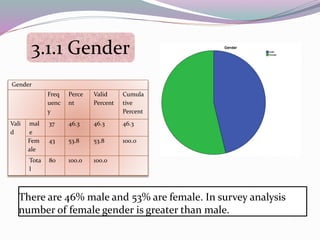
There are 46% male and 53% are female. In survey analysis
number of female gender is greater than male.
Gender
Freq
uenc
y
Perce
nt
Valid
Percent
Cumula
tive
Percent
Vali
d
mal
e
37 46.3 46.3 46.3
Fem
ale
43 53.8 53.8 100.0
Tota
l
80 100.0 100.0
3.1.1 Gender
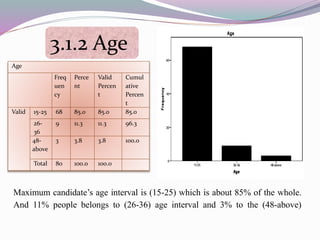
Maximum candidate’s age interval is (15-25) which is about 85% of the whole.
And 11% people belongs to (26-36) age interval and 3% to the (48-above)
3.1.2 Age
Age
Freq
uen
cy
Perce
nt
Valid
Percen
t
Cumul
ative
Percen
t
Valid 15-25 68 85.0 85.0 85.0
26-
36
9 11.3 11.3 96.3
48-
above
3 3.8 3.8 100.0
Total 80 100.0 100.0
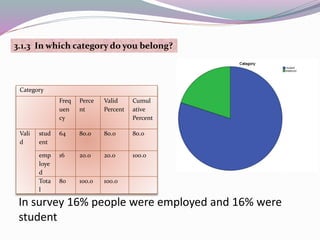
In survey 16% people were employed and 16% were
student
3.1.3 In which category do you belong?
Category
Freq
uen
cy
Perce
nt
Valid
Percent
Cumul
ative
Percent
Vali
d
stud
ent
64 80.0 80.0 80.0
emp
loye
d
16 20.0 20.0 100.0
Tota
l
80 100.0 100.0
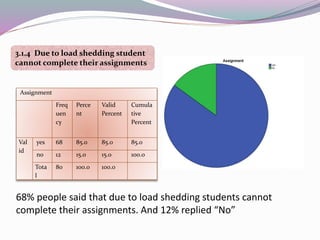
68% people said that due to load shedding students cannot
complete their assignments. And 12% replied “No”
3.1.4 Due to load shedding student
cannot complete their assignments
Assignment
Freq
uen
cy
Perce
nt
Valid
Percent
Cumula
tive
Percent
Val
id
yes 68 85.0 85.0 85.0
no 12 15.0 15.0 100.0
Tota
l
80 100.0 100.0
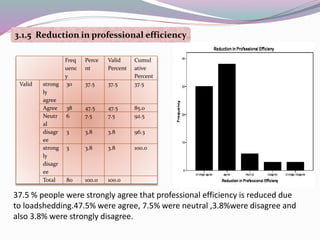
37.5 % people were strongly agree that professional efficiency is reduced due
to loadshedding.47.5% were agree, 7.5% were neutral ,3.8%were disagree and
also 3.8% were strongly disagree.
3.1.5 Reduction in professional efficiency
Freq
uenc
y
Perce
nt
Valid
Percent
Cumul
ative
Percent
Valid strong
ly
agree
30 37.5 37.5 37.5
Agree 38 47.5 47.5 85.0
Neutr
al
6 7.5 7.5 92.5
disagr
ee
3 3.8 3.8 96.3
strong
ly
disagr
ee
3 3.8 3.8 100.0
Total 80 100.0 100.0
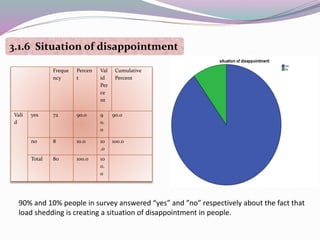
90% and 10% people in survey answered “yes” and ”no” respectively about the fact that
load shedding is creating a situation of disappointment in people.
3.1.6 Situation of disappointment
Freque
ncy
Percen
t
Val
id
Per
ce
nt
Cumulative
Percent
Vali
d
yes 72 90.0 9
0.
0
90.0
no 8 10.0 10
.0
100.0
Total 80 100.0 10
0.
0
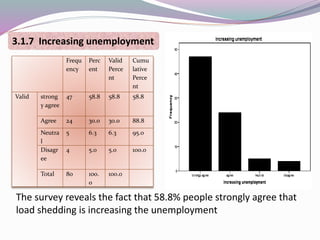
The survey reveals the fact that 58.8% people strongly agree that
load shedding is increasing the unemployment
3.1.7 Increasing unemployment
Frequ
ency
Perc
ent
Valid
Perce
nt
Cumu
lative
Perce
nt
Valid strong
y agree
47 58.8 58.8 58.8
Agree 24 30.0 30.0 88.8
Neutra
l
5 6.3 6.3 95.0
Disagr
ee
4 5.0 5.0 100.0
Total 80 100.
0
100.0
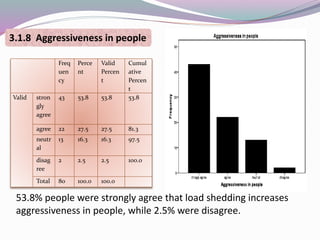
53.8% people were strongly agree that load shedding increases
aggressiveness in people, while 2.5% were disagree.
Freq
uen
cy
Perce
nt
Valid
Percen
t
Cumul
ative
Percen
t
Valid stron
gly
agree
43 53.8 53.8 53.8
agree 22 27.5 27.5 81.3
neutr
al
13 16.3 16.3 97.5
disag
ree
2 2.5 2.5 100.0
Total 80 100.0 100.0
3.1.8 Aggressiveness in people
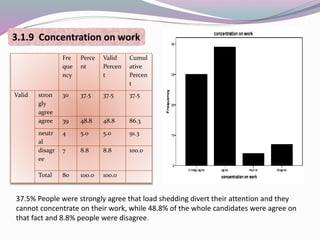
37.5% People were strongly agree that load shedding divert their attention and they
cannot concentrate on their work, while 48.8% of the whole candidates were agree on
that fact and 8.8% people were disagree.
Fre
que
ncy
Perce
nt
Valid
Percen
t
Cumul
ative
Percen
t
Valid stron
gly
agree
30 37.5 37.5 37.5
agree 39 48.8 48.8 86.3
neutr
al
4 5.0 5.0 91.3
disagr
ee
7 8.8 8.8 100.0
Total 80 100.0 100.0
3.1.9 Concentration on work
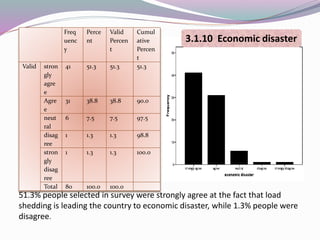
51.3% people selected in survey were strongly agree at the fact that load
shedding is leading the country to economic disaster, while 1.3% people were
disagree.
Freq
uenc
y
Perce
nt
Valid
Percen
t
Cumul
ative
Percen
t
Valid stron
gly
agre
e
41 51.3 51.3 51.3
Agre
e
31 38.8 38.8 90.0
neut
ral
6 7.5 7.5 97.5
disag
ree
1 1.3 1.3 98.8
stron
gly
disag
ree
1 1.3 1.3 100.0
Total 80 100.0 100.0
3.1.10 Economic disaster
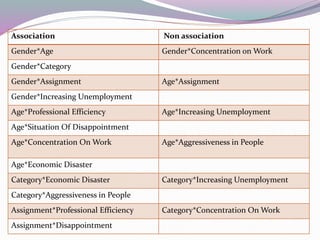
3.2 Bivariate analysis
Association Non association
Gender*Age Gender*Concentration on Work
Gender*Category
Gender*Assignment Age*Assignment
Gender*Increasing Unemployment
Age*Professional Efficiency Age*Increasing Unemployment
Age*Situation Of Disappointment
Age*Concentration On Work Age*Aggressiveness in People
Age*Economic Disaster
Category*Economic Disaster Category*Increasing Unemployment
Category*Aggressiveness in People
Assignment*Professional Efficiency Category*Concentration On Work
Assignment*Disappointment
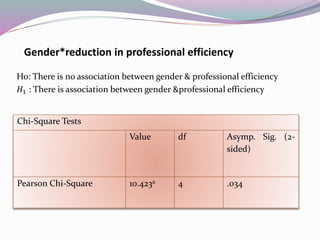
Gender*reduction in professional efficiency
Ho: There is no association between gender & professional efficiency
𝐻1 : There is association between gender &professional efficiency
Chi-Square Tests
Value df Asymp. Sig. (2-
sided)
Pearson Chi-Square 10.423a 4 .034
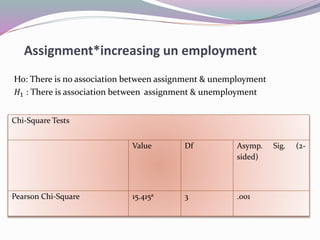
Assignment*increasing un employment
Ho: There is no association between assignment & unemployment
𝐻1 : There is association between assignment & unemployment
Chi-Square Tests
Value Df Asymp. Sig. (2-
sided)
Pearson Chi-Square 15.415a 3 .001
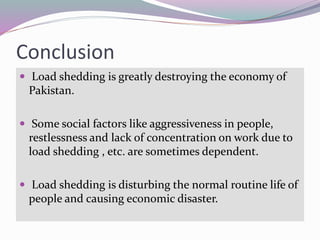
Conclusion
 Load shedding is greatly destroying the economy of
Pakistan.
 Some social factors like aggressiveness in people,
restlessness and lack of concentration on work due to
load shedding , etc. are sometimes dependent.

 Load shedding is disturbing the normal routine life of
people and causing economic disaster.
Recommendation
 If the similar research is conducted in future, the
sample size should be enhanced in order to obtain
more precise results for higher statistical analyses in
quantitative perspective
Hiba Qaiser(04)
Iqra Tanveer ( 05)
Sidra Kanwal (10)
Maria Mushtaq (13)
Maira Anjum (17)
Safia Zafar (35)
Naila Rabnawaz
(47)

Load Shedding

  • 2.
    Survey report submittedfor the course of statistics BS Statistics 5th Semester Regular University of Sargodha Session 2011-2015
  • 4.
  • 5.
    1.1 Introduction toeffects of load shedding This report addresses basically the impacts of load shedding. . Here “load” means the amount of current supplied by a dynamo or generating station at any given time. “Shedding” means reducing the load or amount of electricity. So load-shedding means that the supply of electric current has been reduced. Now-a-days everyone is well familiar with the expression “Load Shedding”. Even a child cries out when the light is off. This load-shedding is caused by the low generation of electricity.
  • 6.
    1.2 History Since 2008the country has witnessed quantum descent in some key problem areas which attained extraordinary heights. Pakistan is in the grip of major infrastructural shortages blocking growth in all sectors including industries, agriculture and services. The industrial sector faces severe energy shortages both in electricity and gas. The year 2008 witnessed a major increase in the frequency and intensity of power load shedding or outages generally in Pakistan and in particular in the industrial sector
  • 7.
    1.3 Effects ofload shedding internationally  The economic cost of load shedding are well-known but the social impact of load shedding still needs to be investigated  Load shedding is a common or even a normal daily event in many developing countries. Examples: The countries like Canada, India , Japan etc. suffer from load shedding.
  • 8.
    Load-shedding causes agreat loss, discomfort and inconvenience. The production of our mills and factories and small scale industries suffers much. Agriculture is also affected and pumps can’t work to supply water from the rivers, canals, ponds etc. to irrigate agricultural land. Office work suffers much as lights and fans are off. Thus load-shedding causes great loss to the country. Domestic life is also affected to a great extent due to load-shedding. Effect of load shedding in Pakistan
  • 9.
     Health issuesdefinitely arises when electricity load shedding of 12-20 hours is in place.  Students suffer most as it hamper their studies especially during their exam time.  Life style and living standard of people is also effected. In Pakistan few people can afford their own UPS or generator.  Load shedding also effect on the export of our country.
  • 10.
    Objectives  Through thissurvey we measure the impact of load shedding on the life of people and how people feel about it and cope with it.  Through survey report our Govt. may take hard decision and to save dying economy by providing supply of power to industries.  Through survey we may correct defective policies made in Pakistan.
  • 11.
  • 12.
    2.1 Data analysis Softwarenamed SPSS(statistical packages for social sciences) 20 versions is used for the survey analysis ’EFFECTS OF LOAD SHEDDING’.
  • 13.
    2.2 Types ofstudies  Bivariate study  Univariate study
  • 14.
    Bivariate study Bivariate analysisis one of the simplest form of quantitative analysis. It involves the performing of an analysis between two variables for the purpose of determining the empirical relationship between them. This analysis reveal whether or not there exist an association between the variables.
  • 15.
    Univariate study Univariate analysisis the simplest form of quantitative analysis. It is define as analysis carried out on only one variable to summarize or describe the variable
  • 16.
  • 17.
  • 18.
    There are 46%male and 53% are female. In survey analysis number of female gender is greater than male. Gender Freq uenc y Perce nt Valid Percent Cumula tive Percent Vali d mal e 37 46.3 46.3 46.3 Fem ale 43 53.8 53.8 100.0 Tota l 80 100.0 100.0 3.1.1 Gender
  • 19.
    Maximum candidate’s ageinterval is (15-25) which is about 85% of the whole. And 11% people belongs to (26-36) age interval and 3% to the (48-above) 3.1.2 Age Age Freq uen cy Perce nt Valid Percen t Cumul ative Percen t Valid 15-25 68 85.0 85.0 85.0 26- 36 9 11.3 11.3 96.3 48- above 3 3.8 3.8 100.0 Total 80 100.0 100.0
  • 20.
    In survey 16%people were employed and 16% were student 3.1.3 In which category do you belong? Category Freq uen cy Perce nt Valid Percent Cumul ative Percent Vali d stud ent 64 80.0 80.0 80.0 emp loye d 16 20.0 20.0 100.0 Tota l 80 100.0 100.0
  • 21.
    68% people saidthat due to load shedding students cannot complete their assignments. And 12% replied “No” 3.1.4 Due to load shedding student cannot complete their assignments Assignment Freq uen cy Perce nt Valid Percent Cumula tive Percent Val id yes 68 85.0 85.0 85.0 no 12 15.0 15.0 100.0 Tota l 80 100.0 100.0
  • 22.
    37.5 % peoplewere strongly agree that professional efficiency is reduced due to loadshedding.47.5% were agree, 7.5% were neutral ,3.8%were disagree and also 3.8% were strongly disagree. 3.1.5 Reduction in professional efficiency Freq uenc y Perce nt Valid Percent Cumul ative Percent Valid strong ly agree 30 37.5 37.5 37.5 Agree 38 47.5 47.5 85.0 Neutr al 6 7.5 7.5 92.5 disagr ee 3 3.8 3.8 96.3 strong ly disagr ee 3 3.8 3.8 100.0 Total 80 100.0 100.0
  • 23.
    90% and 10%people in survey answered “yes” and ”no” respectively about the fact that load shedding is creating a situation of disappointment in people. 3.1.6 Situation of disappointment Freque ncy Percen t Val id Per ce nt Cumulative Percent Vali d yes 72 90.0 9 0. 0 90.0 no 8 10.0 10 .0 100.0 Total 80 100.0 10 0. 0
  • 24.
    The survey revealsthe fact that 58.8% people strongly agree that load shedding is increasing the unemployment 3.1.7 Increasing unemployment Frequ ency Perc ent Valid Perce nt Cumu lative Perce nt Valid strong y agree 47 58.8 58.8 58.8 Agree 24 30.0 30.0 88.8 Neutra l 5 6.3 6.3 95.0 Disagr ee 4 5.0 5.0 100.0 Total 80 100. 0 100.0
  • 25.
    53.8% people werestrongly agree that load shedding increases aggressiveness in people, while 2.5% were disagree. Freq uen cy Perce nt Valid Percen t Cumul ative Percen t Valid stron gly agree 43 53.8 53.8 53.8 agree 22 27.5 27.5 81.3 neutr al 13 16.3 16.3 97.5 disag ree 2 2.5 2.5 100.0 Total 80 100.0 100.0 3.1.8 Aggressiveness in people
  • 26.
    37.5% People werestrongly agree that load shedding divert their attention and they cannot concentrate on their work, while 48.8% of the whole candidates were agree on that fact and 8.8% people were disagree. Fre que ncy Perce nt Valid Percen t Cumul ative Percen t Valid stron gly agree 30 37.5 37.5 37.5 agree 39 48.8 48.8 86.3 neutr al 4 5.0 5.0 91.3 disagr ee 7 8.8 8.8 100.0 Total 80 100.0 100.0 3.1.9 Concentration on work
  • 27.
    51.3% people selectedin survey were strongly agree at the fact that load shedding is leading the country to economic disaster, while 1.3% people were disagree. Freq uenc y Perce nt Valid Percen t Cumul ative Percen t Valid stron gly agre e 41 51.3 51.3 51.3 Agre e 31 38.8 38.8 90.0 neut ral 6 7.5 7.5 97.5 disag ree 1 1.3 1.3 98.8 stron gly disag ree 1 1.3 1.3 100.0 Total 80 100.0 100.0 3.1.10 Economic disaster
  • 28.
  • 29.
    Association Non association Gender*AgeGender*Concentration on Work Gender*Category Gender*Assignment Age*Assignment Gender*Increasing Unemployment Age*Professional Efficiency Age*Increasing Unemployment Age*Situation Of Disappointment Age*Concentration On Work Age*Aggressiveness in People Age*Economic Disaster Category*Economic Disaster Category*Increasing Unemployment Category*Aggressiveness in People Assignment*Professional Efficiency Category*Concentration On Work Assignment*Disappointment
  • 30.
    Gender*reduction in professionalefficiency Ho: There is no association between gender & professional efficiency 𝐻1 : There is association between gender &professional efficiency Chi-Square Tests Value df Asymp. Sig. (2- sided) Pearson Chi-Square 10.423a 4 .034
  • 31.
    Assignment*increasing un employment Ho:There is no association between assignment & unemployment 𝐻1 : There is association between assignment & unemployment Chi-Square Tests Value Df Asymp. Sig. (2- sided) Pearson Chi-Square 15.415a 3 .001
  • 32.
    Conclusion  Load sheddingis greatly destroying the economy of Pakistan.  Some social factors like aggressiveness in people, restlessness and lack of concentration on work due to load shedding , etc. are sometimes dependent.  Load shedding is disturbing the normal routine life of people and causing economic disaster.
  • 33.
    Recommendation  If thesimilar research is conducted in future, the sample size should be enhanced in order to obtain more precise results for higher statistical analyses in quantitative perspective
  • 34.
    Hiba Qaiser(04) Iqra Tanveer( 05) Sidra Kanwal (10) Maria Mushtaq (13) Maira Anjum (17) Safia Zafar (35) Naila Rabnawaz (47)