Power Cables
Lecture Notes by Dr.R.M.Larik 1
• electrical power can be transmitted in two main ways:
• by use of overhead electrical cables or underground ones
• Alternative to overhead lines
• Safer- not exposed to environment, storm, winds, lighting, animals
etc.
• Low maintenance- high installation cost
• Higher reliability- instances of constant disruption aren’t common
• Detection of fault is difficult
• Difficult to upgrade an underground cable
• Aesthetics-out of sight
• Less risk of electric shocks
• Lesser right of way
Lecture Notes by Dr.R.M.Larik 2
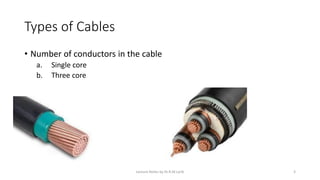
Types of Cables
• Number of conductors in the cable
a. Single core
b. Three core
Lecture Notes by Dr.R.M.Larik 3
• Voltage rating of the cable
• Low tension cables: These have a maximum voltage handling capacity of
1000 V (1 kV)
• High tension cables: These have a maximum voltage handling capacity of
11 kV.
• Super tension cables: These have a maximum voltage handling capacity of
33 kV.
• Extra high tension cables: These have a maximum voltage handling
capacity of 66 kV.
• Extra super voltage cables: These are used for applications with voltage
requirement above 132 kV.
Lecture Notes by Dr.R.M.Larik 4
• Classification Based Upon Insulation Of The Cable
Various insulating materials used in cable construction are Rubber,
Paper, PVC, XLPE (Cross linked Polyethene) etc. Such classification is
based upon operating temperature limitations. Following are some
insulating materials used and their maximum operating temperatures.
• Insulation material Max. operating temperature
• PVC TYPE A 75°C
• PVC TYPE B 85°C
• PVC TYPE C 85°C
• XLPE 90°C
• RUBBER 90°C
• RUBBER – EPR IE-2, EPR IE-3, EPR IE-4, SILICON IE-5 150°C
Lecture Notes by Dr.R.M.Larik 5
Installation And Laying Of The Cable
• Direct Buried: As the name suggests, the conductors are buried underground in a
trench without additional accessories. Sometimes cooling pipes are added if
required. Once the cables are installed, there’s no visible sign above the ground.
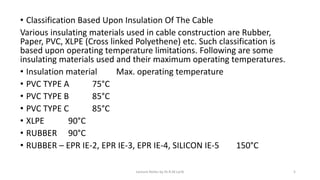
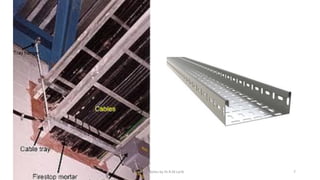
• Trough: Concrete troughs are dug and cables are installed in them. They’re visible
on the surface. Maintenance is easier.
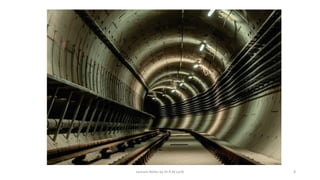
• Tunnels: Sometimes, tunnels are dug up for this purpose. Such construction is
mainly employed if a river needs to be crossed or if the intended power
distribution is to a major city. Maintenance and future expansion is easier, but
initial cost is higher.
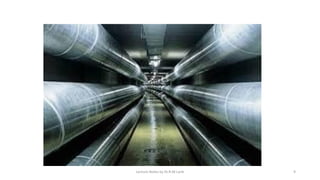
• Gas Insulated Lines: This is a relatively new technology. For cables operating at
higher voltages and currents, and handling high power, such gas insulated line
construction is safer. It is being employed nowadays for advanced projects.
Lecture Notes by Dr.R.M.Larik 6
Lecture Notes by Dr.R.M.Larik 7
Lecture Notes by Dr.R.M.Larik 8
Lecture Notes by Dr.R.M.Larik 9
• variety of sizes, materials, and types, each particularly adapted to its
uses
• conductors, insulation, protective jacket
• Working voltage, determining the thickness of the insulation;
• Current-carrying capacity, determining the cross-sectional size of the
conductor(s);
• Environmental conditions such as temperature, water, chemical or
sunlight exposure, and mechanical impact, determining the form and
composition of the outer cable jacket.
Lecture Notes by Dr.R.M.Larik 10
Construction
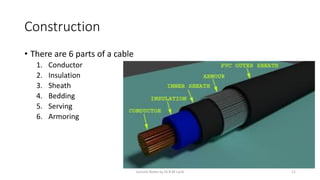
• There are 6 parts of a cable
1. Conductor
2. Insulation
3. Sheath
4. Bedding
5. Serving
6. Armoring
Lecture Notes by Dr.R.M.Larik 11
• Conductor can stranded copper or aluminum conductors, although
small power cables may use solid conductors
• Solid wire consists of one strand of copper metal wire, bare or
surrounded by an insulator.
• Stranded wire has a group of copper wires braided or twisted
together
• Stranded wire is more flexible and easier to install than a large single-
strand wire of the same cross section
Lecture Notes by Dr.R.M.Larik 12
Lecture Notes by Dr.R.M.Larik 13
Properties of Conductor
• Electrical conductivity (ability of how well a material transports electric
charge)
• Al has 61% conductivity of Cu. It must be 56% larger than Cu for same
current carrying capacity. This restricts its use in applications as in motors.
• In aerial power transmission Cu is rarely used because it is costlier than Al.
• Silver has 106% of electrical conductivity than Cu but has high cost and low
tensile strength
• Tensile strength measures the force required to pull an object such as
rope, wire, or a structural beam to the point where it breaks.
• Copper is much heavier than aluminum for conductors of equal current
carrying capacity, so the high tensile strength is offset by its increased
weight.
Lecture Notes by Dr.R.M.Larik 14
• Ductility-the material's ability to be stretched into a wire.
• Copper has a higher ductility than alternate metal conductors with the
exception of gold and silver.[18] Because of copper’s high ductility, it is easy
to draw down to diameters with very close tolerances.
• Creep resistance- the gradual deformation of a material from constant
expansions and contractions under “load, no-load” conditions. This process
has adverse effects on electrical systems: terminations can become loose,
causing connections to heat up or create dangerous arcing.
• Copper has excellent creep characteristics that minimizes loosening at
connections. For other metal conductors that creep, extra maintenance is
required to check terminals periodically and ensure that screws remain
tightened to prevent arcing and overheating
Lecture Notes by Dr.R.M.Larik 15
• Corrosion-the unwanted breakdown and weakening of a material due
to chemical reactions.
• Coefficient of thermal expansion-Metals and other solid materials
expand upon heating and contract upon cooling. This is an
undesirable occurrence in electrical systems.
• Thermal conductivity-ability of a material to conduct heat.
• high thermal conductivity is important for dissipating waste heat,
particularly at terminations and connections. Copper has a 60%
higher thermal conductivity rating than aluminium
• Ease of installation
Lecture Notes by Dr.R.M.Larik 16
Insulation
• High insulation resistance-to guard against electric shocks and avoid
equipment damage from accidental discharges.
• High dielectric strength- the maximum electric field that the material can
withstand under ideal conditions without undergoing electrical
breakdown and becoming electrically conductive (i.e. without failure of its
insulating properties)
• Good mechanical properties
• Non-hygroscopic
• Capable of being operated at high temperature
• Low thermal resistance-easily conduct heat to the environment
• Unaffected by acids and alkalis
Lecture Notes by Dr.R.M.Larik 17
• Rubber
• Relative permittivity is 30 kv/mm
• Resistivity is 1017 ohm-meter
• Absorbs moisture
• Max temperature is 38° C
• Soft and liable to damage
• Vulcanized India Rubber (V.I.R.)
• mixing pure rubber with mineral
matter such as zinc oxide, red
lead and 3 to 5 % sulfur
• Greater mechanical strength and
durability
• But sulfur reacts with copper
• Cables with VIR have tinned Cu
• Low and moderate voltage
Lecture Notes by Dr.R.M.Larik 18
• Impregnated paper
• Paper impregnated with some
paraffinic or naphthenic material
• Low cost
• Low capacitance
• High dielectric strength
• High insulation resistance
• hygroscopic
• Never left unsealed- ends are sealed
with wax or tar
• Used where cable rote has few joints
• PVC-polyvinyl chloride
• High insulation resistance
• High dielectric strength
• Mechanically strong
• Inert to oxygen, acids and alkalis
• Used in cement or chemical factories
• Cheap and durable
• Chlorine reacts with short circuit,
produces smoke
• 75 to 105°C
Lecture Notes by Dr.R.M.Larik 19
• XLPE
• different polyethylene chains
linked together (“cross-linking”)
• prevent the polymer from
melting
• higher temperature
applications.
• Temperature limit is 250ºC.
Lecture Notes by Dr.R.M.Larik 20
Metallic sheath
• A conductive shield
• Protects insulation
• Tape of Cu or lead alloy
• Earthed
• Lead sheaths are heavier
Bedding
• Done to keep the bundle
together
• And to provide a bedding from
the armour
• PVC
Lecture Notes by Dr.R.M.Larik 21
• Armour
• For mechanical protection of
bundle
• Steel wire armour used in multi
core
• Aluminium wire armour used in
single cores
• Outer sheath
• Applied over armour
• Mechanical protection
• Weather and chemicals
• PVC
Lecture Notes by Dr.R.M.Larik 22
Lecture Notes by Dr.R.M.Larik 23

Power cables

  • 1.
    Power Cables Lecture Notesby Dr.R.M.Larik 1
  • 2.
    • electrical powercan be transmitted in two main ways: • by use of overhead electrical cables or underground ones • Alternative to overhead lines • Safer- not exposed to environment, storm, winds, lighting, animals etc. • Low maintenance- high installation cost • Higher reliability- instances of constant disruption aren’t common • Detection of fault is difficult • Difficult to upgrade an underground cable • Aesthetics-out of sight • Less risk of electric shocks • Lesser right of way Lecture Notes by Dr.R.M.Larik 2
  • 3.
    Types of Cables •Number of conductors in the cable a. Single core b. Three core Lecture Notes by Dr.R.M.Larik 3
  • 4.
    • Voltage ratingof the cable • Low tension cables: These have a maximum voltage handling capacity of 1000 V (1 kV) • High tension cables: These have a maximum voltage handling capacity of 11 kV. • Super tension cables: These have a maximum voltage handling capacity of 33 kV. • Extra high tension cables: These have a maximum voltage handling capacity of 66 kV. • Extra super voltage cables: These are used for applications with voltage requirement above 132 kV. Lecture Notes by Dr.R.M.Larik 4
  • 5.
    • Classification BasedUpon Insulation Of The Cable Various insulating materials used in cable construction are Rubber, Paper, PVC, XLPE (Cross linked Polyethene) etc. Such classification is based upon operating temperature limitations. Following are some insulating materials used and their maximum operating temperatures. • Insulation material Max. operating temperature • PVC TYPE A 75°C • PVC TYPE B 85°C • PVC TYPE C 85°C • XLPE 90°C • RUBBER 90°C • RUBBER – EPR IE-2, EPR IE-3, EPR IE-4, SILICON IE-5 150°C Lecture Notes by Dr.R.M.Larik 5
  • 6.
    Installation And LayingOf The Cable • Direct Buried: As the name suggests, the conductors are buried underground in a trench without additional accessories. Sometimes cooling pipes are added if required. Once the cables are installed, there’s no visible sign above the ground. • Trough: Concrete troughs are dug and cables are installed in them. They’re visible on the surface. Maintenance is easier. • Tunnels: Sometimes, tunnels are dug up for this purpose. Such construction is mainly employed if a river needs to be crossed or if the intended power distribution is to a major city. Maintenance and future expansion is easier, but initial cost is higher. • Gas Insulated Lines: This is a relatively new technology. For cables operating at higher voltages and currents, and handling high power, such gas insulated line construction is safer. It is being employed nowadays for advanced projects. Lecture Notes by Dr.R.M.Larik 6
  • 7.
    Lecture Notes byDr.R.M.Larik 7
  • 8.
    Lecture Notes byDr.R.M.Larik 8
  • 9.
    Lecture Notes byDr.R.M.Larik 9
  • 10.
    • variety ofsizes, materials, and types, each particularly adapted to its uses • conductors, insulation, protective jacket • Working voltage, determining the thickness of the insulation; • Current-carrying capacity, determining the cross-sectional size of the conductor(s); • Environmental conditions such as temperature, water, chemical or sunlight exposure, and mechanical impact, determining the form and composition of the outer cable jacket. Lecture Notes by Dr.R.M.Larik 10
  • 11.
    Construction • There are6 parts of a cable 1. Conductor 2. Insulation 3. Sheath 4. Bedding 5. Serving 6. Armoring Lecture Notes by Dr.R.M.Larik 11
  • 12.
    • Conductor canstranded copper or aluminum conductors, although small power cables may use solid conductors • Solid wire consists of one strand of copper metal wire, bare or surrounded by an insulator. • Stranded wire has a group of copper wires braided or twisted together • Stranded wire is more flexible and easier to install than a large single- strand wire of the same cross section Lecture Notes by Dr.R.M.Larik 12
  • 13.
    Lecture Notes byDr.R.M.Larik 13
  • 14.
    Properties of Conductor •Electrical conductivity (ability of how well a material transports electric charge) • Al has 61% conductivity of Cu. It must be 56% larger than Cu for same current carrying capacity. This restricts its use in applications as in motors. • In aerial power transmission Cu is rarely used because it is costlier than Al. • Silver has 106% of electrical conductivity than Cu but has high cost and low tensile strength • Tensile strength measures the force required to pull an object such as rope, wire, or a structural beam to the point where it breaks. • Copper is much heavier than aluminum for conductors of equal current carrying capacity, so the high tensile strength is offset by its increased weight. Lecture Notes by Dr.R.M.Larik 14
  • 15.
    • Ductility-the material'sability to be stretched into a wire. • Copper has a higher ductility than alternate metal conductors with the exception of gold and silver.[18] Because of copper’s high ductility, it is easy to draw down to diameters with very close tolerances. • Creep resistance- the gradual deformation of a material from constant expansions and contractions under “load, no-load” conditions. This process has adverse effects on electrical systems: terminations can become loose, causing connections to heat up or create dangerous arcing. • Copper has excellent creep characteristics that minimizes loosening at connections. For other metal conductors that creep, extra maintenance is required to check terminals periodically and ensure that screws remain tightened to prevent arcing and overheating Lecture Notes by Dr.R.M.Larik 15
  • 16.
    • Corrosion-the unwantedbreakdown and weakening of a material due to chemical reactions. • Coefficient of thermal expansion-Metals and other solid materials expand upon heating and contract upon cooling. This is an undesirable occurrence in electrical systems. • Thermal conductivity-ability of a material to conduct heat. • high thermal conductivity is important for dissipating waste heat, particularly at terminations and connections. Copper has a 60% higher thermal conductivity rating than aluminium • Ease of installation Lecture Notes by Dr.R.M.Larik 16
  • 17.
    Insulation • High insulationresistance-to guard against electric shocks and avoid equipment damage from accidental discharges. • High dielectric strength- the maximum electric field that the material can withstand under ideal conditions without undergoing electrical breakdown and becoming electrically conductive (i.e. without failure of its insulating properties) • Good mechanical properties • Non-hygroscopic • Capable of being operated at high temperature • Low thermal resistance-easily conduct heat to the environment • Unaffected by acids and alkalis Lecture Notes by Dr.R.M.Larik 17
  • 18.
    • Rubber • Relativepermittivity is 30 kv/mm • Resistivity is 1017 ohm-meter • Absorbs moisture • Max temperature is 38° C • Soft and liable to damage • Vulcanized India Rubber (V.I.R.) • mixing pure rubber with mineral matter such as zinc oxide, red lead and 3 to 5 % sulfur • Greater mechanical strength and durability • But sulfur reacts with copper • Cables with VIR have tinned Cu • Low and moderate voltage Lecture Notes by Dr.R.M.Larik 18
  • 19.
    • Impregnated paper •Paper impregnated with some paraffinic or naphthenic material • Low cost • Low capacitance • High dielectric strength • High insulation resistance • hygroscopic • Never left unsealed- ends are sealed with wax or tar • Used where cable rote has few joints • PVC-polyvinyl chloride • High insulation resistance • High dielectric strength • Mechanically strong • Inert to oxygen, acids and alkalis • Used in cement or chemical factories • Cheap and durable • Chlorine reacts with short circuit, produces smoke • 75 to 105°C Lecture Notes by Dr.R.M.Larik 19
  • 20.
    • XLPE • differentpolyethylene chains linked together (“cross-linking”) • prevent the polymer from melting • higher temperature applications. • Temperature limit is 250ºC. Lecture Notes by Dr.R.M.Larik 20
  • 21.
    Metallic sheath • Aconductive shield • Protects insulation • Tape of Cu or lead alloy • Earthed • Lead sheaths are heavier Bedding • Done to keep the bundle together • And to provide a bedding from the armour • PVC Lecture Notes by Dr.R.M.Larik 21
  • 22.
    • Armour • Formechanical protection of bundle • Steel wire armour used in multi core • Aluminium wire armour used in single cores • Outer sheath • Applied over armour • Mechanical protection • Weather and chemicals • PVC Lecture Notes by Dr.R.M.Larik 22
  • 23.
    Lecture Notes byDr.R.M.Larik 23