Under Pressure: Navigating
Extreme Association Trends
Sunday, March 9, 2014
2:45 – 4 PM
Hashtag: #ideas14 LO1
Scott Oser, Scott Oser Associates
Aaron Wolowiec, Event Garde
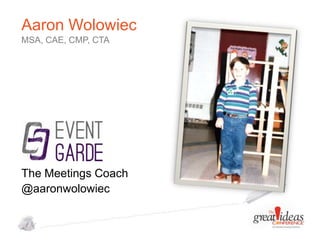
Aaron Wolowiec
MSA, CAE, CMP, CTA

The Meetings Coach
@aaronwolowiec
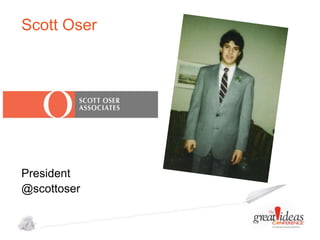
Scott Oser

President
@scottoser
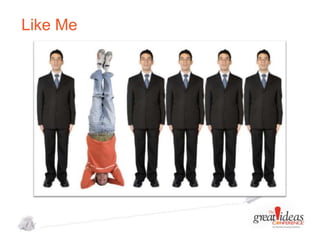
Like Me
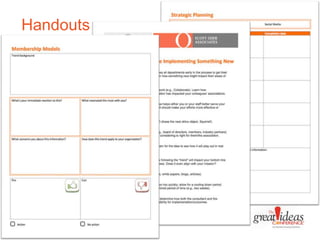
Handouts
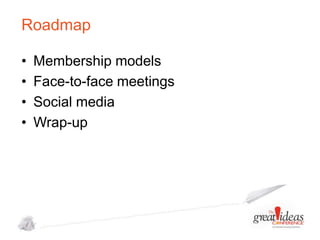
Roadmap
‱
‱
‱
‱

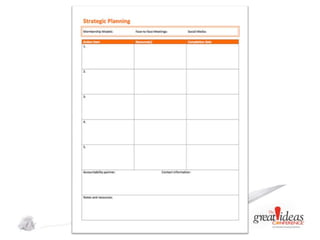
Membership models
Face-to-face meetings
Social media
Wrap-up
Membership Models
Membership is Dead!
The era when associations could count on
members joining and renewing has passed.
--Sarah Sladek, XYZuniversity.com
Membership is Dead!
Over 52% of the 690+ associations participating
in this study report a growth in
membership, versus only 31% reporting a
decline in their membership. And the reported
growth is vigorous, with nearly 24% of
associations reporting a gain in membership of
6% or more.
--2013 Membership Marketing Benchmarking
Report, Marketing General, Inc.
Membership is Dead!
While associations boasting 80% renewal rates or
higher are signiïŹcantly more likely to indicate they
have not made changes to their membership model
(70%), ïŹndings show that associations reporting
increases in new members and increases in overall
renewals are signiïŹcantly more likely to have made
such changes compared to associations with no
change or declines in new members and renewals.
--2013 Membership Marketing Benchmarking
Report, Marketing General, Inc.
Membership is Dead!
The membership model will continue to be a viable
option for associations. At the same
time, associations need to be open to new
audiences and ways of doing things that will
enhance their members’ experience.
--Lori Gusdorf, CAE, Point-Counterpoint: Is Membership
Dead? ASSOCIATIONS NOW, February 2009
Membership is Dead!
Five reasons why membership is killing association
business models:
1. Organize all value around the membership relationship.
2. Tend to focus on association outputs instead of
stakeholder outcomes.
3. Often depend on cross-subsidies that create
unintended consequences.
4. Ask members to make the most important decisions
about new value creation.
5. Require a significant investment of human effort for an
insufficient return.
--Jeff DeCagna, Principled Innovation Blog, July 2012
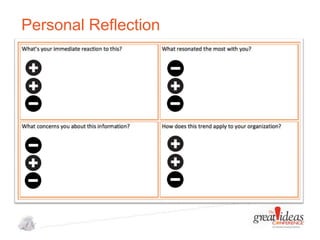
Personal Reflection
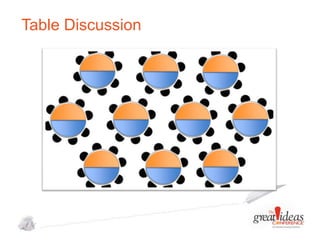
Table Discussion
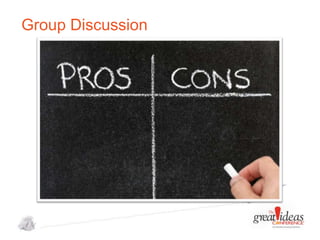
Group Discussion
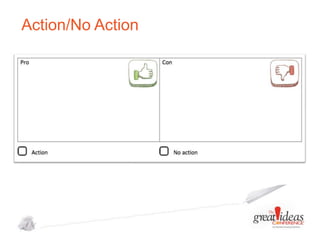
Action/No Action
Face-to-face Meetings
The Demise of Face-to-Face Meetings
Face-to-face experiences serve a comparatively
small minority of stakeholders in most
associations, and no matter how financially
successful these events have been in the past,
there is good reason for concern about their
long-term sustainability.
--Associations Unorthodox: Six Really Radical
Shifts Toward the Future, Jeff De Cagna
The Demise of Face-to-Face Meetings
Across all demographic
segments, respondents reported a strong
preference for in-person education programs
over distance formats.
--The Decision to Learn, Lillie R. Albert, Ph.D.
and Monica Dignam
The Demise of Face-to-Face Meetings
A range of factors—from the economy to technology
advances to younger generations entering the
workforce—point to growth in the use of technology
for learning and to a clear opportunity for technology
to transition into a more significant, more strategic
part of the mix of education and professional
development associations provide to members.
--Association Learning + Technology 2014, Jeff Cobb
and Celisa Steele
The Demise of Face-to-Face Meetings
In a global survey of 2,300 Harvard Business
Review subscribers, 95% said that face-to-face
meetings are both key to successful long-term
relationships and to building strong
relationships.
--Harvard Business Review Report “Managing
Across Distance in Today’s Economic Climate”
The Demise of Face-to-Face Meetings
Adults in online conditions performed modestly
better, on average, than those learning the same
material through traditional face-to-face
instruction.
--U.S. Department of Education, Evaluation of
Evidence-Based Practices in Online Learning: A
Meta-Analysis and Review of Online Learning

Studies
Personal Reflection
Table Discussion
Group Discussion
Action/No Action
Social Media
No Social Media? Are You Crazy?!?
Among our panel of association executives
(several dozen), 58 percent indicated they would
invest at some level in social media in the next
(2013) budget cycle.
--Social Media Use By Associations, One
Orange Feather Inc., 2012
No Social Media? Are You Crazy?!?
The direct effect of social media on your
audience can be difficult to determine.
--The Why and How of Social Media: An
Introduction for Associations, Association
Management Center
No Social Media? Are You Crazy?!?
Social media has the potential to revolutionize
your association’s impact with member
communications, event marketing, advocacy
and networking. It also promises to make
outreach less expensive.
--associationtrends.com
No Social Media? Are You Crazy?!?
Many organizations launch their online
community without conducting needs assessment
interviews or customer surveys to help align their
community with their target audience’s core
problems.
--Paul Schneider, Socious Online Community
Blog, April 12, 2012
No Social Media? Are You Crazy?!?
If you haven’t started to implement social media
into your marketing mix, now is the time to start.
--Sarah Sladek, The State of Social Media in
Associations and What to Do About It
No Social Media? Are You Crazy?!?
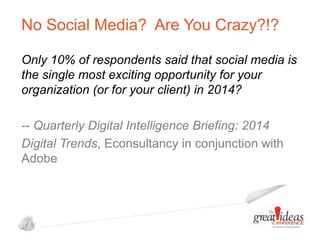
Only 10% of respondents said that social media is
the single most exciting opportunity for your
organization (or for your client) in 2014?
-- Quarterly Digital Intelligence Briefing: 2014
Digital Trends, Econsultancy in conjunction with
Adobe
Personal Reflection
Table Discussion
Group Discussion
Action/No Action
Wrap Up
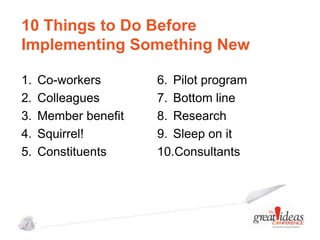
10 Things to Do Before
Implementing Something New
1.
2.
3.
4.
5.

Co-workers
Colleagues
Member benefit
Squirrel!
Constituents

6. Pilot program
7. Bottom line
8. Research
9. Sleep on it
10.Consultants
Contact Us
Scott Oser
President
Scott Oser Associates
scott@scottoserassociates.com
@scottoser
301.279.0468

Aaron Wolowiec, MSA, CAE, CMP, CTA
The Meetings Coach
Event Garde
aaron@eventgarde.com
@aaronwolowiec
616.710.1891

Under Pressure: Navigating Extreme Association Trends

  • 1.
    Under Pressure: Navigating ExtremeAssociation Trends Sunday, March 9, 2014 2:45 – 4 PM Hashtag: #ideas14 LO1 Scott Oser, Scott Oser Associates Aaron Wolowiec, Event Garde
  • 2.
    Aaron Wolowiec MSA, CAE,CMP, CTA The Meetings Coach @aaronwolowiec
  • 3.
  • 4.
  • 5.
  • 6.
  • 7.
  • 8.
    Membership is Dead! Theera when associations could count on members joining and renewing has passed. --Sarah Sladek, XYZuniversity.com
  • 9.
    Membership is Dead! Over52% of the 690+ associations participating in this study report a growth in membership, versus only 31% reporting a decline in their membership. And the reported growth is vigorous, with nearly 24% of associations reporting a gain in membership of 6% or more. --2013 Membership Marketing Benchmarking Report, Marketing General, Inc.
  • 10.
    Membership is Dead! Whileassociations boasting 80% renewal rates or higher are signiïŹcantly more likely to indicate they have not made changes to their membership model (70%), ïŹndings show that associations reporting increases in new members and increases in overall renewals are signiïŹcantly more likely to have made such changes compared to associations with no change or declines in new members and renewals. --2013 Membership Marketing Benchmarking Report, Marketing General, Inc.
  • 11.
    Membership is Dead! Themembership model will continue to be a viable option for associations. At the same time, associations need to be open to new audiences and ways of doing things that will enhance their members’ experience. --Lori Gusdorf, CAE, Point-Counterpoint: Is Membership Dead? ASSOCIATIONS NOW, February 2009
  • 12.
    Membership is Dead! Fivereasons why membership is killing association business models: 1. Organize all value around the membership relationship. 2. Tend to focus on association outputs instead of stakeholder outcomes. 3. Often depend on cross-subsidies that create unintended consequences. 4. Ask members to make the most important decisions about new value creation. 5. Require a significant investment of human effort for an insufficient return. --Jeff DeCagna, Principled Innovation Blog, July 2012
  • 13.
  • 14.
  • 15.
  • 16.
  • 17.
  • 18.
    The Demise ofFace-to-Face Meetings Face-to-face experiences serve a comparatively small minority of stakeholders in most associations, and no matter how financially successful these events have been in the past, there is good reason for concern about their long-term sustainability. --Associations Unorthodox: Six Really Radical Shifts Toward the Future, Jeff De Cagna
  • 19.
    The Demise ofFace-to-Face Meetings Across all demographic segments, respondents reported a strong preference for in-person education programs over distance formats. --The Decision to Learn, Lillie R. Albert, Ph.D. and Monica Dignam
  • 20.
    The Demise ofFace-to-Face Meetings A range of factors—from the economy to technology advances to younger generations entering the workforce—point to growth in the use of technology for learning and to a clear opportunity for technology to transition into a more significant, more strategic part of the mix of education and professional development associations provide to members. --Association Learning + Technology 2014, Jeff Cobb and Celisa Steele
  • 21.
    The Demise ofFace-to-Face Meetings In a global survey of 2,300 Harvard Business Review subscribers, 95% said that face-to-face meetings are both key to successful long-term relationships and to building strong relationships. --Harvard Business Review Report “Managing Across Distance in Today’s Economic Climate”
  • 22.
    The Demise ofFace-to-Face Meetings Adults in online conditions performed modestly better, on average, than those learning the same material through traditional face-to-face instruction. --U.S. Department of Education, Evaluation of Evidence-Based Practices in Online Learning: A Meta-Analysis and Review of Online Learning Studies
  • 23.
  • 24.
  • 25.
  • 26.
  • 27.
  • 28.
    No Social Media?Are You Crazy?!? Among our panel of association executives (several dozen), 58 percent indicated they would invest at some level in social media in the next (2013) budget cycle. --Social Media Use By Associations, One Orange Feather Inc., 2012
  • 29.
    No Social Media?Are You Crazy?!? The direct effect of social media on your audience can be difficult to determine. --The Why and How of Social Media: An Introduction for Associations, Association Management Center
  • 30.
    No Social Media?Are You Crazy?!? Social media has the potential to revolutionize your association’s impact with member communications, event marketing, advocacy and networking. It also promises to make outreach less expensive. --associationtrends.com
  • 31.
    No Social Media?Are You Crazy?!? Many organizations launch their online community without conducting needs assessment interviews or customer surveys to help align their community with their target audience’s core problems. --Paul Schneider, Socious Online Community Blog, April 12, 2012
  • 32.
    No Social Media?Are You Crazy?!? If you haven’t started to implement social media into your marketing mix, now is the time to start. --Sarah Sladek, The State of Social Media in Associations and What to Do About It
  • 33.
    No Social Media?Are You Crazy?!? Only 10% of respondents said that social media is the single most exciting opportunity for your organization (or for your client) in 2014? -- Quarterly Digital Intelligence Briefing: 2014 Digital Trends, Econsultancy in conjunction with Adobe
  • 34.
  • 35.
  • 36.
  • 37.
  • 38.
  • 39.
    10 Things toDo Before Implementing Something New 1. 2. 3. 4. 5. Co-workers Colleagues Member benefit Squirrel! Constituents 6. Pilot program 7. Bottom line 8. Research 9. Sleep on it 10.Consultants
  • 41.
    Contact Us Scott Oser President ScottOser Associates scott@scottoserassociates.com @scottoser 301.279.0468 Aaron Wolowiec, MSA, CAE, CMP, CTA The Meetings Coach Event Garde aaron@eventgarde.com @aaronwolowiec 616.710.1891

Editor's Notes

  • #2 SCOTT: Welcome attendees; thank them for coming
  • #3 SCOTT: My partner today is Aaron Wolowiec. He's the founder and president of Event Garde, a consulting firm quickly gaining recognition in the association community for its creativity and leadership in both instructional design and meeting management. Aaron’s interest in this session stems from his curiosity of extreme association trends and their applicability to the organizations he advises.
  • #4 AARON: My partner today is ScottOser. He's the president of Scott Oser Associates a boutique consulting firm that has been helping associations increase revenues by improving their membership, marketing and sales activities for over 8 years. Scott’s interest in this session stems from the fact that he believes that there can be a “me too” mentality in the association space and he really wants association professionals to hear both sides of current trends so they can make the right decision for their unique situation.
  • #5 “Like Me” activity – AARON will facilitate PROCESSParticipants move chairs back from tables so it will be easy to stand if appropriate. Name categories like:My current role is in education/learning.My current role is in marketing/PR/communications.My current role is in membership.My current role is in meetings/expositions.My current role is in technology/social media.My current role is association CEO/executive director.As people stand, remind them to look around and see who else is also in that group. Finally make the category “other” for roles. (In other words, if your role has not been called, please stand.) The facilitator asks standing members to state their roles.TIPSBecause this strategy is done as an inclusion activity when you do not yet have a relationship with the group, it is important to state the multiple purposes of inclusion activities like this. They include setting norms of participation, focusing mental energy inside the room, answering the question “who am I in relation to others in the room” and beginning the journey from an aggregate of individuals to a group.The category “other” is essential. People feel left out if their role is not acknowledged.
  • #6 AARON will review the handouts posted to the ASAE Great Ideas website
  • #7 AARON will review the session road map and 50,000 overview. SCOTT to discuss the origin of session.
  • #8 SCOTT will facilitate this section of the learning lab. Twenty minutes has been designated as follows:Background information (e.g., quotes, facts, data) – 5 minutePersonal reflection worksheet – 3 minutesReview your notes; place a “plus” next to points in support of this trend; place a “minus” next to points in opposition to this trend – 1 minuteShare your most salient “pro” and “con” points in groups of three or four – 4 minutesVolunteers report out either for or against this trend – 6 minutes Identify action/no action for this trend – 1 minute
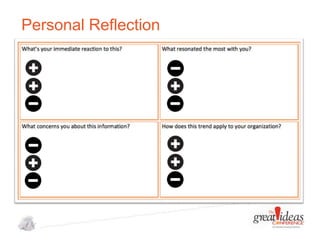
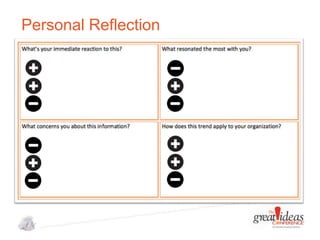
  • #14 Personal reflection worksheet – 3 minutesInstructions: Don’t worry about whether or not they’re “great”/complete responses. For now, just write down anything that comes to mind.What’s your immediate reaction to this?What resonated the most with you?What concerns you about this information?How does this trend apply to your organization?After three minutes has passed:Now review your notes; place a “plus” next to points in support of this trend; place a “minus” next to points in opposition to this trend – 1 minute
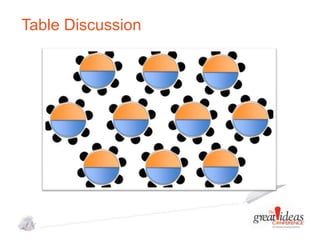
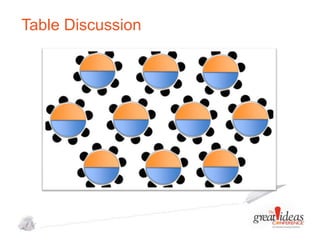
  • #15 Share your most salient “pro” and “con” points in groups of three or four at your table – 4 minutes
  • #16 Volunteers report out either for or against this trend – 6 minutesAaron records pro responses on a flipchartScott records con responses on a flipchart
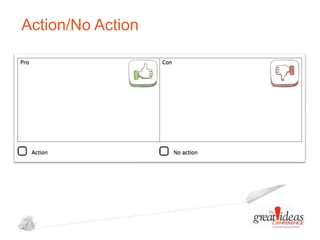
  • #17 Identify personal action/no action for this trend – 1 minute
  • #18 AARON will facilitate this section of the learning lab. Twenty minutes has been designated as follows:Background information (e.g., quotes, facts, data) – 5 minutePersonal reflection worksheet – 3 minutesReview your notes; place a “plus” next to points in support of this trend; place a “minus” next to points in opposition to this trend – 1 minuteShare your most salient “pro” and “con” points in groups of three or four – 4 minutesVolunteers report out either for or against this trend – 6 minutes Identify action/no action for this trend – 1 minute
  • #24 Personal reflection worksheet – 3 minutesInstructions: Don’t worry about whether or not they’re “great”/complete responses. For now, just write down anything that comes to mind.What’s your immediate reaction to this?What resonated the most with you?What concerns you about this information?How does this trend apply to your organization?After three minutes has passed:Now review your notes; place a “plus” next to points in support of this trend; place a “minus” next to points in opposition to this trend – 1 minute
  • #25 Share your most salient “pro” and “con” points in groups of three or four at your table – 4 minutes
  • #26 Volunteers report out either for or against this trend – 6 minutesAaron records pro responses on a flipchartScott records con responses on a flipchart
  • #27 Identify personal action/no action for this trend – 1 minute
  • #28 SCOTT will facilitate this section of the learning lab. Twenty minutes has been designated as follows:Background information (e.g., quotes, facts, data) – 5 minutePersonal reflection worksheet – 3 minutesReview your notes; place a “plus” next to points in support of this trend; place a “minus” next to points in opposition to this trend – 1 minuteShare your most salient “pro” and “con” points in groups of three or four – 4 minutesVolunteers report out either for or against this trend – 6 minutes Identify action/no action for this trend – 1 minute
  • #34 Over 2,500 respondents.
  • #35 Personal reflection worksheet – 3 minutesInstructions: Don’t worry about whether or not they’re “great”/complete responses. For now, just write down anything that comes to mind.What’s your immediate reaction to this?What resonated the most with you?What concerns you about this information?How does this trend apply to your organization?After three minutes has passed:Now review your notes; place a “plus” next to points in support of this trend; place a “minus” next to points in opposition to this trend – 1 minute
  • #36 Share your most salient “pro” and “con” points in groups of three or four at your table – 4 minutes
  • #37 Volunteers report out either for or against this trend – 6 minutesAaron records pro responses on a flipchartScott records con responses on a flipchart
  • #38 Identify personal action/no action for this trend – 1 minute
  • #40 SCOTT to lead discussion:Don't do it just to do it. (Don't chase the next shiny object. Squirrel!)Test or develop a pilot program for the idea to see how it will play out in real life.Talk to your co-workers across all departments early in the process to get their thoughts and perspectives on how something new might impact their areas of responsibility.Talk to your association network (e.g., Collaborate). Learn how product/program implementation has impacted your colleagues’ associations.Ensure that your next big idea helps either you or your staff better serve your members. At the very least, it should make your efforts more effective or efficient.Don't do it just to do it. (Don't chase the next shiny object. Squirrel!)Talk to your constituents (e.g., board of directors, members, industry partners) to help ensure what you are considering is right for them/the association.Test or develop a pilot program for the idea to see how it will play out in real life.Run the numbers to see how following the "trend" will impact your bottom line and your association's business. Does it even align with your mission?Do your research (i.e., books, white papers, blogs, articles). Don't rush into implementation too quickly; allow for a cooling down period. “Sleep on it” for a pre-determined period of time (e.g., two weeks). If working with a consultant, determine how both the consultant and the association will take responsibility for implementation/outcomes.
  • #41 AARON to lead discussion
  • #42 AARON to wrap-up the session:ResourcesWhite paper to be created following the program (i.e., opinion piece/what we saw/facts) Contact information – make business cards available at the door; collect business cards for a copy of the work product/PowerPoint presentationThank you