Rethink Your
Volunteer
Approach
March 6  11 – 11:45 a.m.
Learning Format: Learn
Audience Level: Applied
The NIGP 2.0 Case Study
Implementing a Governance Model
to Address the Dynamic Global Marketplace
Background on NIGP
VISION: A world in which public procurement practitioners
are highly regarded members of a respected professional
order.
MISSION: Develop, support and promote the public
procurement profession.
4
Background on NIGP
 Founded in 1944
 3,100 public agency members; 14,800 public
procurement practitioners receiving member benefits
 73 chapter affiliates
 Largest professional association exclusively for public
procurement
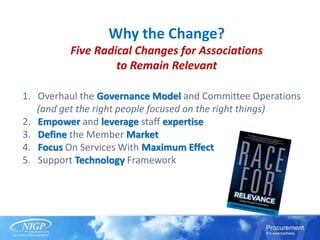
Why the Change?
Five Radical Changes for Associations
to Remain Relevant
1. Overhaul the Governance Model and Committee Operations
(and get the right people focused on the right things)
2. Empower and leverage staff expertise
3. Define the Member Market
4. Focus On Services With Maximum Effect
5. Support Technology Framework
NIGP Testimonial: Don Buffum
Why the Change in Governance?
1. Limited Opportunity to Contribute as Volunteers
2. Leadership Selected by Popularity Rather than Talent
3. Limited Voter Turnout by Members
4. Focus of Governance Placement v. Member Engagement
5. Board Roles Mixed: Strategy and Operations
6. Stakeholder Perspective Non-Existent
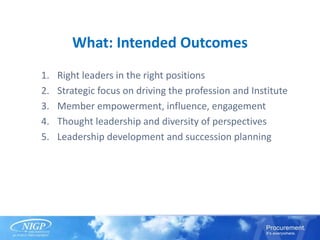
What: Intended Outcomes
1. Right leaders in the right positions
2. Strategic focus on driving the profession and Institute
3. Member empowerment, influence, engagement
4. Thought leadership and diversity of perspectives
5. Leadership development and succession planning
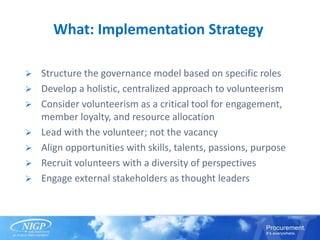
What: Implementation Strategy
 Structure the governance model based on specific roles
 Develop a holistic, centralized approach to volunteerism
 Consider volunteerism as a critical tool for engagement,
member loyalty, and resource allocation
 Lead with the volunteer; not the vacancy
 Align opportunities with skills, talents, passions, purpose
 Recruit volunteers with a diversity of perspectives
 Engage external stakeholders as thought leaders
NIGP Testimonial: Gregory Spearman
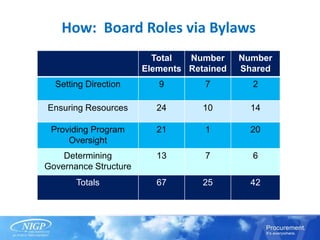
How: Board Roles via Bylaws
Total
Elements
Number
Retained
Number
Shared
Setting Direction 9 7 2
Ensuring Resources 24 10 14
Providing Program
Oversight
21 1 20
Determining
Governance Structure
13 7 6
Totals 67 25 42
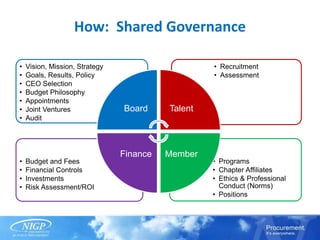
How: Shared Governance
• Programs
• Chapter Affiliates
• Ethics & Professional
Conduct (Norms)
• Positions
• Budget and Fees
• Financial Controls
• Investments
• Risk Assessment/ROI
• Recruitment
• Assessment
• Vision, Mission, Strategy
• Goals, Results, Policy
• CEO Selection
• Budget Philosophy
• Appointments
• Joint Ventures
• Audit
Board Talent
MemberFinance
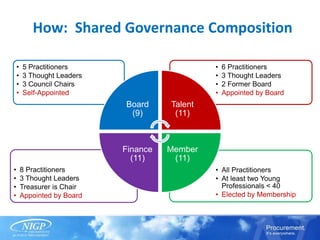
How: Shared Governance Composition
• All Practitioners
• At least two Young
Professionals < 40
• Elected by Membership
• 8 Practitioners
• 3 Thought Leaders
• Treasurer is Chair
• Appointed by Board
• 6 Practitioners
• 3 Thought Leaders
• 2 Former Board
• Appointed by Board
• 5 Practitioners
• 3 Thought Leaders
• 3 Council Chairs
• Self-Appointed
Board
(9)
Talent
(11)
Member
(11)
Finance
(11)
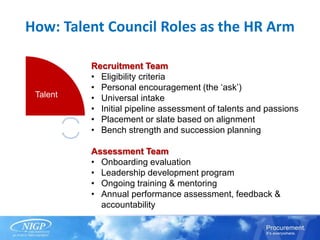
How: Talent Council Roles as the HR Arm
Board
Talent
Member
Finance
Recruitment Team
• Eligibility criteria
• Personal encouragement (the ‘ask’)
• Universal intake
• Initial pipeline assessment of talents and passions
• Placement or slate based on alignment
• Bench strength and succession planning
Assessment Team
• Onboarding evaluation
• Leadership development program
• Ongoing training & mentoring
• Annual performance assessment, feedback &
accountability
NIGP Testimonial: Carrie Woodell
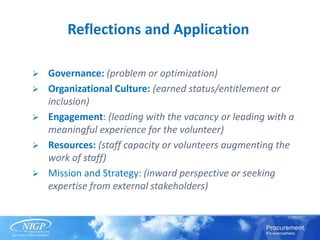
Reflections and Application
 Governance: (problem or optimization)
 Organizational Culture: (earned status/entitlement or
inclusion)
 Engagement: (leading with the vacancy or leading with a
meaningful experience for the volunteer)
 Resources: (staff capacity or volunteers augmenting the
work of staff)
 Mission and Strategy: (inward perspective or seeking
expertise from external stakeholders)
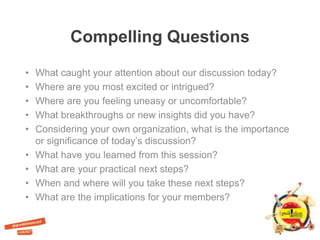
Compelling Questions
• What caught your attention about our discussion today?
• Where are you most excited or intrigued?
• Where are you feeling uneasy or uncomfortable?
• What breakthroughs or new insights did you have?
• Considering your own organization, what is the importance
or significance of today’s discussion?
• What have you learned from this session?
• What are your practical next steps?
• When and where will you take these next steps?
• What are the implications for your members?
Attendees, thank you!
Rick Grimm
CPPO, CPPB, FCIPS
Chief Executive
NIGP
@RickGrimm
Peggy Hoffman
CAE
President
Mariner Management
@PeggyHoffman
Aaron Wolowiec
MSA, CAE, CMP, CTA
President
Event Garde
@AaronWolowiec

Rethink Your Volunteer Approach

  • 1.
    Rethink Your Volunteer Approach March 6 11 – 11:45 a.m. Learning Format: Learn Audience Level: Applied
  • 2.
    The NIGP 2.0Case Study Implementing a Governance Model to Address the Dynamic Global Marketplace
  • 3.
    Background on NIGP VISION:A world in which public procurement practitioners are highly regarded members of a respected professional order. MISSION: Develop, support and promote the public procurement profession.
  • 4.
    4 Background on NIGP Founded in 1944  3,100 public agency members; 14,800 public procurement practitioners receiving member benefits  73 chapter affiliates  Largest professional association exclusively for public procurement
  • 5.
    Why the Change? FiveRadical Changes for Associations to Remain Relevant 1. Overhaul the Governance Model and Committee Operations (and get the right people focused on the right things) 2. Empower and leverage staff expertise 3. Define the Member Market 4. Focus On Services With Maximum Effect 5. Support Technology Framework
  • 6.
  • 7.
    Why the Changein Governance? 1. Limited Opportunity to Contribute as Volunteers 2. Leadership Selected by Popularity Rather than Talent 3. Limited Voter Turnout by Members 4. Focus of Governance Placement v. Member Engagement 5. Board Roles Mixed: Strategy and Operations 6. Stakeholder Perspective Non-Existent
  • 8.
    What: Intended Outcomes 1.Right leaders in the right positions 2. Strategic focus on driving the profession and Institute 3. Member empowerment, influence, engagement 4. Thought leadership and diversity of perspectives 5. Leadership development and succession planning
  • 9.
    What: Implementation Strategy Structure the governance model based on specific roles  Develop a holistic, centralized approach to volunteerism  Consider volunteerism as a critical tool for engagement, member loyalty, and resource allocation  Lead with the volunteer; not the vacancy  Align opportunities with skills, talents, passions, purpose  Recruit volunteers with a diversity of perspectives  Engage external stakeholders as thought leaders
  • 10.
  • 11.
    How: Board Rolesvia Bylaws Total Elements Number Retained Number Shared Setting Direction 9 7 2 Ensuring Resources 24 10 14 Providing Program Oversight 21 1 20 Determining Governance Structure 13 7 6 Totals 67 25 42
  • 12.
    How: Shared Governance •Programs • Chapter Affiliates • Ethics & Professional Conduct (Norms) • Positions • Budget and Fees • Financial Controls • Investments • Risk Assessment/ROI • Recruitment • Assessment • Vision, Mission, Strategy • Goals, Results, Policy • CEO Selection • Budget Philosophy • Appointments • Joint Ventures • Audit Board Talent MemberFinance
  • 13.
    How: Shared GovernanceComposition • All Practitioners • At least two Young Professionals < 40 • Elected by Membership • 8 Practitioners • 3 Thought Leaders • Treasurer is Chair • Appointed by Board • 6 Practitioners • 3 Thought Leaders • 2 Former Board • Appointed by Board • 5 Practitioners • 3 Thought Leaders • 3 Council Chairs • Self-Appointed Board (9) Talent (11) Member (11) Finance (11)
  • 14.
    How: Talent CouncilRoles as the HR Arm Board Talent Member Finance Recruitment Team • Eligibility criteria • Personal encouragement (the ‘ask’) • Universal intake • Initial pipeline assessment of talents and passions • Placement or slate based on alignment • Bench strength and succession planning Assessment Team • Onboarding evaluation • Leadership development program • Ongoing training & mentoring • Annual performance assessment, feedback & accountability
  • 15.
  • 16.
    Reflections and Application Governance: (problem or optimization)  Organizational Culture: (earned status/entitlement or inclusion)  Engagement: (leading with the vacancy or leading with a meaningful experience for the volunteer)  Resources: (staff capacity or volunteers augmenting the work of staff)  Mission and Strategy: (inward perspective or seeking expertise from external stakeholders)
  • 17.
    Compelling Questions • Whatcaught your attention about our discussion today? • Where are you most excited or intrigued? • Where are you feeling uneasy or uncomfortable? • What breakthroughs or new insights did you have? • Considering your own organization, what is the importance or significance of today’s discussion? • What have you learned from this session? • What are your practical next steps? • When and where will you take these next steps? • What are the implications for your members?
  • 18.
    Attendees, thank you! RickGrimm CPPO, CPPB, FCIPS Chief Executive NIGP @RickGrimm Peggy Hoffman CAE President Mariner Management @PeggyHoffman Aaron Wolowiec MSA, CAE, CMP, CTA President Event Garde @AaronWolowiec