unconformities
 Introduction
 Rocks involved in unconformities
 Types of unconformity
 Recognition of unconformities
 Significance of unconformities
 Conclusions
 References
 It is one of the most common geological feature
found in rocks or in succession.
 It is different then all other geological structures viz.
the fold, joints and faults.
 Unconformities are resulted due to tectonic activity in
form of uplift or subsidence of land.
 It is referred to a period of non-deposition.
 UNCONFORMITIES = gaps in rock layers
◦ Form when layers of rock are removed by erosion
◦ Form when a period of time passes without any new
deposition to produce new layers of rock
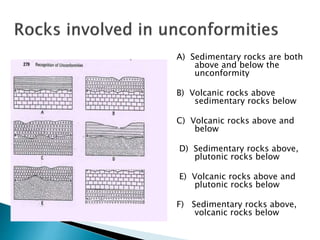
A) Sedimentary rocks are both
above and below the
unconformity
B) Volcanic rocks above
sedimentary rocks below
C) Volcanic rocks above and
below
D) Sedimentary rocks above,
plutonic rocks below
E) Volcanic rocks above and
plutonic rocks below
F) Sedimentary rocks above,
volcanic rocks below
 Angular unconformity
 Disconformity
 Local unconformity
 Non conformity
 Blended unconformity
 Para conformity
 Buttress unconformity
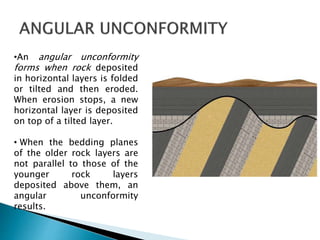
•An angular unconformity
forms when rock deposited
in horizontal layers is folded
or tilted and then eroded.
When erosion stops, a new
horizontal layer is deposited
on top of a tilted layer.
• When the bedding planes
of the older rock layers are
not parallel to those of the
younger rock layers
deposited above them, an
angular unconformity
results.
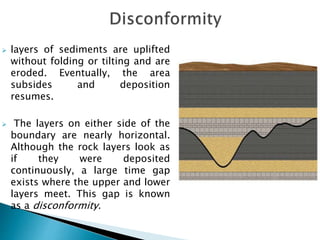
 layers of sediments are uplifted
without folding or tilting and are
eroded. Eventually, the area
subsides and deposition
resumes.
 The layers on either side of the
boundary are nearly horizontal.
Although the rock layers look as
if they were deposited
continuously, a large time gap
exists where the upper and lower
layers meet. This gap is known
as a disconformity.
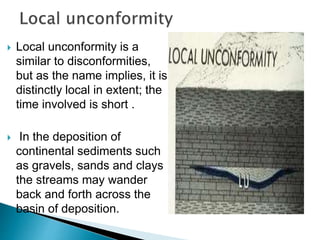
 Local unconformity is a
similar to disconformities,
but as the name implies, it is
distinctly local in extent; the
time involved is short .
 In the deposition of
continental sediments such
as gravels, sands and clays
the streams may wander
back and forth across the
basin of deposition.
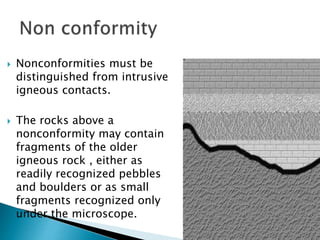
 Nonconformities must be
distinguished from intrusive
igneous contacts.
 The rocks above a
nonconformity may contain
fragments of the older
igneous rock , either as
readily recognized pebbles
and boulders or as small
fragments recognized only
under the microscope.
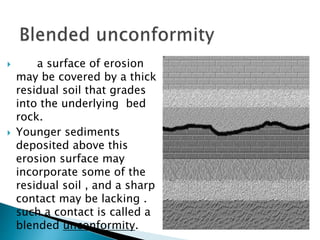
 a surface of erosion
may be covered by a thick
residual soil that grades
into the underlying bed
rock.
 Younger sediments
deposited above this
erosion surface may
incorporate some of the
residual soil , and a sharp
contact may be lacking .
such a contact is called a
blended unconformity.
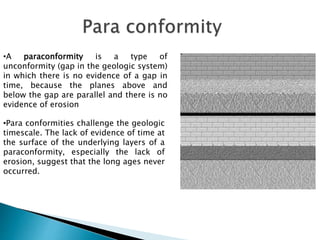
•A paraconformity is a type of
unconformity (gap in the geologic system)
in which there is no evidence of a gap in
time, because the planes above and
below the gap are parallel and there is no
evidence of erosion
•Para conformities challenge the geologic
timescale. The lack of evidence of time at
the surface of the underlying layers of a
paraconformity, especially the lack of
erosion, suggest that the long ages never
occurred.
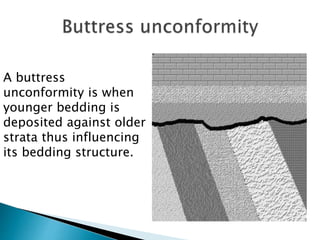
A buttress
unconformity is when
younger bedding is
deposited against older
strata thus influencing
its bedding structure.
 Unconformities may be recognized in single outcrop is most satisfactory.
 If the unconformity is on angular one, the lake of parallelism of the beds on
opposite sides of the contact will be readily apparent . this may be observed
in vertical section.
 Under favorable conditions, disconformities may be readily recognized in
outcrops , road cuts , and quarries.
 The most important criteria for recognizing unconformities in the field are
usually sedimentary but unconformities can also be recognized from gaps in
the paleontological record.
 Recognition of unconformity can be presence of conglomeratic bed at the
interface. It is fossils of wildly different ages which mark the variation of
attitude.
 An angular unconformity, as its name suggests,
is an unconformity between layers that are not
parallel but instead are at an angle.
 The upper, horizontal, layers were deposited a
top the erosion surface, so we can step back in
time by removing them.
 Steno's principle of lateral continuity tells us that
the tillted layers were originally continuous
before being eroded.
 Steno's principle of original hozontality tells us
that these tilted layers were deposited as
horizontal layers and later tilted.
 A disconformities is an ancient surface of
erosion between layers that are parallel.
 The upper layers were deposited a top the
erosion surface, so we can step back in time
by removing them.
 Prior to the erosion, there may have been
layers of sediment that were eroded, and of
which no trace remains.
 A nonconformity is an ancient surface of erosion
between overlying sedimentary rock layers and
underlying unlayered igneous or metamorphic
rocks.
 The layers were deposited a top the erosion
surface, so we can step back in time by removing
them.
 Prior to the erosion, there has to have been rock
into which magma was intruded or beneath
which rocks were metamorphosed. Erosion of all
that rock would require much time.
 Unconformities are erosional or non-depositional breaks
in a sequence of rocks.
 Unconformities are structural features and they play an
important role in investigation of deformed rocks and
represents break in stratigraphic sequence.
 Rocks of various origin may participate in unconformities
like sedimentary rocks, volcanic igneous rocks, plutonic
rocks or metamorphic rocks may be involved.
 Formation of an unconformity may be attributed to three
main processes like erosion, deposition and tectonic
activity.
 STRUCTURAL GEOLOGY- Marland P. Billings-
Prentice Hall of india Pvt Ltd-3rd edition- pp no-
278-292
 1976, Bruce E.Hobbs, Winthrop D.Means, Paul
F.Williams, AN OUTLINEOF STRUCTURAL GEOLOGY,
John Wiley and Sons,Pp:154-155.
 www.google.com
 www.wikipedia.com
Unconformities

Unconformities

  • 1.
  • 2.
     Introduction  Rocksinvolved in unconformities  Types of unconformity  Recognition of unconformities  Significance of unconformities  Conclusions  References
  • 3.
     It isone of the most common geological feature found in rocks or in succession.  It is different then all other geological structures viz. the fold, joints and faults.  Unconformities are resulted due to tectonic activity in form of uplift or subsidence of land.  It is referred to a period of non-deposition.  UNCONFORMITIES = gaps in rock layers ◦ Form when layers of rock are removed by erosion ◦ Form when a period of time passes without any new deposition to produce new layers of rock
  • 4.
    A) Sedimentary rocksare both above and below the unconformity B) Volcanic rocks above sedimentary rocks below C) Volcanic rocks above and below D) Sedimentary rocks above, plutonic rocks below E) Volcanic rocks above and plutonic rocks below F) Sedimentary rocks above, volcanic rocks below
  • 5.
     Angular unconformity Disconformity  Local unconformity  Non conformity  Blended unconformity  Para conformity  Buttress unconformity
  • 6.
    •An angular unconformity formswhen rock deposited in horizontal layers is folded or tilted and then eroded. When erosion stops, a new horizontal layer is deposited on top of a tilted layer. • When the bedding planes of the older rock layers are not parallel to those of the younger rock layers deposited above them, an angular unconformity results.
  • 7.
     layers ofsediments are uplifted without folding or tilting and are eroded. Eventually, the area subsides and deposition resumes.  The layers on either side of the boundary are nearly horizontal. Although the rock layers look as if they were deposited continuously, a large time gap exists where the upper and lower layers meet. This gap is known as a disconformity.
  • 8.
     Local unconformityis a similar to disconformities, but as the name implies, it is distinctly local in extent; the time involved is short .  In the deposition of continental sediments such as gravels, sands and clays the streams may wander back and forth across the basin of deposition.
  • 9.
     Nonconformities mustbe distinguished from intrusive igneous contacts.  The rocks above a nonconformity may contain fragments of the older igneous rock , either as readily recognized pebbles and boulders or as small fragments recognized only under the microscope.
  • 10.
     a surfaceof erosion may be covered by a thick residual soil that grades into the underlying bed rock.  Younger sediments deposited above this erosion surface may incorporate some of the residual soil , and a sharp contact may be lacking . such a contact is called a blended unconformity.
  • 11.
    •A paraconformity isa type of unconformity (gap in the geologic system) in which there is no evidence of a gap in time, because the planes above and below the gap are parallel and there is no evidence of erosion •Para conformities challenge the geologic timescale. The lack of evidence of time at the surface of the underlying layers of a paraconformity, especially the lack of erosion, suggest that the long ages never occurred.
  • 12.
    A buttress unconformity iswhen younger bedding is deposited against older strata thus influencing its bedding structure.
  • 13.
     Unconformities maybe recognized in single outcrop is most satisfactory.  If the unconformity is on angular one, the lake of parallelism of the beds on opposite sides of the contact will be readily apparent . this may be observed in vertical section.  Under favorable conditions, disconformities may be readily recognized in outcrops , road cuts , and quarries.  The most important criteria for recognizing unconformities in the field are usually sedimentary but unconformities can also be recognized from gaps in the paleontological record.  Recognition of unconformity can be presence of conglomeratic bed at the interface. It is fossils of wildly different ages which mark the variation of attitude.
  • 14.
     An angularunconformity, as its name suggests, is an unconformity between layers that are not parallel but instead are at an angle.  The upper, horizontal, layers were deposited a top the erosion surface, so we can step back in time by removing them.  Steno's principle of lateral continuity tells us that the tillted layers were originally continuous before being eroded.  Steno's principle of original hozontality tells us that these tilted layers were deposited as horizontal layers and later tilted.
  • 15.
     A disconformitiesis an ancient surface of erosion between layers that are parallel.  The upper layers were deposited a top the erosion surface, so we can step back in time by removing them.  Prior to the erosion, there may have been layers of sediment that were eroded, and of which no trace remains.
  • 16.
     A nonconformityis an ancient surface of erosion between overlying sedimentary rock layers and underlying unlayered igneous or metamorphic rocks.  The layers were deposited a top the erosion surface, so we can step back in time by removing them.  Prior to the erosion, there has to have been rock into which magma was intruded or beneath which rocks were metamorphosed. Erosion of all that rock would require much time.
  • 17.
     Unconformities areerosional or non-depositional breaks in a sequence of rocks.  Unconformities are structural features and they play an important role in investigation of deformed rocks and represents break in stratigraphic sequence.  Rocks of various origin may participate in unconformities like sedimentary rocks, volcanic igneous rocks, plutonic rocks or metamorphic rocks may be involved.  Formation of an unconformity may be attributed to three main processes like erosion, deposition and tectonic activity.
  • 18.
     STRUCTURAL GEOLOGY-Marland P. Billings- Prentice Hall of india Pvt Ltd-3rd edition- pp no- 278-292  1976, Bruce E.Hobbs, Winthrop D.Means, Paul F.Williams, AN OUTLINEOF STRUCTURAL GEOLOGY, John Wiley and Sons,Pp:154-155.  www.google.com  www.wikipedia.com