 Igneous rock (derived from
the Latin word ignis meaning fire) is one of the
three main rock types, the others
being sedimentaryand metamorphic rock. Igneous
rock is formed through the cooling
and solidification of magma or lava. Igneous rock
may form with or without crystallization, either
below the surface asintrusive (plutonic) rocks or on
the surface as extrusive(volcanic) rocks.
 There are several Classification based on different
properties.
 GENETIC CLASSIFICATION
 BASED ON COLOR
 TEXTURAL
 CHEMICAL COMPOSITIONAL
 CIPW CLASSIFICATION
 IUGS CLASSIFICATION
 Based on genesis of igneous rock it is mainly
classified in to 3
I. Hypabyssal rocks – find at shallow depth
(<1km) ,fine grained
II. Plutonic igneous rock- depth greater than1
km, medium to coarce grained
III. Volcanic rocks- magma which reaches &
flow on the surface, is called lava and forms
extrusive rocks, they are fine grained
 Here it is classified based on the volume
percentage of colored mineral or mafic
mineral.
 Leucocratic-contain lessthan 30% mafic
mineral
 Mesocratic- contain 30%-50%mafic mineral.
 Melanocratic- contain 60-90% mafic mineral.
 Hyper melanic-contain more than 90% mafic
mineral
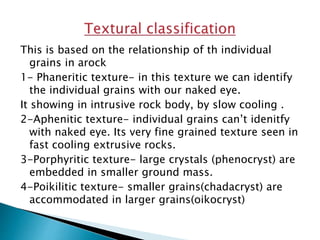
This is based on the relationship of th individual
grains in arock
1- Phaneritic texture- in this texture we can identify
the individual grains with our naked eye.
It showing in intrusive rock body, by slow cooling .
2-Aphenitic texture- individual grains can’t idenitfy
with naked eye. Its very fine grained texture seen in
fast cooling extrusive rocks.
3-Porphyritic texture- large crystals (phenocryst) are
embedded in smaller ground mass.
4-Poikilitic texture- smaller grains(chadacryst) are
accommodated in larger grains(oikocryst)
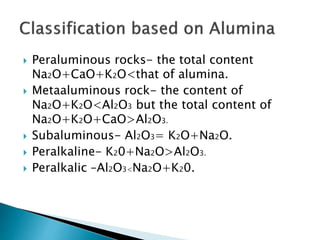
 Peraluminous rocks- the total content
Na2O+CaO+K2O<that of alumina.
 Metaaluminous rock- the content of
Na2O+K2O<Al2O3 but the total content of
Na2O+K2O+CaO>Al2O3.
 Subaluminous- Al2O3= K2O+Na2O.
 Peralkaline- K20+Na2O>Al2O3.
 Peralkalic –Al2O3<Na2O+K20.
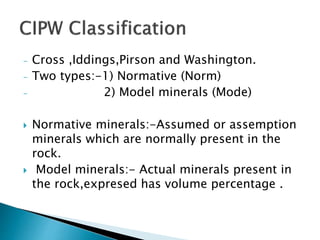
- Cross ,Iddings,Pirson and Washington.
- Two types:-1) Normative (Norm)
- 2) Model minerals (Mode)
 Normative minerals:-Assumed or assemption
minerals which are normally present in the
rock.
 Model minerals:- Actual minerals present in
the rock,expresed has volume percentage .
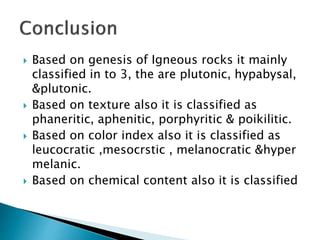
 Based on genesis of Igneous rocks it mainly
classified in to 3, the are plutonic, hypabysal,
&plutonic.
 Based on texture also it is classified as
phaneritic, aphenitic, porphyritic & poikilitic.
 Based on color index also it is classified as
leucocratic ,mesocrstic , melanocratic &hyper
melanic.
 Based on chemical content also it is classified
 Igneous and metamorphic petrology(1962),
Francis J.Turner,McGraw-Hill book company.
 http://en.wikipedia.org/wiki/Granite
 http://www.thefreedictionary.com/granite
Classifications of igneous rocks

Classifications of igneous rocks

  • 2.
     Igneous rock(derived from the Latin word ignis meaning fire) is one of the three main rock types, the others being sedimentaryand metamorphic rock. Igneous rock is formed through the cooling and solidification of magma or lava. Igneous rock may form with or without crystallization, either below the surface asintrusive (plutonic) rocks or on the surface as extrusive(volcanic) rocks.  There are several Classification based on different properties.
  • 3.
     GENETIC CLASSIFICATION BASED ON COLOR  TEXTURAL  CHEMICAL COMPOSITIONAL  CIPW CLASSIFICATION  IUGS CLASSIFICATION
  • 4.
     Based ongenesis of igneous rock it is mainly classified in to 3 I. Hypabyssal rocks – find at shallow depth (<1km) ,fine grained II. Plutonic igneous rock- depth greater than1 km, medium to coarce grained III. Volcanic rocks- magma which reaches & flow on the surface, is called lava and forms extrusive rocks, they are fine grained
  • 5.
     Here itis classified based on the volume percentage of colored mineral or mafic mineral.  Leucocratic-contain lessthan 30% mafic mineral  Mesocratic- contain 30%-50%mafic mineral.  Melanocratic- contain 60-90% mafic mineral.  Hyper melanic-contain more than 90% mafic mineral
  • 6.
    This is basedon the relationship of th individual grains in arock 1- Phaneritic texture- in this texture we can identify the individual grains with our naked eye. It showing in intrusive rock body, by slow cooling . 2-Aphenitic texture- individual grains can’t idenitfy with naked eye. Its very fine grained texture seen in fast cooling extrusive rocks. 3-Porphyritic texture- large crystals (phenocryst) are embedded in smaller ground mass. 4-Poikilitic texture- smaller grains(chadacryst) are accommodated in larger grains(oikocryst)
  • 7.
     Peraluminous rocks-the total content Na2O+CaO+K2O<that of alumina.  Metaaluminous rock- the content of Na2O+K2O<Al2O3 but the total content of Na2O+K2O+CaO>Al2O3.  Subaluminous- Al2O3= K2O+Na2O.  Peralkaline- K20+Na2O>Al2O3.  Peralkalic –Al2O3<Na2O+K20.
  • 8.
    - Cross ,Iddings,Pirsonand Washington. - Two types:-1) Normative (Norm) - 2) Model minerals (Mode)  Normative minerals:-Assumed or assemption minerals which are normally present in the rock.  Model minerals:- Actual minerals present in the rock,expresed has volume percentage .
  • 9.
     Based ongenesis of Igneous rocks it mainly classified in to 3, the are plutonic, hypabysal, &plutonic.  Based on texture also it is classified as phaneritic, aphenitic, porphyritic & poikilitic.  Based on color index also it is classified as leucocratic ,mesocrstic , melanocratic &hyper melanic.  Based on chemical content also it is classified
  • 10.
     Igneous andmetamorphic petrology(1962), Francis J.Turner,McGraw-Hill book company.  http://en.wikipedia.org/wiki/Granite  http://www.thefreedictionary.com/granite