CONCEPTS OF
STRATIGRAPHY
Sharik Shamsudhien
183104008
Stratigraphic concepts
• The field of stratigraphy is a branch of geology that deals
with rock succession through time and space
• Stratigraphy is a complex and intriguing form of geology
which tells the story of the Earth through time.
• In short it is the time frozen in rocks.
• Stratigraphy is largely based on the law of superposition,
originally brought into vogue by Nicholas Steno in the
1600's
Types of Stratigraphy
• Lithostratigraphy
o Physical properties and stratigraphic position relative to other
lithostratigraphic units.
o Organization of strata on the basis of their lithologic characteristics
• Chronostratigraphy
o Integrated approach to establishing the time relationships among
geologic units
o It is the organisation of strata on the basis of Time relationships
• Biostratigraphy
o Study of the fossil record with emphasis on faunal succession to establish
relative time relationships
o Organization of strata on the basis of the fossils they contain
• Magnetostratigraphy
o Study of the magnetic properties of rock units for the purpose of
correlation using magnetic polarity reversals
o Organization of strata on the basis of their magnetic characteristics
• Allostratigraphy
o Study of rock units defined by unconformities and other features
generated by base level change
• Geochronology
o Various techniques, especially isotope geochemistry, to establish
the absolute age of rock units
o Depositional sequences, packages of strata bounded by
unconformities
• Seismic Stratigraphy
o Organization of strata on the basis of their seismic
characteristics
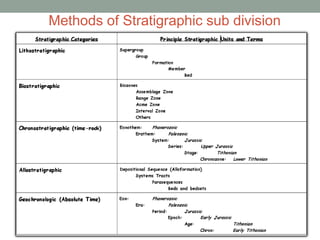
Methods of Stratigraphic sub division
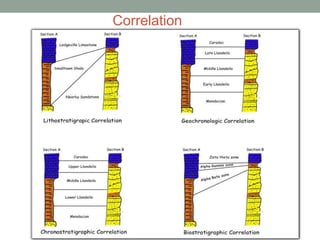
Correlation
Principles (Laws) of Stratigraphy
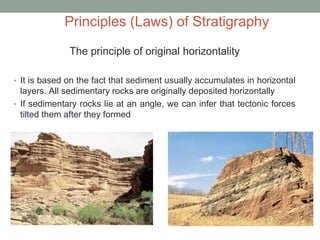
The principle of original horizontality
• It is based on the fact that sediment usually accumulates in horizontal
layers. All sedimentary rocks are originally deposited horizontally
• If sedimentary rocks lie at an angle, we can infer that tectonic forces
tilted them after they formed
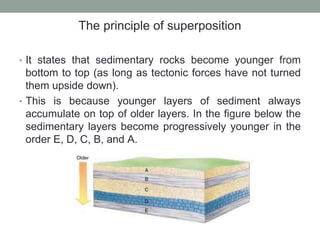
The principle of superposition
• It states that sedimentary rocks become younger from
bottom to top (as long as tectonic forces have not turned
them upside down).
• This is because younger layers of sediment always
accumulate on top of older layers. In the figure below the
sedimentary layers become progressively younger in the
order E, D, C, B, and A.
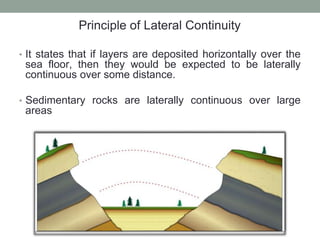
Principle of Lateral Continuity
• It states that if layers are deposited horizontally over the
sea floor, then they would be expected to be laterally
continuous over some distance.
• Sedimentary rocks are laterally continuous over large
areas
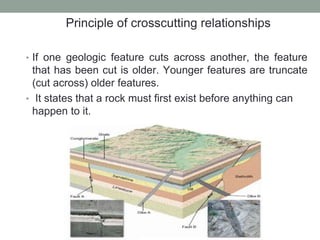
Principle of crosscutting relationships
• If one geologic feature cuts across another, the feature
that has been cut is older. Younger features are truncate
(cut across) older features.
• It states that a rock must first exist before anything can
happen to it.
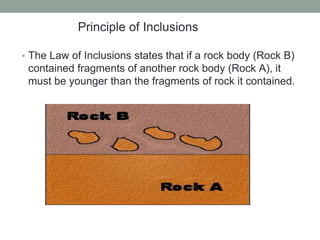
Principle of Inclusions
• The Law of Inclusions states that if a rock body (Rock B)
contained fragments of another rock body (Rock A), it
must be younger than the fragments of rock it contained.
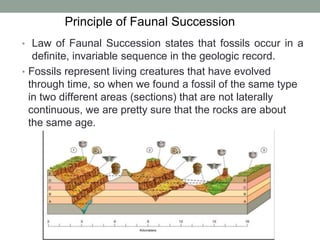
Principle of Faunal Succession
• Law of Faunal Succession states that fossils occur in a
definite, invariable sequence in the geologic record.
• Fossils represent living creatures that have evolved
through time, so when we found a fossil of the same type
in two different areas (sections) that are not laterally
continuous, we are pretty sure that the rocks are about
the same age.
Principle of Uniformitarianism
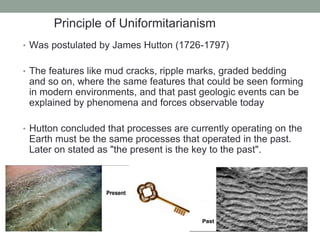
• Was postulated by James Hutton (1726-1797)
• The features like mud cracks, ripple marks, graded bedding
and so on, where the same features that could be seen forming
in modern environments, and that past geologic events can be
explained by phenomena and forces observable today
• Hutton concluded that processes are currently operating on the
Earth must be the same processes that operated in the past.
Later on stated as "the present is the key to the past".
UNCONFORMITIES
• Layers of sedimentary rocks are conformable if they were
deposited without interruption.
• An unconformity represents an interruption in deposition,
usually of long duration.
• During the interval when no sediment was deposited, some
rock layers may have been eroded
• Thus, an unconformity represents a long time interval for
which no geologic record exists in that place. The lost record
may involve hundreds of millions of years
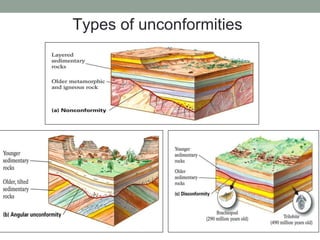
• Disconformity : A disconformity is an
unconformity between parallel layers of sedimentary rocks which
represents a period of erosion or non-deposition. Disconformities
are marked by features of subaerial erosion.
• Nonconformity : A nonconformity exists between
sedimentary rocks and metamorphic or igneous rocks when the
sedimentary rock lies above and was deposited on the pre-
existing and eroded metamorphic or igneous rock.
• Angular unconformity : An angular unconformity is an
unconformity where horizontally parallel strata of sedimentary
rock are deposited on tilted and eroded layers, producing an
angular discordance with the overlying horizontal layers.
• Paraconformity : A paraconformity is a type of
unconformity in which strata are parallel; there is no apparent
erosion and the unconformity surface resembles a simple
bedding plane. It is also called nondepositional unconformity or
pseudoconformity.
Types of unconformities
Thank you

Concepts of Stratigraphy

  • 1.
  • 2.
    Stratigraphic concepts • Thefield of stratigraphy is a branch of geology that deals with rock succession through time and space • Stratigraphy is a complex and intriguing form of geology which tells the story of the Earth through time. • In short it is the time frozen in rocks. • Stratigraphy is largely based on the law of superposition, originally brought into vogue by Nicholas Steno in the 1600's
  • 3.
    Types of Stratigraphy •Lithostratigraphy o Physical properties and stratigraphic position relative to other lithostratigraphic units. o Organization of strata on the basis of their lithologic characteristics • Chronostratigraphy o Integrated approach to establishing the time relationships among geologic units o It is the organisation of strata on the basis of Time relationships • Biostratigraphy o Study of the fossil record with emphasis on faunal succession to establish relative time relationships o Organization of strata on the basis of the fossils they contain
  • 4.
    • Magnetostratigraphy o Studyof the magnetic properties of rock units for the purpose of correlation using magnetic polarity reversals o Organization of strata on the basis of their magnetic characteristics • Allostratigraphy o Study of rock units defined by unconformities and other features generated by base level change • Geochronology o Various techniques, especially isotope geochemistry, to establish the absolute age of rock units o Depositional sequences, packages of strata bounded by unconformities • Seismic Stratigraphy o Organization of strata on the basis of their seismic characteristics
  • 5.
  • 6.
  • 7.
    Principles (Laws) ofStratigraphy The principle of original horizontality • It is based on the fact that sediment usually accumulates in horizontal layers. All sedimentary rocks are originally deposited horizontally • If sedimentary rocks lie at an angle, we can infer that tectonic forces tilted them after they formed
  • 8.
    The principle ofsuperposition • It states that sedimentary rocks become younger from bottom to top (as long as tectonic forces have not turned them upside down). • This is because younger layers of sediment always accumulate on top of older layers. In the figure below the sedimentary layers become progressively younger in the order E, D, C, B, and A.
  • 9.
    Principle of LateralContinuity • It states that if layers are deposited horizontally over the sea floor, then they would be expected to be laterally continuous over some distance. • Sedimentary rocks are laterally continuous over large areas
  • 10.
    Principle of crosscuttingrelationships • If one geologic feature cuts across another, the feature that has been cut is older. Younger features are truncate (cut across) older features. • It states that a rock must first exist before anything can happen to it.
  • 11.
    Principle of Inclusions •The Law of Inclusions states that if a rock body (Rock B) contained fragments of another rock body (Rock A), it must be younger than the fragments of rock it contained.
  • 12.
    Principle of FaunalSuccession • Law of Faunal Succession states that fossils occur in a definite, invariable sequence in the geologic record. • Fossils represent living creatures that have evolved through time, so when we found a fossil of the same type in two different areas (sections) that are not laterally continuous, we are pretty sure that the rocks are about the same age.
  • 13.
    Principle of Uniformitarianism •Was postulated by James Hutton (1726-1797) • The features like mud cracks, ripple marks, graded bedding and so on, where the same features that could be seen forming in modern environments, and that past geologic events can be explained by phenomena and forces observable today • Hutton concluded that processes are currently operating on the Earth must be the same processes that operated in the past. Later on stated as "the present is the key to the past".
  • 14.
    UNCONFORMITIES • Layers ofsedimentary rocks are conformable if they were deposited without interruption. • An unconformity represents an interruption in deposition, usually of long duration. • During the interval when no sediment was deposited, some rock layers may have been eroded • Thus, an unconformity represents a long time interval for which no geologic record exists in that place. The lost record may involve hundreds of millions of years
  • 15.
    • Disconformity :A disconformity is an unconformity between parallel layers of sedimentary rocks which represents a period of erosion or non-deposition. Disconformities are marked by features of subaerial erosion. • Nonconformity : A nonconformity exists between sedimentary rocks and metamorphic or igneous rocks when the sedimentary rock lies above and was deposited on the pre- existing and eroded metamorphic or igneous rock. • Angular unconformity : An angular unconformity is an unconformity where horizontally parallel strata of sedimentary rock are deposited on tilted and eroded layers, producing an angular discordance with the overlying horizontal layers. • Paraconformity : A paraconformity is a type of unconformity in which strata are parallel; there is no apparent erosion and the unconformity surface resembles a simple bedding plane. It is also called nondepositional unconformity or pseudoconformity.
  • 16.
  • 17.