Primary
structures
Omer M. Ahmed
MSc 2016
University of Kerala, India
Introduction
• Structural geology is study of the three dimensional of
the rock units with respect to their deformational
histories.
• Structure is spatial and geometrical configuration of
rock components.
• Structures are classified into two types:
►►Primary structures.
►►Secondary structures
Primary structures
Structures that form during deposition or crystallization
of the rock, are the result of two processes:
1) Settling of solid particles from fluid medium in
which they have been suspended, in most of the
sedimentary rocks.
2) Crystallization of mineral grains from a liquid in
which they have been dissolved as in igneous
rocks.
Sedimentary Rocks
The most important sedimentary primary
structures
 Bedding
 Lamination
 Cross-bedding
 Graded bedding
 Sand dunes
 Ripples marks
 Rain prints
 Mud cracks
 Unconformities
Bedding
• It is a planer arrangement of particles which can be easily
distinguished by difference in color, composition or
texture.
• They may be only a few cm in thickness or may be up to
several meters.
• They form in all sedimentary environments under
different conditions.
• Bedding formed by slow process (suspension) or by rapid
process such as during high flows or floods of rivers,
seasons of strong wind in a desert, certain parts of the tide
cycle in shallow marine environments.
• The boundaries between beds are called contacts,
which can be depositional, erosional, or structural.
• Bedding is labeled as S0;
• Bedding thickness
less than 1 cm: Laminae
10 cm–1m: Moderate beds
Greater than 1 m: Thick beds
Massive: No beds apparent, over several m of
exposure
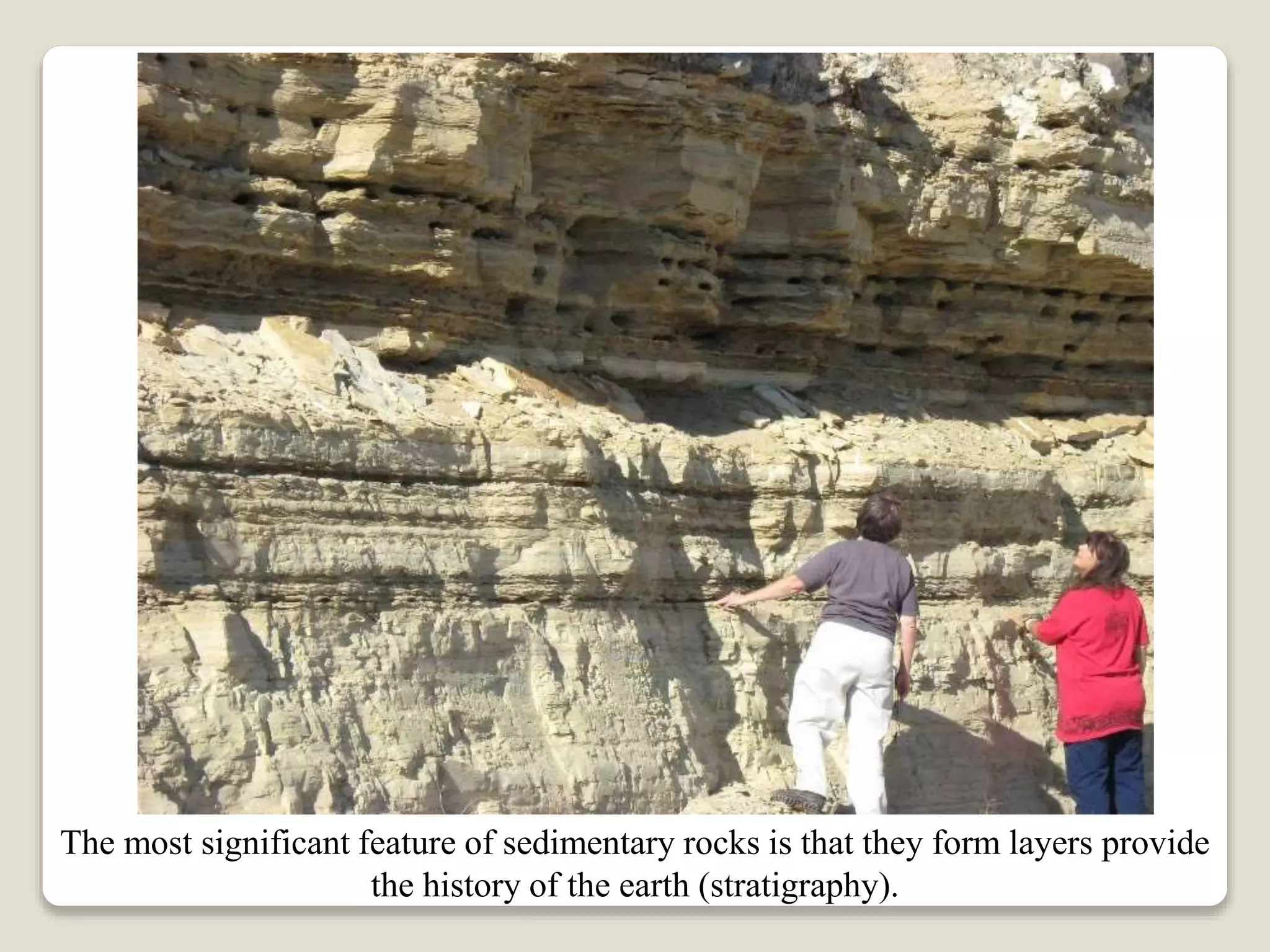
The most significant feature of sedimentary rocks is that they form layers provide
the history of the earth (stratigraphy).
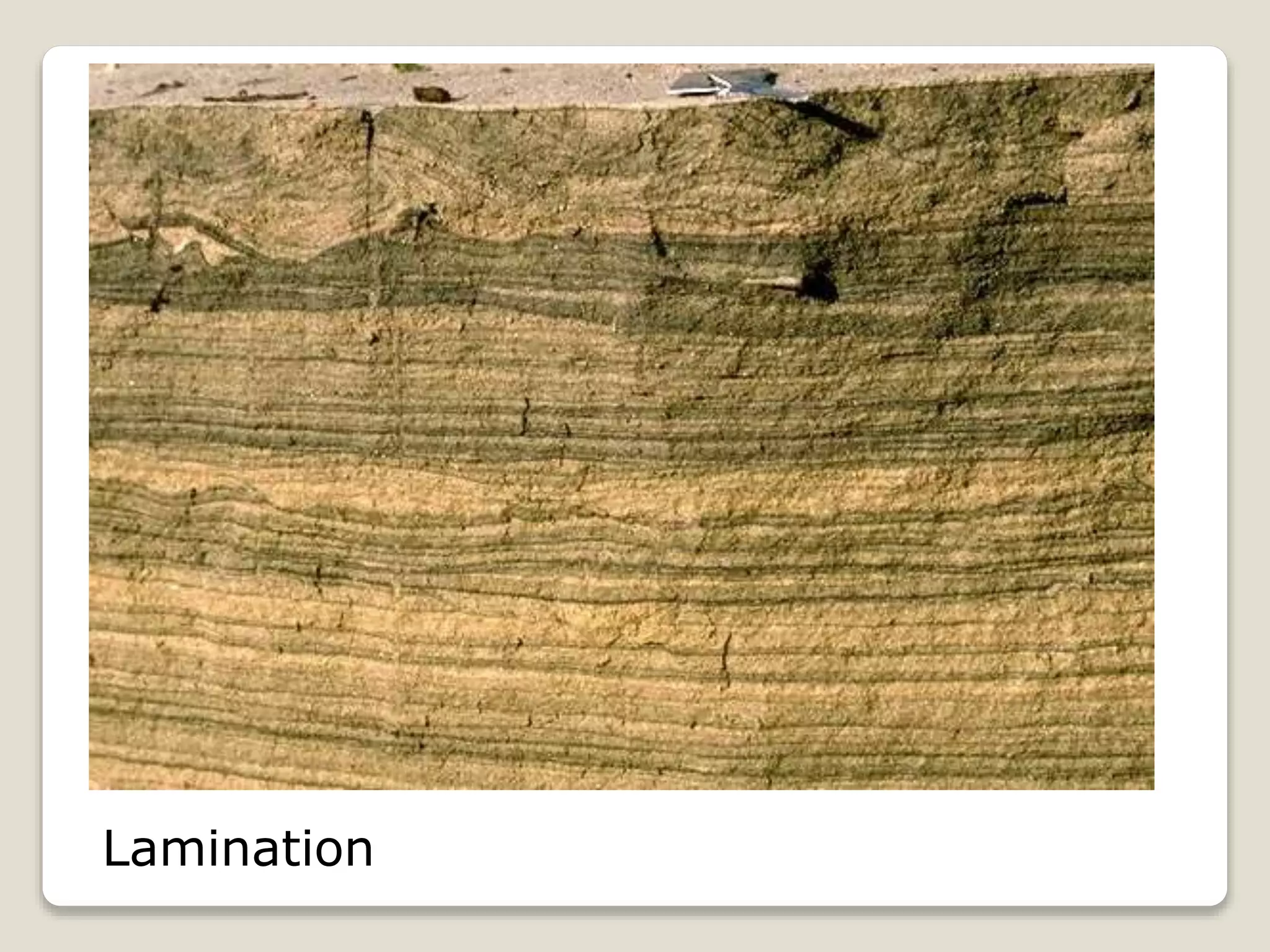
Lamination
• Planar structures of fine layers with 1 cm or less in
thickness. It is usually the result of slow deposition.
• It can be form by alteration of light and dark layers, the
changes can occur in grain size,
clay percentage, microfossil and minerals.
• Lamination can occur as parallel structures or in different
sets that make an angle with each other (cross-lamination).
• Determination of the lamination is easy on fresh surface
but difficult when the rock is massive or has been
intensely sheared.
Lamination
Cross bedding
• Are the nearly horizontal units that internally composed of
inclined layers.
• It is formed on tilted surface during deposition by crossing a
bed to another one.
• The set height is generally greater than 6 cm and the
individual cross-beds are millimeters to 1 cm or more in
thickness.
• Most of the cross-bedding is indicator to deltas, dunes and
current deposition
• The direction of motion of the cross-beds it gives the paleo
currents direction.
Types of cross bedding
Two types :
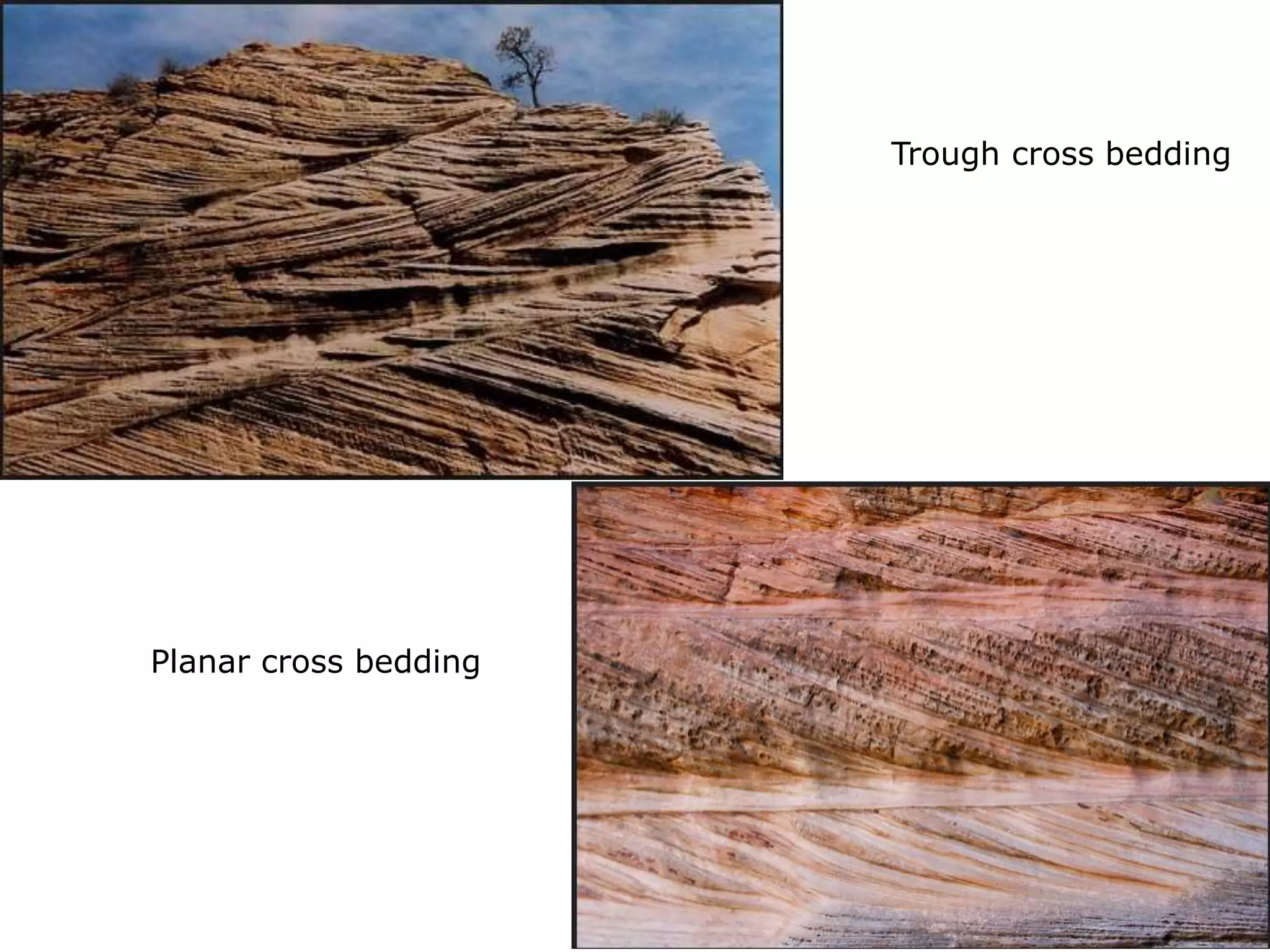
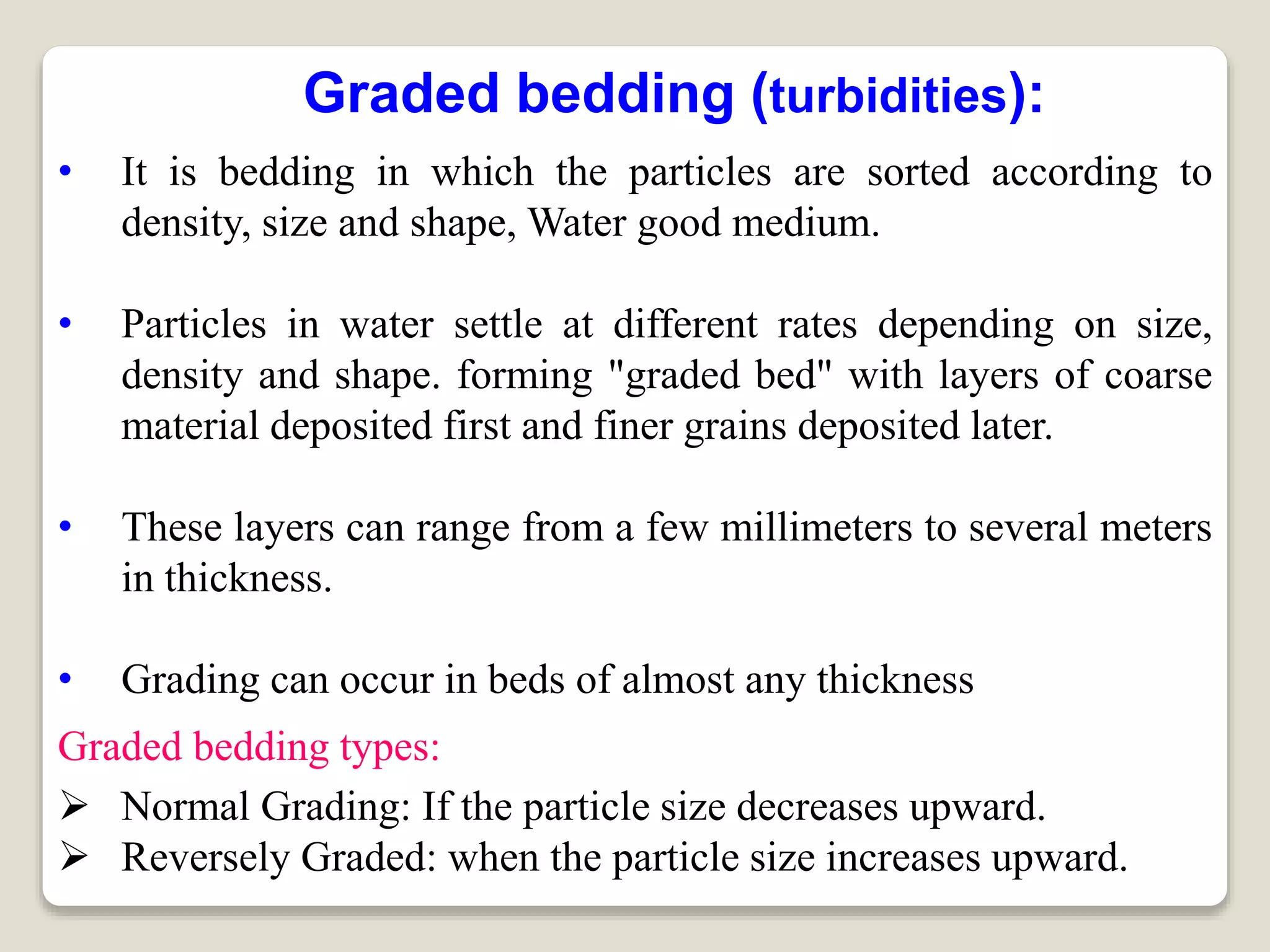
• Tabular cross-bedding, having planar bounding
surfaces.
• Trough cross-bedding, having curved bounding
surfaces.
Uses:
 The orientation of the cross-beds indicates the
paleocurrent direction.
 The style and size of cross bedding used to estimate
current velocity.
Trough cross bedding
Planar cross bedding
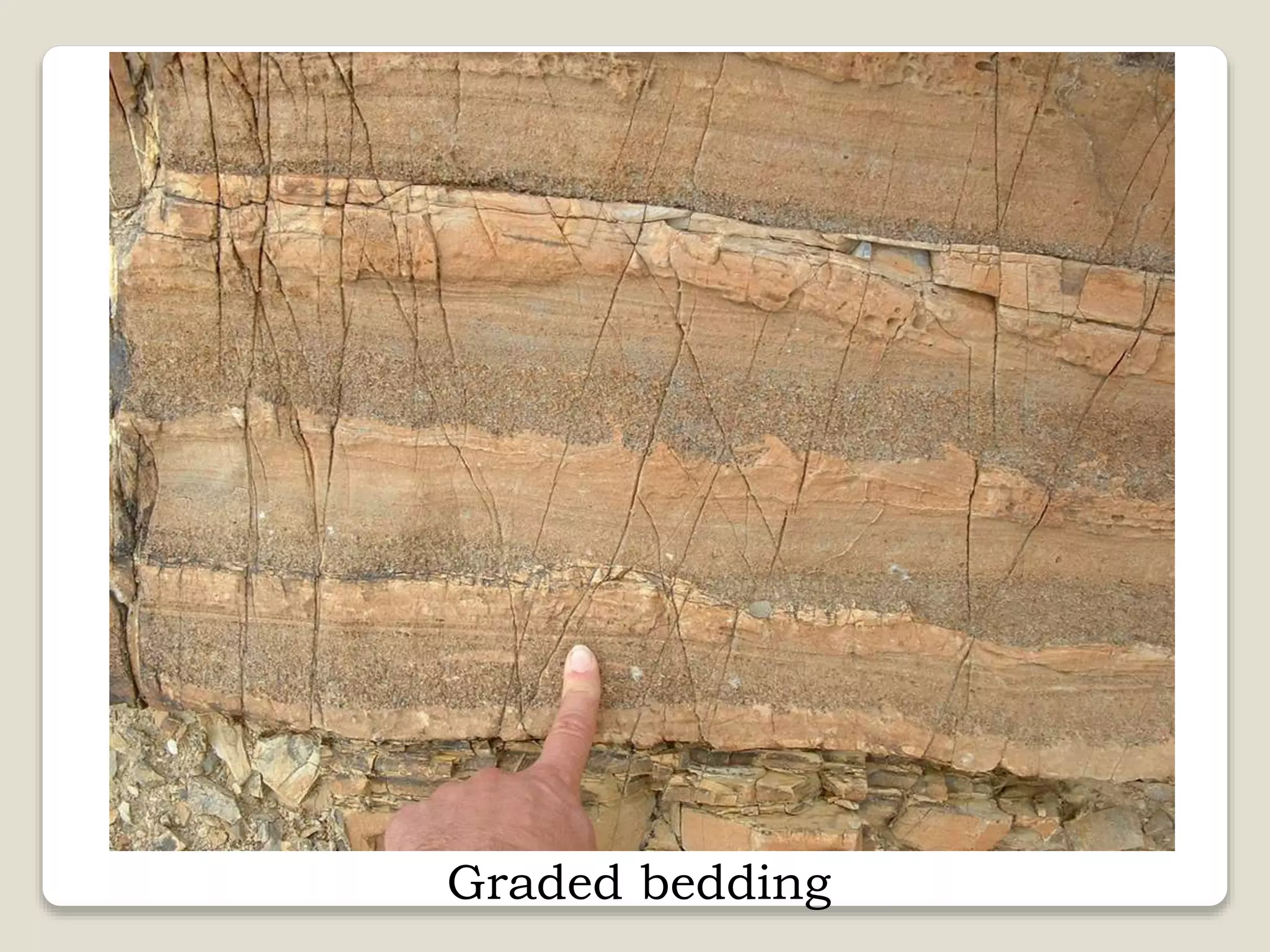
Graded bedding (turbidities):
• It is bedding in which the particles are sorted according to
density, size and shape, Water good medium.
• Particles in water settle at different rates depending on size,
density and shape. forming "graded bed" with layers of coarse
material deposited first and finer grains deposited later.
• These layers can range from a few millimeters to several meters
in thickness.
• Grading can occur in beds of almost any thickness
Graded bedding types:
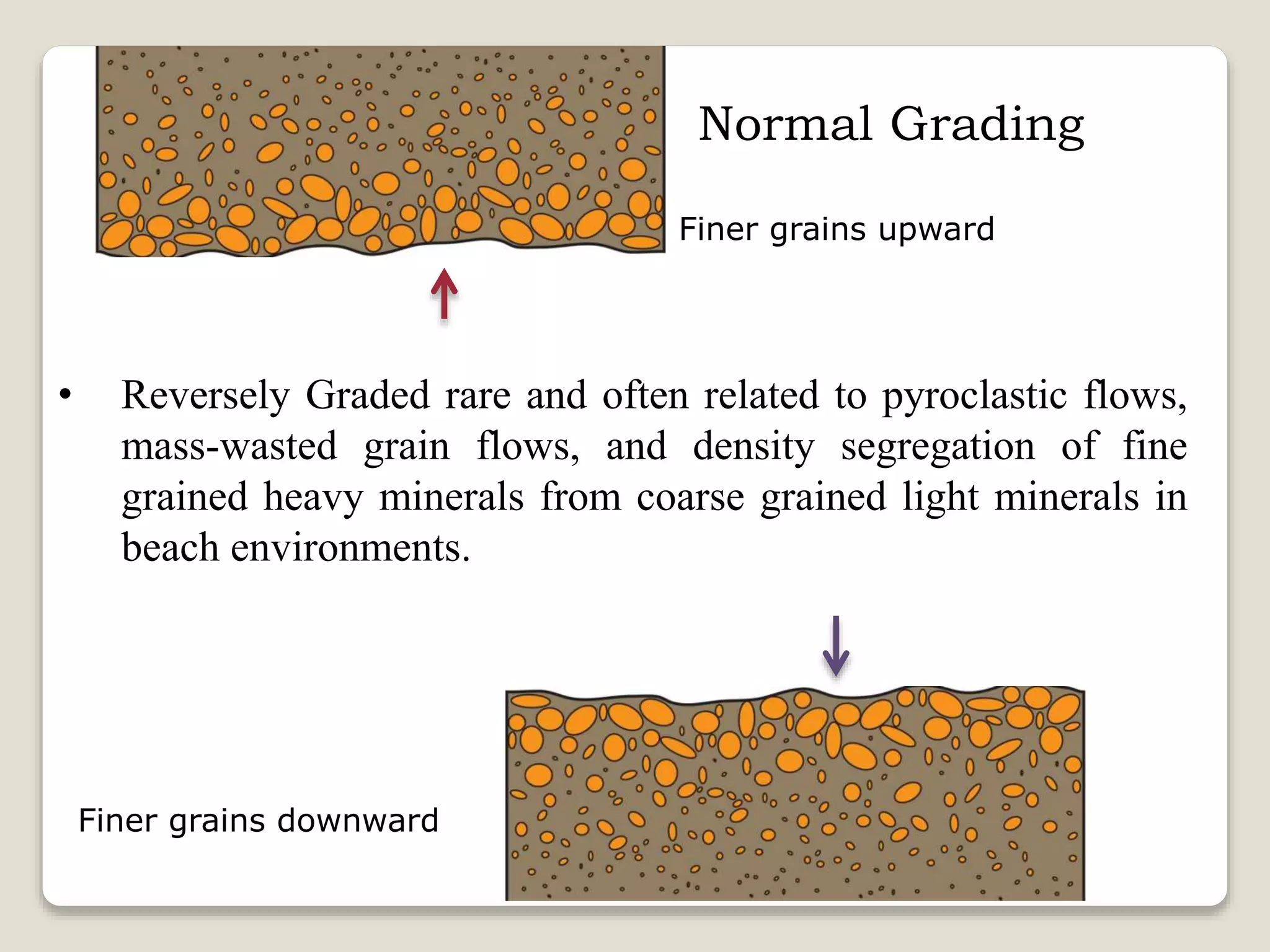
 Normal Grading: If the particle size decreases upward.
 Reversely Graded: when the particle size increases upward.
• Reversely Graded rare and often related to pyroclastic flows,
mass-wasted grain flows, and density segregation of fine
grained heavy minerals from coarse grained light minerals in
beach environments.
Finer grains downward
Finer grains upward
Normal Grading
Graded bedding
Sand Dunes
• Are ridges or hills of sand built by either wind or water flow,
different shapes ,sizes and regions: coastal and lakeshore plains
and desert.
• The origin of sand dunes is very complex, but there are three
essential prerequisites:
 An abundant supply of loose sand in a region
 A wind energy source sufficient to move the sand grains
 A topography whereby the sand particles lose their
momentum and settle out.
• The direction and velocity of winds, in addition to the local
supply of sand, result in a variety of dune shapes and sizes.
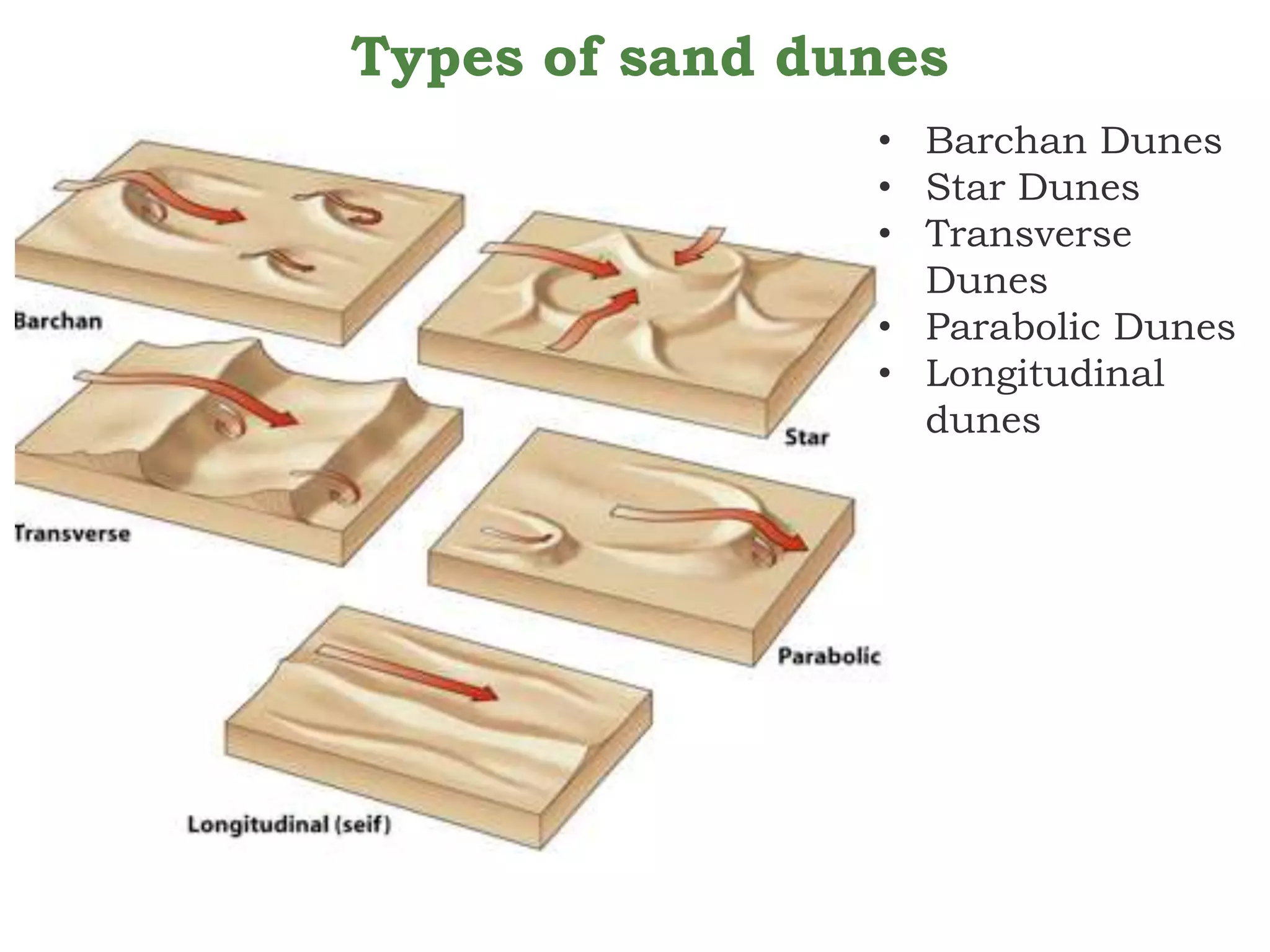
Types of sand dunes
• Barchan Dunes
• Star Dunes
• Transverse
Dunes
• Parabolic Dunes
• Longitudinal
dunes
Ripple Marks
• Are wavy features formed by wind, wave or current.
• Found in modern sedimentary environments and in the
ancient.
• Can form under unidirectional currents (shallow and
deep water) in both siliciclastic and carbonate
sediments.
Types of Ripple Marks
• Symmetrical:
They are formed by two way current, and it is not
inclined in the direction of the wave, often found on
beaches.
• Asymmetrical:
These are created by one way current by the river or
wind. It is inclined in the direction of the current. Can
develop in almost any environment river, delta, shoreline,
offshore shelf and deep sea.
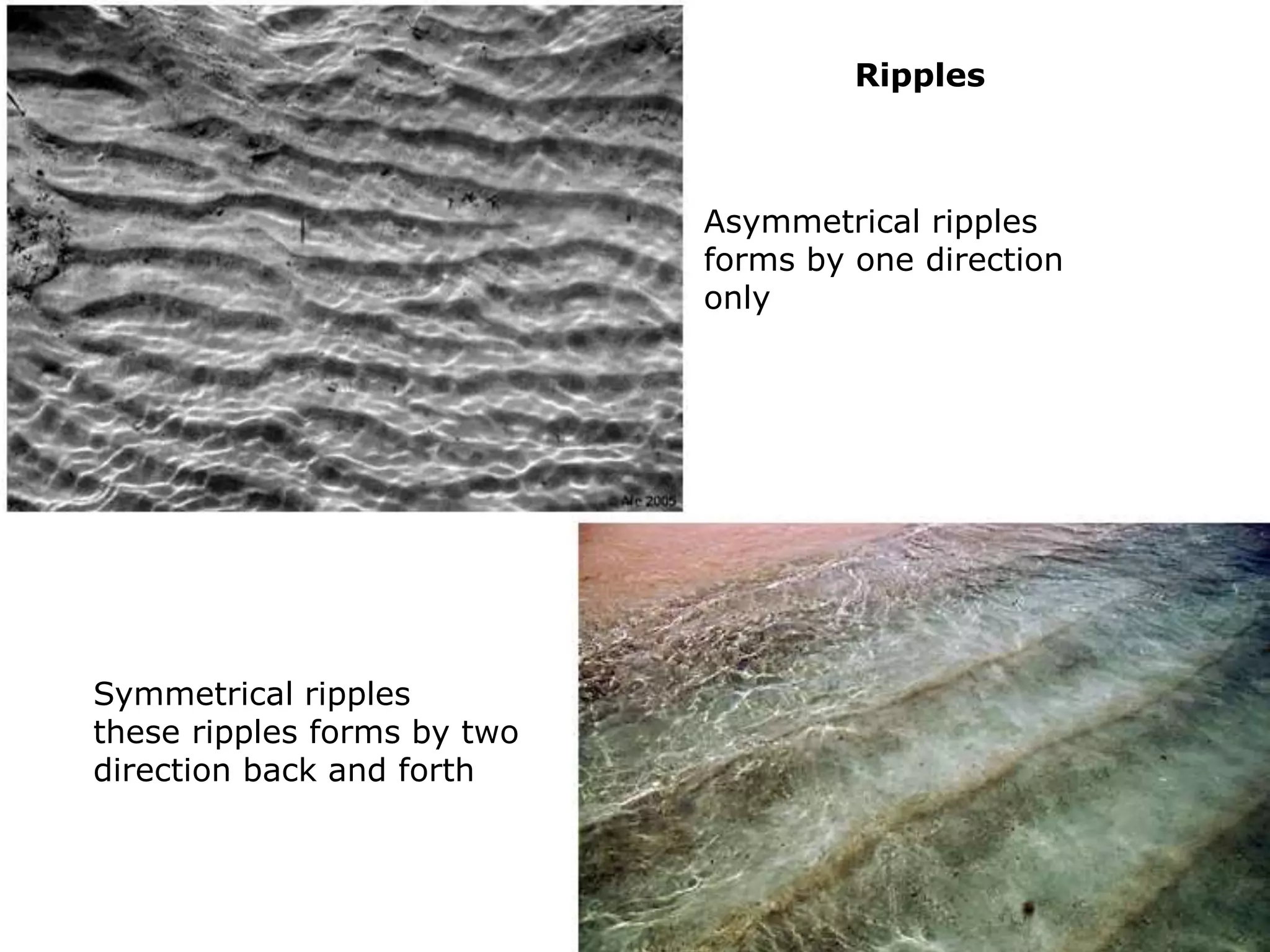
Asymmetrical ripples
forms by one direction
only
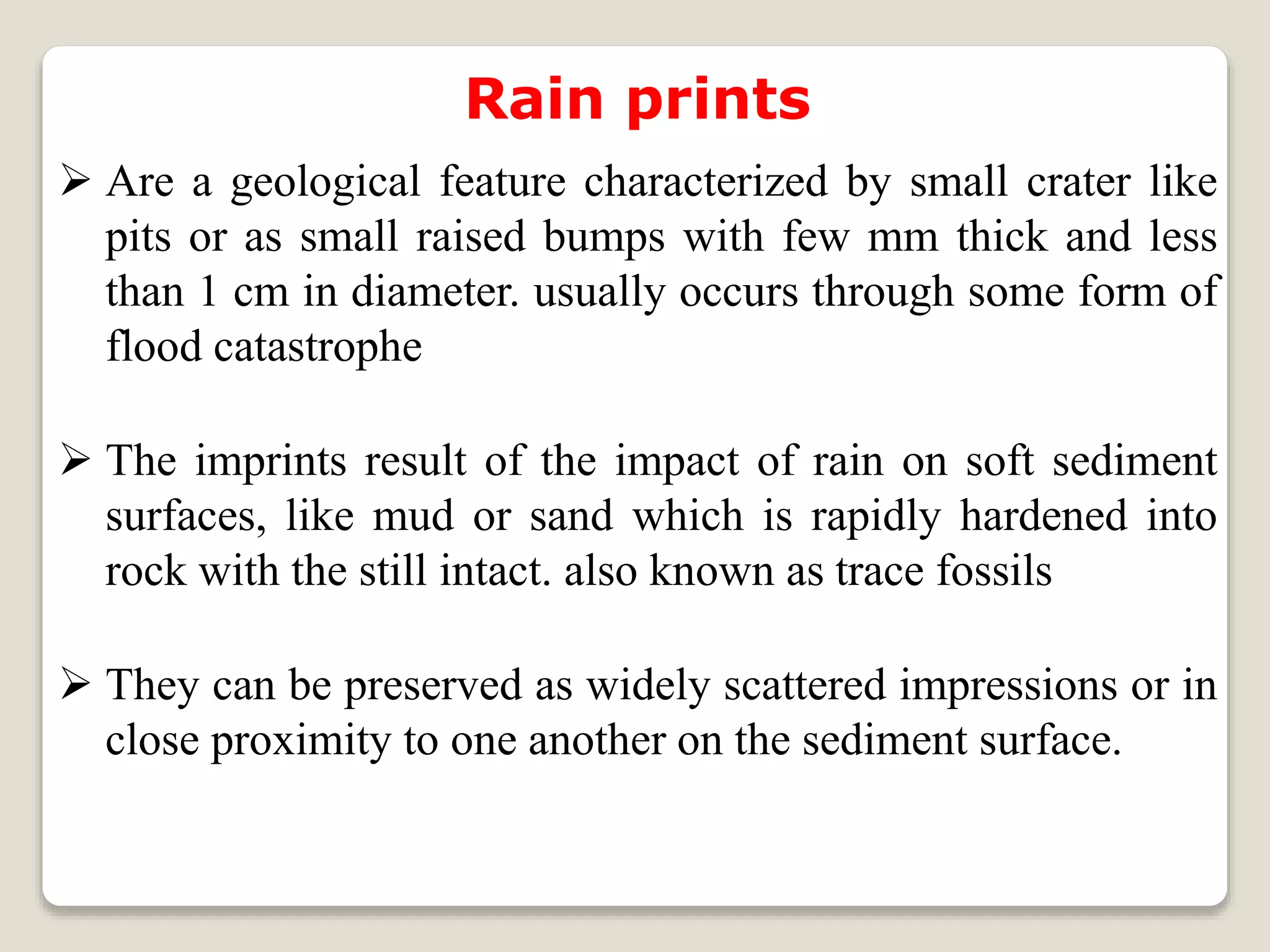
Symmetrical ripples
these ripples forms by two
direction back and forth
Ripples
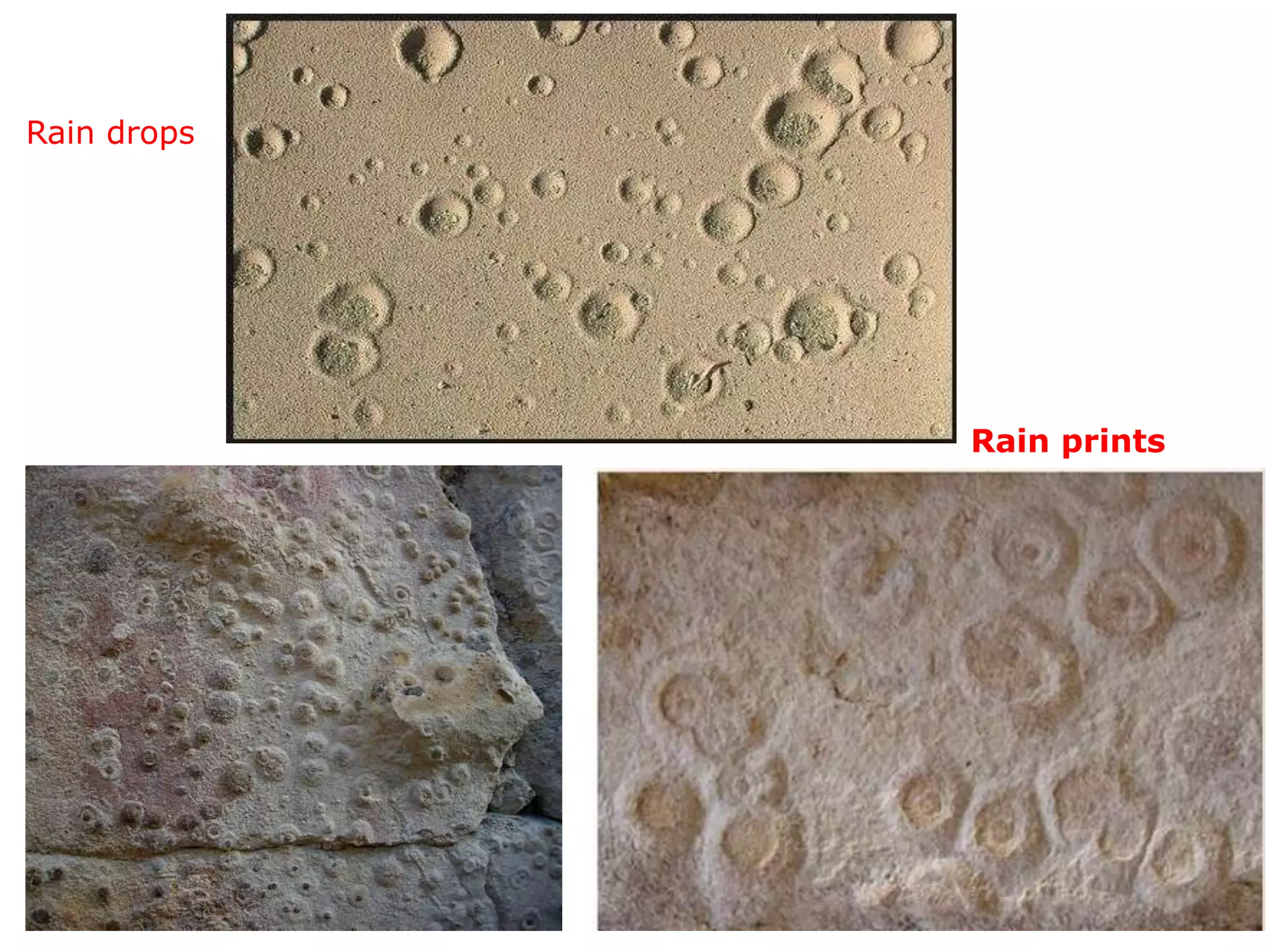
Rain prints
 Are a geological feature characterized by small crater like
pits or as small raised bumps with few mm thick and less
than 1 cm in diameter. usually occurs through some form of
flood catastrophe
 The imprints result of the impact of rain on soft sediment
surfaces, like mud or sand which is rapidly hardened into
rock with the still intact. also known as trace fossils
 They can be preserved as widely scattered impressions or in
close proximity to one another on the sediment surface.
Rain prints
Rain drops
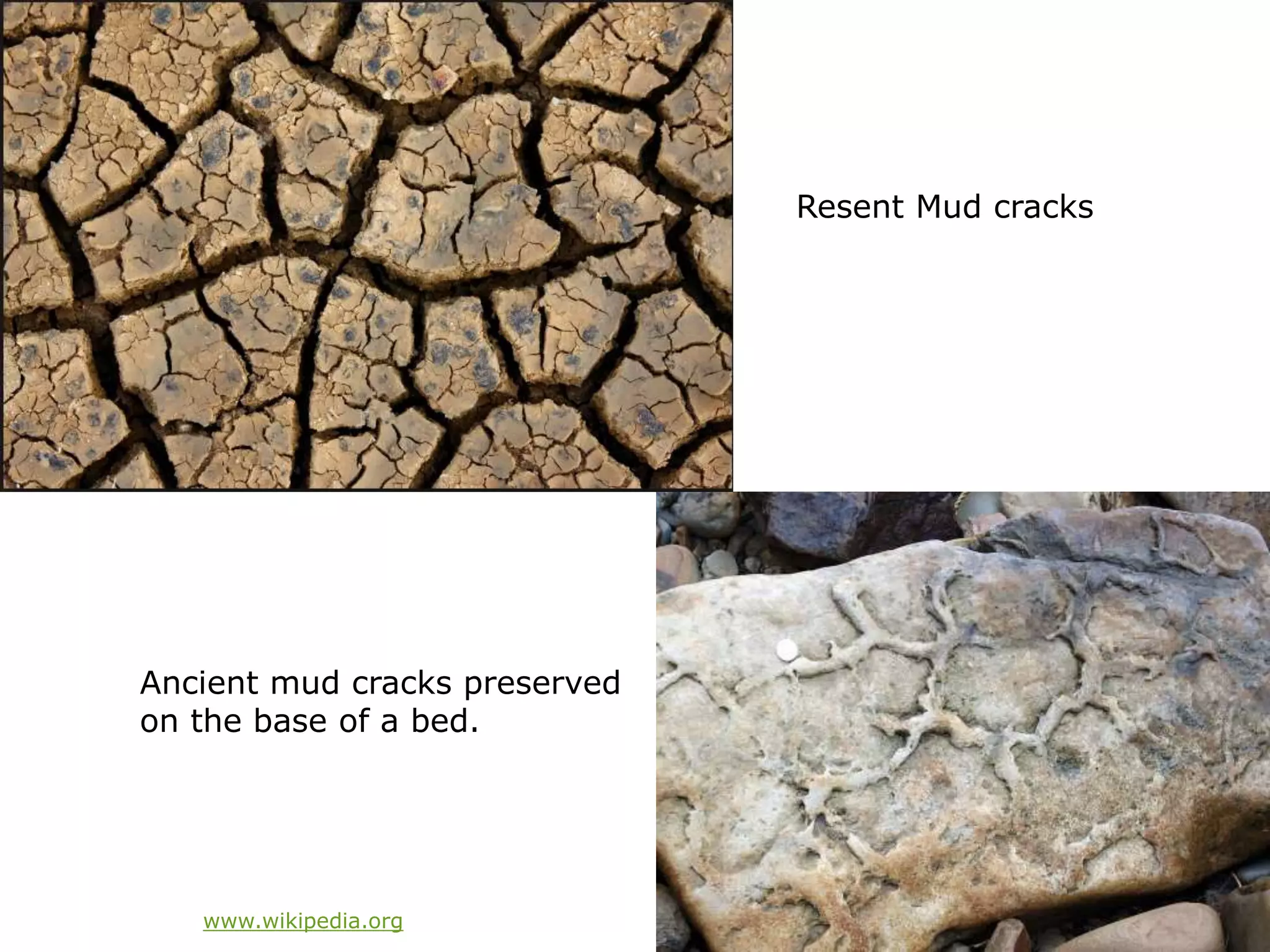
Mud cracks
• Formed as muddy sediment dries and contracts. occurs
in clayey soils as a result of a reduction in water
content. top layer tries to shrink while the material
below stays the same size.
• These cracks may later on filled by sediment and
form casts.
• When the mud cracks preserved on the top of a bed,
the cracks look as they were at the time of formation
(v-shaped) or as casts on the base of the overlying bed.
Ancient mud cracks preserved
on the base of a bed.
Resent Mud cracks
www.wikipedia.org
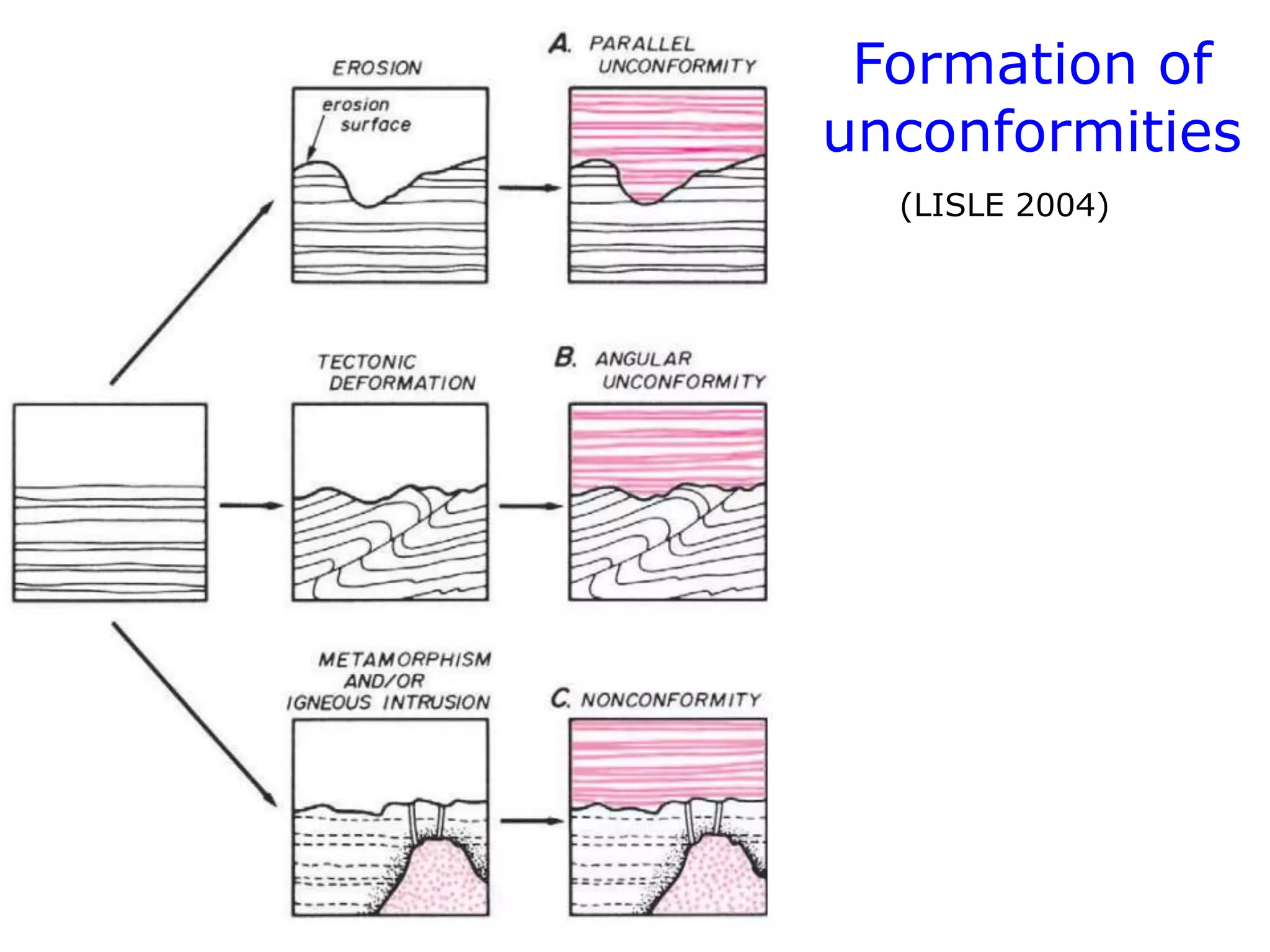
Unconformity
 An unconformity is a surface of erosion or non
deposition that separates younger strata from older ones.
It could be regional or local, indicator to long or short
time.
 The contact between two different units is known as the
surface of unconformity or plane of unconformity which
is represent a considerable length of time.
Types of unconformity
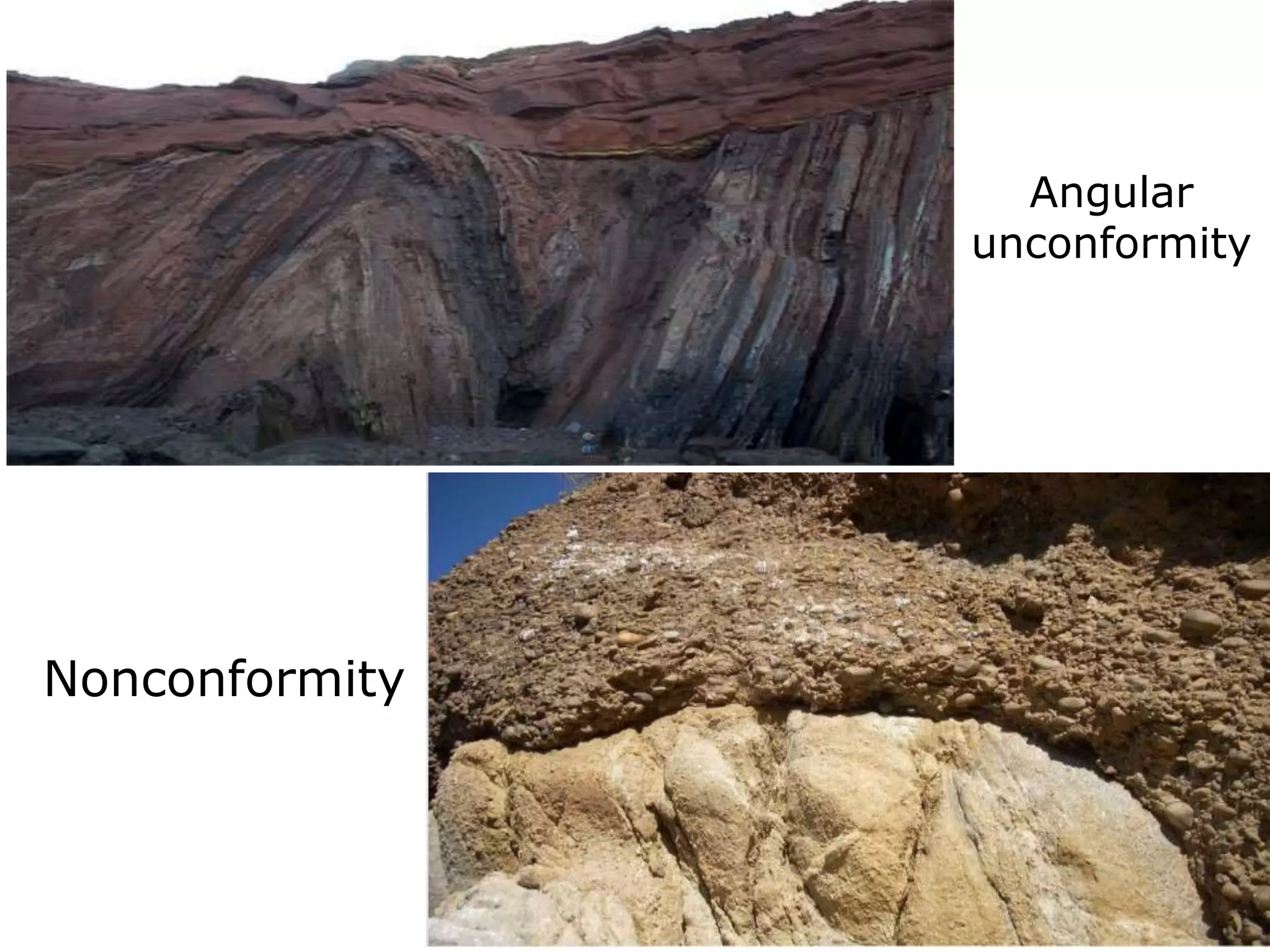
• Parallel unconformity
• Angular unconformity
• Non-conformity
Formation of
unconformities
(LISLE 2004)
Recognition of unconformity
Unconformities can be recognition by the
help of:
• Truncation,
• Gap in succession,
• Basal conglomerate,
• Discordance,
• Difference (in the degree of crystallization)
Angular
unconformity
Nonconformity
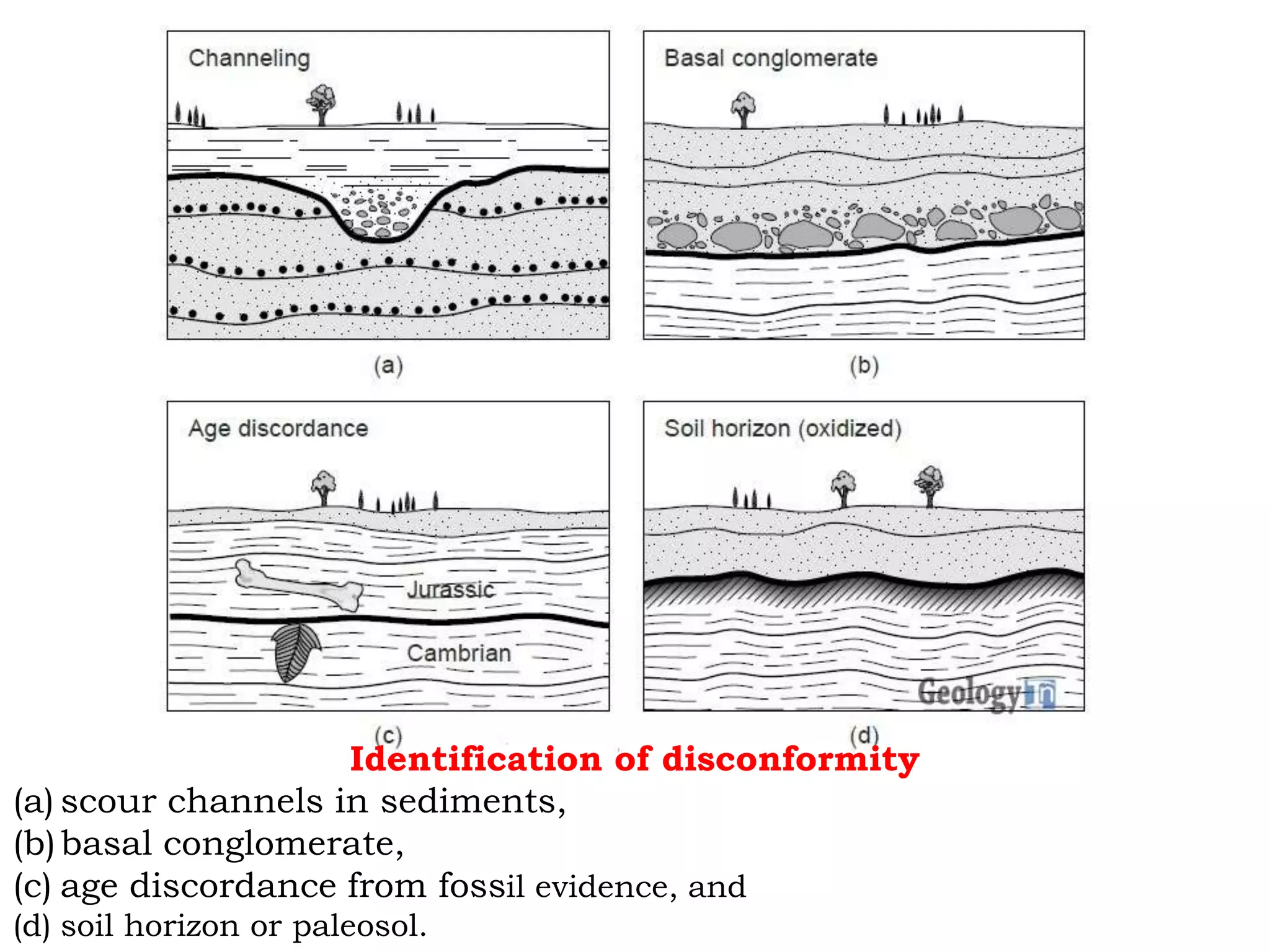
Identification of disconformity
(a) scour channels in sediments,
(b)basal conglomerate,
(c) age discordance from fossil evidence, and
(d) soil horizon or paleosol.
Igneous Rocks
Igneous structures
• The top and bottom features of igneous rocks can be
determined with respect to the reference kind of body in
which they occur.
• The rock invaded by magma is older than the intruding
material.
• The primary Structures in Igneous Rocks :
 Plutons or igneous intrusion
 layered intrusions,
 Pillows and Lava flow
 Dykes
 Sills
 Pyroclastic flow
Layered intrusions
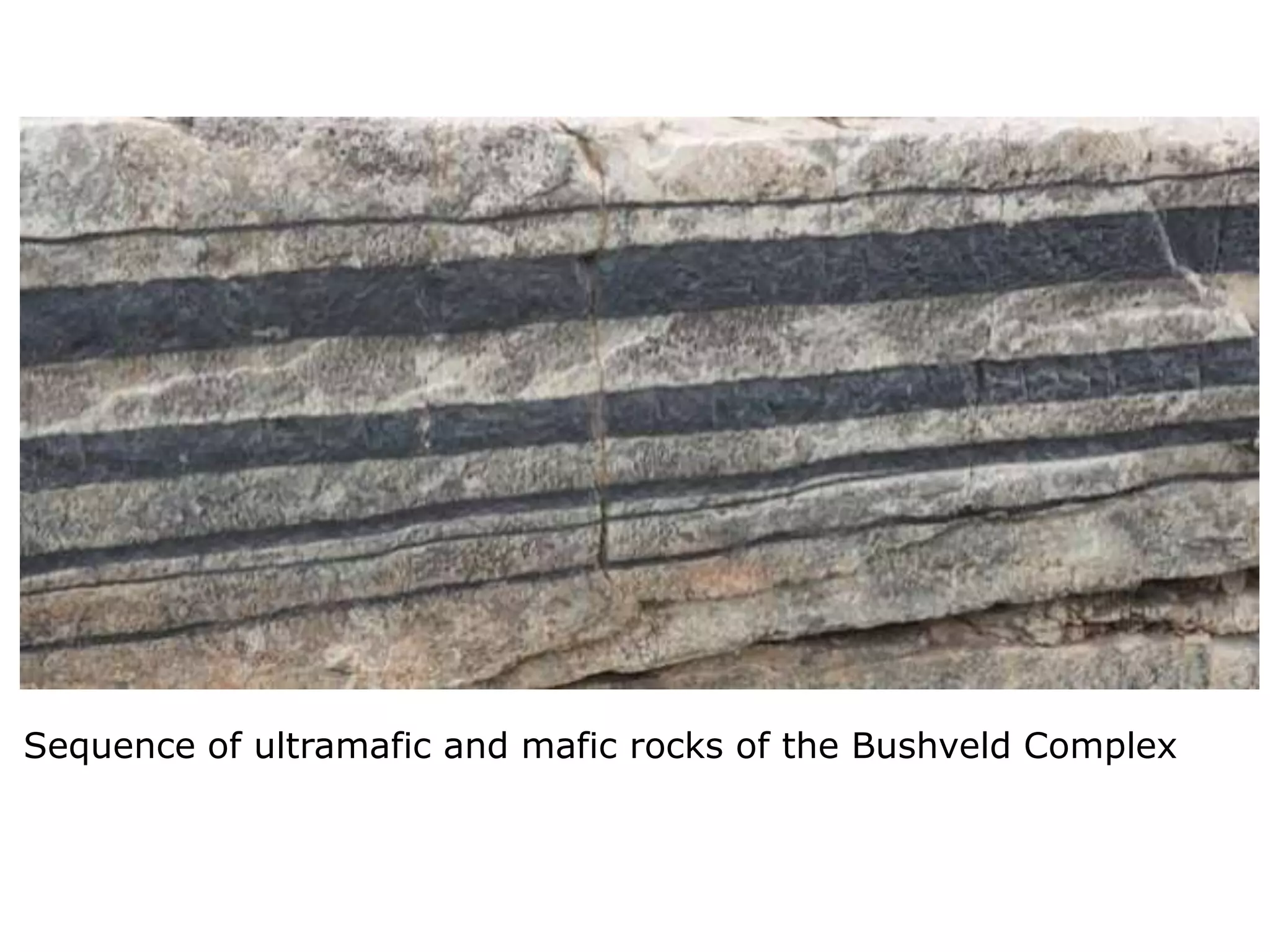
• Large layered intrusions are usually found at the graben
structure that has crystallized at depth in large magma
chambers
• The Bushveld (South Africa), Skaergaard intrusion
(Greenland)
Sequence of ultramafic and mafic rocks of the Bushveld Complex
D y k e
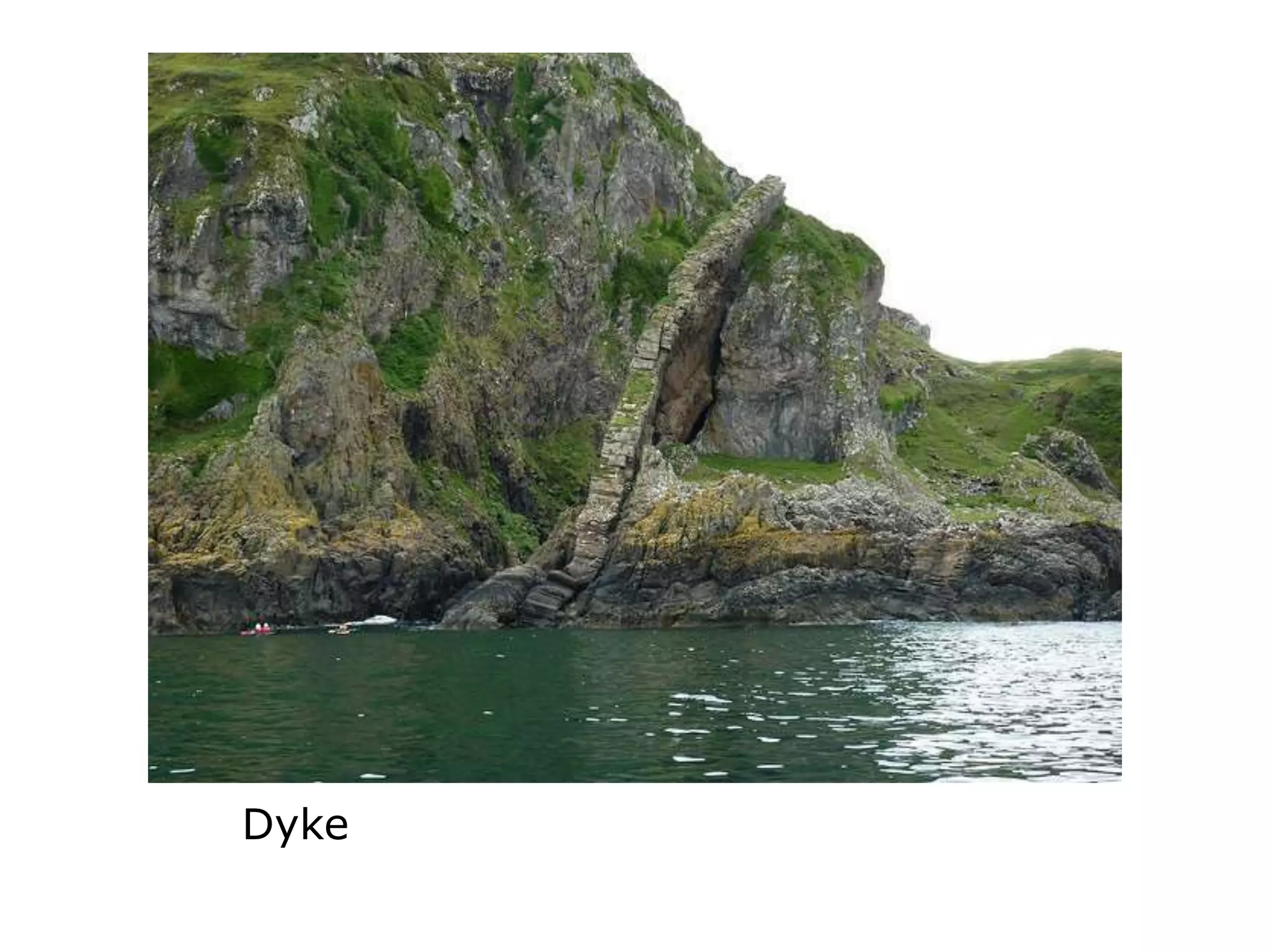
• Dyke (dike) is discordant, or cross cutting, tabular intrusion,
usually igneous in origin,
• Vertical or nearly vertical, having pushed the country rock
way and generally harder than them.
• Most dykes are under 3 m thick but often of considerable
length.
• There is often a weakness between the dyke and the
surrounding rock, when it is weather will form a trench.
• The most famous dyke is the Great Dyke of Zimbabwe
550km length.
Dyke
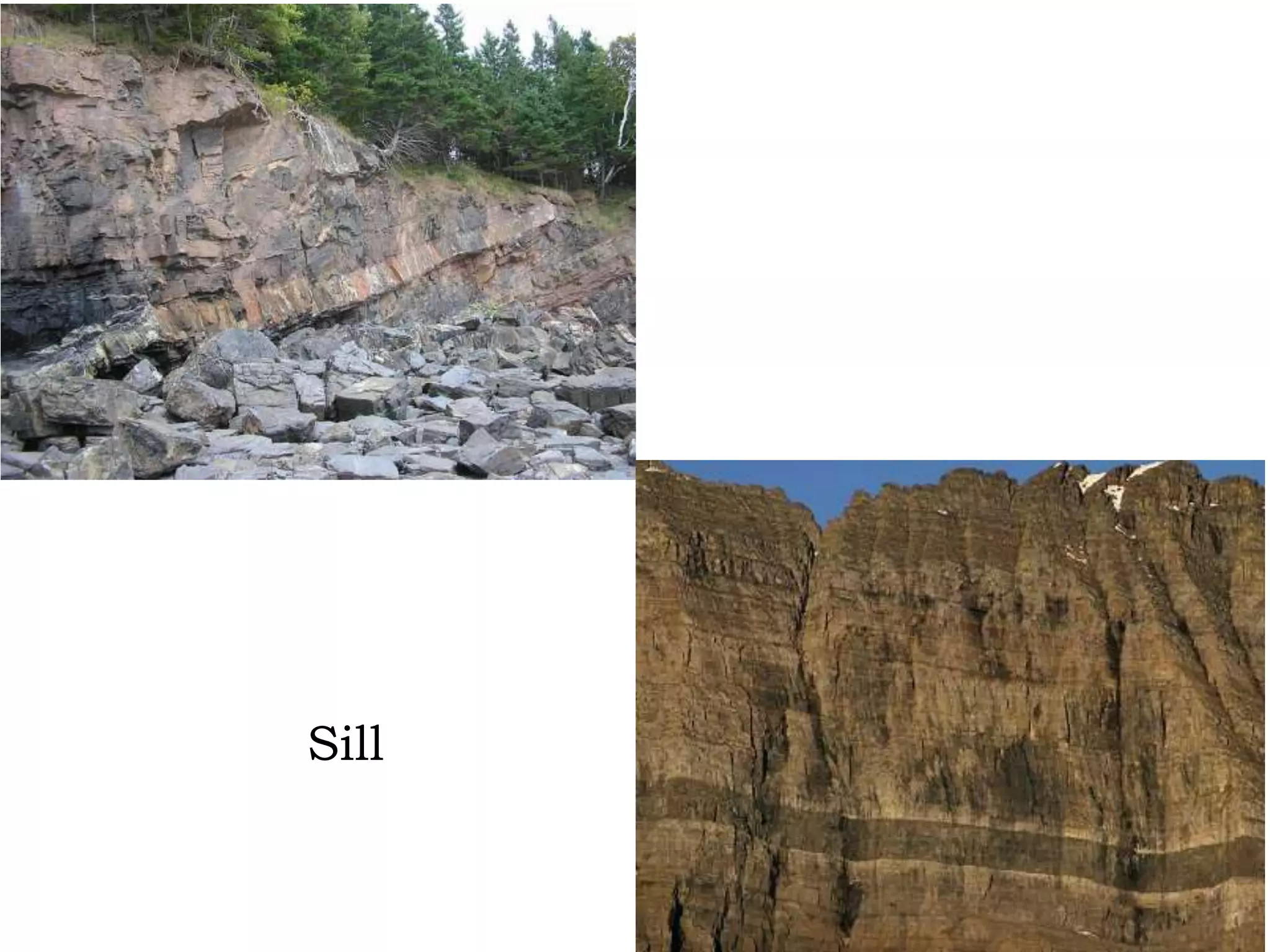
Sills
• Sills also called sheet, flat intrusion of igneous rock that
forms between preexisting layers of rock. generally
concordant with the bedding planes of the surrounding rocks
• The most common sills are horizontal orientations, basic
compositions, vary in thickness from a meter or less to ~10
m.
• Sills can be subdivided on the basis of the number of
intrusions that have formed them and the variability of
the rock types involved.
• A simple sill is the product of a single intrusion, whereas a
multiple sill is formed by two or more intrusions.
Sill
Lava flow
• A stream of magma discharged on to the ground surface from a
volcanic vent or fissure. It can be from single flow or multiple.
• Lava flow is very useful for determine the top and bottom
especially for single flow.
• Since lava vary in thickness, viscosity and composition, the
features and structures formed in them are variable.
• The speed at which lava moves across the ground depends on
several factors
(1) Type of lava erupted and its viscosity;
(2) Steepness of the ground over which it travels
(3) Whether it is flows through a confined channel, or down
a lava tube
(4) Rate of lava production at the vent.
Types of lava
Acidic, intermediate and basic
Basaltic Lavas, particularly, come into three Types: pahoehoe
,aa and pillow lava
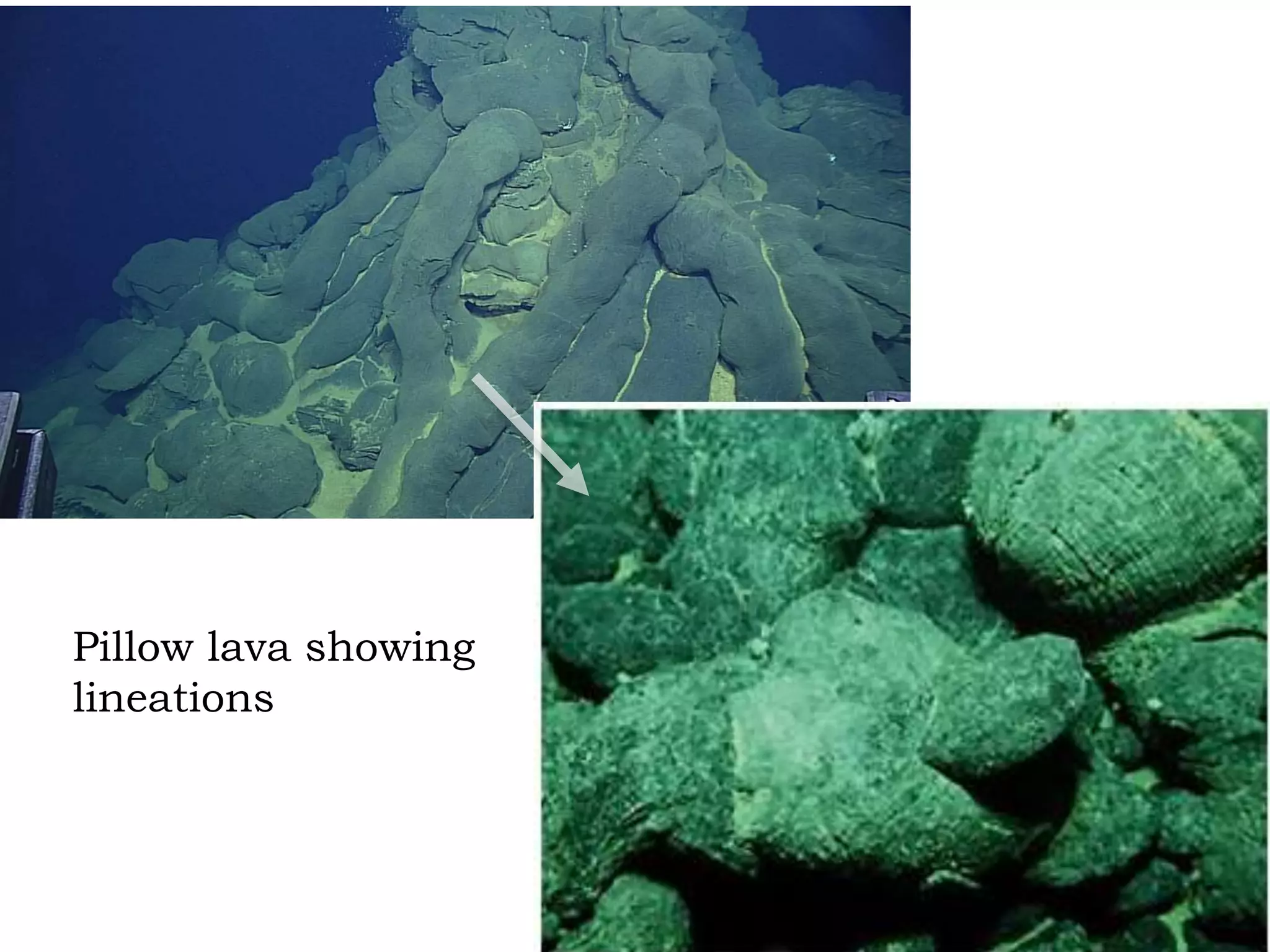
• The pillow lava contain pillow-shaped forming under water,
Pillows often have lineations or scrape marks on their sides
that form during extrusion.
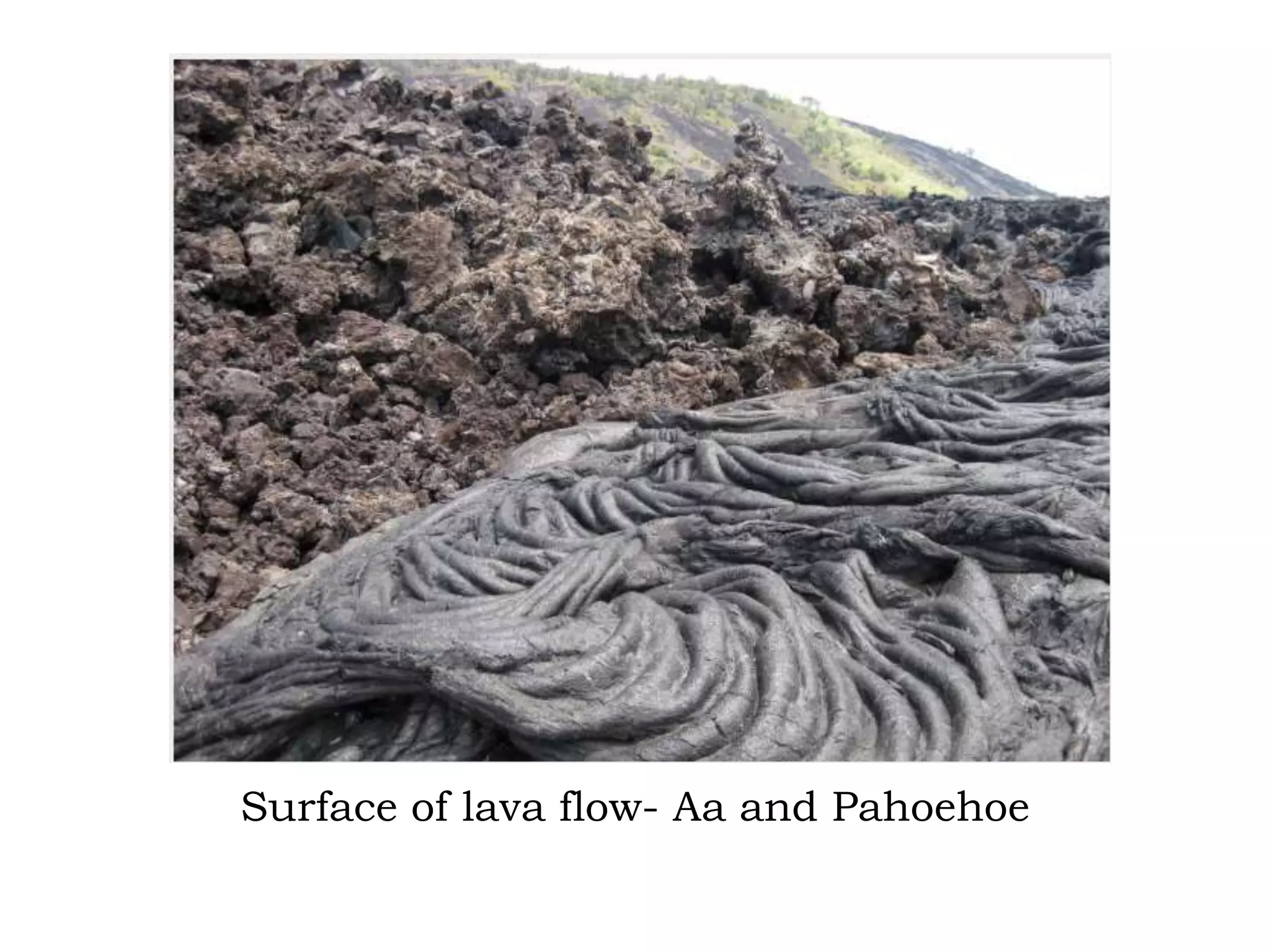
• The pahoehoe flow has a comparatively smooth or "ropy"
surface, forms when lava flows more slowly.
• The surface of the aa flow consists of free chunks of very
angular pieces of lava, forms when lava flows rapidly
forming very rough surface.
Surface of lava flow- Aa and Pahoehoe
Pillow lava showing
lineations
Pyroclastic Flows
• Pyroclastic flows are fluidized masses of rock
fragments and gases that move rapidly in response to
gravity.
• Pyroclastic flows forms by several ways.
 When an eruption column collapses,
 As the result of gravitational collapse
 Explosion on a lava dome or lava flow (Francis,
1993 and Scott, 1989).
• The large size of the fragments within the welded rock
that indicator the closeness from volcanic vent.
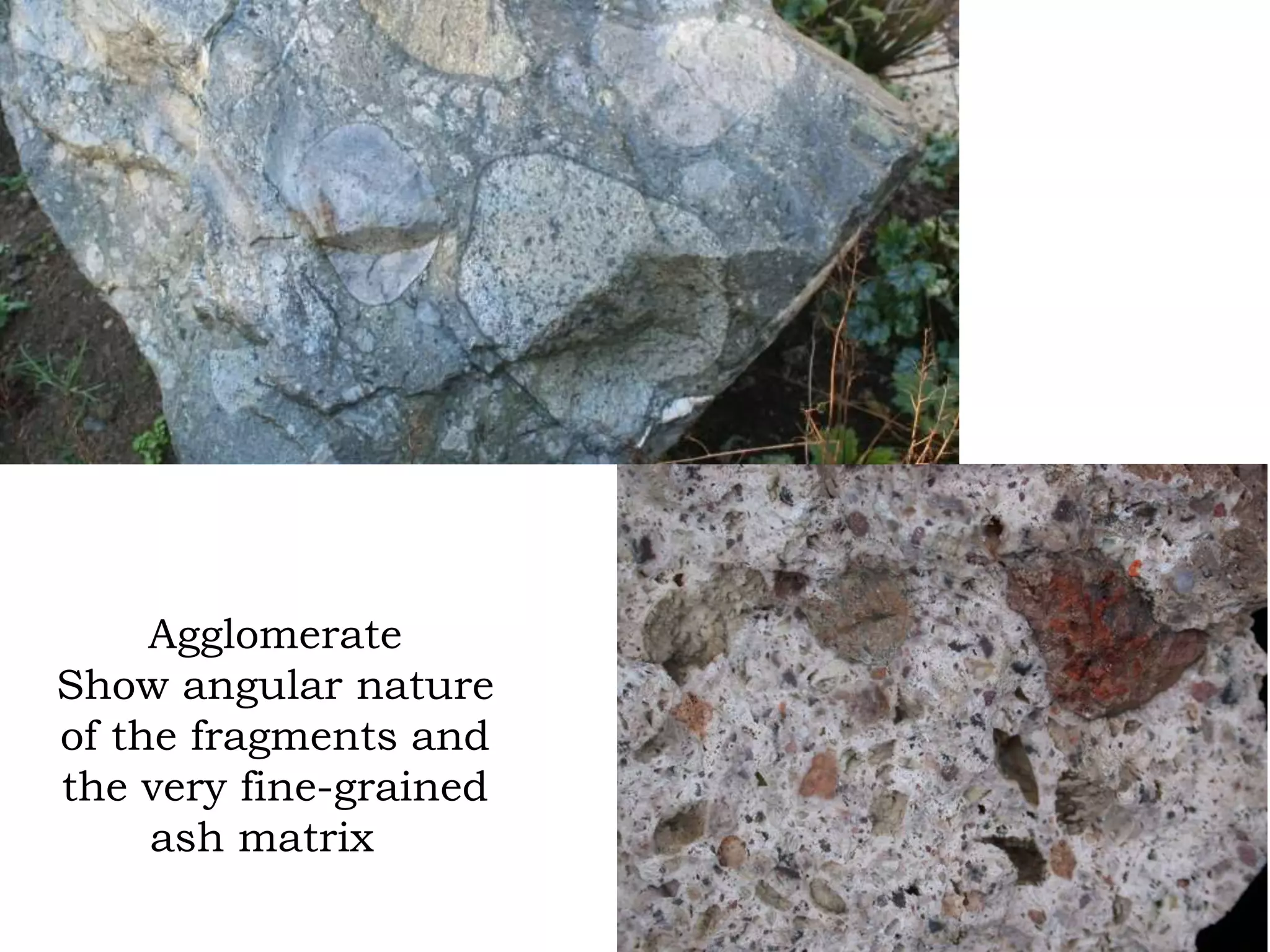
Agglomerate
Show angular nature
of the fragments and
the very fine-grained
ash matrix
References
• R. Shrock Robert (1948), Sequence in layered rocks, McCraw-Hill Book
Company, Inc, 507P.
• G. Dennis Johan (1974), Structural geology, The Ronald press company, 532P.
• GHOSH, S.K (1993), Structural geology, Great Britan, BPPC, Wheatons Ltd,
Exeter, 598P.
• LISLE, R. J (2004), Geological Structures and Maps, a practical guide, Third
edition, Elsevier Butterworth-Heinemann Linacre House, Jordan Hill, Oxford,
106P.
Thank yo
omerupto3@gmail.com

Primary structures of sedimentary and igneous rocks

  • 1.
    Primary structures Omer M. Ahmed MSc2016 University of Kerala, India
  • 2.
    Introduction • Structural geologyis study of the three dimensional of the rock units with respect to their deformational histories. • Structure is spatial and geometrical configuration of rock components. • Structures are classified into two types: ►►Primary structures. ►►Secondary structures
  • 3.
    Primary structures Structures thatform during deposition or crystallization of the rock, are the result of two processes: 1) Settling of solid particles from fluid medium in which they have been suspended, in most of the sedimentary rocks. 2) Crystallization of mineral grains from a liquid in which they have been dissolved as in igneous rocks.
  • 4.
  • 5.
    The most importantsedimentary primary structures  Bedding  Lamination  Cross-bedding  Graded bedding  Sand dunes  Ripples marks  Rain prints  Mud cracks  Unconformities
  • 6.
    Bedding • It isa planer arrangement of particles which can be easily distinguished by difference in color, composition or texture. • They may be only a few cm in thickness or may be up to several meters. • They form in all sedimentary environments under different conditions. • Bedding formed by slow process (suspension) or by rapid process such as during high flows or floods of rivers, seasons of strong wind in a desert, certain parts of the tide cycle in shallow marine environments.
  • 7.
    • The boundariesbetween beds are called contacts, which can be depositional, erosional, or structural. • Bedding is labeled as S0; • Bedding thickness less than 1 cm: Laminae 10 cm–1m: Moderate beds Greater than 1 m: Thick beds Massive: No beds apparent, over several m of exposure
  • 8.
    The most significantfeature of sedimentary rocks is that they form layers provide the history of the earth (stratigraphy).
  • 9.
    Lamination • Planar structuresof fine layers with 1 cm or less in thickness. It is usually the result of slow deposition. • It can be form by alteration of light and dark layers, the changes can occur in grain size, clay percentage, microfossil and minerals. • Lamination can occur as parallel structures or in different sets that make an angle with each other (cross-lamination). • Determination of the lamination is easy on fresh surface but difficult when the rock is massive or has been intensely sheared.
  • 10.
  • 11.
    Cross bedding • Arethe nearly horizontal units that internally composed of inclined layers. • It is formed on tilted surface during deposition by crossing a bed to another one. • The set height is generally greater than 6 cm and the individual cross-beds are millimeters to 1 cm or more in thickness. • Most of the cross-bedding is indicator to deltas, dunes and current deposition • The direction of motion of the cross-beds it gives the paleo currents direction.
  • 12.
    Types of crossbedding Two types : • Tabular cross-bedding, having planar bounding surfaces. • Trough cross-bedding, having curved bounding surfaces. Uses:  The orientation of the cross-beds indicates the paleocurrent direction.  The style and size of cross bedding used to estimate current velocity.
  • 13.
  • 14.
    Graded bedding (turbidities): •It is bedding in which the particles are sorted according to density, size and shape, Water good medium. • Particles in water settle at different rates depending on size, density and shape. forming "graded bed" with layers of coarse material deposited first and finer grains deposited later. • These layers can range from a few millimeters to several meters in thickness. • Grading can occur in beds of almost any thickness Graded bedding types:  Normal Grading: If the particle size decreases upward.  Reversely Graded: when the particle size increases upward.
  • 15.
    • Reversely Gradedrare and often related to pyroclastic flows, mass-wasted grain flows, and density segregation of fine grained heavy minerals from coarse grained light minerals in beach environments. Finer grains downward Finer grains upward Normal Grading
  • 16.
  • 17.
    Sand Dunes • Areridges or hills of sand built by either wind or water flow, different shapes ,sizes and regions: coastal and lakeshore plains and desert. • The origin of sand dunes is very complex, but there are three essential prerequisites:  An abundant supply of loose sand in a region  A wind energy source sufficient to move the sand grains  A topography whereby the sand particles lose their momentum and settle out. • The direction and velocity of winds, in addition to the local supply of sand, result in a variety of dune shapes and sizes.
  • 18.
    Types of sanddunes • Barchan Dunes • Star Dunes • Transverse Dunes • Parabolic Dunes • Longitudinal dunes
  • 19.
    Ripple Marks • Arewavy features formed by wind, wave or current. • Found in modern sedimentary environments and in the ancient. • Can form under unidirectional currents (shallow and deep water) in both siliciclastic and carbonate sediments.
  • 20.
    Types of RippleMarks • Symmetrical: They are formed by two way current, and it is not inclined in the direction of the wave, often found on beaches. • Asymmetrical: These are created by one way current by the river or wind. It is inclined in the direction of the current. Can develop in almost any environment river, delta, shoreline, offshore shelf and deep sea.
  • 21.
    Asymmetrical ripples forms byone direction only Symmetrical ripples these ripples forms by two direction back and forth Ripples
  • 22.
    Rain prints  Area geological feature characterized by small crater like pits or as small raised bumps with few mm thick and less than 1 cm in diameter. usually occurs through some form of flood catastrophe  The imprints result of the impact of rain on soft sediment surfaces, like mud or sand which is rapidly hardened into rock with the still intact. also known as trace fossils  They can be preserved as widely scattered impressions or in close proximity to one another on the sediment surface.
  • 23.
  • 24.
    Mud cracks • Formedas muddy sediment dries and contracts. occurs in clayey soils as a result of a reduction in water content. top layer tries to shrink while the material below stays the same size. • These cracks may later on filled by sediment and form casts. • When the mud cracks preserved on the top of a bed, the cracks look as they were at the time of formation (v-shaped) or as casts on the base of the overlying bed.
  • 25.
    Ancient mud crackspreserved on the base of a bed. Resent Mud cracks www.wikipedia.org
  • 26.
    Unconformity  An unconformityis a surface of erosion or non deposition that separates younger strata from older ones. It could be regional or local, indicator to long or short time.  The contact between two different units is known as the surface of unconformity or plane of unconformity which is represent a considerable length of time. Types of unconformity • Parallel unconformity • Angular unconformity • Non-conformity
  • 27.
  • 28.
    Recognition of unconformity Unconformitiescan be recognition by the help of: • Truncation, • Gap in succession, • Basal conglomerate, • Discordance, • Difference (in the degree of crystallization)
  • 29.
  • 30.
    Identification of disconformity (a)scour channels in sediments, (b)basal conglomerate, (c) age discordance from fossil evidence, and (d) soil horizon or paleosol.
  • 31.
  • 32.
    Igneous structures • Thetop and bottom features of igneous rocks can be determined with respect to the reference kind of body in which they occur. • The rock invaded by magma is older than the intruding material. • The primary Structures in Igneous Rocks :  Plutons or igneous intrusion  layered intrusions,  Pillows and Lava flow  Dykes  Sills  Pyroclastic flow
  • 33.
    Layered intrusions • Largelayered intrusions are usually found at the graben structure that has crystallized at depth in large magma chambers • The Bushveld (South Africa), Skaergaard intrusion (Greenland)
  • 34.
    Sequence of ultramaficand mafic rocks of the Bushveld Complex
  • 35.
    D y ke • Dyke (dike) is discordant, or cross cutting, tabular intrusion, usually igneous in origin, • Vertical or nearly vertical, having pushed the country rock way and generally harder than them. • Most dykes are under 3 m thick but often of considerable length. • There is often a weakness between the dyke and the surrounding rock, when it is weather will form a trench. • The most famous dyke is the Great Dyke of Zimbabwe 550km length.
  • 36.
  • 37.
    Sills • Sills alsocalled sheet, flat intrusion of igneous rock that forms between preexisting layers of rock. generally concordant with the bedding planes of the surrounding rocks • The most common sills are horizontal orientations, basic compositions, vary in thickness from a meter or less to ~10 m. • Sills can be subdivided on the basis of the number of intrusions that have formed them and the variability of the rock types involved. • A simple sill is the product of a single intrusion, whereas a multiple sill is formed by two or more intrusions.
  • 38.
  • 39.
    Lava flow • Astream of magma discharged on to the ground surface from a volcanic vent or fissure. It can be from single flow or multiple. • Lava flow is very useful for determine the top and bottom especially for single flow. • Since lava vary in thickness, viscosity and composition, the features and structures formed in them are variable. • The speed at which lava moves across the ground depends on several factors (1) Type of lava erupted and its viscosity; (2) Steepness of the ground over which it travels (3) Whether it is flows through a confined channel, or down a lava tube (4) Rate of lava production at the vent.
  • 40.
    Types of lava Acidic,intermediate and basic Basaltic Lavas, particularly, come into three Types: pahoehoe ,aa and pillow lava • The pillow lava contain pillow-shaped forming under water, Pillows often have lineations or scrape marks on their sides that form during extrusion. • The pahoehoe flow has a comparatively smooth or "ropy" surface, forms when lava flows more slowly. • The surface of the aa flow consists of free chunks of very angular pieces of lava, forms when lava flows rapidly forming very rough surface.
  • 41.
    Surface of lavaflow- Aa and Pahoehoe
  • 42.
  • 43.
    Pyroclastic Flows • Pyroclasticflows are fluidized masses of rock fragments and gases that move rapidly in response to gravity. • Pyroclastic flows forms by several ways.  When an eruption column collapses,  As the result of gravitational collapse  Explosion on a lava dome or lava flow (Francis, 1993 and Scott, 1989). • The large size of the fragments within the welded rock that indicator the closeness from volcanic vent.
  • 44.
    Agglomerate Show angular nature ofthe fragments and the very fine-grained ash matrix
  • 45.
    References • R. ShrockRobert (1948), Sequence in layered rocks, McCraw-Hill Book Company, Inc, 507P. • G. Dennis Johan (1974), Structural geology, The Ronald press company, 532P. • GHOSH, S.K (1993), Structural geology, Great Britan, BPPC, Wheatons Ltd, Exeter, 598P. • LISLE, R. J (2004), Geological Structures and Maps, a practical guide, Third edition, Elsevier Butterworth-Heinemann Linacre House, Jordan Hill, Oxford, 106P.
  • 46.