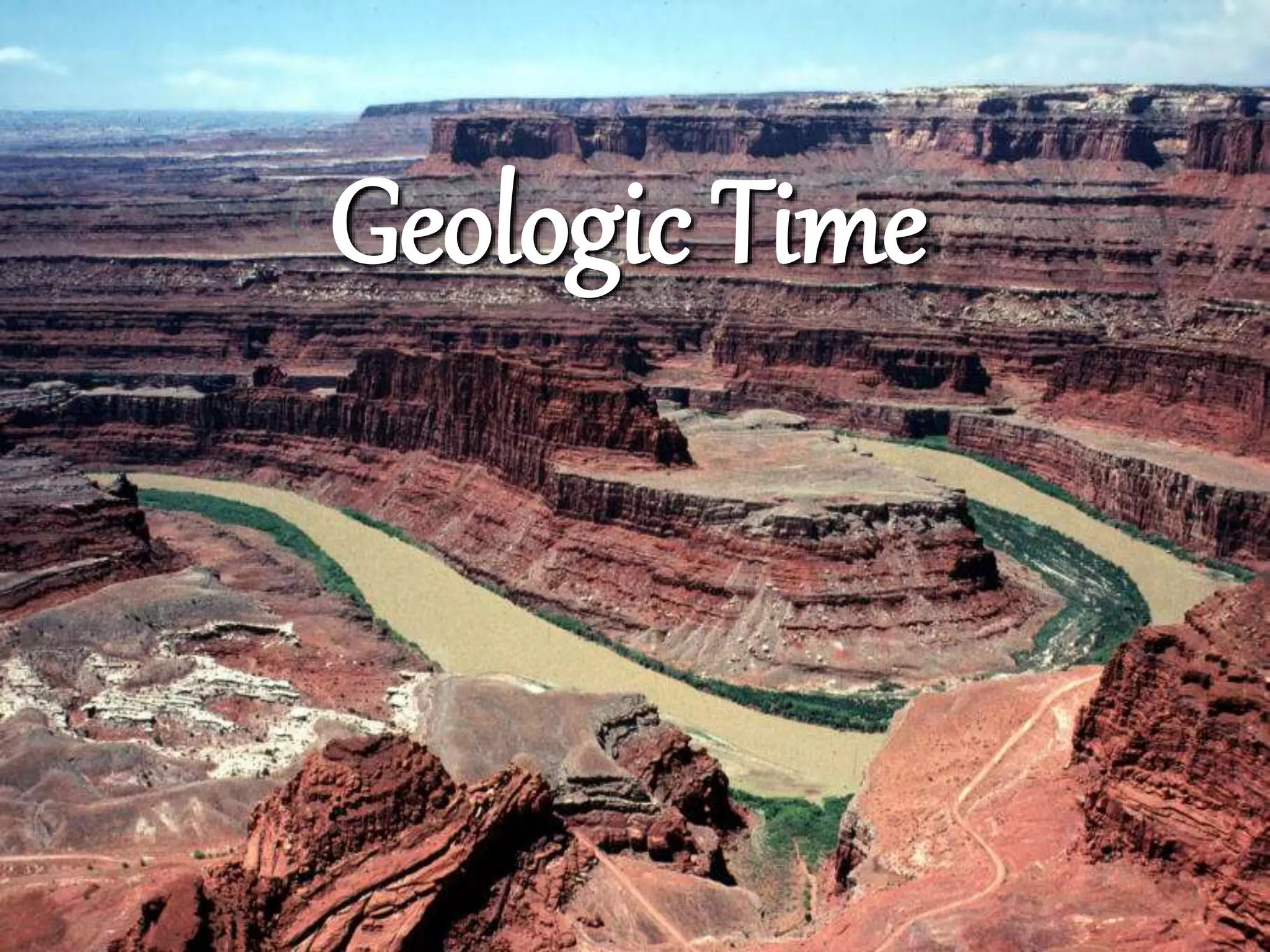
Geologic Time
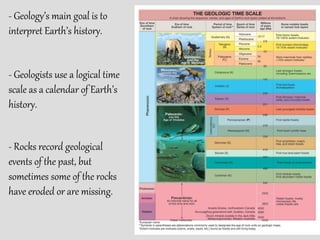
- Geologists use a logical time
scale as a calendar of Earth’s
history.
- Rocks record geological
events of the past, but
sometimes some of the rocks
have eroded or are missing.
- Geology’s main goal is to
interpret Earth’s history.
- Prior to the discovery of radioactivity, geologists had no accurate method of
dating geological events.
Geologic Time
- Instead, they used relative dating, which placed events in a sequence based
on logical assumptions and observations (like knowing that your mom is
older than you without knowing her age).
- When radioactivity came along, it didn’t replace relative dating techniques;
it actually supplemented them. To make things more streamlined, several
basic principles or rules were developed and applied. We’ll learn each of
these and apply them this semester.
Relative Dating Rules
- There are seven main principles we’ll apply when dealing with relative
dating. They are as follows:
1. Law of Superposition
2. Principle of Original Horizontality
3. Principle of Cross-Cutting Relationships
4. Inclusions
5. Fossil Succession
6. Lateral Continuity
7. Unconformities
Law of Superposition
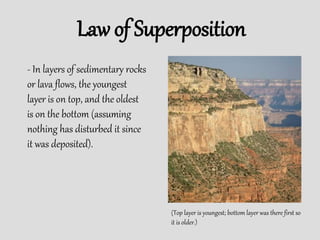
- In layers of sedimentary rocks
or lava flows, the youngest
layer is on top, and the oldest
is on the bottom (assuming
nothing has disturbed it since
it was deposited).
(Top layer is youngest; bottom layer was there first so
it is older.)
Original Horizontality
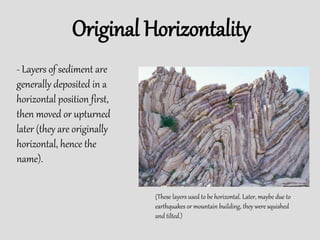
- Layers of sediment are
generally deposited in a
horizontal position first,
then moved or upturned
later (they are originally
horizontal, hence the
name).
(These layers used to be horizontal. Later, maybe due to
earthquakes or mountain building, they were squished
and tilted.)
Cross-Cutting Relations
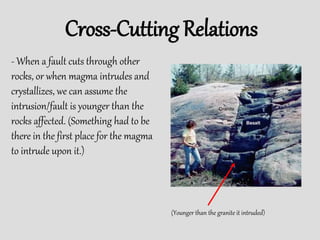
- When a fault cuts through other
rocks, or when magma intrudes and
crystallizes, we can assume the
intrusion/fault is younger than the
rocks affected. (Something had to be
there in the first place for the magma
to intrude upon it.)
(Younger than the granite it intruded)
Inclusions
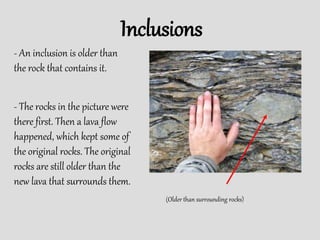
(Older than surrounding rocks)
- An inclusion is older than
the rock that contains it.
- The rocks in the picture were
there first. Then a lava flow
happened, which kept some of
the original rocks. The original
rocks are still older than the
new lava that surrounds them.
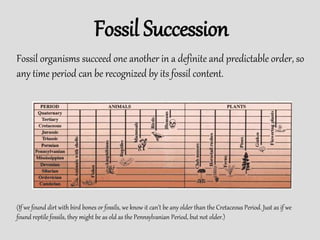
Fossil Succession
Fossil organisms succeed one another in a definite and predictable order, so
any time period can be recognized by its fossil content.
(If we found dirt with bird bones or fossils, we know it can’t be any older than the Cretaceous Period. Just as if we
found reptile fossils, they might be as old as the Pennsylvanian Period, but not older.)
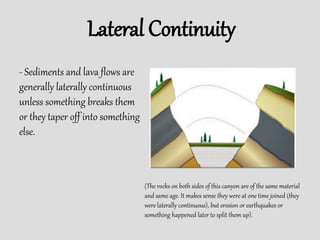
Lateral Continuity
(The rocks on both sides of this canyon are of the same material
and same age. It makes sense they were at one time joined (they
were laterally continuous), but erosion or earthquakes or
something happened later to split them up).
- Sediments and lava flows are
generally laterally continuous
unless something breaks them
or they taper off into something
else.
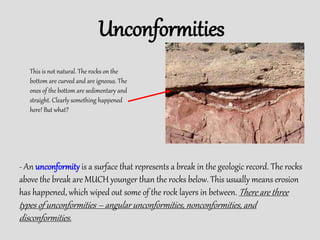
Unconformities
- An unconformity is a surface that represents a break in the geologic record. The rocks
above the break are MUCH younger than the rocks below. This usually means erosion
has happened, which wiped out some of the rock layers in between. There are three
types of unconformities – angular unconformities, nonconformities, and
disconformities.
This is not natural. The rocks on the
bottom are curved and are igneous. The
ones of the bottom are sedimentary and
straight. Clearly something happened
here! But what?
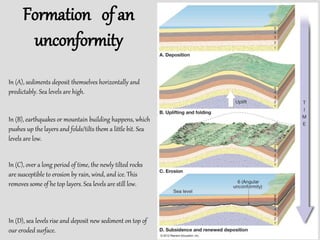
Formation of an
unconformity
In (A), sediments deposit themselves horizontally and
predictably. Sea levels are high.
In (B), earthquakes or mountain building happens, which
pushes up the layers and folds/tilts them a little bit. Sea
levels are low.
In (C), over a long period of time, the newly tilted rocks
are susceptible to erosion by rain, wind, and ice. This
removes some of he top layers. Sea levels are still low.
In (D), sea levels rise and deposit new sediment on top of
our eroded surface.
Angular Unconformities
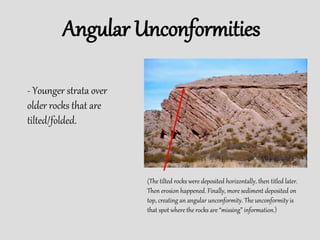
- Younger strata over
older rocks that are
tilted/folded.
(The tilted rocks were deposited horizontally, then titled later.
Then erosion happened. Finally, more sediment deposited on
top, creating an angular unconformity. The unconformity is
that spot where the rocks are “missing” information.)
Disconformities
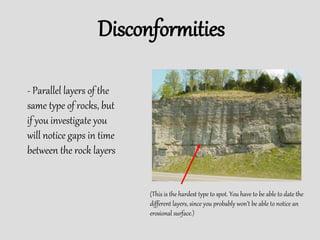
- Parallel layers of the
same type of rocks, but
if you investigate you
will notice gaps in time
between the rock layers
(This is the hardest type to spot. You have to be able to date the
different layers, since you probably won’t be able to notice an
erosional surface.)
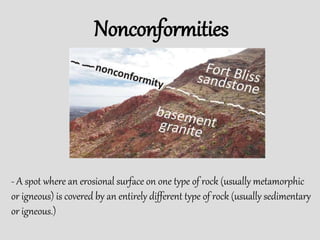
Nonconformities
- A spot where an erosional surface on one type of rock (usually metamorphic
or igneous) is covered by an entirely different type of rock (usually sedimentary
or igneous.)

Relative and absolute_dating

  • 1.
  • 2.
    - Geologists usea logical time scale as a calendar of Earth’s history. - Rocks record geological events of the past, but sometimes some of the rocks have eroded or are missing. - Geology’s main goal is to interpret Earth’s history.
  • 3.
    - Prior tothe discovery of radioactivity, geologists had no accurate method of dating geological events. Geologic Time - Instead, they used relative dating, which placed events in a sequence based on logical assumptions and observations (like knowing that your mom is older than you without knowing her age). - When radioactivity came along, it didn’t replace relative dating techniques; it actually supplemented them. To make things more streamlined, several basic principles or rules were developed and applied. We’ll learn each of these and apply them this semester.
  • 4.
    Relative Dating Rules -There are seven main principles we’ll apply when dealing with relative dating. They are as follows: 1. Law of Superposition 2. Principle of Original Horizontality 3. Principle of Cross-Cutting Relationships 4. Inclusions 5. Fossil Succession 6. Lateral Continuity 7. Unconformities
  • 5.
    Law of Superposition -In layers of sedimentary rocks or lava flows, the youngest layer is on top, and the oldest is on the bottom (assuming nothing has disturbed it since it was deposited). (Top layer is youngest; bottom layer was there first so it is older.)
  • 6.
    Original Horizontality - Layersof sediment are generally deposited in a horizontal position first, then moved or upturned later (they are originally horizontal, hence the name). (These layers used to be horizontal. Later, maybe due to earthquakes or mountain building, they were squished and tilted.)
  • 7.
    Cross-Cutting Relations - Whena fault cuts through other rocks, or when magma intrudes and crystallizes, we can assume the intrusion/fault is younger than the rocks affected. (Something had to be there in the first place for the magma to intrude upon it.) (Younger than the granite it intruded)
  • 8.
    Inclusions (Older than surroundingrocks) - An inclusion is older than the rock that contains it. - The rocks in the picture were there first. Then a lava flow happened, which kept some of the original rocks. The original rocks are still older than the new lava that surrounds them.
  • 9.
    Fossil Succession Fossil organismssucceed one another in a definite and predictable order, so any time period can be recognized by its fossil content. (If we found dirt with bird bones or fossils, we know it can’t be any older than the Cretaceous Period. Just as if we found reptile fossils, they might be as old as the Pennsylvanian Period, but not older.)
  • 10.
    Lateral Continuity (The rockson both sides of this canyon are of the same material and same age. It makes sense they were at one time joined (they were laterally continuous), but erosion or earthquakes or something happened later to split them up). - Sediments and lava flows are generally laterally continuous unless something breaks them or they taper off into something else.
  • 11.
    Unconformities - An unconformityis a surface that represents a break in the geologic record. The rocks above the break are MUCH younger than the rocks below. This usually means erosion has happened, which wiped out some of the rock layers in between. There are three types of unconformities – angular unconformities, nonconformities, and disconformities. This is not natural. The rocks on the bottom are curved and are igneous. The ones of the bottom are sedimentary and straight. Clearly something happened here! But what?
  • 12.
    Formation of an unconformity In(A), sediments deposit themselves horizontally and predictably. Sea levels are high. In (B), earthquakes or mountain building happens, which pushes up the layers and folds/tilts them a little bit. Sea levels are low. In (C), over a long period of time, the newly tilted rocks are susceptible to erosion by rain, wind, and ice. This removes some of he top layers. Sea levels are still low. In (D), sea levels rise and deposit new sediment on top of our eroded surface.
  • 13.
    Angular Unconformities - Youngerstrata over older rocks that are tilted/folded. (The tilted rocks were deposited horizontally, then titled later. Then erosion happened. Finally, more sediment deposited on top, creating an angular unconformity. The unconformity is that spot where the rocks are “missing” information.)
  • 14.
    Disconformities - Parallel layersof the same type of rocks, but if you investigate you will notice gaps in time between the rock layers (This is the hardest type to spot. You have to be able to date the different layers, since you probably won’t be able to notice an erosional surface.)
  • 15.
    Nonconformities - A spotwhere an erosional surface on one type of rock (usually metamorphic or igneous) is covered by an entirely different type of rock (usually sedimentary or igneous.)