Relative Dating  Chapter 13 Clues to Earth’s Past
Rules of Relative Dating Law of Superposition – the youngest layers are on the top and oldest on the bottom. Layers are always laid down flat. Uniformitarianism – processes happened in the past just as they happen today. Volcanic eruptions Erosion Fault movement Look out for  unconformities !!!  *layers that are missing from erosion
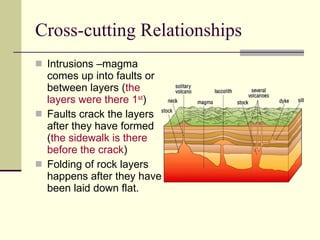
Cross-cutting Relationships Intrusions –magma comes up into faults or between layers ( the layers were there 1 st ) Faults crack the layers after they have formed ( the sidewalk is there before the crack ) Folding of rock layers happens after they have been laid down flat.
3 types of unconformities Like pages missing from the middle of a book Erosion takes away layers leaving a gap in the rock record. Correlation of rock sequences – by comparing rock layers from different areas a complete record of layers can be determined. 3 types Angular unconformity  Disconformity Nonconformity
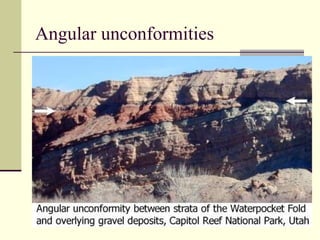
Angular unconformities Horizontal sedimentary layers are TILTED when they are uplifted then eroded. New sedimentary layers are deposited on top of this erosional surface. Look for  angles  in the lower rock layers!
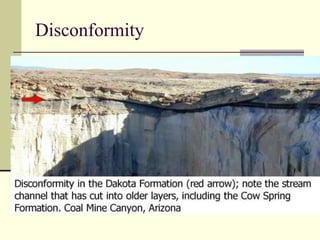
Disconformity Sedimentary rock layers were uplifted and eroded. New sedimentary layers were added on top of this erosional surface. The layers are ALL parallel. There is a gap in the rock record.
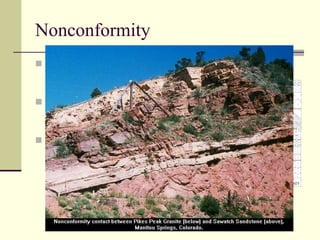
Nonconformity Igneous or metamorphic rocks  are uplifted and eroded Sedimentary rocks are deposited on top of this erosion surface The surface between the 2 different rock types is a nonconformity.
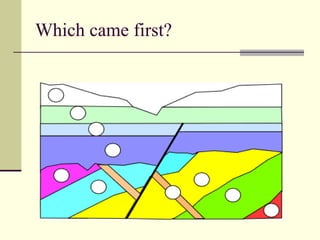
Which came first?
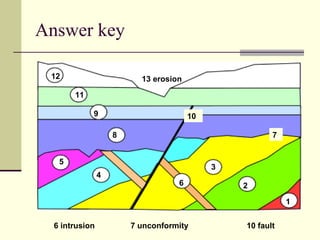
Answer key 1 2 3 6 4 8 9 11 12 7 5 10 13 erosion 6 intrusion  7 unconformity  10 fault

Relative Dating

  • 1.
    Relative Dating Chapter 13 Clues to Earth’s Past
  • 2.
    Rules of RelativeDating Law of Superposition – the youngest layers are on the top and oldest on the bottom. Layers are always laid down flat. Uniformitarianism – processes happened in the past just as they happen today. Volcanic eruptions Erosion Fault movement Look out for unconformities !!! *layers that are missing from erosion
  • 3.
    Cross-cutting Relationships Intrusions–magma comes up into faults or between layers ( the layers were there 1 st ) Faults crack the layers after they have formed ( the sidewalk is there before the crack ) Folding of rock layers happens after they have been laid down flat.
  • 4.
    3 types ofunconformities Like pages missing from the middle of a book Erosion takes away layers leaving a gap in the rock record. Correlation of rock sequences – by comparing rock layers from different areas a complete record of layers can be determined. 3 types Angular unconformity Disconformity Nonconformity
  • 5.
    Angular unconformities Horizontalsedimentary layers are TILTED when they are uplifted then eroded. New sedimentary layers are deposited on top of this erosional surface. Look for angles in the lower rock layers!
  • 6.
    Disconformity Sedimentary rocklayers were uplifted and eroded. New sedimentary layers were added on top of this erosional surface. The layers are ALL parallel. There is a gap in the rock record.
  • 7.
    Nonconformity Igneous ormetamorphic rocks are uplifted and eroded Sedimentary rocks are deposited on top of this erosion surface The surface between the 2 different rock types is a nonconformity.
  • 8.
  • 9.
    Answer key 12 3 6 4 8 9 11 12 7 5 10 13 erosion 6 intrusion 7 unconformity 10 fault