Drinking Milk
Technology
Res. Asst. Dr. Bahar ONARAN, DVM
Ankara University, Faculty of Veterinary Medicine
Department of Food Hygiene and Technology
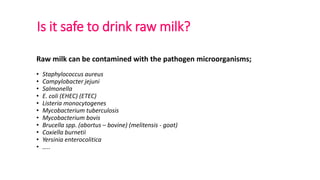
Is it safe to drink raw milk?
Raw milk can be contamined with the pathogen microorganisms;
• Staphylococcus aureus
• Campylobacter jejuni
• Salmonella
• E. coli (EHEC) (ETEC)
• Listeria monocytogenes
• Mycobacterium tuberculosis
• Mycobacterium bovis
• Brucella spp. (abortus – bovine) (melitensis - goat)
• Coxiella burnetii
• Yersinia enterocolitica
• …..
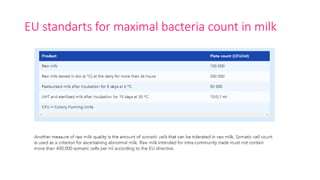
EU standarts for maximal bacteria count in milk
Drinking Milk Technologies
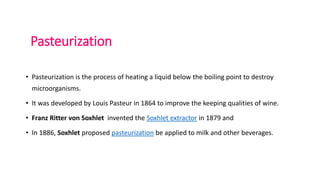
Pasteurization
Ultra High Temperature
Pasteurization
• Pasteurization is the process of heating a liquid below the boiling point to destroy
microorganisms.
• It was developed by Louis Pasteur in 1864 to improve the keeping qualities of wine.
• Franz Ritter von Soxhlet invented the Soxhlet extractor in 1879 and
• In 1886, Soxhlet proposed pasteurization be applied to milk and other beverages.
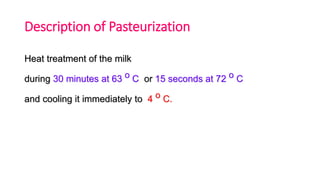
Description of Pasteurization
Heat treatment of the milk
during 30 minutes at 63 o C or 15 seconds at 72 o C
and cooling it immediately to 4 o C.
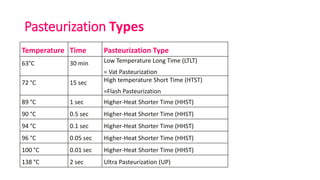
Pasteurization Types
Temperature Time Pasteurization Type
63°C 30 min Low Temperature Long Time (LTLT)
= Vat Pasteurization
72 °C 15 sec High temperature Short Time (HTST)
=Flash Pasteurization
89 °C 1 sec Higher-Heat Shorter Time (HHST)
90 °C 0.5 sec Higher-Heat Shorter Time (HHST)
94 °C 0.1 sec Higher-Heat Shorter Time (HHST)
96 °C 0.05 sec Higher-Heat Shorter Time (HHST)
100 °C 0.01 sec Higher-Heat Shorter Time (HHST)
138 °C 2 sec Ultra Pasteurization (UP)
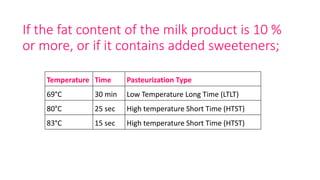
If the fat content of the milk product is 10 %
or more, or if it contains added sweeteners;
Temperature Time Pasteurization Type
69°C 30 min Low Temperature Long Time (LTLT)
80°C 25 sec High temperature Short Time (HTST)
83°C 15 sec High temperature Short Time (HTST)
The Purpose of Pasteurization
Destroying the milk-borne pathogens
Destroying the majority of the spoilage bacteria
Increasing the quality of milk and milk products
Ensuring that the ornagoleptic properties of
milk are effected minimally
Effect of Pasteurization
A. Bactericidal effect
All of the pathogens are inhibited
• Mycobacterium tuberculosis (63°C 30 min)
• Coxiella burnetti (72 °C 15 sec)
B. Reduction of the cream layer
C. Inactivation of phosphatase enzyme
Stages of Pasteurization
• Clarification
• Homogenization
• Standardization
• Pasteurization
• Cooling
• Packaging
• Storage
Standardization
• The purpose of standardization is to give the
milk a defined, guaranteed fat content.
Common values are;
• 3 %  regular-grade milk
• 1.5 %  low-fat milk
• 0.1 - 0.5 %  non-fat milk
• The fat is a very important economic factor.
The standardization of milk and cream must
be carried out with great accuracy.
Homogenization
Reduce the size of the fat globules in the milk
in order to prevent creaming.
Pasteurization Types
• Low Temperature Long Time
- LTLT
• High temperature Short Time
- HTST
Low Temperature Long Time – LTLT
(Vat Pasteurization)
• Heating treatment
indirect
• Heating treatment
 30 minutes at 63 o C
Low Temperature Long Time - LTLT
• Batches have two nested walls.
• Heat exchange occurs
via the walls of batch.
• There is water and hot steam circulation in
the nested walls.
• Cooling occurs via cold water.
High temperature Short Time - HTST
(Flash Pasteurization)
Modern method
Can pasteurize more milk.
Heat treatment 15 seconds at 72 o C
Permenency system
Reduces the amount of time required
to pasteurize milk.
UHT (Ultra-high-temperature)
is a food processing technology that sterilizes liquid food,
chiefly milk, by heating it 135 °C for 2-5 seconds
 the temperature required to kill spores in milk.
The heat used during the UHT process can cause Maillard
browning and change the taste and smell of dairy products.
UHT milk packaged in a sterile container, if not opened, has
a typical unrefrigerated shelf life of six to nine months.
In contrast, HTST pasteurized milk has a shelf life of about
two weeks from processing, or about one week from being
put on sale.
Ultra-high-temperature processing
• is performed in complex production plants, which perform several
stages of food processing and packaging automatically and in
succession:
• Heating
• Flash cooling
• Homogenization
• Aseptic packaging
• In the heating stage, the treated liquid is first pre-heated to a non-
critical temperature (70–80°C for milk), and then quickly heated to
the temperature required by the process.
There are two types of heating technologies:
• Direct  where the product is put in a direct contact with the hot
steam,
• Indirect  where the product and the heating medium remain
separated by the equipment's contact surfaces.
• The main goals of the design, both from product quality and from
efficiency standpoints, are to maintain the high product temperature
for the shortest period possible, and to ensure that the temperature
is evenly distributed throughout.
Direct heating systems
• Direct systems have an advantage
that the product is held at a high temperature for a shorter period of
time, thereby reducing the thermal damage for the sensitive products
such as milk.
There are two groups of direct systems:
Injection-based
Infusion-based
Injection-based
where the high-pressure steam is
injected into the liquid.
allows fast heating and cooling, but is
only suitable for some products.
As the product comes in contact with
the hot nozzle, there is a possibility of
local overheating.
Infusion-based
where the liquid is pumped through
a nozzle into a chamber with high-pressure
steam at a relatively low concentration,
providing a large surface contact area.
achieves sudden heating and cooling and
even distribution of temperature, avoiding
local overheating.
suitable for liquids of both low and
high viscosity.
Indirect heating systems
• In indirect systems, the product is heated by a solid heat exchanger similar
to those used for pasteurization. However, as higher temperatures are
applied, it is necessary to employ higher pressures in order to prevent
boiling.
There are three types of exchangers in use:
• Plate exchangers,
• Tubular exchangers,
• Scraped-surface exchangers.
• For higher efficiency, pressurized water or steam is used as the medium for
heating the exchangers themselves, accompanied with a regeneration unit
which allows reuse of the medium and energy saving.
UHT
Advantages
very short time heating
components effected minimally
Long shelf life
Package sizes
 10 lt of packages for food industry
More economic
 packaging, storing, transportation are more economic.
High quality

Drinking Milk Technology.pptx

  • 1.
    Drinking Milk Technology Res. Asst.Dr. Bahar ONARAN, DVM Ankara University, Faculty of Veterinary Medicine Department of Food Hygiene and Technology
  • 2.
    Is it safeto drink raw milk? Raw milk can be contamined with the pathogen microorganisms; • Staphylococcus aureus • Campylobacter jejuni • Salmonella • E. coli (EHEC) (ETEC) • Listeria monocytogenes • Mycobacterium tuberculosis • Mycobacterium bovis • Brucella spp. (abortus – bovine) (melitensis - goat) • Coxiella burnetii • Yersinia enterocolitica • …..
  • 3.
    EU standarts formaximal bacteria count in milk
  • 4.
  • 5.
    Pasteurization • Pasteurization isthe process of heating a liquid below the boiling point to destroy microorganisms. • It was developed by Louis Pasteur in 1864 to improve the keeping qualities of wine. • Franz Ritter von Soxhlet invented the Soxhlet extractor in 1879 and • In 1886, Soxhlet proposed pasteurization be applied to milk and other beverages.
  • 6.
    Description of Pasteurization Heattreatment of the milk during 30 minutes at 63 o C or 15 seconds at 72 o C and cooling it immediately to 4 o C.
  • 7.
    Pasteurization Types Temperature TimePasteurization Type 63°C 30 min Low Temperature Long Time (LTLT) = Vat Pasteurization 72 °C 15 sec High temperature Short Time (HTST) =Flash Pasteurization 89 °C 1 sec Higher-Heat Shorter Time (HHST) 90 °C 0.5 sec Higher-Heat Shorter Time (HHST) 94 °C 0.1 sec Higher-Heat Shorter Time (HHST) 96 °C 0.05 sec Higher-Heat Shorter Time (HHST) 100 °C 0.01 sec Higher-Heat Shorter Time (HHST) 138 °C 2 sec Ultra Pasteurization (UP)
  • 8.
    If the fatcontent of the milk product is 10 % or more, or if it contains added sweeteners; Temperature Time Pasteurization Type 69°C 30 min Low Temperature Long Time (LTLT) 80°C 25 sec High temperature Short Time (HTST) 83°C 15 sec High temperature Short Time (HTST)
  • 9.
    The Purpose ofPasteurization Destroying the milk-borne pathogens Destroying the majority of the spoilage bacteria Increasing the quality of milk and milk products Ensuring that the ornagoleptic properties of milk are effected minimally
  • 10.
    Effect of Pasteurization A.Bactericidal effect All of the pathogens are inhibited • Mycobacterium tuberculosis (63°C 30 min) • Coxiella burnetti (72 °C 15 sec) B. Reduction of the cream layer C. Inactivation of phosphatase enzyme
  • 11.
    Stages of Pasteurization •Clarification • Homogenization • Standardization • Pasteurization • Cooling • Packaging • Storage
  • 12.
    Standardization • The purposeof standardization is to give the milk a defined, guaranteed fat content. Common values are; • 3 %  regular-grade milk • 1.5 %  low-fat milk • 0.1 - 0.5 %  non-fat milk • The fat is a very important economic factor. The standardization of milk and cream must be carried out with great accuracy.
  • 13.
    Homogenization Reduce the sizeof the fat globules in the milk in order to prevent creaming.
  • 14.
    Pasteurization Types • LowTemperature Long Time - LTLT • High temperature Short Time - HTST
  • 15.
    Low Temperature LongTime – LTLT (Vat Pasteurization) • Heating treatment indirect • Heating treatment  30 minutes at 63 o C
  • 16.
    Low Temperature LongTime - LTLT • Batches have two nested walls. • Heat exchange occurs via the walls of batch. • There is water and hot steam circulation in the nested walls. • Cooling occurs via cold water.
  • 17.
    High temperature ShortTime - HTST (Flash Pasteurization) Modern method Can pasteurize more milk. Heat treatment 15 seconds at 72 o C Permenency system Reduces the amount of time required to pasteurize milk.
  • 18.
    UHT (Ultra-high-temperature) is afood processing technology that sterilizes liquid food, chiefly milk, by heating it 135 °C for 2-5 seconds  the temperature required to kill spores in milk. The heat used during the UHT process can cause Maillard browning and change the taste and smell of dairy products. UHT milk packaged in a sterile container, if not opened, has a typical unrefrigerated shelf life of six to nine months. In contrast, HTST pasteurized milk has a shelf life of about two weeks from processing, or about one week from being put on sale.
  • 19.
    Ultra-high-temperature processing • isperformed in complex production plants, which perform several stages of food processing and packaging automatically and in succession: • Heating • Flash cooling • Homogenization • Aseptic packaging • In the heating stage, the treated liquid is first pre-heated to a non- critical temperature (70–80°C for milk), and then quickly heated to the temperature required by the process.
  • 20.
    There are twotypes of heating technologies: • Direct  where the product is put in a direct contact with the hot steam, • Indirect  where the product and the heating medium remain separated by the equipment's contact surfaces. • The main goals of the design, both from product quality and from efficiency standpoints, are to maintain the high product temperature for the shortest period possible, and to ensure that the temperature is evenly distributed throughout.
  • 21.
    Direct heating systems •Direct systems have an advantage that the product is held at a high temperature for a shorter period of time, thereby reducing the thermal damage for the sensitive products such as milk. There are two groups of direct systems: Injection-based Infusion-based
  • 22.
    Injection-based where the high-pressuresteam is injected into the liquid. allows fast heating and cooling, but is only suitable for some products. As the product comes in contact with the hot nozzle, there is a possibility of local overheating.
  • 23.
    Infusion-based where the liquidis pumped through a nozzle into a chamber with high-pressure steam at a relatively low concentration, providing a large surface contact area. achieves sudden heating and cooling and even distribution of temperature, avoiding local overheating. suitable for liquids of both low and high viscosity.
  • 24.
    Indirect heating systems •In indirect systems, the product is heated by a solid heat exchanger similar to those used for pasteurization. However, as higher temperatures are applied, it is necessary to employ higher pressures in order to prevent boiling. There are three types of exchangers in use: • Plate exchangers, • Tubular exchangers, • Scraped-surface exchangers. • For higher efficiency, pressurized water or steam is used as the medium for heating the exchangers themselves, accompanied with a regeneration unit which allows reuse of the medium and energy saving.
  • 25.
    UHT Advantages very short timeheating components effected minimally Long shelf life Package sizes  10 lt of packages for food industry More economic  packaging, storing, transportation are more economic. High quality