SVCAET & RS ,RAIPUR
Master’s Seminar
On
“Extrusion cooking “
Presented by
Name- Suraj kumar
Class- M.Tech (final)
College Id.- 220118011
Session – 2018-19
 Introduction of extrusion cooking.
 Example of extruded product.
 Advantages of Extrusion cooking.
 Extruders and its classification.
 Principle process of extrusion.
 Extruders parts and component.
 Characteristics of Extruded Products.
 Factors Affecting Extrusion Cooking.
Content
Extrusion cooking is a modern (HTST) cooking process (thermo-
mechanical process) in which heat transfer, mass transfer, pressure
changes and shear are combined to produce effects such as
 Cooking
 Sterilization
 Drying,
 Melting,
 Cooling,
 Texturizing,
 Conveying,
 Puffing,
 Mixing,
 Kneading,
 Forming, etc.
for manufacture of new and traditional products such as e.g. pasta.
EXTRUSION COOKING
 In extrusion cooking, the food material is heated either by
external heat source or by heat produced through dies to
expand and extrude in desired shape.
 Extruder is used to produce extrudate of different shapes by
forcing a specially designed opening after a previous heating
of the material.
Some examples of extruded product such as Pasta ,Snack
products (puffed snacks, crisp breads),Confectionery
products (toffee,peanut)
Advantages of extrusion
 Low processing Cost
extrusion has lower processing costs than other cooking and
forming processes.We can save 19 per cent raw material,14 per
cent labor and 44 per cent capital investment.
 Less space
extrusion processing needs less space per unit of operation that
other cooking system.
 Energy efficient
Extruders operate at relatively low moisture while cooking food
products, so less re-drying is required.
 Adaptablity
The extrusion process is remarkably adaptable in being able to
accommodate the demand by consumer for new product.
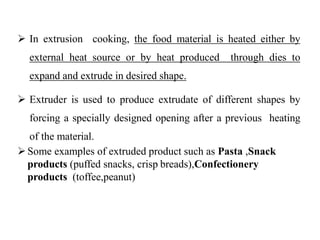
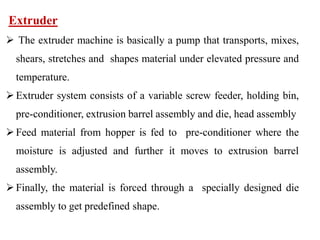
Extruder
 The extruder machine is basically a pump that transports, mixes,
shears, stretches and shapes material under elevated pressure and
temperature.
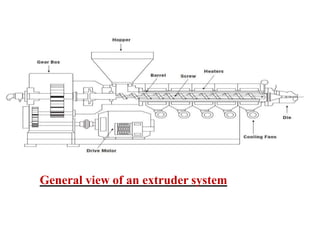
Extruder system consists of a variable screw feeder, holding bin,
pre-conditioner, extrusion barrel assembly and die, head assembly
Feed material from hopper is fed to pre-conditioner where the
moisture is adjusted and further it moves to extrusion barrel
assembly.
Finally, the material is forced through a specially designed die
assembly to get predefined shape.
General view of an extruder system
Classification of extruder
BASED ON CONSTRUCTION
1.Single screw extruder
2.Twine screw extruder(TSE)
(A) Co-rotating TSE.
(B) Counter rotating TSE
BASED ON OPERATION
1. Hot extruder
2. Cold extruder
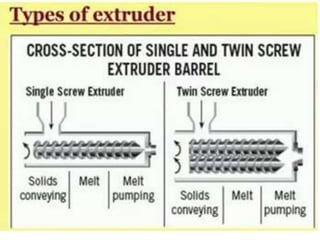
(i)Single screw extruders – It contains one smooth, deep flighted
Archimedes screw within a grooved barrel.
(ii)Twin screw extruders – It contains two screws inside a barrel. It
consumes less energy and shows higher rate of production, therefore,
industries widely prefer twin-screw extruders.
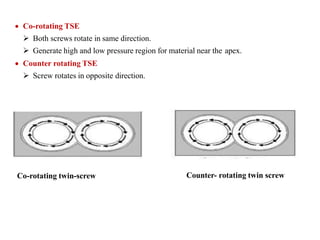
 Co-rotating TSE
 Both screws rotate in same direction.
 Generate high and low pressure region for material near the apex.
 Counter rotating TSE
 Screw rotates in opposite direction.
Co-rotating twin-screw Counter- rotating twin screw
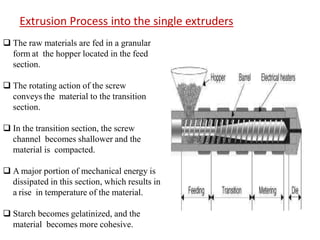
 The raw materials are fed in a granular
form at the hopper located in the feed
section.
 The rotating action of the screw
conveys the material to the transition
section.
 In the transition section, the screw
channel becomes shallower and the
material is compacted.
 A major portion of mechanical energy is
dissipated in this section, which results in
a rise in temperature of the material.
 Starch becomes gelatinized, and the
material becomes more cohesive.
Extrusion Process into the single extruders
 If food is heated above 100 oC,the extrusion is known as hot extrusion.
 High pressures and temperatures are used to form expanded products.
 The rapid release of pressure as the food emerges from the die causes
instantaneous expansion of steam and gas in the material, to form a low-
density product.
 Hot extrusion is a HTST process, which minimizes the loss of nutrients and
reduces microbial contamination..
Hot Extrusion cooking
Cold extrusion
 If food is heated below 100 oC the process is known as cold
extrusion.
 In this process food is extruded without cooking or
distortion of food.
 It is used to produce pasta, hot dogs, pastry dough and
some types of confectionary .
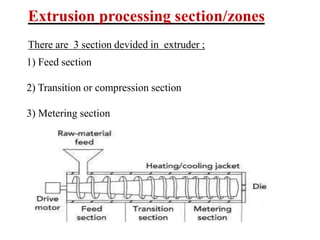
Extrusion processing section/zones
There are 3 section devided in extruder ;
1) Feed section
2) Transition or compression section
3) Metering section
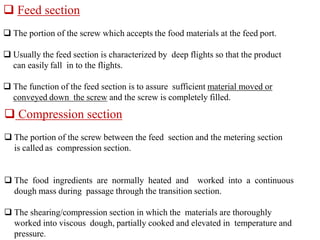
 Feed section
 The portion of the screw which accepts the food materials at the feed port.
 Usually the feed section is characterized by deep flights so that the product
can easily fall in to the flights.
 The function of the feed section is to assure sufficient material moved or
conveyed down the screw and the screw is completely filled.
 Compression section
 The portion of the screw between the feed section and the metering section
is called as compression section.
 The food ingredients are normally heated and worked into a continuous
dough mass during passage through the transition section.
 The shearing/compression section in which the materials are thoroughly
worked into viscous dough, partially cooked and elevated in temperature and
pressure.
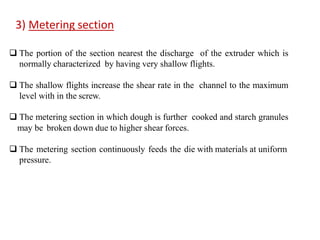
 The portion of the section nearest the discharge of the extruder which is
normally characterized by having very shallow flights.
 The shallow flights increase the shear rate in the channel to the maximum
level with in the screw.
 The metering section in which dough is further cooked and starch granules
may be broken down due to higher shear forces.
 The metering section continuously feeds the die with materials at uniform
pressure.
3) Metering section
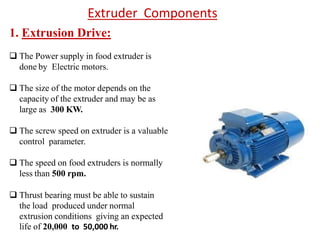
1. Extrusion Drive:
 The Power supply in food extruder is
done by Electric motors.
 The size of the motor depends on the
capacity of the extruder and may be as
large as 300 KW.
 The screw speed on extruder is a valuable
control parameter.
 The speed on food extruders is normally
less than 500 rpm.
 Thrust bearing must be able to sustain
the load produced under normal
extrusion conditions giving an expected
life of 20,000 to 50,000 hr.
Extruder Components
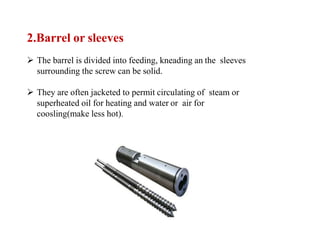
2.Barrel or sleeves
 The barrel is divided into feeding, kneading an the sleeves
surrounding the screw can be solid.
 They are often jacketed to permit circulating of steam or
superheated oil for heating and water or air for
coosling(make less hot).
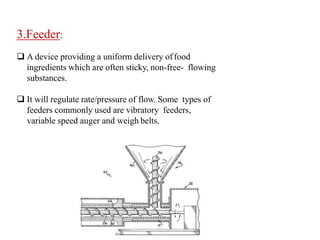
3.Feeder:
 A device providing a uniform delivery offood
ingredients which are often sticky, non-free- flowing
substances.
 It will regulate rate/pressure of flow. Some types of
feeders commonly used are vibratory feeders,
variable speed auger and weigh belts.
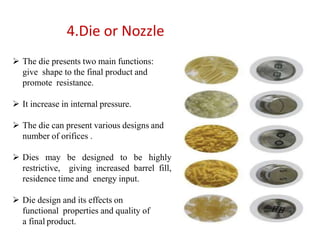
 The die presents two main functions:
give shape to the final product and
promote resistance.
 It increase in internal pressure.
 The die can present various designs and
number of orifices .
 Dies may be designed to be highly
restrictive, giving increased barrel fill,
residence time and energy input.
 Die design and its effects on
functional properties and quality of
a final product.
4.Die or Nozzle
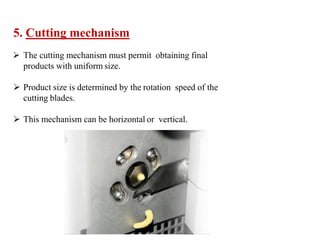
5. Cutting mechanism
 The cutting mechanism must permit obtaining final
products with uniform size.
 Product size is determined by the rotation speed of the
cutting blades.
 This mechanism can be horizontal or vertical.
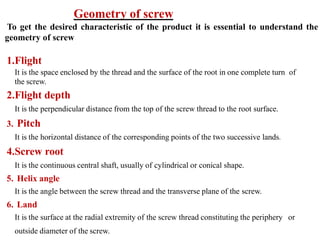
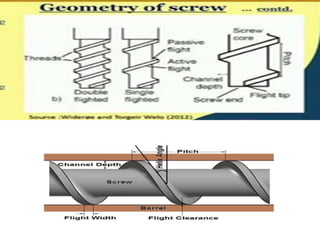
1.Flight
It is the space enclosed by the thread and the surface of the root in one complete turn of
the screw.
2.Flight depth
It is the perpendicular distance from the top of the screw thread to the root surface.
3. Pitch
It is the horizontal distance of the corresponding points of the two successive lands.
4.Screw root
It is the continuous central shaft, usually of cylindrical or conical shape.
5. Helix angle
It is the angle between the screw thread and the transverse plane of the screw.
6. Land
It is the surface at the radial extremity of the screw thread constituting the periphery or
outside diameter of the screw.
Geometry of screw
To get the desired characteristic of the product it is essential to understand the
geometry of screw
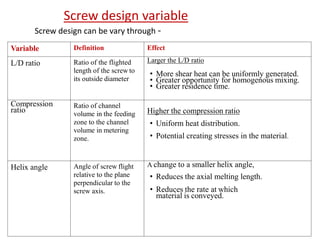
Variable Definition Effect
L/D ratio Ratio of the flighted
length of the screw to
its outside diameter
Larger the L/D ratio
• More shear heat can be uniformly generated.
• Greater opportunity for homogenous mixing.
• Greater residence time.
Compression
ratio
Ratio of channel
volume in the feeding
zone to the channel
volume in metering
zone.
Higher the compression ratio
• Uniform heat distribution.
• Potential creating stresses in the material.
Helix angle Angle of screw flight
relative to the plane
perpendicular to the
screw axis.
A change to a smaller helix angle,
• Reduces the axial melting length.
• Reduces the rate at which
material is conveyed.
Screw design variable
Screw design can be vary through -
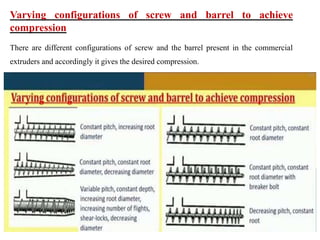
Varying configurations of screw and barrel to achieve
compression
There are different configurations of screw and the barrel present in the commercial
extruders and accordingly it gives the desired compression.
Material flow in the barrel
When the die is fitted at the end of barrel, pressure develop at the end
of the screw
1. Drag flow
It is the flow of material inside the barrel due to the action of
dragging.
2.Pressure flow
It is the reverse flow of the material in the screw channel.
3.Leakage flow
It is the reverse flow through the clearance.
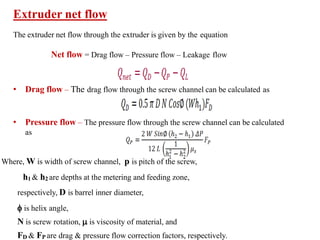
Extruder net flow
The extruder net flow through the extruder is given by the equation
Net flow = Drag flow – Pressure flow – Leakage flow
• Drag flow – The drag flow through the screw channel can be calculated as
• Pressure flow – The pressure flow through the screw channel can be calculated
as
Where, W is width of screw channel, p is pitch of the screw,
h1 & h2 are depths at the metering and feeding zone,
respectively, D is barrel inner diameter,
 is helix angle,
N is screw rotation,  is viscosity of material, and
FD & FP are drag & pressure flow correction factors, respectively.
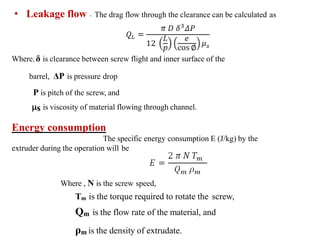
• Leakage flow – The drag flow through the clearance can be calculated as
Where, δ is clearance between screw flight and inner surface of the
barrel, ΔP is pressure drop
P is pitch of the screw, and
s is viscosity of material flowing through channel.
Energy consumption
The specific energy consumption E (J/kg) by the
extruder during the operation will be
Where , N is the screw speed,
Tm is the torque required to rotate the screw,
Qm is the flow rate of the material, and
ρm is the density of extrudate.
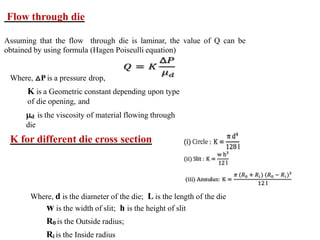
Flow through die
Assuming that the flow through die is laminar, the value of Q can be
obtained by using formula (Hagen Poiseulli equation)
Where, △P is a pressure drop,
K is a Geometric constant depending upon type
of die opening, and
d is the viscosity of material flowing through
die
K for different die cross section
Where, d is the diameter of the die; L is the length of the die
w is the width of slit; h is the height of slit
R0 is the Outside radius;
Ri is the Inside radius
Protein Quality.
 The nature of extruded proteins depends on the Extruder operating
conditions, especially temperature profile as the extruded product is
formed.
 High-heat treatment causes denaturation of many proteins, which
influences physical characteristics such as viscosity.
Starch Characteristics.
 Properties of starch in an extruded product that influence quality characteristics
include such measures as water absorption index, water solubility index, and
enzyme susceptibility.
 These depend on the operating parameters within the extruder as well as the
type of raw materials used for extrusion.
Characteristics of Extruded Products
Mechanical Properties.
 Physical and rheological properties determine the characteristics of the extruded
product.
 These may be expressed as fundamental parameters, like elastic modulus, or
may be characterized by Empirical measures, such as hardness or crispness.
 Instruments that measure fundamental properties (rheometers) or empirical
techniques (Instron or penetrometer) may be used to quantify characteristics of
extruded products.
Bulk Density.
 The density of the final product depends on the nature of the solid
material as well as on the amount of air space within the product.
 A highly expanded product, with plenty of air spaces, has significantly
lower bulk density than a product with little air inclusion.
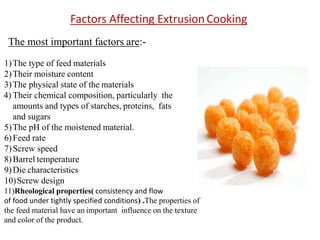
The most important factors are:-
1)The type of feed materials
2)Their moisture content
3)The physical state of the materials
4) Their chemical composition, particularly the
amounts and types of starches, proteins, fats
and sugars
5)The pH of the moistened material.
6)Feed rate
7)Screw speed
8)Barrel temperature
9)Die characteristics
10)Screw design
11)Rheological properties( consistency and flow
of food under tightly specified conditions) .The properties of
the feed material have an important influence on the texture
and color of the product.
Factors Affecting Extrusion Cooking
THANK YOU

Extrusion cooking seminar new

  • 1.
    SVCAET & RS,RAIPUR Master’s Seminar On “Extrusion cooking “ Presented by Name- Suraj kumar Class- M.Tech (final) College Id.- 220118011 Session – 2018-19
  • 2.
     Introduction ofextrusion cooking.  Example of extruded product.  Advantages of Extrusion cooking.  Extruders and its classification.  Principle process of extrusion.  Extruders parts and component.  Characteristics of Extruded Products.  Factors Affecting Extrusion Cooking. Content
  • 3.
    Extrusion cooking isa modern (HTST) cooking process (thermo- mechanical process) in which heat transfer, mass transfer, pressure changes and shear are combined to produce effects such as  Cooking  Sterilization  Drying,  Melting,  Cooling,  Texturizing,  Conveying,  Puffing,  Mixing,  Kneading,  Forming, etc. for manufacture of new and traditional products such as e.g. pasta. EXTRUSION COOKING
  • 4.
     In extrusioncooking, the food material is heated either by external heat source or by heat produced through dies to expand and extrude in desired shape.  Extruder is used to produce extrudate of different shapes by forcing a specially designed opening after a previous heating of the material. Some examples of extruded product such as Pasta ,Snack products (puffed snacks, crisp breads),Confectionery products (toffee,peanut)
  • 5.
    Advantages of extrusion Low processing Cost extrusion has lower processing costs than other cooking and forming processes.We can save 19 per cent raw material,14 per cent labor and 44 per cent capital investment.  Less space extrusion processing needs less space per unit of operation that other cooking system.  Energy efficient Extruders operate at relatively low moisture while cooking food products, so less re-drying is required.  Adaptablity The extrusion process is remarkably adaptable in being able to accommodate the demand by consumer for new product.
  • 6.
    Extruder  The extrudermachine is basically a pump that transports, mixes, shears, stretches and shapes material under elevated pressure and temperature. Extruder system consists of a variable screw feeder, holding bin, pre-conditioner, extrusion barrel assembly and die, head assembly Feed material from hopper is fed to pre-conditioner where the moisture is adjusted and further it moves to extrusion barrel assembly. Finally, the material is forced through a specially designed die assembly to get predefined shape.
  • 7.
    General view ofan extruder system
  • 8.
    Classification of extruder BASEDON CONSTRUCTION 1.Single screw extruder 2.Twine screw extruder(TSE) (A) Co-rotating TSE. (B) Counter rotating TSE BASED ON OPERATION 1. Hot extruder 2. Cold extruder (i)Single screw extruders – It contains one smooth, deep flighted Archimedes screw within a grooved barrel. (ii)Twin screw extruders – It contains two screws inside a barrel. It consumes less energy and shows higher rate of production, therefore, industries widely prefer twin-screw extruders.
  • 10.
     Co-rotating TSE Both screws rotate in same direction.  Generate high and low pressure region for material near the apex.  Counter rotating TSE  Screw rotates in opposite direction. Co-rotating twin-screw Counter- rotating twin screw
  • 11.
     The rawmaterials are fed in a granular form at the hopper located in the feed section.  The rotating action of the screw conveys the material to the transition section.  In the transition section, the screw channel becomes shallower and the material is compacted.  A major portion of mechanical energy is dissipated in this section, which results in a rise in temperature of the material.  Starch becomes gelatinized, and the material becomes more cohesive. Extrusion Process into the single extruders
  • 12.
     If foodis heated above 100 oC,the extrusion is known as hot extrusion.  High pressures and temperatures are used to form expanded products.  The rapid release of pressure as the food emerges from the die causes instantaneous expansion of steam and gas in the material, to form a low- density product.  Hot extrusion is a HTST process, which minimizes the loss of nutrients and reduces microbial contamination.. Hot Extrusion cooking Cold extrusion  If food is heated below 100 oC the process is known as cold extrusion.  In this process food is extruded without cooking or distortion of food.  It is used to produce pasta, hot dogs, pastry dough and some types of confectionary .
  • 13.
    Extrusion processing section/zones Thereare 3 section devided in extruder ; 1) Feed section 2) Transition or compression section 3) Metering section
  • 14.
     Feed section The portion of the screw which accepts the food materials at the feed port.  Usually the feed section is characterized by deep flights so that the product can easily fall in to the flights.  The function of the feed section is to assure sufficient material moved or conveyed down the screw and the screw is completely filled.  Compression section  The portion of the screw between the feed section and the metering section is called as compression section.  The food ingredients are normally heated and worked into a continuous dough mass during passage through the transition section.  The shearing/compression section in which the materials are thoroughly worked into viscous dough, partially cooked and elevated in temperature and pressure.
  • 15.
     The portionof the section nearest the discharge of the extruder which is normally characterized by having very shallow flights.  The shallow flights increase the shear rate in the channel to the maximum level with in the screw.  The metering section in which dough is further cooked and starch granules may be broken down due to higher shear forces.  The metering section continuously feeds the die with materials at uniform pressure. 3) Metering section
  • 16.
    1. Extrusion Drive: The Power supply in food extruder is done by Electric motors.  The size of the motor depends on the capacity of the extruder and may be as large as 300 KW.  The screw speed on extruder is a valuable control parameter.  The speed on food extruders is normally less than 500 rpm.  Thrust bearing must be able to sustain the load produced under normal extrusion conditions giving an expected life of 20,000 to 50,000 hr. Extruder Components
  • 17.
    2.Barrel or sleeves The barrel is divided into feeding, kneading an the sleeves surrounding the screw can be solid.  They are often jacketed to permit circulating of steam or superheated oil for heating and water or air for coosling(make less hot).
  • 18.
    3.Feeder:  A deviceproviding a uniform delivery offood ingredients which are often sticky, non-free- flowing substances.  It will regulate rate/pressure of flow. Some types of feeders commonly used are vibratory feeders, variable speed auger and weigh belts.
  • 19.
     The diepresents two main functions: give shape to the final product and promote resistance.  It increase in internal pressure.  The die can present various designs and number of orifices .  Dies may be designed to be highly restrictive, giving increased barrel fill, residence time and energy input.  Die design and its effects on functional properties and quality of a final product. 4.Die or Nozzle
  • 20.
    5. Cutting mechanism The cutting mechanism must permit obtaining final products with uniform size.  Product size is determined by the rotation speed of the cutting blades.  This mechanism can be horizontal or vertical.
  • 21.
    1.Flight It is thespace enclosed by the thread and the surface of the root in one complete turn of the screw. 2.Flight depth It is the perpendicular distance from the top of the screw thread to the root surface. 3. Pitch It is the horizontal distance of the corresponding points of the two successive lands. 4.Screw root It is the continuous central shaft, usually of cylindrical or conical shape. 5. Helix angle It is the angle between the screw thread and the transverse plane of the screw. 6. Land It is the surface at the radial extremity of the screw thread constituting the periphery or outside diameter of the screw. Geometry of screw To get the desired characteristic of the product it is essential to understand the geometry of screw
  • 23.
    Variable Definition Effect L/Dratio Ratio of the flighted length of the screw to its outside diameter Larger the L/D ratio • More shear heat can be uniformly generated. • Greater opportunity for homogenous mixing. • Greater residence time. Compression ratio Ratio of channel volume in the feeding zone to the channel volume in metering zone. Higher the compression ratio • Uniform heat distribution. • Potential creating stresses in the material. Helix angle Angle of screw flight relative to the plane perpendicular to the screw axis. A change to a smaller helix angle, • Reduces the axial melting length. • Reduces the rate at which material is conveyed. Screw design variable Screw design can be vary through -
  • 24.
    Varying configurations ofscrew and barrel to achieve compression There are different configurations of screw and the barrel present in the commercial extruders and accordingly it gives the desired compression.
  • 25.
    Material flow inthe barrel When the die is fitted at the end of barrel, pressure develop at the end of the screw 1. Drag flow It is the flow of material inside the barrel due to the action of dragging. 2.Pressure flow It is the reverse flow of the material in the screw channel. 3.Leakage flow It is the reverse flow through the clearance.
  • 26.
    Extruder net flow Theextruder net flow through the extruder is given by the equation Net flow = Drag flow – Pressure flow – Leakage flow • Drag flow – The drag flow through the screw channel can be calculated as • Pressure flow – The pressure flow through the screw channel can be calculated as Where, W is width of screw channel, p is pitch of the screw, h1 & h2 are depths at the metering and feeding zone, respectively, D is barrel inner diameter,  is helix angle, N is screw rotation,  is viscosity of material, and FD & FP are drag & pressure flow correction factors, respectively.
  • 27.
    • Leakage flow– The drag flow through the clearance can be calculated as Where, δ is clearance between screw flight and inner surface of the barrel, ΔP is pressure drop P is pitch of the screw, and s is viscosity of material flowing through channel. Energy consumption The specific energy consumption E (J/kg) by the extruder during the operation will be Where , N is the screw speed, Tm is the torque required to rotate the screw, Qm is the flow rate of the material, and ρm is the density of extrudate.
  • 28.
    Flow through die Assumingthat the flow through die is laminar, the value of Q can be obtained by using formula (Hagen Poiseulli equation) Where, △P is a pressure drop, K is a Geometric constant depending upon type of die opening, and d is the viscosity of material flowing through die K for different die cross section Where, d is the diameter of the die; L is the length of the die w is the width of slit; h is the height of slit R0 is the Outside radius; Ri is the Inside radius
  • 29.
    Protein Quality.  Thenature of extruded proteins depends on the Extruder operating conditions, especially temperature profile as the extruded product is formed.  High-heat treatment causes denaturation of many proteins, which influences physical characteristics such as viscosity. Starch Characteristics.  Properties of starch in an extruded product that influence quality characteristics include such measures as water absorption index, water solubility index, and enzyme susceptibility.  These depend on the operating parameters within the extruder as well as the type of raw materials used for extrusion. Characteristics of Extruded Products
  • 30.
    Mechanical Properties.  Physicaland rheological properties determine the characteristics of the extruded product.  These may be expressed as fundamental parameters, like elastic modulus, or may be characterized by Empirical measures, such as hardness or crispness.  Instruments that measure fundamental properties (rheometers) or empirical techniques (Instron or penetrometer) may be used to quantify characteristics of extruded products. Bulk Density.  The density of the final product depends on the nature of the solid material as well as on the amount of air space within the product.  A highly expanded product, with plenty of air spaces, has significantly lower bulk density than a product with little air inclusion.
  • 31.
    The most importantfactors are:- 1)The type of feed materials 2)Their moisture content 3)The physical state of the materials 4) Their chemical composition, particularly the amounts and types of starches, proteins, fats and sugars 5)The pH of the moistened material. 6)Feed rate 7)Screw speed 8)Barrel temperature 9)Die characteristics 10)Screw design 11)Rheological properties( consistency and flow of food under tightly specified conditions) .The properties of the feed material have an important influence on the texture and color of the product. Factors Affecting Extrusion Cooking
  • 32.