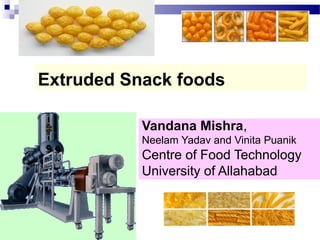

Extruded Snack foods
Vandana Mishra,
Neelam Yadav and Vinita Puanik
Centre of Food Technology
University of Allahabad
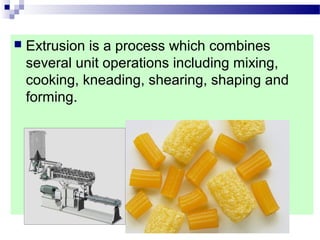
 Extrusion is a process which combines
several unit operations including mixing,
cooking, kneading, shearing, shaping and
forming.
Extrusion cooking (HTST) is a popular means
of preparing snacks and ready to eat foods.
Its advantages include
 energy efficient,
 lack of process effluents and
 versatility with respect to ingredient selection,
and the shapes and textures of products that
can be produced.
Extrusion processing is used for processing of
starch as well as pertinacious material.
It is an important food processing technique for
preparation of nutritious food
Snack foods:
 The snack food processes, which use extrusion cooking, include
the production of direct expanded extrudate and extruded pellets
or half products of the third generation snacks.
 The extruded half products require a secondary puffing step. Prior
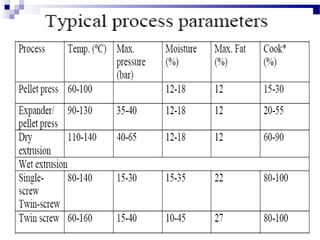
to consumption, the third generation snacks are puffed in a fryer,
or expanded in hot air or a microwave oven.
 Snack food technology of direct expanded, and shaped snacks is
similar to RTE cereals processes, but normally performed at lower
moistures, so that a higher energy input from mechanical sources
occurs.
 In general, direct expanded products are made using high-shear
extruders.
 Other categories of the direct expanded foods are crisps or flat
breads, which are produced using the twin-screw extruder
technology. Also, twin-screw extruders can be used for cracker
production.
Types of Snack Foods
Each snack processor may use a specific unit operation and
somewhat different technologies to produce unique snacks.
There are many ways to classify snacks. Manufacturers use three
main terms to identify snacks:
 First generation snacks: Simply Extruded Snacks
In this category all the natural products used for snacking,
nuts, potato chips and popped popcorn are included.
 Second generation snacks: ExpandedSnacks
The majority of the snacks fall in this category.
All the single ingredient snacks, simple shaped products like
corn tortilla chips and puffed corn curls and all directly
expanded snacks are included in this category.
 Third generation snacks, half products” or pellets
In this category, multi ingredient formed snacks and
pellets, made by extrusion cooking are included.
Most snack manufacturers use some form of existing
technology as the basis for creating snack products, but
incorporating variation is very necessary, especially to
increase the snack’s health image appeal by lowering fat
and calories or adding nutrients. This variation can be
accomplished by using extrusion technology.
 Simply Extruded Snacks
This category has the greatest potential for growth among
snack foods. These snacks can be made to produce
innovation, which captures consumer imagination.
Some examples are three-dimensional snacks, a variety of
animals, cartoon, and alphabets shapes etc.
Raw material costs play an important role in the finished
product’s selling price. Therefore it is advantageous to
use the lowest cost raw material to produce a successful
snack.
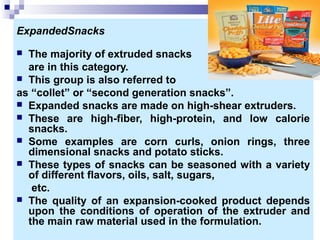
ExpandedSnacks
 The majority of extruded snacks
are in this category.
 This group is also referred to
as “collet” or “second generation snacks”.
 Expanded snacks are made on high-shear extruders.
 These are high-fiber, high-protein, and low calorie
snacks.
 Some examples are corn curls, onion rings, three
dimensional snacks and potato sticks.
 These types of snacks can be seasoned with a variety
of different flavors, oils, salt, sugars,
etc.
 The quality of an expansion-cooked product depends
upon the conditions of operation of the extruder and
the main raw material used in the formulation.
Fried Collets
These are the most familiar extruded snacks in
the market.
 A special die arrangement gives the product a
twisted, puffed shape.
 These collets are made on collet extruders.
 The product is then fried in vegetable oil, and
coated with cheese and some other flavor.
 During frying, the moisture level in the product
reduces from 8 percent to 1-2 percent.
 The most common material used for fried collet
is corn meal.
 Some other cereal grains can also be used for
this type of product.
Baked Collets
Baked collets are another example of
extruded snacks.
 This includes products such as baked corn
curls, onion rings and potato sticks.
 Baked collets can be made with different
cereal grains and tuber flours.
 Protein, fibers, cellulose, and bran can be
blended with cereal grain up to 20 percent to
make healthy snacks.
 Potato sticks are usually made by mixing
potato flour with corn or rice flour.
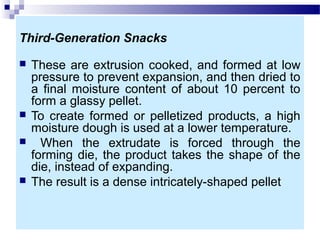
Third-Generation Snacks
 These are extrusion cooked, and formed at low
pressure to prevent expansion, and then dried to
a final moisture content of about 10 percent to
form a glassy pellet.
 To create formed or pelletized products, a high
moisture dough is used at a lower temperature.
 When the extrudate is forced through the
forming die, the product takes the shape of the
die, instead of expanding.
 The result is a dense intricately-shaped pellet
Flow diagram for the
production of second
and third generation
snacks
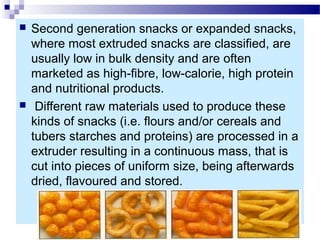
 Second generation snacks or expanded snacks,
where most extruded snacks are classified, are
usually low in bulk density and are often
marketed as high-fibre, low-calorie, high protein
and nutritional products.
 Different raw materials used to produce these
kinds of snacks (i.e. flours and/or cereals and
tubers starches and proteins) are processed in a
extruder resulting in a continuous mass, that is
cut into pieces of uniform size, being afterwards
dried, flavoured and stored.
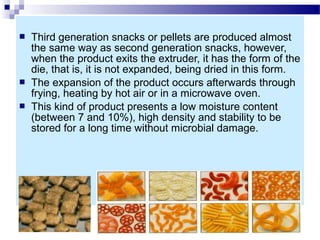
 Third generation snacks or pellets are produced almost
the same way as second generation snacks, however,
when the product exits the extruder, it has the form of the
die, that is, it is not expanded, being dried in this form.
 The expansion of the product occurs afterwards through
frying, heating by hot air or in a microwave oven.
 This kind of product presents a low moisture content
(between 7 and 10%), high density and stability to be
stored for a long time without microbial damage.
 Co-Extruded Snacks
This is a relatively new technology introduced in 1984 to the
snack food industry.
 Coextrusion is a process that combines two different extruded
streams to obtain two-component products characterized by a
dual texture and/or color.
 The two materials can come from two extruders or from one
extruder and one pump.
 This process can produce a snack with two different flavors,
or two textures or two colors.
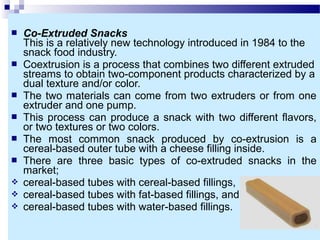
 The most common snack produced by co-extrusion is a
cereal-based outer tube with a cheese filling inside.
 There are three basic types of co-extruded snacks in the
market;
 cereal-based tubes with cereal-based fillings,
 cereal-based tubes with fat-based fillings, and
 cereal-based tubes with water-based fillings.
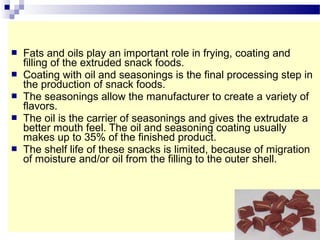
 Fats and oils play an important role in frying, coating and
filling of the extruded snack foods.
 Coating with oil and seasonings is the final processing step in
the production of snack foods.
 The seasonings allow the manufacturer to create a variety of
flavors.
 The oil is the carrier of seasonings and gives the extrudate a
better mouth feel. The oil and seasoning coating usually
makes up to 35% of the finished product.
 The shelf life of these snacks is limited, because of migration
of moisture and/or oil from the filling to the outer shell.
 Common Ingredients
Extrusion technology, have led to more diverse and
complex formulations for snack foods.
The most common source of ingredients is
 corn,
 wheat,
 rice, potato,
 tapioca, and oats.
A major ingredient in snack formulation is starch.
In its natural form, the starch is insoluble, tasteless,
and unsuited for human use.
To make it digestible and acceptable, it must be
cooked.
CerealSources
Almost any cereal can be extruded, but if
expansion is a major objective, the numbers of
functional cereals are limited to de-germed
corn/grits and rice.
 Cereals that have high amounts of lipids are more
difficult to expand due to dough slippage within the
extruder barrel.
 This type of cereal usually requires high moisture
and high temperature before significant puffing will
occur.
 In general, starches with 5-20 percent amylose
content will significantly improve expansion as well
as the texture of snack foods.
Rice as a Starch Source
1) Small, tightly packed starch granules that
hydrate slowly
2) Becomes sticky when it gelatinizes
3) Choose long grain varieties over medium
and short grain varieties as they are
much less sticky when cooked
4) Rice is very digestible even when cook
values are low
5) Rice bran may contain up to 40% starch
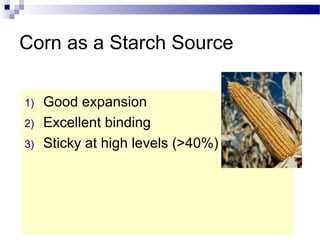
Corn as a Starch Source
1) Good expansion
2) Excellent binding
3) Sticky at high levels (>40%)
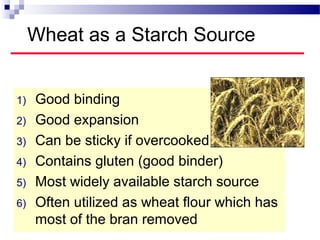
Wheat as a Starch Source
1) Good binding
2) Good expansion
3) Can be sticky if overcooked
4) Contains gluten (good binder)
5) Most widely available starch source
6) Often utilized as wheat flour which has
most of the bran removed
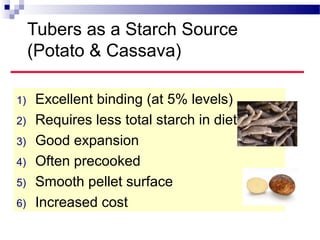
Tubers as a Starch Source
(Potato & Cassava)
1) Excellent binding (at 5% levels)
2) Requires less total starch in diet
3) Good expansion
4) Often precooked
5) Smooth pellet surface
6) Increased cost
Factors influencing the degree of puffing of
snacks during extrusion
 The amount of moisture in the feed material,
dough residence time in the extruder barrel
and cereal particle size.
 To manufacture expanded products, the
pressure and temperature are increased, while
the moisture level is accurately controlled.
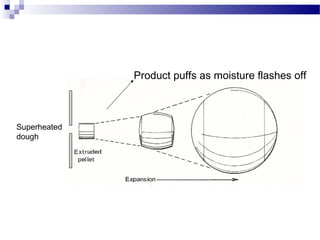
 When the product exerts the extruder through
the forming die, the change in atmospheric
pressure causes the internal moisture to turn
to steam. This puffs the fully-cooked dough
into an expanded product.
The factors are-
a) Raw materials
The most used raw materials in the extrusion process are
- starch and
- protein based materials.
The structure of the extruded products may be formed from
starch or protein polymers.
In general, the chemical or physicochemical changes in
biopolymers that can occur during extrusion cooking include:
binding, cleavage, loss of native conformation, fragment
recombination and thermal degradation.
Thermally labile compounds such as flavors and vitamins may
be injected immediately before the die to minimize exposure
to heat and shear.
 Moisture
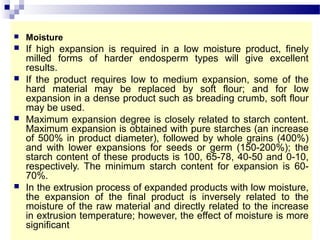
 If high expansion is required in a low moisture product, finely
milled forms of harder endosperm types will give excellent
results.
 If the product requires low to medium expansion, some of the
hard material may be replaced by soft flour; and for low
expansion in a dense product such as breading crumb, soft flour
may be used.
 Maximum expansion degree is closely related to starch content.
Maximum expansion is obtained with pure starches (an increase
of 500% in product diameter), followed by whole grains (400%)
and with lower expansions for seeds or germ (150-200%); the
starch content of these products is 100, 65-78, 40-50 and 0-10,
respectively. The minimum starch content for expansion is 60-
70%.
 In the extrusion process of expanded products with low moisture,
the expansion of the final product is inversely related to the
moisture of the raw material and directly related to the increase
in extrusion temperature; however, the effect of moisture is more
significant
Superheated
dough
Product puffs as moisture flashes off
Fibre
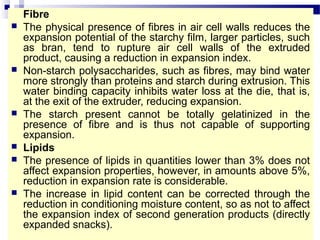
 The physical presence of fibres in air cell walls reduces the
expansion potential of the starchy film, larger particles, such
as bran, tend to rupture air cell walls of the extruded
product, causing a reduction in expansion index.
 Non-starch polysaccharides, such as fibres, may bind water
more strongly than proteins and starch during extrusion. This
water binding capacity inhibits water loss at the die, that is,
at the exit of the extruder, reducing expansion.
 The starch present cannot be totally gelatinized in the
presence of fibre and is thus not capable of supporting
expansion.
 Lipids
 The presence of lipids in quantities lower than 3% does not
affect expansion properties, however, in amounts above 5%,
reduction in expansion rate is considerable.
 The increase in lipid content can be corrected through the
reduction in conditioning moisture content, so as not to affect
the expansion index of second generation products (directly
expanded snacks).
 Temperature
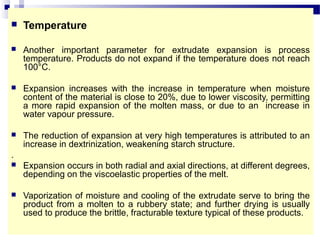
 Another important parameter for extrudate expansion is process
temperature. Products do not expand if the temperature does not reach
100°C.
 Expansion increases with the increase in temperature when moisture
content of the material is close to 20%, due to lower viscosity, permitting
a more rapid expansion of the molten mass, or due to an increase in
water vapour pressure.
 The reduction of expansion at very high temperatures is attributed to an
increase in dextrinization, weakening starch structure.
.
 Expansion occurs in both radial and axial directions, at different degrees,
depending on the viscoelastic properties of the melt.
 Vaporization of moisture and cooling of the extrudate serve to bring the
product from a molten to a rubbery state; and further drying is usually
used to produce the brittle, fracturable texture typical of these products.
Conclusion
In the future science and technology of the
extrusion field, scientists and engineers
should focus on the relationship between
composition changes and product quality,
evaluating and enhancing nutritional, sensory
and functional properties of extruded foods.
Thank you

Extruded Snack Food

  • 1.
    Extruded Snack foods VandanaMishra, Neelam Yadav and Vinita Puanik Centre of Food Technology University of Allahabad
  • 2.
     Extrusion isa process which combines several unit operations including mixing, cooking, kneading, shearing, shaping and forming.
  • 3.
    Extrusion cooking (HTST)is a popular means of preparing snacks and ready to eat foods. Its advantages include  energy efficient,  lack of process effluents and  versatility with respect to ingredient selection, and the shapes and textures of products that can be produced. Extrusion processing is used for processing of starch as well as pertinacious material. It is an important food processing technique for preparation of nutritious food
  • 5.
    Snack foods:  Thesnack food processes, which use extrusion cooking, include the production of direct expanded extrudate and extruded pellets or half products of the third generation snacks.  The extruded half products require a secondary puffing step. Prior to consumption, the third generation snacks are puffed in a fryer, or expanded in hot air or a microwave oven.  Snack food technology of direct expanded, and shaped snacks is similar to RTE cereals processes, but normally performed at lower moistures, so that a higher energy input from mechanical sources occurs.  In general, direct expanded products are made using high-shear extruders.  Other categories of the direct expanded foods are crisps or flat breads, which are produced using the twin-screw extruder technology. Also, twin-screw extruders can be used for cracker production.
  • 6.
    Types of SnackFoods Each snack processor may use a specific unit operation and somewhat different technologies to produce unique snacks. There are many ways to classify snacks. Manufacturers use three main terms to identify snacks:  First generation snacks: Simply Extruded Snacks In this category all the natural products used for snacking, nuts, potato chips and popped popcorn are included.  Second generation snacks: ExpandedSnacks The majority of the snacks fall in this category. All the single ingredient snacks, simple shaped products like corn tortilla chips and puffed corn curls and all directly expanded snacks are included in this category.  Third generation snacks, half products” or pellets In this category, multi ingredient formed snacks and pellets, made by extrusion cooking are included.
  • 7.
    Most snack manufacturersuse some form of existing technology as the basis for creating snack products, but incorporating variation is very necessary, especially to increase the snack’s health image appeal by lowering fat and calories or adding nutrients. This variation can be accomplished by using extrusion technology.  Simply Extruded Snacks This category has the greatest potential for growth among snack foods. These snacks can be made to produce innovation, which captures consumer imagination. Some examples are three-dimensional snacks, a variety of animals, cartoon, and alphabets shapes etc. Raw material costs play an important role in the finished product’s selling price. Therefore it is advantageous to use the lowest cost raw material to produce a successful snack.
  • 8.
    ExpandedSnacks  The majorityof extruded snacks are in this category.  This group is also referred to as “collet” or “second generation snacks”.  Expanded snacks are made on high-shear extruders.  These are high-fiber, high-protein, and low calorie snacks.  Some examples are corn curls, onion rings, three dimensional snacks and potato sticks.  These types of snacks can be seasoned with a variety of different flavors, oils, salt, sugars, etc.  The quality of an expansion-cooked product depends upon the conditions of operation of the extruder and the main raw material used in the formulation.
  • 9.
    Fried Collets These arethe most familiar extruded snacks in the market.  A special die arrangement gives the product a twisted, puffed shape.  These collets are made on collet extruders.  The product is then fried in vegetable oil, and coated with cheese and some other flavor.  During frying, the moisture level in the product reduces from 8 percent to 1-2 percent.  The most common material used for fried collet is corn meal.  Some other cereal grains can also be used for this type of product.
  • 10.
    Baked Collets Baked colletsare another example of extruded snacks.  This includes products such as baked corn curls, onion rings and potato sticks.  Baked collets can be made with different cereal grains and tuber flours.  Protein, fibers, cellulose, and bran can be blended with cereal grain up to 20 percent to make healthy snacks.  Potato sticks are usually made by mixing potato flour with corn or rice flour.
  • 11.
    Third-Generation Snacks  Theseare extrusion cooked, and formed at low pressure to prevent expansion, and then dried to a final moisture content of about 10 percent to form a glassy pellet.  To create formed or pelletized products, a high moisture dough is used at a lower temperature.  When the extrudate is forced through the forming die, the product takes the shape of the die, instead of expanding.  The result is a dense intricately-shaped pellet
  • 12.
    Flow diagram forthe production of second and third generation snacks
  • 13.
     Second generationsnacks or expanded snacks, where most extruded snacks are classified, are usually low in bulk density and are often marketed as high-fibre, low-calorie, high protein and nutritional products.  Different raw materials used to produce these kinds of snacks (i.e. flours and/or cereals and tubers starches and proteins) are processed in a extruder resulting in a continuous mass, that is cut into pieces of uniform size, being afterwards dried, flavoured and stored.
  • 14.
     Third generationsnacks or pellets are produced almost the same way as second generation snacks, however, when the product exits the extruder, it has the form of the die, that is, it is not expanded, being dried in this form.  The expansion of the product occurs afterwards through frying, heating by hot air or in a microwave oven.  This kind of product presents a low moisture content (between 7 and 10%), high density and stability to be stored for a long time without microbial damage.
  • 15.
     Co-Extruded Snacks Thisis a relatively new technology introduced in 1984 to the snack food industry.  Coextrusion is a process that combines two different extruded streams to obtain two-component products characterized by a dual texture and/or color.  The two materials can come from two extruders or from one extruder and one pump.  This process can produce a snack with two different flavors, or two textures or two colors.  The most common snack produced by co-extrusion is a cereal-based outer tube with a cheese filling inside.  There are three basic types of co-extruded snacks in the market;  cereal-based tubes with cereal-based fillings,  cereal-based tubes with fat-based fillings, and  cereal-based tubes with water-based fillings.
  • 16.
     Fats andoils play an important role in frying, coating and filling of the extruded snack foods.  Coating with oil and seasonings is the final processing step in the production of snack foods.  The seasonings allow the manufacturer to create a variety of flavors.  The oil is the carrier of seasonings and gives the extrudate a better mouth feel. The oil and seasoning coating usually makes up to 35% of the finished product.  The shelf life of these snacks is limited, because of migration of moisture and/or oil from the filling to the outer shell.
  • 17.
     Common Ingredients Extrusiontechnology, have led to more diverse and complex formulations for snack foods. The most common source of ingredients is  corn,  wheat,  rice, potato,  tapioca, and oats. A major ingredient in snack formulation is starch. In its natural form, the starch is insoluble, tasteless, and unsuited for human use. To make it digestible and acceptable, it must be cooked.
  • 18.
    CerealSources Almost any cerealcan be extruded, but if expansion is a major objective, the numbers of functional cereals are limited to de-germed corn/grits and rice.  Cereals that have high amounts of lipids are more difficult to expand due to dough slippage within the extruder barrel.  This type of cereal usually requires high moisture and high temperature before significant puffing will occur.  In general, starches with 5-20 percent amylose content will significantly improve expansion as well as the texture of snack foods.
  • 19.
    Rice as aStarch Source 1) Small, tightly packed starch granules that hydrate slowly 2) Becomes sticky when it gelatinizes 3) Choose long grain varieties over medium and short grain varieties as they are much less sticky when cooked 4) Rice is very digestible even when cook values are low 5) Rice bran may contain up to 40% starch
  • 20.
    Corn as aStarch Source 1) Good expansion 2) Excellent binding 3) Sticky at high levels (>40%)
  • 21.
    Wheat as aStarch Source 1) Good binding 2) Good expansion 3) Can be sticky if overcooked 4) Contains gluten (good binder) 5) Most widely available starch source 6) Often utilized as wheat flour which has most of the bran removed
  • 22.
    Tubers as aStarch Source (Potato & Cassava) 1) Excellent binding (at 5% levels) 2) Requires less total starch in diet 3) Good expansion 4) Often precooked 5) Smooth pellet surface 6) Increased cost
  • 23.
    Factors influencing thedegree of puffing of snacks during extrusion  The amount of moisture in the feed material, dough residence time in the extruder barrel and cereal particle size.  To manufacture expanded products, the pressure and temperature are increased, while the moisture level is accurately controlled.  When the product exerts the extruder through the forming die, the change in atmospheric pressure causes the internal moisture to turn to steam. This puffs the fully-cooked dough into an expanded product.
  • 24.
    The factors are- a)Raw materials The most used raw materials in the extrusion process are - starch and - protein based materials. The structure of the extruded products may be formed from starch or protein polymers. In general, the chemical or physicochemical changes in biopolymers that can occur during extrusion cooking include: binding, cleavage, loss of native conformation, fragment recombination and thermal degradation. Thermally labile compounds such as flavors and vitamins may be injected immediately before the die to minimize exposure to heat and shear.
  • 25.
     Moisture  Ifhigh expansion is required in a low moisture product, finely milled forms of harder endosperm types will give excellent results.  If the product requires low to medium expansion, some of the hard material may be replaced by soft flour; and for low expansion in a dense product such as breading crumb, soft flour may be used.  Maximum expansion degree is closely related to starch content. Maximum expansion is obtained with pure starches (an increase of 500% in product diameter), followed by whole grains (400%) and with lower expansions for seeds or germ (150-200%); the starch content of these products is 100, 65-78, 40-50 and 0-10, respectively. The minimum starch content for expansion is 60- 70%.  In the extrusion process of expanded products with low moisture, the expansion of the final product is inversely related to the moisture of the raw material and directly related to the increase in extrusion temperature; however, the effect of moisture is more significant
  • 26.
  • 27.
    Fibre  The physicalpresence of fibres in air cell walls reduces the expansion potential of the starchy film, larger particles, such as bran, tend to rupture air cell walls of the extruded product, causing a reduction in expansion index.  Non-starch polysaccharides, such as fibres, may bind water more strongly than proteins and starch during extrusion. This water binding capacity inhibits water loss at the die, that is, at the exit of the extruder, reducing expansion.  The starch present cannot be totally gelatinized in the presence of fibre and is thus not capable of supporting expansion.  Lipids  The presence of lipids in quantities lower than 3% does not affect expansion properties, however, in amounts above 5%, reduction in expansion rate is considerable.  The increase in lipid content can be corrected through the reduction in conditioning moisture content, so as not to affect the expansion index of second generation products (directly expanded snacks).
  • 28.
     Temperature  Anotherimportant parameter for extrudate expansion is process temperature. Products do not expand if the temperature does not reach 100°C.  Expansion increases with the increase in temperature when moisture content of the material is close to 20%, due to lower viscosity, permitting a more rapid expansion of the molten mass, or due to an increase in water vapour pressure.  The reduction of expansion at very high temperatures is attributed to an increase in dextrinization, weakening starch structure. .  Expansion occurs in both radial and axial directions, at different degrees, depending on the viscoelastic properties of the melt.  Vaporization of moisture and cooling of the extrudate serve to bring the product from a molten to a rubbery state; and further drying is usually used to produce the brittle, fracturable texture typical of these products.
  • 30.
    Conclusion In the futurescience and technology of the extrusion field, scientists and engineers should focus on the relationship between composition changes and product quality, evaluating and enhancing nutritional, sensory and functional properties of extruded foods.
  • 31.