CRITICAL CONTROL
POINTS
PREPARED BY:-
SOURABH BHARTIA
B.SC. & M.SC.
(FOOD PROCESSING & TECHNOLOGY)
UNIVERSITY TEACHING DEPARTMENT
ATAL BIHARI VAJPAYEE UNIVERSITY,
BILASPUR (C.G.)
sourabhbhartia@gmail.com
www.linkedin.com/in/sourabh-bhartia
Prepared by :- Sourabh Bhartia
CONTENTS
 CRITICAL CONTROL POINT .1
 THE FOOD RISK MANAGEMENT OVERVIEW .2
 HACCP .3
 TACCP .6
 VACCP .10
 REFERENCE .13
Prepared by :- Sourabh Bhartia
CCP 1
STANDS FOR “CRITICAL CONTROL POINT”
 It is the point where the failure of standard operation
procedure could cause harm to customers and to the
business, or even loss of the business itself;
 It is a point, step or procedure in processing at which
control has to be applied.
 It is an attribute of Food Risk Management.
Prepared by :- Sourabh Bhartia
FOOD RISK MANAGEMENT 2
Un-intentional Intentional
FOOD QUALITY
FOOD SAFETY
FOOD FRAUD
MOTIVATION
ECONOMIC GAIN
FOOD DEFENCE
HARM PUBLIC
HEALTH
Controlled by Food Quality
Management System (FQMS).
Controlled by Food Safety
Management System (FSMS)
i.e. HACCP.
Controlled by VACCP (Vulnerability
Assessment Critical Control Point).
Controlled by TACCP (Threat
Assessment Critical Control Point).
Prepared by :- Sourabh Bhartia
HACCP 3
STANDS FOR “HAZARD ANALYSIS & CRITICAL CONTROL POINT”
 It is a step or point or procedure in processing at which
control has to be applied and, is essential to prevent and
eliminate any food safety hazard or to reduce it at
acceptable level.
 Types of hazards HACCP deals with :-
Physical Hazards
Chemical Hazards
Biological Hazards
Prepared by :- Sourabh Bhartia
7 Principles of HACCP 4
1. Conduct a Hazard Analysis;
2. Determine Critical Control Points;
3. Decide Critical Limits;
4. Define Monitoring Procedures;
5. Define Corrective Action Procedures;
6. Define Verification Procedures;
7. Record Keeping.
Benefits of HACCP
Prepared by :- Sourabh Bhartia
5
Why need HACCP ?
 Prevention of food borne disease outbreaks;
 Food safety.
 Everyone have right to expect the food they eat to be
safe & suitable for consumption;
 To make Food Safety a Global Concern;
 To improve Scientific & Systematic approach;
 To make consumer more aware;
 For Global Fair Trade.
Prepared by :- Sourabh Bhartia
TACCP 6
STANDS FOR “THREAT ASSESSMENT & CRITICAL CONTROL POINT”
TACCP AIMS TO :-
 Reduce the likelihood & consequence
of a deliberate attack;
 Protect Organizational reputation;
 Reassure customers & the public that
proportionate steps are in place to
protect food;
 Demonstrate that reasonable
precautions are taken & due diligence
is exercised in protecting food
Prepared by :- Sourabh Bhartia
TYPES of THREATS TACCP DEALS WITH 7
 Economically Motivated Adulteration
 Espionage
 Malicious Contamination
 Counterfeiting
 Extortion
 Cyber Crime
Prepared by :- Sourabh Bhartia
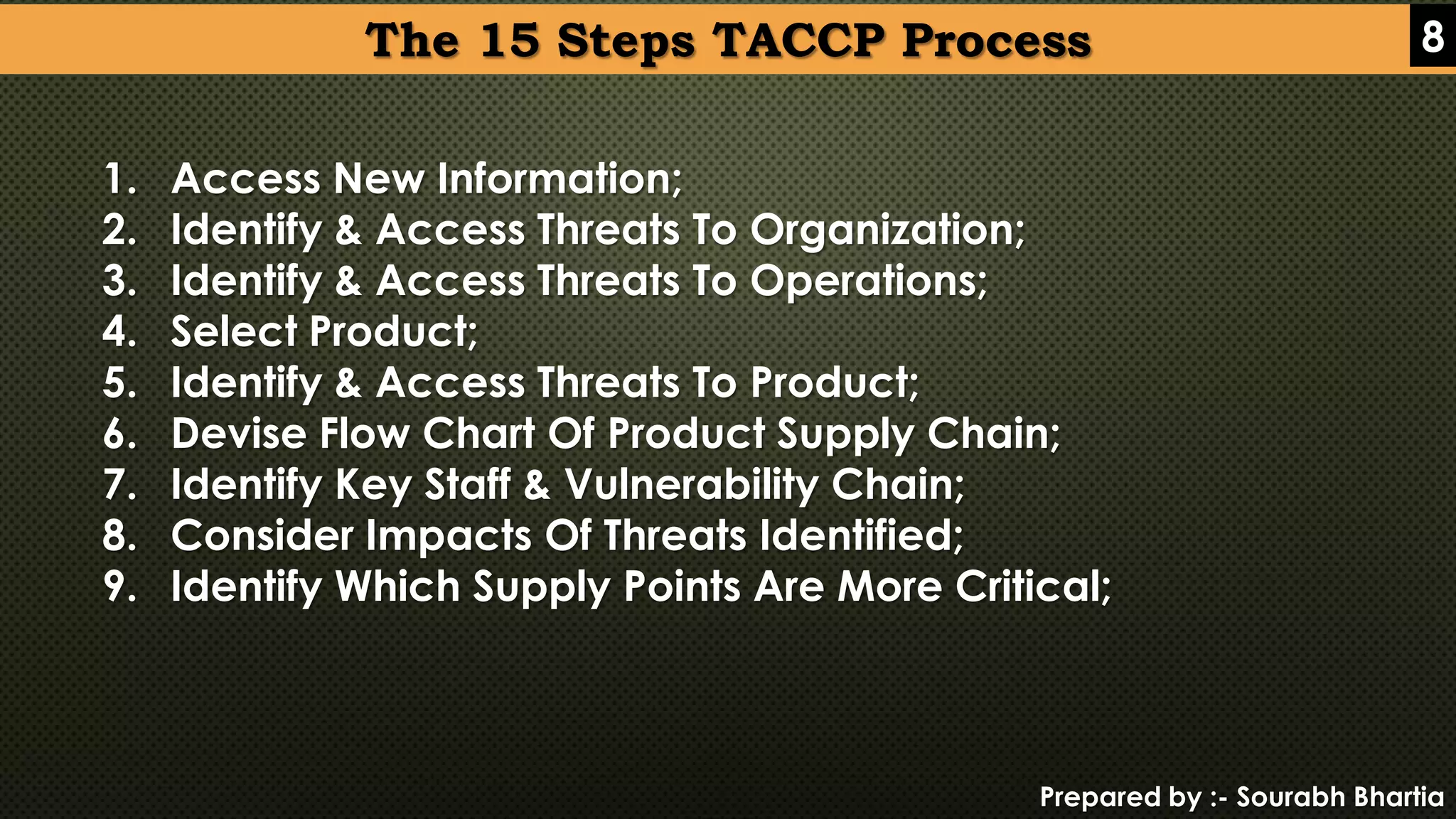
The 15 Steps TACCP Process 8
1. Access New Information;
2. Identify & Access Threats To Organization;
3. Identify & Access Threats To Operations;
4. Select Product;
5. Identify & Access Threats To Product;
6. Devise Flow Chart Of Product Supply Chain;
7. Identify Key Staff & Vulnerability Chain;
8. Consider Impacts Of Threats Identified;
9. Identify Which Supply Points Are More Critical;
Prepared by :- Sourabh Bhartia
The 15 Steps TACCP Process 9
10. Determine If Control Procedures Would Detect The Threat;
11. Likelihood Vs. Impact = Priority;
12. Identify Who Could Carry Out;
13. Decide & Implement Necessary Controls;
14. Review & Revise;
15. Monitor Horizon Scans & Emerging Risks.
Prepared by :- Sourabh Bhartia
VACCP 10
STANDS FOR “VULNERABILITY ASSESSMENT & CRITICAL CONTROL
POINT”
 It focuses on food frauds as well, and widens the scope to
include systematic prevention of any potential
adulteration of food, by identifying the vulnerable points
in a Supply Chain.
Prepared by :- Sourabh Bhartia
TYPES OF VULNERABILITIES VACCP DEALS WITH 11
SUBSTITUTION
CONCEALMENT
MISLABELLING
GREY MARKET PRODUCTION
UNAPPROVED ENHANCEMENT
COUNTER FEEDING
DILUTION
 Sunflower oil substituted with mineral oil.
 Hydrolyzed leather protein in milk.
 Poultry injected with hormones to conceal diseases.
 Harmful food color applied to fruits to cover defects
 Expiry Provenance (unsafe origin).
 Mislabeled recycled cooking oil.
 Sales of excess products unreported.
 Melamine added to enhance protein value.
 Use of unauthorized additives like use of harmful
dyes in spices.
 Copies of popular foods not produced with safety
measures.
 Using non-potable or unsafe water.
 Olive oil diluted with potentially toxic tea tree oil.
Prepared by :- Sourabh Bhartia
The 6 Steps VACCP Process 12
1. Conduct a risk analysis. Evaluate any significant risk &
exposures
2. Determine the critical points for controlling the security.
3. Determine procedures and technical means of verifying
each critical point to control security.
4. Determine the corrective measures to be implemented
when the surveillance reveals that a critical point for
security control is no longer under control.
5. Apply verification procedures in order to confirm that the
system is functioning effectively.
6. Build up a file which includes all procedures and reports
concerning these provisions and their implementations.
Prepared by :- Sourabh Bhartia
REFERENCE 13
 https://globalfoodsafetyresource.com/ta
ccp-and-vaccp-what-is-the-difference/
 https://onlinelibrary.wiley.com/doi/full
/10.1111/1750-3841.13256
Prepared by :- Sourabh Bhartia
14

CRITICAL CONTROL POINTS

  • 1.
    CRITICAL CONTROL POINTS PREPARED BY:- SOURABHBHARTIA B.SC. & M.SC. (FOOD PROCESSING & TECHNOLOGY) UNIVERSITY TEACHING DEPARTMENT ATAL BIHARI VAJPAYEE UNIVERSITY, BILASPUR (C.G.) sourabhbhartia@gmail.com www.linkedin.com/in/sourabh-bhartia
  • 2.
    Prepared by :-Sourabh Bhartia CONTENTS  CRITICAL CONTROL POINT .1  THE FOOD RISK MANAGEMENT OVERVIEW .2  HACCP .3  TACCP .6  VACCP .10  REFERENCE .13
  • 3.
    Prepared by :-Sourabh Bhartia CCP 1 STANDS FOR “CRITICAL CONTROL POINT”  It is the point where the failure of standard operation procedure could cause harm to customers and to the business, or even loss of the business itself;  It is a point, step or procedure in processing at which control has to be applied.  It is an attribute of Food Risk Management.
  • 4.
    Prepared by :-Sourabh Bhartia FOOD RISK MANAGEMENT 2 Un-intentional Intentional FOOD QUALITY FOOD SAFETY FOOD FRAUD MOTIVATION ECONOMIC GAIN FOOD DEFENCE HARM PUBLIC HEALTH Controlled by Food Quality Management System (FQMS). Controlled by Food Safety Management System (FSMS) i.e. HACCP. Controlled by VACCP (Vulnerability Assessment Critical Control Point). Controlled by TACCP (Threat Assessment Critical Control Point).
  • 5.
    Prepared by :-Sourabh Bhartia HACCP 3 STANDS FOR “HAZARD ANALYSIS & CRITICAL CONTROL POINT”  It is a step or point or procedure in processing at which control has to be applied and, is essential to prevent and eliminate any food safety hazard or to reduce it at acceptable level.  Types of hazards HACCP deals with :- Physical Hazards Chemical Hazards Biological Hazards
  • 6.
    Prepared by :-Sourabh Bhartia 7 Principles of HACCP 4 1. Conduct a Hazard Analysis; 2. Determine Critical Control Points; 3. Decide Critical Limits; 4. Define Monitoring Procedures; 5. Define Corrective Action Procedures; 6. Define Verification Procedures; 7. Record Keeping.
  • 7.
    Benefits of HACCP Preparedby :- Sourabh Bhartia 5 Why need HACCP ?  Prevention of food borne disease outbreaks;  Food safety.  Everyone have right to expect the food they eat to be safe & suitable for consumption;  To make Food Safety a Global Concern;  To improve Scientific & Systematic approach;  To make consumer more aware;  For Global Fair Trade.
  • 8.
    Prepared by :-Sourabh Bhartia TACCP 6 STANDS FOR “THREAT ASSESSMENT & CRITICAL CONTROL POINT” TACCP AIMS TO :-  Reduce the likelihood & consequence of a deliberate attack;  Protect Organizational reputation;  Reassure customers & the public that proportionate steps are in place to protect food;  Demonstrate that reasonable precautions are taken & due diligence is exercised in protecting food
  • 9.
    Prepared by :-Sourabh Bhartia TYPES of THREATS TACCP DEALS WITH 7  Economically Motivated Adulteration  Espionage  Malicious Contamination  Counterfeiting  Extortion  Cyber Crime
  • 10.
    Prepared by :-Sourabh Bhartia The 15 Steps TACCP Process 8 1. Access New Information; 2. Identify & Access Threats To Organization; 3. Identify & Access Threats To Operations; 4. Select Product; 5. Identify & Access Threats To Product; 6. Devise Flow Chart Of Product Supply Chain; 7. Identify Key Staff & Vulnerability Chain; 8. Consider Impacts Of Threats Identified; 9. Identify Which Supply Points Are More Critical;
  • 11.
    Prepared by :-Sourabh Bhartia The 15 Steps TACCP Process 9 10. Determine If Control Procedures Would Detect The Threat; 11. Likelihood Vs. Impact = Priority; 12. Identify Who Could Carry Out; 13. Decide & Implement Necessary Controls; 14. Review & Revise; 15. Monitor Horizon Scans & Emerging Risks.
  • 12.
    Prepared by :-Sourabh Bhartia VACCP 10 STANDS FOR “VULNERABILITY ASSESSMENT & CRITICAL CONTROL POINT”  It focuses on food frauds as well, and widens the scope to include systematic prevention of any potential adulteration of food, by identifying the vulnerable points in a Supply Chain.
  • 13.
    Prepared by :-Sourabh Bhartia TYPES OF VULNERABILITIES VACCP DEALS WITH 11 SUBSTITUTION CONCEALMENT MISLABELLING GREY MARKET PRODUCTION UNAPPROVED ENHANCEMENT COUNTER FEEDING DILUTION  Sunflower oil substituted with mineral oil.  Hydrolyzed leather protein in milk.  Poultry injected with hormones to conceal diseases.  Harmful food color applied to fruits to cover defects  Expiry Provenance (unsafe origin).  Mislabeled recycled cooking oil.  Sales of excess products unreported.  Melamine added to enhance protein value.  Use of unauthorized additives like use of harmful dyes in spices.  Copies of popular foods not produced with safety measures.  Using non-potable or unsafe water.  Olive oil diluted with potentially toxic tea tree oil.
  • 14.
    Prepared by :-Sourabh Bhartia The 6 Steps VACCP Process 12 1. Conduct a risk analysis. Evaluate any significant risk & exposures 2. Determine the critical points for controlling the security. 3. Determine procedures and technical means of verifying each critical point to control security. 4. Determine the corrective measures to be implemented when the surveillance reveals that a critical point for security control is no longer under control. 5. Apply verification procedures in order to confirm that the system is functioning effectively. 6. Build up a file which includes all procedures and reports concerning these provisions and their implementations.
  • 15.
    Prepared by :-Sourabh Bhartia REFERENCE 13  https://globalfoodsafetyresource.com/ta ccp-and-vaccp-what-is-the-difference/  https://onlinelibrary.wiley.com/doi/full /10.1111/1750-3841.13256
  • 16.
    Prepared by :-Sourabh Bhartia 14