DEPTH STUDY
GERMANY
THE IMPACT
OF THE TREATY
OF VERSAILLES
2
CAMBRIDGE IGCSE – DEPTH STUDY: GERMANY
BACKGROUND
• The new Weimar Republic had to shoulder the blame for
the disastrous Treaty of Versailles.
CAMBRIDGE IGCSE – DEPTH STUDY: GERMANY
THE TREATY OF VERSAILLES
• Germany rejected it but was forced to sign it in June 1919.
• Millions of Germans were given to neighbouring states and
Germany was left with too few soldiers to defend herself.
• The German Government had been excluded from the
negotiations and the treaty imposed. It was a “diktat” (a
dictated peace).
• War guilt was imposed on Germany to justify making her
pay reparations to the Allies.
• Adolf Hitler called the treaty a diktat.
CAMBRIDGE IGCSE – DEPTH STUDY: GERMANY
POLITICAL INSTABILITY
• The Weimar Republic was blamed for Germany’s
humiliation at Versailles, which weakened the new
democracy.
• Its first years were troubled by constant instability.
CAMBRIDGE IGCSE – DEPTH STUDY: GERMANY
TIMELINE
• January and March 1919 – Spartacist rising in Berlin: more
than 1,200 killed by the army under General Groener. A
Soviet Republic was declared in Bavaria.
• March 1920 - Wolfgang Kapp led rightist nationalist
Freikorps (disbanded soldiers) in their bid for power in
Berlin. They were defeated by a general strike. The
communists formed the Ruhr Army (50,000 workers) to
resist the Freikorps and the army. Ebert granted
concessions, then used the army. Over 1,000 workers and
250 police were killed by 1923.
• June 1922 – Assassination of the Foreign Minister, Walter
Rathenau, by right-wing terrorists. They disliked his Jewish
origins and he had attempted to improve the Treaty of
Versailles.
CAMBRIDGE IGCSE – DEPTH STUDY: GERMANY
TIMELINE cont.
• January 1923 – French and Belgian troops invaded the Ruhr
to extract reparations by force.
• Summer 1923 – Economic collapse followed by communist
strikes in Saxony. Suppressed by government troops in
October.
• November 1923 – The Munich Putsch.
CAMBRIDGE IGCSE – DEPTH STUDY: GERMANY
CONSTITUTIONAL PROBLEMS
• The Weimar Republic was also undermined by its own
constitution.
• It was based on proportional representation and could not
provide support for strong measures.
• Socialist support fell from 38% in 1919 to 21% in 1920.
CAMBRIDGE IGCSE – DEPTH STUDY: GERMANY
PR AND HYPERINFLATION
• PROPORTIONAL REPRESENTATION
Members of the Reichstag were elected in exactly the same
proportion as the votes cast for them in the election. This led to weak
coalition governments.
• HYPERINFLATION
Rapidly accelerating inflation in which prices rise ten or a hundred-
fold within a month
CAMBRIDGE IGCSE – DEPTH STUDY: GERMANY
THE ARMY
• The Treaty of Versailles was unpopular with the Germans.
• The right wing was the strongest opposition.
• The army resented the treaty because it was decimated: from
one million professional soldiers was reduced to 100,000
volunteers.
• Many discharged soldiers joined the Freikorps to continue
their military life.
CAMBRIDGE IGCSE – DEPTH STUDY: GERMANY
THE FREIKORPS
• This move concerned the Allies who regarded the number
enrolled in the Freikorps as part of the 100,000 limitation.
• When the Weimar Government attempted to implement an
Allied request that the Freikorps be disbanded there was a
revolt, the Kapp Putsch.
• The Freikorps were a group of ex-soldiers who shared strong
anti-communist views and a taste for violence.
• They were a volunteer force initially formed by Ebert on the
eve of the Spartacist Uprisings (January and March 1919).
• They were armed and well-equipped.
• They numbered about 4,000 in January 1919.
CAMBRIDGE IGCSE – DEPTH STUDY: GERMANY
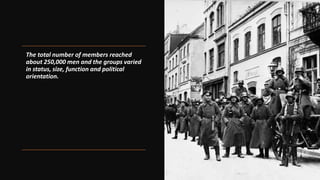
The total number of members reached
about 250,000 men and the groups varied
in status, size, function and political
orientation.
CAMBRIDGE IGCSE – DEPTH STUDY: GERMANY
THE KAPP PUTSCH, MARCH 1920
• The leader was Dr Wolfgang Kapp.
• The objective of the revolt was to overthrow the Weimar
Government and to replace it with a nationalist government.
• The method was through marching towards Berlin.
• The Government response was poor, because it was unable to
rely on army’s support and they fled to Dresden.
CAMBRIDGE IGCSE – DEPTH STUDY: GERMANY
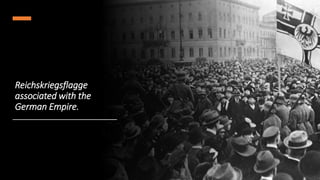
Reichskriegsflagge
associated with the
German Empire.
CAMBRIDGE IGCSE – DEPTH STUDY: GERMANY
THE KAPP PUTSCH, MARCH 1920
cont.
• The government appealed for assistance from the Berlin
workers.
• The reason for the failure of the putsch was the general
strike in Berlin, bringing the capital to a halt – transport,
public utilities and civil service.
• The significance of the putsch was big.
• The government survived but it had not been able to restore
order using its own law-enforcing agencies.
• While the army did not actively support the putsch, neither
did it assist the government.
CAMBRIDGE IGCSE – DEPTH STUDY: GERMANY
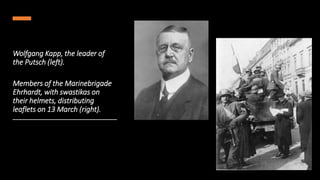
Wolfgang Kapp, the leader of
the Putsch (left).
Members of the Marinebrigade
Ehrhardt, with swastikas on
their helmets, distributing
leaflets on 13 March (right).
CAMBRIDGE IGCSE – DEPTH STUDY: GERMANY
THE ECONOMY
• The treaty stripped Germany of European territory,
resources, colonies and its navy.
• It also imposed reparations, assessed in 1921 at 6.6 billion
pounds.
• The Weimar government argued that this amount placed an
impossible strain on an economy already burdened with war
debts and deprived of the means to create wealth.
• In 1922 the government failed to pay its second instalment.
• The French thought that Germans were bluffing and trying to
avoid their treaty obligation. Together with the Belgians they
decided to occupy the Ruhr industrial region in January 1923.
CAMBRIDGE IGCSE – DEPTH STUDY: GERMANY
RUHR OCUPPATION
• The intention was to seize coal to the value of the money
owed.
• The action misfired and led to a serious economic and
financial crisis.
• The Germans authorised passive resistance to the French.
This meant that the German population of the Ruhr refused
to work in the mines or accept orders from the occupiers.
• Amid violence and shootings, the French responded by
expelling 100,000 Germans from the Ruhr.
• Since the Ruhr was the main wealth-producing area, the
revenue of the government fell at the very time that it
needed to find more money.
CAMBRIDGE IGCSE – DEPTH STUDY: GERMANY
RUHR OCUPPATION cont.
• The expelled Germans also had to be rehoused.
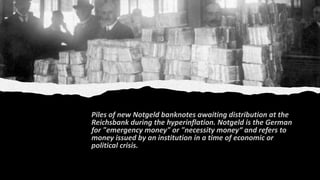
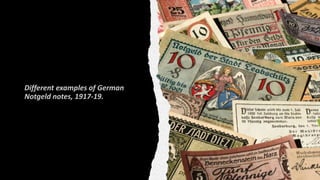
• The government decided to print money.
• This action led to hyperinflation during the second half of
1923.
• The currency collapsed and Germans resorted to bartering –
exchanging goods for other goods or services.
CAMBRIDGE IGCSE – DEPTH STUDY: GERMANY
HYPERINFLATION
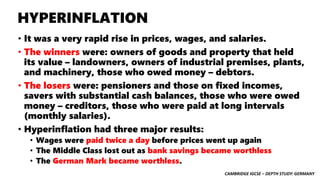
• It was a very rapid rise in prices, wages, and salaries.
• The winners were: owners of goods and property that held
its value – landowners, owners of industrial premises, plants,
and machinery, those who owed money – debtors.
• The losers were: pensioners and those on fixed incomes,
savers with substantial cash balances, those who were owed
money – creditors, those who were paid at long intervals
(monthly salaries).
• Hyperinflation had three major results:
• Wages were paid twice a day before prices went up again
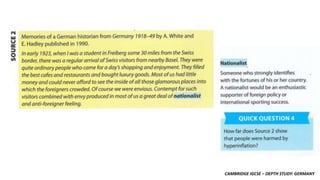
• The Middle Class lost out as bank savings became worthless
• The German Mark became worthless.
CAMBRIDGE IGCSE – DEPTH STUDY: GERMANY
THE WEIMAR GOVERNMENT
RESPONSE
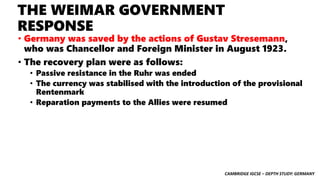
• Germany was saved by the actions of Gustav Stresemann,
who was Chancellor and Foreign Minister in August 1923.
• The recovery plan were as follows:
• Passive resistance in the Ruhr was ended
• The currency was stabilised with the introduction of the provisional
Rentenmark
• Reparation payments to the Allies were resumed