WORLD WAR I
Marching Toward War
Rising Tensions in Europe
The Rise of Nationalism
What is nationalism?
• By 1907 Europe was split into
two rival sides
• Germany, Austria, and Italy (The
Triple Alliance)
• France, Britain, and Russia (The
Triple Entente)
• Both sides formed alliances to
protect the other if one was
attacked
• Each nation-state saw war as a
chance to expand the state and
achieve their political ambitions
Marching Toward War
• Imperialism and Militarism
• European countries
establishing colonies
(imperialism) around the
world led to an intense
competition
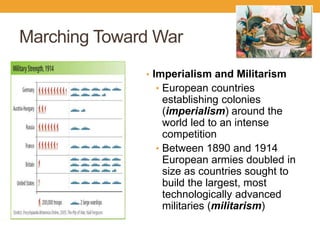
• Between 1890 and 1914
European armies doubled in
size as countries sought to
build the largest, most
technologically advanced
militaries (militarism)
Marching Toward War
• Crisis in the Balkans
• A Restless Region
• As the Ottoman Empire declined, states in the Balkans wanted to free themselves
from Ottoman rule; but Austria-Hungary and Russia both wanted to control the states
in this region
• Serbia, supported by Russia, was determined to create a Slavic state in the Balkans
but Austria was determined to prevent that from happening; many saw Serbia as a
catalyst for war
• Assassination of Francis Ferdinand
• June 28, 1914 Austrian Archduke Francis Ferdinand and his wife Sophia were
assassinated by Gavrilo Princip, a member of a Serbian terrorist organization
Marching Toward War
• Austria saw this incident as an opportunity to take out
Serbia
• Austria asked Germany for support
• With German support, Austria issued an ultimatum to
Serbia on July 23 which was designed so Serbia would
reject it, giving Austria-Hungary the excuse to declare war
• “July Ultimatum” was rejected and Austria declared war
on Serbia on July 28; this launched World War I
World War Military Alliances
Marching Toward War
• Declarations of War
• Russia, supporting Serbia, launched full mobilization of its army to
Germany and Austria on July 29th
• On August 1st, 1914 Germany declared war on Russia
• On August 2nd, Germany demanded that Belgium (neutral country) allow
German troops to pass thru Belgian territory to attack France
• August 3rd Germany declared war on France
• On August 4th Britain declared war on Germany “officially” over the
violation of Belgian neutrality; this officially launched all the great powers
of Europe into war- one which was met with enthusiasm at first
Europe Plunges Into War
Great War Begins
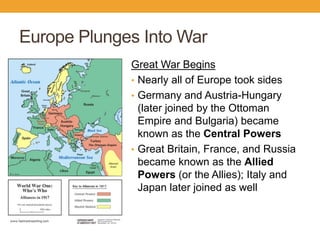
• Nearly all of Europe took sides
• Germany and Austria-Hungary
(later joined by the Ottoman
Empire and Bulgaria) became
known as the Central Powers
• Great Britain, France, and Russia
became known as the Allied
Powers (or the Allies); Italy and
Japan later joined as well
Europe Plunges Into War
Bloody Stalemate
• General Alfred von Schlieffen developed the Schlieffen Plan which would prepare
Germany for a 2 front war against both France and Russia
• More troops would be sent to France because Russia lacked railroads to send supplies and troops
to the front
• Plan depended on quick French surrender, after the surrender troops would be sent east to Russia
• September 1914 Schliffen Plan was in ruins after the Battle of the Marne outside
of Paris
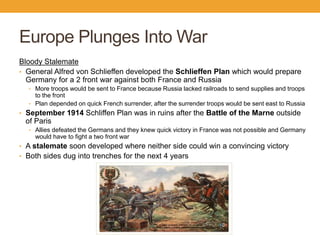
• Allies defeated the Germans and they knew quick victory in France was not possible and Germany
would have to fight a two front war
• A stalemate soon developed where neither side could win a convincing victory
• Both sides dug into trenches for the next 4 years
Europe Plunges Into War
Trench Warfare
• Armies on both sides dug miles of
trenches and attacked each other
across a “no man’s land” (area
between the opposing sides trenches)
for minimal military gain
• Life in the trenches was full of mud,
poor food, sickness and misery
Europe Plunges Into War
Trench Warfare
• Trenches stretched 500 miles from the
North Sea to the Swiss Border
• New weapons(tanks, machine guns,
poison gas, submarines, airplanes) killed
greater numbers of soldiers but did not
bring a swift end to warfare
• 1916 slaughter reached its peak
• Battle of Verdun 300,000 causalities on both
sides
• Somme River 500,000 causalities over 4
months
• Gains for each side in these battles?
Germans advanced 4 miles, British
advanced 5 miles
Europe Plunges Into War
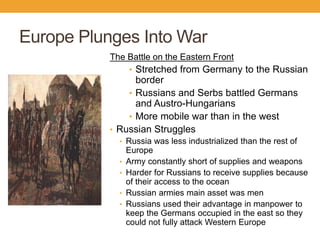
The Battle on the Eastern Front
• Stretched from Germany to the Russian
border
• Russians and Serbs battled Germans
and Austro-Hungarians
• More mobile war than in the west
• Russian Struggles
• Russia was less industrialized than the rest of
Europe
• Army constantly short of supplies and weapons
• Harder for Russians to receive supplies because
of their access to the ocean
• Russian armies main asset was men
• Russians used their advantage in manpower to
keep the Germans occupied in the east so they
could not fully attack Western Europe
A Global Conflict
War moved beyond Europe
• As the war dragged on the European powers
looked for new fronts and other allies around
the world to help to the balance in their favor
• Europeans attacked the Ottoman Empire at
the Dardanelles
• Wanted to open a supply line to Russia
• February 1915 Battle of Gallipoli turned
into a bloody stalemate after a huge loss of
life
• In Asia and Africa Germany’s colonial
possessions were attacked
• Japanese attacked German Pacific colonies
• English and French attacked Germany’s
colonies in Africa
• British and French colonial subjects were enlisted
to fight for their colonial masters
A Global Conflict
• America Joins the War
• 1915 Germans use new technology, the submarine, to control the
seas
• Germans begin to sink boats without warning around Britain,
policy called unrestricted submarine warfare
• May 1915 the Germans sink the Lusitania, a British passenger
ship that had Americans on board
• Americans were outraged and the Germans shortly agreed to
stop sinking neutral ships
A Global Conflict
• Germany did not keep their word about
submarine warfare and returned to this
tactic in 1917
• They knew that it could lead to U.S.
entering war on the side of the allies
• Germany hoped that the naval blockade of
Great Britain would starve the Allies into
defeat before the U.S. entered the war
• February 1917 the U.S. intercepts the
Zimmerman note that promises German
help to Mexico regain lost territory to the
U.S. if Mexico helps Germany
• This was the last straw and the Americans
entered the war on the side of the Allies
• April 2, 1917 U.S. declares war on
Germany
A Global Conflict
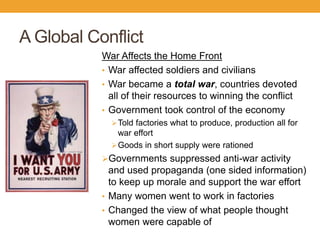
War Affects the Home Front
• War affected soldiers and civilians
• War became a total war, countries devoted
all of their resources to winning the conflict
• Government took control of the economy
Told factories what to produce, production all for
war effort
Goods in short supply were rationed
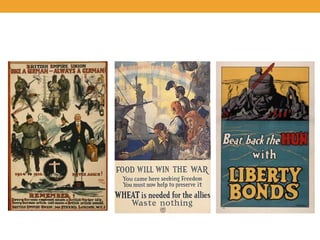
Governments suppressed anti-war activity
and used propaganda (one sided information)
to keep up morale and support the war effort
• Many women went to work in factories
• Changed the view of what people thought
women were capable of
A Global Conflict
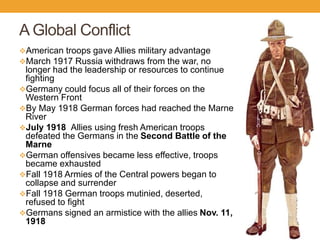
American troops gave Allies military advantage
March 1917 Russia withdraws from the war, no
longer had the leadership or resources to continue
fighting
Germany could focus all of their forces on the
Western Front
By May 1918 German forces had reached the Marne
River
July 1918 Allies using fresh American troops
defeated the Germans in the Second Battle of the
Marne
German offensives became less effective, troops
became exhausted
Fall 1918 Armies of the Central powers began to
collapse and surrender
Fall 1918 German troops mutinied, deserted,
refused to fight
Germans signed an armistice with the allies Nov. 11,
1918
A Global Conflict
Legacy of the War
A. Entire generation of young European
men were wiped out
• 8.5 million died, 21 million were wounded
B. Idea of war on a global scale
C. New technologies led to more
destruction and death
D. Economic Impact
• Drained countries of wealth, to fight was
and rebuild
• Destroyed farmland , villages and towns
E. Led to feelings of insecurity and
despair that was reflected in the art
and literature of the time
F. The peace treaty promoted anger
and resentment
• We are Making a New World
• Paul Nash (1918)
A Flawed Peace
• January 1919 Allied powers met to discuss what would happen now
that the war was over
• Big Four countries dictated most of the decisions (U.S., France, Great
Britain, Italy)
• Russia, Germany and the other Central Powers were not represented
• U.S. president Woodrow Wilson came with a plan called the Fourteen
Points, Wilson’s plan to bring peace to Europe
• Main goal was to provide countries with the idea of self determination,
or the right to choose their own government
• European nations wanted to punish Germany and did not want to go
along with Wilson’s ideas
A Flawed Peace
• June 1919 Treaty of Versailles was
signed between Germany and the Allied
powers
o Treaty established a League of
Nations to negotiate peace among
nations and to prevent future wars
o Punished Germany
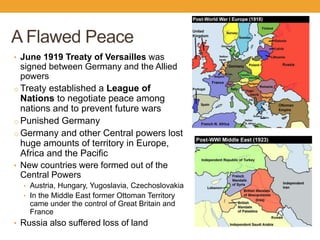
o Germany and other Central powers lost
huge amounts of territory in Europe,
Africa and the Pacific
• New countries were formed out of the
Central Powers
• Austria, Hungary, Yugoslavia, Czechoslovakia
• In the Middle East former Ottoman Territory
came under the control of Great Britain and
France
• Russia also suffered loss of land
A Flawed Peace
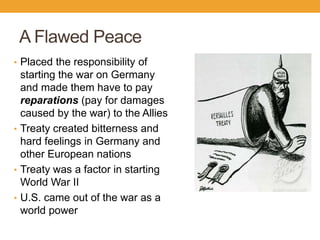
• Placed the responsibility of
starting the war on Germany
and made them have to pay
reparations (pay for damages
caused by the war) to the Allies
• Treaty created bitterness and
hard feelings in Germany and
other European nations
• Treaty was a factor in starting
World War II
• U.S. came out of the war as a
world power

World war i

  • 1.
  • 2.
    Marching Toward War RisingTensions in Europe The Rise of Nationalism What is nationalism? • By 1907 Europe was split into two rival sides • Germany, Austria, and Italy (The Triple Alliance) • France, Britain, and Russia (The Triple Entente) • Both sides formed alliances to protect the other if one was attacked • Each nation-state saw war as a chance to expand the state and achieve their political ambitions
  • 3.
    Marching Toward War •Imperialism and Militarism • European countries establishing colonies (imperialism) around the world led to an intense competition • Between 1890 and 1914 European armies doubled in size as countries sought to build the largest, most technologically advanced militaries (militarism)
  • 4.
    Marching Toward War •Crisis in the Balkans • A Restless Region • As the Ottoman Empire declined, states in the Balkans wanted to free themselves from Ottoman rule; but Austria-Hungary and Russia both wanted to control the states in this region • Serbia, supported by Russia, was determined to create a Slavic state in the Balkans but Austria was determined to prevent that from happening; many saw Serbia as a catalyst for war • Assassination of Francis Ferdinand • June 28, 1914 Austrian Archduke Francis Ferdinand and his wife Sophia were assassinated by Gavrilo Princip, a member of a Serbian terrorist organization
  • 5.
    Marching Toward War •Austria saw this incident as an opportunity to take out Serbia • Austria asked Germany for support • With German support, Austria issued an ultimatum to Serbia on July 23 which was designed so Serbia would reject it, giving Austria-Hungary the excuse to declare war • “July Ultimatum” was rejected and Austria declared war on Serbia on July 28; this launched World War I
  • 6.
  • 7.
    Marching Toward War •Declarations of War • Russia, supporting Serbia, launched full mobilization of its army to Germany and Austria on July 29th • On August 1st, 1914 Germany declared war on Russia • On August 2nd, Germany demanded that Belgium (neutral country) allow German troops to pass thru Belgian territory to attack France • August 3rd Germany declared war on France • On August 4th Britain declared war on Germany “officially” over the violation of Belgian neutrality; this officially launched all the great powers of Europe into war- one which was met with enthusiasm at first
  • 8.
    Europe Plunges IntoWar Great War Begins • Nearly all of Europe took sides • Germany and Austria-Hungary (later joined by the Ottoman Empire and Bulgaria) became known as the Central Powers • Great Britain, France, and Russia became known as the Allied Powers (or the Allies); Italy and Japan later joined as well
  • 9.
    Europe Plunges IntoWar Bloody Stalemate • General Alfred von Schlieffen developed the Schlieffen Plan which would prepare Germany for a 2 front war against both France and Russia • More troops would be sent to France because Russia lacked railroads to send supplies and troops to the front • Plan depended on quick French surrender, after the surrender troops would be sent east to Russia • September 1914 Schliffen Plan was in ruins after the Battle of the Marne outside of Paris • Allies defeated the Germans and they knew quick victory in France was not possible and Germany would have to fight a two front war • A stalemate soon developed where neither side could win a convincing victory • Both sides dug into trenches for the next 4 years
  • 10.
    Europe Plunges IntoWar Trench Warfare • Armies on both sides dug miles of trenches and attacked each other across a “no man’s land” (area between the opposing sides trenches) for minimal military gain • Life in the trenches was full of mud, poor food, sickness and misery
  • 11.
    Europe Plunges IntoWar Trench Warfare • Trenches stretched 500 miles from the North Sea to the Swiss Border • New weapons(tanks, machine guns, poison gas, submarines, airplanes) killed greater numbers of soldiers but did not bring a swift end to warfare • 1916 slaughter reached its peak • Battle of Verdun 300,000 causalities on both sides • Somme River 500,000 causalities over 4 months • Gains for each side in these battles? Germans advanced 4 miles, British advanced 5 miles
  • 12.
    Europe Plunges IntoWar The Battle on the Eastern Front • Stretched from Germany to the Russian border • Russians and Serbs battled Germans and Austro-Hungarians • More mobile war than in the west • Russian Struggles • Russia was less industrialized than the rest of Europe • Army constantly short of supplies and weapons • Harder for Russians to receive supplies because of their access to the ocean • Russian armies main asset was men • Russians used their advantage in manpower to keep the Germans occupied in the east so they could not fully attack Western Europe
  • 13.
    A Global Conflict Warmoved beyond Europe • As the war dragged on the European powers looked for new fronts and other allies around the world to help to the balance in their favor • Europeans attacked the Ottoman Empire at the Dardanelles • Wanted to open a supply line to Russia • February 1915 Battle of Gallipoli turned into a bloody stalemate after a huge loss of life • In Asia and Africa Germany’s colonial possessions were attacked • Japanese attacked German Pacific colonies • English and French attacked Germany’s colonies in Africa • British and French colonial subjects were enlisted to fight for their colonial masters
  • 14.
    A Global Conflict •America Joins the War • 1915 Germans use new technology, the submarine, to control the seas • Germans begin to sink boats without warning around Britain, policy called unrestricted submarine warfare • May 1915 the Germans sink the Lusitania, a British passenger ship that had Americans on board • Americans were outraged and the Germans shortly agreed to stop sinking neutral ships
  • 15.
    A Global Conflict •Germany did not keep their word about submarine warfare and returned to this tactic in 1917 • They knew that it could lead to U.S. entering war on the side of the allies • Germany hoped that the naval blockade of Great Britain would starve the Allies into defeat before the U.S. entered the war • February 1917 the U.S. intercepts the Zimmerman note that promises German help to Mexico regain lost territory to the U.S. if Mexico helps Germany • This was the last straw and the Americans entered the war on the side of the Allies • April 2, 1917 U.S. declares war on Germany
  • 16.
    A Global Conflict WarAffects the Home Front • War affected soldiers and civilians • War became a total war, countries devoted all of their resources to winning the conflict • Government took control of the economy Told factories what to produce, production all for war effort Goods in short supply were rationed Governments suppressed anti-war activity and used propaganda (one sided information) to keep up morale and support the war effort • Many women went to work in factories • Changed the view of what people thought women were capable of
  • 18.
    A Global Conflict Americantroops gave Allies military advantage March 1917 Russia withdraws from the war, no longer had the leadership or resources to continue fighting Germany could focus all of their forces on the Western Front By May 1918 German forces had reached the Marne River July 1918 Allies using fresh American troops defeated the Germans in the Second Battle of the Marne German offensives became less effective, troops became exhausted Fall 1918 Armies of the Central powers began to collapse and surrender Fall 1918 German troops mutinied, deserted, refused to fight Germans signed an armistice with the allies Nov. 11, 1918
  • 19.
    A Global Conflict Legacyof the War A. Entire generation of young European men were wiped out • 8.5 million died, 21 million were wounded B. Idea of war on a global scale C. New technologies led to more destruction and death D. Economic Impact • Drained countries of wealth, to fight was and rebuild • Destroyed farmland , villages and towns E. Led to feelings of insecurity and despair that was reflected in the art and literature of the time F. The peace treaty promoted anger and resentment • We are Making a New World • Paul Nash (1918)
  • 20.
    A Flawed Peace •January 1919 Allied powers met to discuss what would happen now that the war was over • Big Four countries dictated most of the decisions (U.S., France, Great Britain, Italy) • Russia, Germany and the other Central Powers were not represented • U.S. president Woodrow Wilson came with a plan called the Fourteen Points, Wilson’s plan to bring peace to Europe • Main goal was to provide countries with the idea of self determination, or the right to choose their own government • European nations wanted to punish Germany and did not want to go along with Wilson’s ideas
  • 21.
    A Flawed Peace •June 1919 Treaty of Versailles was signed between Germany and the Allied powers o Treaty established a League of Nations to negotiate peace among nations and to prevent future wars o Punished Germany o Germany and other Central powers lost huge amounts of territory in Europe, Africa and the Pacific • New countries were formed out of the Central Powers • Austria, Hungary, Yugoslavia, Czechoslovakia • In the Middle East former Ottoman Territory came under the control of Great Britain and France • Russia also suffered loss of land
  • 22.
    A Flawed Peace •Placed the responsibility of starting the war on Germany and made them have to pay reparations (pay for damages caused by the war) to the Allies • Treaty created bitterness and hard feelings in Germany and other European nations • Treaty was a factor in starting World War II • U.S. came out of the war as a world power