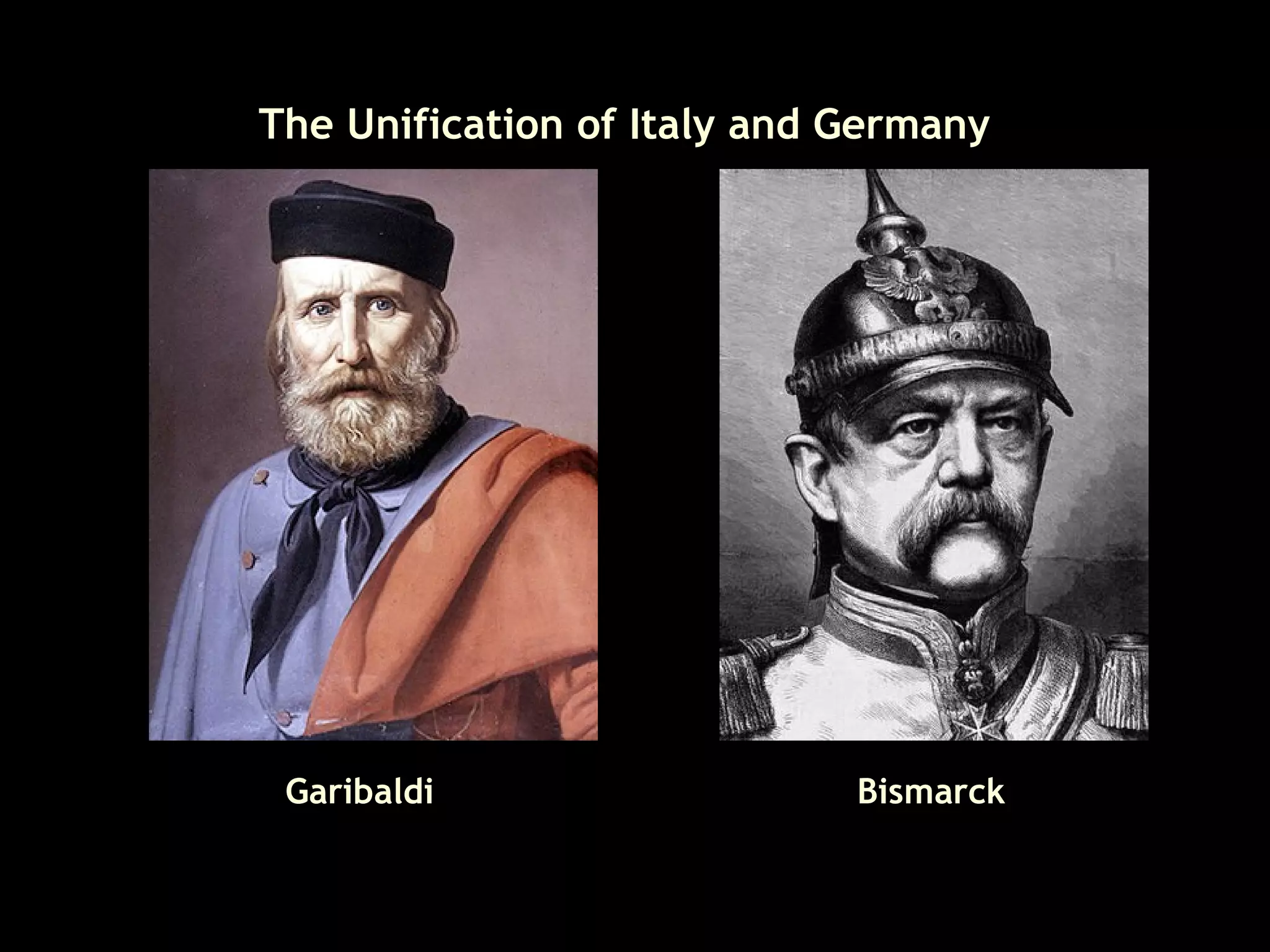
The Unification of Italy and Germany Garibaldi Bismarck
What is Nationalism? Nationalism is a feeling of belonging and loyalty that causes people to think of themselves as a nation. During the 19 th  and 20 th  centuries, nationalism was a powerful force that could: Create one nation from many separate countries (ex. Italy and Germany) Break one nation up into many countries  (ex. Austria-Hungary, and Turkey)
Nationalism  Nationalism can be a cause of war (ex. WWI and WWII) It has encouraged colonies to seek independence from their colonizers. (ex. India, Indonesia, and countries in Africa) Nationalism can take many different forms but certain factors need to be present for it to grow .
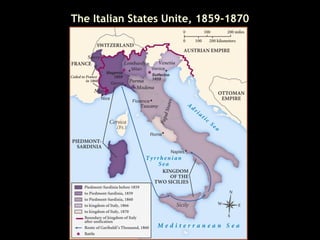
The Italian States Unite, 1859-1870
Barriers to Italian Nationalism Italy was divided into several states. Italy did not threaten the balance of power in Europe. After the Congress of Vienna, Italy was made up of nine different states: Piedmont-Sardinia (the largest state) Venetia and Lombardy belonged to Austria the Pope ruled the Papal States in central Italy the other states were ruled by foreign princes under Austrian control
Barriers to Italian Nationalism Geography - mountains split Italy West and East; the Po river, North and South  Illiteracy – as most of the population could not read and write, nationalistic propaganda was difficult to spread  The Pope - felt a united Italy would lessen his rights in the papal states  Lack of consensus - Italian states disagreed on a leader and type of government  Lack of European support - European nations felt a strong Italy would interfere with their plans
Factors That Led to Italian Unification Geography Italy is isolated The Alps are to the North, surrounded by oceans. Geographic isolation allows Italy to develop its own ways, customs. History Italians are very proud of their heritage, including the Italian Renaissance. Napoleon’s conquest of Italian states led to a desire not to be conquered again    Italian unity. Efforts of Three Men: Mazzini, Garibaldi, Cavour
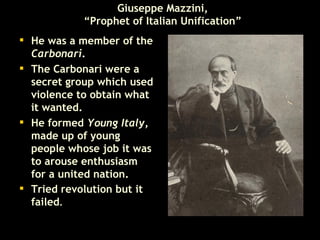
Giuseppe Mazzini, “Prophet of Italian Unification” He was a member of the  Carbonari . The Carbonari were a secret group which used violence to obtain what it wanted. He formed  Young Italy , made up of young people whose job it was to arouse enthusiasm for a united nation. Tried revolution but it failed .
Mazzini- Essay on Nationalism (1852)   Directions:  Read the essay and answer the following questions What are the two questions at the heart of the revolutions?  How are the two questions exemplified in the French Revolution? What does consanguinity mean? How can you sum up the second argument for unity?
Count Cavour,  “Architect of Italian Unification” Count Camillo di Cavour was the “architect” (planner) of Piedmont-Sardinia’s revolt against Austria. This revolt encouraged other Italian states to revolt.
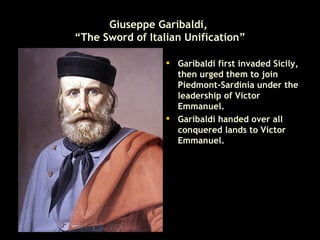
Giuseppe Garibaldi,  “The Sword of Italian Unification” Garibaldi first invaded Sicily, then urged them to join Piedmont-Sardinia under the leadership of Victor Emmanuel. Garibaldi handed over all conquered lands to Victor Emmanuel.
How Italy was United The Addition of the Papal States: Victor Emmanuel conquers the Papal States; stops  Garibaldi’s advance. Unification nears completion. 1860: elections were held in all of Italy, except  Venetia and Rome. 1861: in the city of Turin, representatives of a united  nation formed a parliament and proclaimed the establishment of  Italy under Victor Emmanuel II.
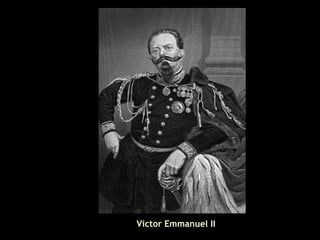
Victor Emmanuel II
Problems Faced by a United Italy Victor Emmanuel II, King of Italy is a  constitutional monarch.  Right to vote is limited to upper and middle class property holders.  Many Catholics refuse to participate in new nation (as did the Pope).  Bribery and corruption were frequent in poor, uneducated lower classes.  Some Italian speaking areas were not united with the central government.  Some felt Italy should become a world power and fight for colonies.  Italy lacked industrial development, agriculture, and natural resources.  Prices were high, people could not afford manufactured goods.
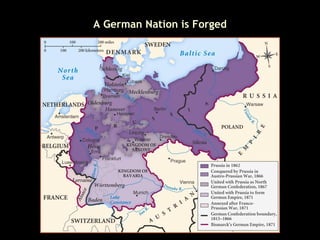
A German Nation is Forged
Background to German Unification Prior to the French Revolution, there were more than 300 German states. Prussia and Austria were the largest. The Congress of Vienna reduced the number of German states to 39. The smaller number of German states encouraged feelings of nationalism and patriotism among these German states.
Barriers to German Unification France preferred 39 weak states to one nation. Austria knew Prussia was most powerful state. Rulers of smaller states feared loss of power in a united Germany.  Protestant/Catholic hostility (from Thirty Years’ War).  Economic differences between western industrial states and agricultural eastern states.
Factors Encouraging German Unification Napoleon encouraged German unification with the  Confederation of the Rhine  under the Napoleonic Code. Intellectuals supported a German Nation: Heinrich von Treitschke envisioned a German Fatherland   Goethe and Schiller saw a common nationality for all Germans   Congress of Vienna created a  German Confederation  which was made up of 39 states.  Zollverein  created to increase trade, reduce problems of many state governments; taxes, coinage and postal system.
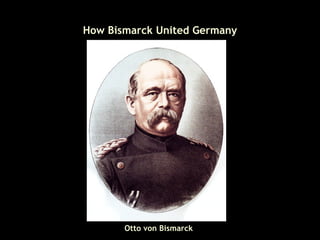
How Bismarck United Germany Otto von Bismarck
How Bismarck United Germany Prussia led German unification. Otto von Bismarck led Prussia Conservative chosen as Prime Minister  stood for absolutism, Divine Right Monarchy and the Protestant Lutheran church did not trust people or democracy Master of Realpolitick Politics of reality Tough power politics  No idealism  William I, King of Prussia appointed Bismarck chief minister in the Prussian Parliament ,1848
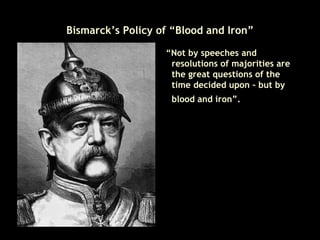
Bismarck’s Policy of “Blood and Iron” “ Not by speeches and resolutions of majorities are the great questions of the time decided upon – but by blood and iron”.
German Unification   Could not persuade parliament Declared he would rule without the consent of parliament and without a legal budget  Aligned with Austria to attack Denmark for Schleswig and Holstein  Quick victory increases Prussian nationalism
German Unification Prussia controls Schleswig and Austria Holstein Hoping this will lead to turmoil he can use Border conflicts with Austria between Schleswig and Holstein  Austria declares war on Prussia in 1866 Seven Weeks’ war  Prussia Annexes more territory  Eastern and Western Prussia united for first time
France: Bismarck’s Strategy Spanish throne is offered to a relative of the King of Prussia after leaders of the Spanish revolution removed their leader.  Louis Napoleon (Napoleon Bonaparte’s nephew), Emperor of France convinces German prince to refuse crown then sends an envoy to convince William I of Prussia not to accept the crown. From the City of Ems, William I sends a telegram to Bismarck about the request, this is called the Ems Dispatch.  Bismarck, seizing his opportunity, rewords the telegram and publishes it in the newspapers.
Bismarck’s Plan Pays Off Prussians become upset about unfair demands to their king; French are insulted by Prussia.   France declares war though unprepared  Prussia thus acquires:  French provinces of Alsace & Lorraine  money to cover the cost of war  The Franco-Prussian War completes the unification of Germany.  South German states unite with north to fight France 1871: German Empire is formed, William I of Prussia as Emperor.
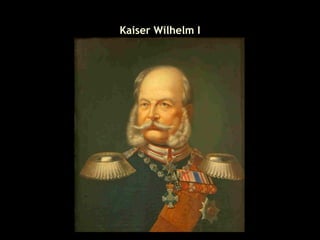
Kaiser Wilhelm I
Problems Faced by a United Germany Germany was far from democratic:  The Government of the German Empire was a federal union of states with the King of Prussia as ruler and a two house legislature with:  A powerful 61 member appointed upper house  A 400 member lower house chosen by  universal male suffrage (all men could vote)  Strong king who made government appointments, strong upper house had power  strong army, soldiers prominent in society
Bismarck’s Policies Made socialism illegal  Improved working conditions  Persecuted national and religious minorities, especially Catholics  In foreign affairs, tried to isolate France by making friendships with Austria and Russia   Use of  Realpolitik Realpolitik  was Bismarck’s foreign policy    decisions are not based on ideological or moral considerations; decisions should be based on self-interest.
Comparing Revolutions, Revolts, and Unifications What is one factor that has been present in all of the conflicts we have studied so far?  Why do you think this factor repeatedly shows up?

Italian and German Unification

  • 1.
    The Unification ofItaly and Germany Garibaldi Bismarck
  • 2.
    What is Nationalism?Nationalism is a feeling of belonging and loyalty that causes people to think of themselves as a nation. During the 19 th and 20 th centuries, nationalism was a powerful force that could: Create one nation from many separate countries (ex. Italy and Germany) Break one nation up into many countries (ex. Austria-Hungary, and Turkey)
  • 3.
    Nationalism Nationalismcan be a cause of war (ex. WWI and WWII) It has encouraged colonies to seek independence from their colonizers. (ex. India, Indonesia, and countries in Africa) Nationalism can take many different forms but certain factors need to be present for it to grow .
  • 4.
    The Italian StatesUnite, 1859-1870
  • 5.
    Barriers to ItalianNationalism Italy was divided into several states. Italy did not threaten the balance of power in Europe. After the Congress of Vienna, Italy was made up of nine different states: Piedmont-Sardinia (the largest state) Venetia and Lombardy belonged to Austria the Pope ruled the Papal States in central Italy the other states were ruled by foreign princes under Austrian control
  • 6.
    Barriers to ItalianNationalism Geography - mountains split Italy West and East; the Po river, North and South Illiteracy – as most of the population could not read and write, nationalistic propaganda was difficult to spread The Pope - felt a united Italy would lessen his rights in the papal states Lack of consensus - Italian states disagreed on a leader and type of government Lack of European support - European nations felt a strong Italy would interfere with their plans
  • 7.
    Factors That Ledto Italian Unification Geography Italy is isolated The Alps are to the North, surrounded by oceans. Geographic isolation allows Italy to develop its own ways, customs. History Italians are very proud of their heritage, including the Italian Renaissance. Napoleon’s conquest of Italian states led to a desire not to be conquered again  Italian unity. Efforts of Three Men: Mazzini, Garibaldi, Cavour
  • 8.
    Giuseppe Mazzini, “Prophetof Italian Unification” He was a member of the Carbonari . The Carbonari were a secret group which used violence to obtain what it wanted. He formed Young Italy , made up of young people whose job it was to arouse enthusiasm for a united nation. Tried revolution but it failed .
  • 9.
    Mazzini- Essay onNationalism (1852) Directions: Read the essay and answer the following questions What are the two questions at the heart of the revolutions? How are the two questions exemplified in the French Revolution? What does consanguinity mean? How can you sum up the second argument for unity?
  • 10.
    Count Cavour, “Architect of Italian Unification” Count Camillo di Cavour was the “architect” (planner) of Piedmont-Sardinia’s revolt against Austria. This revolt encouraged other Italian states to revolt.
  • 11.
    Giuseppe Garibaldi, “The Sword of Italian Unification” Garibaldi first invaded Sicily, then urged them to join Piedmont-Sardinia under the leadership of Victor Emmanuel. Garibaldi handed over all conquered lands to Victor Emmanuel.
  • 12.
    How Italy wasUnited The Addition of the Papal States: Victor Emmanuel conquers the Papal States; stops Garibaldi’s advance. Unification nears completion. 1860: elections were held in all of Italy, except Venetia and Rome. 1861: in the city of Turin, representatives of a united nation formed a parliament and proclaimed the establishment of Italy under Victor Emmanuel II.
  • 13.
  • 14.
    Problems Faced bya United Italy Victor Emmanuel II, King of Italy is a constitutional monarch. Right to vote is limited to upper and middle class property holders. Many Catholics refuse to participate in new nation (as did the Pope). Bribery and corruption were frequent in poor, uneducated lower classes. Some Italian speaking areas were not united with the central government. Some felt Italy should become a world power and fight for colonies. Italy lacked industrial development, agriculture, and natural resources. Prices were high, people could not afford manufactured goods.
  • 15.
    A German Nationis Forged
  • 16.
    Background to GermanUnification Prior to the French Revolution, there were more than 300 German states. Prussia and Austria were the largest. The Congress of Vienna reduced the number of German states to 39. The smaller number of German states encouraged feelings of nationalism and patriotism among these German states.
  • 17.
    Barriers to GermanUnification France preferred 39 weak states to one nation. Austria knew Prussia was most powerful state. Rulers of smaller states feared loss of power in a united Germany. Protestant/Catholic hostility (from Thirty Years’ War). Economic differences between western industrial states and agricultural eastern states.
  • 18.
    Factors Encouraging GermanUnification Napoleon encouraged German unification with the Confederation of the Rhine under the Napoleonic Code. Intellectuals supported a German Nation: Heinrich von Treitschke envisioned a German Fatherland Goethe and Schiller saw a common nationality for all Germans Congress of Vienna created a German Confederation which was made up of 39 states. Zollverein created to increase trade, reduce problems of many state governments; taxes, coinage and postal system.
  • 19.
    How Bismarck UnitedGermany Otto von Bismarck
  • 20.
    How Bismarck UnitedGermany Prussia led German unification. Otto von Bismarck led Prussia Conservative chosen as Prime Minister stood for absolutism, Divine Right Monarchy and the Protestant Lutheran church did not trust people or democracy Master of Realpolitick Politics of reality Tough power politics No idealism William I, King of Prussia appointed Bismarck chief minister in the Prussian Parliament ,1848
  • 21.
    Bismarck’s Policy of“Blood and Iron” “ Not by speeches and resolutions of majorities are the great questions of the time decided upon – but by blood and iron”.
  • 22.
    German Unification Could not persuade parliament Declared he would rule without the consent of parliament and without a legal budget Aligned with Austria to attack Denmark for Schleswig and Holstein Quick victory increases Prussian nationalism
  • 23.
    German Unification Prussiacontrols Schleswig and Austria Holstein Hoping this will lead to turmoil he can use Border conflicts with Austria between Schleswig and Holstein Austria declares war on Prussia in 1866 Seven Weeks’ war Prussia Annexes more territory Eastern and Western Prussia united for first time
  • 24.
    France: Bismarck’s StrategySpanish throne is offered to a relative of the King of Prussia after leaders of the Spanish revolution removed their leader. Louis Napoleon (Napoleon Bonaparte’s nephew), Emperor of France convinces German prince to refuse crown then sends an envoy to convince William I of Prussia not to accept the crown. From the City of Ems, William I sends a telegram to Bismarck about the request, this is called the Ems Dispatch. Bismarck, seizing his opportunity, rewords the telegram and publishes it in the newspapers.
  • 25.
    Bismarck’s Plan PaysOff Prussians become upset about unfair demands to their king; French are insulted by Prussia. France declares war though unprepared Prussia thus acquires: French provinces of Alsace & Lorraine money to cover the cost of war The Franco-Prussian War completes the unification of Germany. South German states unite with north to fight France 1871: German Empire is formed, William I of Prussia as Emperor.
  • 26.
  • 27.
    Problems Faced bya United Germany Germany was far from democratic: The Government of the German Empire was a federal union of states with the King of Prussia as ruler and a two house legislature with: A powerful 61 member appointed upper house A 400 member lower house chosen by universal male suffrage (all men could vote) Strong king who made government appointments, strong upper house had power strong army, soldiers prominent in society
  • 28.
    Bismarck’s Policies Madesocialism illegal Improved working conditions Persecuted national and religious minorities, especially Catholics In foreign affairs, tried to isolate France by making friendships with Austria and Russia Use of Realpolitik Realpolitik was Bismarck’s foreign policy  decisions are not based on ideological or moral considerations; decisions should be based on self-interest.
  • 29.
    Comparing Revolutions, Revolts,and Unifications What is one factor that has been present in all of the conflicts we have studied so far? Why do you think this factor repeatedly shows up?