By: Hussain Al-ghawi Dec 2015
Types of Word Formation Processes
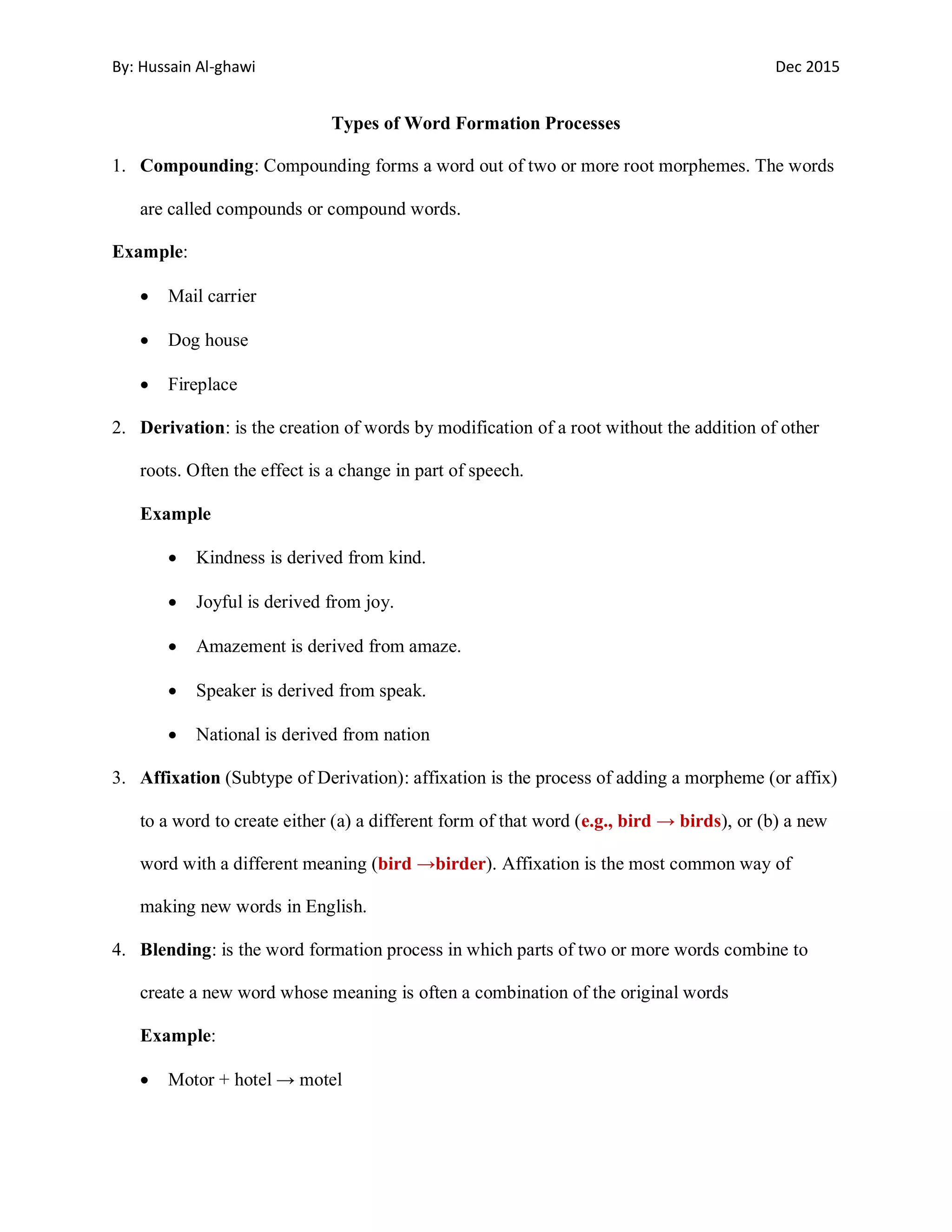
1. Compounding: Compounding forms a word out of two or more root morphemes. The words
are called compounds or compound words.
Example:
 Mail carrier
 Dog house
 Fireplace
2. Derivation: is the creation of words by modification of a root without the addition of other
roots. Often the effect is a change in part of speech.
Example
 Kindness is derived from kind.
 Joyful is derived from joy.
 Amazement is derived from amaze.
 Speaker is derived from speak.
 National is derived from nation
3. Affixation (Subtype of Derivation): affixation is the process of adding a morpheme (or affix)
to a word to create either (a) a different form of that word (e.g., bird → birds), or (b) a new
word with a different meaning (bird →birder). Affixation is the most common way of
making new words in English.
4. Blending: is the word formation process in which parts of two or more words combine to
create a new word whose meaning is often a combination of the original words
Example:
 Motor + hotel → motel
By: Hussain Al-ghawi Dec 2015
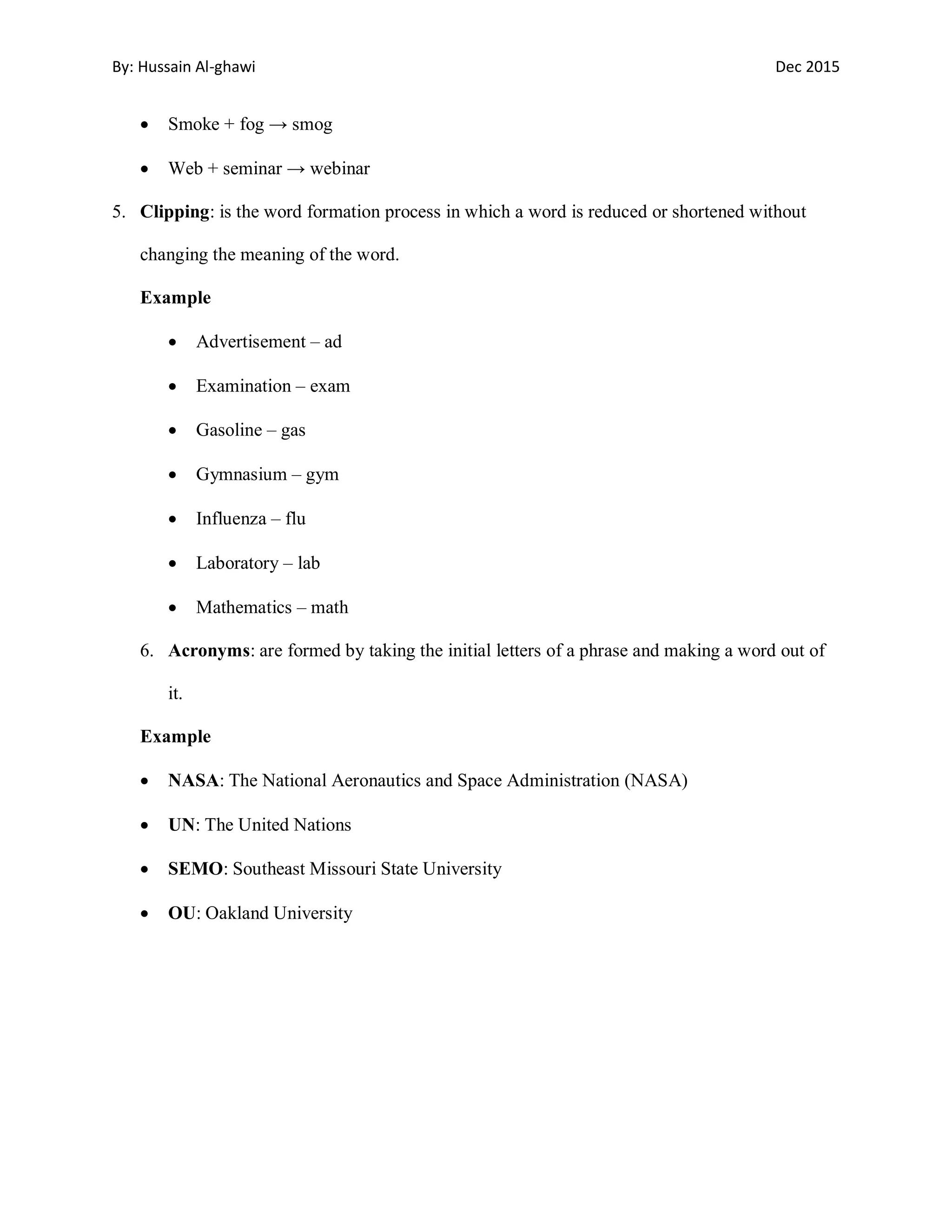
 Smoke + fog → smog
 Web + seminar → webinar
5. Clipping: is the word formation process in which a word is reduced or shortened without
changing the meaning of the word.
Example
 Advertisement – ad
 Examination – exam
 Gasoline – gas
 Gymnasium – gym
 Influenza – flu
 Laboratory – lab
 Mathematics – math
6. Acronyms: are formed by taking the initial letters of a phrase and making a word out of
it.
Example
 NASA: The National Aeronautics and Space Administration (NASA)
 UN: The United Nations
 SEMO: Southeast Missouri State University
 OU: Oakland University

Types of word formation processes

  • 1.
    By: Hussain Al-ghawiDec 2015 Types of Word Formation Processes 1. Compounding: Compounding forms a word out of two or more root morphemes. The words are called compounds or compound words. Example:  Mail carrier  Dog house  Fireplace 2. Derivation: is the creation of words by modification of a root without the addition of other roots. Often the effect is a change in part of speech. Example  Kindness is derived from kind.  Joyful is derived from joy.  Amazement is derived from amaze.  Speaker is derived from speak.  National is derived from nation 3. Affixation (Subtype of Derivation): affixation is the process of adding a morpheme (or affix) to a word to create either (a) a different form of that word (e.g., bird → birds), or (b) a new word with a different meaning (bird →birder). Affixation is the most common way of making new words in English. 4. Blending: is the word formation process in which parts of two or more words combine to create a new word whose meaning is often a combination of the original words Example:  Motor + hotel → motel
  • 2.
    By: Hussain Al-ghawiDec 2015  Smoke + fog → smog  Web + seminar → webinar 5. Clipping: is the word formation process in which a word is reduced or shortened without changing the meaning of the word. Example  Advertisement – ad  Examination – exam  Gasoline – gas  Gymnasium – gym  Influenza – flu  Laboratory – lab  Mathematics – math 6. Acronyms: are formed by taking the initial letters of a phrase and making a word out of it. Example  NASA: The National Aeronautics and Space Administration (NASA)  UN: The United Nations  SEMO: Southeast Missouri State University  OU: Oakland University