GENERAL LINGUUISTICS
DERIVATION AND INFLECTION
PRESENTED BY:
LUZ PIEDAD CARMONA GUEVARA
BA in Foreign Language: English
TO:
MARTHA ISABEL BONILLA MORA
SANTO TOMÁS UNIVERSITY
EDUCATION´S FACULTY
CAU MANIZALES
2013
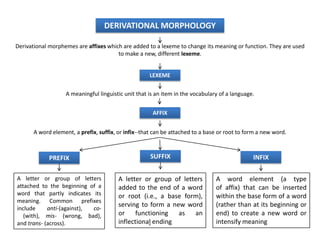
DERIVATIONAL MORPHOLOGY
Derivational morphemes are affixes which are added to a lexeme to change its meaning or function. They are used
to make a new, different lexeme.
LEXEME
A meaningful linguistic unit that is an item in the vocabulary of a language.
AFFIX
A word element, a prefix, suffix, or infix--that can be attached to a base or root to form a new word.
PREFIX SUFFIX INFIX
A letter or group of letters
attached to the beginning of a
word that partly indicates its
meaning. Common prefixes
include anti-(against), co-
(with), mis- (wrong, bad),
and trans- (across).
A letter or group of letters
added to the end of a word
or root (i.e., a base form),
serving to form a new word
or functioning as an
inflectional ending
A word element (a type
of affix) that can be inserted
within the base form of a word
(rather than at its beginning or
end) to create a new word or
intensify meaning
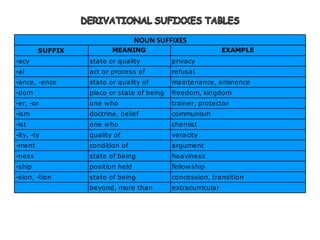
SUFFIX MEANING EXAMPLE
-acy state or quality privacy
-al act or process of refusal
-ance, -ence state or quality of maintenance, eminence
-dom place or state of being freedom, kingdom
-er, -or one who trainer, protector
-ism doctrine, belief communism
-ist one who chemist
-ity, -ty quality of veracity
-ment condition of argument
-ness state of being heaviness
-ship position held fellowship
-sion, -tion state of being concession, transition
beyond, more than extracurricular
NOUN SUFFIXES
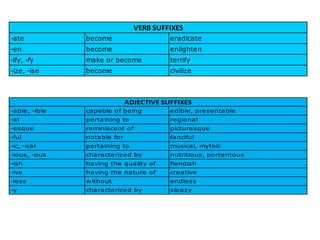
-ate become eradicate
-en become enlighten
-ify, -fy make or become terrify
-ize, -ise become civilize
VERB SUFFIXES
-able, -ible capable of being edible, presentable
-al pertaining to regional
-esque reminiscent of picturesque
-ful notable for fanciful
-ic, -ical pertaining to musical, mythic
-ious, -ous characterized by nutritious, portentous
-ish having the quality of fiendish
-ive having the nature of creative
-less without endless
-y characterized by sleazy
ADJECTIVE SUFFIXES
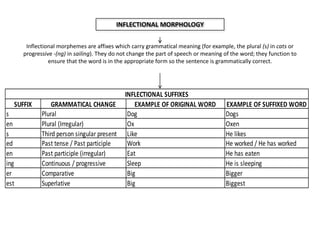
INFLECTIONAL MORPHOLOGY
Inflectional morphemes are affixes which carry grammatical meaning (for example, the plural (s) in cats or
progressive -(ng) in sailing). They do not change the part of speech or meaning of the word; they function to
ensure that the word is in the appropriate form so the sentence is grammatically correct.
SUFFIX GRAMMATICAL CHANGE EXAMPLE OF ORIGINAL WORD EXAMPLE OF SUFFIXED WORD
s Plural Dog Dogs
en Plural (Irregular) Ox Oxen
s Third person singular present Like He likes
ed Past tense / Past participle Work He worked / He has worked
en Past participle (irregular) Eat He has eaten
ing Continuous / progressive Sleep He is sleeping
er Comparative Big Bigger
est Superlative Big Biggest
INFLECTIONAL SUFFIXES

Derivational Morphology

  • 1.
    GENERAL LINGUUISTICS DERIVATION ANDINFLECTION PRESENTED BY: LUZ PIEDAD CARMONA GUEVARA BA in Foreign Language: English TO: MARTHA ISABEL BONILLA MORA SANTO TOMÁS UNIVERSITY EDUCATION´S FACULTY CAU MANIZALES 2013
  • 2.
    DERIVATIONAL MORPHOLOGY Derivational morphemesare affixes which are added to a lexeme to change its meaning or function. They are used to make a new, different lexeme. LEXEME A meaningful linguistic unit that is an item in the vocabulary of a language. AFFIX A word element, a prefix, suffix, or infix--that can be attached to a base or root to form a new word. PREFIX SUFFIX INFIX A letter or group of letters attached to the beginning of a word that partly indicates its meaning. Common prefixes include anti-(against), co- (with), mis- (wrong, bad), and trans- (across). A letter or group of letters added to the end of a word or root (i.e., a base form), serving to form a new word or functioning as an inflectional ending A word element (a type of affix) that can be inserted within the base form of a word (rather than at its beginning or end) to create a new word or intensify meaning
  • 4.
    SUFFIX MEANING EXAMPLE -acystate or quality privacy -al act or process of refusal -ance, -ence state or quality of maintenance, eminence -dom place or state of being freedom, kingdom -er, -or one who trainer, protector -ism doctrine, belief communism -ist one who chemist -ity, -ty quality of veracity -ment condition of argument -ness state of being heaviness -ship position held fellowship -sion, -tion state of being concession, transition beyond, more than extracurricular NOUN SUFFIXES
  • 5.
    -ate become eradicate -enbecome enlighten -ify, -fy make or become terrify -ize, -ise become civilize VERB SUFFIXES -able, -ible capable of being edible, presentable -al pertaining to regional -esque reminiscent of picturesque -ful notable for fanciful -ic, -ical pertaining to musical, mythic -ious, -ous characterized by nutritious, portentous -ish having the quality of fiendish -ive having the nature of creative -less without endless -y characterized by sleazy ADJECTIVE SUFFIXES
  • 6.
    INFLECTIONAL MORPHOLOGY Inflectional morphemesare affixes which carry grammatical meaning (for example, the plural (s) in cats or progressive -(ng) in sailing). They do not change the part of speech or meaning of the word; they function to ensure that the word is in the appropriate form so the sentence is grammatically correct. SUFFIX GRAMMATICAL CHANGE EXAMPLE OF ORIGINAL WORD EXAMPLE OF SUFFIXED WORD s Plural Dog Dogs en Plural (Irregular) Ox Oxen s Third person singular present Like He likes ed Past tense / Past participle Work He worked / He has worked en Past participle (irregular) Eat He has eaten ing Continuous / progressive Sleep He is sleeping er Comparative Big Bigger est Superlative Big Biggest INFLECTIONAL SUFFIXES