Teaching PrefixesSuffixesAndRootsKeith PruittWords of Wisdom Educational Consultingwww.woweducationalconsulting.com
One way to greatly enlarge the vocabulary of students in very short order is through teaching prefixes, suffixes and root words.  Knowledge of these areas will help to greatly expand student vocabulary.Let’s first explore the nature of compound words.
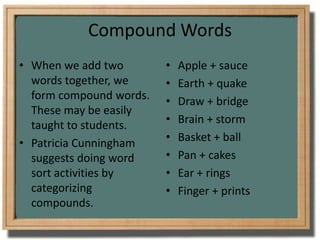
Compound WordsWhen we add two words together, we form compound words.  These may be easily taught to students.Patricia Cunningham suggests doing word sort activities by categorizing compounds.Apple + sauceEarth + quakeDraw + bridgeBrain + stormBasket + ballPan + cakesEar + ringsFinger + prints
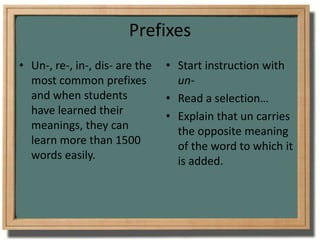
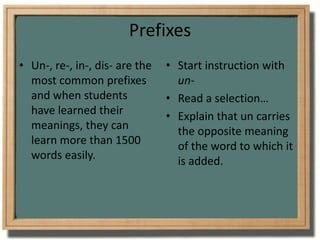
PrefixesUn-, re-, in-, dis- are the most common prefixes and when students have learned their meanings, they can learn more than 1500 words easily.Start instruction with un-Read a selection… Explain that un carries the opposite meaning of the word to which it is added.
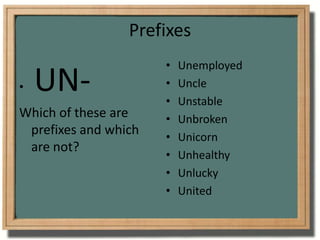
PrefixesUN-Which of these are prefixes and which are not?UnemployedUncleUnstableUnbrokenUnicorn UnhealthyUnluckyUnited
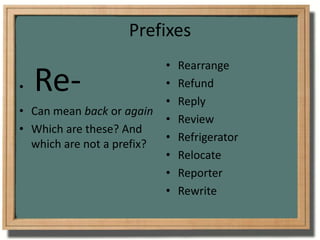
PrefixesRe-Can mean back or againWhich are these? And which are not a prefix?RearrangeRefundReplyReviewRefrigeratorRelocateReporterRewrite
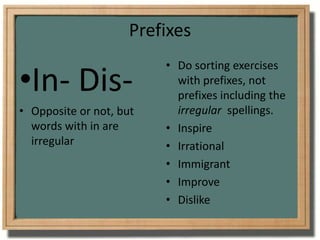
PrefixesIn- Dis-Opposite or not, but words with in are irregularDo sorting exercises with prefixes, not prefixes including the irregular  spellings.InspireIrrationalImmigrantImproveDislike
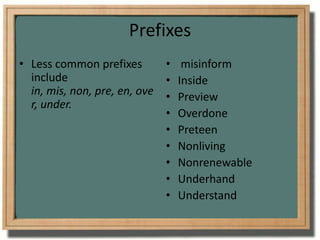
PrefixesLess common prefixes include in, mis, non, pre, en, over, under. misinformInsidePreviewOverdonePreteenNonlivingNonrenewableUnderhandUnderstand
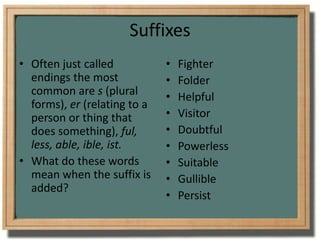
SuffixesOften just called endings the most common are s (plural forms), er(relating to a person or thing that does something), ful, less, able, ible, ist.What do these words mean when the suffix is added?FighterFolderHelpfulVisitorDoubtfulPowerlessSuitableGulliblePersist
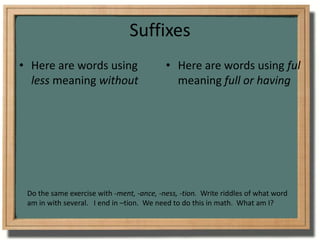
SuffixesHere are words using less meaning withoutHere are words using ful meaning full or havingDo the same exercise with -ment, -ance, -ness, -tion.  Write riddles of what word am in with several.   I end in –tion.  We need to do this in math.  What am I?
PrefixesUn-, re-, in-, dis- are the most common prefixes and when students have learned their meanings, they can learn more than 1500 words easily.Start instruction with un-Read a selection… Explain that un carries the opposite meaning of the word to which it is added.
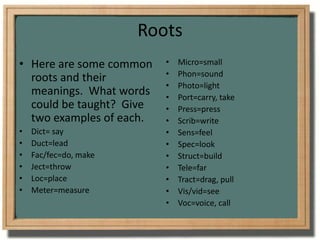
RootsHere are some common roots and their meanings.  What words could be taught?  Give two examples of each.Dict= sayDuct=leadFac/fec=do, makeJect=throwLoc=placeMeter=measureMicro=smallPhon=soundPhoto=lightPort=carry, takePress=pressScrib=writeSens=feelSpec=lookStruct=buildTele=farTract=drag, pullVis/vid=seeVoc=voice, call
 If we will spend just a few moments a day working with these words, we can seriously impact the knowledge base of each student.Keith PruittWords of Wisdom Educational Consultingwww.woweducationalconsulting.com

Teaching prefixes, suffixes and roots

  • 1.
    Teaching PrefixesSuffixesAndRootsKeith PruittWordsof Wisdom Educational Consultingwww.woweducationalconsulting.com
  • 2.
    One way togreatly enlarge the vocabulary of students in very short order is through teaching prefixes, suffixes and root words. Knowledge of these areas will help to greatly expand student vocabulary.Let’s first explore the nature of compound words.
  • 3.
    Compound WordsWhen weadd two words together, we form compound words. These may be easily taught to students.Patricia Cunningham suggests doing word sort activities by categorizing compounds.Apple + sauceEarth + quakeDraw + bridgeBrain + stormBasket + ballPan + cakesEar + ringsFinger + prints
  • 4.
    PrefixesUn-, re-, in-,dis- are the most common prefixes and when students have learned their meanings, they can learn more than 1500 words easily.Start instruction with un-Read a selection… Explain that un carries the opposite meaning of the word to which it is added.
  • 5.
    PrefixesUN-Which of theseare prefixes and which are not?UnemployedUncleUnstableUnbrokenUnicorn UnhealthyUnluckyUnited
  • 6.
    PrefixesRe-Can mean backor againWhich are these? And which are not a prefix?RearrangeRefundReplyReviewRefrigeratorRelocateReporterRewrite
  • 7.
    PrefixesIn- Dis-Opposite ornot, but words with in are irregularDo sorting exercises with prefixes, not prefixes including the irregular spellings.InspireIrrationalImmigrantImproveDislike
  • 8.
    PrefixesLess common prefixesinclude in, mis, non, pre, en, over, under. misinformInsidePreviewOverdonePreteenNonlivingNonrenewableUnderhandUnderstand
  • 9.
    SuffixesOften just calledendings the most common are s (plural forms), er(relating to a person or thing that does something), ful, less, able, ible, ist.What do these words mean when the suffix is added?FighterFolderHelpfulVisitorDoubtfulPowerlessSuitableGulliblePersist
  • 10.
    SuffixesHere are wordsusing less meaning withoutHere are words using ful meaning full or havingDo the same exercise with -ment, -ance, -ness, -tion. Write riddles of what word am in with several. I end in –tion. We need to do this in math. What am I?
  • 11.
    PrefixesUn-, re-, in-,dis- are the most common prefixes and when students have learned their meanings, they can learn more than 1500 words easily.Start instruction with un-Read a selection… Explain that un carries the opposite meaning of the word to which it is added.
  • 12.
    RootsHere are somecommon roots and their meanings. What words could be taught? Give two examples of each.Dict= sayDuct=leadFac/fec=do, makeJect=throwLoc=placeMeter=measureMicro=smallPhon=soundPhoto=lightPort=carry, takePress=pressScrib=writeSens=feelSpec=lookStruct=buildTele=farTract=drag, pullVis/vid=seeVoc=voice, call
  • 13.
    If wewill spend just a few moments a day working with these words, we can seriously impact the knowledge base of each student.Keith PruittWords of Wisdom Educational Consultingwww.woweducationalconsulting.com