What is wordformation
• word formation is an ambiguous term that can refer to
either: the processes through which words can change
(i.e. morphology), or. the creation of new lexemes in a
particular language.
• The English language is known for its wonderful quality of
the way in which words and sentences are formed and
used. Formation of new words from an existing root word
by adding a syllable or another word is the general
process; however, there are multiple ways in which it can
be done.
3.
Types of WordFormation with Examples
• The formation of words is classified into four types based
on how the process of formation is carried out. They are:
• By adding prefixes
• By adding suffixes
• Converting from one word class to another
• Forming compound words
5.
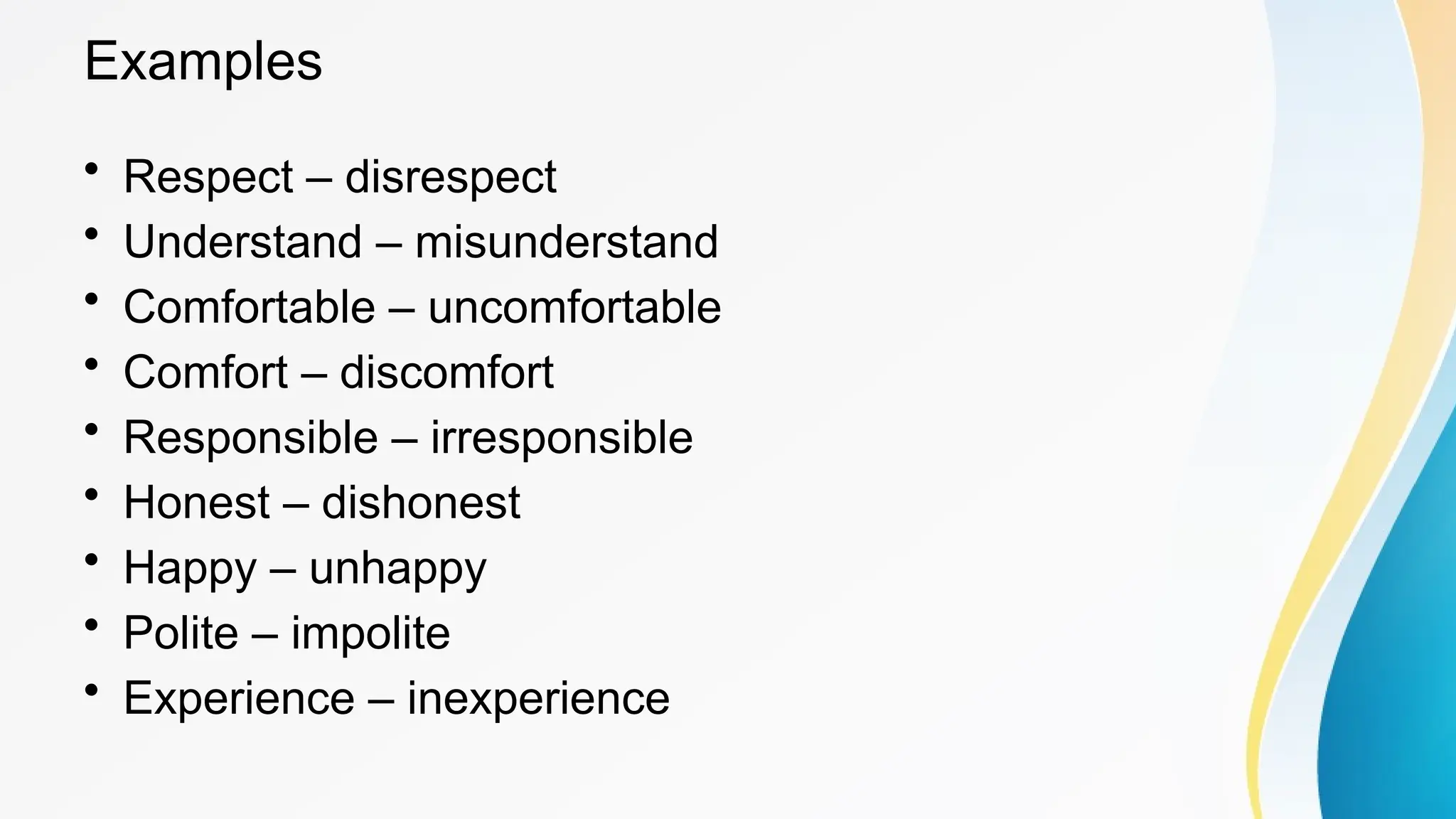
Adding Prefixes
• Theterm ‘prefix’ refers to one or more alphabets added to
the stem of a word, mostly to make it negative. The most
commonly used prefixes include ‘in-’, ‘un-’, ‘dis-’, ‘im-’,
‘ir-’, etc.
• Look at the examples given below for a clearer
understanding of how prefixes are used to form new
words.
Adding Suffixes
• Asuffix is a short syllable added at the end of a base
word. The addition of suffixes usually changes the word
class of the particular word.
• Suffixes are letters added to the end of a base word to
change its conjugation, word type, or other grammar
properties like plurality.
• The most common suffixes include ‘-ment’, ‘-ness’, ‘-ity’, ‘-
ous’, ‘-tion’, ‘-sion’, ‘-al’, ‘-able’, ‘-ible’, ‘-ive’, ‘-ly’, ‘-ate’, ‘-
er’, ‘-or’, etc. Check out the following examples to see
how suffixes are added.
Conversion:
• The processof conversion focuses solely on changing the
word class of the particular word.
• If you have noticed, you would have seen how some
nouns are used to perform the role of a verb or an
adjective acting like a noun just by the addition of another
word or slightly altering the spelling of the actual word.
12.
Examples
• Everyone istalented.
• ‘Talented’ – a past participle is used as an adjective in the
above sentence. The word is formed by adding the suffix
‘ed’ to the end of the noun ‘talent’.
• He texted me about the meeting only at the last minute.
• The noun ‘text’ used to refer to a text message sent on a
phone is used as a verb in the sentence by adding an ‘ed’
to the end of the word.
13.
Forming Compound Words
•Compound words are formed by combining one part of speech with
another to form a specific word class. There are many ways in which
compound words are formed. Verbs are combined with adjectives to
form compound verbs, a present participle is combined with a noun to
form a compound noun, two nouns are combined to form a compound
noun, an adjective and a noun are combined to form a compound
noun, an adverb is combined with a noun to form a compound noun,
an adjective is combined with a past participle to form a compound
adjective and so on. Take a look at the following examples and go
through the articles on compound nouns, compound words and
compound adjectives to understand how they work.
14.
Examples
• Short (adjective)+ hand (noun) – Shorthand
• Swimming (present participle) + pool (noun) – Swimming
pool
• Three (adjective) + legged (past participle) – Three-
legged
• Break (verb) + Down (preposition) – Breakdown
• Up (preposition) + town (noun) – Uptown
• Copy (verb) + writer (noun) – Copywriter
• Sun (noun) + rise (verb) – Sunrise
• Count (verb) + down (preposition) – Countdown
15.
Clipping
• Clipping isthe process of shortening a word without
changing its meaning or part of speech.
• Clipping is one of the ways new words are created in
English. It involves the shortening of a longer word, often
reducing it to one syllable.
• Many examples are very informal or slang. Maths, which
is a clipped form of mathematics, is an example of this.
16.
Example
• In aconversation between siblings, they may refer to
each other as ‘bro’ or ‘sis’, which are the clipped versions
of ‘brother’ and ‘sister’. However, if they were to introduce
each other to someone unfamiliar, they would probably
say, 'This is my brother/sister.'
17.
Back Formation
• Back-formationis a word creation process in which prefixes or
suffixes are removed from existing words.
• This word formation can also be referred to as back-
derivation, as the process is simply taking the existing word
and breaking it down to a simpler form.
• There are a number of examples of back-formation in the
English language, including edit (from editor)
• burgle (from burglar)
• televise (from television)
• and choreograph (from choreography).
18.
Difference between clippingand back-formation?
• When a word undergoes the back-formation process, a
new meaning is created. On the other hand, clipping is a
process in which words are shortened but still keep their
original meaning and word class.
19.
Rules to beFollowed When Forming Words
• Formation of words can be a very interesting exercise, but you have to
be really careful when you are adding inflections or affixes. There are a
few things you will need to bear in mind when you are forming words.
• Take a look at the following points to learn what they are.
• Before making any change to the stem of the word, try to analyse what
is the kind of meaning you want the word to convey and what role the
word will have to play in the sentence.
• In most cases, the beginning of the base word remains the same. Only
when prefixes are added the word has a syllable added to the
beginning of it. Notice that even in this case, the word is retained as
such.
20.
conti......
• When wordsare formed by conversion, be very careful.
Make sure you know that you are converting them
accurately and using them in the sentence properly.
• When forming compound words, see to it that you
hyphenate them if necessary, use the right combination of
words and do not just mix and match any word.
• Changing from one tense to another can also be
considered a type of word formation, as the word is
inflected to indicate the twelve different tenses in the
English language.