


2016
Nazish Jamali
B.Ed (Hons)
5/30/2016
Word Formation Processes
1
1Nazish Jamali
Assignment
Subject: English Content-1
Topic: Word Formation Processes
Presented by: Nazish Jamali
Batch: 2016
Semester: 01
Submission Date: 30-05-2016
2
2Nazish Jamali
Table of contents
Topics Page No.
Objectives ……………………………………………………. 03
Word formation processes …………………………… 04
What is word formation? ……………………………… 04
How to generate new words…………………………. 04
Types of word formation………………………………. 04
1. Affixation……………………………………………… 05
a) What is Suffixation? …………………………………. 05
b) What is prefixation? …………………………………. 07
2. Coinage………………………………………………… 09
3. Backformation……………………………………… 10
4. Borrowing……………………………………………. 11
5. Conversion…………………………………………… 12
6. Compounding………………………………………13
7. Acronym…………………………………………….. 14
8. Blending……………………………………………… 15
9. Clipping………………………………………………. 17
Conclusion…………………………………………………… 18
Reference
3
3Nazish Jamali
Objectives
After this lesson student will be able to know
 Word formation processes
 How to generate new words
 Word formation processes types
1. Affixation with vocabulary words
2. Coinage with vocabulary words
3. Backformation with vocabulary words
4. Borrowing with vocabulary words
5. Conversion with vocabulary words
6. Compounding with vocabulary words
7. Acronym with vocabulary words
8. Blending with vocabulary words
9. Clipping with vocabulary words
4
4Nazish Jamali
Process of word formation
What is word formation?
The word formation is the creation of a new word. Word formation is sometimes
compared with semantic change and it is a change in a single word’s meaning.
The limit between word formation and semantic change can be difficult to define
a new use of an old word can be seen as a new word derived from an old one.
Or in other words we say word formation is process of create new words by
existing elements of language according to certain patterns and rules.
How to generate new words
New words can be formed by adding affixes to existing words or by using existing
words to create blend words and compound words
Types of word formation
1. Affixation 2. Coinage
3. Backformation 4. Borrowing
5. Conversion 6. Compounding
7. Acronym 8. Blending
9. Clipping
5
5Nazish Jamali
1.Affixation
Affixation is the morphological process whereby an affix is attached to a root word.
The function of affixation is that, the adding an established prefix or a suffix to the
existing base. Affixation is the most common way of making new words in
English. The two primary kinds of affixation are prefixation (the addition of
a prefix) and suffixation (the addition of a suffix).
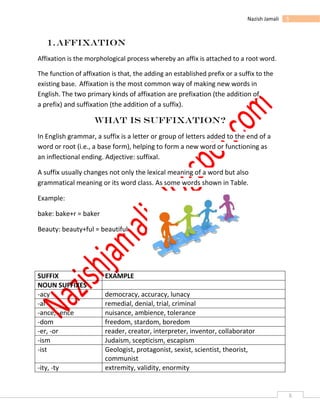
What is Suffixation?
In English grammar, a suffix is a letter or group of letters added to the end of a
word or root (i.e., a base form), helping to form a new word or functioning as
an inflectional ending. Adjective: suffixal.
A suffix usually changes not only the lexical meaning of a word but also
grammatical meaning or its word class. As some words shown in Table.
Example:
bake: bake+r = baker
Beauty: beauty+ful = beautiful
SUFFIX EXAMPLE
NOUN SUFFIXES
-acy democracy, accuracy, lunacy
-al remedial, denial, trial, criminal
-ance, -ence nuisance, ambience, tolerance
-dom freedom, stardom, boredom
-er, -or reader, creator, interpreter, inventor, collaborator
-ism Judaism, scepticism, escapism
-ist Geologist, protagonist, sexist, scientist, theorist,
communist
-ity, -ty extremity, validity, enormity
6
6Nazish Jamali
-ment enchantment, argument
-ness heaviness, highness, sickness
-ship friendship, hardship, internship
-sion, -tion position, promotion, cohesion
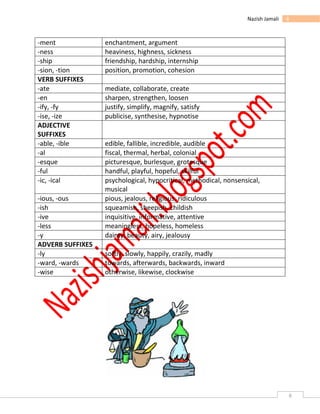
VERB SUFFIXES
-ate mediate, collaborate, create
-en sharpen, strengthen, loosen
-ify, -fy justify, simplify, magnify, satisfy
-ise, -ize publicise, synthesise, hypnotise
ADJECTIVE
SUFFIXES
-able, -ible edible, fallible, incredible, audible
-al fiscal, thermal, herbal, colonial
-esque picturesque, burlesque, grotesque
-ful handful, playful, hopeful, skilful
-ic, -ical psychological, hypocritical, methodical, nonsensical,
musical
-ious, -ous pious, jealous, religious, ridiculous
-ish squeamish, sheepish, childish
-ive inquisitive, informative, attentive
-less meaningless, hopeless, homeless
-y dainty, beauty, airy, jealousy
ADVERB SUFFIXES
-ly softly, slowly, happily, crazily, madly
-ward, -wards towards, afterwards, backwards, inward
-wise otherwise, likewise, clockwise
7
7Nazish Jamali
What is prefixation?
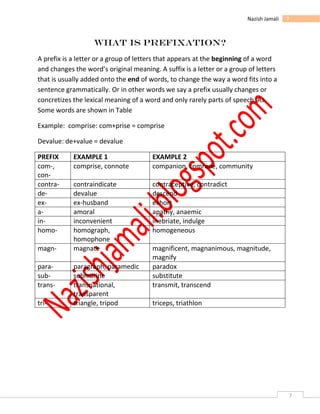
A prefix is a letter or a group of letters that appears at the beginning of a word
and changes the word’s original meaning. A suffix is a letter or a group of letters
that is usually added onto the end of words, to change the way a word fits into a
sentence grammatically. Or in other words we say a prefix usually changes or
concretizes the lexical meaning of a word and only rarely parts of speech. As
Some words are shown in Table
Example: comprise: com+prise = comprise
Devalue: de+value = devalue
PREFIX EXAMPLE 1 EXAMPLE 2
com-,
con-
comprise, connote companion, comrade, community
contra- contraindicate contraceptive, contradict
de- devalue descend
ex- ex-husband exhort
a- amoral apathy, anaemic
in- inconvenient inebriate, indulge
homo- homograph,
homophone
homogeneous
magn- magnate magnificent, magnanimous, magnitude,
magnify
para- paragraph, paramedic paradox
sub- submarine substitute
trans- transnational,
transparent
transmit, transcend
tri- triangle, tripod triceps, triathlon
8
8Nazish Jamali
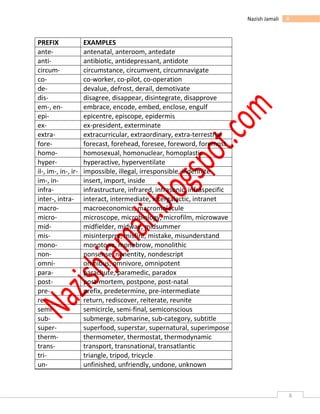
PREFIX EXAMPLES
ante- antenatal, anteroom, antedate
anti- antibiotic, antidepressant, antidote
circum- circumstance, circumvent, circumnavigate
co- co-worker, co-pilot, co-operation
de- devalue, defrost, derail, demotivate
dis- disagree, disappear, disintegrate, disapprove
em-, en- embrace, encode, embed, enclose, engulf
epi- epicentre, episcope, epidermis
ex- ex-president, exterminate
extra- extracurricular, extraordinary, extra-terrestrial
fore- forecast, forehead, foresee, foreword, foremost
homo- homosexual, homonuclear, homoplastic
hyper- hyperactive, hyperventilate
il-, im-, in-, ir- impossible, illegal, irresponsible, indefinite
im-, in- insert, import, inside
infra- infrastructure, infrared, infrasonic, infraspecific
inter-, intra- interact, intermediate, intergalactic, intranet
macro- macroeconomics, macromolecule
micro- microscope, microbiology, microfilm, microwave
mid- midfielder, midway, midsummer
mis- misinterpret, misfire, mistake, misunderstand
mono- monotone, monobrow, monolithic
non- nonsense, nonentity, nondescript
omni- omnibus, omnivore, omnipotent
para- parachute, paramedic, paradox
post- post-mortem, postpone, post-natal
pre- prefix, predetermine, pre-intermediate
re- return, rediscover, reiterate, reunite
semi- semicircle, semi-final, semiconscious
sub- submerge, submarine, sub-category, subtitle
super- superfood, superstar, supernatural, superimpose
therm- thermometer, thermostat, thermodynamic
trans- transport, transnational, transatlantic
tri- triangle, tripod, tricycle
un- unfinished, unfriendly, undone, unknown
9
9Nazish Jamali
2.Coinage
Coinage is the word formation process in which a new word is created either
consciously or accidentally without using the other word formation processes and
often from apparently nothing. As neologism or coinage, we classify the word
formation process of inventing completely new words (neology). Also coinage
refers to extension of a name of a product from a specific reference to a more
general one such as LG, Nokia and Kodak etc.
And in some cases, the meaning of these words is broadened. Example,
complicated chemical or technical terms (like Aspirin: acetylsalicylic acid) are
adopted as the trademark term and often replace standard terms for e.g. in this
example, painkillers. This also happened to words like Xerox,Kleenex or the
German Nutella.
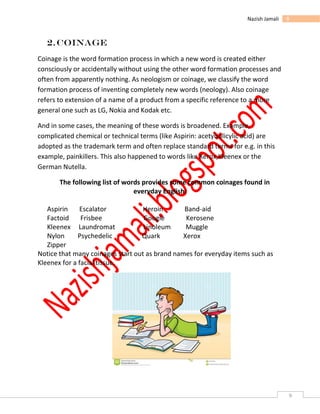
The following list of words provides some common coinages found in
everyday English:
Aspirin Escalator Heroin Band-aid
Factoid Frisbee Google Kerosene
Kleenex Laundromat Linoleum Muggle
Nylon Psychedelic Quark Xerox
Zipper
Notice that many coinages start out as brand names for everyday items such as
Kleenex for a facial tissue.
10
10Nazish Jamali
3.Backformation
Back-formation is the word formation process in
which an actual or supposed derivational affix
detaches from the base form of a word to create a
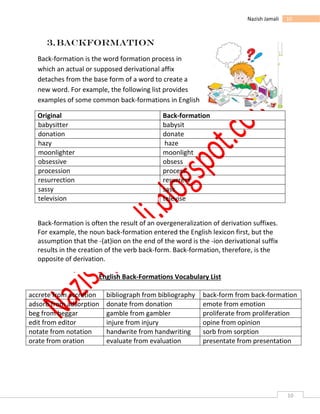
new word. For example, the following list provides
examples of some common back-formations in English
Original Back-formation
babysitter babysit
donation donate
hazy haze
moonlighter moonlight
obsessive obsess
procession process
resurrection resurrect
sassy sass
television televise
Back-formation is often the result of an overgeneralization of derivation suffixes.
For example, the noun back-formation entered the English lexicon first, but the
assumption that the -(at)ion on the end of the word is the -ion derivational suffix
results in the creation of the verb back-form. Back-formation, therefore, is the
opposite of derivation.
English Back-Formations Vocabulary List
accrete from accretion bibliograph from bibliography back-form from back-formation
adsorb from adsorption donate from donation emote from emotion
beg from beggar gamble from gambler proliferate from proliferation
edit from editor injure from injury opine from opinion
notate from notation handwrite from handwriting sorb from sorption
orate from oration evaluate from evaluation presentate from presentation
11
11Nazish Jamali
4. Borrowing
Borrowing is the word formation process in which a word from one language is
borrowed directly into another language.
For example, the following common English words are borrowed from foreign
languages:
 algebra – Arabic
 philosophy – Greek
 cherub – Hebrew
 chow mein – Chinese
 fjord – Norwegian
 pizza – Italian
 yo-yo – Tagalog
 galore – Irish
 haiku – Japanese
 kielbasa – Polish
 murder – French
 near – Sanskrit
 bagel – Yiddish
 paprika – Hungarian
 smorgasbord – Swedish
 tamale – Spanish
Borrowed words are also referred to as loanwords.
12
12Nazish Jamali
5. Conversion
Conversion is the word formation process in which a
word of one grammatical form becomes a word of
another grammatical form without any changes to
spelling or pronunciation. For example, the noun
email appeared in English before the verb: a decade ago
I would have sent you an email (noun) where as now I
can either send you an email (noun) or simply email
(verb) you. The original noun email experienced conversion, thus resulting in the
new verb email. Conversion is also referred to as zero derivation or null derivation
with the assumption that the formal change between words results in the
addition of an invisible morpheme. However, many linguistics argue for a clear
distinction between the word formation processes of derivation and conversion.
Noun to Verb Conversion and Verb to Noun
The following list provides examples of verbs converted from nouns and nouns
converted from verbs.
Nouns Verbs and Verb Noun
access
bottle
can
closet
email
eye
fiddle
fool
Google
host
knife
microwave
name
pocket
salt
shape
ship
spear
To access
To bottle
To can
To closet
To email
To eye
To fiddle
To fool
To Google
To host
To knife
To microwave
To name
To pocket
To salt
To shape
To ship
To spear
to alert
to attack
to call
to clone
to command
to cover
to cry
to experience
to fear
to feel
to hope
to increase
to judge
to laugh
to rise
to run
to sleep
to start
alert
attack
call
clone
command
cover
cry
experience
fear
feel
hope
increase
judge
laugh
rise
run
sleep
start
13
13Nazish Jamali
6. Compounding
Compounding is the process of putting words together to build a new one that
''does not denote two things, but one'' and that is ''pronounced as one unit.
A compound word contains at least two bases which are both words ,or at any
rate, root morphemes.
For Example:
(Tea) + ( pot ) = teapot ( noun + noun)
(Hair) + (dress) + er => hairdresser (noun + verb )
(Blue) + (bird) = bluebird (adjective + noun)
(Over) + (lord) = overlord ( preposition + noun )
OR
Compounding is the word formation process in which two or more lexemes
combine into a single new word. Compound words may be written as one word or
as two words joined with a hyphen.
Other example:
 noun-noun compound: note + book = notebook
 adjective-noun compound: blue + berry = blueberry
 verb-noun compound: work + room = workroom
 noun-verb compound: breast + feed = breastfeed
 verb-verb compound: stir + fry = stir-fry
 adjective-verb compound: high + light = highlight
 verb-preposition compound: break + up = breakup
 preposition-verb compound: out + run = outrun
 adjective-adjective compound: bitter + sweet = bittersweet
 preposition-preposition compound: in + to = into
Compounds may be compositional, meaning that the meaning of the new word is
determined by combining the meanings of the parts, or non-compositional,
meaning that the meaning of the new word cannot be determined by combining
14
14Nazish Jamali
the meanings of the parts. For example, a blueberry is a berry that is blue.
However, a breakup is not a relationship that was severed into pieces in an
upward direction.
Compound nouns should not be confused with nouns modified by adjectives,
verbs, and other nouns. For example, the adjective black of the noun phrase black
bird is different from the adjective black of the compound noun blackbird in that
black of black bird functions as a noun phrase modifier while
the black of blackbird is an inseparable part of the noun: a black bird also refers to
any bird that is black in color while a blackbird is a specific type of bird.
7. Acronyms
Acronyms are words formed by the word formation process in which an initialism
is pronounced as a word. For example, HIV is an initialism for Human
Immunodeficiency Virus that is spoken as the three letters H-I-V.
However, AIDS is an acronym for Acquired Immunodeficiency Syndrome that is
spoken as the word aids.
Other examples of acronyms in English include:
 ASAP – as soon as possible
 AWOL – absent without leave
 laser - light amplification by stimulated emission of radiation
 NASA – National Aeronautics and Space Administration
 NASDAQ - National Association of Securities Dealers Automated Quotations
 PIN – personal identification number
 radar - radio detection and ranging
 scuba - self-contained underwater breathing apparatus
 TESOL – Teachers of English to Speakers of Other Languages
 WASP – White Anglo-Saxon Protestant
Acronyms are related to the word formation process of abbreviation.
15
15Nazish Jamali
8. Blending
A blending is a combination of two or more words to create a new one, usually by
taking the beginning of the other word and the end of the other one.
So new words like
spork (spoon + fork),
fanzine (fan + magazine),
bromance (brother + romance) or
Spanglish (Spanish + English) are created.
There are of course other ways to create a blending:
for example, you can take both beginnings of a word
(cybernetic + organism = cyborg) or take a whole word and combine it with a part
of another one (guess + estimate = guesstimate).
Another example of combining words, in this case names, is the bleding of
celebrity couple names, such as
Brangelina (Brad + Angelina) or Bennifer (Ben + Jennifer).
There are two different words with completely unequal meanings put together to
form a new word with a new meaning.
Examples and Observations:
motel (motorway hotel)
brunch (breakfast lunch fridge (freezer refrigerator)
smog (smoke fog)
stagflation (stagnation and inflation)
spork (spoon and fork)
carjacking (car and hijacking)
mocktail(mock and cocktail with no alcohol)
splog (spam and blog)
alcopop (alcohol + pop)
bash (bat + mash)
biopic (biography + picture)
Breathalyzer (breath + analyzer)
camcorder (camera + recorder)
chexting (cheating + texting)
clash (clap + crash)
cosmeceutical (cosmetic + pharmaceutical)
docudrama (documentary+ drama)
16
16Nazish Jamali
faction (fact + fiction)
electrocute (electricity + execute)
fanzine (fan + magazine)
emoticon (emote + icon)
flare (flame + glare)
glimmer (gleam + shimmer)
Globish (global + English)
guitarthritis (guitar + arthritis)
infotainment (information + entertainment)
moped (motor + pedal)
palimony (pal + alimony
pornacopia (pornography + cornucopia)
pulsar (pulse + quasar
sitcom (situation + comedy)
slanguage (slang + language)
smash (smack + mash)
sportscast (sports + broadcast)
stagflation (stagnation + inflation)
staycation (stay home + vacation)
telegenic (television + photogenic)
textpectation (text message + expectation)
workaholic (work + alcoholic).
17
17Nazish Jamali
9. Clipping
Clipping is the word formation process in which a word is reduced or shortened
without changing the meaning of the word. Clipping differs from back-formation
in that the new word retains the meaning of the original word. For example:
 advertisement – ad
 alligator – gator
 examination – exam
 gasoline – gas
 gymnasium – gym
 influenza – flu
 laboratory – lab
 mathematics – math
 memorandum – memo
 photograph – photo
 public house – pub
 raccoon – coon
 reputation – rep
 situation comedy – sitcom
 telephone – phone
The four types of clipping are
1. back clipping
2. fore-clipping
3. middle clipping
4. complex clipping
Back clipping is removing the end of a word as in gas from gasoline.
Fore-clipping is removing the beginning of a word as in gator from alligator.
Middle clipping is retaining only the middle of a word as in flu from influenza.
Complex clipping is removing multiple parts from multiple words as
in sitcom from situation comedy.
18
18Nazish Jamali
Conclusion
As we have seen before, there are many ways to create new words: Borrowing
from other languages, blending together from several words we already have. Of
course there are even more possibilities than mentioned before. There is the
possibility to convert words from one grammatical category to another,
for example from verb to noun (to flow => the flow) or from noun to verb
(the e-mail => to e-mail). Other examples for other word formation
processes include clippings, with which the word is shortened
(e.g. influenza => flu; advertising => ad; motorbike => bike), or folk etymology,
where words from other languages are taken and then, over time, people try to
make sense of them. So slowly but surely the word is changed to a more familiar
form that usually keeps its original meaning, e.g. the Spanish word cucaracha was
borrowed and then gradually transformed to cockroach. Even the creative
respelling, where the spelling of words is changed for products (e.g. Kleen,
Krunch), is considered to be one of these processes. So finally, if we take a look
around, we will see a mass of new words surrounding us, brought to us both
consciously by language trends or advertising and unconsciously through
language change over time.
19
19Nazish Jamali
Reference
1. http://www.ruf.rice.edu/~kemmer/Words/wordtypes.html
2. https://en.wikipedia.org/wiki/Word_formation
3. http://www.slideshare.net/furrakhabbas/processes-of-word-formation
4. http://vlearn.fed.cuhk.edu.hk/wordformation/word-formation-processes/
5. http://www.really-learn-english.com/word-formation-processes.html
6. http://www.translationdirectory.com/articles/article1991.php
7. http://www.kau.edu.sa/Files/0008867/Subjects/8714_5Word%20Formatio
n%20Processes.pdf
8. http://killmonotony.net/written/wfp.pdf
9. https://abuzaidalbadri.files.wordpress.com/2012/01/wordprocesspaper.pd
f
10.http://www.slideshare.net/lalitaggarwalstiff/word-formation-process
11. http://catdir.loc.gov/catdir/samples/cam041/2003048479.pdf

Word formation process english content my assignment

  • 1.
  • 2.
    1 1Nazish Jamali Assignment Subject: EnglishContent-1 Topic: Word Formation Processes Presented by: Nazish Jamali Batch: 2016 Semester: 01 Submission Date: 30-05-2016
  • 3.
    2 2Nazish Jamali Table ofcontents Topics Page No. Objectives ……………………………………………………. 03 Word formation processes …………………………… 04 What is word formation? ……………………………… 04 How to generate new words…………………………. 04 Types of word formation………………………………. 04 1. Affixation……………………………………………… 05 a) What is Suffixation? …………………………………. 05 b) What is prefixation? …………………………………. 07 2. Coinage………………………………………………… 09 3. Backformation……………………………………… 10 4. Borrowing……………………………………………. 11 5. Conversion…………………………………………… 12 6. Compounding………………………………………13 7. Acronym…………………………………………….. 14 8. Blending……………………………………………… 15 9. Clipping………………………………………………. 17 Conclusion…………………………………………………… 18 Reference
  • 4.
    3 3Nazish Jamali Objectives After thislesson student will be able to know  Word formation processes  How to generate new words  Word formation processes types 1. Affixation with vocabulary words 2. Coinage with vocabulary words 3. Backformation with vocabulary words 4. Borrowing with vocabulary words 5. Conversion with vocabulary words 6. Compounding with vocabulary words 7. Acronym with vocabulary words 8. Blending with vocabulary words 9. Clipping with vocabulary words
  • 5.
    4 4Nazish Jamali Process ofword formation What is word formation? The word formation is the creation of a new word. Word formation is sometimes compared with semantic change and it is a change in a single word’s meaning. The limit between word formation and semantic change can be difficult to define a new use of an old word can be seen as a new word derived from an old one. Or in other words we say word formation is process of create new words by existing elements of language according to certain patterns and rules. How to generate new words New words can be formed by adding affixes to existing words or by using existing words to create blend words and compound words Types of word formation 1. Affixation 2. Coinage 3. Backformation 4. Borrowing 5. Conversion 6. Compounding 7. Acronym 8. Blending 9. Clipping
  • 6.
    5 5Nazish Jamali 1.Affixation Affixation isthe morphological process whereby an affix is attached to a root word. The function of affixation is that, the adding an established prefix or a suffix to the existing base. Affixation is the most common way of making new words in English. The two primary kinds of affixation are prefixation (the addition of a prefix) and suffixation (the addition of a suffix). What is Suffixation? In English grammar, a suffix is a letter or group of letters added to the end of a word or root (i.e., a base form), helping to form a new word or functioning as an inflectional ending. Adjective: suffixal. A suffix usually changes not only the lexical meaning of a word but also grammatical meaning or its word class. As some words shown in Table. Example: bake: bake+r = baker Beauty: beauty+ful = beautiful SUFFIX EXAMPLE NOUN SUFFIXES -acy democracy, accuracy, lunacy -al remedial, denial, trial, criminal -ance, -ence nuisance, ambience, tolerance -dom freedom, stardom, boredom -er, -or reader, creator, interpreter, inventor, collaborator -ism Judaism, scepticism, escapism -ist Geologist, protagonist, sexist, scientist, theorist, communist -ity, -ty extremity, validity, enormity
  • 7.
    6 6Nazish Jamali -ment enchantment,argument -ness heaviness, highness, sickness -ship friendship, hardship, internship -sion, -tion position, promotion, cohesion VERB SUFFIXES -ate mediate, collaborate, create -en sharpen, strengthen, loosen -ify, -fy justify, simplify, magnify, satisfy -ise, -ize publicise, synthesise, hypnotise ADJECTIVE SUFFIXES -able, -ible edible, fallible, incredible, audible -al fiscal, thermal, herbal, colonial -esque picturesque, burlesque, grotesque -ful handful, playful, hopeful, skilful -ic, -ical psychological, hypocritical, methodical, nonsensical, musical -ious, -ous pious, jealous, religious, ridiculous -ish squeamish, sheepish, childish -ive inquisitive, informative, attentive -less meaningless, hopeless, homeless -y dainty, beauty, airy, jealousy ADVERB SUFFIXES -ly softly, slowly, happily, crazily, madly -ward, -wards towards, afterwards, backwards, inward -wise otherwise, likewise, clockwise
  • 8.
    7 7Nazish Jamali What isprefixation? A prefix is a letter or a group of letters that appears at the beginning of a word and changes the word’s original meaning. A suffix is a letter or a group of letters that is usually added onto the end of words, to change the way a word fits into a sentence grammatically. Or in other words we say a prefix usually changes or concretizes the lexical meaning of a word and only rarely parts of speech. As Some words are shown in Table Example: comprise: com+prise = comprise Devalue: de+value = devalue PREFIX EXAMPLE 1 EXAMPLE 2 com-, con- comprise, connote companion, comrade, community contra- contraindicate contraceptive, contradict de- devalue descend ex- ex-husband exhort a- amoral apathy, anaemic in- inconvenient inebriate, indulge homo- homograph, homophone homogeneous magn- magnate magnificent, magnanimous, magnitude, magnify para- paragraph, paramedic paradox sub- submarine substitute trans- transnational, transparent transmit, transcend tri- triangle, tripod triceps, triathlon
  • 9.
    8 8Nazish Jamali PREFIX EXAMPLES ante-antenatal, anteroom, antedate anti- antibiotic, antidepressant, antidote circum- circumstance, circumvent, circumnavigate co- co-worker, co-pilot, co-operation de- devalue, defrost, derail, demotivate dis- disagree, disappear, disintegrate, disapprove em-, en- embrace, encode, embed, enclose, engulf epi- epicentre, episcope, epidermis ex- ex-president, exterminate extra- extracurricular, extraordinary, extra-terrestrial fore- forecast, forehead, foresee, foreword, foremost homo- homosexual, homonuclear, homoplastic hyper- hyperactive, hyperventilate il-, im-, in-, ir- impossible, illegal, irresponsible, indefinite im-, in- insert, import, inside infra- infrastructure, infrared, infrasonic, infraspecific inter-, intra- interact, intermediate, intergalactic, intranet macro- macroeconomics, macromolecule micro- microscope, microbiology, microfilm, microwave mid- midfielder, midway, midsummer mis- misinterpret, misfire, mistake, misunderstand mono- monotone, monobrow, monolithic non- nonsense, nonentity, nondescript omni- omnibus, omnivore, omnipotent para- parachute, paramedic, paradox post- post-mortem, postpone, post-natal pre- prefix, predetermine, pre-intermediate re- return, rediscover, reiterate, reunite semi- semicircle, semi-final, semiconscious sub- submerge, submarine, sub-category, subtitle super- superfood, superstar, supernatural, superimpose therm- thermometer, thermostat, thermodynamic trans- transport, transnational, transatlantic tri- triangle, tripod, tricycle un- unfinished, unfriendly, undone, unknown
  • 10.
    9 9Nazish Jamali 2.Coinage Coinage isthe word formation process in which a new word is created either consciously or accidentally without using the other word formation processes and often from apparently nothing. As neologism or coinage, we classify the word formation process of inventing completely new words (neology). Also coinage refers to extension of a name of a product from a specific reference to a more general one such as LG, Nokia and Kodak etc. And in some cases, the meaning of these words is broadened. Example, complicated chemical or technical terms (like Aspirin: acetylsalicylic acid) are adopted as the trademark term and often replace standard terms for e.g. in this example, painkillers. This also happened to words like Xerox,Kleenex or the German Nutella. The following list of words provides some common coinages found in everyday English: Aspirin Escalator Heroin Band-aid Factoid Frisbee Google Kerosene Kleenex Laundromat Linoleum Muggle Nylon Psychedelic Quark Xerox Zipper Notice that many coinages start out as brand names for everyday items such as Kleenex for a facial tissue.
  • 11.
    10 10Nazish Jamali 3.Backformation Back-formation isthe word formation process in which an actual or supposed derivational affix detaches from the base form of a word to create a new word. For example, the following list provides examples of some common back-formations in English Original Back-formation babysitter babysit donation donate hazy haze moonlighter moonlight obsessive obsess procession process resurrection resurrect sassy sass television televise Back-formation is often the result of an overgeneralization of derivation suffixes. For example, the noun back-formation entered the English lexicon first, but the assumption that the -(at)ion on the end of the word is the -ion derivational suffix results in the creation of the verb back-form. Back-formation, therefore, is the opposite of derivation. English Back-Formations Vocabulary List accrete from accretion bibliograph from bibliography back-form from back-formation adsorb from adsorption donate from donation emote from emotion beg from beggar gamble from gambler proliferate from proliferation edit from editor injure from injury opine from opinion notate from notation handwrite from handwriting sorb from sorption orate from oration evaluate from evaluation presentate from presentation
  • 12.
    11 11Nazish Jamali 4. Borrowing Borrowingis the word formation process in which a word from one language is borrowed directly into another language. For example, the following common English words are borrowed from foreign languages:  algebra – Arabic  philosophy – Greek  cherub – Hebrew  chow mein – Chinese  fjord – Norwegian  pizza – Italian  yo-yo – Tagalog  galore – Irish  haiku – Japanese  kielbasa – Polish  murder – French  near – Sanskrit  bagel – Yiddish  paprika – Hungarian  smorgasbord – Swedish  tamale – Spanish Borrowed words are also referred to as loanwords.
  • 13.
    12 12Nazish Jamali 5. Conversion Conversionis the word formation process in which a word of one grammatical form becomes a word of another grammatical form without any changes to spelling or pronunciation. For example, the noun email appeared in English before the verb: a decade ago I would have sent you an email (noun) where as now I can either send you an email (noun) or simply email (verb) you. The original noun email experienced conversion, thus resulting in the new verb email. Conversion is also referred to as zero derivation or null derivation with the assumption that the formal change between words results in the addition of an invisible morpheme. However, many linguistics argue for a clear distinction between the word formation processes of derivation and conversion. Noun to Verb Conversion and Verb to Noun The following list provides examples of verbs converted from nouns and nouns converted from verbs. Nouns Verbs and Verb Noun access bottle can closet email eye fiddle fool Google host knife microwave name pocket salt shape ship spear To access To bottle To can To closet To email To eye To fiddle To fool To Google To host To knife To microwave To name To pocket To salt To shape To ship To spear to alert to attack to call to clone to command to cover to cry to experience to fear to feel to hope to increase to judge to laugh to rise to run to sleep to start alert attack call clone command cover cry experience fear feel hope increase judge laugh rise run sleep start
  • 14.
    13 13Nazish Jamali 6. Compounding Compoundingis the process of putting words together to build a new one that ''does not denote two things, but one'' and that is ''pronounced as one unit. A compound word contains at least two bases which are both words ,or at any rate, root morphemes. For Example: (Tea) + ( pot ) = teapot ( noun + noun) (Hair) + (dress) + er => hairdresser (noun + verb ) (Blue) + (bird) = bluebird (adjective + noun) (Over) + (lord) = overlord ( preposition + noun ) OR Compounding is the word formation process in which two or more lexemes combine into a single new word. Compound words may be written as one word or as two words joined with a hyphen. Other example:  noun-noun compound: note + book = notebook  adjective-noun compound: blue + berry = blueberry  verb-noun compound: work + room = workroom  noun-verb compound: breast + feed = breastfeed  verb-verb compound: stir + fry = stir-fry  adjective-verb compound: high + light = highlight  verb-preposition compound: break + up = breakup  preposition-verb compound: out + run = outrun  adjective-adjective compound: bitter + sweet = bittersweet  preposition-preposition compound: in + to = into Compounds may be compositional, meaning that the meaning of the new word is determined by combining the meanings of the parts, or non-compositional, meaning that the meaning of the new word cannot be determined by combining
  • 15.
    14 14Nazish Jamali the meaningsof the parts. For example, a blueberry is a berry that is blue. However, a breakup is not a relationship that was severed into pieces in an upward direction. Compound nouns should not be confused with nouns modified by adjectives, verbs, and other nouns. For example, the adjective black of the noun phrase black bird is different from the adjective black of the compound noun blackbird in that black of black bird functions as a noun phrase modifier while the black of blackbird is an inseparable part of the noun: a black bird also refers to any bird that is black in color while a blackbird is a specific type of bird. 7. Acronyms Acronyms are words formed by the word formation process in which an initialism is pronounced as a word. For example, HIV is an initialism for Human Immunodeficiency Virus that is spoken as the three letters H-I-V. However, AIDS is an acronym for Acquired Immunodeficiency Syndrome that is spoken as the word aids. Other examples of acronyms in English include:  ASAP – as soon as possible  AWOL – absent without leave  laser - light amplification by stimulated emission of radiation  NASA – National Aeronautics and Space Administration  NASDAQ - National Association of Securities Dealers Automated Quotations  PIN – personal identification number  radar - radio detection and ranging  scuba - self-contained underwater breathing apparatus  TESOL – Teachers of English to Speakers of Other Languages  WASP – White Anglo-Saxon Protestant Acronyms are related to the word formation process of abbreviation.
  • 16.
    15 15Nazish Jamali 8. Blending Ablending is a combination of two or more words to create a new one, usually by taking the beginning of the other word and the end of the other one. So new words like spork (spoon + fork), fanzine (fan + magazine), bromance (brother + romance) or Spanglish (Spanish + English) are created. There are of course other ways to create a blending: for example, you can take both beginnings of a word (cybernetic + organism = cyborg) or take a whole word and combine it with a part of another one (guess + estimate = guesstimate). Another example of combining words, in this case names, is the bleding of celebrity couple names, such as Brangelina (Brad + Angelina) or Bennifer (Ben + Jennifer). There are two different words with completely unequal meanings put together to form a new word with a new meaning. Examples and Observations: motel (motorway hotel) brunch (breakfast lunch fridge (freezer refrigerator) smog (smoke fog) stagflation (stagnation and inflation) spork (spoon and fork) carjacking (car and hijacking) mocktail(mock and cocktail with no alcohol) splog (spam and blog) alcopop (alcohol + pop) bash (bat + mash) biopic (biography + picture) Breathalyzer (breath + analyzer) camcorder (camera + recorder) chexting (cheating + texting) clash (clap + crash) cosmeceutical (cosmetic + pharmaceutical) docudrama (documentary+ drama)
  • 17.
    16 16Nazish Jamali faction (fact+ fiction) electrocute (electricity + execute) fanzine (fan + magazine) emoticon (emote + icon) flare (flame + glare) glimmer (gleam + shimmer) Globish (global + English) guitarthritis (guitar + arthritis) infotainment (information + entertainment) moped (motor + pedal) palimony (pal + alimony pornacopia (pornography + cornucopia) pulsar (pulse + quasar sitcom (situation + comedy) slanguage (slang + language) smash (smack + mash) sportscast (sports + broadcast) stagflation (stagnation + inflation) staycation (stay home + vacation) telegenic (television + photogenic) textpectation (text message + expectation) workaholic (work + alcoholic).
  • 18.
    17 17Nazish Jamali 9. Clipping Clippingis the word formation process in which a word is reduced or shortened without changing the meaning of the word. Clipping differs from back-formation in that the new word retains the meaning of the original word. For example:  advertisement – ad  alligator – gator  examination – exam  gasoline – gas  gymnasium – gym  influenza – flu  laboratory – lab  mathematics – math  memorandum – memo  photograph – photo  public house – pub  raccoon – coon  reputation – rep  situation comedy – sitcom  telephone – phone The four types of clipping are 1. back clipping 2. fore-clipping 3. middle clipping 4. complex clipping Back clipping is removing the end of a word as in gas from gasoline. Fore-clipping is removing the beginning of a word as in gator from alligator. Middle clipping is retaining only the middle of a word as in flu from influenza. Complex clipping is removing multiple parts from multiple words as in sitcom from situation comedy.
  • 19.
    18 18Nazish Jamali Conclusion As wehave seen before, there are many ways to create new words: Borrowing from other languages, blending together from several words we already have. Of course there are even more possibilities than mentioned before. There is the possibility to convert words from one grammatical category to another, for example from verb to noun (to flow => the flow) or from noun to verb (the e-mail => to e-mail). Other examples for other word formation processes include clippings, with which the word is shortened (e.g. influenza => flu; advertising => ad; motorbike => bike), or folk etymology, where words from other languages are taken and then, over time, people try to make sense of them. So slowly but surely the word is changed to a more familiar form that usually keeps its original meaning, e.g. the Spanish word cucaracha was borrowed and then gradually transformed to cockroach. Even the creative respelling, where the spelling of words is changed for products (e.g. Kleen, Krunch), is considered to be one of these processes. So finally, if we take a look around, we will see a mass of new words surrounding us, brought to us both consciously by language trends or advertising and unconsciously through language change over time.
  • 20.
    19 19Nazish Jamali Reference 1. http://www.ruf.rice.edu/~kemmer/Words/wordtypes.html 2.https://en.wikipedia.org/wiki/Word_formation 3. http://www.slideshare.net/furrakhabbas/processes-of-word-formation 4. http://vlearn.fed.cuhk.edu.hk/wordformation/word-formation-processes/ 5. http://www.really-learn-english.com/word-formation-processes.html 6. http://www.translationdirectory.com/articles/article1991.php 7. http://www.kau.edu.sa/Files/0008867/Subjects/8714_5Word%20Formatio n%20Processes.pdf 8. http://killmonotony.net/written/wfp.pdf 9. https://abuzaidalbadri.files.wordpress.com/2012/01/wordprocesspaper.pd f 10.http://www.slideshare.net/lalitaggarwalstiff/word-formation-process 11. http://catdir.loc.gov/catdir/samples/cam041/2003048479.pdf