Analyzing English Grammar 
Thomas P. Klammer and Others 
BASIC SENTENCE 
TRANSFORMATIONS 
Chapter 9 
Presented by: 
Bilal H. Yaseen GS39550 
Hani Shakir GS39584 
Rashad Yaqoob GS38704 
Presented to 
Dr. Helen Tan 
Faculty of Modern Languages and Communication 
University Putra Malaysia 
November 2014
THE INDIRECT OBJECT TRANSFORMATION 
• We may ask " if we depend on these five types in order to communicate, how 
will our language performance be? 
• The answer is: if speakers and writers of English use only these types in Chapter 
8, our language performance will not only be “childlike” in its simplicity ,but also 
boringly repetitive. 
• In addition to that, we need a phenomenon by which we are able to express 
complex relationships between ideas, attitudes and differences in emphasize. 
• As a result, one sentence can be transformed into another in English to 
emphasize information, to ask questions ,to issue imperative ,to negate , etc. 
Thus, a phenomenon resulting from the combining of simple structures into more 
complex ones is called sentence transformation. 
( words may be added, moved or deleted by transformations)
THE INDIRECT OBJECT TRANSFORMATION 
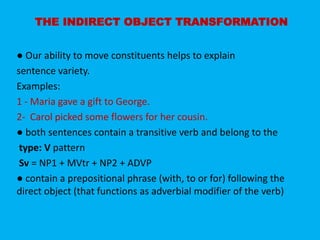
● Our ability to move constituents helps to explain 
sentence variety. 
Examples: 
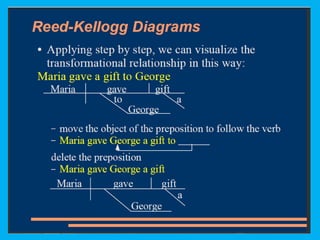
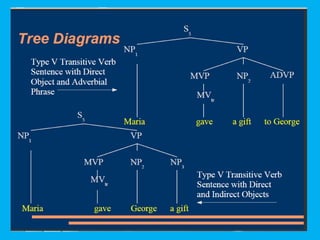
1 - Maria gave a gift to George. 
2- Carol picked some flowers for her cousin. 
● both sentences contain a transitive verb and belong to the 
type: V pattern 
Sv = NP1 + MVtr + NP2 + ADVP 
● contain a prepositional phrase (with, to or for) following the 
direct object (that functions as adverbial modifier of the verb)
THE INDIRECT OBJECT TRANSFORMATION 
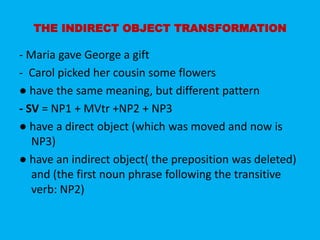
- Maria gave George a gift 
- Carol picked her cousin some flowers 
● have the same meaning, but different pattern 
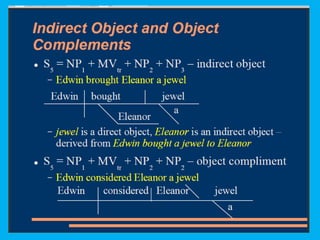
- SV = NP1 + MVtr +NP2 + NP3 
● have a direct object (which was moved and now is 
NP3) 
● have an indirect object( the preposition was deleted) 
and (the first noun phrase following the transitive 
verb: NP2)
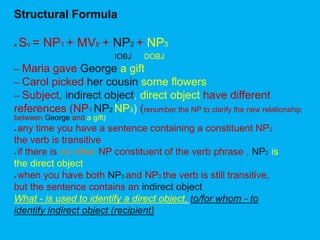
Structural Formula 
●Sv = NP1 + MVtr + NP2 + NP3 
IOBJ DOBJ 
– Maria gave George a gift 
– Carol picked her cousin some flowers 
– Subject, indirect object, direct object have different 
references (NP1 NP2NP3) (renumber the NP to clarify the new relationship 
between George and a gift) 
● any time you have a sentence containing a constituent NP2 
the verb is transitive 
● if there is no other NP constituent of the verb phrase , NP2 is 
the direct object 
●when you have both NP2 and NP3 the verb is still transitive, 
but the sentence contains an indirect object 
What - is used to identify a direct object, to/for whom - to 
identify indirect object (recipient)
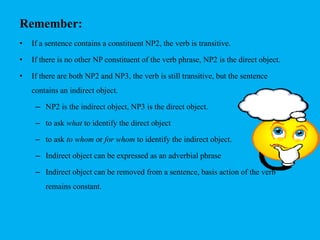
Remember: 
• If a sentence contains a constituent NP2, the verb is transitive. 
• If there is no other NP constituent of the verb phrase, NP2 is the direct object. 
• If there are both NP2 and NP3, the verb is still transitive, but the sentence 
contains an indirect object. 
– NP2 is the indirect object, NP3 is the direct object. 
– to ask what to identify the direct object 
– to ask to whom or for whom to identify the indirect object. 
– Indirect object can be expressed as an adverbial phrase 
– Indirect object can be removed from a sentence, basis action of the verb 
remains constant.
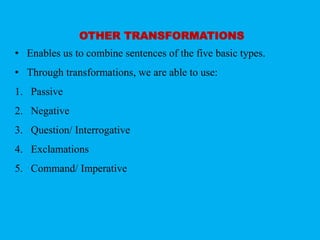
OTHER TRANSFORMATIONS 
• Enables us to combine sentences of the five basic types. 
• Through transformations, we are able to use: 
1. Passive 
2. Negative 
3. Question/ Interrogative 
4. Exclamations 
5. Command/ Imperative
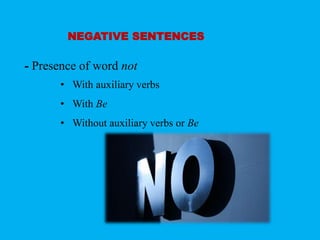
NEGATIVE SENTENCES 
- Presence of word not 
• With auxiliary verbs 
• With Be 
• Without auxiliary verbs or Be
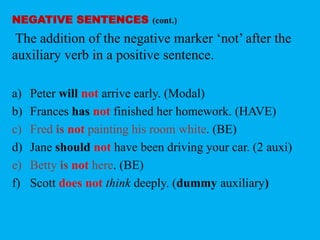
NEGATIVE SENTENCES (cont.) 
The addition of the negative marker ‘not’ after the 
auxiliary verb in a positive sentence. 
a) Peter will not arrive early. (Modal) 
b) Frances has not finished her homework. (HAVE) 
c) Fred is not painting his room white. (BE) 
d) Jane should not have been driving your car. (2 auxi) 
e) Betty is not here. (BE) 
f) Scott does not think deeply. (dummy auxiliary)
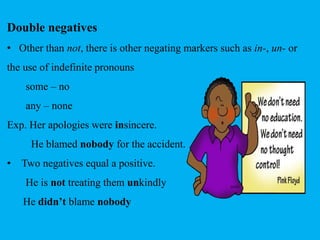
Double negatives 
• Other than not, there is other negating markers such as in-, un- or 
the use of indefinite pronouns 
some – no 
any – none 
Exp. Her apologies were insincere. 
He blamed nobody for the accident. 
• Two negatives equal a positive. 
He is not treating them unkindly 
He didn’t blame nobody
INTERROGATIVE SENTENCES 
o Ask questions 
• Yes/no question – seeks yes/no answer 
Did Mary win the competition? 
• Wh-question – Wh- fronting 
Who won the competition?
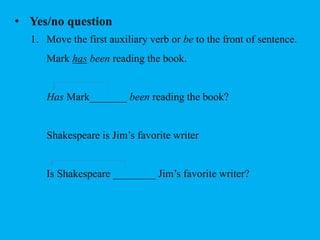
• Yes/no question 
1. Move the first auxiliary verb or be to the front of sentence. 
Mark has been reading the book. 
Has Mark_______ been reading the book? 
Shakespeare is Jim’s favorite writer 
Is Shakespeare ________ Jim’s favorite writer?
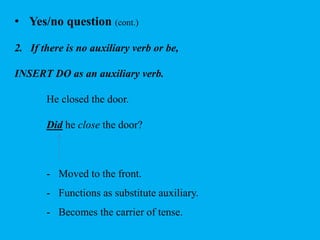
• Yes/no question (cont.) 
2. If there is no auxiliary verb or be, 
INSERT DO as an auxiliary verb. 
He closed the door. 
Did he close the door? 
- Moved to the front. 
- Functions as substitute auxiliary. 
- Becomes the carrier of tense.
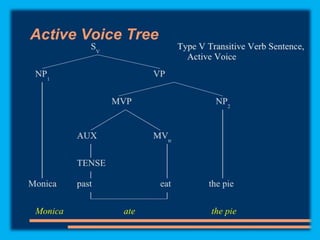
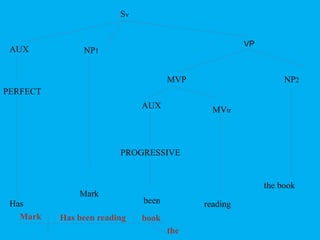
Sv 
NP1 
VP 
MVP 
NP2 
Aux 
YES/ NO Q TENSE PERFECT PROGRESSIVE 
MVtr 
read the book 
Mark 
Present [HAVE + {-en}] 
[BE + {-ing}]
Sv 
AUX 
PERFECT 
Has 
NP1 
Mark 
VP 
MVP NP2 
AUX 
MVtr 
PROGRESSIVE 
been reading 
the book 
Mark Has been reading book 
the
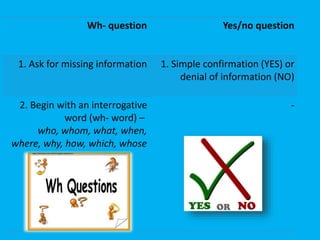
Wh- question Yes/no question 
1. Ask for missing information 1. Simple confirmation (YES) or 
denial of information (NO) 
2. Begin with an interrogative 
word (wh- word) – 
who, whom, what, when, 
where, why, how, which, whose 
-
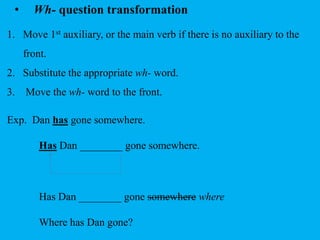
• Wh- question transformation 
1. Move 1st auxiliary, or the main verb if there is no auxiliary to the 
front. 
2. Substitute the appropriate wh- word. 
3. Move the wh- word to the front. 
Exp. Dan has gone somewhere. 
Has Dan ________ gone somewhere. 
Has Dan ________ gone somewhere where 
Where has Dan gone?
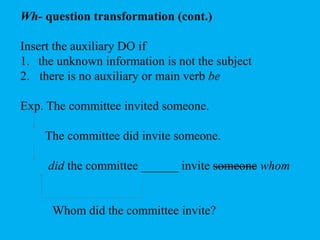
Wh- question transformation (cont.) 
Insert the auxiliary DO if 
1. the unknown information is not the subject 
2. there is no auxiliary or main verb be 
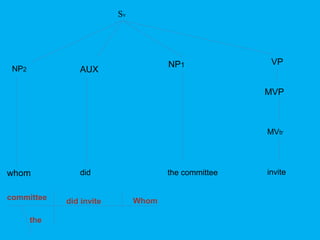
Exp. The committee invited someone. 
The committee did invite someone. 
did the committee ______ invite someone whom 
Whom did the committee invite?
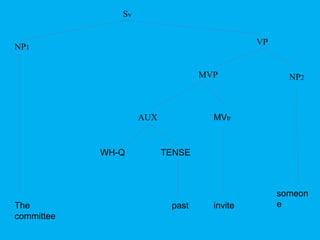
Sv 
NP1 
VP 
MVP NP2 
AUX MVtr 
WH-Q TENSE 
The 
committee 
past invite 
someon 
e
Sv 
NP2 AUX 
NP1 VP 
MVP 
MVtr 
whom did the committee invite 
committee 
the 
did invite Whom
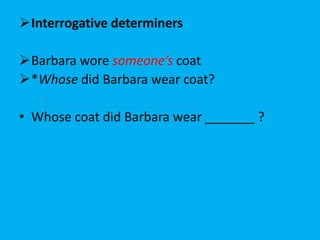
Interrogative determiners 
Barbara wore someone’s coat 
*Whose did Barbara wear coat? 
• Whose coat did Barbara wear _______ ?
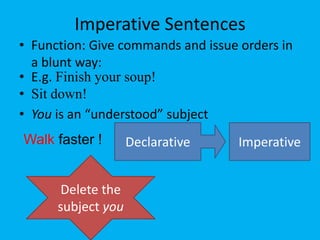
Imperative Sentences 
• Function: Give commands and issue orders in 
a blunt way: 
• E.g. Finish your soup! 
• Sit down! 
• You is an “understood” subject 
EWxaamlkp lfea:ster ! Declarative Imperative 
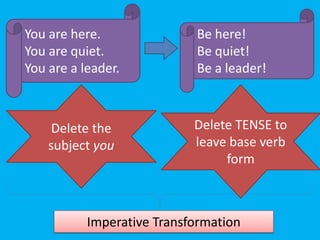
Delete the 
subject you
● 
● 
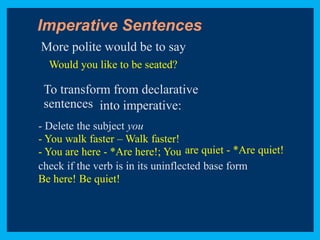
Imperative Sentences 
More polite would be to say 
Would you like to be seated? 
To transform from declarative 
sentences into imperative: 
- Delete the subject you 
- You walk faster –Walk faster! 
- You are here - *Are here!; You are quiet - *Are quiet! 
check if the verb is in its uninflected base form 
Be here! Be quiet!
You are here. 
You are quiet. 
You are a leader. 
*Be Are here! 
here! 
*Be Are quiet! 
quiet! 
Be *Are a leader! 
a leader! 
Delete TENSE to 
leave base verb 
form 
Delete the 
subject you 
Imperative Transformation
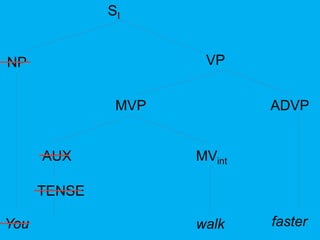
SI 
NP VP 
MVP ADVP 
AUX MVint 
TENSE 
You walk faster
The End 
Thanks

Sentence transformation chapte 9 presentation

  • 1.
    Analyzing English Grammar Thomas P. Klammer and Others BASIC SENTENCE TRANSFORMATIONS Chapter 9 Presented by: Bilal H. Yaseen GS39550 Hani Shakir GS39584 Rashad Yaqoob GS38704 Presented to Dr. Helen Tan Faculty of Modern Languages and Communication University Putra Malaysia November 2014
  • 2.
    THE INDIRECT OBJECTTRANSFORMATION • We may ask " if we depend on these five types in order to communicate, how will our language performance be? • The answer is: if speakers and writers of English use only these types in Chapter 8, our language performance will not only be “childlike” in its simplicity ,but also boringly repetitive. • In addition to that, we need a phenomenon by which we are able to express complex relationships between ideas, attitudes and differences in emphasize. • As a result, one sentence can be transformed into another in English to emphasize information, to ask questions ,to issue imperative ,to negate , etc. Thus, a phenomenon resulting from the combining of simple structures into more complex ones is called sentence transformation. ( words may be added, moved or deleted by transformations)
  • 3.
    THE INDIRECT OBJECTTRANSFORMATION ● Our ability to move constituents helps to explain sentence variety. Examples: 1 - Maria gave a gift to George. 2- Carol picked some flowers for her cousin. ● both sentences contain a transitive verb and belong to the type: V pattern Sv = NP1 + MVtr + NP2 + ADVP ● contain a prepositional phrase (with, to or for) following the direct object (that functions as adverbial modifier of the verb)
  • 4.
    THE INDIRECT OBJECTTRANSFORMATION - Maria gave George a gift - Carol picked her cousin some flowers ● have the same meaning, but different pattern - SV = NP1 + MVtr +NP2 + NP3 ● have a direct object (which was moved and now is NP3) ● have an indirect object( the preposition was deleted) and (the first noun phrase following the transitive verb: NP2)
  • 5.
    Structural Formula ●Sv= NP1 + MVtr + NP2 + NP3 IOBJ DOBJ – Maria gave George a gift – Carol picked her cousin some flowers – Subject, indirect object, direct object have different references (NP1 NP2NP3) (renumber the NP to clarify the new relationship between George and a gift) ● any time you have a sentence containing a constituent NP2 the verb is transitive ● if there is no other NP constituent of the verb phrase , NP2 is the direct object ●when you have both NP2 and NP3 the verb is still transitive, but the sentence contains an indirect object What - is used to identify a direct object, to/for whom - to identify indirect object (recipient)
  • 9.
    Remember: • Ifa sentence contains a constituent NP2, the verb is transitive. • If there is no other NP constituent of the verb phrase, NP2 is the direct object. • If there are both NP2 and NP3, the verb is still transitive, but the sentence contains an indirect object. – NP2 is the indirect object, NP3 is the direct object. – to ask what to identify the direct object – to ask to whom or for whom to identify the indirect object. – Indirect object can be expressed as an adverbial phrase – Indirect object can be removed from a sentence, basis action of the verb remains constant.
  • 18.
    OTHER TRANSFORMATIONS •Enables us to combine sentences of the five basic types. • Through transformations, we are able to use: 1. Passive 2. Negative 3. Question/ Interrogative 4. Exclamations 5. Command/ Imperative
  • 19.
    NEGATIVE SENTENCES -Presence of word not • With auxiliary verbs • With Be • Without auxiliary verbs or Be
  • 20.
    NEGATIVE SENTENCES (cont.) The addition of the negative marker ‘not’ after the auxiliary verb in a positive sentence. a) Peter will not arrive early. (Modal) b) Frances has not finished her homework. (HAVE) c) Fred is not painting his room white. (BE) d) Jane should not have been driving your car. (2 auxi) e) Betty is not here. (BE) f) Scott does not think deeply. (dummy auxiliary)
  • 21.
    Double negatives •Other than not, there is other negating markers such as in-, un- or the use of indefinite pronouns some – no any – none Exp. Her apologies were insincere. He blamed nobody for the accident. • Two negatives equal a positive. He is not treating them unkindly He didn’t blame nobody
  • 22.
    INTERROGATIVE SENTENCES oAsk questions • Yes/no question – seeks yes/no answer Did Mary win the competition? • Wh-question – Wh- fronting Who won the competition?
  • 23.
    • Yes/no question 1. Move the first auxiliary verb or be to the front of sentence. Mark has been reading the book. Has Mark_______ been reading the book? Shakespeare is Jim’s favorite writer Is Shakespeare ________ Jim’s favorite writer?
  • 24.
    • Yes/no question(cont.) 2. If there is no auxiliary verb or be, INSERT DO as an auxiliary verb. He closed the door. Did he close the door? - Moved to the front. - Functions as substitute auxiliary. - Becomes the carrier of tense.
  • 25.
    Sv NP1 VP MVP NP2 Aux YES/ NO Q TENSE PERFECT PROGRESSIVE MVtr read the book Mark Present [HAVE + {-en}] [BE + {-ing}]
  • 26.
    Sv AUX PERFECT Has NP1 Mark VP MVP NP2 AUX MVtr PROGRESSIVE been reading the book Mark Has been reading book the
  • 27.
    Wh- question Yes/noquestion 1. Ask for missing information 1. Simple confirmation (YES) or denial of information (NO) 2. Begin with an interrogative word (wh- word) – who, whom, what, when, where, why, how, which, whose -
  • 28.
    • Wh- questiontransformation 1. Move 1st auxiliary, or the main verb if there is no auxiliary to the front. 2. Substitute the appropriate wh- word. 3. Move the wh- word to the front. Exp. Dan has gone somewhere. Has Dan ________ gone somewhere. Has Dan ________ gone somewhere where Where has Dan gone?
  • 29.
    Wh- question transformation(cont.) Insert the auxiliary DO if 1. the unknown information is not the subject 2. there is no auxiliary or main verb be Exp. The committee invited someone. The committee did invite someone. did the committee ______ invite someone whom Whom did the committee invite?
  • 30.
    Sv NP1 VP MVP NP2 AUX MVtr WH-Q TENSE The committee past invite someon e
  • 31.
    Sv NP2 AUX NP1 VP MVP MVtr whom did the committee invite committee the did invite Whom
  • 32.
    Interrogative determiners Barbarawore someone’s coat *Whose did Barbara wear coat? • Whose coat did Barbara wear _______ ?
  • 33.
    Imperative Sentences •Function: Give commands and issue orders in a blunt way: • E.g. Finish your soup! • Sit down! • You is an “understood” subject EWxaamlkp lfea:ster ! Declarative Imperative Delete the subject you
  • 34.
    ● ● ImperativeSentences More polite would be to say Would you like to be seated? To transform from declarative sentences into imperative: - Delete the subject you - You walk faster –Walk faster! - You are here - *Are here!; You are quiet - *Are quiet! check if the verb is in its uninflected base form Be here! Be quiet!
  • 35.
    You are here. You are quiet. You are a leader. *Be Are here! here! *Be Are quiet! quiet! Be *Are a leader! a leader! Delete TENSE to leave base verb form Delete the subject you Imperative Transformation
  • 36.
    SI NP VP MVP ADVP AUX MVint TENSE You walk faster
  • 37.